10/19/2012


      21st Century Digital
           Citizen -–
        Opportunities and
           Challenges

                                    Sangeet Bhullar
                                    Executive Director, WISE KIDS


                                    Copyright © WISE KIDS 2012. All rights Reserved.


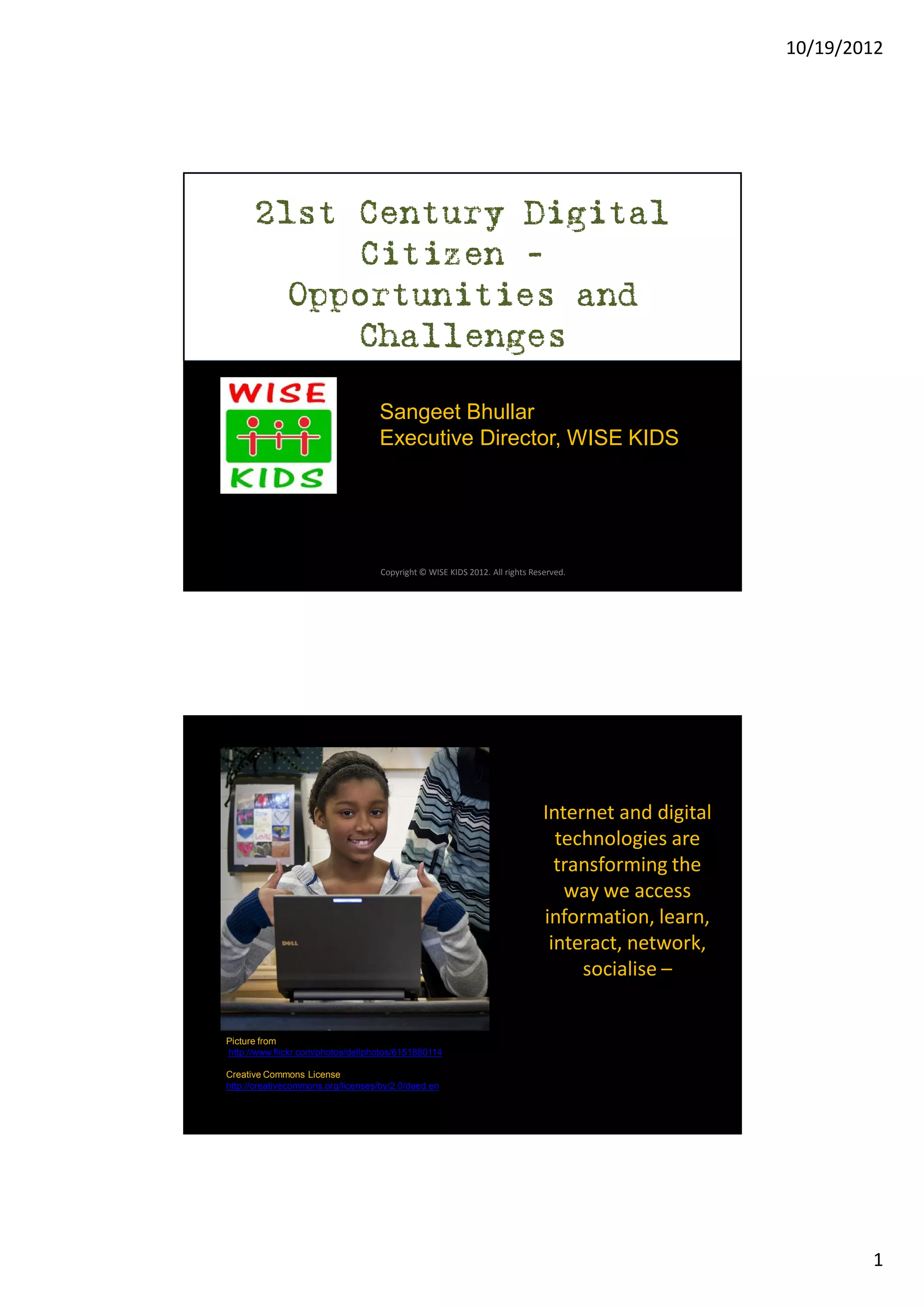
                                                                              Internet and digital
                                                                                technologies are
                                                                                transforming the
                                                                                 way we access
                                                                              information, learn,
                                                                               interact, network,
                                                                                   socialise –


Picture from
http://www.flickr.com/photos/dellphotos/6151880114

Creative Commons License
http://creativecommons.org/licenses/by/2.0/deed.en


                                                                                                             1
10/19/2012


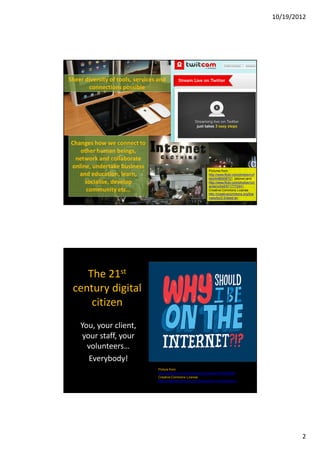
Sheer diversity of tools, services and
       connections possible


 Changes how we connect to
    other human beings,
  network and collaborate
 online, undertake business
                                                                     Pictures from:
    and education, learn,                                            http://www.flickr.com/photos/ivyf
                                                                     ield/4486938721 (above) and
      socialise, develop                                             http://www.flickr.com/photos/rich
                                                                     ardwinchell/5717772441
      community etc…                                                 Creative Commons License
                                                                     http://creativecommons.org/lice
                                                                     nses/by/2.0/deed.en


    The 21st
 century digital
     citizen
    You, your client,
    your staff, your
      volunteers…
      Everybody!
                                   Picture from
                                   http://www.flickr.com/photos/chrispiascik/7793299246/
                                   Creative Commons License
                                   http://creativecommons.org/licenses/by-nd/2.0/deed.en


                                                                                                                 2
10/19/2012


   The Knight Commission recognised that successful
   participation in the digital age entails two kinds of skills sets
   – digital literacy and media literacy:

   “Digital literacy means learning how to work the
   information and communication technologies in a
   networked environment, as well as understanding the
   social, cultural and ethical issues that go along with the use
   of these technologies. Media literacy is the ability to access,
   analyse, evaluate, create, reflect upon, and act with the
   information products that media disseminate.”


   Taken from a Nesta Futurelab Publication: Big Data - The
   power and possibilities of Big Data
   http://www.nesta.org.uk/library/documents/Hot_Topics_Big_Data_v5.pdf


  The social
   media
 revolution!
http://www.youtube.com/
watch?v=x0EnhXn5boM&f
   eature=relmfu [long
         version]

http://www.youtube.com/
watch?v=3SuNx0UrnEo&fe
  ature=channel&list=UL
                                   Picture from
      [short version]              http://www.flickr.com/photos/chrispiascik/7218587840/

                                   Creative Commons License
                                   http://creativecommons.org/licenses/by-nd/2.0/deed.en


                                                                                                   3
10/19/2012


Why use digital
technologies?
 Why engage
   online?
•Access to all sorts of
networks
•A global store front
•Cost efficiencies - flexible
•Relevance – it’s where the
audience is

                                       Picture from
                                       http://www.flickr.com/photos/chrispiascik/7218587840/

                                       Creative Commons License
                                       http://creativecommons.org/licenses/by-nd/2.0/deed.en


     Social Media are only one part of the digital technology
                            landscape

 •   Google+ Hangouts
     http://www.youtube.com/watch?fea
     ture=player_embedded&v=3pmSWh
     2BQco
 •   Cloud based tools eg Google Docs,
     Dropbox
 •   Enterprise Tools eg Yammer
 •   VOIP Tools like Skype
 •   Publishing Tools
 •   Online Classroom Tools
 •   Social Media Tools like Facebook ,
     Twitter, LinkedIn, YouTube and other
     broadcast and mobile app tools - for
     connecting to audiences, advocacy,
     petitions, fund-raising etc


                                                                                                       4
10/19/2012


                        What else do we know?


                    Picture from
                    http://www.flickr.com/photos/olpc/2606362543

                    Creative Commons License
                    http://creativecommons.org/licenses/by/2.0/deed.en


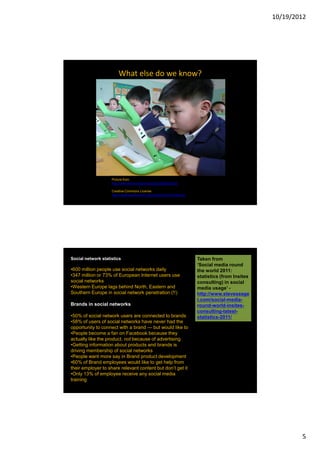
Social network statistics                                                Taken from
                                                                         ‘Social media round
•600 million people use social networks daily                            the world 2011:
•347 million or 73% of European Internet users use                       statistics (from Insites
social networks                                                          consulting) in social
•Western Europe lags behind North, Eastern and                           media usage’ -
Southern Europe in social network penetration (!!)                       http://www.steveseage
                                                                         r.com/social-media-
Brands in social networks                                                round-world-insites-
                                                                         consulting-latest-
•50% of social network users are connected to brands                     statistics-2011/
•58% of users of social networks have never had the
opportunity to connect with a brand — but would like to
•People become a fan on Facebook because they
actually like the product, not because of advertising
•Getting information about products and brands is
driving membership of social networks
•People want more say in Brand product development
•60% of Brand employees would like to get help from
their employer to share relevant content but don’t get it
•Only 13% of employee receive any social media
training


                                                                                                            5
10/19/2012


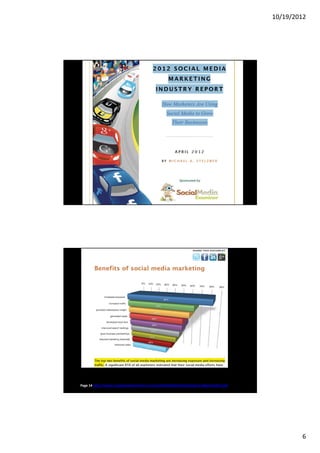
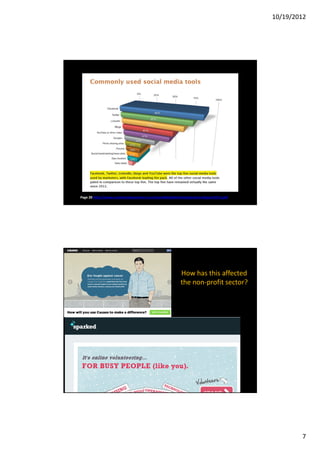
Page 14 http://www.socialmediaexaminer.com/SocialMediaMarketingIndustryReport2012.pdf


                                                                                                6
10/19/2012


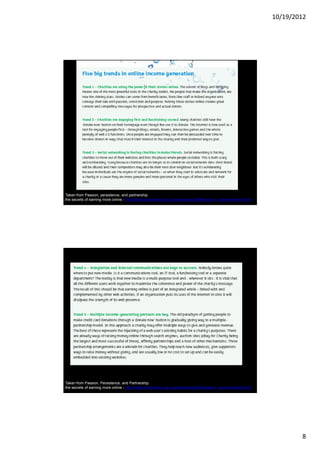
Page 20 http://www.socialmediaexaminer.com/SocialMediaMarketingIndustryReport2012.pdf


                                                         How has this affected
                                                         the non-profit sector?


                                                                                                7
10/19/2012


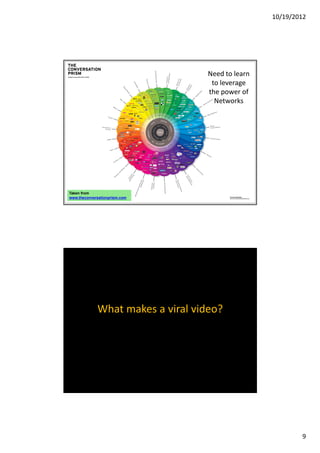
Taken from Passion, persistence, and partnership:
the secrets of earning more online - http://www.missionfish.org.uk/downloads/pdf/Research_summaryReport.pdf


Taken from Passion, Persistence, and Partnership:
the secrets of earning more online - http://www.missionfish.org.uk/downloads/pdf/Research_summaryReport.pdf


                                                                                                                      8
10/19/2012


                                   Need to learn
                                    to leverage
                                   the power of
                                     Networks


Taken from
www.theconversationprism.com


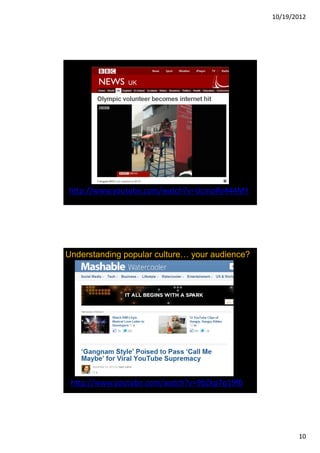
             What makes a viral video?


                                                           9
10/19/2012


http://www.youtube.com/watch?v=UcmoRy444MY


Understanding popular culture   your audience?


 http://www.youtube.com/watch?v=9bZkp7q19f0


                                                        10
10/19/2012


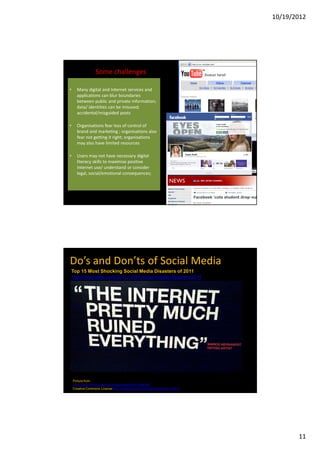
                  Some challenges

•     Many digital and Internet services and
      applications can blur boundaries
      between public and private information;
      data/ identities can be misused;
      accidental/misguided posts

•     Organisations fear loss of control of
      brand and marketing ; organisations also
      fear not getting it right; organisations
      may also have limited resources

•     Users may not have necessary digital
      literacy skills to maximise positive
      Internet use/ understand or consider
      legal, social/emotional consequences;


Do’s and Don’ts of Social Media
Top 15 Most Shocking Social Media Disasters of 2011
http://mashable.com/2011/12/31/social-media-disasters-2011


    Picture from
    http://www.flickr.com/photos/mtarvainen/5001489169/
    Creative Commons License http://creativecommons.org/licenses/by-nd/2.0


                                                                                    11
10/19/2012


             Legal to use licensed media


UK Legal Framework
Racial and Religious Hatred Act 2006
Criminal Justice Act 2003
Sexual Offences Act 2003
Communications Act 2003 (section 127)
Data Protection Act 1998
The Computer Misuse Act 1990 (sections 1 - 3)
Malicious Communications Act 1988 (section 1)
Copyright, Design and Patents Act 1988
Public Order Act 1986 (sections 17 — 29)
Obscene Publications Act 1959 and 1964
Protection from Harassment Act 1997
Regulation of Investigatory Powers Act 2000
Criminal Justice and Immigration Act 2008
Education and Inspections Act 2006


Taken from the Kent e-Safety Policy Template:
http://www.kenttrustweb.org.uk/UserFiles/CW/File/Childrens_Services/Childrens_
Safeguards_Service/esafety/e-Safety_policy_template_2012.pdf


                                                                                        12
10/19/2012


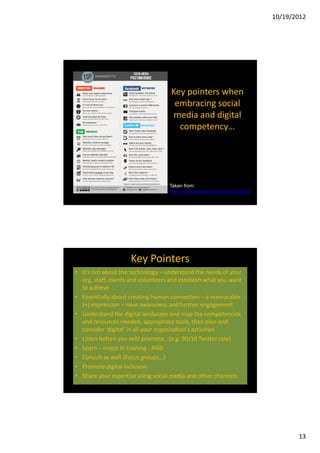
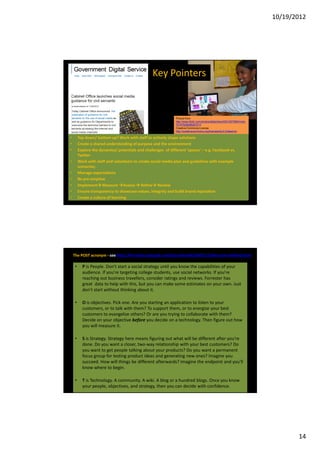
                                    Key pointers when
                                     embracing social
                                     media and digital
                                      competency…


                                    Taken from:
                                    http://topnonprofits.com/posting-guide


                     Key Pointers
• It’s not about the technology – understand the needs of your
  org, staff, clients and volunteers and establish what you want
  to achieve
• Essentially about creating human connection – a memorable
  (+) impression – raise awareness and further engagement
• Understand the digital landscape and map the competencies
  and resources needed, appropriate tools, then plan and
  consider ‘digital’ in all your organisation’s activities
• Listen before you sell/ promote…(e.g. 90/10 Twitter rule)
• Learn – invest in training - AND
• Consult as well (Focus groups…)
• Promote digital inclusion
• Share your expertise using social media and other channels


                                                                                    13
10/19/2012


                                                   Key Pointers


                                                                Picture from
                                                                http://www.flickr.com/photos/dellphotos/5501057589/in/set-
                                                                72157626068267213
                                                                Creative Commons License
                                                                http://creativecommons.org/licenses/by/2.0/deed.en

•        Top down/ bottom up? Work with staff to actively shape solutions
•        Create a shared understanding of purpose and the environment
•        Explore the dynamics/ potentials and challenges of different ‘spaces’ – e.g. Facebook vs.
         Twitter
•        Work with staff and volunteers to create social media plan and guidelines with example
         scenarios;
•        Manage expectations
•        Be pre-emptive
•        Implement Measure Assess Refine Review
•        Ensure transparency to showcase values, integrity and build brand reputation
•        Create a culture of learning


    The POST acronym - see http://forrester.typepad.com/groundswell/2007/12/the-post-method.html

     •     P is People. Don't start a social strategy until you know the capabilities of your
           audience. If you're targeting college students, use social networks. If you're
           reaching out business travellers, consider ratings and reviews. Forrester has
           great data to help with this, but you can make some estimates on your own. Just
           don't start without thinking about it.

     •     O is objectives. Pick one. Are you starting an application to listen to your
           customers, or to talk with them? To support them, or to energize your best
           customers to evangelize others? Or are you trying to collaborate with them?
           Decide on your objective before you decide on a technology. Then figure out how
           you will measure it.

     •     S is Strategy. Strategy here means figuring out what will be different after you're
           done. Do you want a closer, two-way relationship with your best customers? Do
           you want to get people talking about your products? Do you want a permanent
           focus group for testing product ideas and generating new ones? Imagine you
           succeed. How will things be different afterwards? Imagine the endpoint and you'll
           know where to begin.

     •     T is Technology. A community. A wiki. A blog or a hundred blogs. Once you know
           your people, objectives, and strategy, then you can decide with confidence.


                                                                                                                                    14
10/19/2012


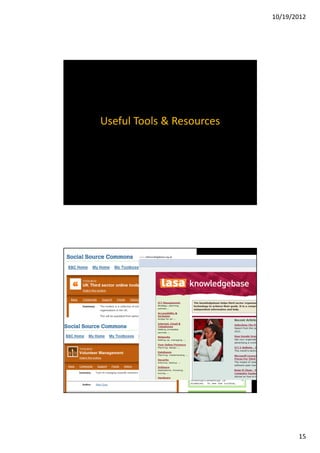
Useful Tools & Resources


                                  15
10/19/2012


       16
10/19/2012


                     Useful Links
WISE KIDS micro-site for the Volunteering in a Digital Age
conference:
https://sites.google.com/site/volunteeringinadigitalage


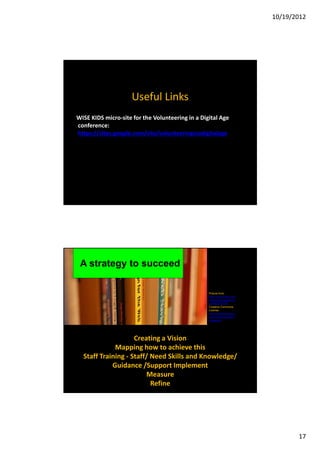
 A strategy to succeed

                                                  Picture from
                                                  http://www.flickr.com/
                                                  photos/rodrigogalind
                                                  ez/4637637337
                                                  Creative Commons
                                                  License
                                                  http://creativecommo
                                                  ns.org/licenses/by/2.
                                                  0/deed.en


                    Creating a Vision
             Mapping how to achieve this
  Staff Training - Staff/ Need Skills and Knowledge/
            Guidance /Support Implement
                        Measure
                          Refine


                                                                                  17
10/19/2012


                          Thank You
                   sangeet@wisekids.org.uk
                       www.wisekids.org.uk


                              About WISE KIDS

• WISE KIDS believes that the Internet is a vital tool in the Information
  Age, and works to Promote Awareness of New Media, Digital and
  Internet Technologies, Internet Literacy, Proficiency and Safety

• WISE KIDS provides:
  – Customised Training Programmes (online and face-to-face)
  – Consultancy
  – Research and Resource Development
  – Awareness Raising Events


                              Copyright © WISE KIDS 2012.


                                                                                   18

Keynote presentation for Conference: Vounteering in a Digital Age

  • 1.
    10/19/2012 21st Century Digital Citizen -– Opportunities and Challenges Sangeet Bhullar Executive Director, WISE KIDS Copyright © WISE KIDS 2012. All rights Reserved. Internet and digital technologies are transforming the way we access information, learn, interact, network, socialise – Picture from http://www.flickr.com/photos/dellphotos/6151880114 Creative Commons License http://creativecommons.org/licenses/by/2.0/deed.en 1
  • 2.
    10/19/2012 Sheer diversity oftools, services and connections possible Changes how we connect to other human beings, network and collaborate online, undertake business Pictures from: and education, learn, http://www.flickr.com/photos/ivyf ield/4486938721 (above) and socialise, develop http://www.flickr.com/photos/rich ardwinchell/5717772441 community etc… Creative Commons License http://creativecommons.org/lice nses/by/2.0/deed.en The 21st century digital citizen You, your client, your staff, your volunteers… Everybody! Picture from http://www.flickr.com/photos/chrispiascik/7793299246/ Creative Commons License http://creativecommons.org/licenses/by-nd/2.0/deed.en 2
  • 3.
    10/19/2012 The Knight Commission recognised that successful participation in the digital age entails two kinds of skills sets – digital literacy and media literacy: “Digital literacy means learning how to work the information and communication technologies in a networked environment, as well as understanding the social, cultural and ethical issues that go along with the use of these technologies. Media literacy is the ability to access, analyse, evaluate, create, reflect upon, and act with the information products that media disseminate.” Taken from a Nesta Futurelab Publication: Big Data - The power and possibilities of Big Data http://www.nesta.org.uk/library/documents/Hot_Topics_Big_Data_v5.pdf The social media revolution! http://www.youtube.com/ watch?v=x0EnhXn5boM&f eature=relmfu [long version] http://www.youtube.com/ watch?v=3SuNx0UrnEo&fe ature=channel&list=UL Picture from [short version] http://www.flickr.com/photos/chrispiascik/7218587840/ Creative Commons License http://creativecommons.org/licenses/by-nd/2.0/deed.en 3
  • 4.
    10/19/2012 Why use digital technologies? Why engage online? •Access to all sorts of networks •A global store front •Cost efficiencies - flexible •Relevance – it’s where the audience is Picture from http://www.flickr.com/photos/chrispiascik/7218587840/ Creative Commons License http://creativecommons.org/licenses/by-nd/2.0/deed.en Social Media are only one part of the digital technology landscape • Google+ Hangouts http://www.youtube.com/watch?fea ture=player_embedded&v=3pmSWh 2BQco • Cloud based tools eg Google Docs, Dropbox • Enterprise Tools eg Yammer • VOIP Tools like Skype • Publishing Tools • Online Classroom Tools • Social Media Tools like Facebook , Twitter, LinkedIn, YouTube and other broadcast and mobile app tools - for connecting to audiences, advocacy, petitions, fund-raising etc 4
  • 5.
    10/19/2012 What else do we know? Picture from http://www.flickr.com/photos/olpc/2606362543 Creative Commons License http://creativecommons.org/licenses/by/2.0/deed.en Social network statistics Taken from ‘Social media round •600 million people use social networks daily the world 2011: •347 million or 73% of European Internet users use statistics (from Insites social networks consulting) in social •Western Europe lags behind North, Eastern and media usage’ - Southern Europe in social network penetration (!!) http://www.steveseage r.com/social-media- Brands in social networks round-world-insites- consulting-latest- •50% of social network users are connected to brands statistics-2011/ •58% of users of social networks have never had the opportunity to connect with a brand — but would like to •People become a fan on Facebook because they actually like the product, not because of advertising •Getting information about products and brands is driving membership of social networks •People want more say in Brand product development •60% of Brand employees would like to get help from their employer to share relevant content but don’t get it •Only 13% of employee receive any social media training 5
  • 6.
  • 7.
  • 8.
    10/19/2012 Taken from Passion,persistence, and partnership: the secrets of earning more online - http://www.missionfish.org.uk/downloads/pdf/Research_summaryReport.pdf Taken from Passion, Persistence, and Partnership: the secrets of earning more online - http://www.missionfish.org.uk/downloads/pdf/Research_summaryReport.pdf 8
  • 9.
    10/19/2012 Need to learn to leverage the power of Networks Taken from www.theconversationprism.com What makes a viral video? 9
  • 10.
    10/19/2012 http://www.youtube.com/watch?v=UcmoRy444MY Understanding popular culture your audience? http://www.youtube.com/watch?v=9bZkp7q19f0 10
  • 11.
    10/19/2012 Some challenges • Many digital and Internet services and applications can blur boundaries between public and private information; data/ identities can be misused; accidental/misguided posts • Organisations fear loss of control of brand and marketing ; organisations also fear not getting it right; organisations may also have limited resources • Users may not have necessary digital literacy skills to maximise positive Internet use/ understand or consider legal, social/emotional consequences; Do’s and Don’ts of Social Media Top 15 Most Shocking Social Media Disasters of 2011 http://mashable.com/2011/12/31/social-media-disasters-2011 Picture from http://www.flickr.com/photos/mtarvainen/5001489169/ Creative Commons License http://creativecommons.org/licenses/by-nd/2.0 11
  • 12.
    10/19/2012 Legal to use licensed media UK Legal Framework Racial and Religious Hatred Act 2006 Criminal Justice Act 2003 Sexual Offences Act 2003 Communications Act 2003 (section 127) Data Protection Act 1998 The Computer Misuse Act 1990 (sections 1 - 3) Malicious Communications Act 1988 (section 1) Copyright, Design and Patents Act 1988 Public Order Act 1986 (sections 17 — 29) Obscene Publications Act 1959 and 1964 Protection from Harassment Act 1997 Regulation of Investigatory Powers Act 2000 Criminal Justice and Immigration Act 2008 Education and Inspections Act 2006 Taken from the Kent e-Safety Policy Template: http://www.kenttrustweb.org.uk/UserFiles/CW/File/Childrens_Services/Childrens_ Safeguards_Service/esafety/e-Safety_policy_template_2012.pdf 12
  • 13.
    10/19/2012 Key pointers when embracing social media and digital competency… Taken from: http://topnonprofits.com/posting-guide Key Pointers • It’s not about the technology – understand the needs of your org, staff, clients and volunteers and establish what you want to achieve • Essentially about creating human connection – a memorable (+) impression – raise awareness and further engagement • Understand the digital landscape and map the competencies and resources needed, appropriate tools, then plan and consider ‘digital’ in all your organisation’s activities • Listen before you sell/ promote…(e.g. 90/10 Twitter rule) • Learn – invest in training - AND • Consult as well (Focus groups…) • Promote digital inclusion • Share your expertise using social media and other channels 13
  • 14.
    10/19/2012 Key Pointers Picture from http://www.flickr.com/photos/dellphotos/5501057589/in/set- 72157626068267213 Creative Commons License http://creativecommons.org/licenses/by/2.0/deed.en • Top down/ bottom up? Work with staff to actively shape solutions • Create a shared understanding of purpose and the environment • Explore the dynamics/ potentials and challenges of different ‘spaces’ – e.g. Facebook vs. Twitter • Work with staff and volunteers to create social media plan and guidelines with example scenarios; • Manage expectations • Be pre-emptive • Implement Measure Assess Refine Review • Ensure transparency to showcase values, integrity and build brand reputation • Create a culture of learning The POST acronym - see http://forrester.typepad.com/groundswell/2007/12/the-post-method.html • P is People. Don't start a social strategy until you know the capabilities of your audience. If you're targeting college students, use social networks. If you're reaching out business travellers, consider ratings and reviews. Forrester has great data to help with this, but you can make some estimates on your own. Just don't start without thinking about it. • O is objectives. Pick one. Are you starting an application to listen to your customers, or to talk with them? To support them, or to energize your best customers to evangelize others? Or are you trying to collaborate with them? Decide on your objective before you decide on a technology. Then figure out how you will measure it. • S is Strategy. Strategy here means figuring out what will be different after you're done. Do you want a closer, two-way relationship with your best customers? Do you want to get people talking about your products? Do you want a permanent focus group for testing product ideas and generating new ones? Imagine you succeed. How will things be different afterwards? Imagine the endpoint and you'll know where to begin. • T is Technology. A community. A wiki. A blog or a hundred blogs. Once you know your people, objectives, and strategy, then you can decide with confidence. 14
  • 15.
  • 16.
  • 17.
    10/19/2012 Useful Links WISE KIDS micro-site for the Volunteering in a Digital Age conference: https://sites.google.com/site/volunteeringinadigitalage A strategy to succeed Picture from http://www.flickr.com/ photos/rodrigogalind ez/4637637337 Creative Commons License http://creativecommo ns.org/licenses/by/2. 0/deed.en Creating a Vision Mapping how to achieve this Staff Training - Staff/ Need Skills and Knowledge/ Guidance /Support Implement Measure Refine 17
  • 18.
    10/19/2012 Thank You sangeet@wisekids.org.uk www.wisekids.org.uk About WISE KIDS • WISE KIDS believes that the Internet is a vital tool in the Information Age, and works to Promote Awareness of New Media, Digital and Internet Technologies, Internet Literacy, Proficiency and Safety • WISE KIDS provides: – Customised Training Programmes (online and face-to-face) – Consultancy – Research and Resource Development – Awareness Raising Events Copyright © WISE KIDS 2012. 18