Networked and Hyperconnected
The New Social (and work) Operating System


   National Conference of State Legislators
   October 11, 2012
   Lee Rainie: Director, Pew Internet Project
   Email: Lrainie@pewinternet.org


                                                PewInternet.org
“Tweckle (twek’ul) vt. To
abuse a speaker to Twitter
 followers in the audience
while he/she is speaking.”


                              2
3
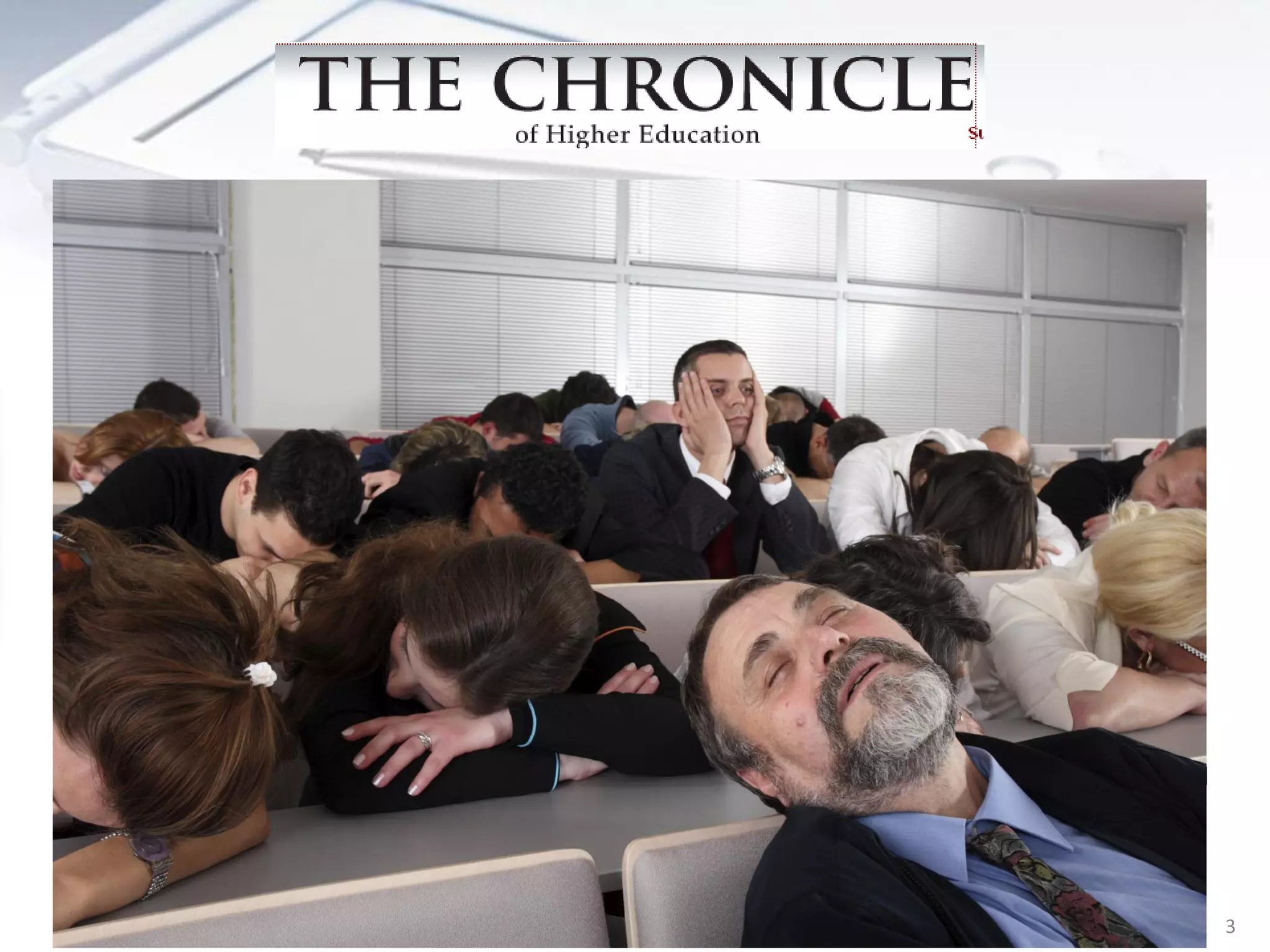
we need a tshirt, "I survived the keynote
             disaster of 09"

  it's awesome in the "I don't want to turn
away from the accident because I might see
            a severed head" way

too bad they took my utensils away w/ my
plate. I could have jammed the butter knife
               into my temple.

                                              4
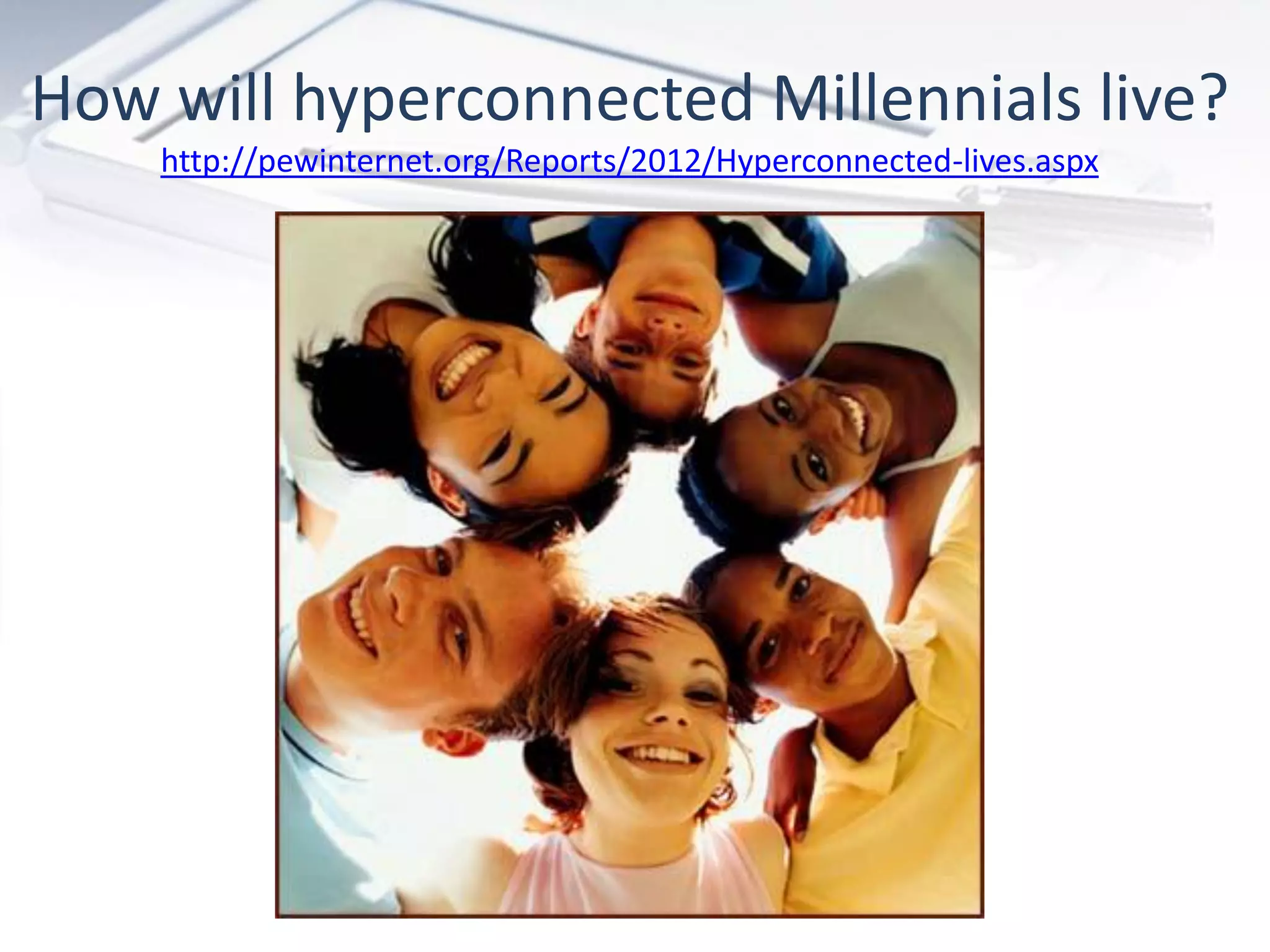
How will hyperconnected Millennials live?
    http://pewinternet.org/Reports/2012/Hyperconnected-lives.aspx
Vote for …
Millennials’ future
• In 2020 the brains of multitasking teens and young
  adults are "wired" differently from those over age 35
  and overall it yields helpful results. They do not suffer
  notable cognitive shortcomings as they multitask and
  cycle quickly through personal- and work-related tasks.
  Rather, they are learning more and they are more
  adept at finding answers to deep questions, in part
  because they can search effectively and access
  collective intelligence via the Internet. In sum, the
  changes in learning behavior and cognition among the
  young generally produce positive outcomes.
… or …
Millennials’ future
• In 2020, the brains of multitasking teens and young
  adults are "wired" differently from those over age 35
  and overall it yields baleful results. They do not retain
  information; they spend most of their energy sharing
  short social messages, being entertained, and being
  distracted away from deep engagement with people
  and knowledge. They lack deep-thinking capabilities;
  they lack face-to-face social skills; they depend in
  unhealthy ways on the Internet and mobile devices to
  function. In sum, the changes in behavior and cognition
  among the young are generally negative outcomes.
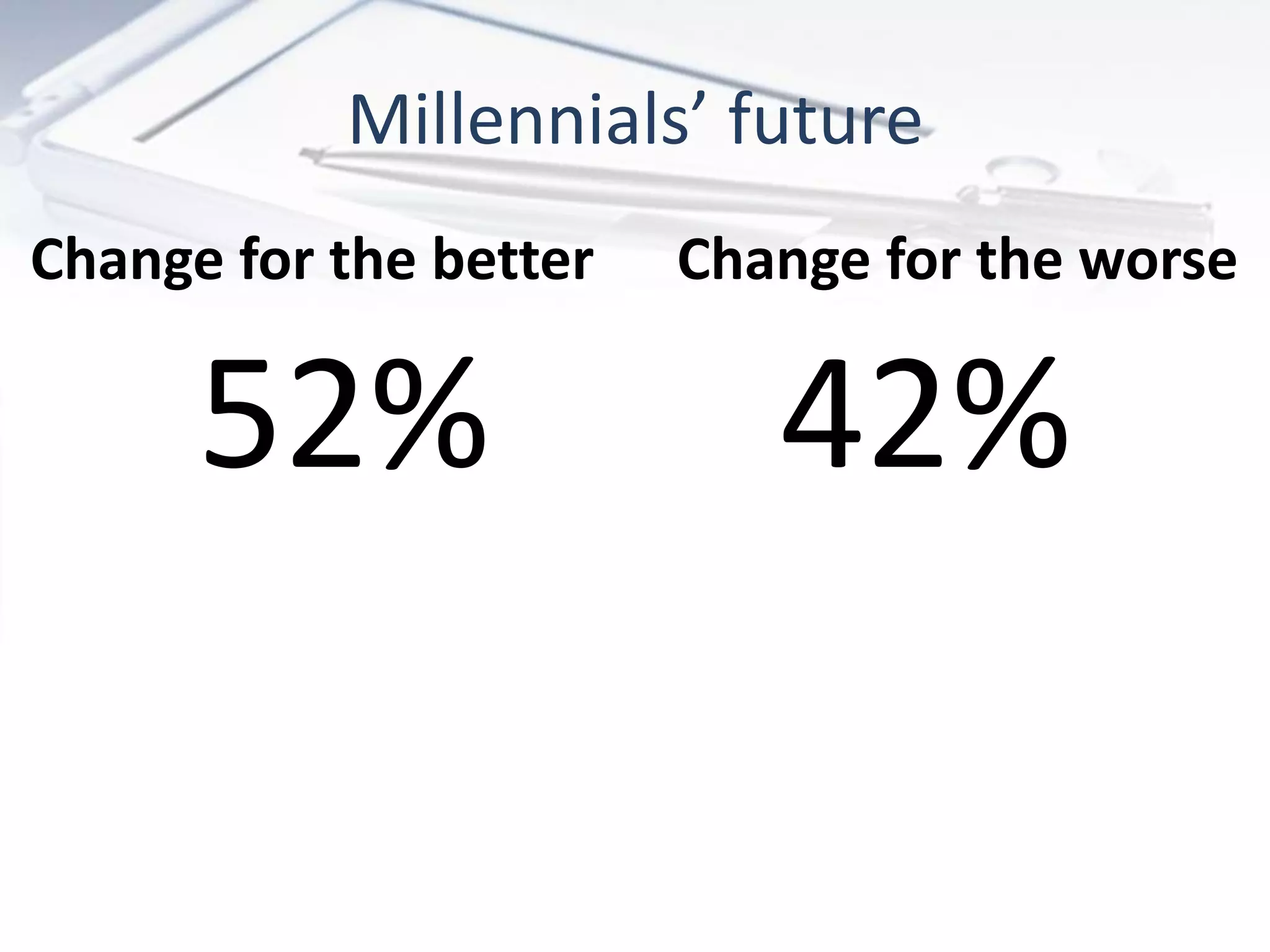
Millennials’ future
Change for the better   Change for the worse

      52%                  42%
Theme - Supertaskers
Theme – New winners/losers
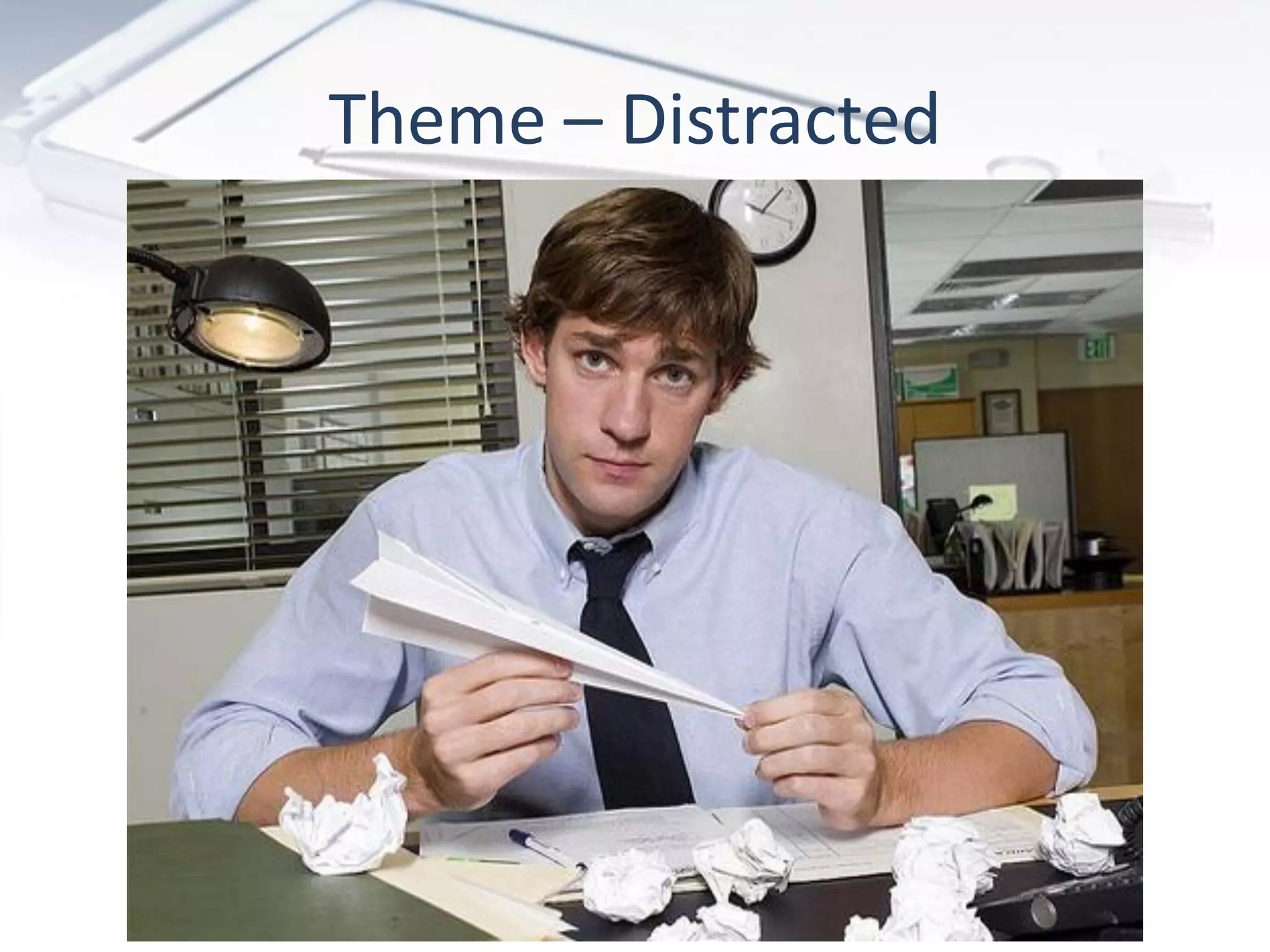
Theme – Distracted
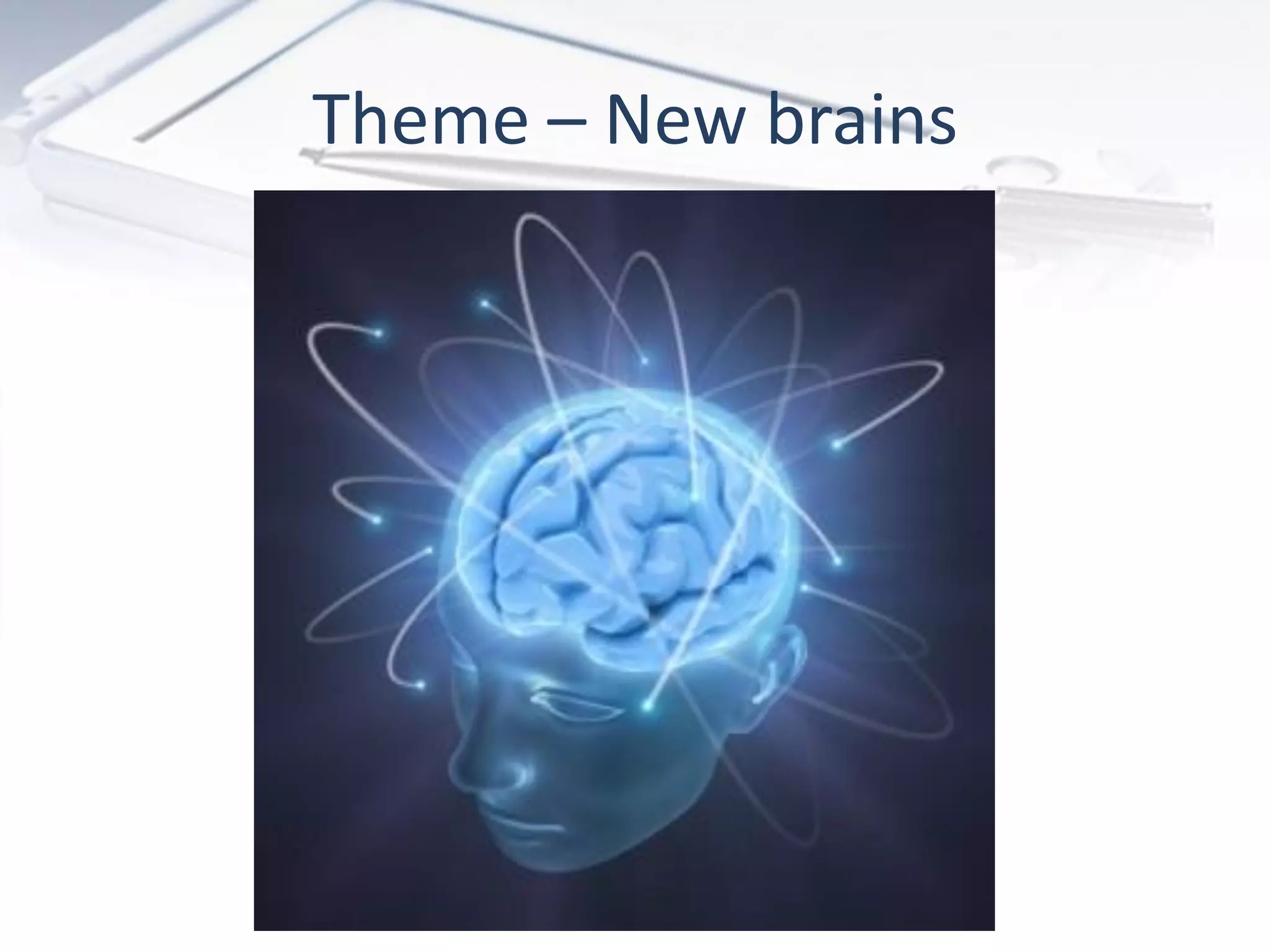
Theme – New brains
The three
revolutions that
  got us here
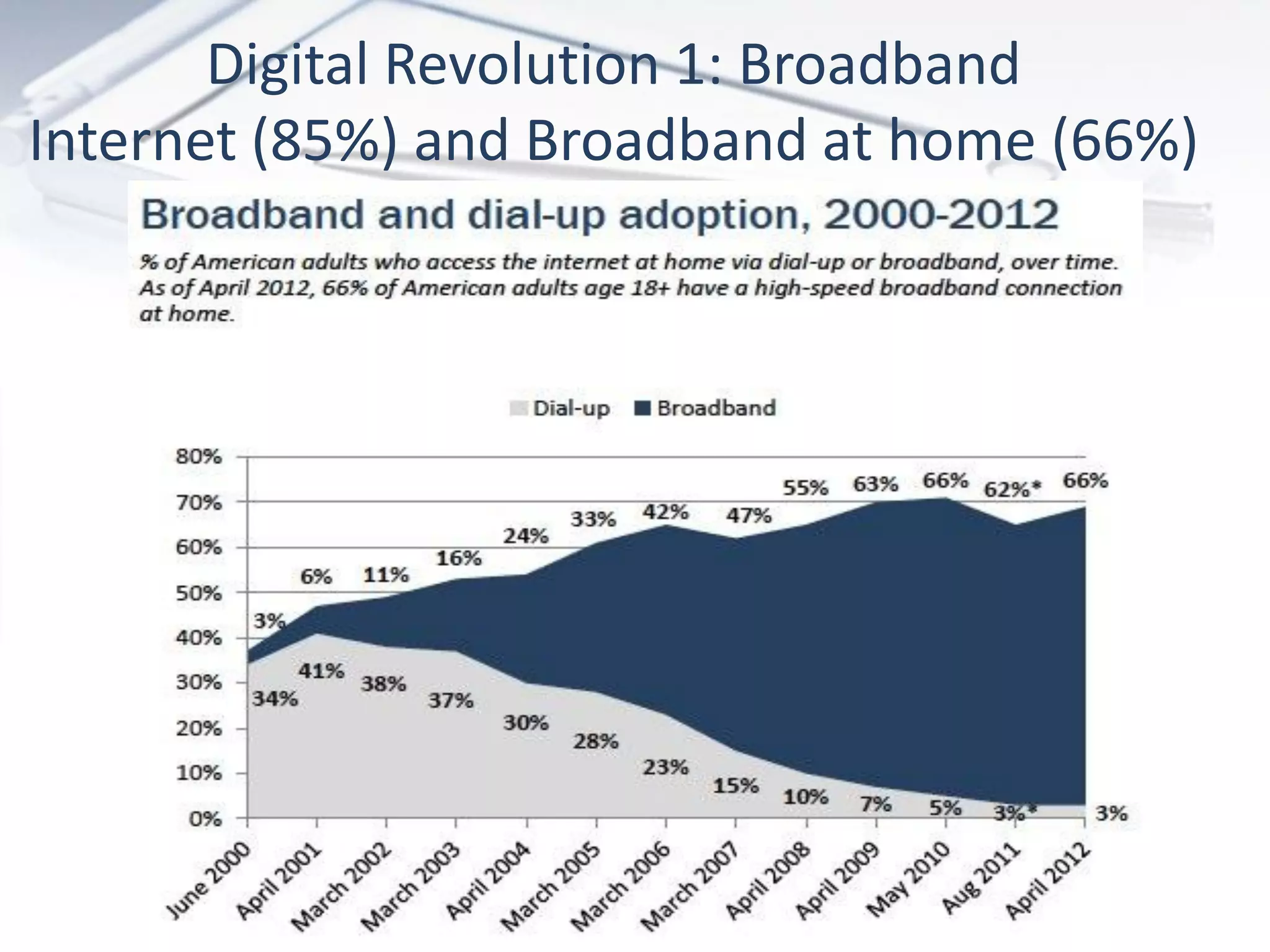
Digital Revolution 1: Broadband
Internet (85%) and Broadband at home (66%)
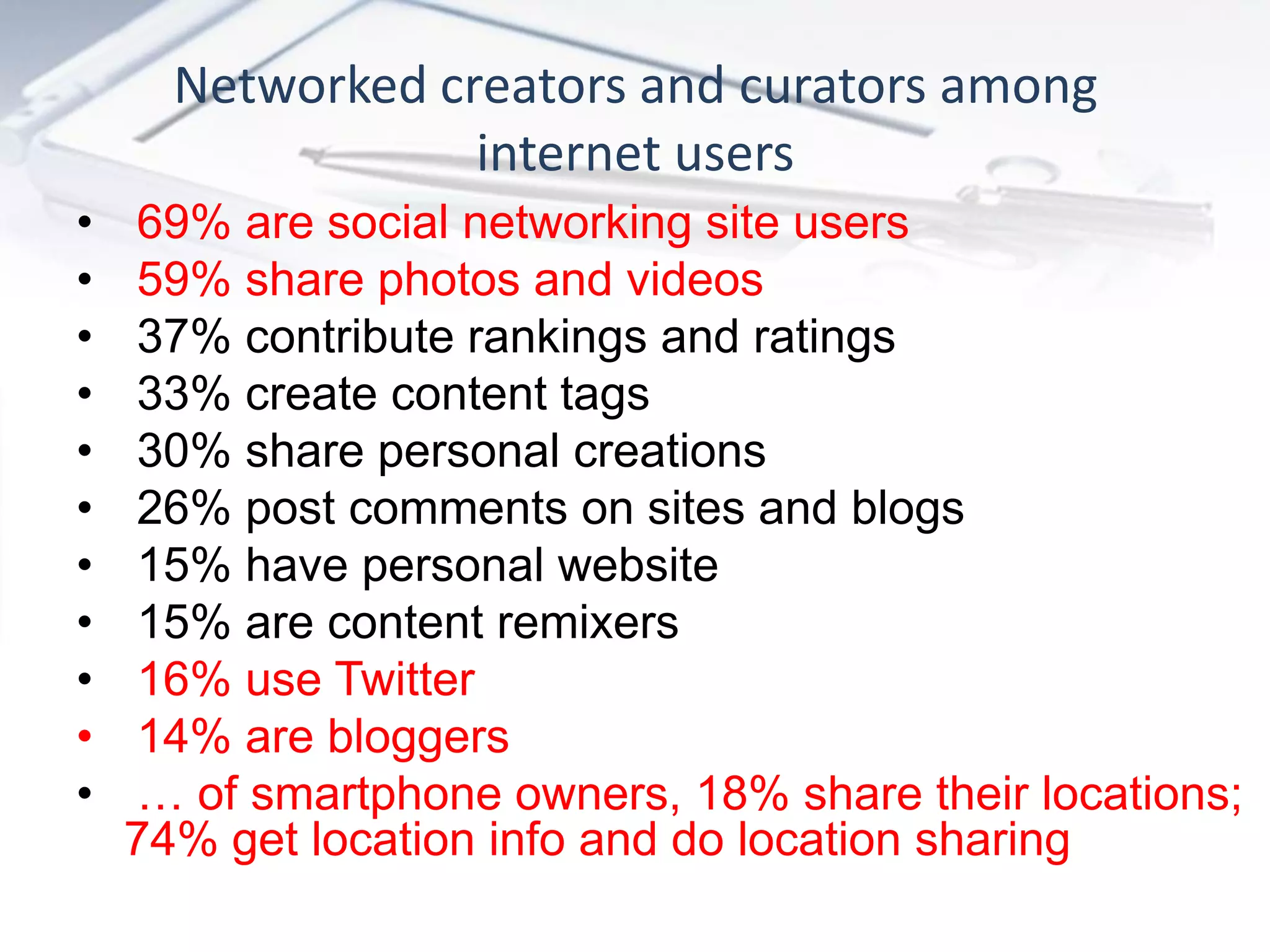
Networked creators and curators among
                  internet users
•   69% are social networking site users
•   59% share photos and videos
•   37% contribute rankings and ratings
•   33% create content tags
•   30% share personal creations
•   26% post comments on sites and blogs
•   15% have personal website
•   15% are content remixers
•   16% use Twitter
•   14% are bloggers
•   … of smartphone owners, 18% share their locations;
    74% get location info and do location sharing
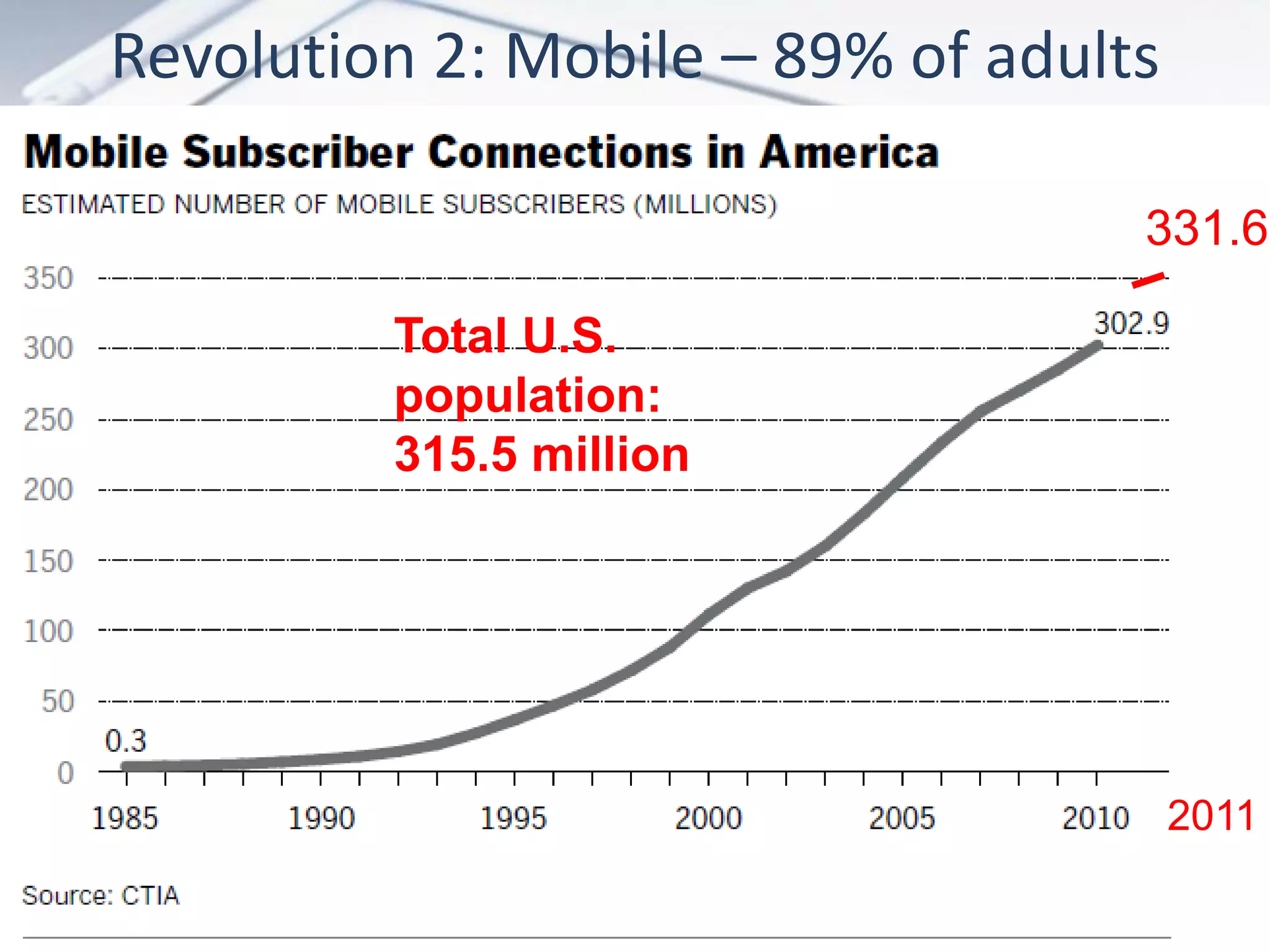
Revolution 2: Mobile – 89% of adults

                                   331.6

         Total U.S.
         population:
         315.5 million


                                       2011
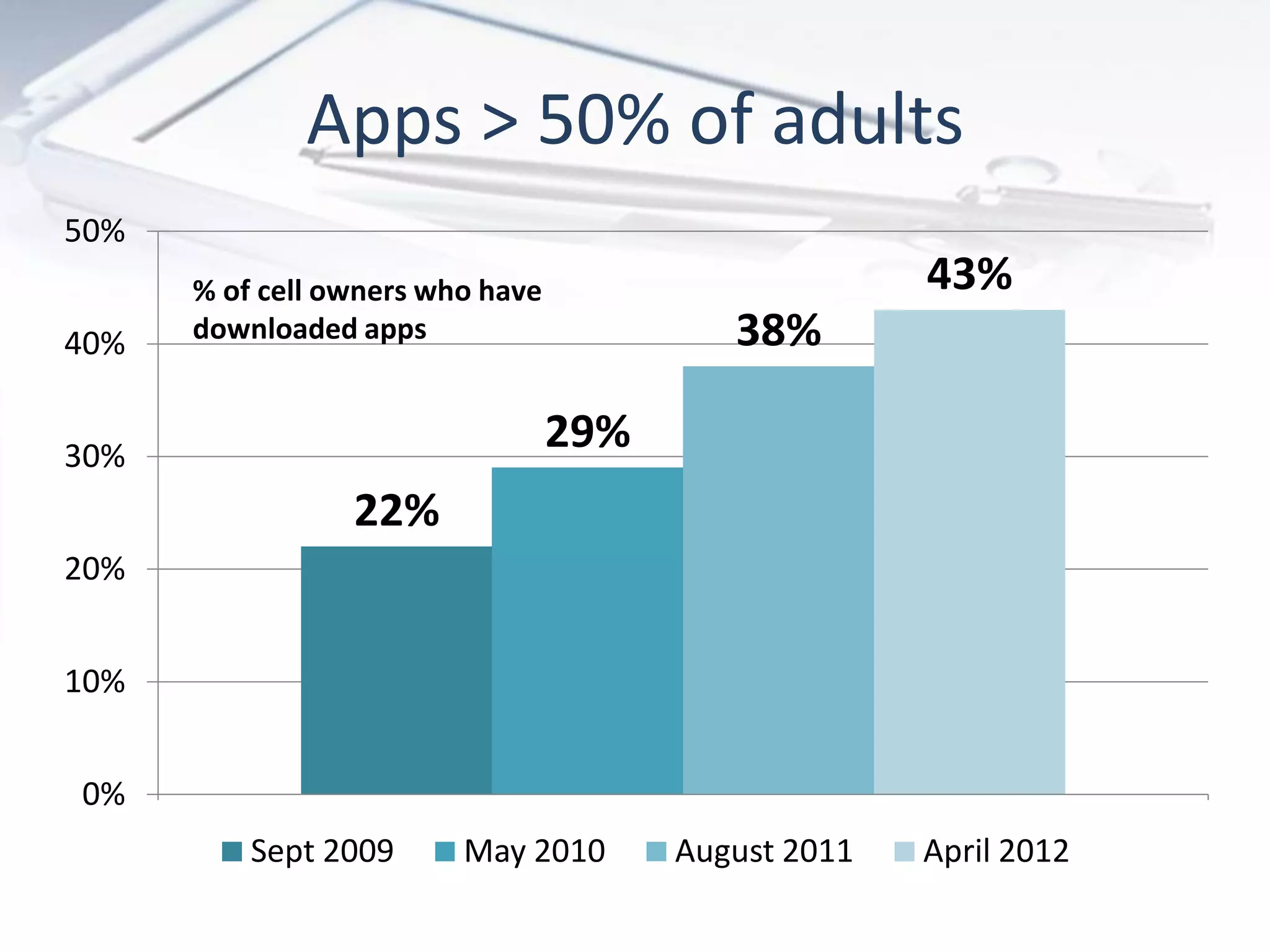
Apps > 50% of adults
50%
      % of cell owners who have                       43%
40%   downloaded apps                      38%

30%
                                  29%
                 22%
20%


10%


0%
          Sept 2009      May 2010       August 2011   April 2012
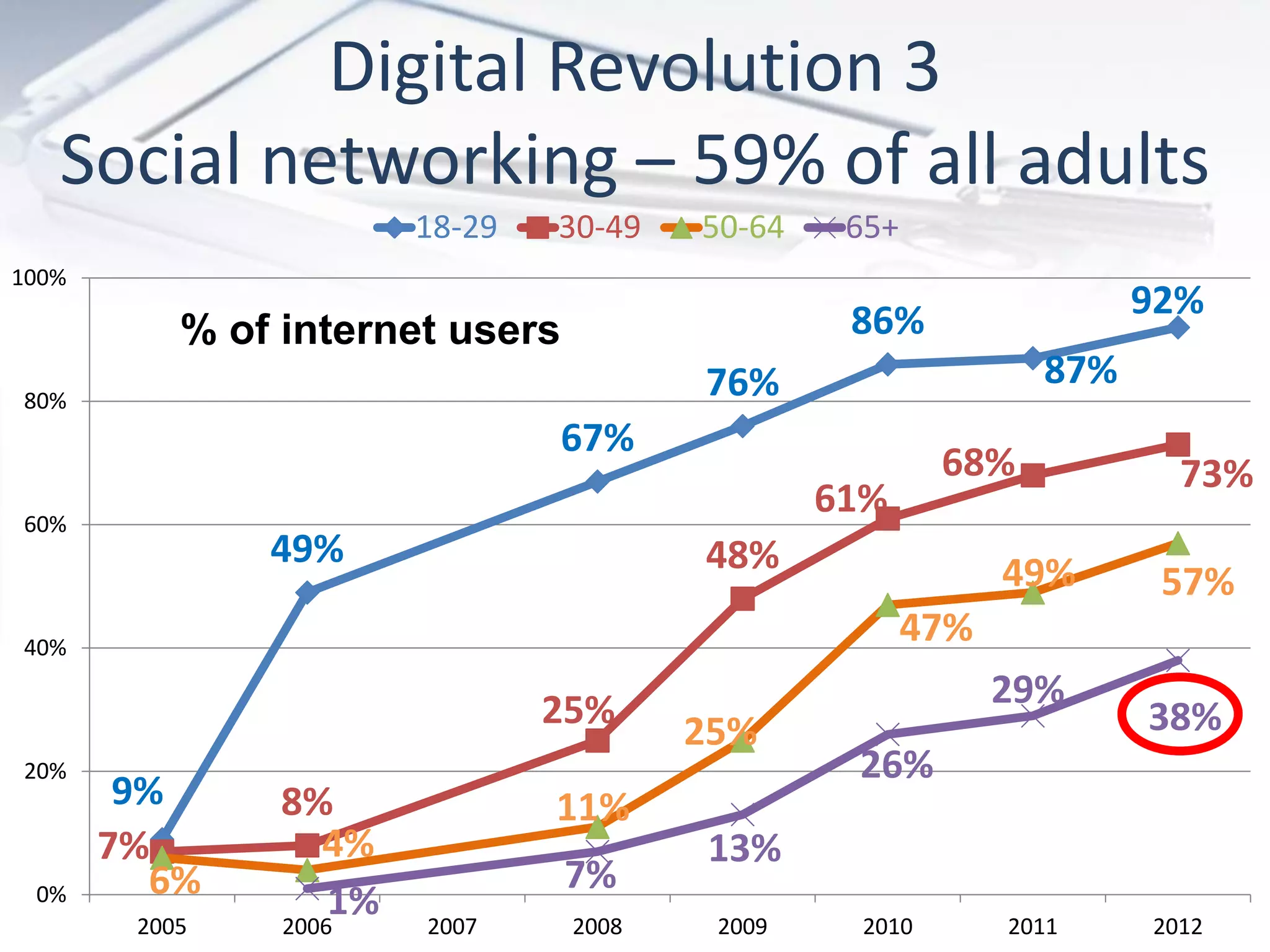
Digital Revolution 3
   Social networking – 59% of all adults
                         18-29   30-49   50-64    65+
100%
                                                  86%                 92%
           % of internet users
                                         76%                    87%
80%
                                 67%
                                                         68%            73%
60%
                                                 61%
               49%                       48%                  49%      57%
40%
                                                        47%
                                 25%                          29%
                                         25%                          38%
20%                                               26%
        9%      8%               11%
       7%          4%                    13%
          6%                     7%
 0%
        2005    2006
                    1%   2007     2008    2009    2010        2011    2012
Impact on knowledge workers and
            their constituents

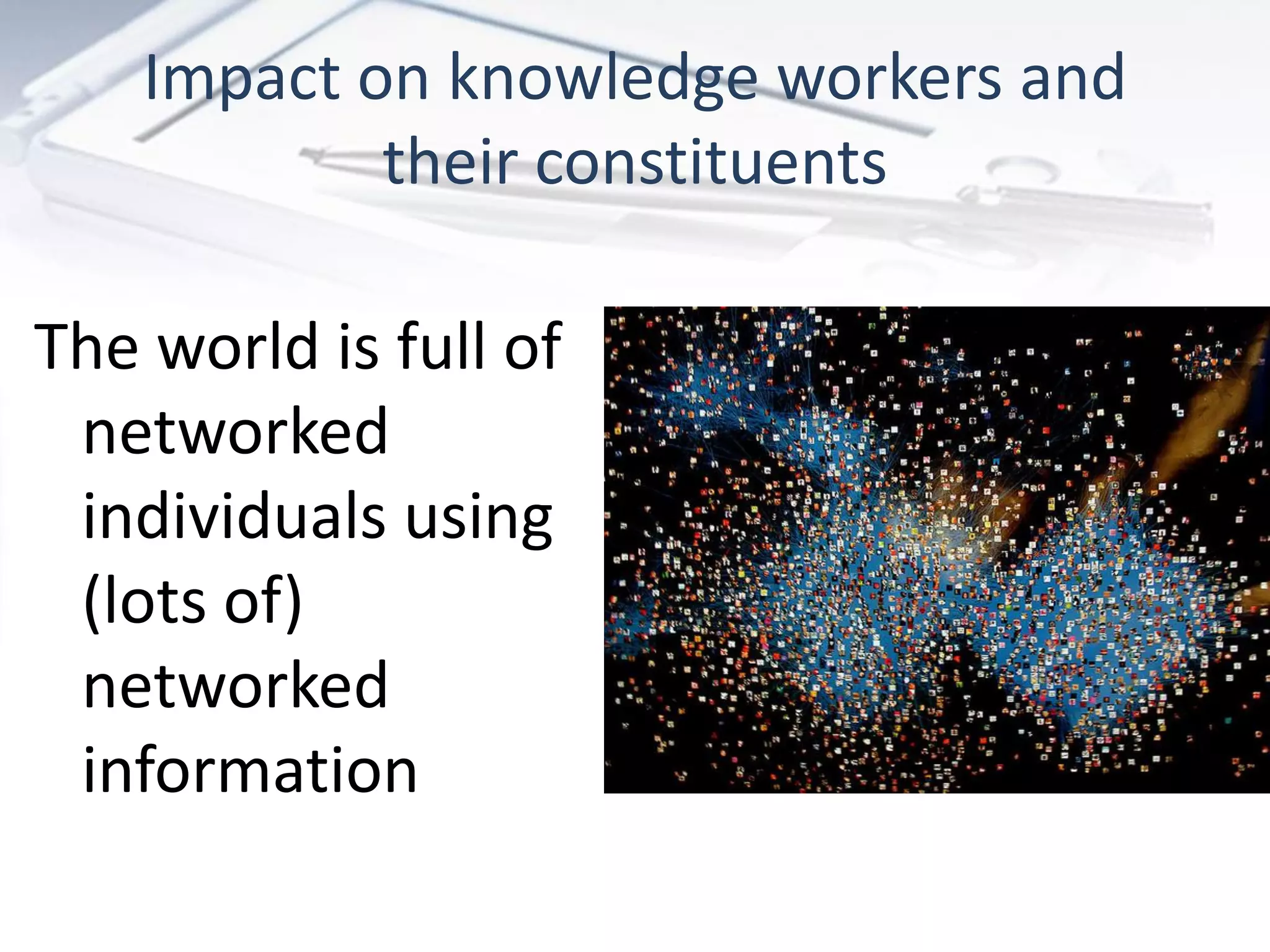
The world is full of
 networked
 individuals using
 (lots of)
 networked
 information
Impact on knowledge workers and
          their constituents


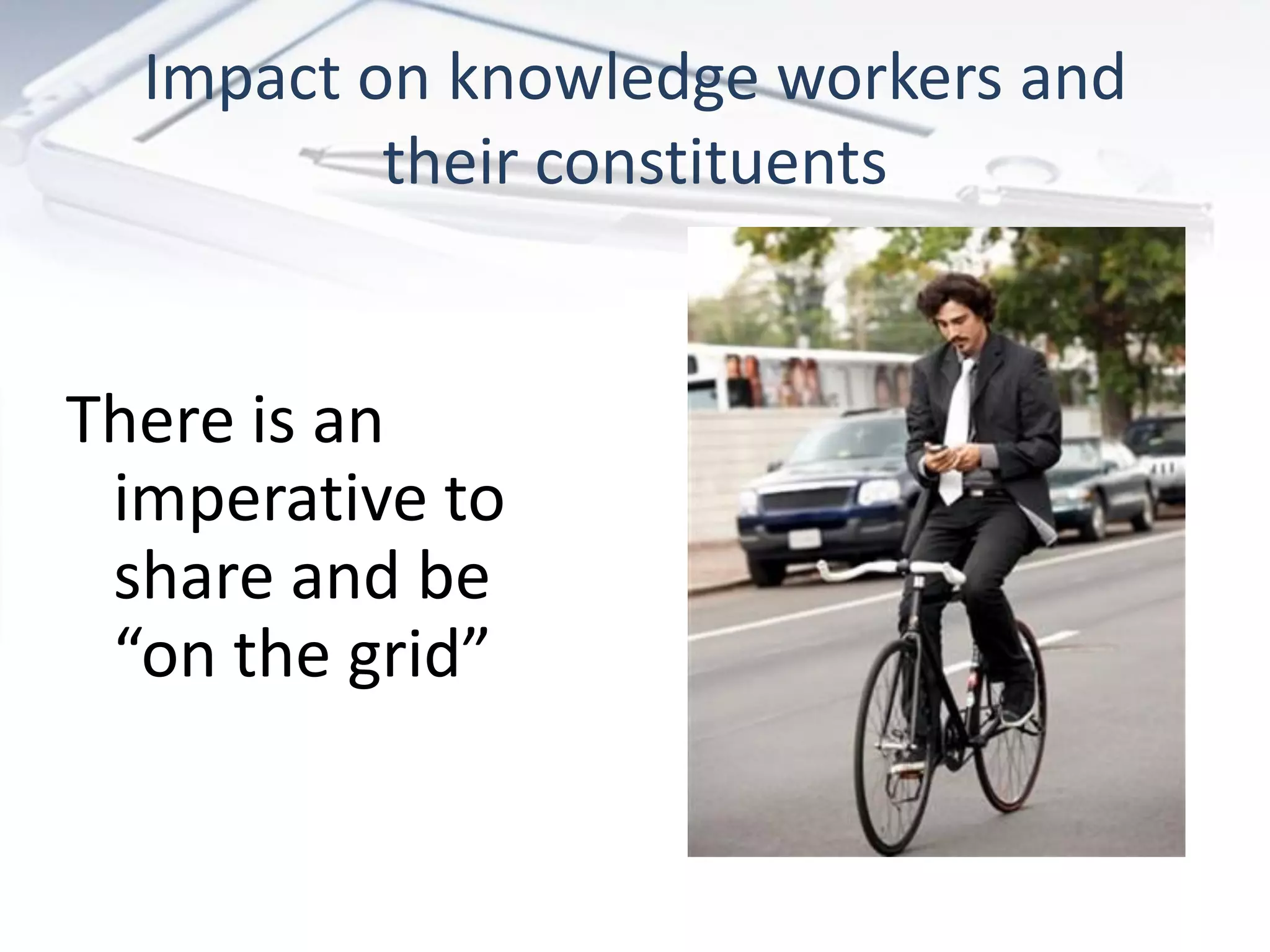
There is an
 imperative to
 share and be
 “on the grid”
Impact on knowledge workers and
          their constituents


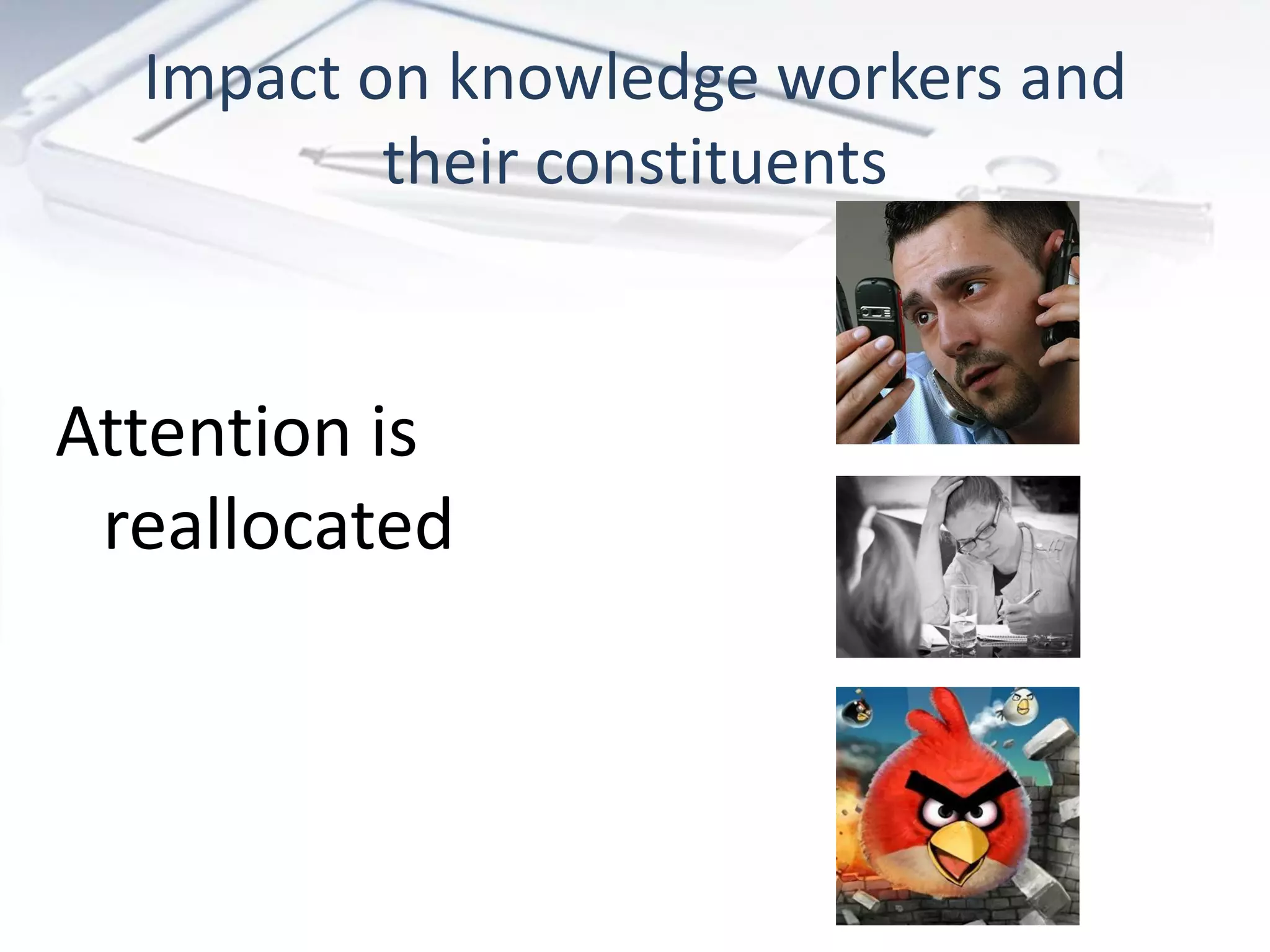
Attention is
 reallocated
Impact on knowledge workers and
            their constituents


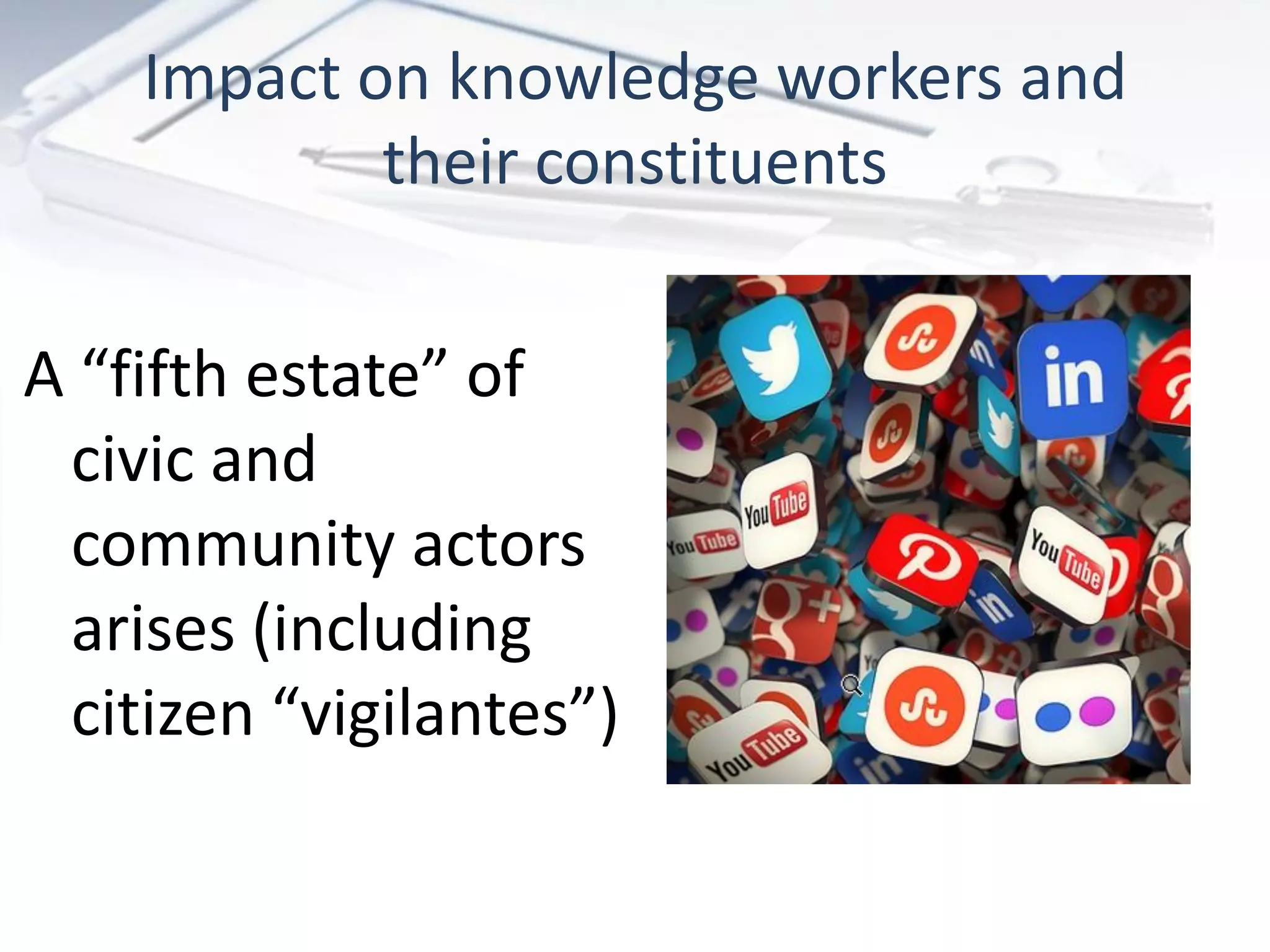
A “fifth estate” of
 civic and
 community actors
 arises (including
 citizen “vigilantes”)
Impact on knowledge workers and their
              constituents
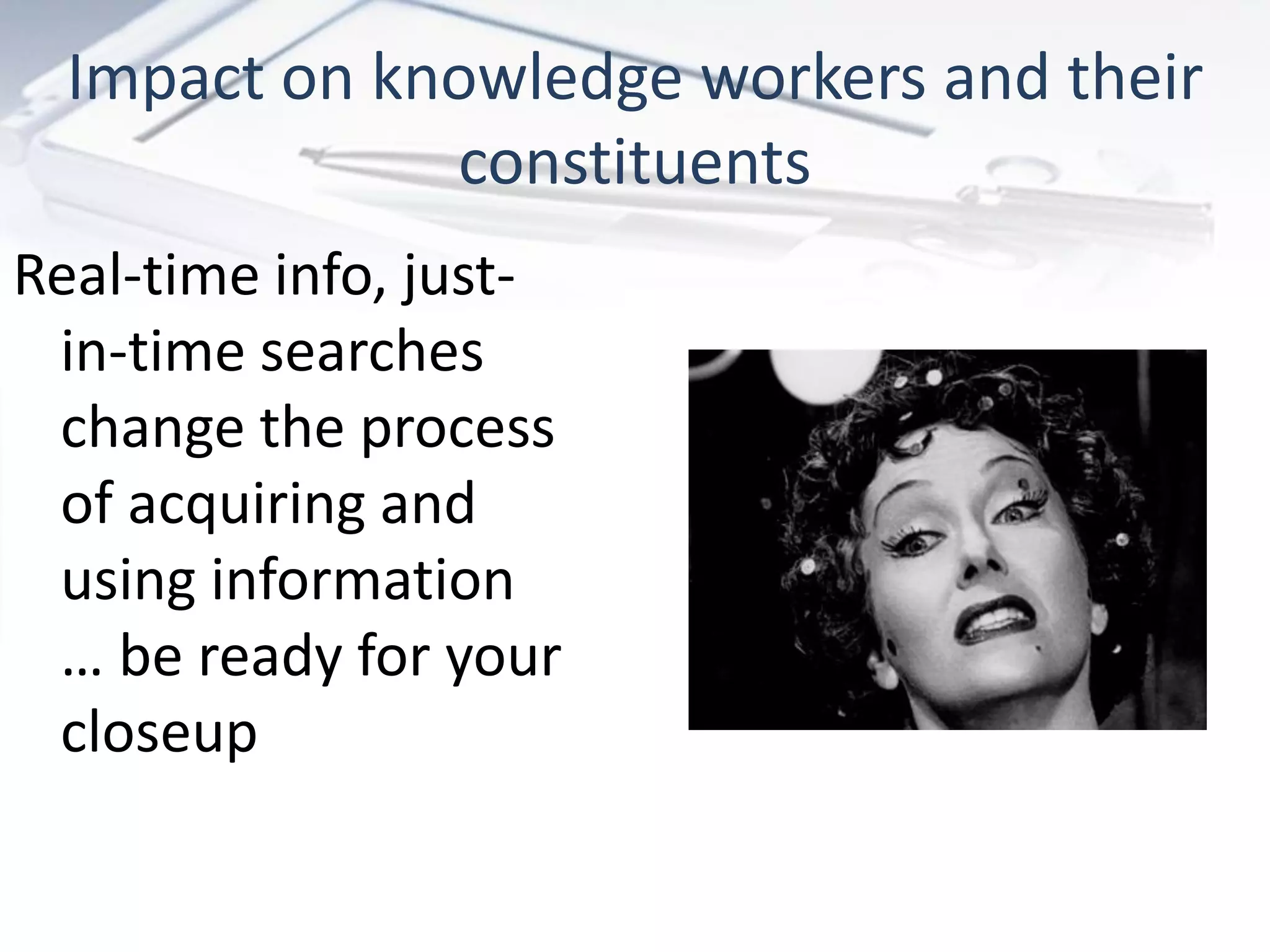
Real-time info, just-
 in-time searches
 change the process
 of acquiring and
 using information
 … be ready for your
 closeup
Impact on knowledge workers and
          their constituents
Influence is
  migrating from
  organizations
  to networks
  and new
  “experts”
Impact on knowledge workers and their
            constituents
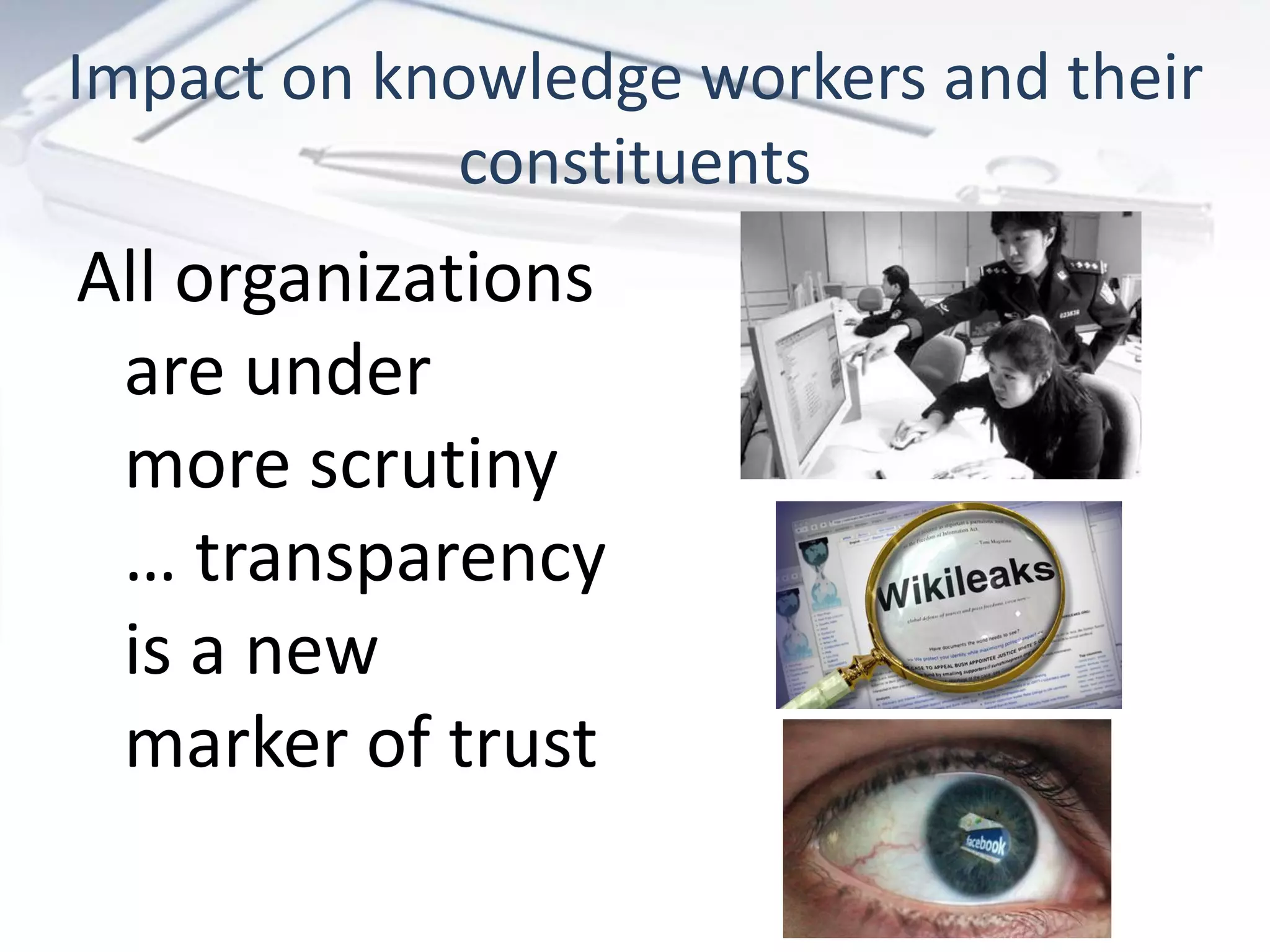
All organizations
 are under
 more scrutiny
 … transparency
 is a new
 marker of trust
Closing thoughts from the report
         on the hyperconnected
• Amber Case, cyberanthropologist, CEO of Geoloqi
  “Today and in the future, it will not be as important to
    internalize information but to elastically be able to take
    multiple sources of information in, synthesize them, and
    make rapid decisions. Memories are becoming
    hyperlinks to information triggered by keywords and
    URLs. We are becoming ‘persistent paleontologists’ of
    our own external memories, as our brains are storing the
    keywords to get back to those memories and not the full
    memories themselves.”
Closing thoughts from the report
      on the hyperconnected
• Tiffany Shlain, director of the film Connected
  “The key will be valuing when to be present and
    when to unplug. The core of what makes us
    human is to connect deeply, so this always will be
    valued. Just as we lost oral tradition with the
    written word, we will lose something big [in this
    change], but we will gain a new way of thinking.
    As Sophocles once said, ‘Nothing vast enters the
    life of mortals without a curse.’”
Thank you!

Networked and Hyperconnected: The New Social (and work) Operating System

  • 1.
    Networked and Hyperconnected TheNew Social (and work) Operating System National Conference of State Legislators October 11, 2012 Lee Rainie: Director, Pew Internet Project Email: Lrainie@pewinternet.org PewInternet.org
  • 2.
    “Tweckle (twek’ul) vt.To abuse a speaker to Twitter followers in the audience while he/she is speaking.” 2
  • 3.
  • 4.
    we need atshirt, "I survived the keynote disaster of 09" it's awesome in the "I don't want to turn away from the accident because I might see a severed head" way too bad they took my utensils away w/ my plate. I could have jammed the butter knife into my temple. 4
  • 5.
    How will hyperconnectedMillennials live? http://pewinternet.org/Reports/2012/Hyperconnected-lives.aspx
  • 6.
  • 7.
    Millennials’ future • In2020 the brains of multitasking teens and young adults are "wired" differently from those over age 35 and overall it yields helpful results. They do not suffer notable cognitive shortcomings as they multitask and cycle quickly through personal- and work-related tasks. Rather, they are learning more and they are more adept at finding answers to deep questions, in part because they can search effectively and access collective intelligence via the Internet. In sum, the changes in learning behavior and cognition among the young generally produce positive outcomes.
  • 8.
  • 9.
    Millennials’ future • In2020, the brains of multitasking teens and young adults are "wired" differently from those over age 35 and overall it yields baleful results. They do not retain information; they spend most of their energy sharing short social messages, being entertained, and being distracted away from deep engagement with people and knowledge. They lack deep-thinking capabilities; they lack face-to-face social skills; they depend in unhealthy ways on the Internet and mobile devices to function. In sum, the changes in behavior and cognition among the young are generally negative outcomes.
  • 10.
    Millennials’ future Change forthe better Change for the worse 52% 42%
  • 11.
  • 12.
    Theme – Newwinners/losers
  • 13.
  • 14.
  • 15.
  • 16.
    Digital Revolution 1:Broadband Internet (85%) and Broadband at home (66%)
  • 17.
    Networked creators andcurators among internet users • 69% are social networking site users • 59% share photos and videos • 37% contribute rankings and ratings • 33% create content tags • 30% share personal creations • 26% post comments on sites and blogs • 15% have personal website • 15% are content remixers • 16% use Twitter • 14% are bloggers • … of smartphone owners, 18% share their locations; 74% get location info and do location sharing
  • 18.
    Revolution 2: Mobile– 89% of adults 331.6 Total U.S. population: 315.5 million 2011
  • 19.
    Apps > 50%of adults 50% % of cell owners who have 43% 40% downloaded apps 38% 30% 29% 22% 20% 10% 0% Sept 2009 May 2010 August 2011 April 2012
  • 20.
    Digital Revolution 3 Social networking – 59% of all adults 18-29 30-49 50-64 65+ 100% 86% 92% % of internet users 76% 87% 80% 67% 68% 73% 60% 61% 49% 48% 49% 57% 40% 47% 25% 29% 25% 38% 20% 26% 9% 8% 11% 7% 4% 13% 6% 7% 0% 2005 2006 1% 2007 2008 2009 2010 2011 2012
  • 21.
    Impact on knowledgeworkers and their constituents The world is full of networked individuals using (lots of) networked information
  • 22.
    Impact on knowledgeworkers and their constituents There is an imperative to share and be “on the grid”
  • 23.
    Impact on knowledgeworkers and their constituents Attention is reallocated
  • 24.
    Impact on knowledgeworkers and their constituents A “fifth estate” of civic and community actors arises (including citizen “vigilantes”)
  • 25.
    Impact on knowledgeworkers and their constituents Real-time info, just- in-time searches change the process of acquiring and using information … be ready for your closeup
  • 26.
    Impact on knowledgeworkers and their constituents Influence is migrating from organizations to networks and new “experts”
  • 27.
    Impact on knowledgeworkers and their constituents All organizations are under more scrutiny … transparency is a new marker of trust
  • 28.
    Closing thoughts fromthe report on the hyperconnected • Amber Case, cyberanthropologist, CEO of Geoloqi “Today and in the future, it will not be as important to internalize information but to elastically be able to take multiple sources of information in, synthesize them, and make rapid decisions. Memories are becoming hyperlinks to information triggered by keywords and URLs. We are becoming ‘persistent paleontologists’ of our own external memories, as our brains are storing the keywords to get back to those memories and not the full memories themselves.”
  • 29.
    Closing thoughts fromthe report on the hyperconnected • Tiffany Shlain, director of the film Connected “The key will be valuing when to be present and when to unplug. The core of what makes us human is to connect deeply, so this always will be valued. Just as we lost oral tradition with the written word, we will lose something big [in this change], but we will gain a new way of thinking. As Sophocles once said, ‘Nothing vast enters the life of mortals without a curse.’”
  • 30.