Libraries as social networks Lee Rainie, Director, Pew Internet Project 5.6.11 San Francisco library system  Email:  [email_address] Twitter: @Lrainie
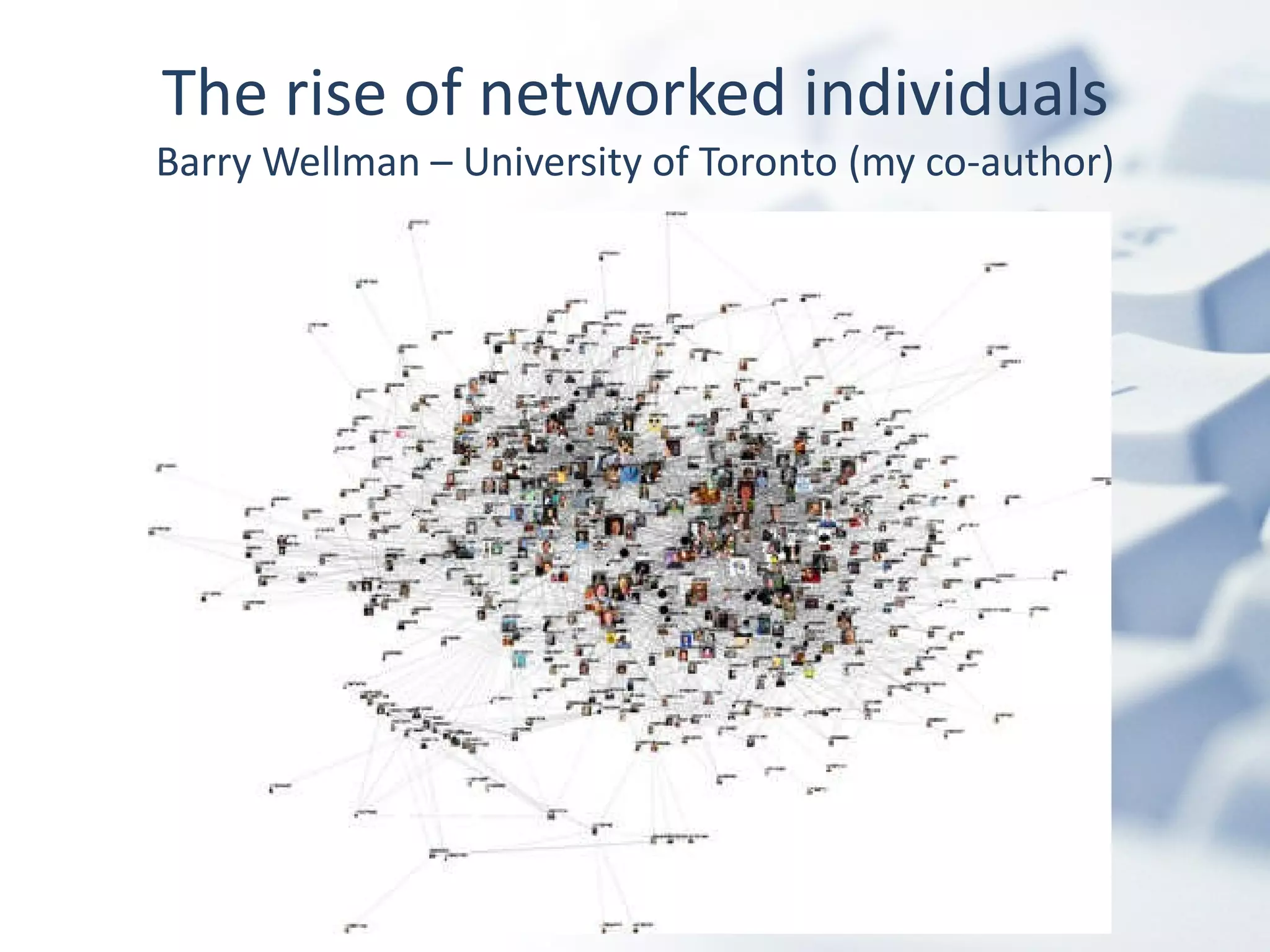
The rise of networked individuals Barry Wellman – University of Toronto (my co-author)
New social operating system (1): Networked Individualism Groups and bureaucracies give way to networks Social networks are more influential Social networks are differently composed Social networks are more vivid and tied to creation of information/media
New social operating system (2): New kinds of communities Explosion of group activity and group niches Rise of social posses Advent of just-in-time, just-like-me peer-to-peer (support) groups Fifth Estate of content contributors
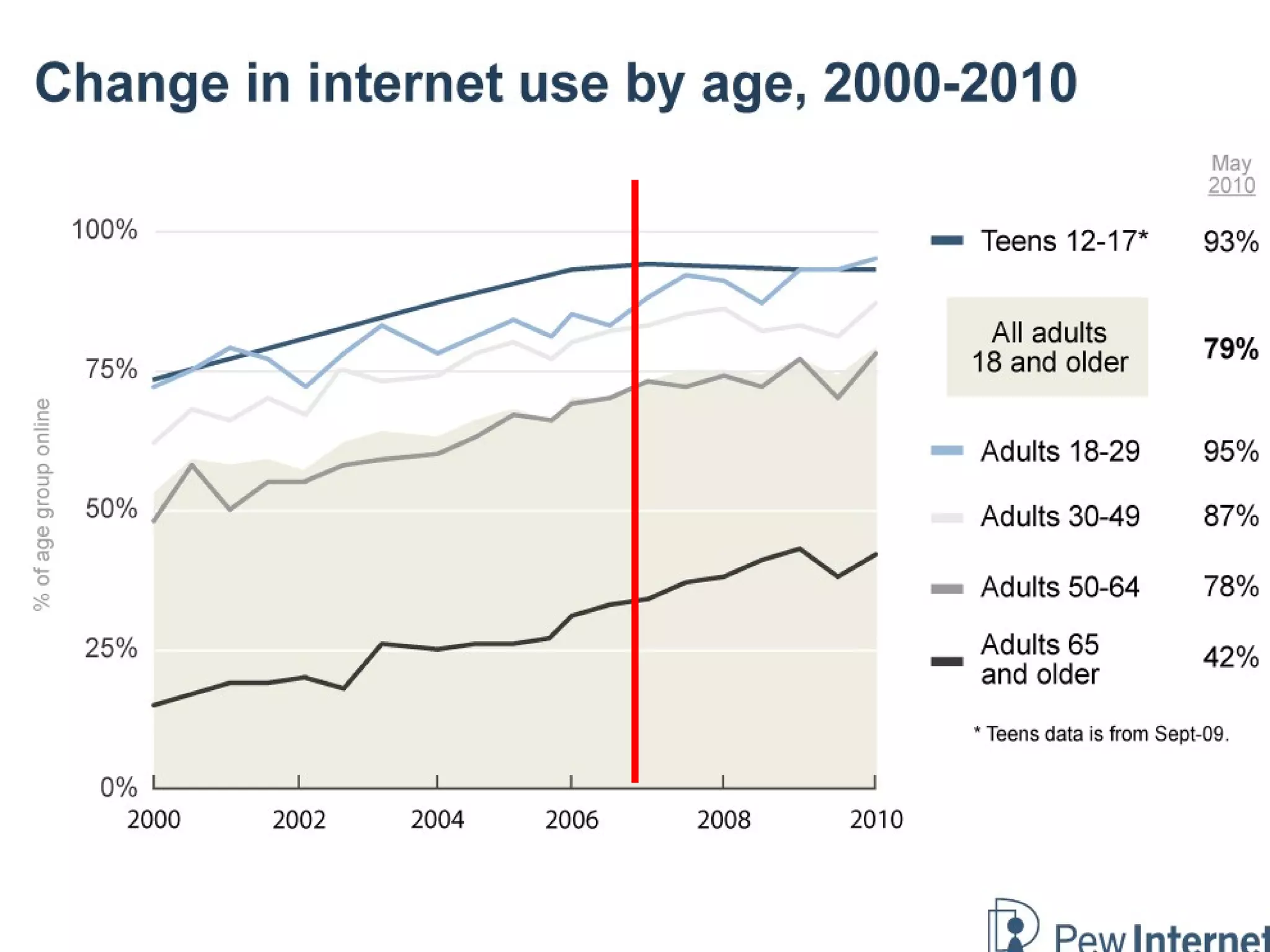
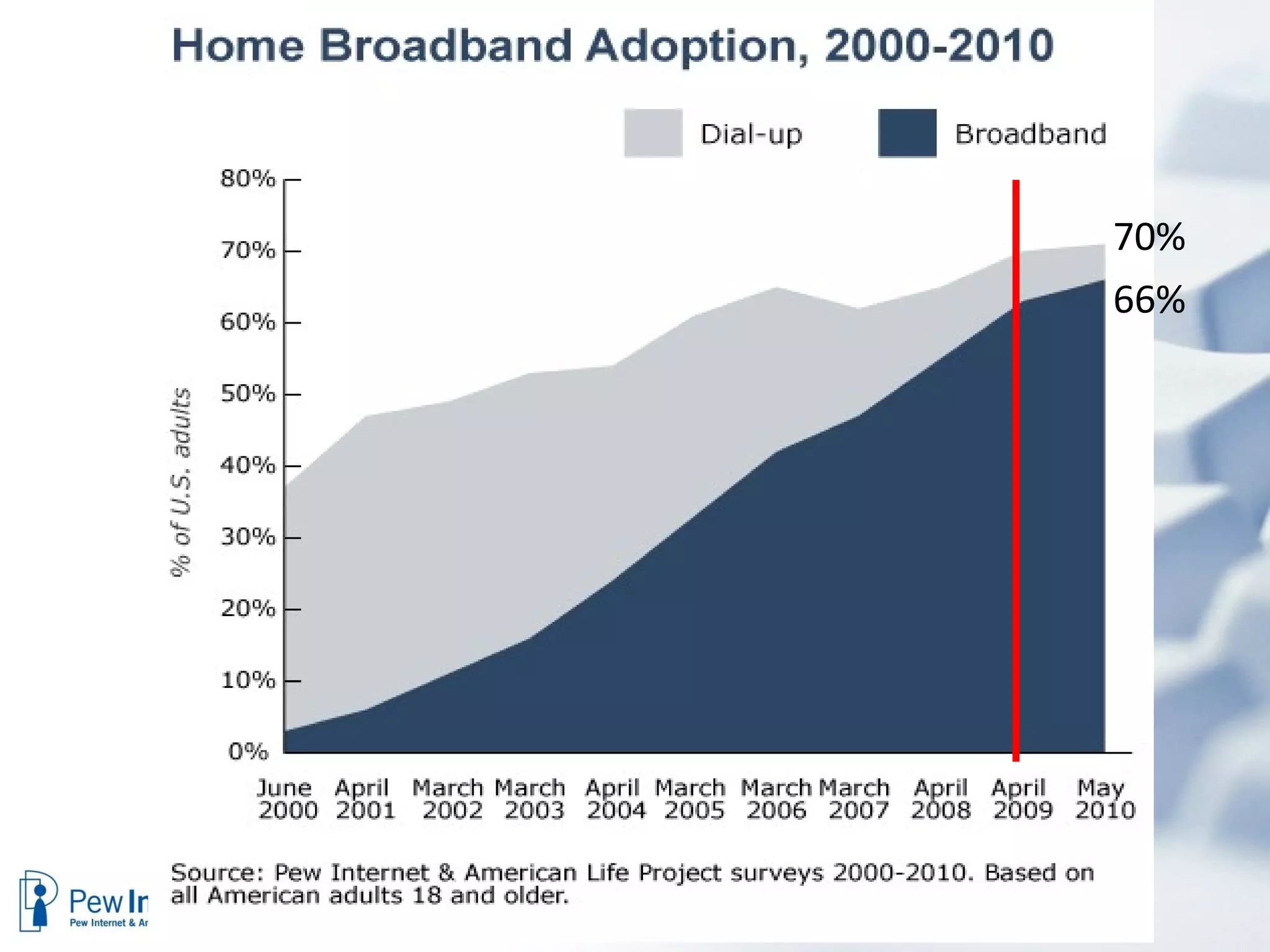
Revolution #1  Internet and Broadband
 
70%  66%
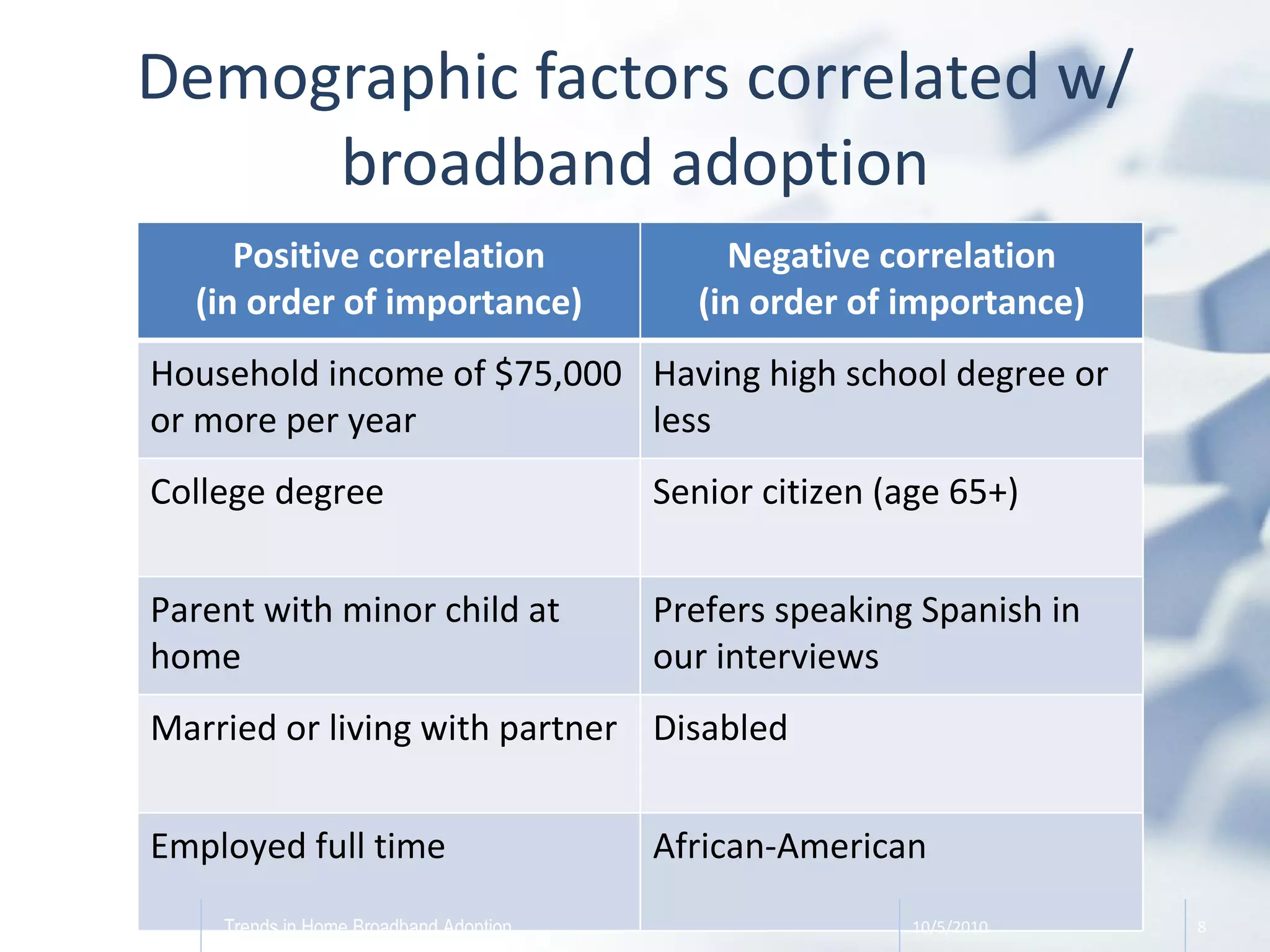
Demographic factors correlated w/ broadband adoption 10/5/2010 Trends in Home Broadband Adoption Positive correlation (in order of importance) Negative correlation (in order of importance) Household income of $75,000 or more per year Having high school degree or less College degree Senior citizen (age 65+) Parent with minor child at home Prefers speaking Spanish in our interviews Married or living with partner Disabled Employed full time African-American
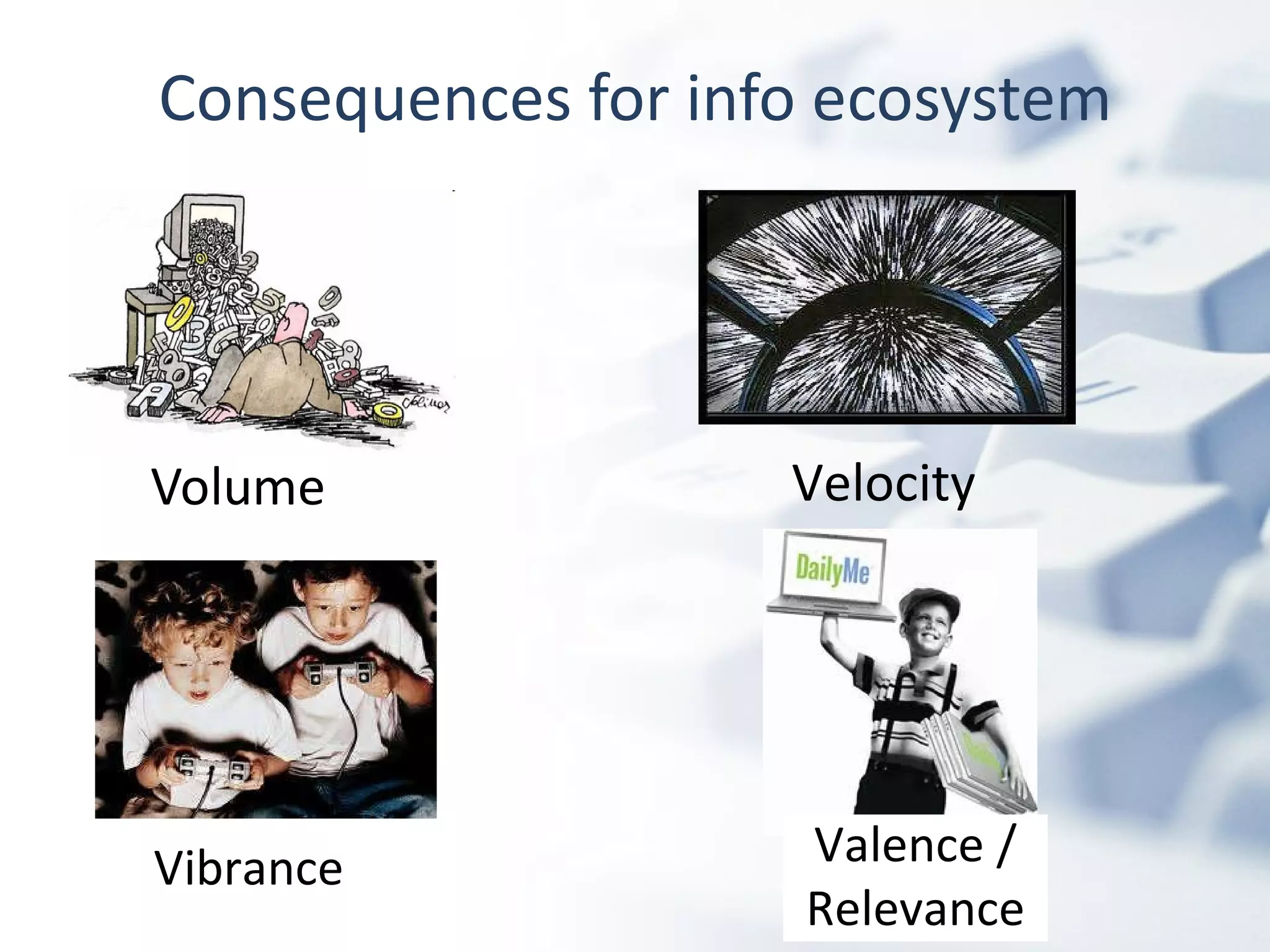
Consequences for info ecosystem Volume Velocity Vibrance Valence / Relevance
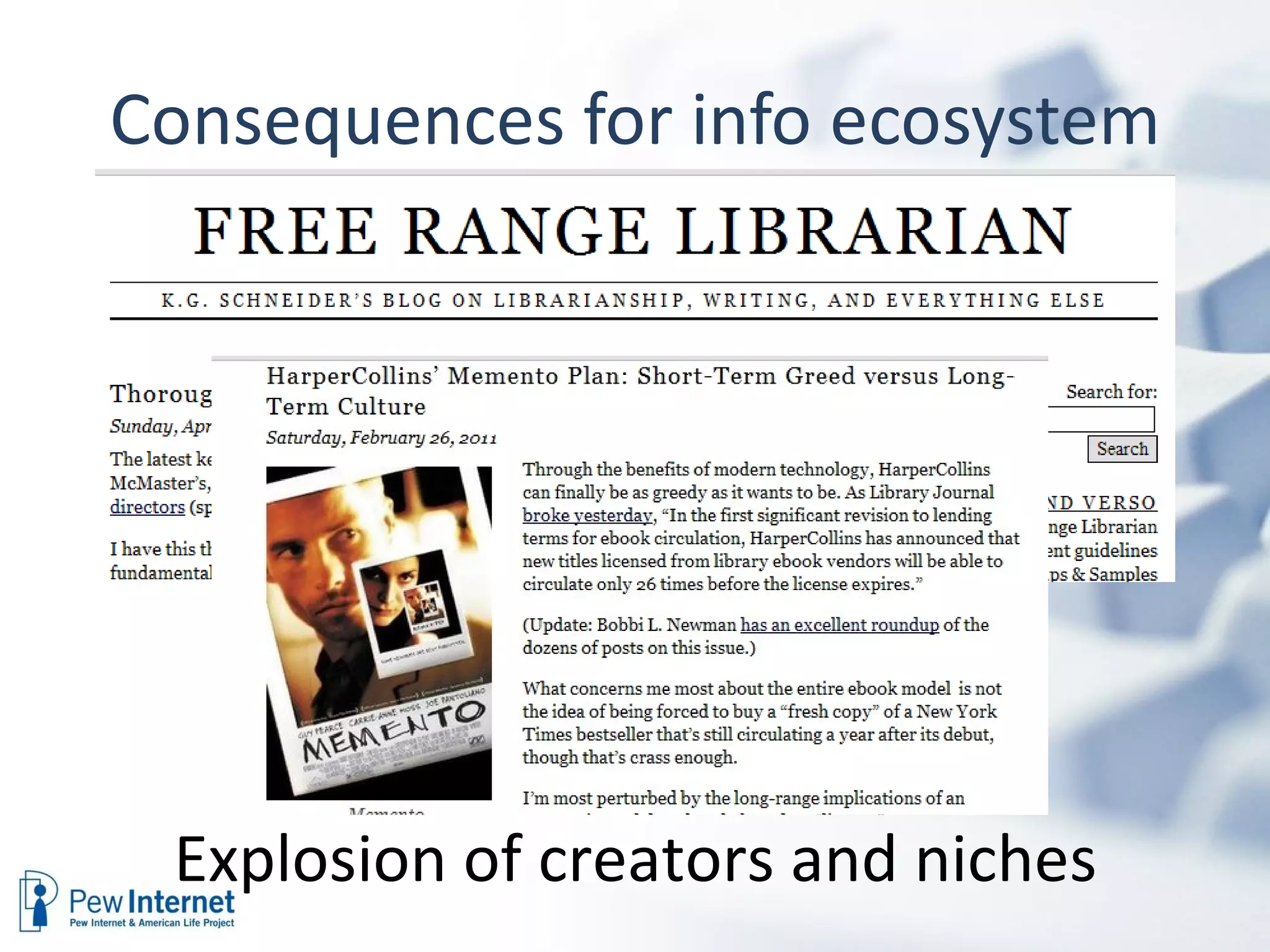
Consequences for info ecosystem Explosion of creators and niches
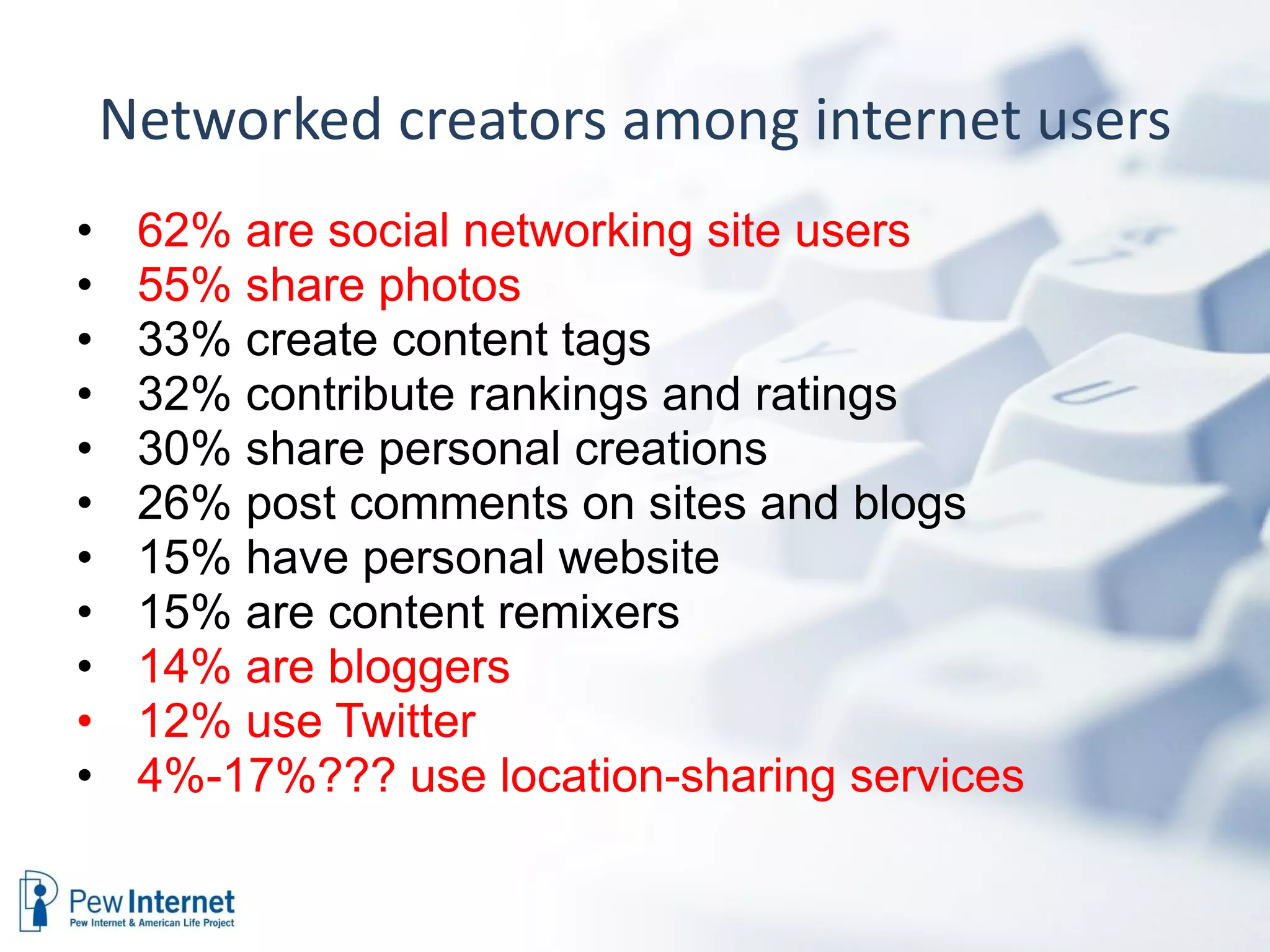
Networked creators among internet users 62% are social networking site users 55% share photos 33% create content tags  32% contribute rankings and ratings 30% share personal creations  26% post comments on sites and blogs 15% have personal website 15% are content remixers  14% are bloggers 12% use Twitter 4%-17%??? use location-sharing services
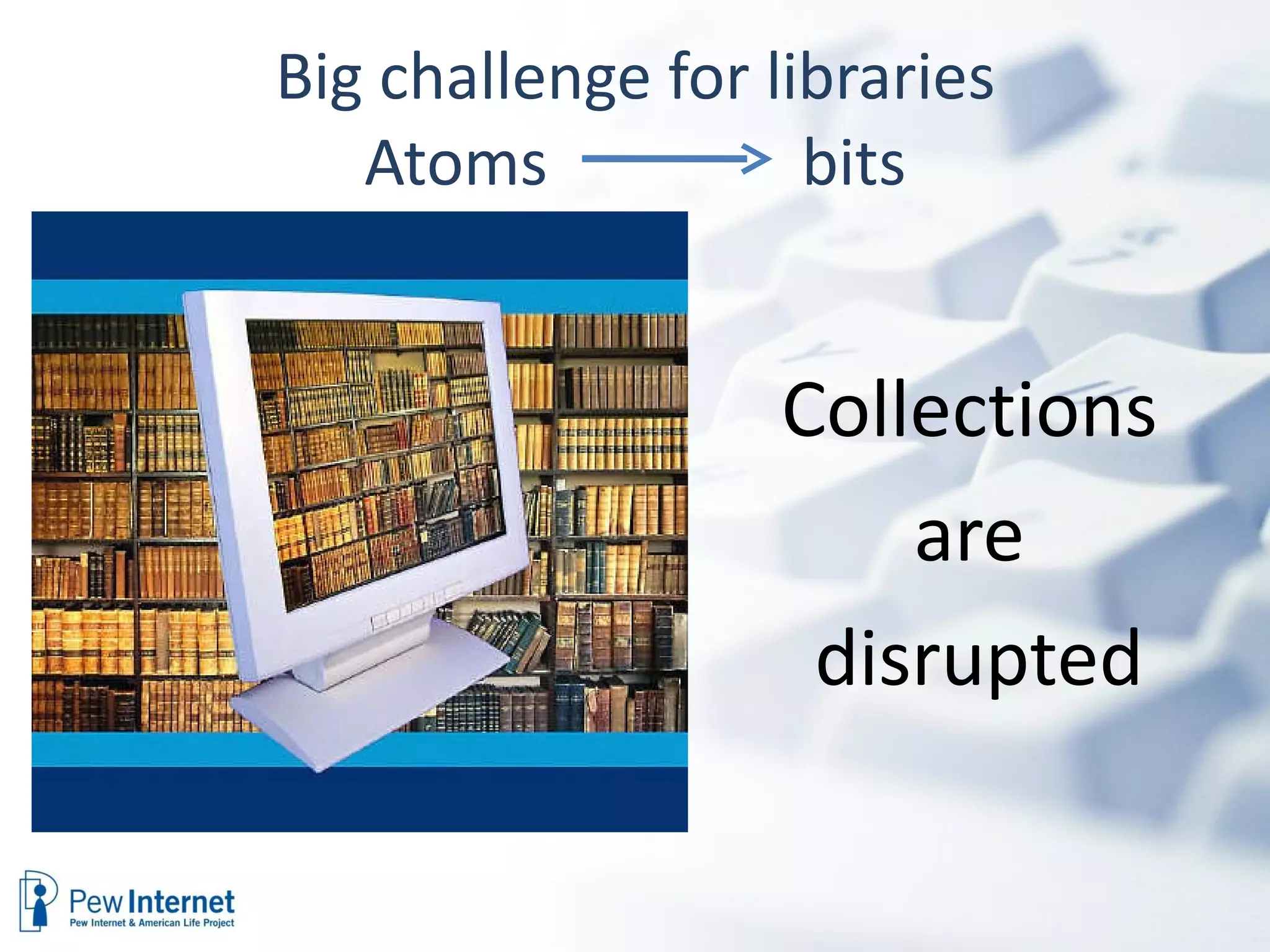
Big challenge for libraries Atoms  bits Collections  are  disrupted
Big  social networking add by libraries 1 – Cover access divides 44% of those living below the poverty line used library connections 61% of those ages 14-24 used them for school 54% of poor senior citizens used library connections for health/wellness needs 63% used library connections to help others Source:  Opportunity for All, Univ. of Washingon, Gates Foundation, IMLS  http://cis.washington.edu/usimpact/documents/OPP4ALL_FinalReport.pdf
Big social networking add by libraries 2 – Cover participatory divides 2/3 of library connection users sought assistance from library staff 60% of library connectors use them for social purposes 42% for education purposes 40% for jobs/career purposes 37% health and wellness purposes 33% for community engagement Source:  Opportunity for All, Univ. of Washingon, Gates Foundation, IMLS  http://cis.washington.edu/usimpact/documents/OPP4ALL_FinalReport.pdf
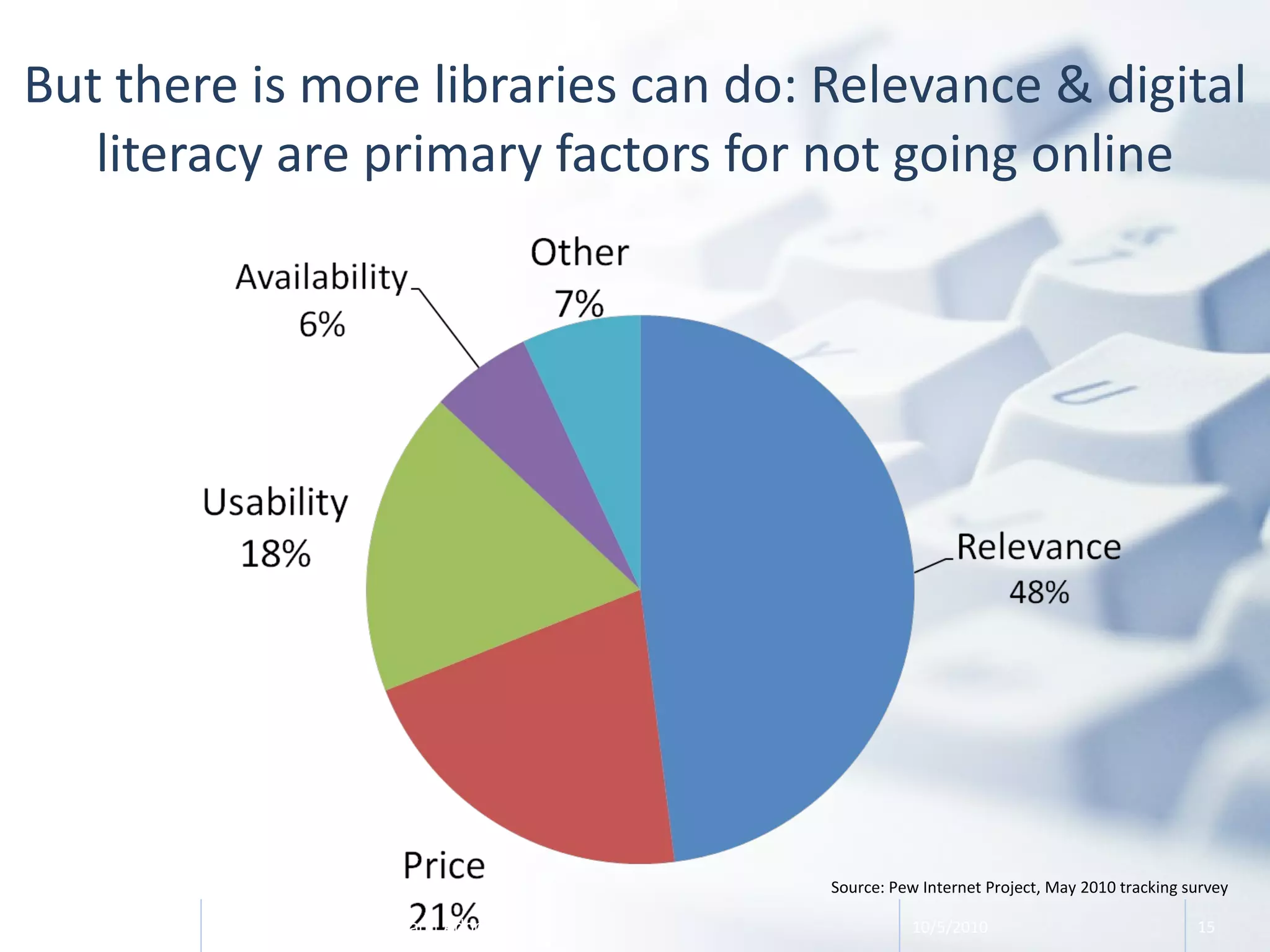
But there is more libraries can do: Relevance & digital literacy are primary factors for not going online Source: Pew Internet Project, May 2010 tracking survey 10/5/2010 Trends in Home Broadband Adoption
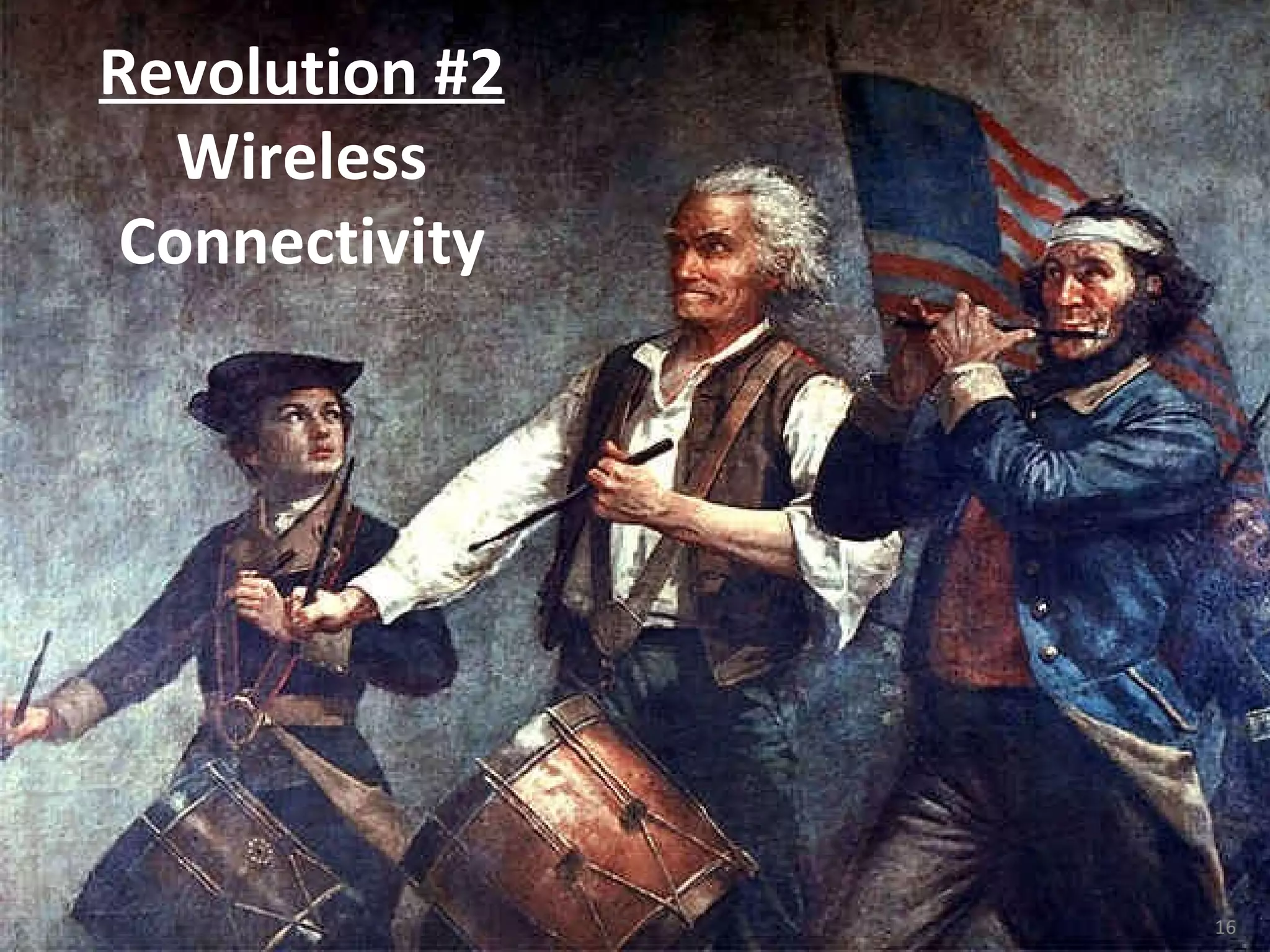
Revolution #2  Wireless Connectivity
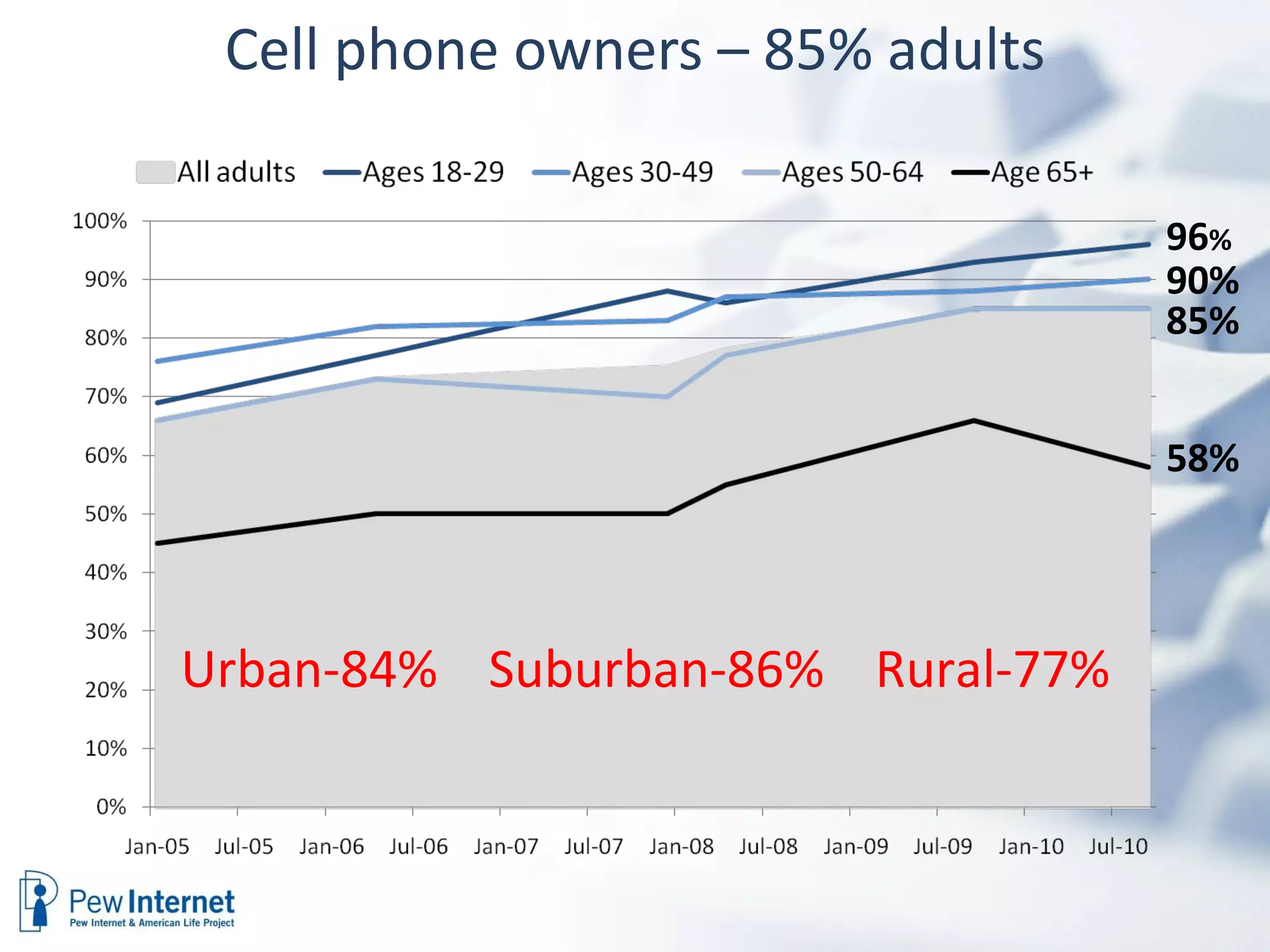
Cell phone owners – 85% adults 96 %  90%  85%  58%  Urban-84%  Suburban-86%  Rural-77%
2/22/2011
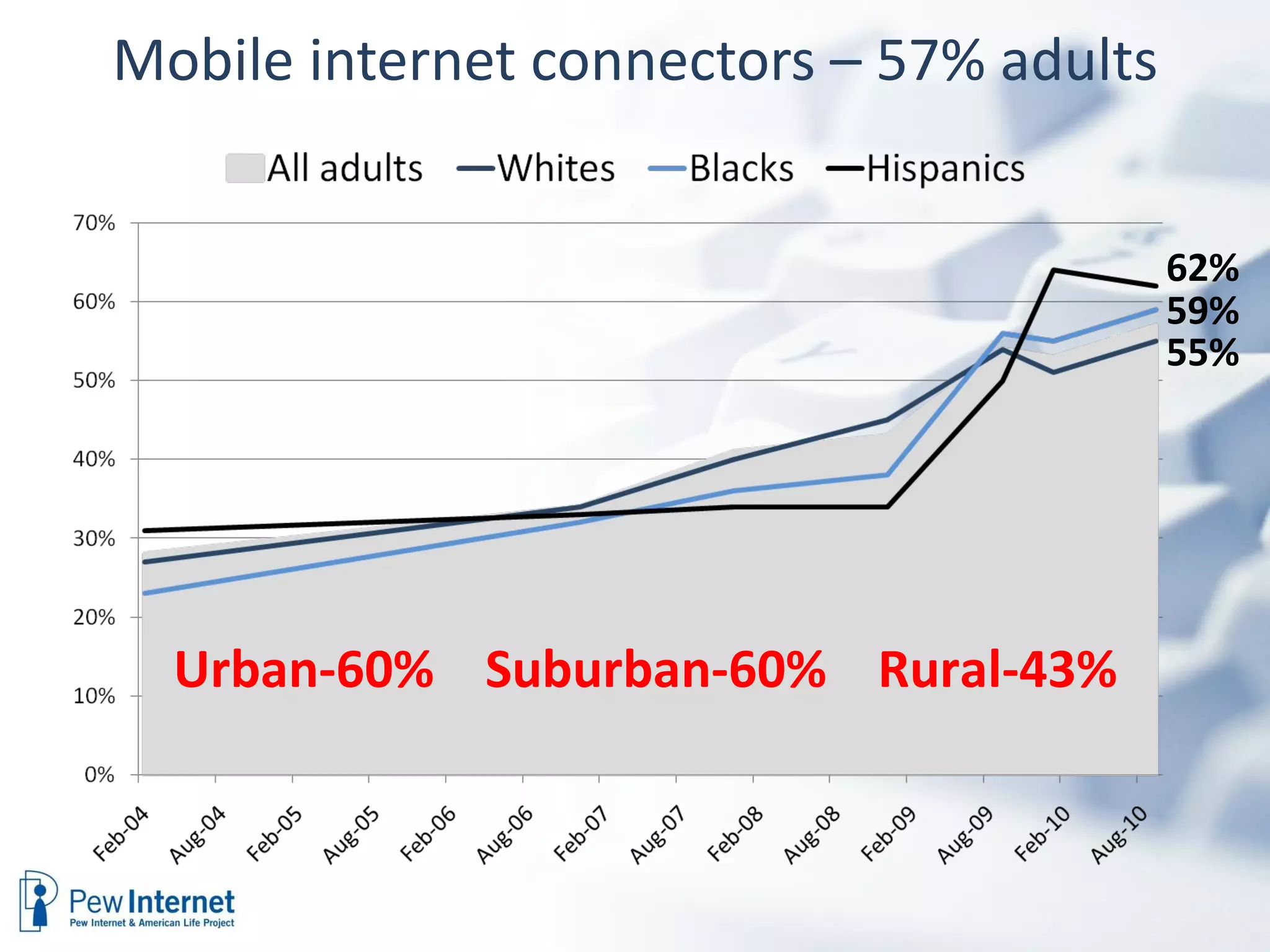
Mobile internet connectors – 57% adults 62%  59%  55%  Urban-60%  Suburban-60%  Rural-43%
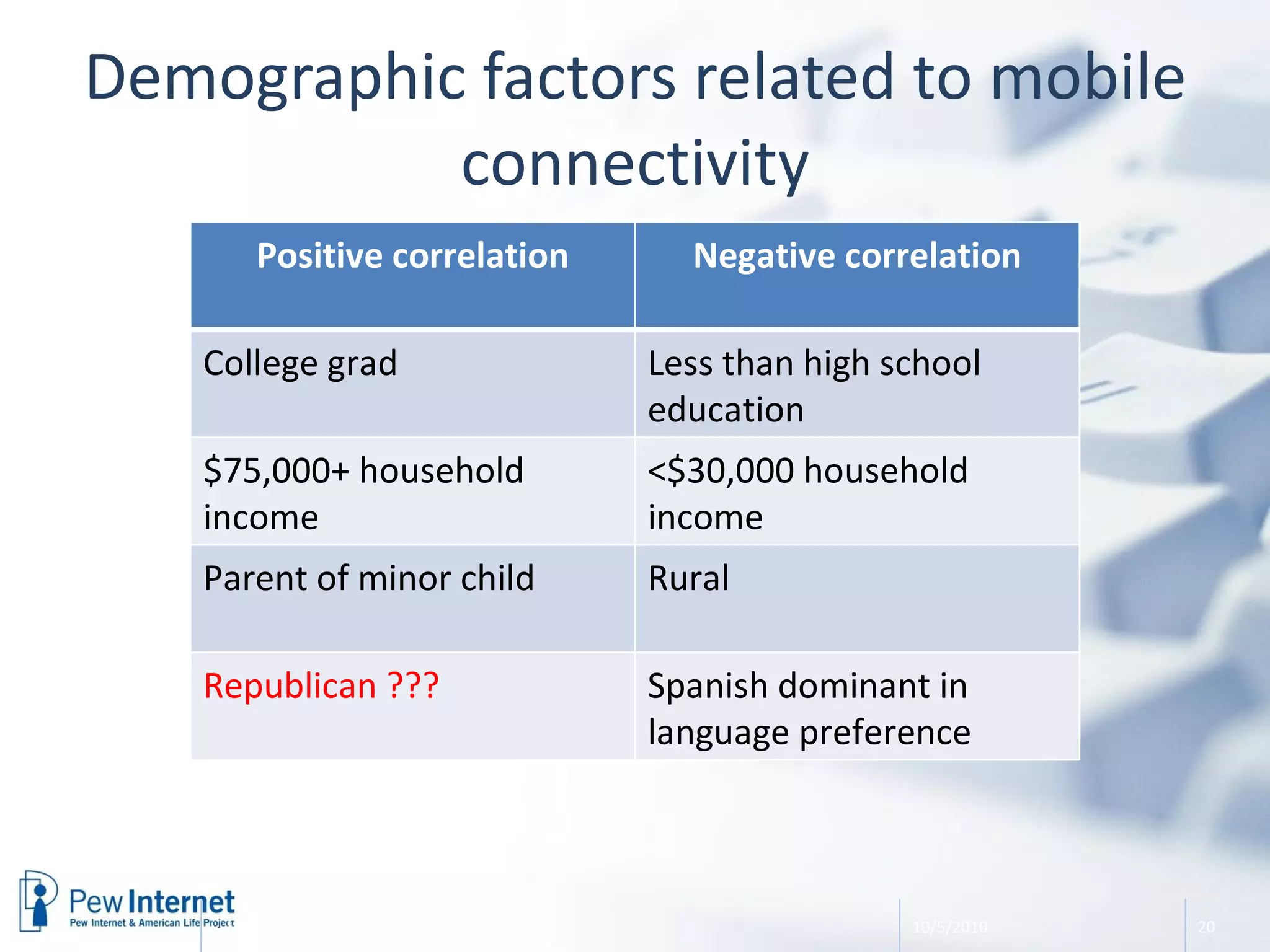
Demographic factors related to mobile connectivity 10/5/2010 Trends in Home Broadband Adoption Positive correlation Negative correlation College grad Less than high school education $75,000+ household income <$30,000 household income Parent of minor child Rural Republican ???  Spanish dominant in language preference
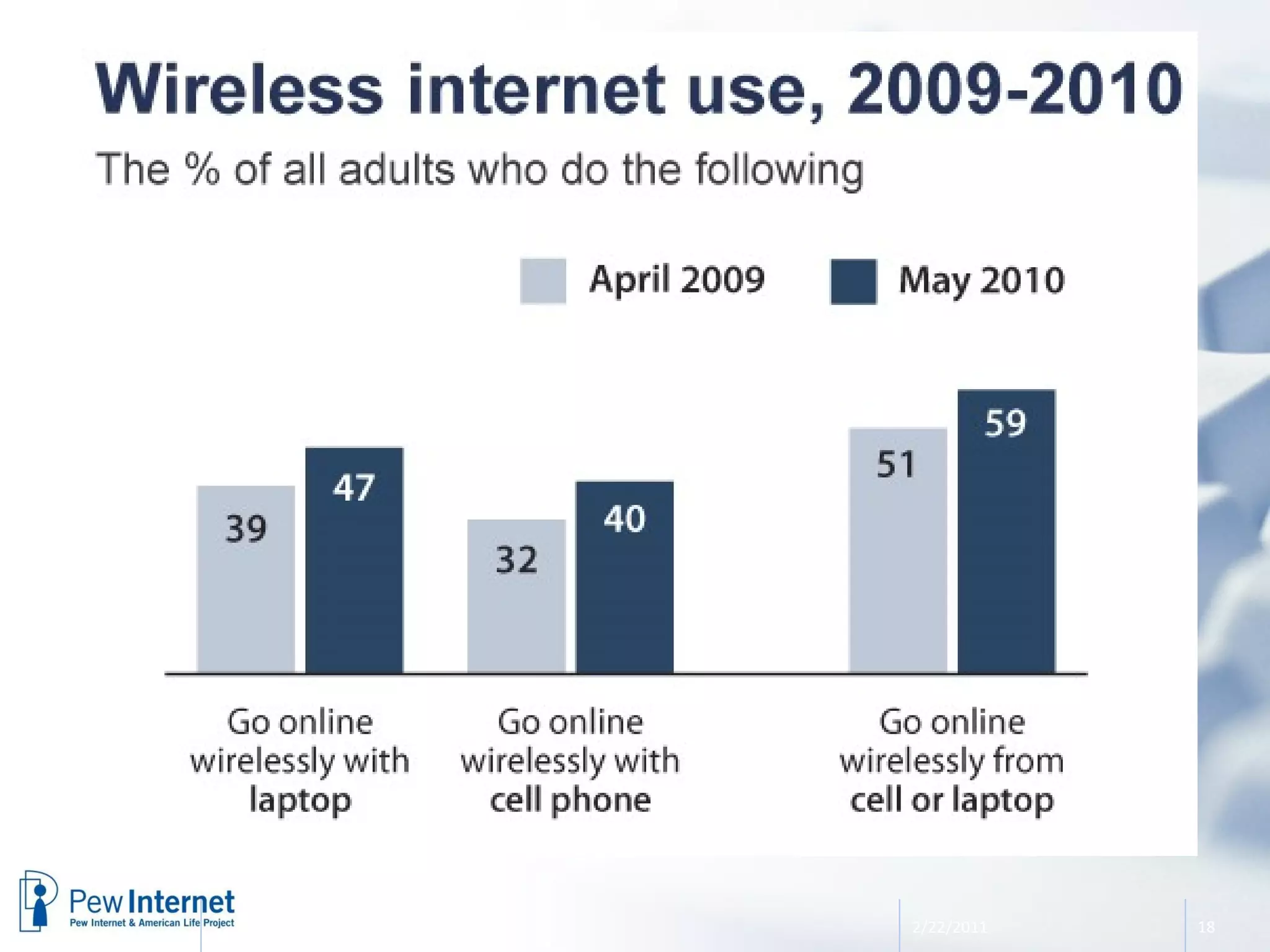
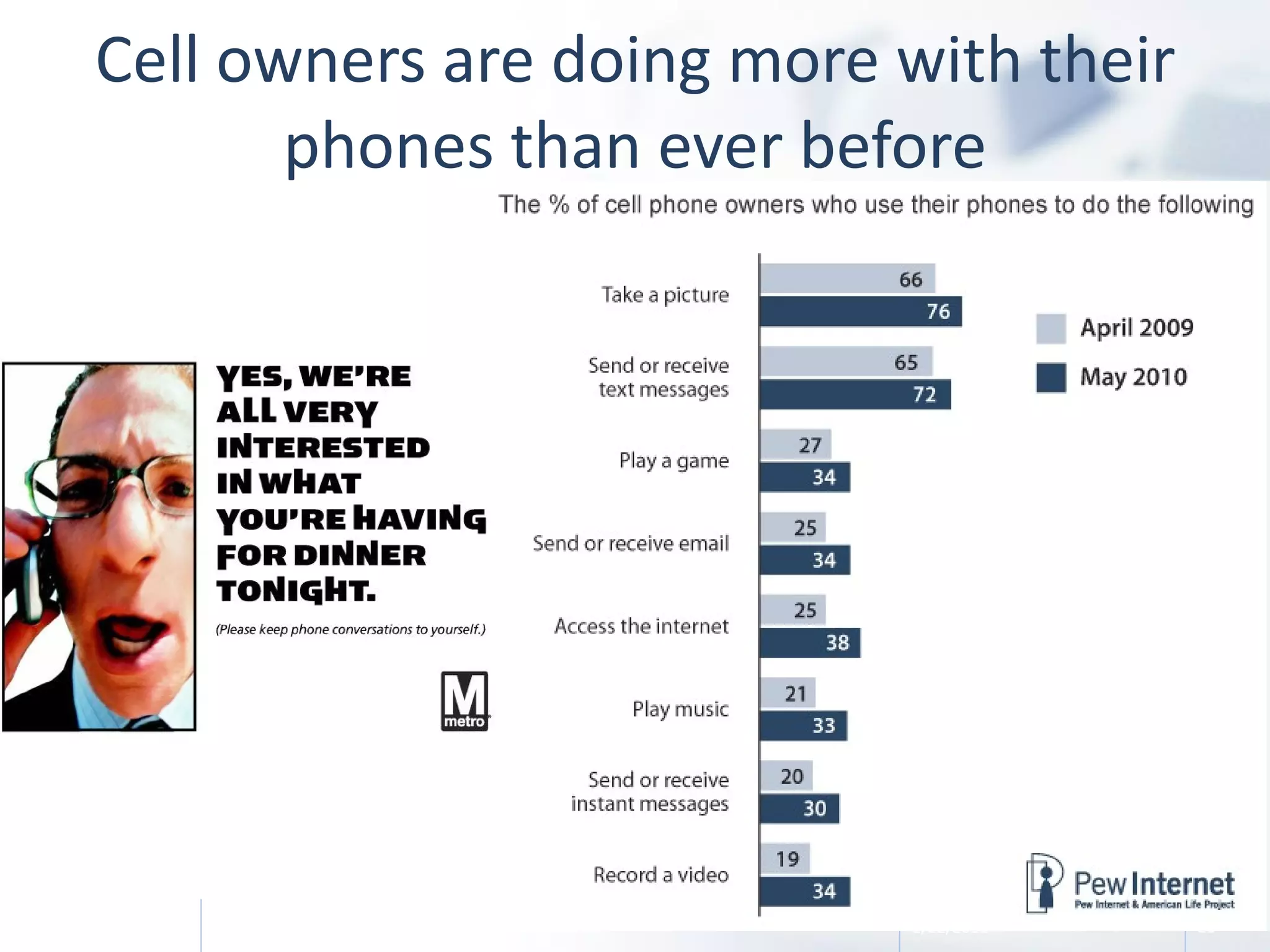
Cell owners are doing more with their phones than ever before 2/22/2011
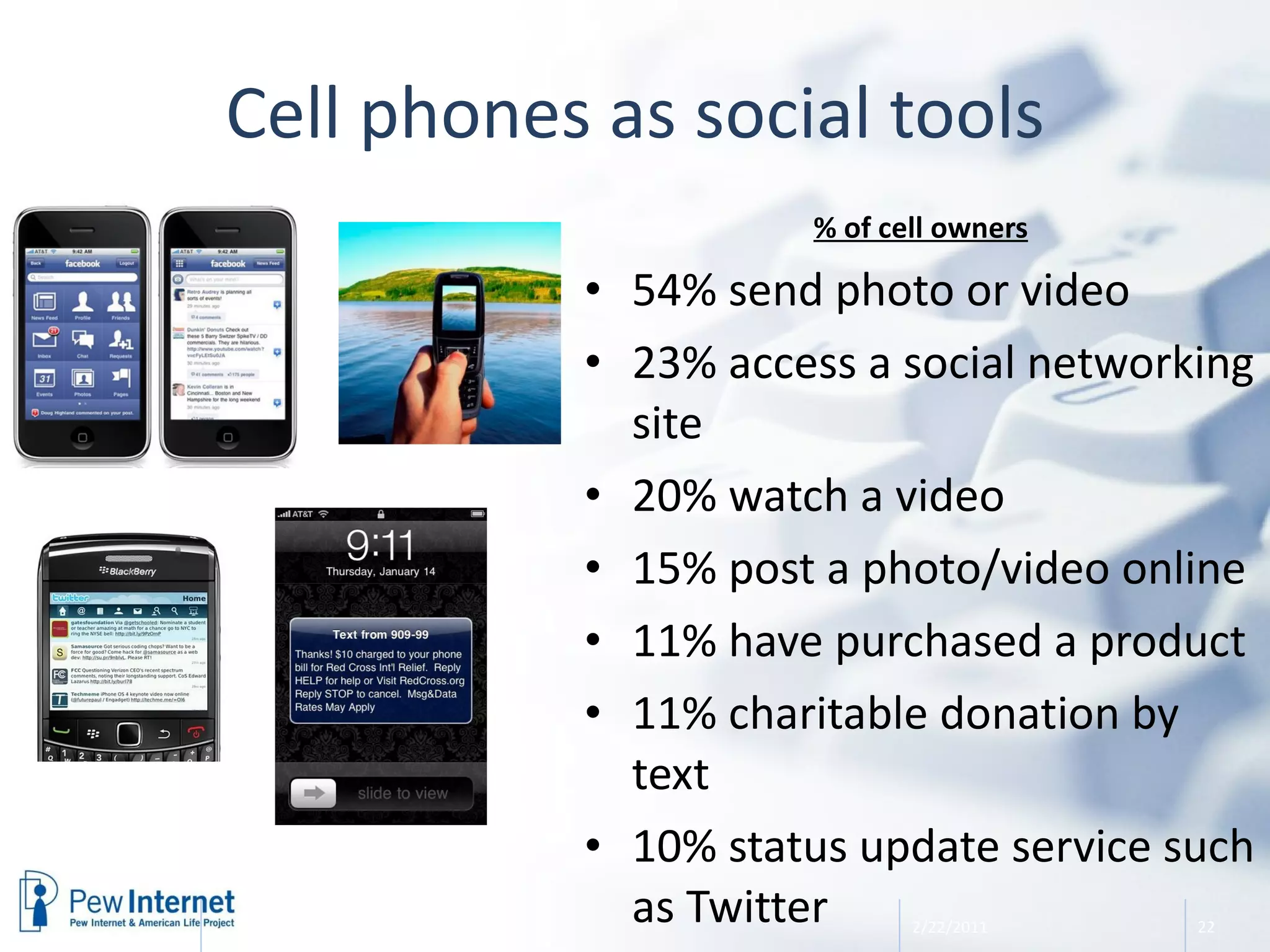
Cell phones as social tools % of cell owners 54% send photo or video  23% access a social networking site 20% watch a video  15% post a photo/video online  11% have purchased a product 11% charitable donation by text  10% status update service such as Twitter 2/22/2011
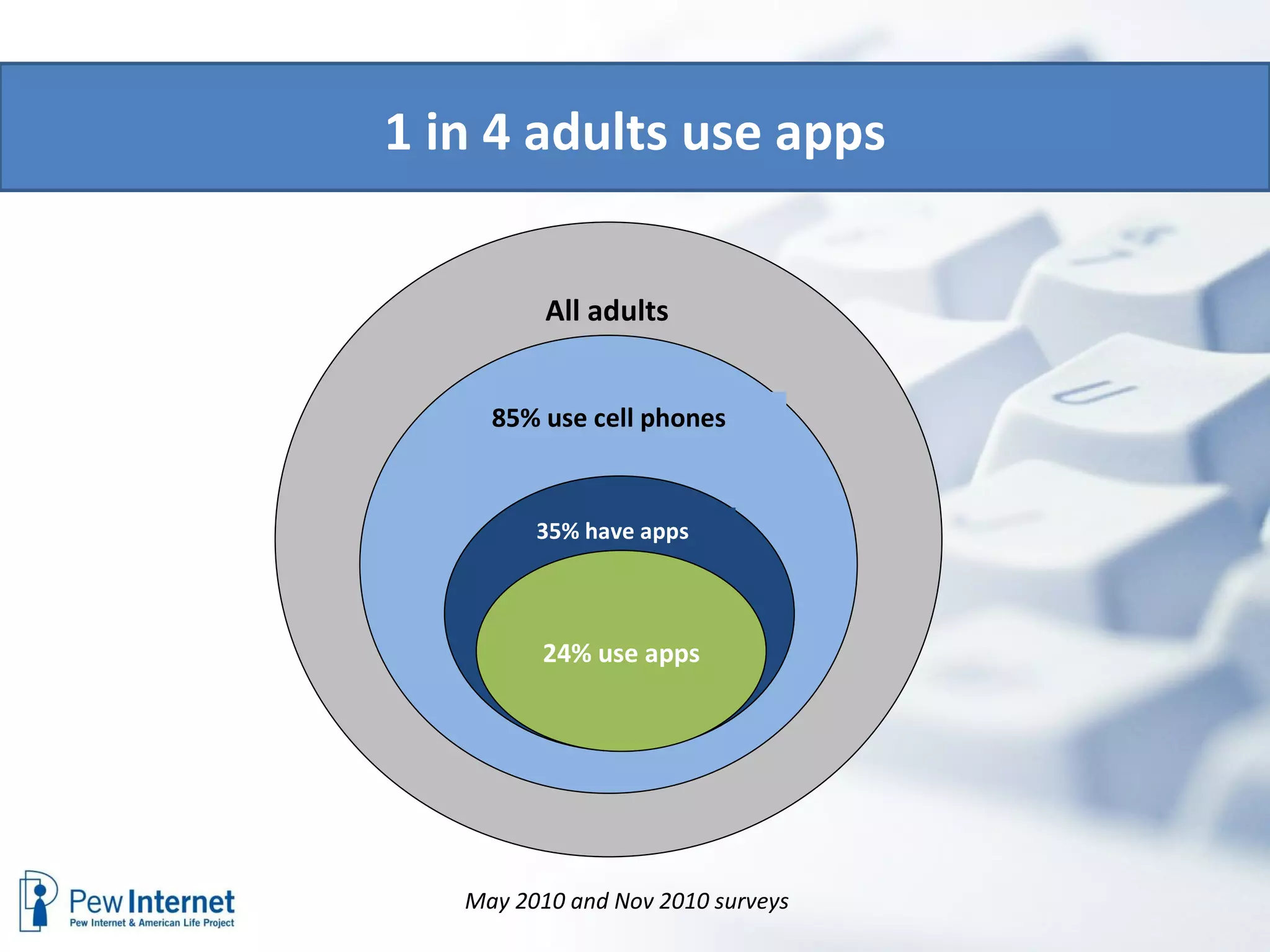
85% use cell phones 35% have apps 24% use apps All adults May 2010 and Nov 2010 surveys  1 in 4 adults use apps
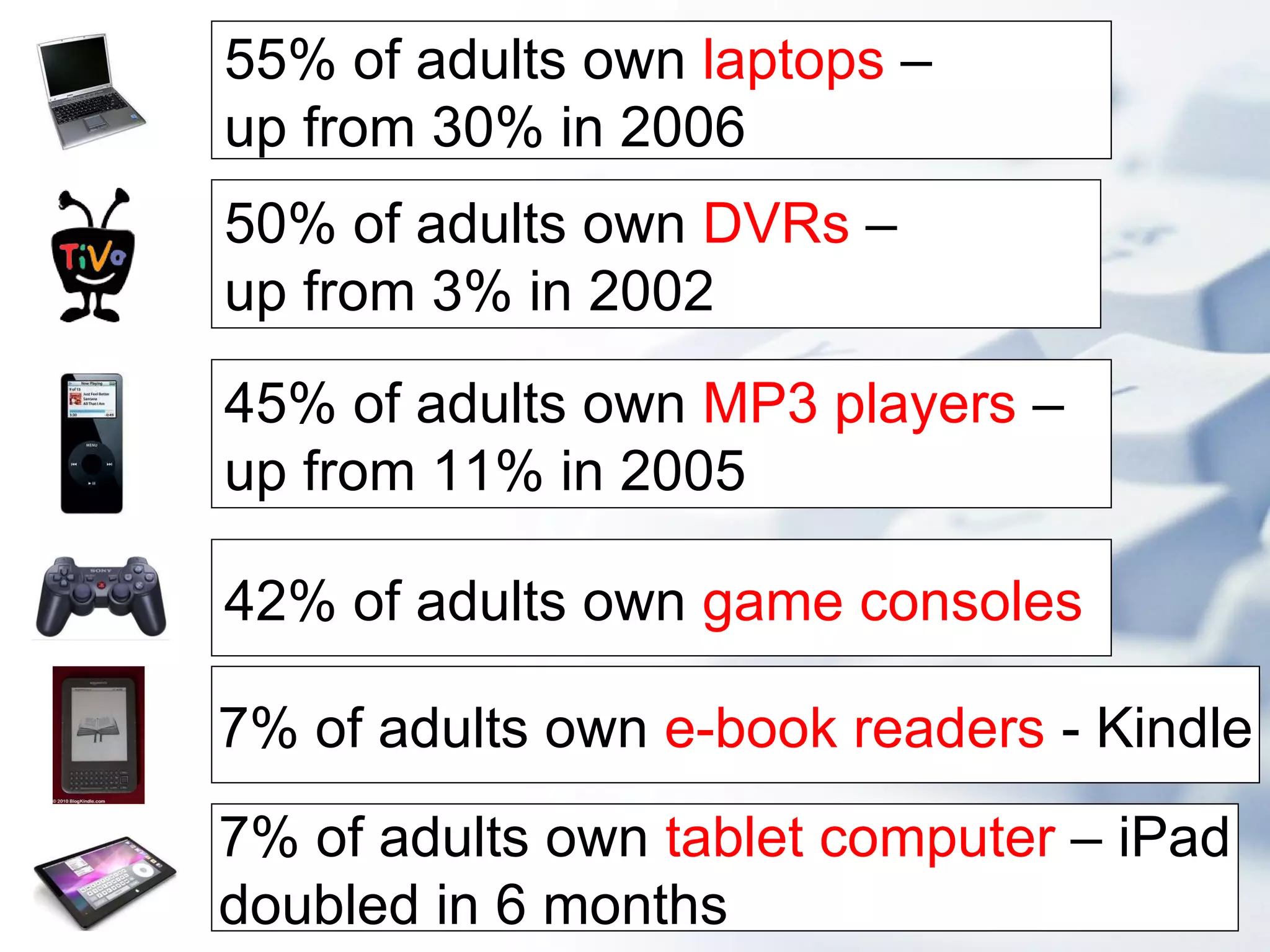
55% of adults own  laptops  –  up from 30% in 2006 45% of adults own  MP3 players  –  up from 11% in 2005 50% of adults own  DVRs  –  up from 3% in 2002 42% of adults own  game consoles 7% of adults own  e-book readers  - Kindle 7% of adults own  tablet computer  – iPad doubled in 6 months
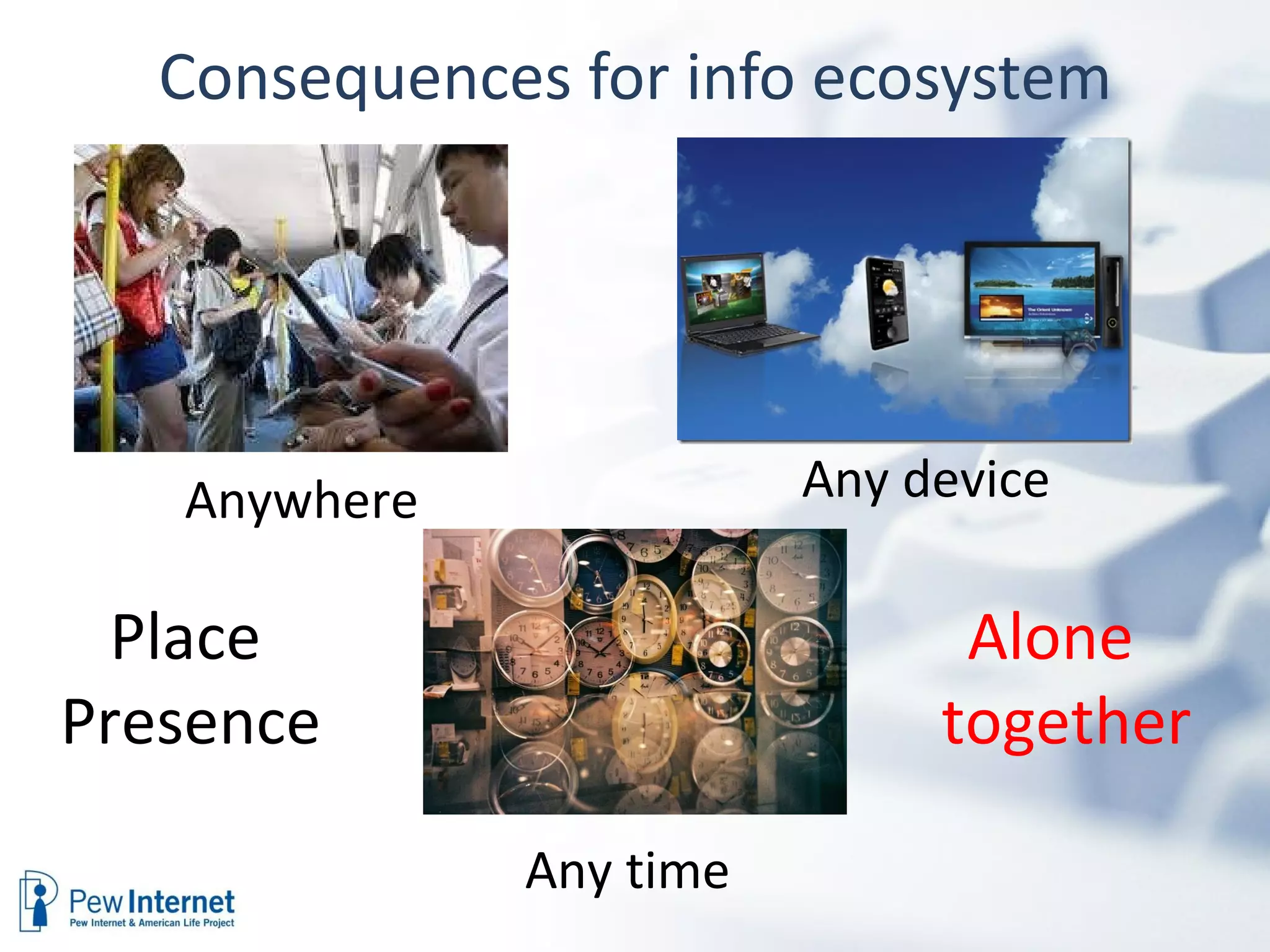
Consequences for info ecosystem Anywhere  Any device Presence Place Any time  Alone together
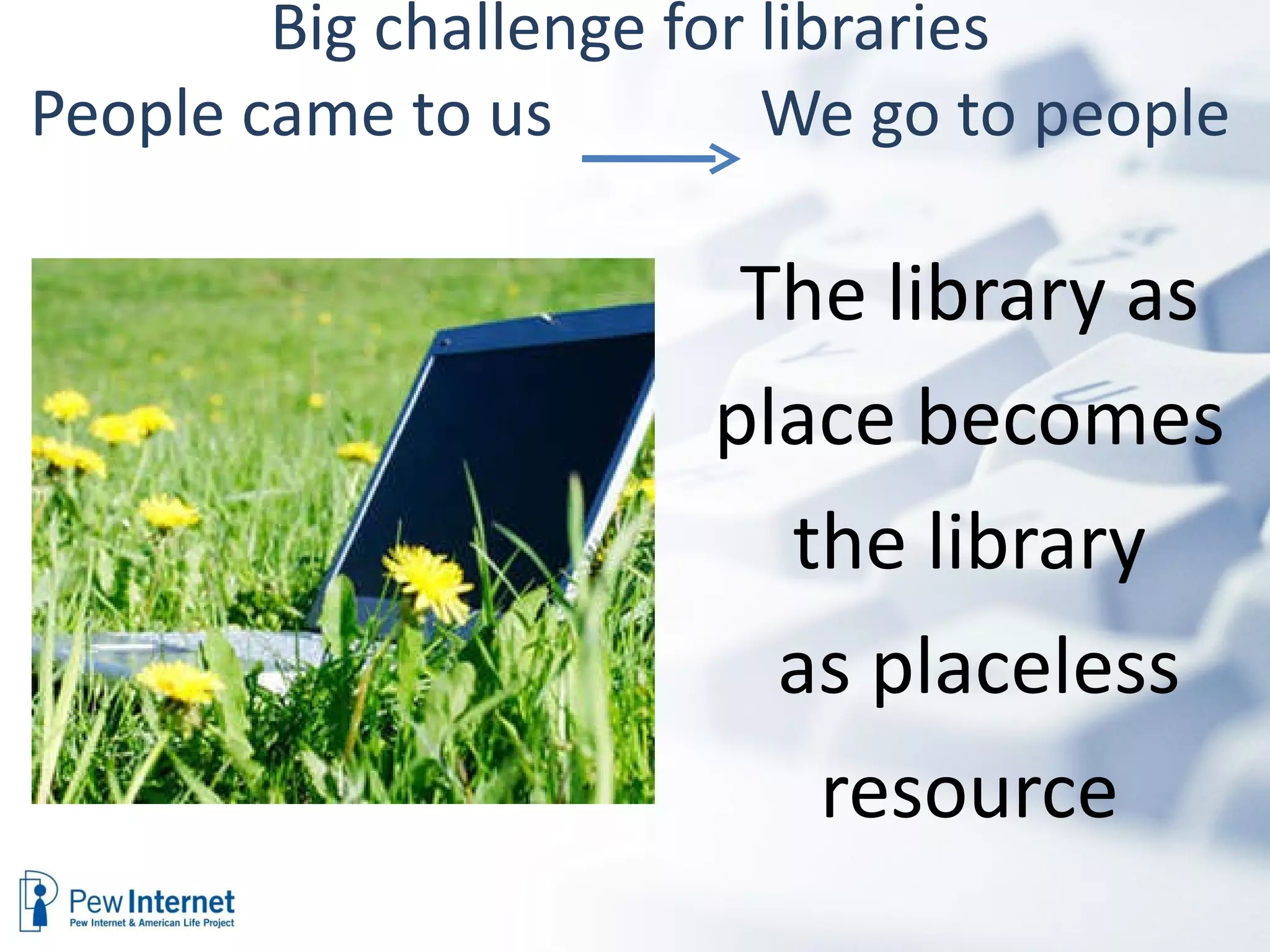
Big challenge for libraries People came to us  We go to people  The library as  place becomes  the library  as placeless resource
Big social networking add by libraries Help navigate and “make peace” with info Apps vs. web vs. traditional resource locators Access to real-time information Context of information – augmented reality Sanctuary – quiet space
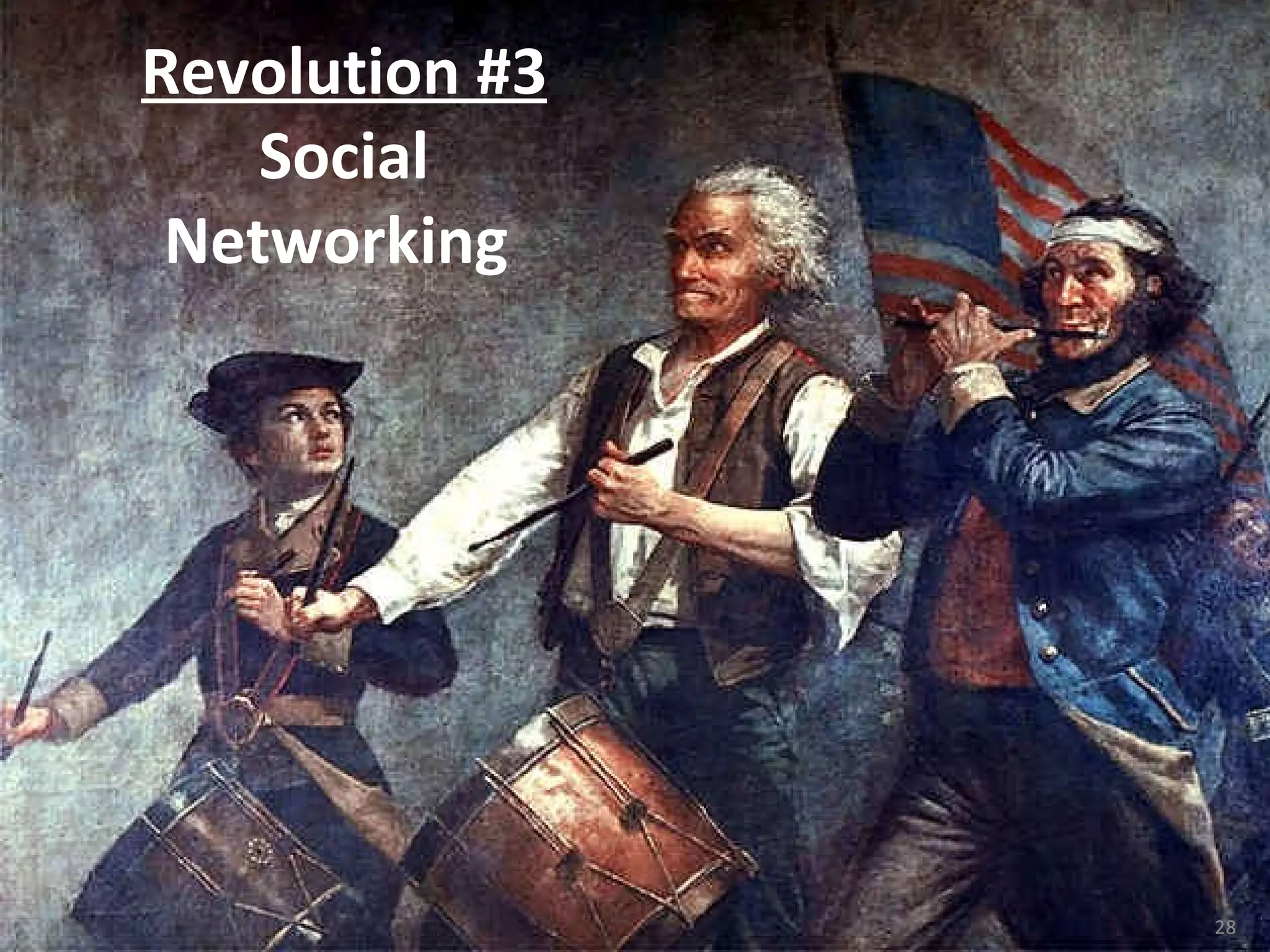
Revolution #3 Social Networking
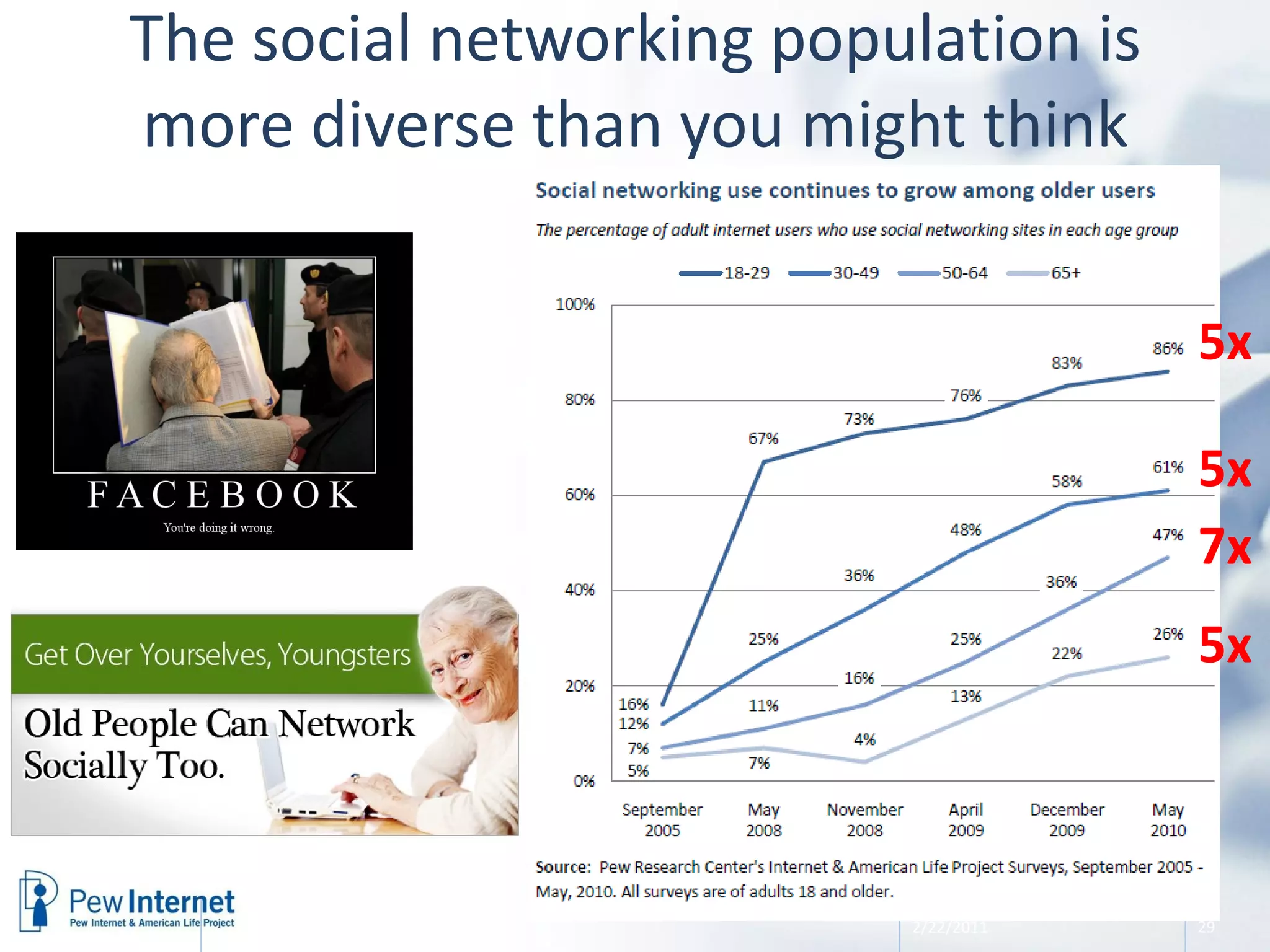
The social networking population is more diverse than you might think 2/22/2011 5x 5x 7x 5x
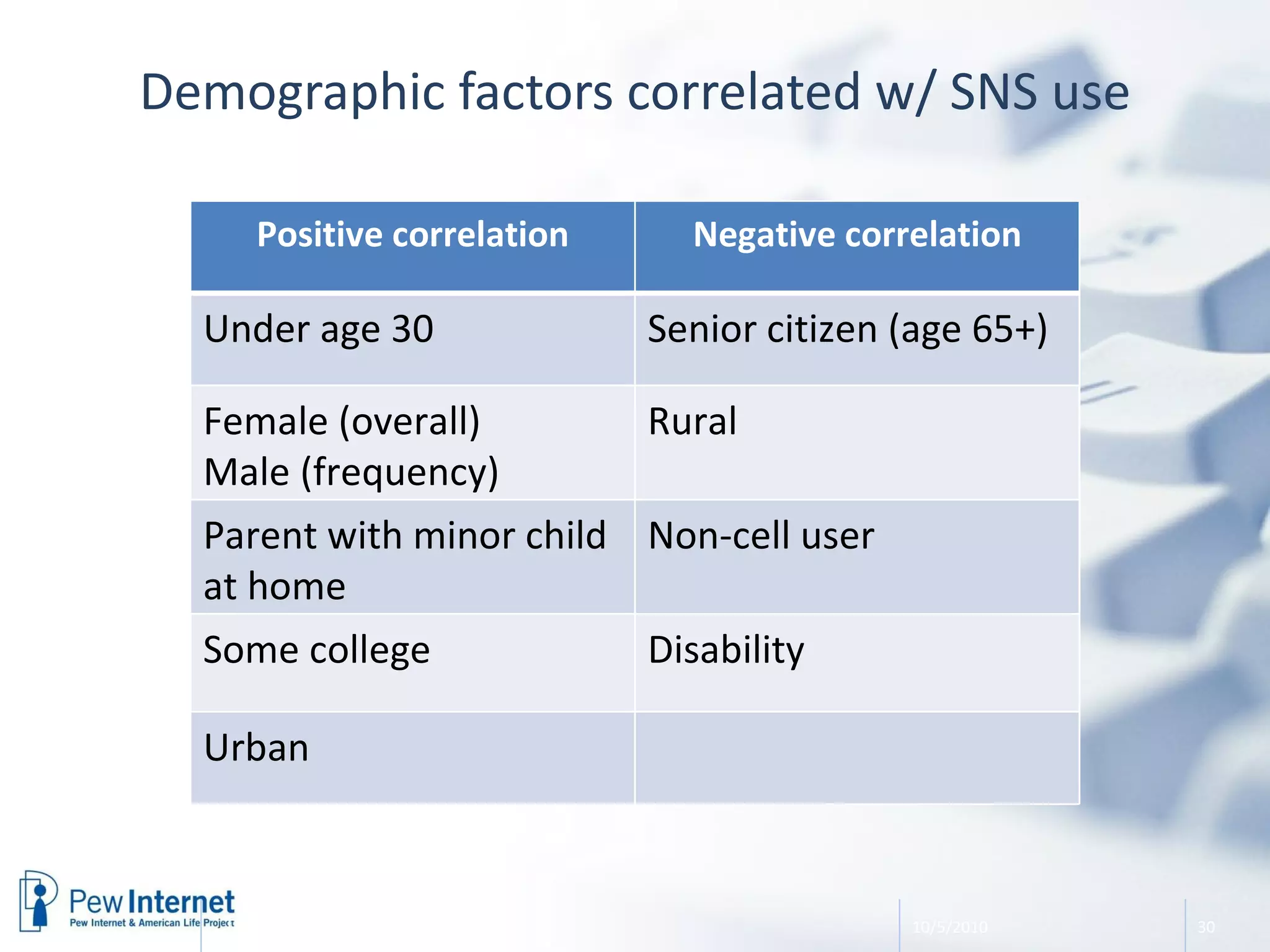
Demographic factors correlated w/ SNS use 10/5/2010 Trends in Home Broadband Adoption Positive correlation Negative correlation Under age 30 Senior citizen (age 65+) Female (overall) Male (frequency) Rural Parent with minor child at home Non-cell user Some college Disability Urban
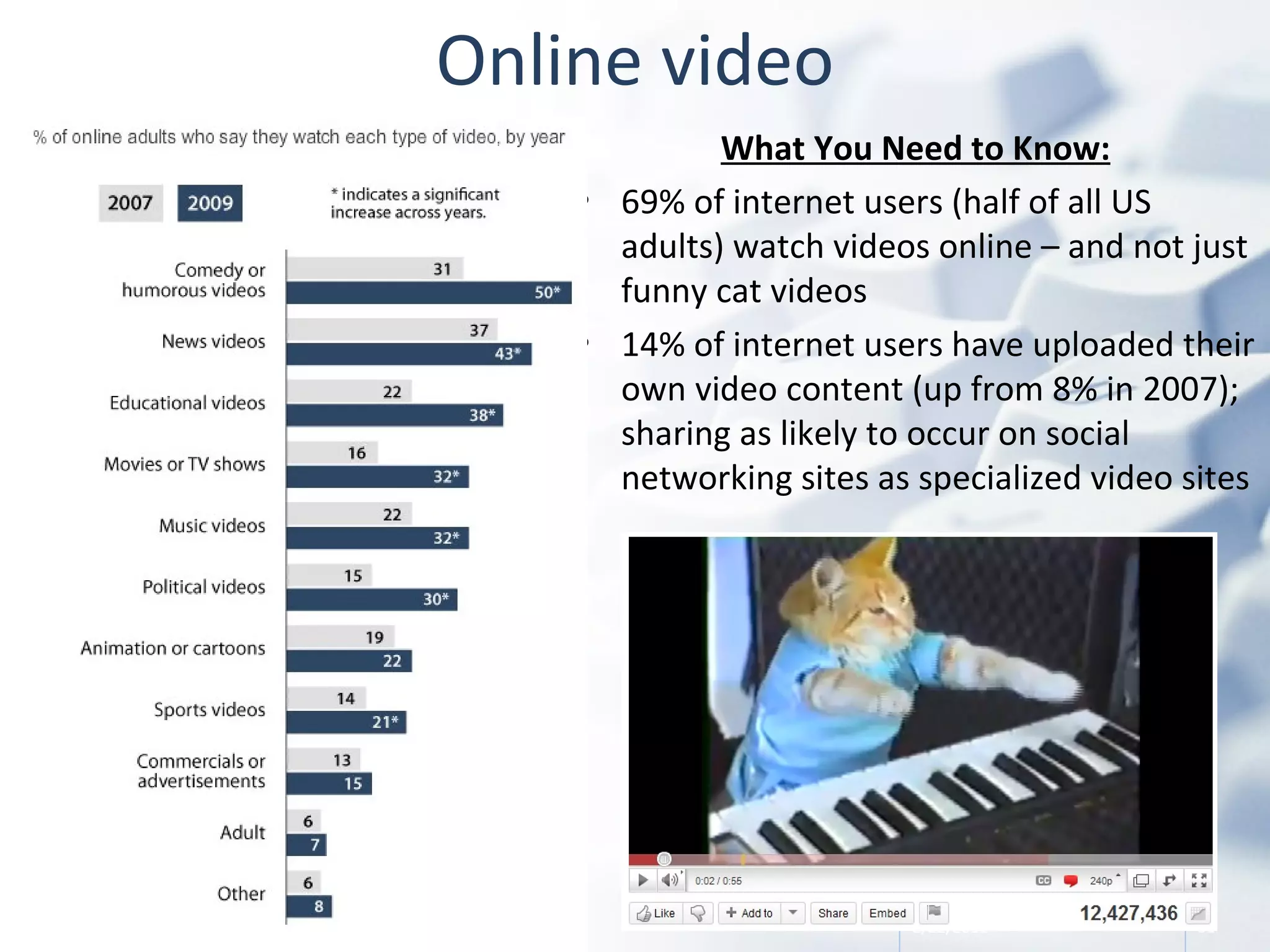
Online video 2/22/2011 What You Need to Know: 69% of internet users (half of all US adults) watch videos online – and not just funny cat videos 14% of internet users have uploaded their own video content (up from 8% in 2007); sharing as likely to occur on social networking sites as specialized video sites
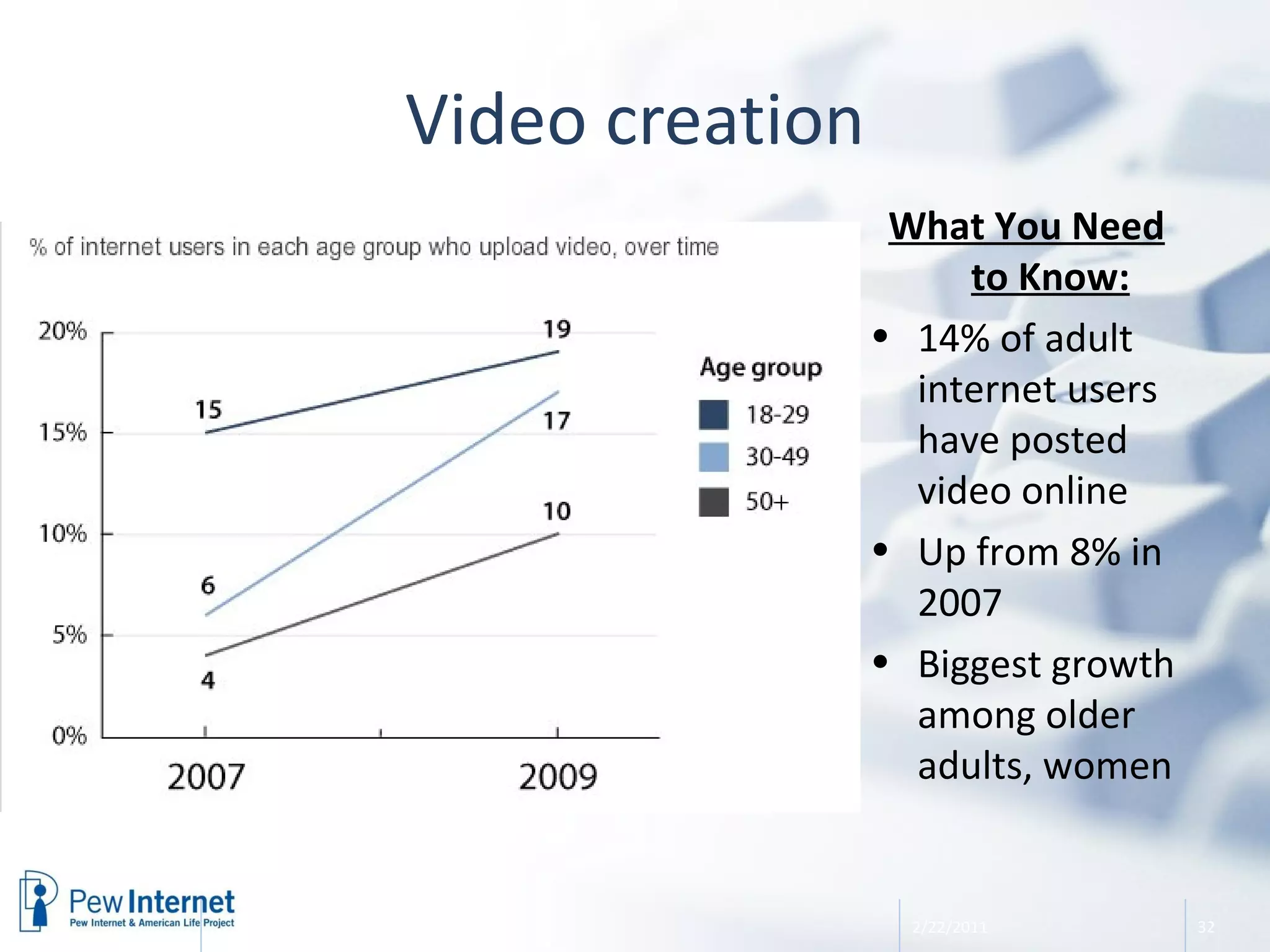
Video creation 2/22/2011 What You Need to Know: 14% of adult internet users have posted video online Up from 8% in 2007 Biggest growth among older adults, women
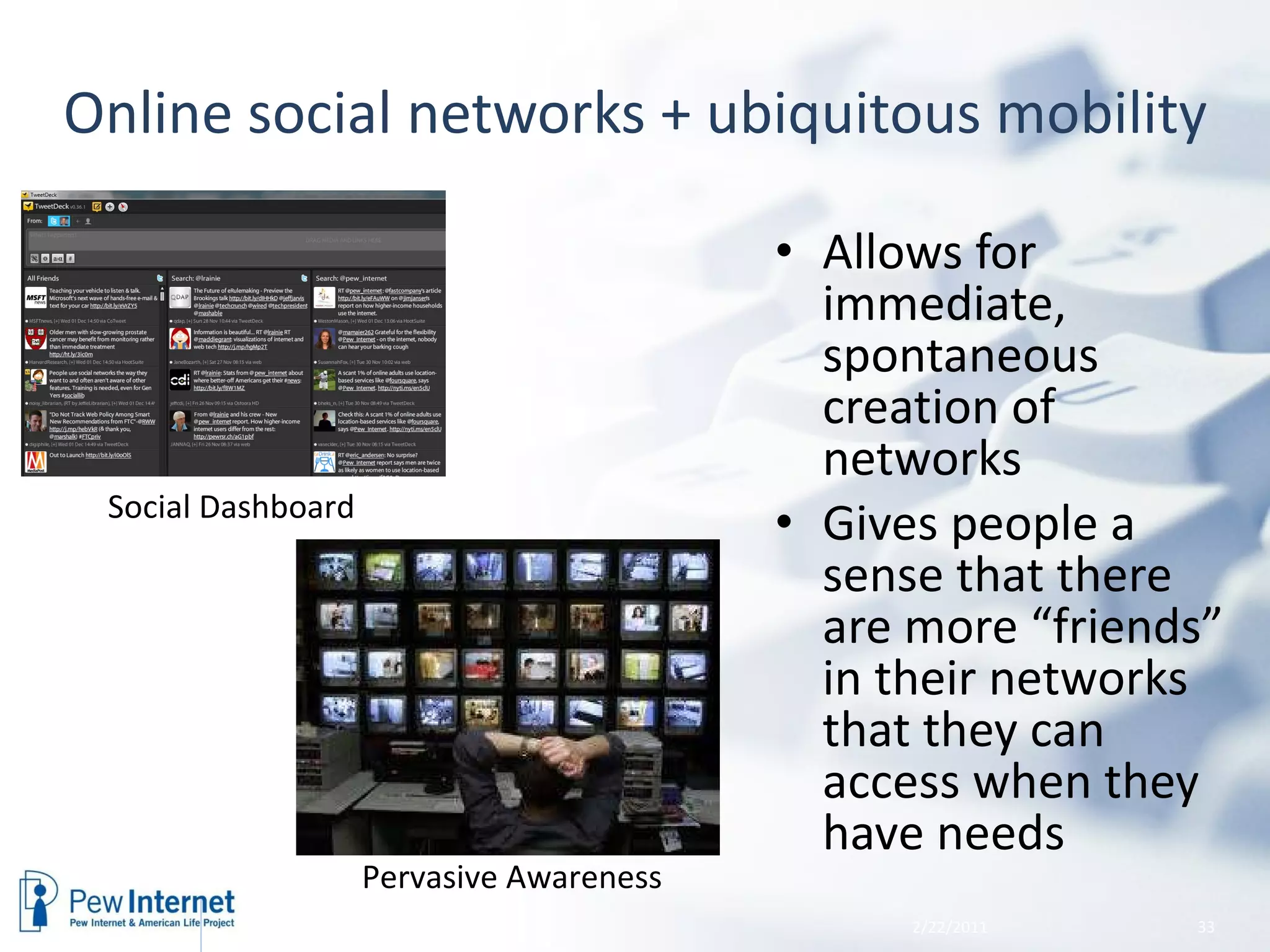
Online social networks + ubiquitous mobility Allows for immediate, spontaneous creation of networks Gives people a sense that there are more “friends” in their networks that they can access when they have needs 2/22/2011 Social Dashboard  Pervasive Awareness
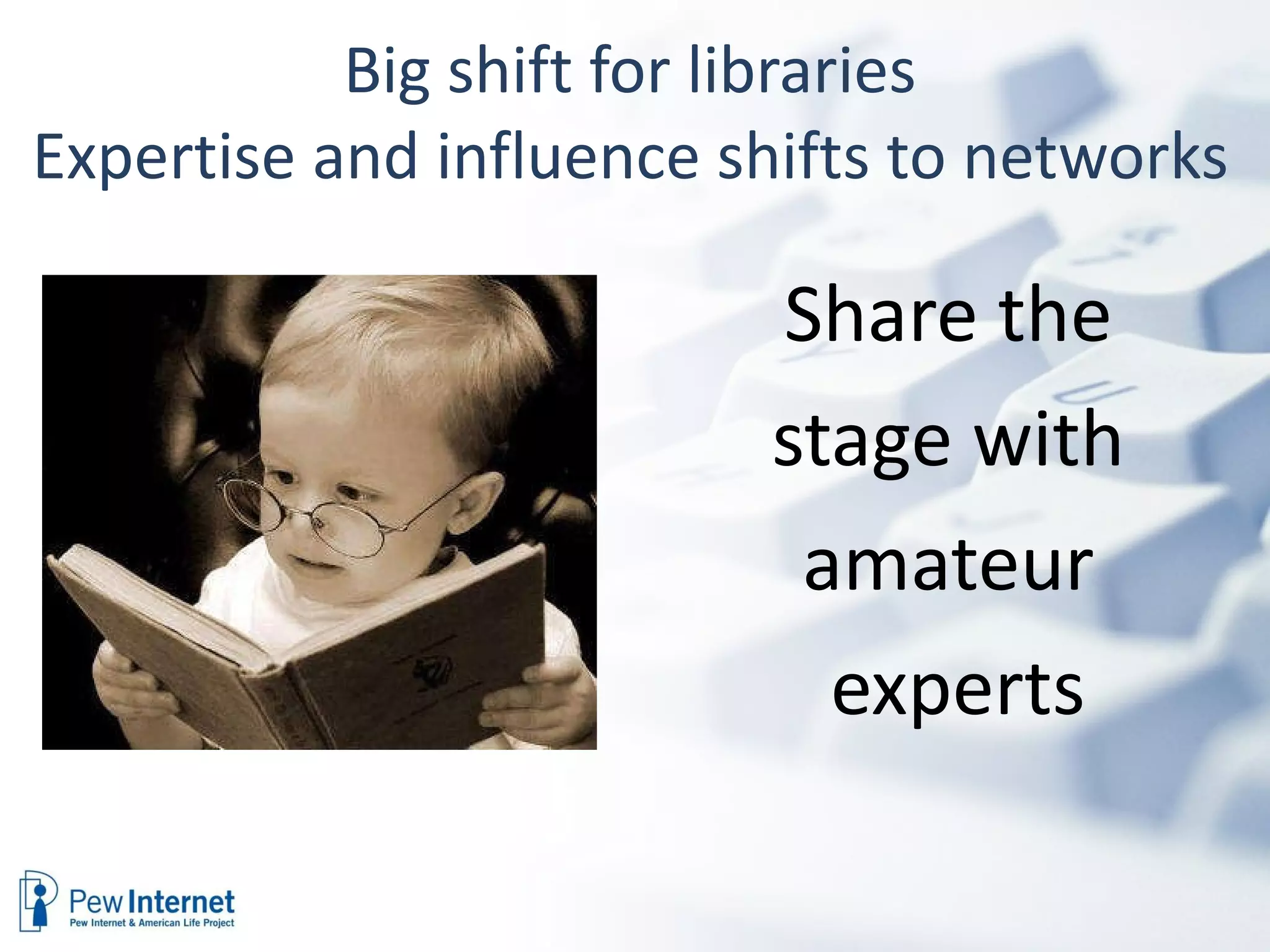
Big shift for libraries Expertise and influence shifts to networks Share the  stage with  amateur  experts
Big social networking add by libraries 1 - Can be embedded in …  Attention zones Continuous partial attention Deep dives Info-snacking Day dreaming??? Media zones Social streams Immersive  Creative / participatory Study / work
Big social networking by libraries 2 – Can be nodes in social networks As sentries – word of mouth matters more As information evaluators – they vouch for/discredit a business’s credibility and authenticity As forums for action – everybody’s a broadcaster/publisher
 
Cosmic social networking add by libraries 1 – Can be teachers of new literacies  - screen literacy - graphics and symbols - navigation literacy - connections and context literacy - skepticism - value of contemplative time - how to create content - ethical behavior in new world
Cosmic social networking add by libraries 2 – Can help fill in civic gaps - the big sort among institutions: public, private, non-profit reimagining roles - the big sort on news and information landscape - the big empowerment and move to networked individuals
Meta issue 1: The future of knowledge  How is it created?  How is it disseminated?
Meta issue 2: The future of reference expertise  How to you search for info? How to you assess it and aggregate it?
Meta issue 3: The future of  public   technology  What is the future  of knowledge “containers” and access points? What divides does that create? What “lending” and “access” models are possible?
Meta issue 4: The future of learning spaces What fosters collaboration? What is the role of solitary focus? (and quiet space?)
Meta issue 5: The future of community anchor institutions Does local matter? What does our community need?
Practical question - 1 What’s the franchise vs. commodity? What’s the aggregation play? Do what you do best and link to the rest
Practical question – 2  What’s the social networking play ? What alliances can we strike to do distributed versions of our mission? What’s the word-of-mouth, viral play?
Practical question - 3 What’s the mobile play?  How do we understand and exploit real-time information with our patrons?
Practical question - 4 What’s the gift economy play?   Another way to say it:  What’s the API  play? What can we pry loose that OTHERS can exploit? What feedback do we want from our stakeholders?
Practical question - 5 What’s the definition of success that is based on outcomes NOT outputs?  How do we measure it?
Key questions for any organization - 6  What’s the gamer play  – immersive, compelling, skills building
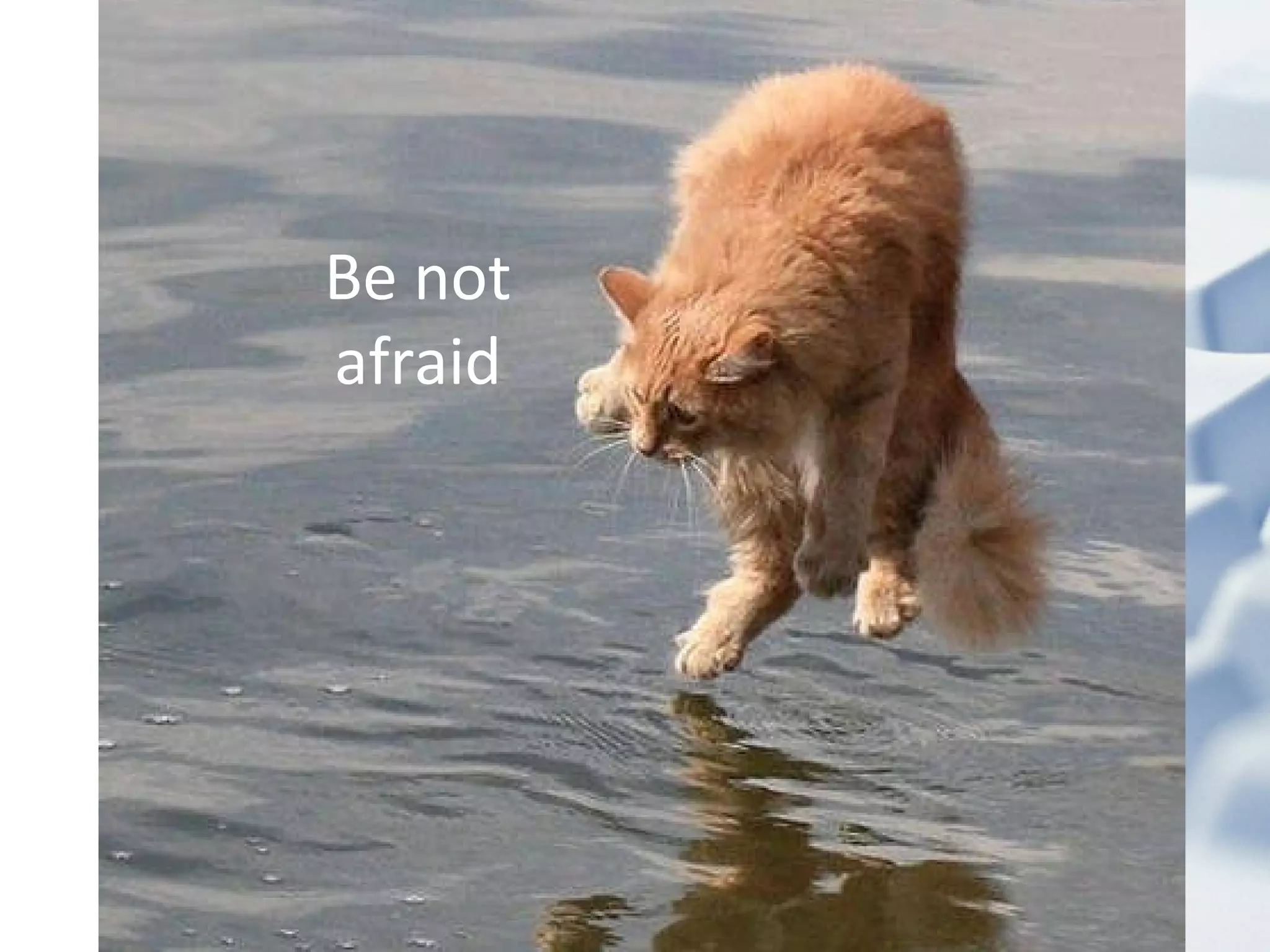
Be not afraid

The Networked Librarian: Libraries as social networks

  • 1.
    Libraries as socialnetworks Lee Rainie, Director, Pew Internet Project 5.6.11 San Francisco library system Email: [email_address] Twitter: @Lrainie
  • 2.
    The rise ofnetworked individuals Barry Wellman – University of Toronto (my co-author)
  • 3.
    New social operatingsystem (1): Networked Individualism Groups and bureaucracies give way to networks Social networks are more influential Social networks are differently composed Social networks are more vivid and tied to creation of information/media
  • 4.
    New social operatingsystem (2): New kinds of communities Explosion of group activity and group niches Rise of social posses Advent of just-in-time, just-like-me peer-to-peer (support) groups Fifth Estate of content contributors
  • 5.
    Revolution #1 Internet and Broadband
  • 6.
  • 7.
  • 8.
    Demographic factors correlatedw/ broadband adoption 10/5/2010 Trends in Home Broadband Adoption Positive correlation (in order of importance) Negative correlation (in order of importance) Household income of $75,000 or more per year Having high school degree or less College degree Senior citizen (age 65+) Parent with minor child at home Prefers speaking Spanish in our interviews Married or living with partner Disabled Employed full time African-American
  • 9.
    Consequences for infoecosystem Volume Velocity Vibrance Valence / Relevance
  • 10.
    Consequences for infoecosystem Explosion of creators and niches
  • 11.
    Networked creators amonginternet users 62% are social networking site users 55% share photos 33% create content tags 32% contribute rankings and ratings 30% share personal creations 26% post comments on sites and blogs 15% have personal website 15% are content remixers 14% are bloggers 12% use Twitter 4%-17%??? use location-sharing services
  • 12.
    Big challenge forlibraries Atoms bits Collections are disrupted
  • 13.
    Big socialnetworking add by libraries 1 – Cover access divides 44% of those living below the poverty line used library connections 61% of those ages 14-24 used them for school 54% of poor senior citizens used library connections for health/wellness needs 63% used library connections to help others Source: Opportunity for All, Univ. of Washingon, Gates Foundation, IMLS http://cis.washington.edu/usimpact/documents/OPP4ALL_FinalReport.pdf
  • 14.
    Big social networkingadd by libraries 2 – Cover participatory divides 2/3 of library connection users sought assistance from library staff 60% of library connectors use them for social purposes 42% for education purposes 40% for jobs/career purposes 37% health and wellness purposes 33% for community engagement Source: Opportunity for All, Univ. of Washingon, Gates Foundation, IMLS http://cis.washington.edu/usimpact/documents/OPP4ALL_FinalReport.pdf
  • 15.
    But there ismore libraries can do: Relevance & digital literacy are primary factors for not going online Source: Pew Internet Project, May 2010 tracking survey 10/5/2010 Trends in Home Broadband Adoption
  • 16.
    Revolution #2 Wireless Connectivity
  • 17.
    Cell phone owners– 85% adults 96 % 90% 85% 58% Urban-84% Suburban-86% Rural-77%
  • 18.
  • 19.
    Mobile internet connectors– 57% adults 62% 59% 55% Urban-60% Suburban-60% Rural-43%
  • 20.
    Demographic factors relatedto mobile connectivity 10/5/2010 Trends in Home Broadband Adoption Positive correlation Negative correlation College grad Less than high school education $75,000+ household income <$30,000 household income Parent of minor child Rural Republican ??? Spanish dominant in language preference
  • 21.
    Cell owners aredoing more with their phones than ever before 2/22/2011
  • 22.
    Cell phones associal tools % of cell owners 54% send photo or video 23% access a social networking site 20% watch a video 15% post a photo/video online 11% have purchased a product 11% charitable donation by text 10% status update service such as Twitter 2/22/2011
  • 23.
    85% use cellphones 35% have apps 24% use apps All adults May 2010 and Nov 2010 surveys 1 in 4 adults use apps
  • 24.
    55% of adultsown laptops – up from 30% in 2006 45% of adults own MP3 players – up from 11% in 2005 50% of adults own DVRs – up from 3% in 2002 42% of adults own game consoles 7% of adults own e-book readers - Kindle 7% of adults own tablet computer – iPad doubled in 6 months
  • 25.
    Consequences for infoecosystem Anywhere Any device Presence Place Any time Alone together
  • 26.
    Big challenge forlibraries People came to us We go to people The library as place becomes the library as placeless resource
  • 27.
    Big social networkingadd by libraries Help navigate and “make peace” with info Apps vs. web vs. traditional resource locators Access to real-time information Context of information – augmented reality Sanctuary – quiet space
  • 28.
  • 29.
    The social networkingpopulation is more diverse than you might think 2/22/2011 5x 5x 7x 5x
  • 30.
    Demographic factors correlatedw/ SNS use 10/5/2010 Trends in Home Broadband Adoption Positive correlation Negative correlation Under age 30 Senior citizen (age 65+) Female (overall) Male (frequency) Rural Parent with minor child at home Non-cell user Some college Disability Urban
  • 31.
    Online video 2/22/2011What You Need to Know: 69% of internet users (half of all US adults) watch videos online – and not just funny cat videos 14% of internet users have uploaded their own video content (up from 8% in 2007); sharing as likely to occur on social networking sites as specialized video sites
  • 32.
    Video creation 2/22/2011What You Need to Know: 14% of adult internet users have posted video online Up from 8% in 2007 Biggest growth among older adults, women
  • 33.
    Online social networks+ ubiquitous mobility Allows for immediate, spontaneous creation of networks Gives people a sense that there are more “friends” in their networks that they can access when they have needs 2/22/2011 Social Dashboard Pervasive Awareness
  • 34.
    Big shift forlibraries Expertise and influence shifts to networks Share the stage with amateur experts
  • 35.
    Big social networkingadd by libraries 1 - Can be embedded in … Attention zones Continuous partial attention Deep dives Info-snacking Day dreaming??? Media zones Social streams Immersive Creative / participatory Study / work
  • 36.
    Big social networkingby libraries 2 – Can be nodes in social networks As sentries – word of mouth matters more As information evaluators – they vouch for/discredit a business’s credibility and authenticity As forums for action – everybody’s a broadcaster/publisher
  • 37.
  • 38.
    Cosmic social networkingadd by libraries 1 – Can be teachers of new literacies - screen literacy - graphics and symbols - navigation literacy - connections and context literacy - skepticism - value of contemplative time - how to create content - ethical behavior in new world
  • 39.
    Cosmic social networkingadd by libraries 2 – Can help fill in civic gaps - the big sort among institutions: public, private, non-profit reimagining roles - the big sort on news and information landscape - the big empowerment and move to networked individuals
  • 40.
    Meta issue 1:The future of knowledge How is it created? How is it disseminated?
  • 41.
    Meta issue 2:The future of reference expertise How to you search for info? How to you assess it and aggregate it?
  • 42.
    Meta issue 3:The future of public technology What is the future of knowledge “containers” and access points? What divides does that create? What “lending” and “access” models are possible?
  • 43.
    Meta issue 4:The future of learning spaces What fosters collaboration? What is the role of solitary focus? (and quiet space?)
  • 44.
    Meta issue 5:The future of community anchor institutions Does local matter? What does our community need?
  • 45.
    Practical question -1 What’s the franchise vs. commodity? What’s the aggregation play? Do what you do best and link to the rest
  • 46.
    Practical question –2 What’s the social networking play ? What alliances can we strike to do distributed versions of our mission? What’s the word-of-mouth, viral play?
  • 47.
    Practical question -3 What’s the mobile play? How do we understand and exploit real-time information with our patrons?
  • 48.
    Practical question -4 What’s the gift economy play? Another way to say it: What’s the API play? What can we pry loose that OTHERS can exploit? What feedback do we want from our stakeholders?
  • 49.
    Practical question -5 What’s the definition of success that is based on outcomes NOT outputs? How do we measure it?
  • 50.
    Key questions forany organization - 6 What’s the gamer play – immersive, compelling, skills building
  • 51.

Editor's Notes

  • #2 Title: Libraries as social networks Subject: Lee Rainie, Director of the Pew Research Center&apos;s Internet &amp; American Life Project, will discuss the latest research findings of the Project about how Americans use the internet and cell phones. He will describe how libraries can be actors in building and participating in social networks through their use of social media such as Facebook, Twitter, and blogging and through delivering their time-tested -- and trusted -- services to their patrons.
  • #8 Rise of broadband at home was transformative – internet becomes a central info and communications hub in the home after the switch from dial-up. People do more stuff online; privilege the internet over other info sources in many cases; report better outcomes from internet use, and, most importantly become content creators. Two thirds of adults and 80% of teens are content creators. This is the big change the internet has introduced to media landscape. Probably take a minute to say this.
  • #10 The info ecology changes thanks to rise of internet/broadband. Volume of information rises 20-30% per year. Never had anything close to this in human history. Velocity of information increases, especially in groups. Personally relevant news speeds up as people customize personal feeds, alerts, listservs, group communications. Vibrance of information/media increases as bandwidth increases and computing power grows so media experiences become more immersive and compelling Valence/relevance of information grows in the era of the “Daily Me” and “Daily Us” and custom feeds. 2 mins
  • #11 Perhaps biggest change in info ecology is the democratization of media – and proliferation of niches. The Long Tail becomes reality for media and brands.
  • #12 This is the way Pew Internet measures content creation….
  • #24 9% of cell phone users have software applications or “apps” on their phones that help them track or manage their health. Some 15% of those ages 18-29 have such apps.
  • #26 The change wrought by mobile is that people are perpetually connected and pervasively available. It means that media and people are available anywhere with any device on any of three screens. Quick tout of Nielsen 3-Screen research (unless you want to do that) and how this shifts the venues and times of people’s encounters with media. Consumers run the playlist now, not the media companies. This changes people’s sense of place (and placelessness) and present. They can be with any one at any time and this creates the reality of “absent presence”.
  • #37 In the challenging new media ecosystem – as more information comes at them from more sources at ever-greater speeds – people cope with the change by relying more and more on their social networks. There are three important ways they do that. The first is that they rely on their networks to act as their “alert” system – sentries. We hear from more and more people who begin and end their days by checking in with their social networks to see what’s new, what’s worth viewing, what’s most enjoyable in media spaces.