How libraries can survive  in the new media ecosystem Lee Rainie – Director Pew Internet Project HELIN Library Consortium  Bryant University January 14, 2009
 
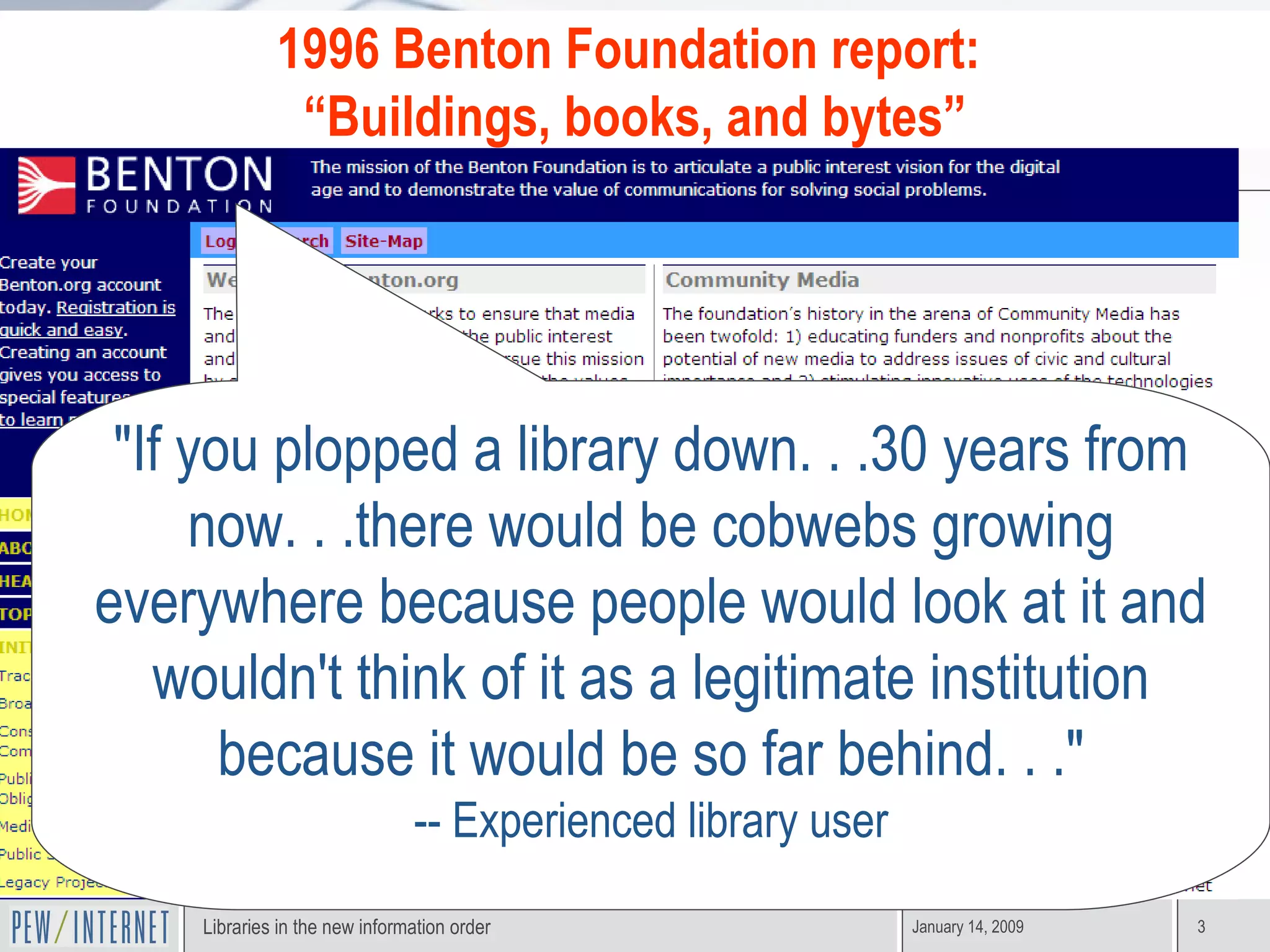
"If you plopped a library down. . .30 years from now. . .there would be cobwebs growing everywhere because people would look at it and wouldn't think of it as a legitimate institution because it would be so far behind. . ." -- Experienced library user 1996 Benton Foundation report:  “ Buildings, books, and bytes”
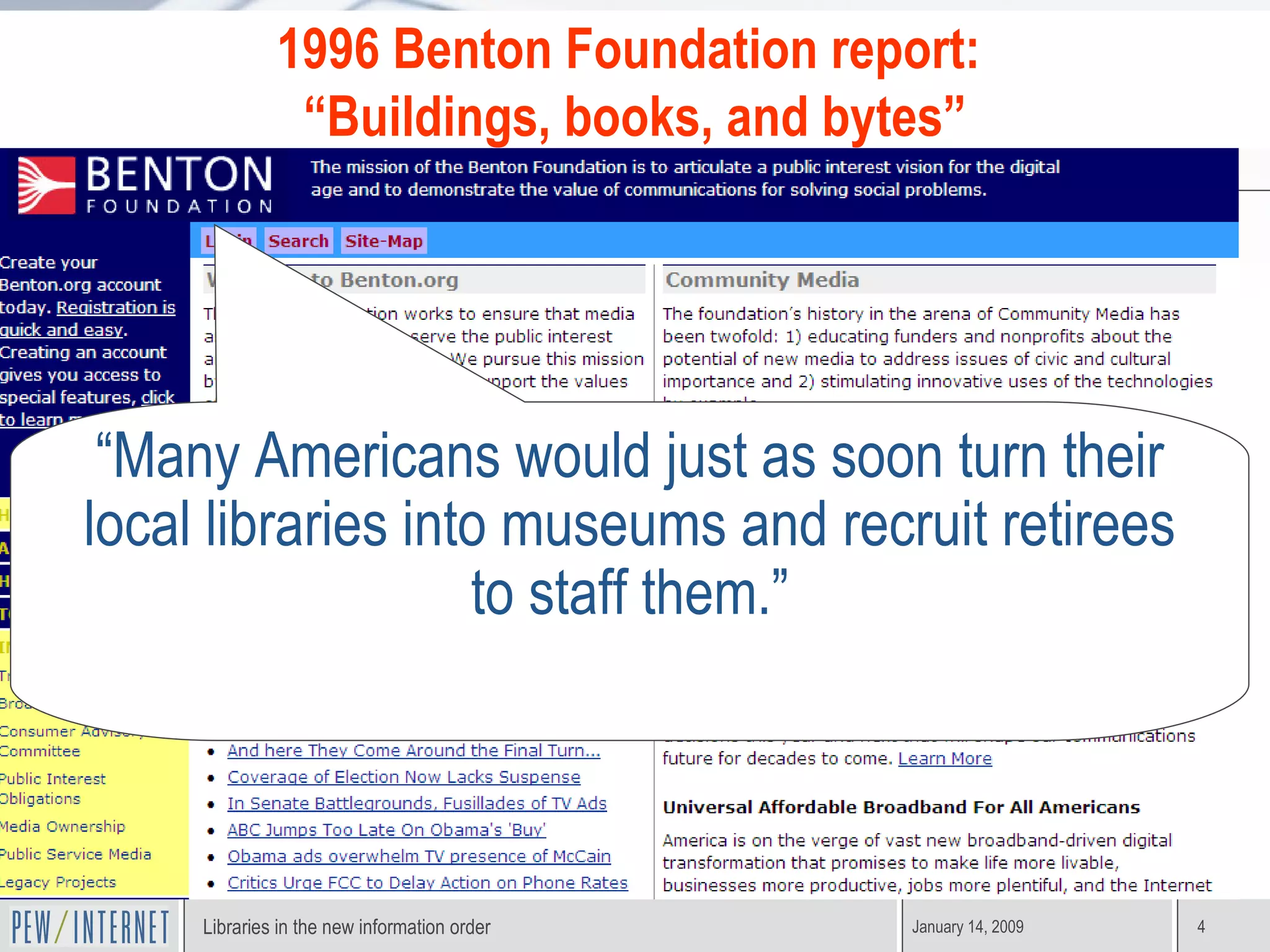
“ Many Americans would just as soon turn their local libraries into museums and recruit retirees to staff them.” 1996 Benton Foundation report:  “ Buildings, books, and bytes”
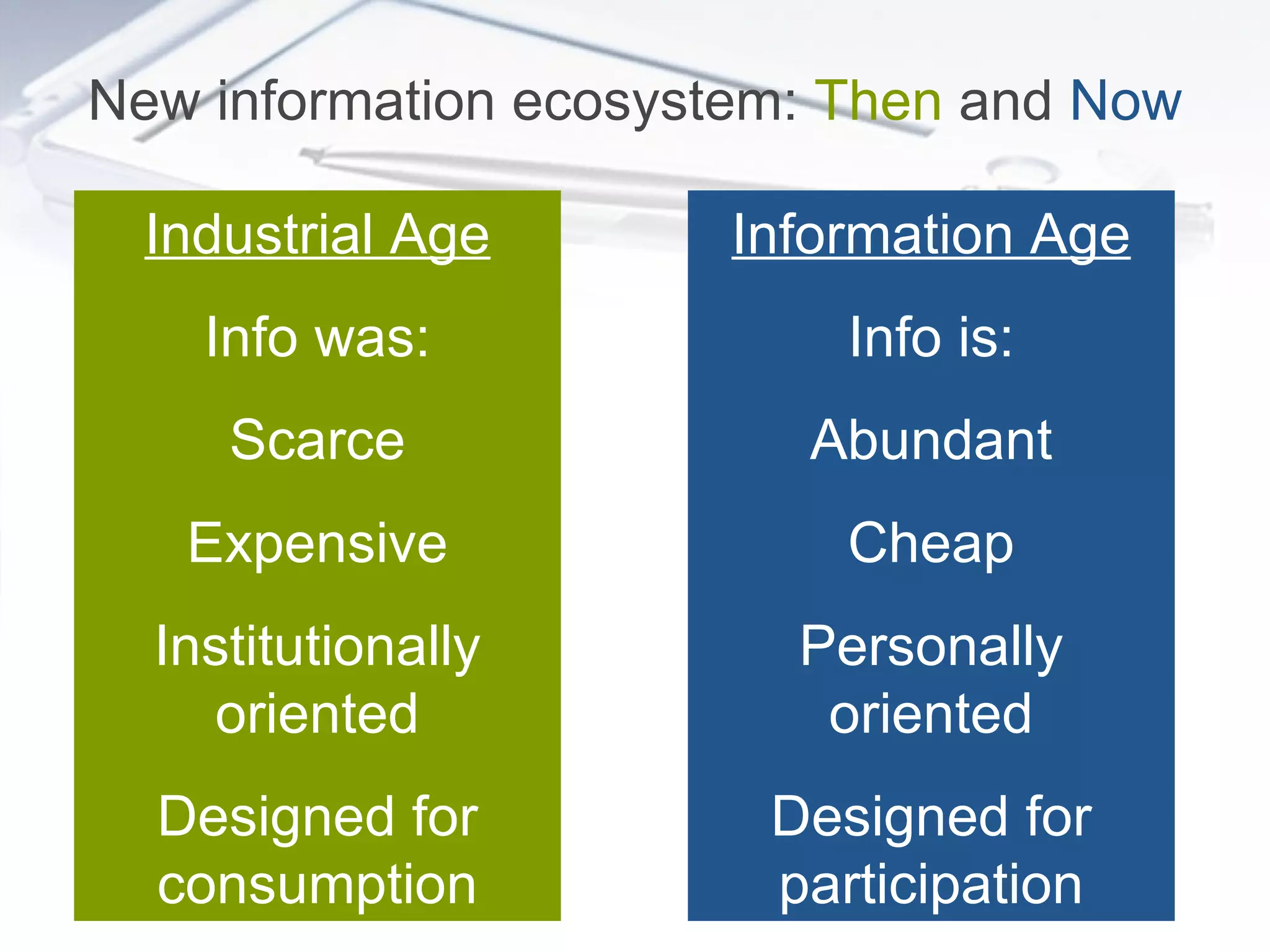
New information ecosystem:  Then   and  Now Industrial Age Info was: Scarce Expensive Institutionally oriented Designed for consumption Information Age Info is: Abundant Cheap Personally oriented Designed for participation
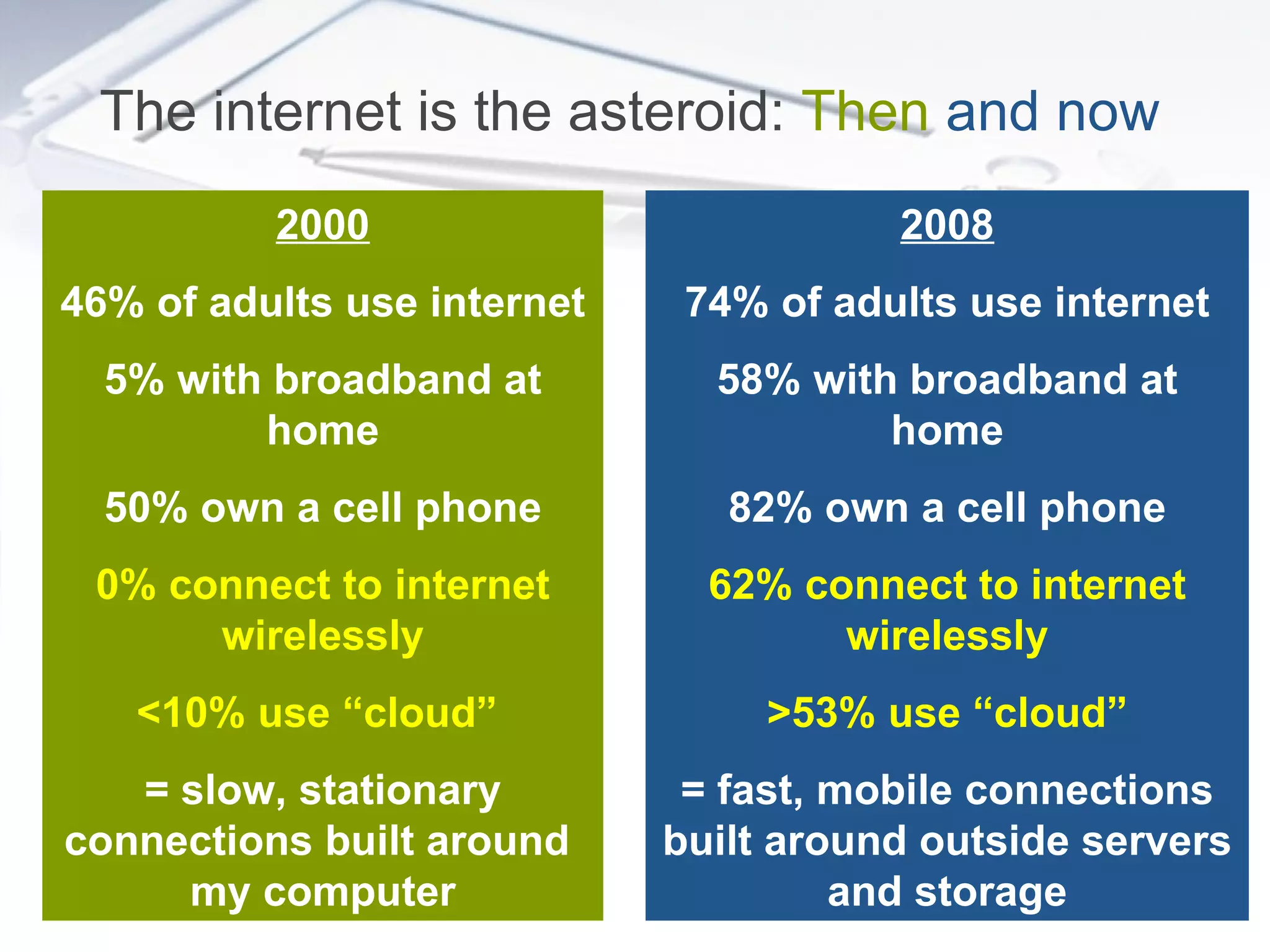
2000 46% of adults use internet 5% with broadband at home 50% own a cell phone 0% connect to internet wirelessly <10% use “cloud”  = slow, stationary connections built around  my computer 2008 74% of adults use internet 58% with broadband at home 82% own a cell phone 62% connect to internet wirelessly >53% use “cloud” = fast, mobile connections built around outside servers and storage The internet is the asteroid:  Then   and now
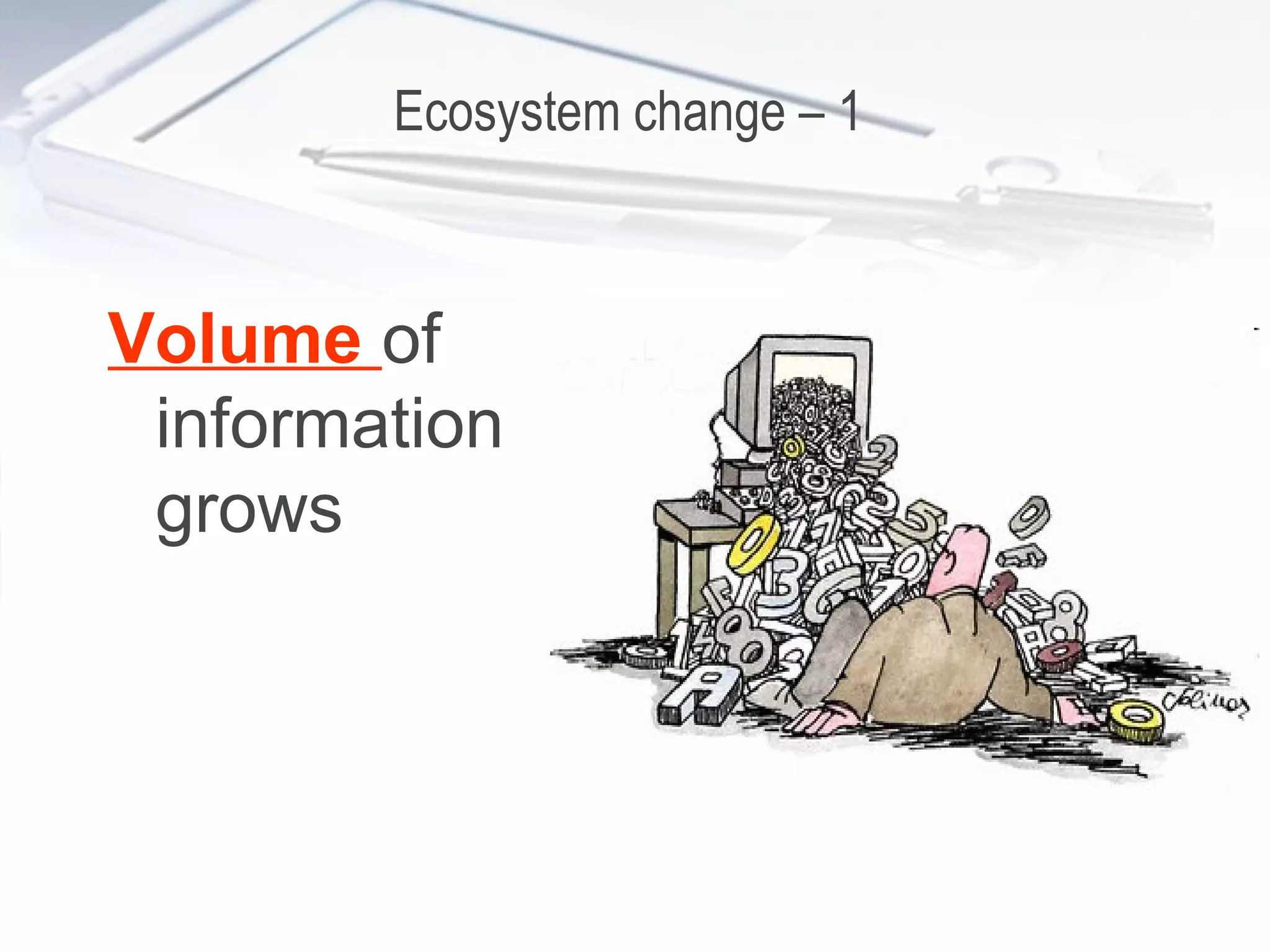
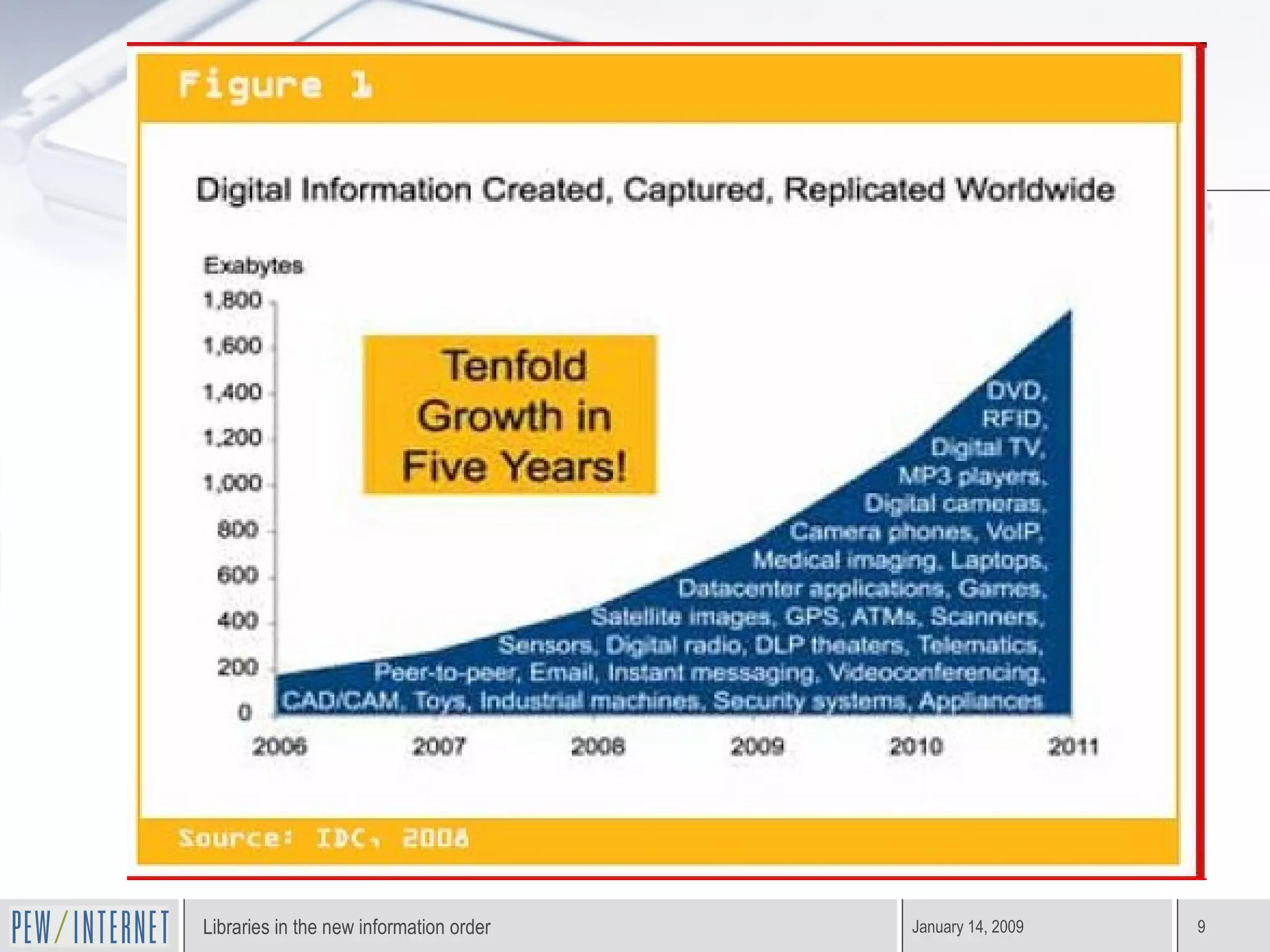
Ecosystem change – 1  Volume  of information grows
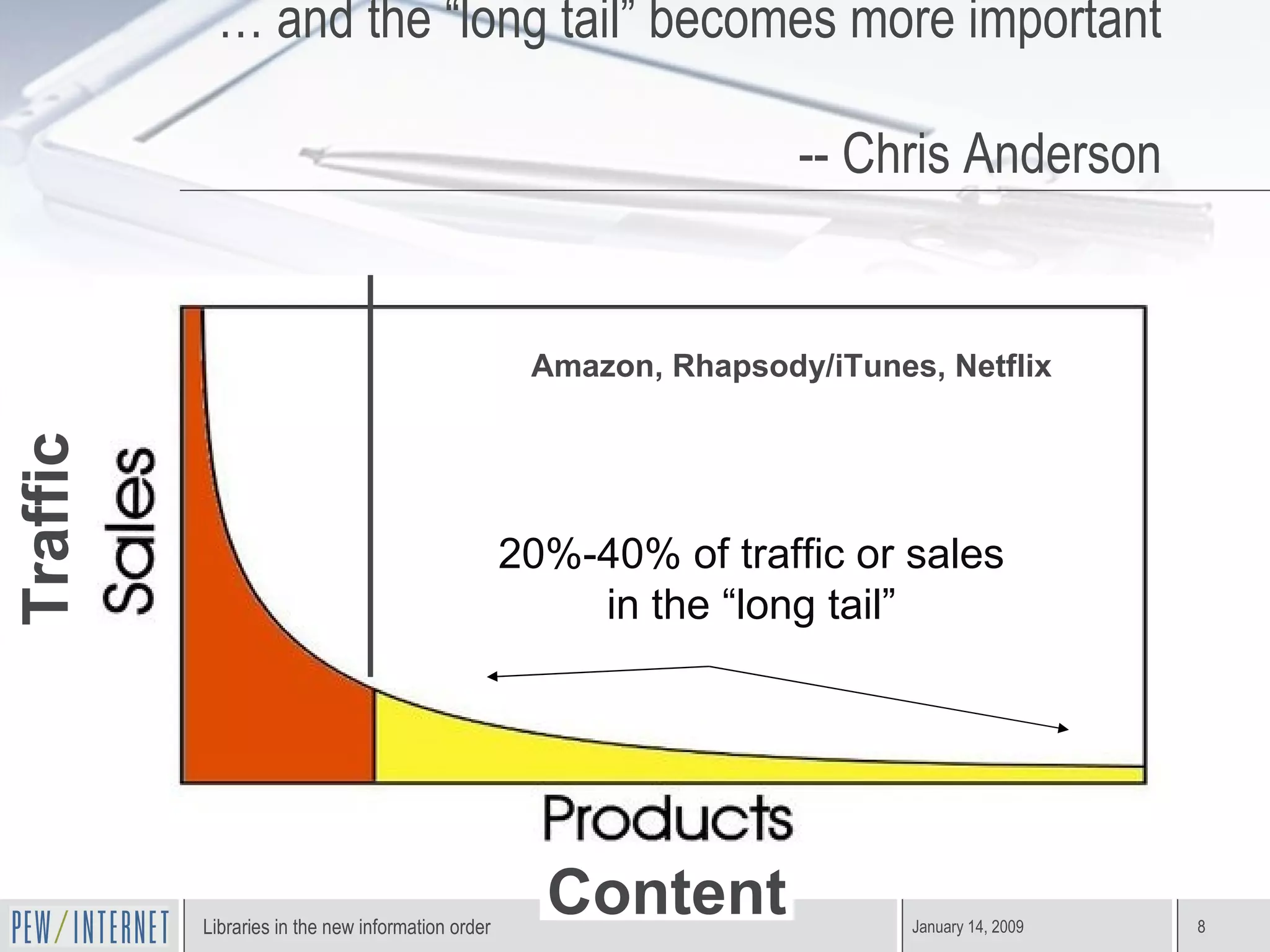
… and the “long tail” becomes more important  -- Chris Anderson Traffic Content 20%-40% of traffic or sales in the “long tail” Amazon, Rhapsody/iTunes, Netflix
 
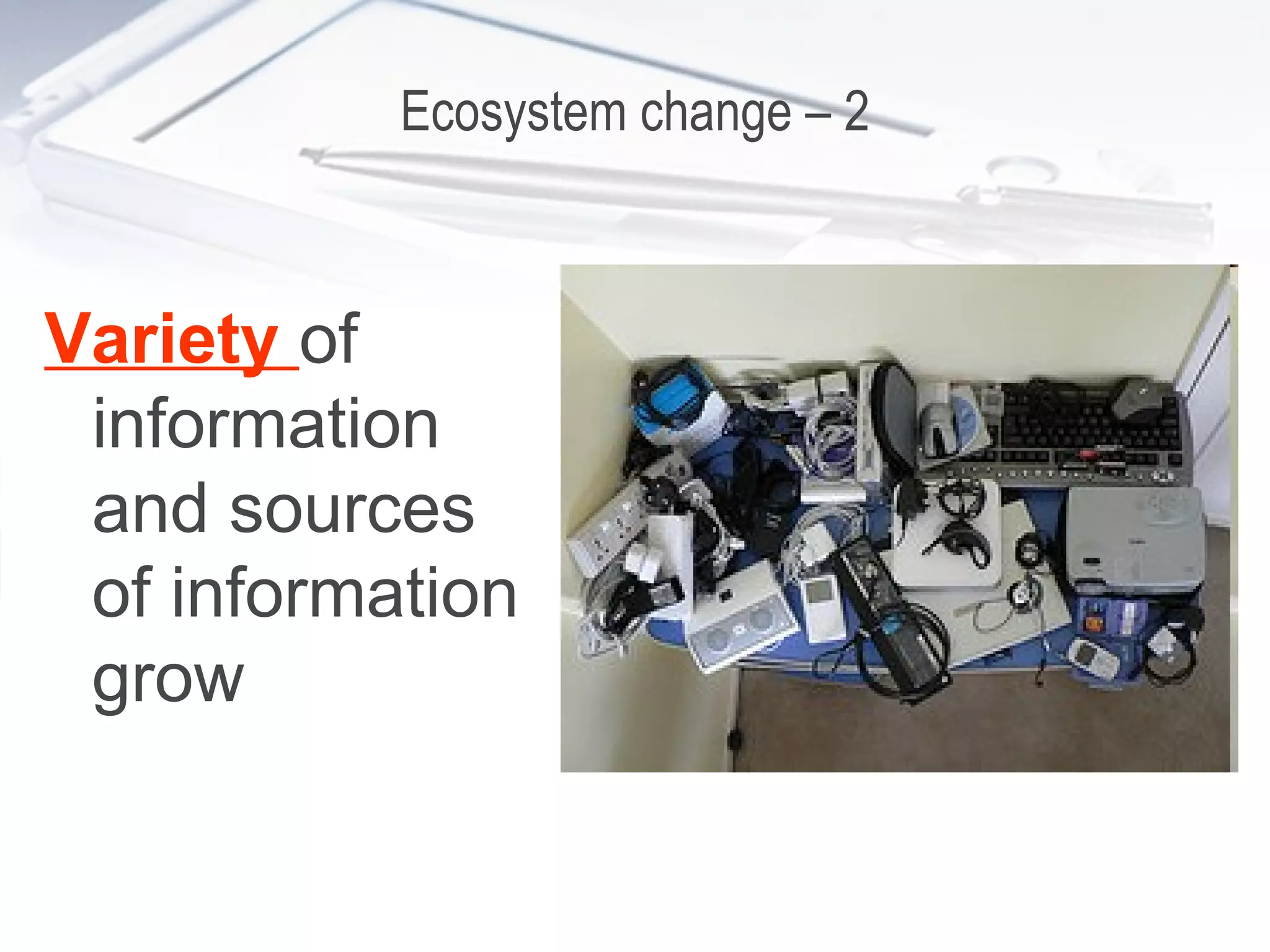
Ecosystem change – 2 Variety  of information and sources of information grow
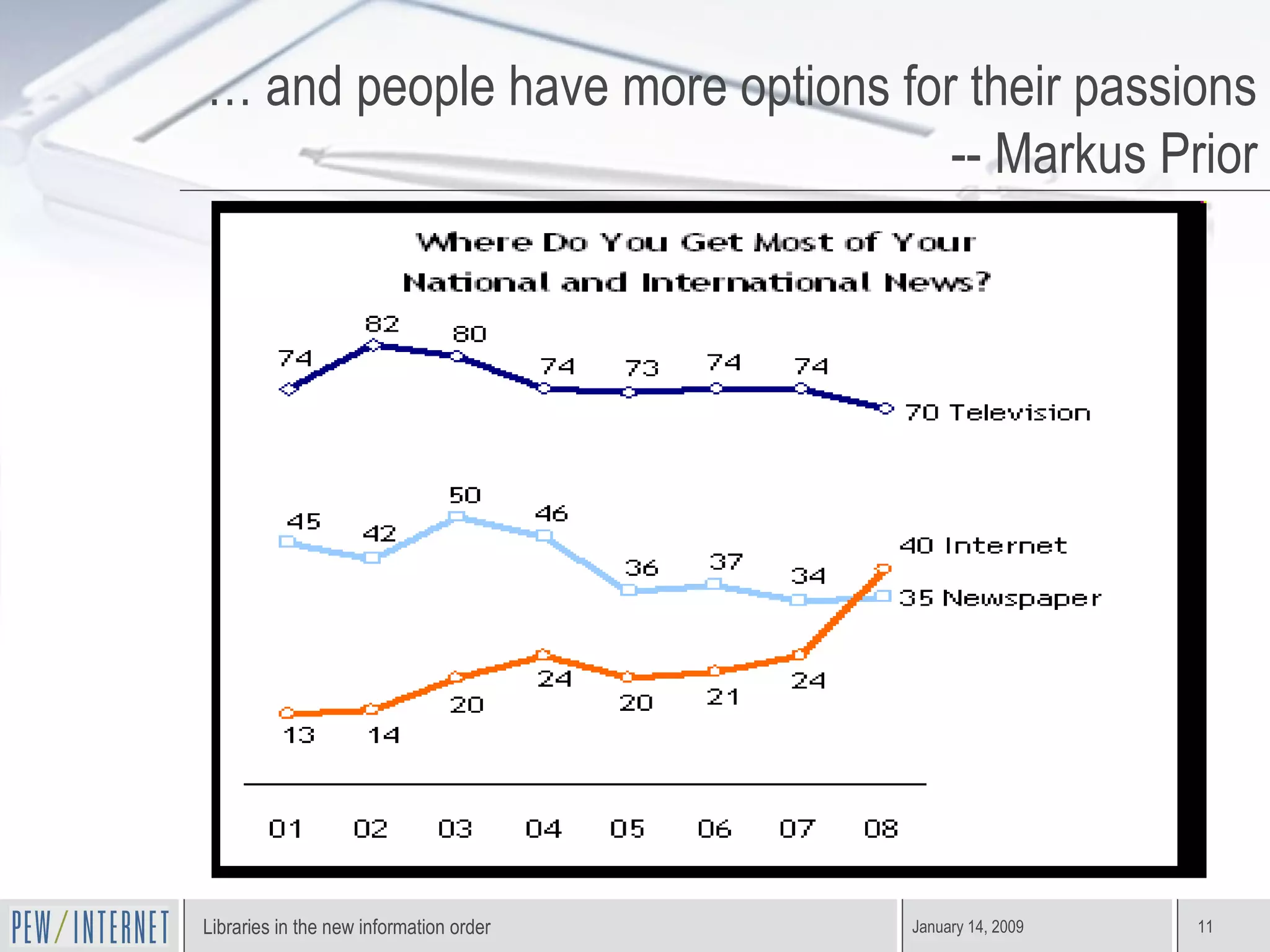
… and people have more options for their passions -- Markus Prior
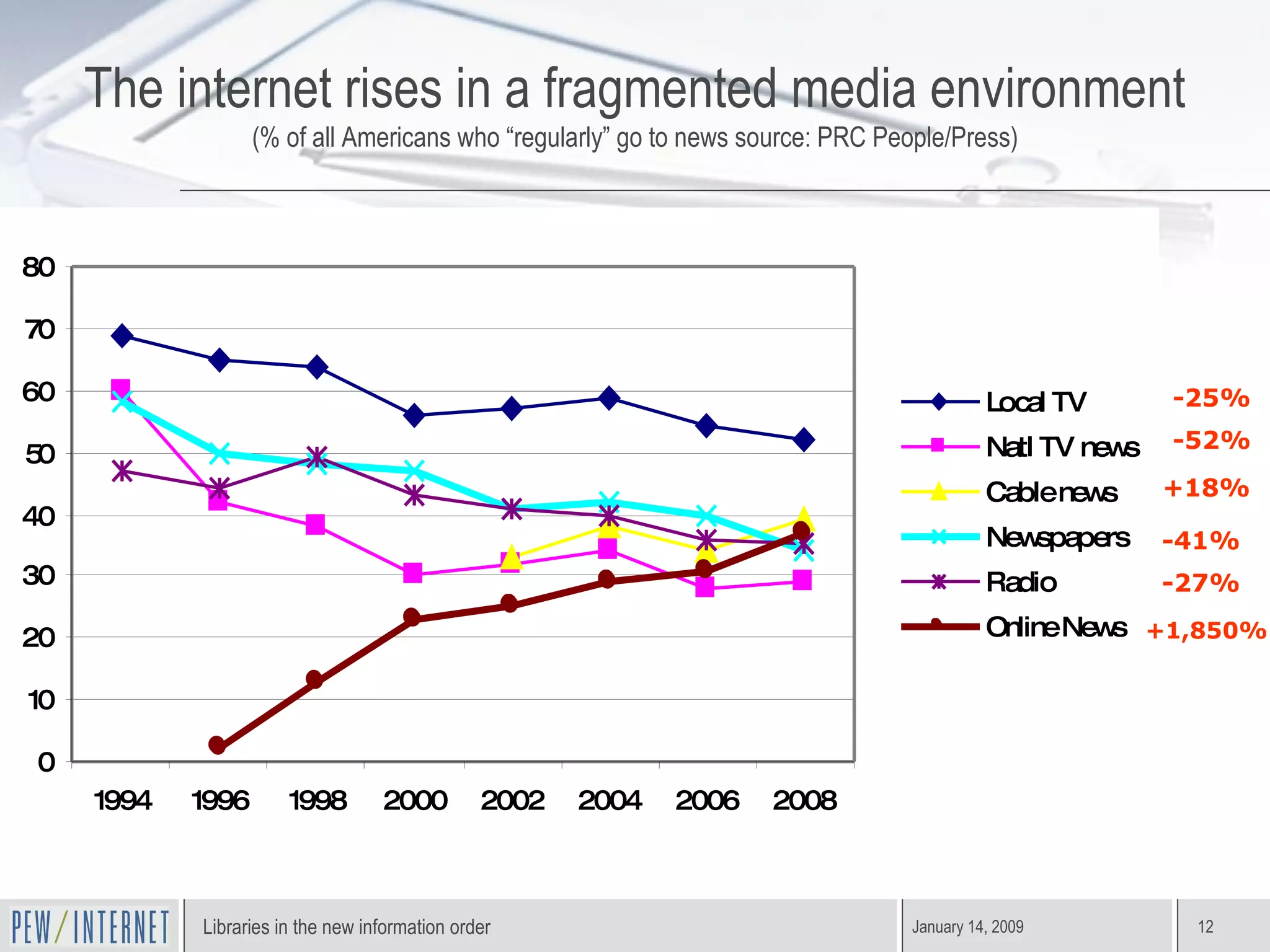
The internet rises in a fragmented media environment (% of all Americans who “regularly” go to news source: PRC People/Press) +1,850% -25% -52% +18% -41% -27%
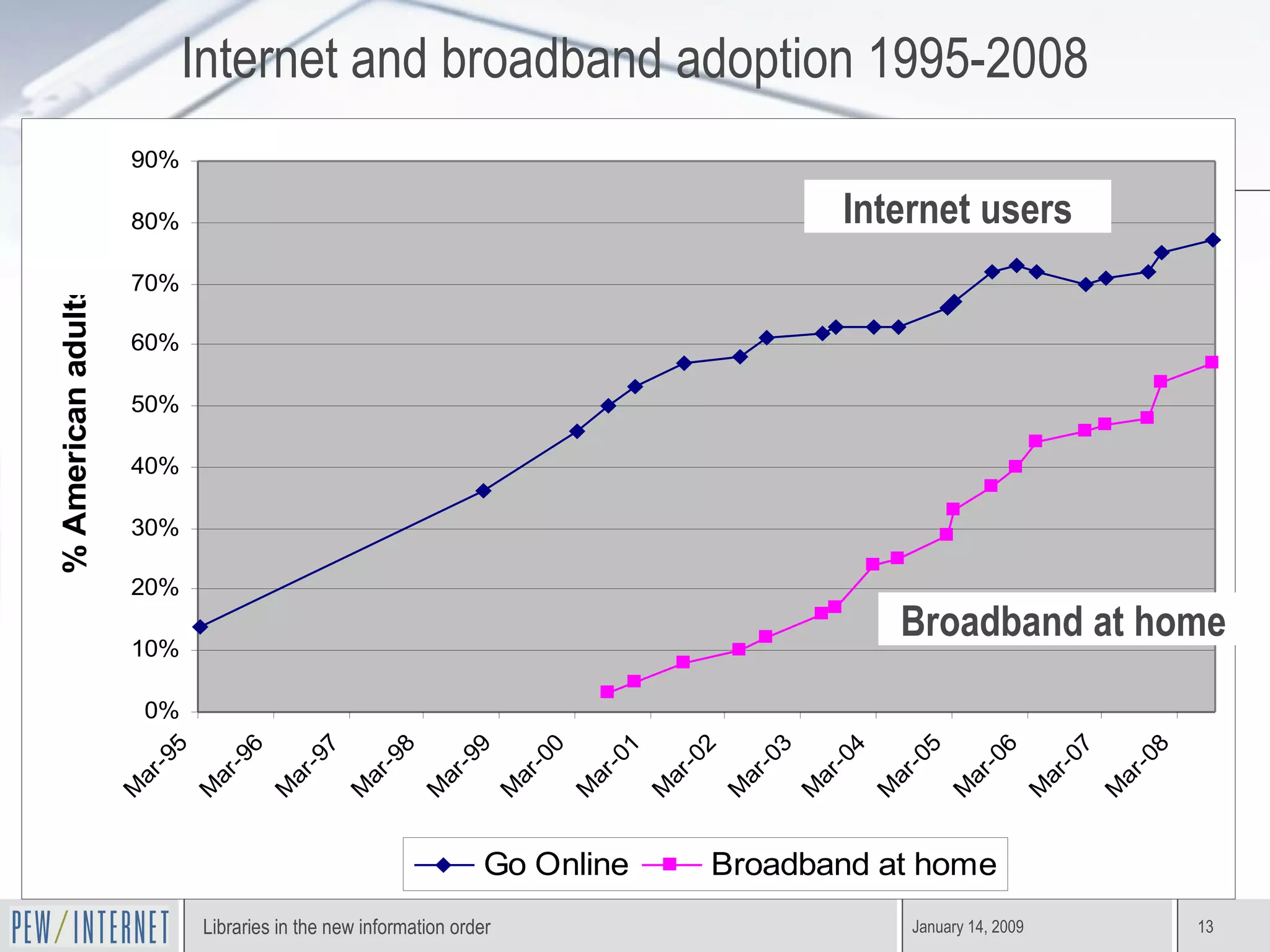
Internet and broadband adoption 1995-2008 Internet users Broadband at home
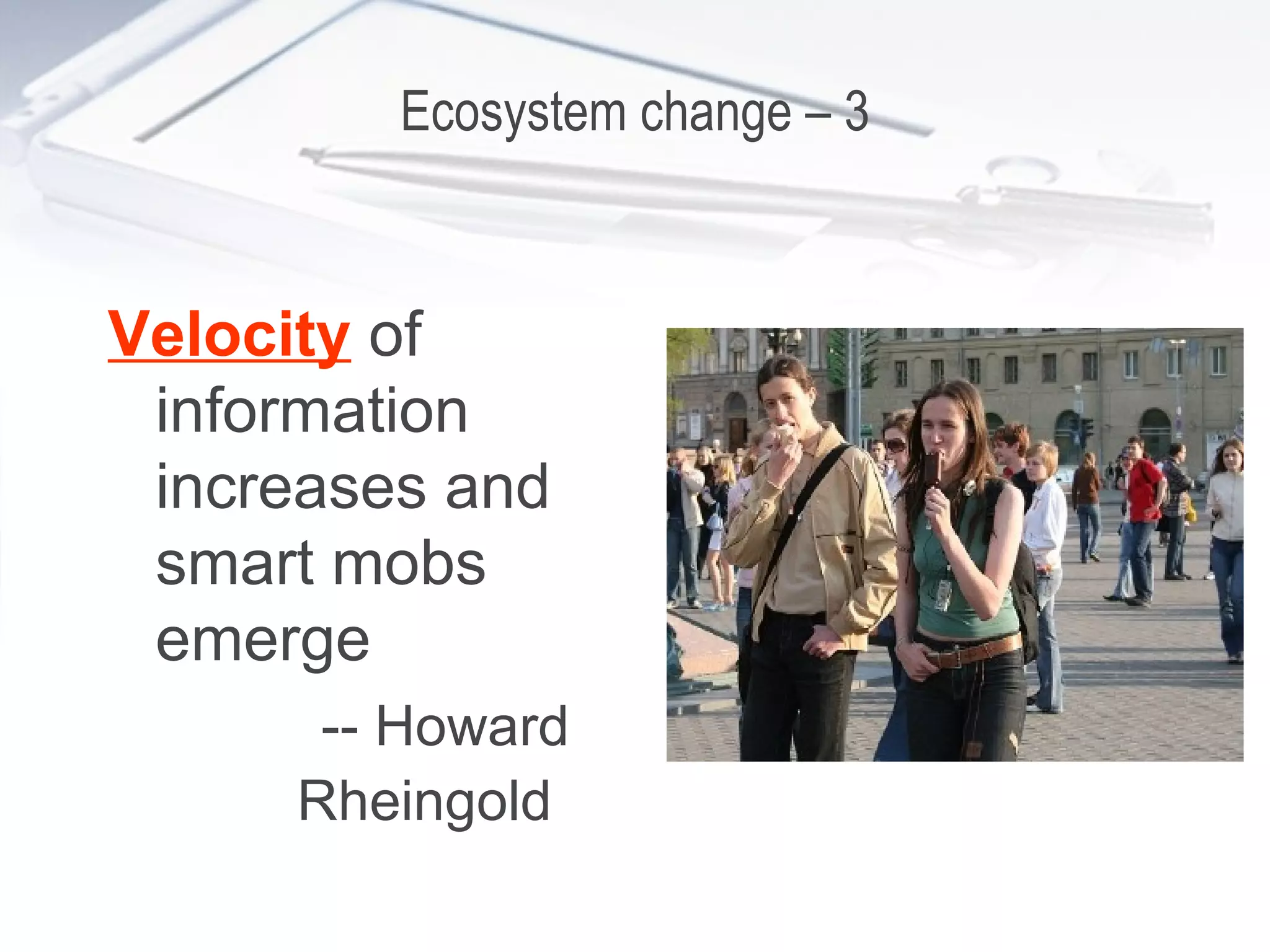
Ecosystem change – 3 Velocity  of information increases and smart mobs emerge -- Howard Rheingold
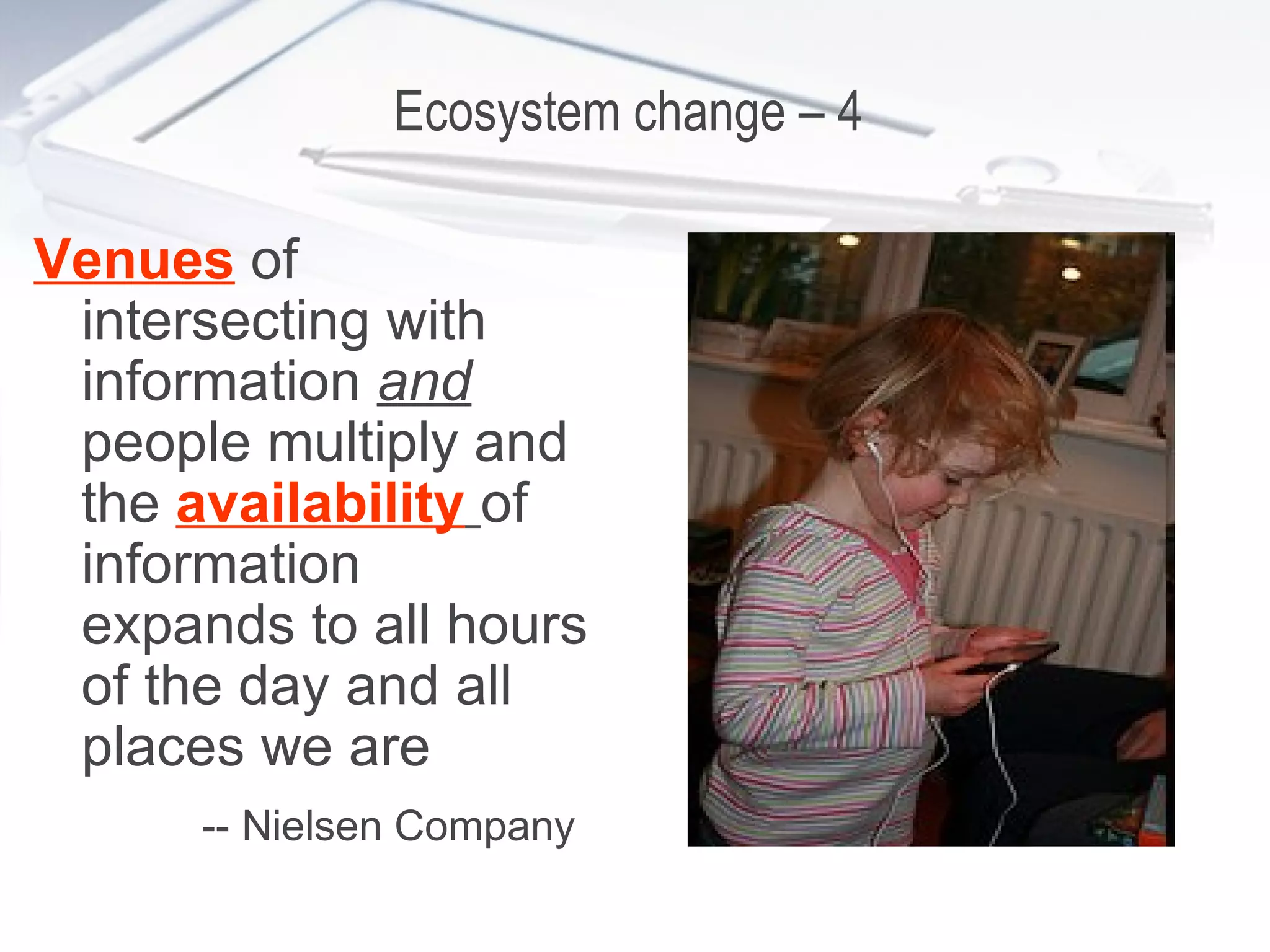
Ecosystem change – 4  Venues  of intersecting with information  and   people multiply and the  availability   of information expands to all hours of the day and all places we are -- Nielsen Company
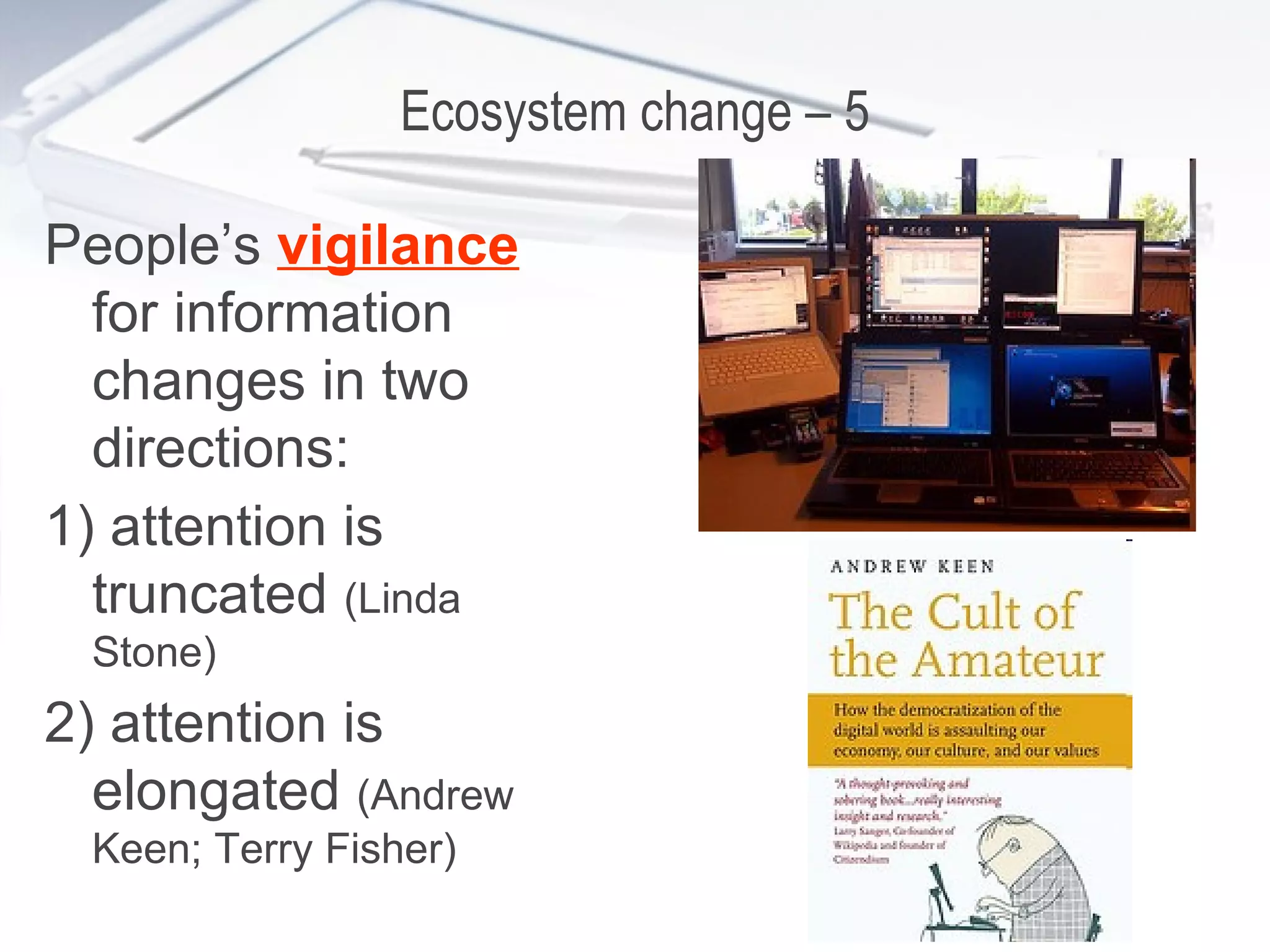
Ecosystem change – 5 People’s  vigilance  for information changes in two directions: 1) attention is truncated  (Linda Stone) 2) attention is elongated  (Andrew Keen; Terry Fisher)
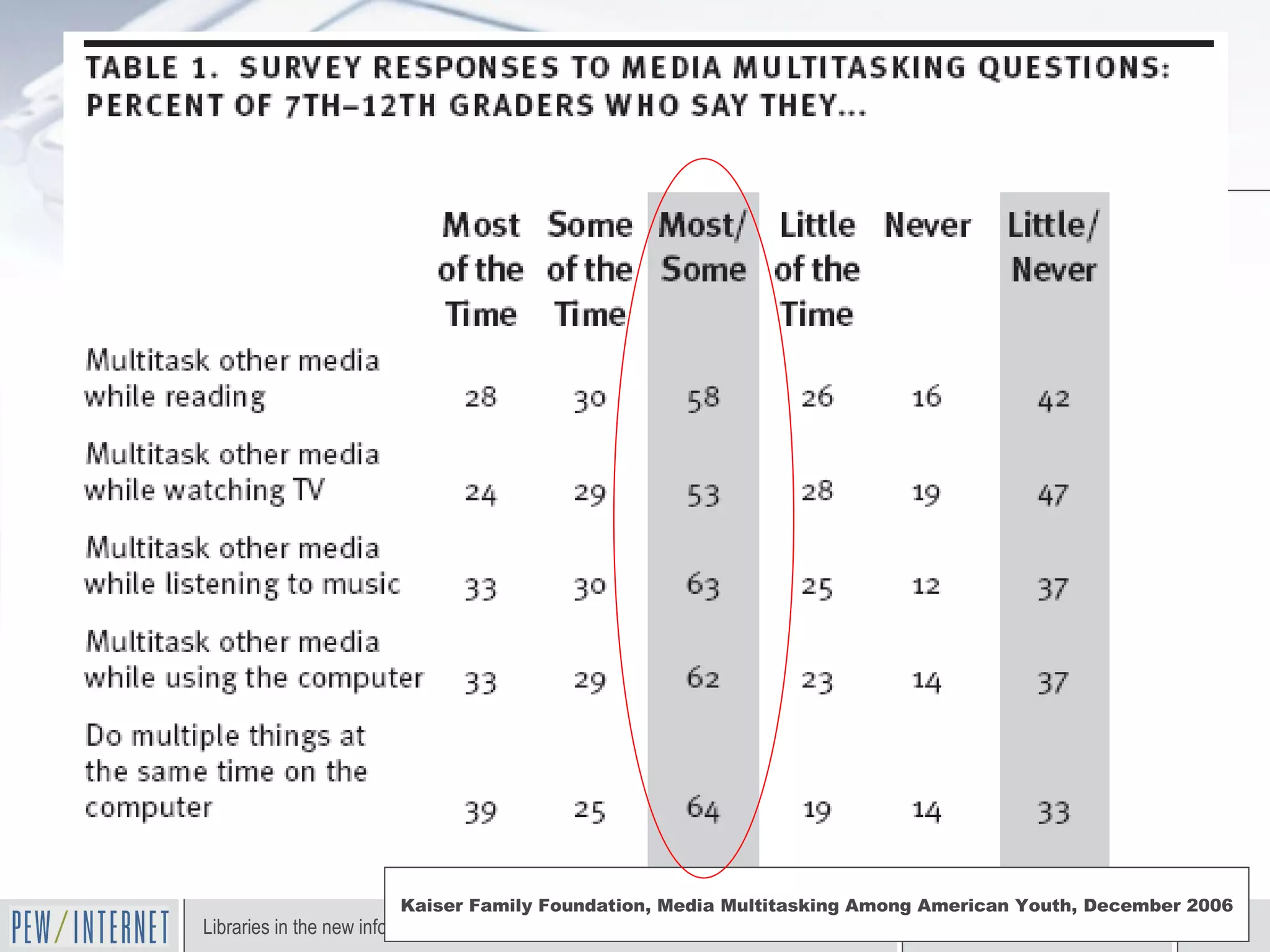
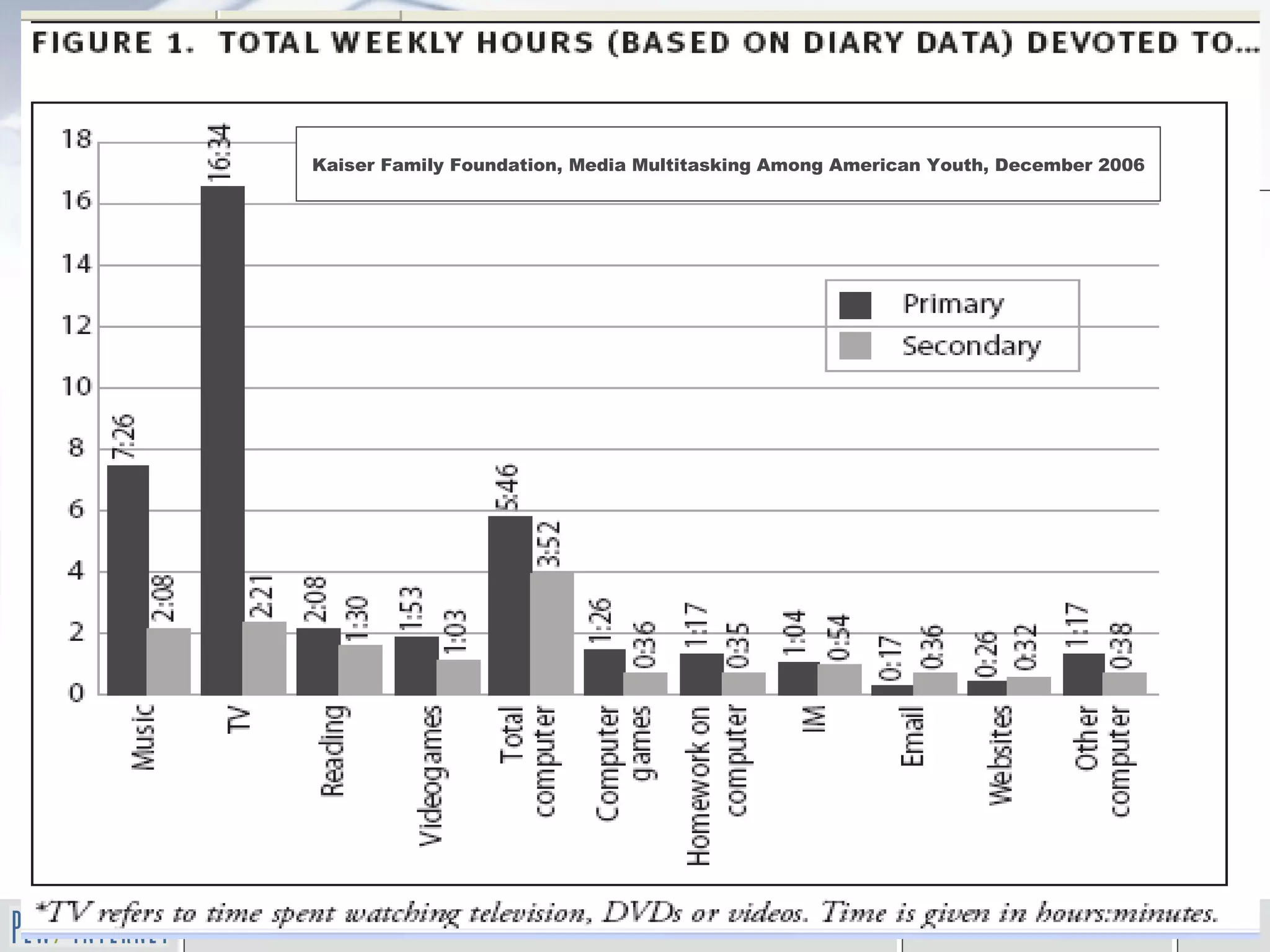
Kaiser Family Foundation, Media Multitasking Among American Youth, December 2006
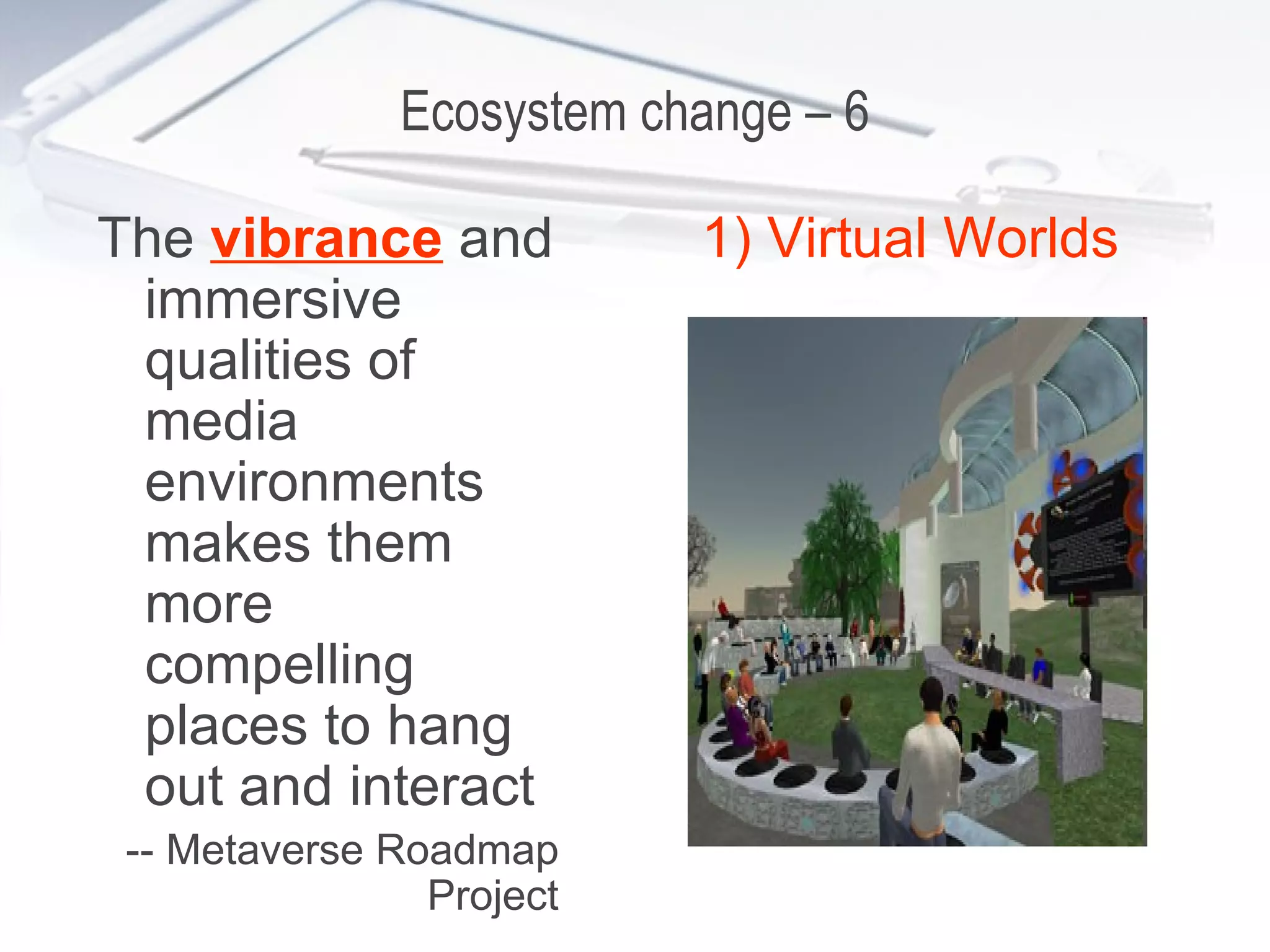
Ecosystem change – 6 The  vibrance  and immersive qualities of media environments makes them more compelling places to hang out and interact -- Metaverse Roadmap Project 1) Virtual Worlds
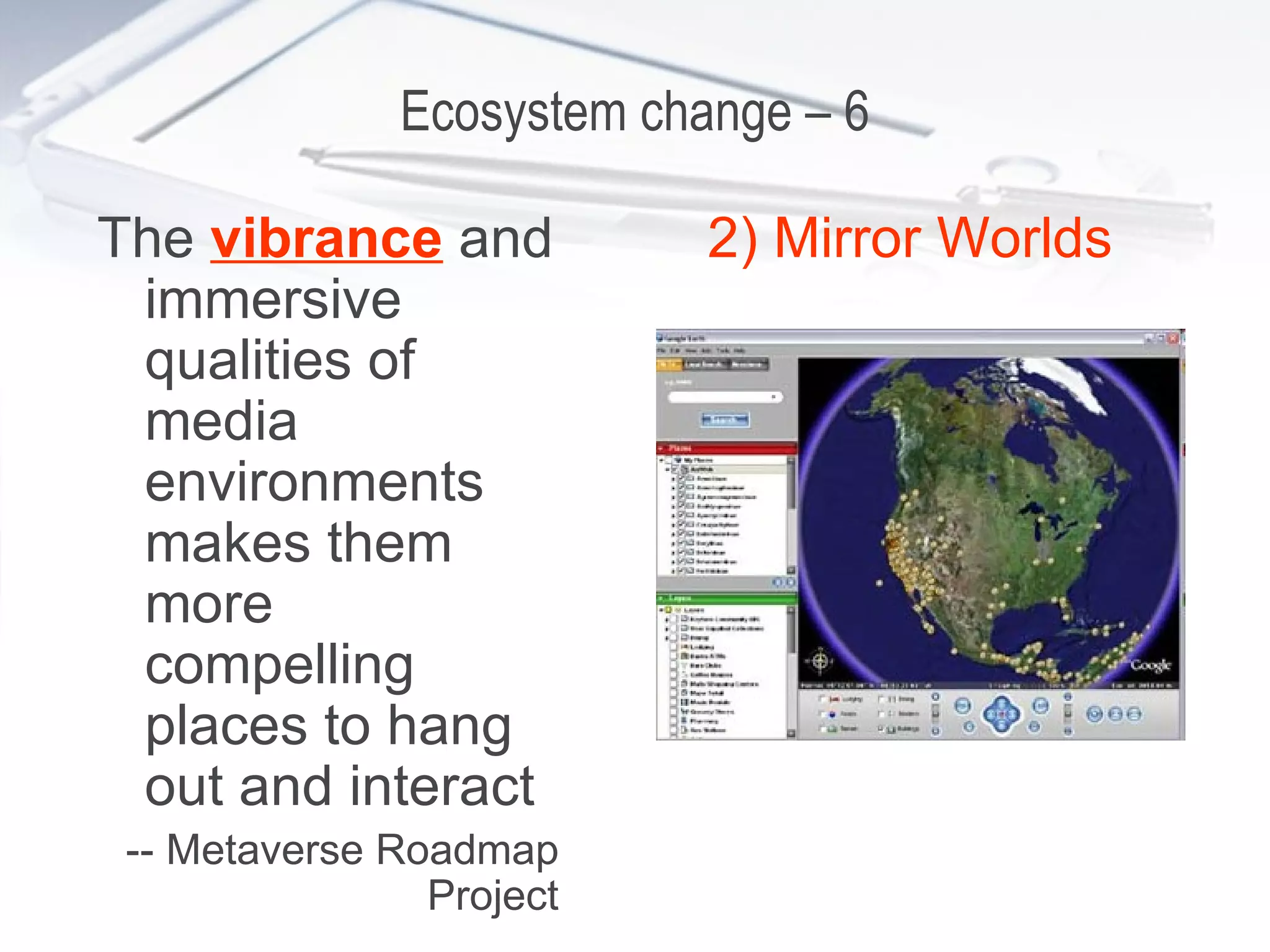
Ecosystem change – 6 The  vibrance  and immersive qualities of media environments makes them more compelling places to hang out and interact -- Metaverse Roadmap Project 2) Mirror Worlds
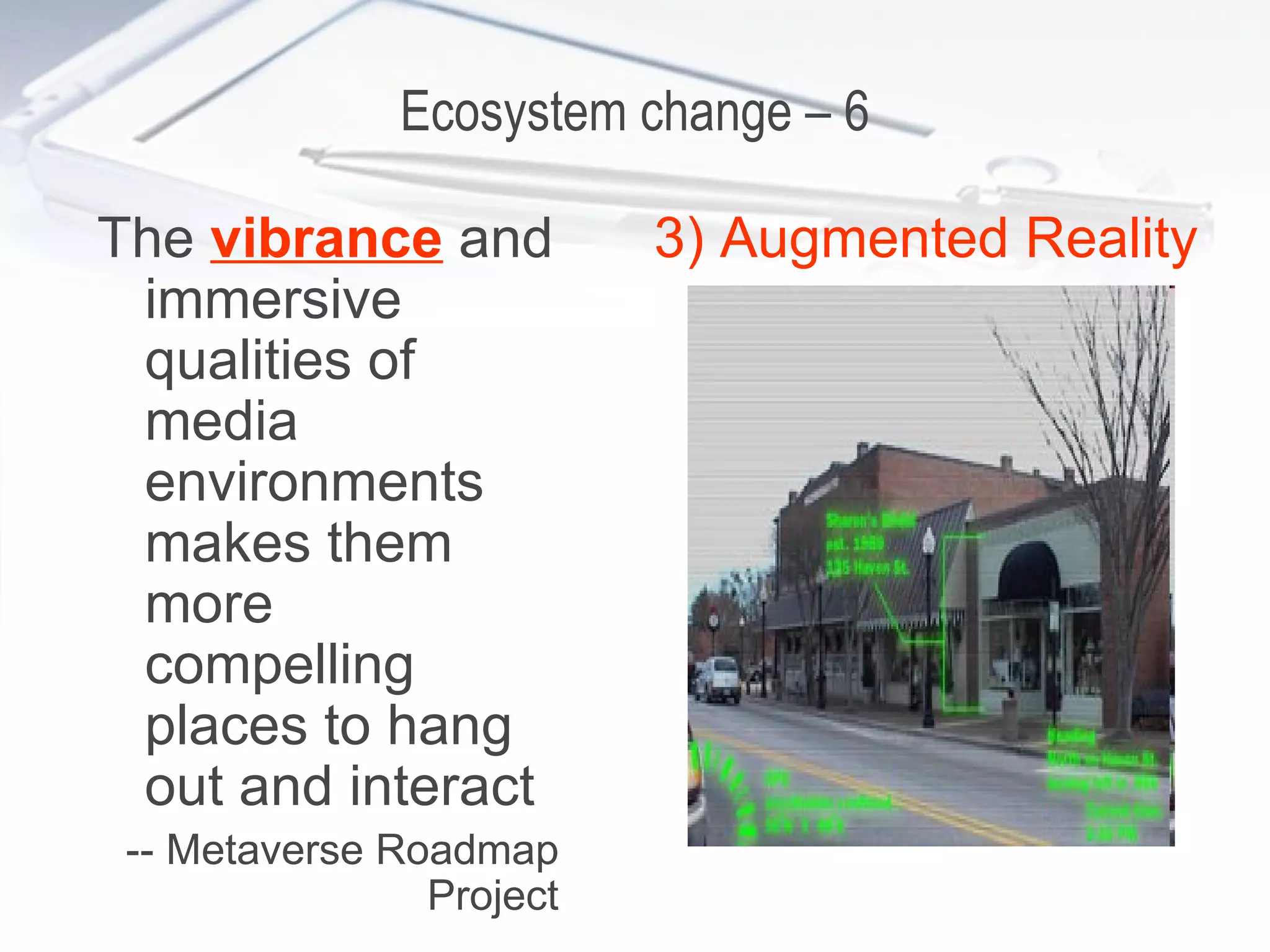
Ecosystem change – 6 The  vibrance  and immersive qualities of media environments makes them more compelling places to hang out and interact -- Metaverse Roadmap Project 3) Augmented Reality
Ecosystem change – 6 The  vibrance  and immersive qualities of media environments makes them more compelling places to hang out and interact -- Metaverse Roadmap Project 4) Life-logging
Ecosystem change – 7 Valence  (relevance) of information improves –  search and customization get better as we create the “Daily Me” and “Daily Us”  –  Nicholas Negroponte
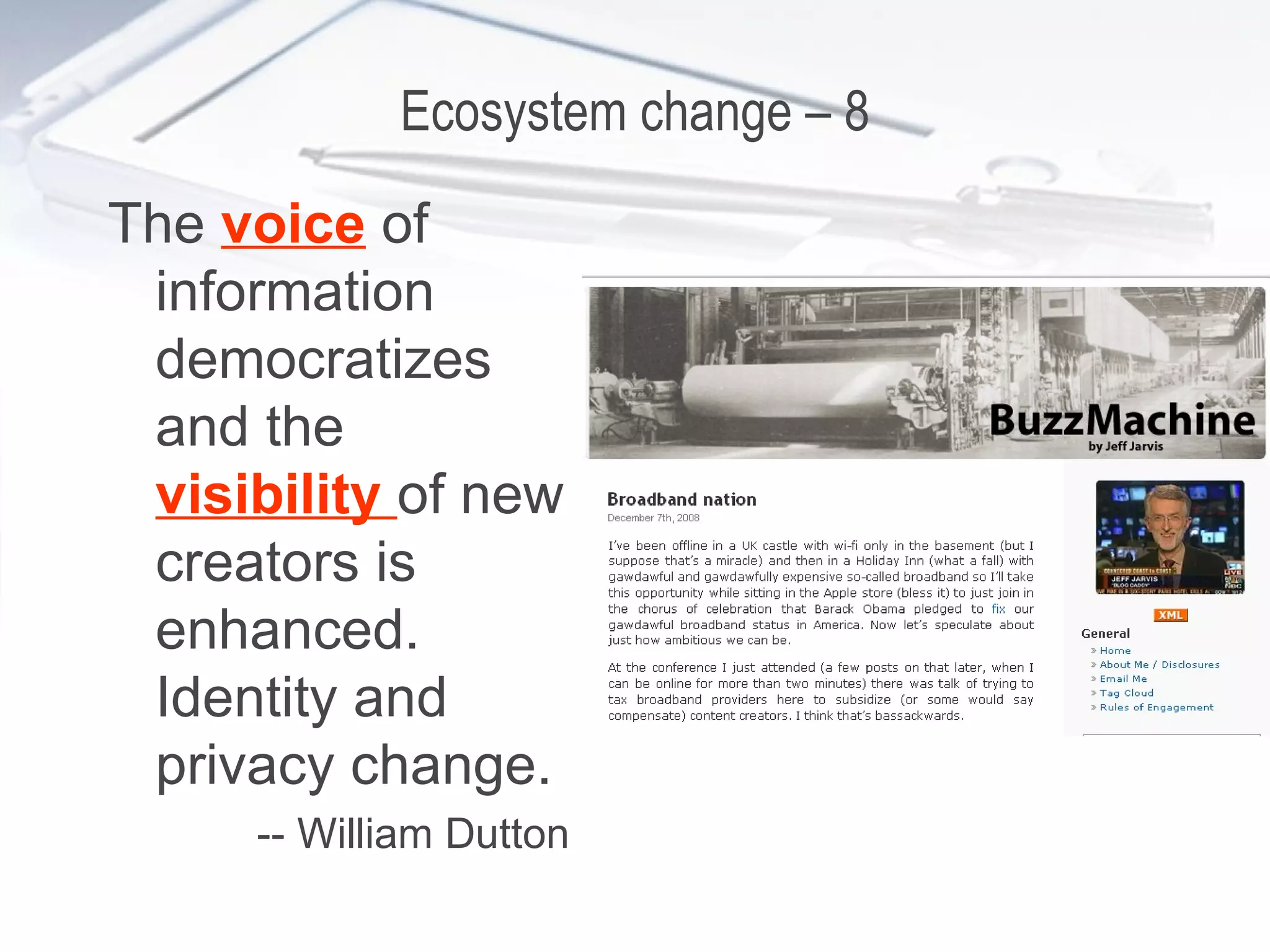
Ecosystem change – 8 The  voice  of information democratizes and the  visibility  of new creators is enhanced. Identity and privacy change. -- William Dutton
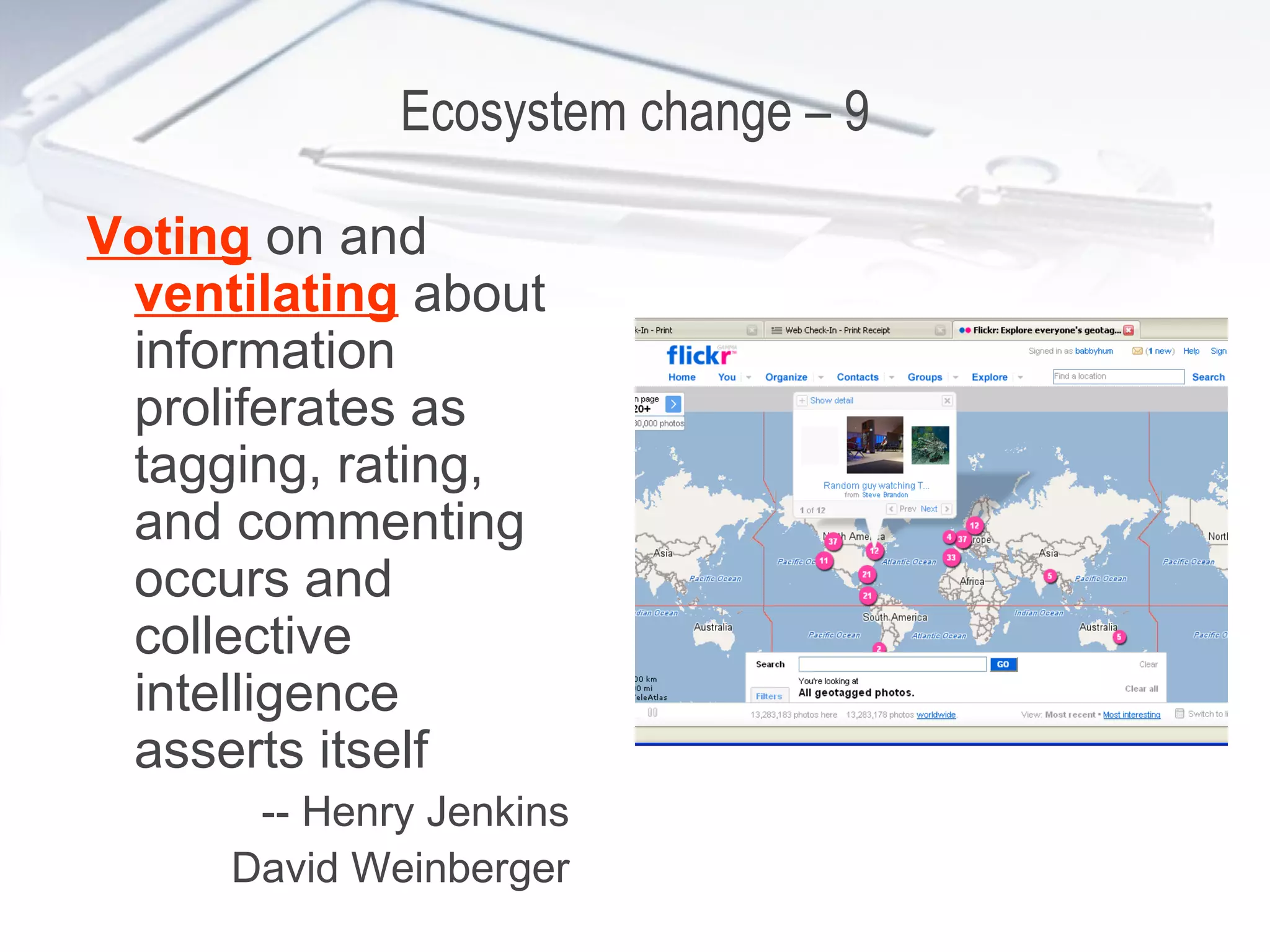
Ecosystem change – 9 Voting  on and  ventilating  about information proliferates as tagging, rating, and commenting occurs and collective intelligence   asserts itself -- Henry Jenkins David Weinberger
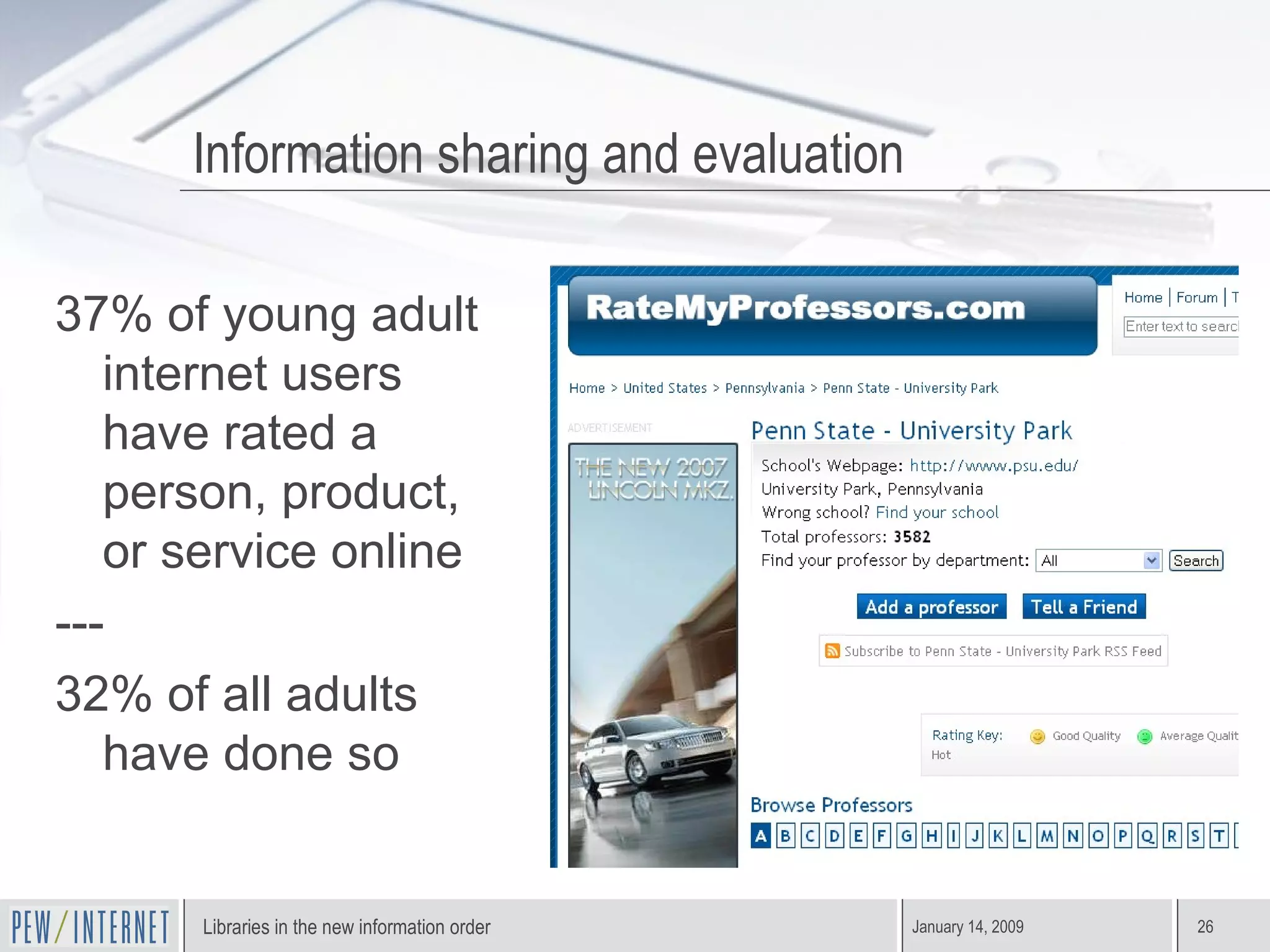
37% of young adult internet users have rated a person, product, or service online --- 32% of all adults have done so Information sharing and evaluation
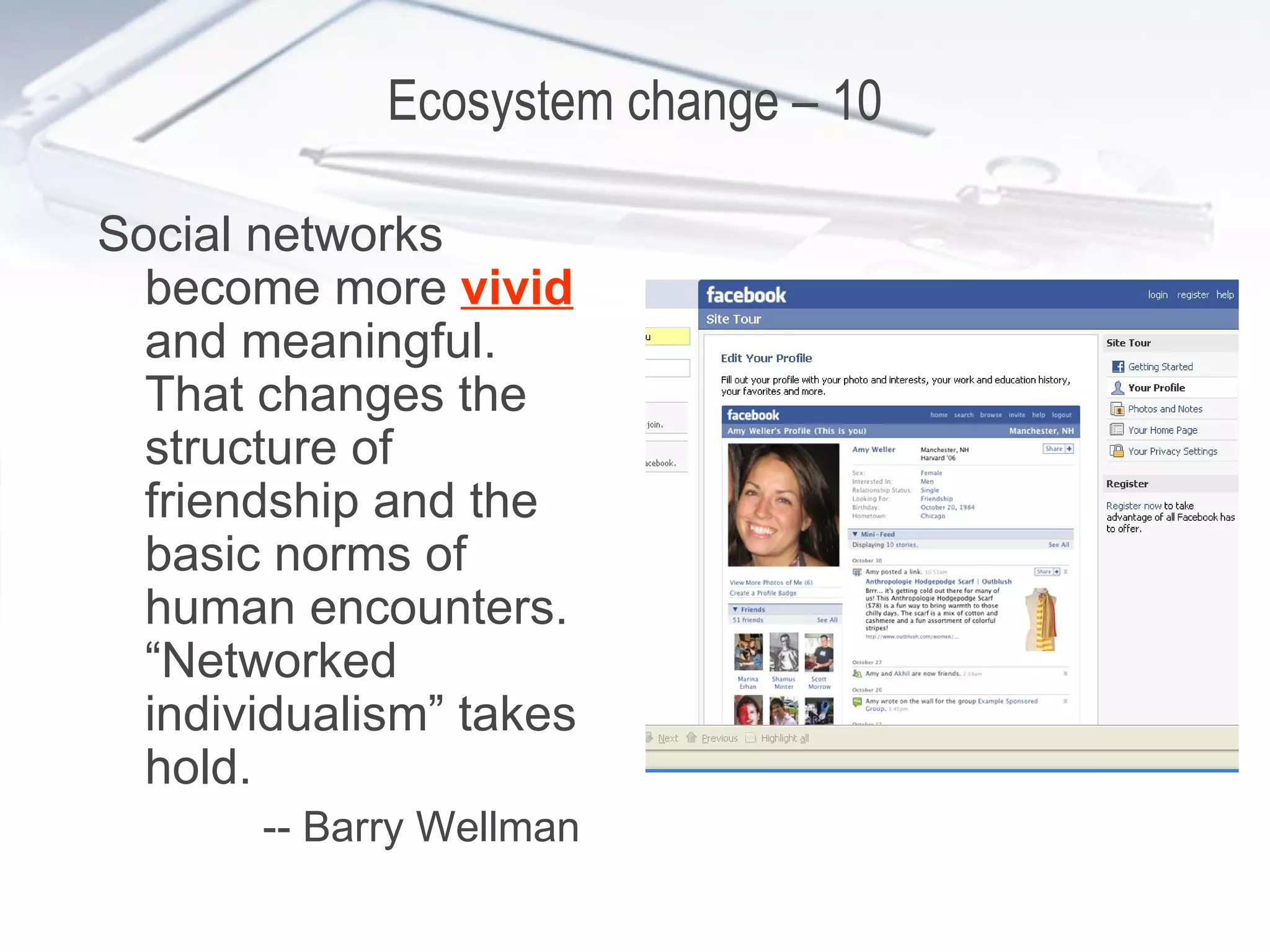
Ecosystem change – 10 Social networks become more  vivid  and meaningful. That changes the structure of friendship and the basic norms of human encounters. “Networked individualism” takes hold. -- Barry Wellman
Action item Be findable. Be available – timelines are fading.
Action item Think of yourself as a news node for information and interaction.  --- Prepare for the “big bang” moment.
Action item Think of yourself as a social network node for people looking for “friendsters”  --- The internet is “personified” in some people’s lives and you can provide information and social support in the same ways social networks can
Action item Think of yourself as an information hub -- an aggregator and a linker to others who have useful, interesting material  --- Links are the currency of the internet, partnerships/affiliate relations are the norm. That’s how you build social capital.
Action item Experiment with Web 2.0 applications – blogs, wikis, tagging, reputation/rating, widgets, and social networking  --- Watch your usage data and the psychographics of users. Solicit feedback and show you are listening to responses
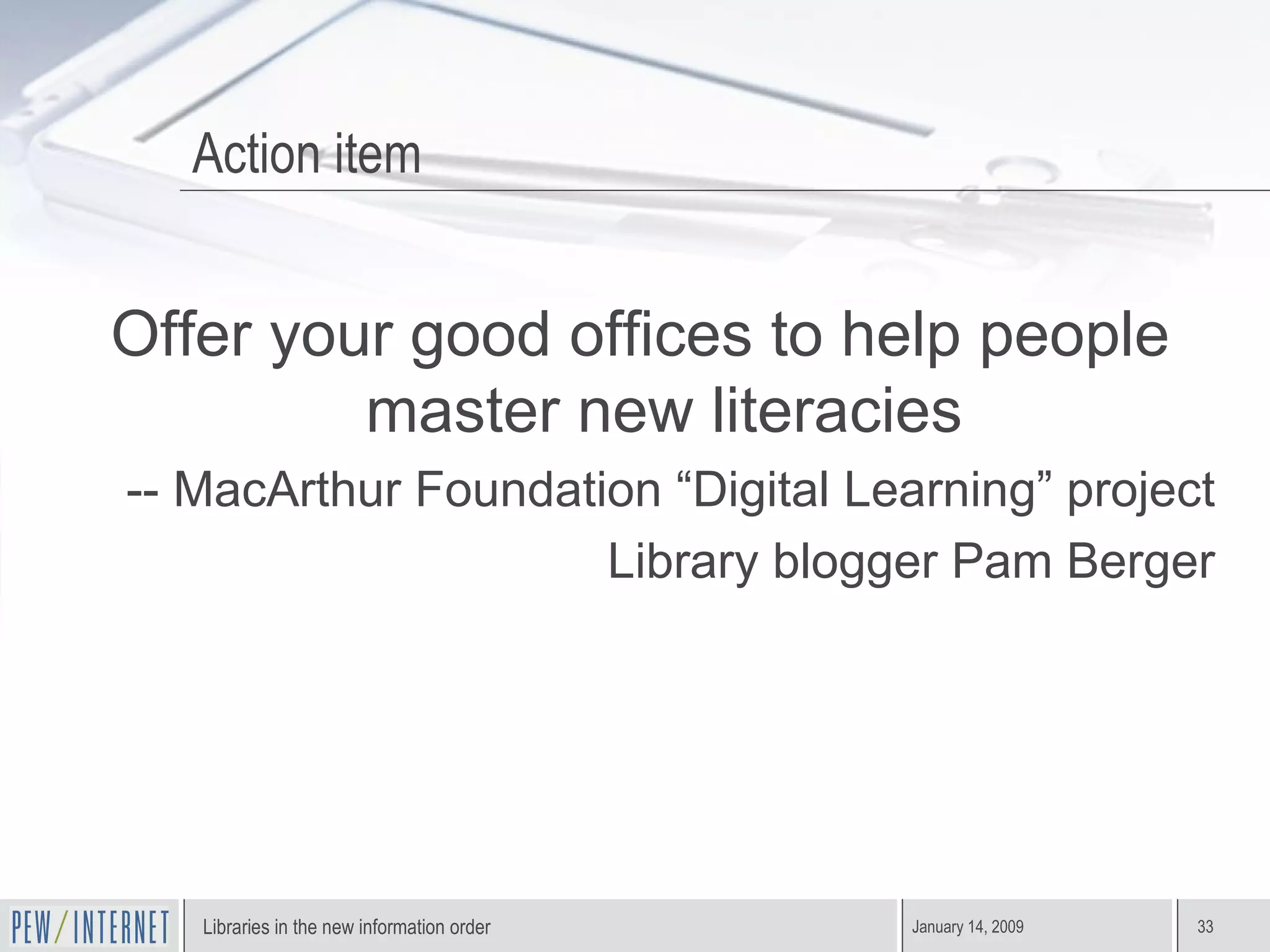
Action item Offer your good offices to help people master new literacies -- MacArthur Foundation “Digital Learning” project Library blogger Pam Berger
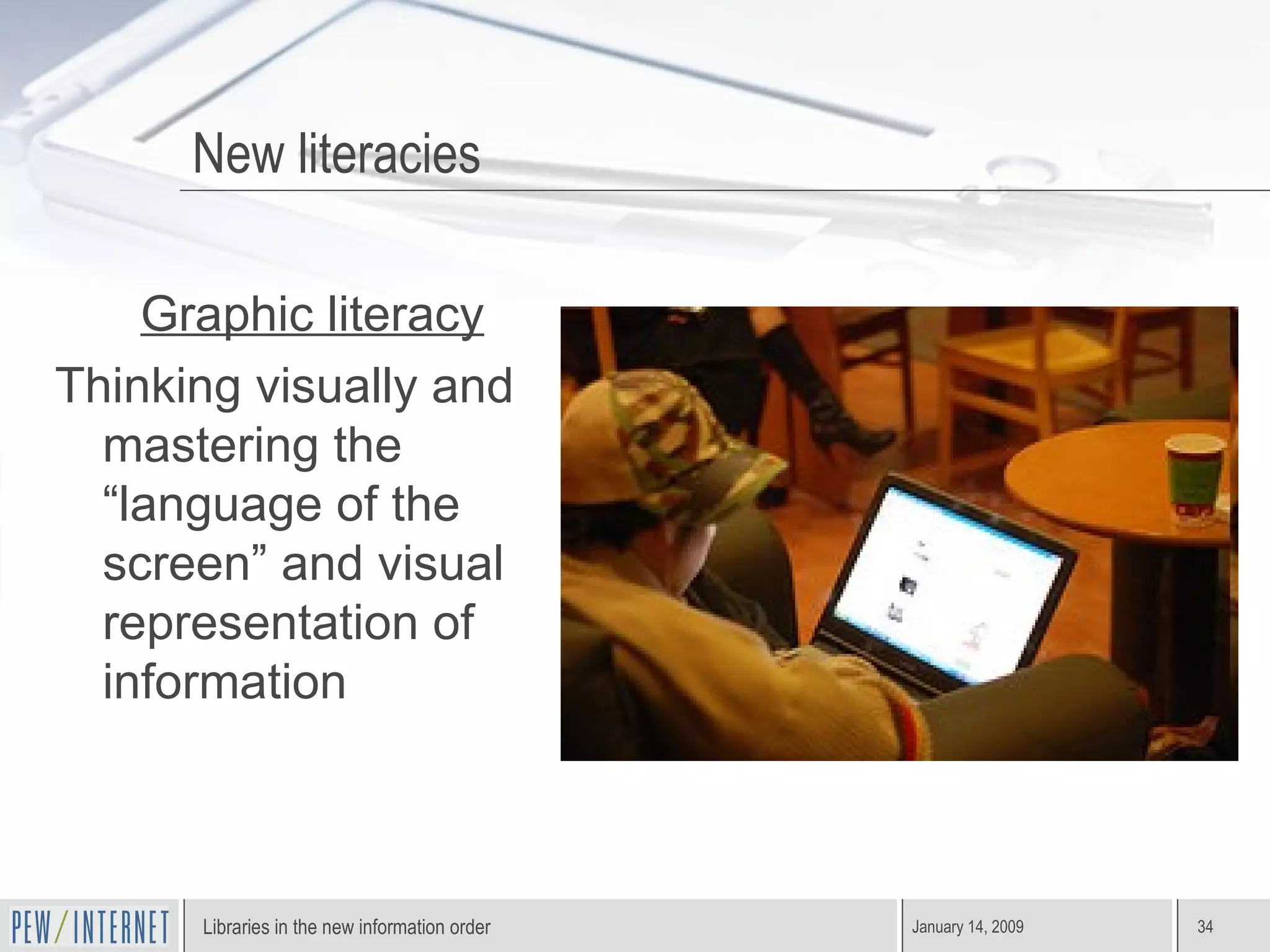
Graphic literacy Thinking visually and mastering the “language of the screen” and visual representation of information New literacies
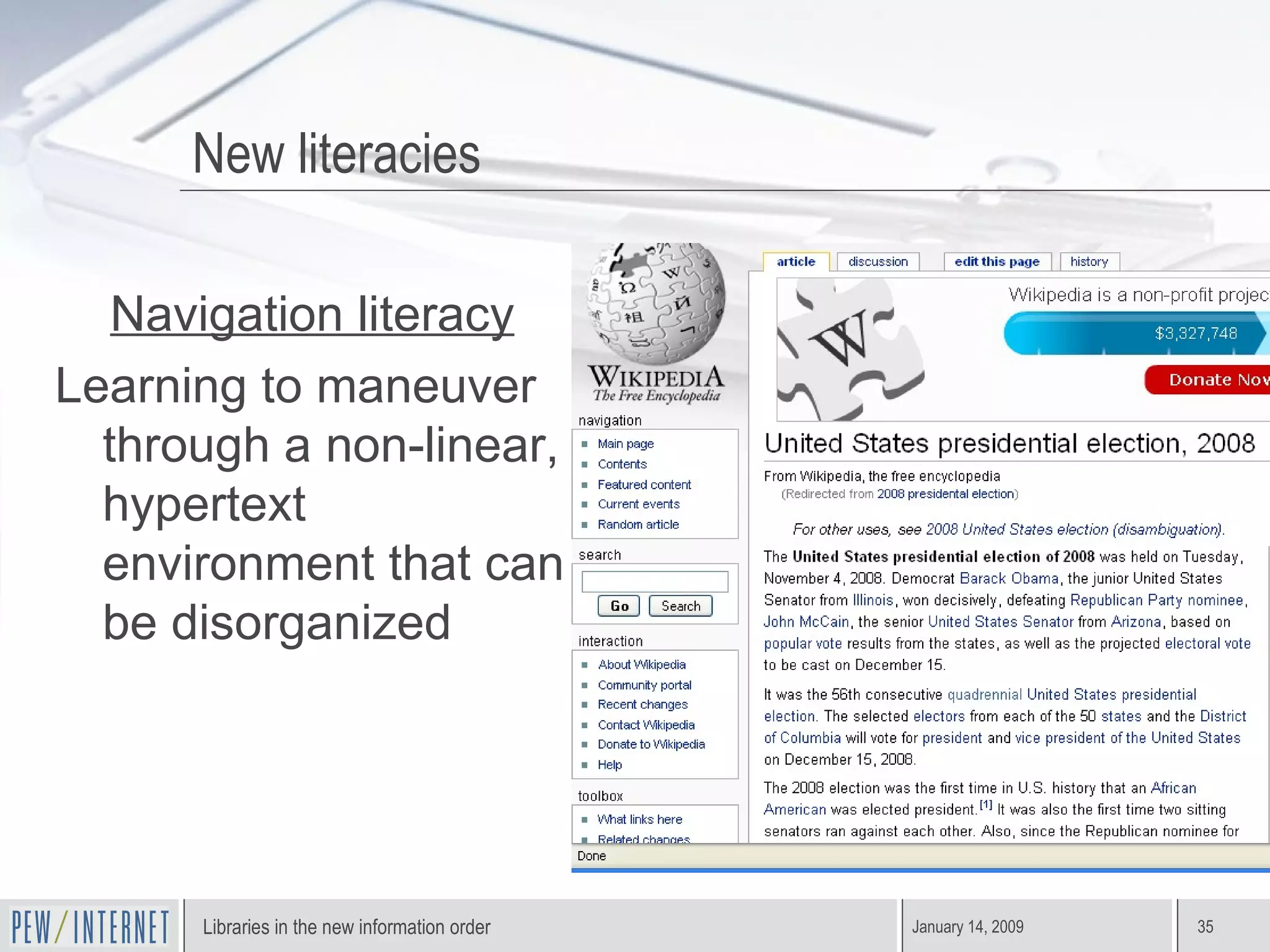
Navigation literacy Learning to maneuver through a non-linear, hypertext environment that can be disorganized New literacies
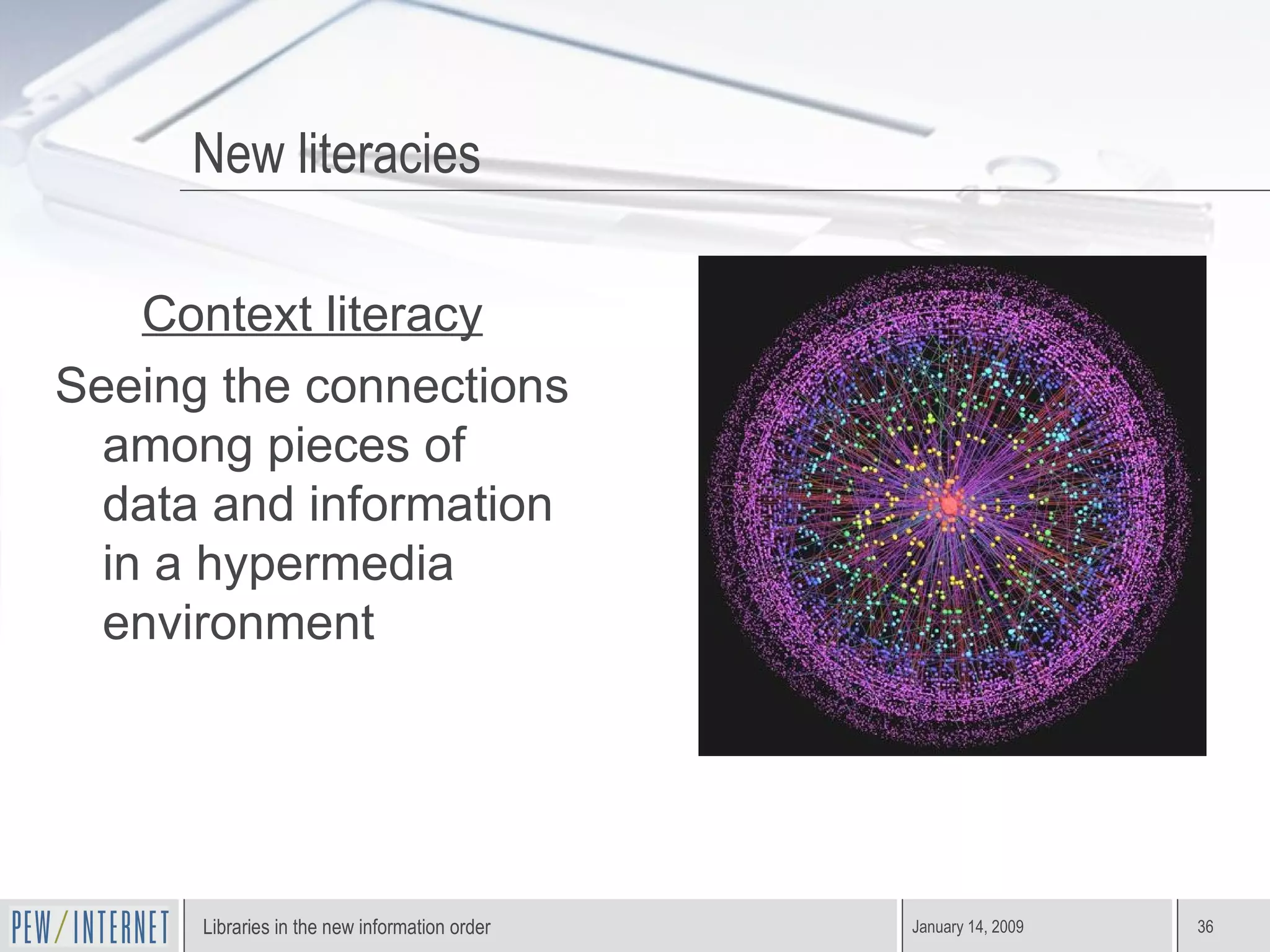
Context literacy Seeing the connections among pieces of data and information in a hypermedia environment New literacies
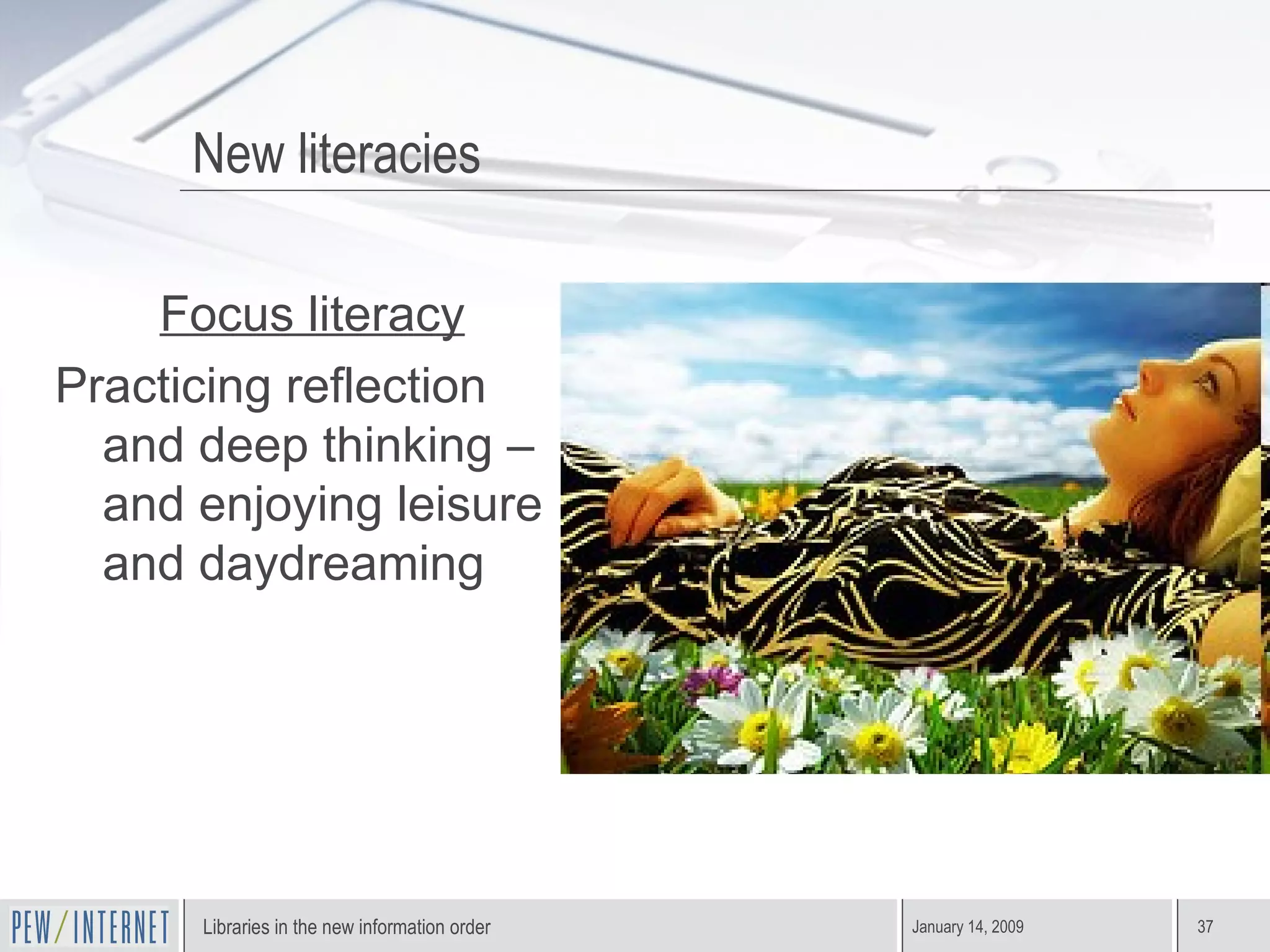
Focus literacy Practicing reflection and deep thinking – and enjoying leisure and daydreaming New literacies
Skepticism literacy Learning to evaluate information and how to assess its accuracy and sourcing New literacies
Ethical literacy Understanding the rules of cyberspace, living responsibly,  and helping set civil norms New literacies
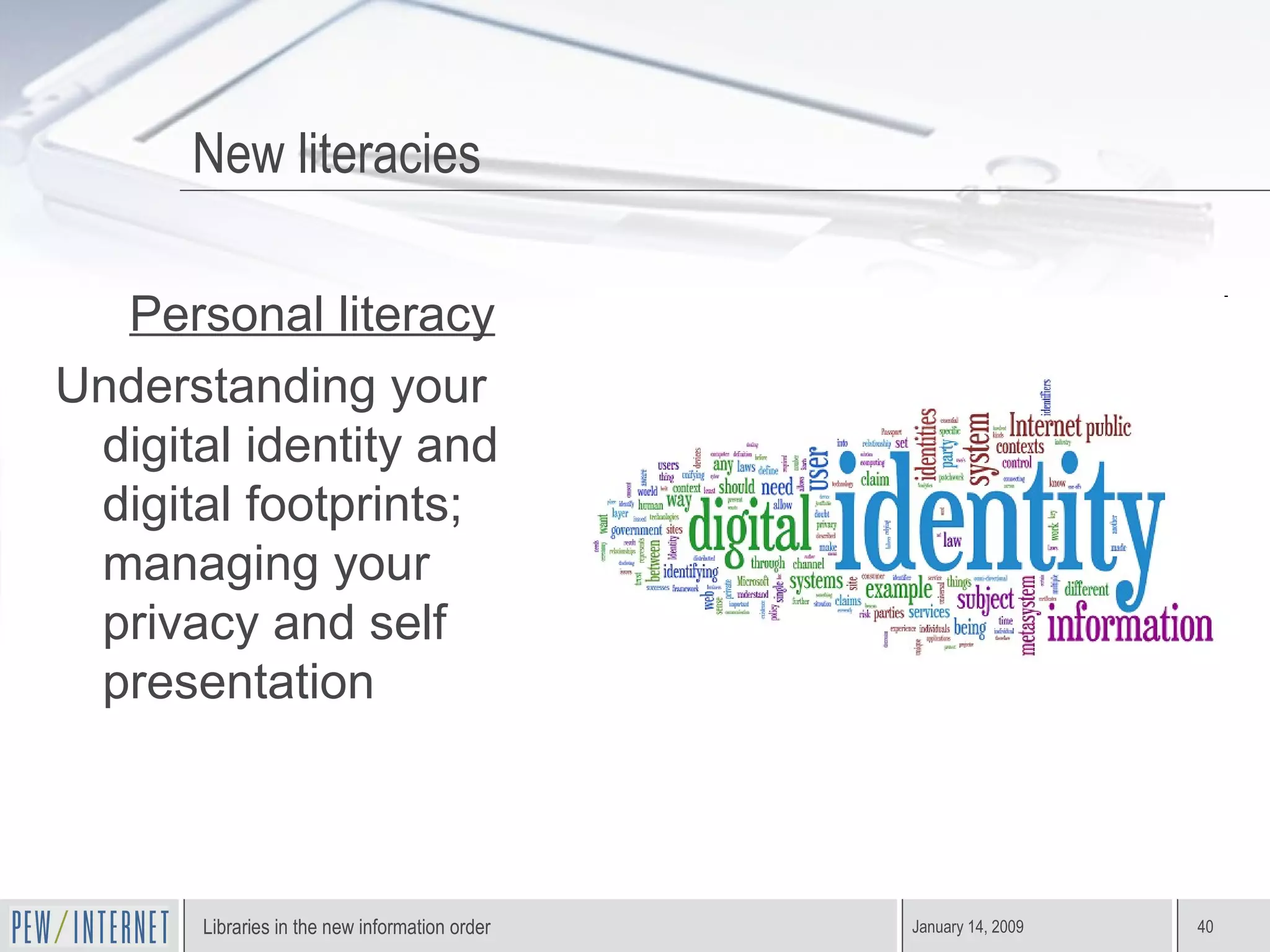
Personal literacy Understanding your digital identity and digital footprints; managing your privacy and self presentation New literacies
Thank you! Lee Rainie Director Pew Internet & American Life Project 1615 L Street NW Suite 700 Washington, DC 20036 [email_address] 202-419-4500

How libraries can survive in the new media ecosystem

  • 1.
    How libraries cansurvive in the new media ecosystem Lee Rainie – Director Pew Internet Project HELIN Library Consortium Bryant University January 14, 2009
  • 2.
  • 3.
    &quot;If you ploppeda library down. . .30 years from now. . .there would be cobwebs growing everywhere because people would look at it and wouldn't think of it as a legitimate institution because it would be so far behind. . .&quot; -- Experienced library user 1996 Benton Foundation report: “ Buildings, books, and bytes”
  • 4.
    “ Many Americanswould just as soon turn their local libraries into museums and recruit retirees to staff them.” 1996 Benton Foundation report: “ Buildings, books, and bytes”
  • 5.
    New information ecosystem: Then and Now Industrial Age Info was: Scarce Expensive Institutionally oriented Designed for consumption Information Age Info is: Abundant Cheap Personally oriented Designed for participation
  • 6.
    2000 46% ofadults use internet 5% with broadband at home 50% own a cell phone 0% connect to internet wirelessly <10% use “cloud” = slow, stationary connections built around my computer 2008 74% of adults use internet 58% with broadband at home 82% own a cell phone 62% connect to internet wirelessly >53% use “cloud” = fast, mobile connections built around outside servers and storage The internet is the asteroid: Then and now
  • 7.
    Ecosystem change –1 Volume of information grows
  • 8.
    … and the“long tail” becomes more important -- Chris Anderson Traffic Content 20%-40% of traffic or sales in the “long tail” Amazon, Rhapsody/iTunes, Netflix
  • 9.
  • 10.
    Ecosystem change –2 Variety of information and sources of information grow
  • 11.
    … and peoplehave more options for their passions -- Markus Prior
  • 12.
    The internet risesin a fragmented media environment (% of all Americans who “regularly” go to news source: PRC People/Press) +1,850% -25% -52% +18% -41% -27%
  • 13.
    Internet and broadbandadoption 1995-2008 Internet users Broadband at home
  • 14.
    Ecosystem change –3 Velocity of information increases and smart mobs emerge -- Howard Rheingold
  • 15.
    Ecosystem change –4 Venues of intersecting with information and people multiply and the availability of information expands to all hours of the day and all places we are -- Nielsen Company
  • 16.
    Ecosystem change –5 People’s vigilance for information changes in two directions: 1) attention is truncated (Linda Stone) 2) attention is elongated (Andrew Keen; Terry Fisher)
  • 17.
    Kaiser Family Foundation,Media Multitasking Among American Youth, December 2006
  • 18.
    Kaiser Family Foundation,Media Multitasking Among American Youth, December 2006
  • 19.
    Ecosystem change –6 The vibrance and immersive qualities of media environments makes them more compelling places to hang out and interact -- Metaverse Roadmap Project 1) Virtual Worlds
  • 20.
    Ecosystem change –6 The vibrance and immersive qualities of media environments makes them more compelling places to hang out and interact -- Metaverse Roadmap Project 2) Mirror Worlds
  • 21.
    Ecosystem change –6 The vibrance and immersive qualities of media environments makes them more compelling places to hang out and interact -- Metaverse Roadmap Project 3) Augmented Reality
  • 22.
    Ecosystem change –6 The vibrance and immersive qualities of media environments makes them more compelling places to hang out and interact -- Metaverse Roadmap Project 4) Life-logging
  • 23.
    Ecosystem change –7 Valence (relevance) of information improves – search and customization get better as we create the “Daily Me” and “Daily Us” – Nicholas Negroponte
  • 24.
    Ecosystem change –8 The voice of information democratizes and the visibility of new creators is enhanced. Identity and privacy change. -- William Dutton
  • 25.
    Ecosystem change –9 Voting on and ventilating about information proliferates as tagging, rating, and commenting occurs and collective intelligence asserts itself -- Henry Jenkins David Weinberger
  • 26.
    37% of youngadult internet users have rated a person, product, or service online --- 32% of all adults have done so Information sharing and evaluation
  • 27.
    Ecosystem change –10 Social networks become more vivid and meaningful. That changes the structure of friendship and the basic norms of human encounters. “Networked individualism” takes hold. -- Barry Wellman
  • 28.
    Action item Befindable. Be available – timelines are fading.
  • 29.
    Action item Thinkof yourself as a news node for information and interaction. --- Prepare for the “big bang” moment.
  • 30.
    Action item Thinkof yourself as a social network node for people looking for “friendsters” --- The internet is “personified” in some people’s lives and you can provide information and social support in the same ways social networks can
  • 31.
    Action item Thinkof yourself as an information hub -- an aggregator and a linker to others who have useful, interesting material --- Links are the currency of the internet, partnerships/affiliate relations are the norm. That’s how you build social capital.
  • 32.
    Action item Experimentwith Web 2.0 applications – blogs, wikis, tagging, reputation/rating, widgets, and social networking --- Watch your usage data and the psychographics of users. Solicit feedback and show you are listening to responses
  • 33.
    Action item Offeryour good offices to help people master new literacies -- MacArthur Foundation “Digital Learning” project Library blogger Pam Berger
  • 34.
    Graphic literacy Thinkingvisually and mastering the “language of the screen” and visual representation of information New literacies
  • 35.
    Navigation literacy Learningto maneuver through a non-linear, hypertext environment that can be disorganized New literacies
  • 36.
    Context literacy Seeingthe connections among pieces of data and information in a hypermedia environment New literacies
  • 37.
    Focus literacy Practicingreflection and deep thinking – and enjoying leisure and daydreaming New literacies
  • 38.
    Skepticism literacy Learningto evaluate information and how to assess its accuracy and sourcing New literacies
  • 39.
    Ethical literacy Understandingthe rules of cyberspace, living responsibly, and helping set civil norms New literacies
  • 40.
    Personal literacy Understandingyour digital identity and digital footprints; managing your privacy and self presentation New literacies
  • 41.
    Thank you! LeeRainie Director Pew Internet & American Life Project 1615 L Street NW Suite 700 Washington, DC 20036 [email_address] 202-419-4500

Editor's Notes

  • #2 Title: Surviving in the new media ecosystem Subject: The internet, cell phones, and other digital technologies have allowed people to have larger social networks, to participate in and learn from larger numbers of groups, to act in new ways to shape their world, and to gather, asses and act on information of all kinds from all kinds of “media.” This marks a major shift in the social and civic lives of Americans that has big implications for libraries as they think about serving their communities. Lee will explore all these changes through the lens of the surveys and research of the Pew Internet &amp; American Life Project.