HONEY POT
CONTENTS
Introduction
A honeypot is a trap set to detect, deflect, or in some manner
counteract attempts at unauthorized use of information systems

They are the highly flexible security tool with different applications for
security. They don't fix a single problem. Instead they have multiple
uses, such as prevention, detection, or information gathering
A honeypot is an information system resource whose value lies in
unauthori z ed or illicit use of that resource.
What is honeypot??
•

A Honey Pot is an intrusion detection technique used to study hackers
movements.

•

Virtual machine that sits on a network or a client

•

Goals
 Should look as real as possible!
 Should be monitored to see if its being used to launch a
massive attack on other systems
 Should include files that are of interest to the hacker.
Historical Aspects
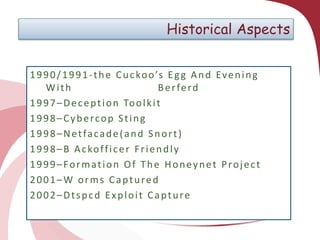
1 9 9 0 / 1 9 9 1 - t h e C u c ko o ’s E g g A n d E v e n i n g
With
B e r fe r d
1 9 9 7 – D e c e p t i o n To o l k i t
1998–Cybercop Sting
1998–Netfacade(and Snort)
1 9 9 8 – B A c ko f f i c e r F r i e n d l y
1999–Formation Of The Honeynet Project
2001–W orms Captured
2002–Dtspcd Exploit Capture
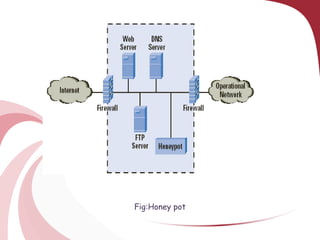
Fig:Honey pot
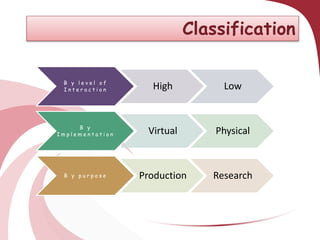
Classification
B y level of
Interaction

High

Low

B y
Implementation

Virtual

Physical

B y purpose

Production

Research
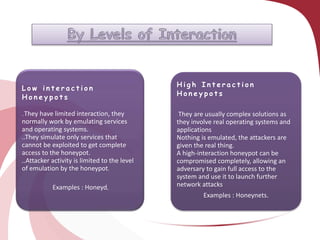
Low interaction
Honeypots
They have limited interaction, they
normally work by emulating services
and operating systems.
..They simulate only services that
cannot be exploited to get complete
access to the honeypot.
..Attacker activity is limited to the level
of emulation by the honeypot.
..

Examples : Honeyd,

High Interaction
Honeypots
They are usually complex solutions as
they involve real operating systems and
applications
Nothing is emulated, the attackers are
given the real thing.
A high-interaction honeypot can be
compromised completely, allowing an
adversary to gain full access to the
system and use it to launch further
network attacks
Examples : Honeynets.
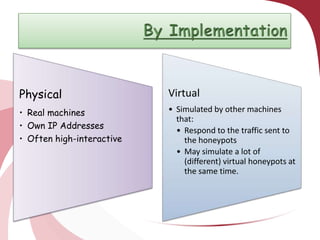
Physical

Virtual

• Real machines
• Own IP Addresses
• Often high-interactive

• Simulated by other machines
that:
• Respond to the traffic sent to
the honeypots
• May simulate a lot of
(different) virtual honeypots at
the same time.
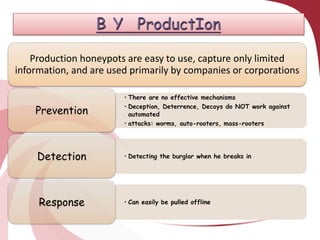
Production honeypots are easy to use, capture only limited
information, and are used primarily by companies or corporations
Prevention

• There are no effective mechanisms
• Deception, Deterrence, Decoys do NOT work against
automated
• attacks: worms, auto-rooters, mass-rooters

Detection

• Detecting the burglar when he breaks in

Response

• Can easily be pulled offline
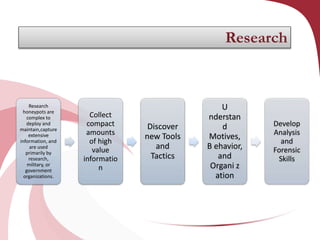
Research

Research
honeypots are
complex to
deploy and
maintain,capture
extensive
information, and
are used
primarily by
research,
military, or
government
organizations.

Collect
compact
amounts
of high
value
informatio
n

Discover
new Tools
and
Tactics

U
nderstan
d
Motives,
B ehavior,
and
Organi z
ation

Develop
Analysis
and
Forensic
Skills
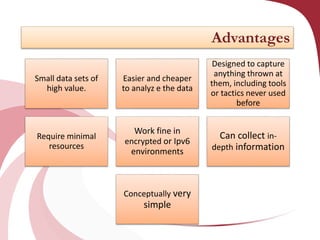
Advantages
Small data sets of
high value.

Easier and cheaper
to analyz e the data

Designed to capture
anything thrown at
them, including tools
or tactics never used
before

Require minimal
resources

Work fine in
encrypted or Ipv6
environments

Can collect indepth information

Conceptually very

simple
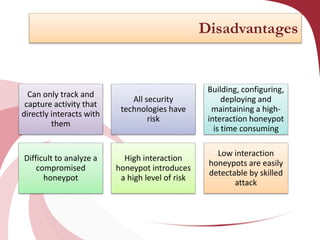
Disadvantages

Can only track and
capture activity that
directly interacts with
them

All security
technologies have
risk

Building, configuring,
deploying and
maintaining a highinteraction honeypot
is time consuming

Difficult to analyze a
compromised
honeypot

High interaction
honeypot introduces
a high level of risk

Low interaction
honeypots are easily
detectable by skilled
attack
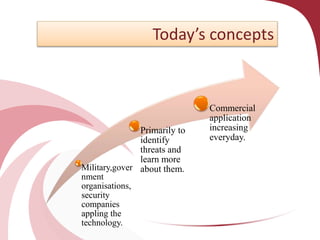
Today’s concepts

Primarily to
identify
threats and
learn more
Military,gover about them.
nment
organisations,
security
companies
appling the
technology.

Commercial
application
increasing
everyday.
Conclusion

Can collect in depth data which no other technology can
Different from others – its value lies in being attacked,
probed or compromised

Extremely useful in observing hacker movements and
preparing the systems for future attacks
Not a solution!
Honey po tppt
Honey po tppt

Honey po tppt

  • 1.
  • 2.
  • 3.
    Introduction A honeypot isa trap set to detect, deflect, or in some manner counteract attempts at unauthorized use of information systems They are the highly flexible security tool with different applications for security. They don't fix a single problem. Instead they have multiple uses, such as prevention, detection, or information gathering A honeypot is an information system resource whose value lies in unauthori z ed or illicit use of that resource.
  • 4.
    What is honeypot?? • AHoney Pot is an intrusion detection technique used to study hackers movements. • Virtual machine that sits on a network or a client • Goals  Should look as real as possible!  Should be monitored to see if its being used to launch a massive attack on other systems  Should include files that are of interest to the hacker.
  • 5.
    Historical Aspects 1 99 0 / 1 9 9 1 - t h e C u c ko o ’s E g g A n d E v e n i n g With B e r fe r d 1 9 9 7 – D e c e p t i o n To o l k i t 1998–Cybercop Sting 1998–Netfacade(and Snort) 1 9 9 8 – B A c ko f f i c e r F r i e n d l y 1999–Formation Of The Honeynet Project 2001–W orms Captured 2002–Dtspcd Exploit Capture
  • 6.
  • 7.
    Classification B y levelof Interaction High Low B y Implementation Virtual Physical B y purpose Production Research
  • 8.
    Low interaction Honeypots They havelimited interaction, they normally work by emulating services and operating systems. ..They simulate only services that cannot be exploited to get complete access to the honeypot. ..Attacker activity is limited to the level of emulation by the honeypot. .. Examples : Honeyd, High Interaction Honeypots They are usually complex solutions as they involve real operating systems and applications Nothing is emulated, the attackers are given the real thing. A high-interaction honeypot can be compromised completely, allowing an adversary to gain full access to the system and use it to launch further network attacks Examples : Honeynets.
  • 9.
    Physical Virtual • Real machines •Own IP Addresses • Often high-interactive • Simulated by other machines that: • Respond to the traffic sent to the honeypots • May simulate a lot of (different) virtual honeypots at the same time.
  • 10.
    Production honeypots areeasy to use, capture only limited information, and are used primarily by companies or corporations Prevention • There are no effective mechanisms • Deception, Deterrence, Decoys do NOT work against automated • attacks: worms, auto-rooters, mass-rooters Detection • Detecting the burglar when he breaks in Response • Can easily be pulled offline
  • 11.
    Research Research honeypots are complex to deployand maintain,capture extensive information, and are used primarily by research, military, or government organizations. Collect compact amounts of high value informatio n Discover new Tools and Tactics U nderstan d Motives, B ehavior, and Organi z ation Develop Analysis and Forensic Skills
  • 12.
    Advantages Small data setsof high value. Easier and cheaper to analyz e the data Designed to capture anything thrown at them, including tools or tactics never used before Require minimal resources Work fine in encrypted or Ipv6 environments Can collect indepth information Conceptually very simple
  • 13.
    Disadvantages Can only trackand capture activity that directly interacts with them All security technologies have risk Building, configuring, deploying and maintaining a highinteraction honeypot is time consuming Difficult to analyze a compromised honeypot High interaction honeypot introduces a high level of risk Low interaction honeypots are easily detectable by skilled attack
  • 14.
    Today’s concepts Primarily to identify threatsand learn more Military,gover about them. nment organisations, security companies appling the technology. Commercial application increasing everyday.
  • 15.
    Conclusion Can collect indepth data which no other technology can Different from others – its value lies in being attacked, probed or compromised Extremely useful in observing hacker movements and preparing the systems for future attacks Not a solution!