Presentation on 
“HONEYPOT” 
Submitted by: Gaurav 
Gupta 
DTU/2K13/CO/049
DEFINITION 
A honeypot is an information system 
resource whose value lies in unauthorized or 
illicit use of that resource. 
- Lance Spitzner
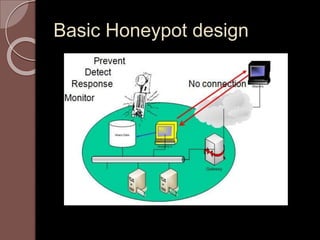
Basic Honeypot design
Value of Honeypots 
Primary value of honeypots is to 
collect information. 
This information is then used to better 
identify, understand and protect 
against threats. 
Honeypots add little direct value to 
protecting your network.
How it helps us? 
 Helps to learn system’s weakness 
 Hacker can be caught & stopped 
 Design better & secured network
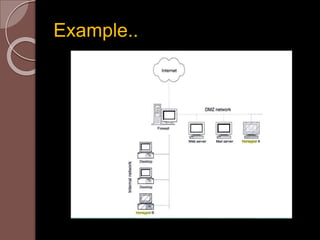
Example..
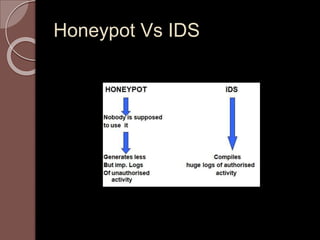
Honeypot Vs IDS
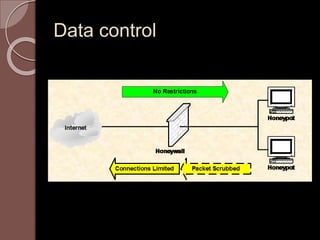
No Data Control
Data control
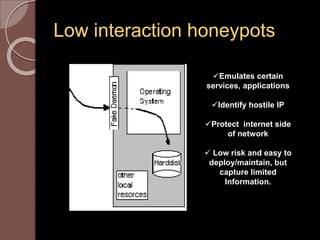
Low interaction honeypots 
Emulates certain 
services, applications 
Identify hostile IP 
Protect internet side 
of network 
 Low risk and easy to 
deploy/maintain, but 
capture limited 
Information.
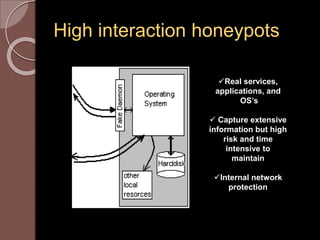
High interaction honeypots 
Real services, 
applications, and 
OS’s 
 Capture extensive 
information but high 
risk and time 
intensive to 
maintain 
Internal network 
protection
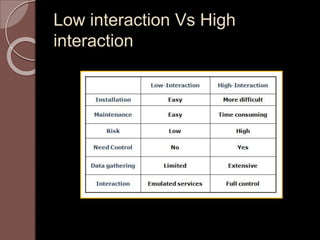
Low interaction Vs High 
interaction
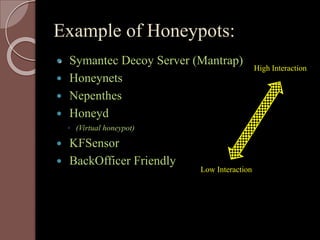
Example of Honeypots: 
 Symantec Decoy Server (Mantrap) 
 Honeynets 
 Nepenthes 
 Honeyd 
◦ (Virtual honeypot) 
 KFSensor 
 BackOfficer Friendly 
High Interaction 
Low Interaction
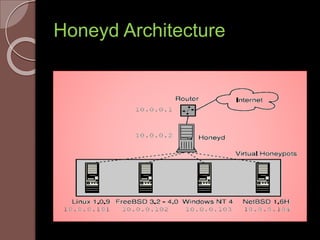
Honeyd 
Honeyd is a low-interaction virtual 
honeypot 
◦ Run multiple virtual hosts on a computer 
network 
◦ A network administrator running Honeyd 
can monitor his/her logs to see if there is 
any traffic going to the virtual hosts set up 
by Honeyd 
◦ Supports multiple IP addresses 
◦ Supports subsystem
Honeyd Architecture
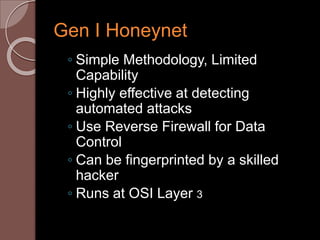
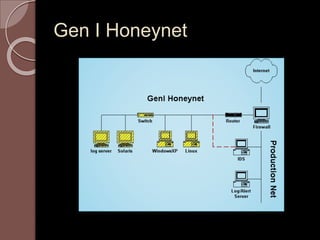
Gen I Honeynet 
◦ Simple Methodology, Limited 
Capability 
◦ Highly effective at detecting 
automated attacks 
◦ Use Reverse Firewall for Data 
Control 
◦ Can be fingerprinted by a skilled 
hacker 
◦ Runs at OSI Layer 3
Gen I Honeynet
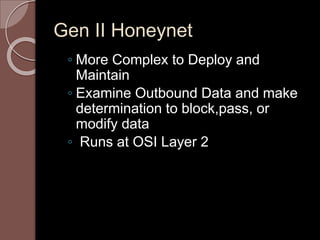
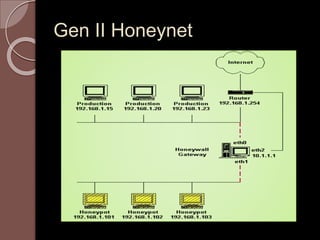
Gen II Honeynet 
◦ More Complex to Deploy and 
Maintain 
◦ Examine Outbound Data and make 
determination to block,pass, or 
modify data 
◦ Runs at OSI Layer 2
Gen II Honeynet
Advantages and Disadvantages of 
Honeypots 
Advantages : 
Honeypots are focused (small data sets) 
Honeypots help to reduce false positive 
Honeypots help to catch unknown attacks (false 
negative) 
Honeypots can capture encrypted activity (cf. Sebek) 
Honeypots work with IPv6 
Honeypots are very flexible (advantage/disadvantage?) 
Honeypots require minimal resources 
Disadvantages : 
Honeypots field of view limited (focused) 
Honeypots can be detected by attacker
Future work 
I. Ease of use: In future Honeypots will most 
probably appear in prepackaged solutions, 
which will be easier to administer and maintain. 
People will be able to install and develop 
Honeypots at home and without difficulty. 
II. Closer integration: Currently Honeypots are 
used along with other technologies such as 
firewall, tripwire, IDS etc. As technologies are 
developing, in future Honeypots will be used in 
closer integration with them. 
III. Specific purpose: Already certain features such 
as honeytokens are under development to 
target Honeypots only for a specific purpose. 
Eg: catching only those attempting credit card 
fraud etc.
Thanks for 
listening

Honeypots

  • 1.
    Presentation on “HONEYPOT” Submitted by: Gaurav Gupta DTU/2K13/CO/049
  • 2.
    DEFINITION A honeypotis an information system resource whose value lies in unauthorized or illicit use of that resource. - Lance Spitzner
  • 3.
  • 4.
    Value of Honeypots Primary value of honeypots is to collect information. This information is then used to better identify, understand and protect against threats. Honeypots add little direct value to protecting your network.
  • 5.
    How it helpsus?  Helps to learn system’s weakness  Hacker can be caught & stopped  Design better & secured network
  • 6.
  • 7.
  • 8.
  • 9.
  • 10.
    Low interaction honeypots Emulates certain services, applications Identify hostile IP Protect internet side of network  Low risk and easy to deploy/maintain, but capture limited Information.
  • 11.
    High interaction honeypots Real services, applications, and OS’s  Capture extensive information but high risk and time intensive to maintain Internal network protection
  • 12.
    Low interaction VsHigh interaction
  • 13.
    Example of Honeypots:  Symantec Decoy Server (Mantrap)  Honeynets  Nepenthes  Honeyd ◦ (Virtual honeypot)  KFSensor  BackOfficer Friendly High Interaction Low Interaction
  • 14.
    Honeyd Honeyd isa low-interaction virtual honeypot ◦ Run multiple virtual hosts on a computer network ◦ A network administrator running Honeyd can monitor his/her logs to see if there is any traffic going to the virtual hosts set up by Honeyd ◦ Supports multiple IP addresses ◦ Supports subsystem
  • 15.
  • 16.
    Gen I Honeynet ◦ Simple Methodology, Limited Capability ◦ Highly effective at detecting automated attacks ◦ Use Reverse Firewall for Data Control ◦ Can be fingerprinted by a skilled hacker ◦ Runs at OSI Layer 3
  • 17.
  • 18.
    Gen II Honeynet ◦ More Complex to Deploy and Maintain ◦ Examine Outbound Data and make determination to block,pass, or modify data ◦ Runs at OSI Layer 2
  • 19.
  • 20.
    Advantages and Disadvantagesof Honeypots Advantages : Honeypots are focused (small data sets) Honeypots help to reduce false positive Honeypots help to catch unknown attacks (false negative) Honeypots can capture encrypted activity (cf. Sebek) Honeypots work with IPv6 Honeypots are very flexible (advantage/disadvantage?) Honeypots require minimal resources Disadvantages : Honeypots field of view limited (focused) Honeypots can be detected by attacker
  • 21.
    Future work I.Ease of use: In future Honeypots will most probably appear in prepackaged solutions, which will be easier to administer and maintain. People will be able to install and develop Honeypots at home and without difficulty. II. Closer integration: Currently Honeypots are used along with other technologies such as firewall, tripwire, IDS etc. As technologies are developing, in future Honeypots will be used in closer integration with them. III. Specific purpose: Already certain features such as honeytokens are under development to target Honeypots only for a specific purpose. Eg: catching only those attempting credit card fraud etc.
  • 22.