Presented By :
1. AMIT KUMAR (2017AN-02)
2. KARISHMA SAPKALE (2017AN-17)
NETWORK
MANAGEMENT
& SECURITY
TOPIC
TABLE OF
CONTENTS
1. Introduction
2. Litrature Review
3. The security techniques for networking
3.1 Intrusion detection system
3.2 Firewall
4. The idea of honeypots
5. Working of honeypot
6. Comparison between IDS, firewall and
Honeypot to Provide Security
6.1 Honeypots vs firewall
6.2 Honeypots vs IDS
7. Advantages of honeypots
8. Disadvantages of honeypots
9. Application of honepots
10. Conclusion
1. INTRODUCTION  The idea of honeypots began in 1991 with two
publications,
1.“The Cuckoos Egg” and
2. “An Evening with Breford”.
“The Cuckoos Egg” by Clifford Stoll was about his
experience catching a computer hacker that was in his
corporation searching for secrets.
“An Evening with Berferd” by Bill Chewick is about a
computer hacker’s moves through traps that he and his
colleagues used to catch him.
 Lance Spitzner, key member of a research group in the
United States called Project Honeynet, defines the term
honeypot.
The main goals are the distraction of an attacker and the
gain of information about an attack and the attacker.
Honeypot is a trap means "trap" people who attempt to
penetrate other person‟s computer systems.
What it is
??????
HONEYPOT
It is a computer system
on the Internet that is
expressly set up to
attract and "trap"
people who attempt to
penetrate other people's
computer systems.
2. LITRATURE
REVIEW
 The first type of honeypot was released in 1997 called the
Deceptive Toolkit.
In 1998 the first commercial honeypot came out. This was
called Cybercop Sting. In 2002 the honeypot could be
shared and used all over the world
In the year, 2005, The Philippine Honeypot Project was
started to promote computer safety over in the Philippines
There are number of techniques has been used for network
security .
1. The IDS
2. The Simulating Networks with Honeyd is proposed
3. The Official Nmap Project Guide to Network
Discovery and Security Scanning is proposed
4. Firewall
There are several papers have been explored on the
honeypot, to secure data over cloud in paper. There is also
paper on honeypot using artificial intelligence. Some papers
discusses about the concept of hybrid honeypot
3.THE
SECURITY
TECHNIQUES
FOR
NETWORKING
3.1 INTRUSION
DETECTION SYSTEM
3.2 FIREWALL
SECURITY
3.1 Intrusion Detection System
1. Intrusion detection system silently monitor the network’s
traffic and give the alerts to administrator
2. A number of issues were with IDS too as facing with an
increasing number of false negatives and false positives.
3. The IDS consists of several elements where the main
element is a sensor, the mechanism for analysis,
responsible for intrusion detection
4. The sensor receives data from three main sources of
information:
(a) the IDS knowledge database,
(b) system logs ,
(c) audit trails.
5. The layered-integrated model (integrated IDS
+Layered IDS). This model was mainly proposed to solve
two major concerns related to cloud computing, that are log
management and high performance intrusion detection
(a) IDS are easier to deploy as it does not affect existing
systems or infrastructure.
(b) Network based IDS sensors can detect many attacks by
checking the packet headers for any malicious attack like
TCP SYN attack, fragmented packet attack etc.
(c) IDS monitor traffic on a real time. So, network based
IDS can detect malicious activity as they occur.
(a) IDS is not an alternative to strong user identification and
authentication mechanism.
(b) IDS is not a solution to all security concerns.
(c) False positives occur when IDS incorrectly identifies
normal activity as being malicious, False negatives occur
when IDS fails to detect the malicious activity .
Advantages of IDS
Disadvantages of
IDS
3.2 Firewall security
1. A firewall is a combination of hardware and software
that allows some packets to pass and blocking others.
2. It functions to avoid unauthorized or illegal
sessions established to the devices in the network
areas it protects.
3. Firewalls are configured to protect against
unauthenticated interactive logins from the outside
world.
4. The firewall can be thought of as a pair of
mechanisms: one which exists to block traffic, and
the other which exists to permit traffic.
5. Administrators that manage the firewalls have a
have to be careful while setting the firewall rules.
(a) Firewalls can prevent the traffic which is non-
legitimate.
(b) A firewall helps protecting the internal network by
hiding names of internal systems from the outside hosts.
(a) Firewalls use set of rules that are manually configured
to differentiate legitimate traffic from non-legitimate
traffic.
(b) Firewalls cannot prevent attacks coming from Intranet.
Advantages of
Firewalls:
Disadvantages of
Firewalls:
4. THE IDEA OF
HONEYPOTS
 The two main reasons why honeypots are deployed :
1. probe and attempt to gain access to your systems and
2. gain insight into attack methodologies to better protect
real production systems.
 There are two categories of honeypots –
1. production honeypots and
2. research honeypots.
A production honeypot is used to help mitigate risk in an
organization while research, is meant to gather as
much information as possible.
 Honeypots do not add any security value to an
organization, but they can help to understand the blackhat
community and their attacks as well as to build some
better defenses against security threats .
 Honeypots do not solve a specific problem. They can be
used everything from slowing down or stopping
automated attacks, capturing new exploits for early
warning and prediction.
Types of Honeypot
 Honeypots come in many different shapes and sizes. They
can be everything from a Windows program that emulates
common services, such as the Windows honeypot
KFSensor3, to entire networks of real computers to be
attacked, such as Honeynet .
5. WORKING
OF
HONEYPOT
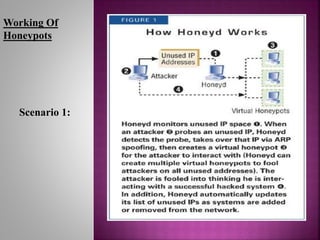
 The honeypot is a computer system running on the
Internet which is used to designed to trap the other people
(hackers) activity who attempt to illegally break into others
computer systems.
Honeypot is mainly induced an attacker to use the
vulnerable systems, in order to learn the type and kind of
attacks.
Another use of honeypots is to delay the attack on the
real target, make the attacker waste time in a honeypot so
that the possibility of a real network services to be detected
is greatly reduced.
Honeypot tools include sensitive monitor & event log.
Event log to detect an intruder to access and collect
information on the activities and the same can be used as
network evidences .
It is highly recommend deploying Snort with any
honeypot. Snort is an OpenSource IDS system that will not
only detect and alert any attacks against your honeypot, but
it can capture the packets and packet payloads involved in
the attack .This information can prove critical in analyzing
the attackers' activities
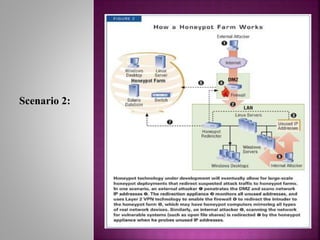
Working Of
Honeypots
Scenario 1:
Scenario 2:
6. COMPARISON
BETWEEN IDS,
FIREWALLAND
HONEYPOT
6.1 Honey pots vs
Firewalls
6.2 Honeypots vs IDS
6.1 Honey pots vs Firewalls
1. A firewall is designed to keep the attackers out of the
network whereas honeypots are designed to entice the
hackers to attack the system.
2. firewalls log activities and logs also contain events
related to production systems. However in case of
honeypot, the logs are only due to non-productive
systems(firewall log contains 1000 entries of all the
systems of the network whereas the honeypots log only
contain 5-10 entries )
6.2 Honeypots vs IDS
1. To detect malicious behavior, NIDS require signatures
of known attacks and often fail to detect compromises
that were unknown at the time it was deployed. On the
other hand, honeypots can detect vulnerabilities that
are not yet understood.
2. Forensic analysis of data collected from honeypots is
less likely to lead to false positives than data collected
by NIDS.
3. IDS often depend upon signature matching or
statistical models to identify attacks & honeypots are
designed to capture all known and unknown attacks .
7. Advantages Of
Honeypots
1. Honeypots can capture attacks and give information
about the attack type and if needed .
2. It helps to understand more attacks that may happen.
3. Focusing only on the malicious traffic makes the
investigation far easier.
4. there is no need for huge data storage
5. Any computer can be used as a honeypot system. (also
cost effective in order to built honepot)
8. Disadvantages
Of Honeypots
1. We can only capture data when the hacker is attacking
the system actively.
2. If there is an attack occuring in another system, our
honeypot will not be able to identify it
3. There is fingerprinting disadvantage of honeypots. It is
easy for an experienced hacker to understand if he is
attacking a honeypot system or a real system
4. The honeypot may be used as a zombie to reach other
systems and compromise them
9. APPLICATION
(a) Honeypot can be used in Cyber Crime Investigation
and Network Forensic System .
(b) Honeypot security system is using for e-banking
(c) Honeypot is used to Prevent DDos Attacks in Cloud.
(d) It is used in cloud computing to prevent data to be
stolen by intruder.
Computer crimes are increasing day by day so
countermeasures are developed to detect or prevent
attacks - most of these measures are based on known
facts, known attack patterns. By knowing attack strategies
countermeasures can be improved and vulnerabilities can
be fixed. Honeypot comes into play for such purposes.
“Honey pots :study the trail of hackers and to alert
network administrators of a possible intrusion . The
traditional approach to security so honey pot is adopted by
organizations.”
10. CONCLUSION
HONEYPOTS: Definition, working, advantages, disadvantages

HONEYPOTS: Definition, working, advantages, disadvantages

  • 1.
    Presented By : 1.AMIT KUMAR (2017AN-02) 2. KARISHMA SAPKALE (2017AN-17) NETWORK MANAGEMENT & SECURITY TOPIC
  • 2.
    TABLE OF CONTENTS 1. Introduction 2.Litrature Review 3. The security techniques for networking 3.1 Intrusion detection system 3.2 Firewall 4. The idea of honeypots 5. Working of honeypot 6. Comparison between IDS, firewall and Honeypot to Provide Security 6.1 Honeypots vs firewall 6.2 Honeypots vs IDS 7. Advantages of honeypots 8. Disadvantages of honeypots 9. Application of honepots 10. Conclusion
  • 3.
    1. INTRODUCTION The idea of honeypots began in 1991 with two publications, 1.“The Cuckoos Egg” and 2. “An Evening with Breford”. “The Cuckoos Egg” by Clifford Stoll was about his experience catching a computer hacker that was in his corporation searching for secrets. “An Evening with Berferd” by Bill Chewick is about a computer hacker’s moves through traps that he and his colleagues used to catch him.  Lance Spitzner, key member of a research group in the United States called Project Honeynet, defines the term honeypot. The main goals are the distraction of an attacker and the gain of information about an attack and the attacker. Honeypot is a trap means "trap" people who attempt to penetrate other person‟s computer systems. What it is ?????? HONEYPOT It is a computer system on the Internet that is expressly set up to attract and "trap" people who attempt to penetrate other people's computer systems.
  • 4.
    2. LITRATURE REVIEW  Thefirst type of honeypot was released in 1997 called the Deceptive Toolkit. In 1998 the first commercial honeypot came out. This was called Cybercop Sting. In 2002 the honeypot could be shared and used all over the world In the year, 2005, The Philippine Honeypot Project was started to promote computer safety over in the Philippines There are number of techniques has been used for network security . 1. The IDS 2. The Simulating Networks with Honeyd is proposed 3. The Official Nmap Project Guide to Network Discovery and Security Scanning is proposed 4. Firewall There are several papers have been explored on the honeypot, to secure data over cloud in paper. There is also paper on honeypot using artificial intelligence. Some papers discusses about the concept of hybrid honeypot
  • 5.
    3.THE SECURITY TECHNIQUES FOR NETWORKING 3.1 INTRUSION DETECTION SYSTEM 3.2FIREWALL SECURITY 3.1 Intrusion Detection System 1. Intrusion detection system silently monitor the network’s traffic and give the alerts to administrator 2. A number of issues were with IDS too as facing with an increasing number of false negatives and false positives. 3. The IDS consists of several elements where the main element is a sensor, the mechanism for analysis, responsible for intrusion detection 4. The sensor receives data from three main sources of information: (a) the IDS knowledge database, (b) system logs , (c) audit trails. 5. The layered-integrated model (integrated IDS +Layered IDS). This model was mainly proposed to solve two major concerns related to cloud computing, that are log management and high performance intrusion detection
  • 6.
    (a) IDS areeasier to deploy as it does not affect existing systems or infrastructure. (b) Network based IDS sensors can detect many attacks by checking the packet headers for any malicious attack like TCP SYN attack, fragmented packet attack etc. (c) IDS monitor traffic on a real time. So, network based IDS can detect malicious activity as they occur. (a) IDS is not an alternative to strong user identification and authentication mechanism. (b) IDS is not a solution to all security concerns. (c) False positives occur when IDS incorrectly identifies normal activity as being malicious, False negatives occur when IDS fails to detect the malicious activity . Advantages of IDS Disadvantages of IDS
  • 7.
    3.2 Firewall security 1.A firewall is a combination of hardware and software that allows some packets to pass and blocking others. 2. It functions to avoid unauthorized or illegal sessions established to the devices in the network areas it protects. 3. Firewalls are configured to protect against unauthenticated interactive logins from the outside world. 4. The firewall can be thought of as a pair of mechanisms: one which exists to block traffic, and the other which exists to permit traffic. 5. Administrators that manage the firewalls have a have to be careful while setting the firewall rules.
  • 8.
    (a) Firewalls canprevent the traffic which is non- legitimate. (b) A firewall helps protecting the internal network by hiding names of internal systems from the outside hosts. (a) Firewalls use set of rules that are manually configured to differentiate legitimate traffic from non-legitimate traffic. (b) Firewalls cannot prevent attacks coming from Intranet. Advantages of Firewalls: Disadvantages of Firewalls:
  • 9.
    4. THE IDEAOF HONEYPOTS  The two main reasons why honeypots are deployed : 1. probe and attempt to gain access to your systems and 2. gain insight into attack methodologies to better protect real production systems.  There are two categories of honeypots – 1. production honeypots and 2. research honeypots. A production honeypot is used to help mitigate risk in an organization while research, is meant to gather as much information as possible.  Honeypots do not add any security value to an organization, but they can help to understand the blackhat community and their attacks as well as to build some better defenses against security threats .  Honeypots do not solve a specific problem. They can be used everything from slowing down or stopping automated attacks, capturing new exploits for early warning and prediction.
  • 10.
    Types of Honeypot Honeypots come in many different shapes and sizes. They can be everything from a Windows program that emulates common services, such as the Windows honeypot KFSensor3, to entire networks of real computers to be attacked, such as Honeynet .
  • 11.
    5. WORKING OF HONEYPOT  Thehoneypot is a computer system running on the Internet which is used to designed to trap the other people (hackers) activity who attempt to illegally break into others computer systems. Honeypot is mainly induced an attacker to use the vulnerable systems, in order to learn the type and kind of attacks. Another use of honeypots is to delay the attack on the real target, make the attacker waste time in a honeypot so that the possibility of a real network services to be detected is greatly reduced. Honeypot tools include sensitive monitor & event log. Event log to detect an intruder to access and collect information on the activities and the same can be used as network evidences . It is highly recommend deploying Snort with any honeypot. Snort is an OpenSource IDS system that will not only detect and alert any attacks against your honeypot, but it can capture the packets and packet payloads involved in the attack .This information can prove critical in analyzing the attackers' activities
  • 12.
  • 13.
  • 14.
    6. COMPARISON BETWEEN IDS, FIREWALLAND HONEYPOT 6.1Honey pots vs Firewalls 6.2 Honeypots vs IDS 6.1 Honey pots vs Firewalls 1. A firewall is designed to keep the attackers out of the network whereas honeypots are designed to entice the hackers to attack the system. 2. firewalls log activities and logs also contain events related to production systems. However in case of honeypot, the logs are only due to non-productive systems(firewall log contains 1000 entries of all the systems of the network whereas the honeypots log only contain 5-10 entries )
  • 15.
    6.2 Honeypots vsIDS 1. To detect malicious behavior, NIDS require signatures of known attacks and often fail to detect compromises that were unknown at the time it was deployed. On the other hand, honeypots can detect vulnerabilities that are not yet understood. 2. Forensic analysis of data collected from honeypots is less likely to lead to false positives than data collected by NIDS. 3. IDS often depend upon signature matching or statistical models to identify attacks & honeypots are designed to capture all known and unknown attacks .
  • 16.
    7. Advantages Of Honeypots 1.Honeypots can capture attacks and give information about the attack type and if needed . 2. It helps to understand more attacks that may happen. 3. Focusing only on the malicious traffic makes the investigation far easier. 4. there is no need for huge data storage 5. Any computer can be used as a honeypot system. (also cost effective in order to built honepot) 8. Disadvantages Of Honeypots 1. We can only capture data when the hacker is attacking the system actively. 2. If there is an attack occuring in another system, our honeypot will not be able to identify it 3. There is fingerprinting disadvantage of honeypots. It is easy for an experienced hacker to understand if he is attacking a honeypot system or a real system 4. The honeypot may be used as a zombie to reach other systems and compromise them
  • 17.
    9. APPLICATION (a) Honeypotcan be used in Cyber Crime Investigation and Network Forensic System . (b) Honeypot security system is using for e-banking (c) Honeypot is used to Prevent DDos Attacks in Cloud. (d) It is used in cloud computing to prevent data to be stolen by intruder. Computer crimes are increasing day by day so countermeasures are developed to detect or prevent attacks - most of these measures are based on known facts, known attack patterns. By knowing attack strategies countermeasures can be improved and vulnerabilities can be fixed. Honeypot comes into play for such purposes. “Honey pots :study the trail of hackers and to alert network administrators of a possible intrusion . The traditional approach to security so honey pot is adopted by organizations.” 10. CONCLUSION