Intrusion Detection and Hackers ExploitsIntrusion Detection and Hackers Exploits
IP Spoofing AttackIP Spoofing Attack
))ANAND KUMAR MISHRAANAND KUMAR MISHRA((
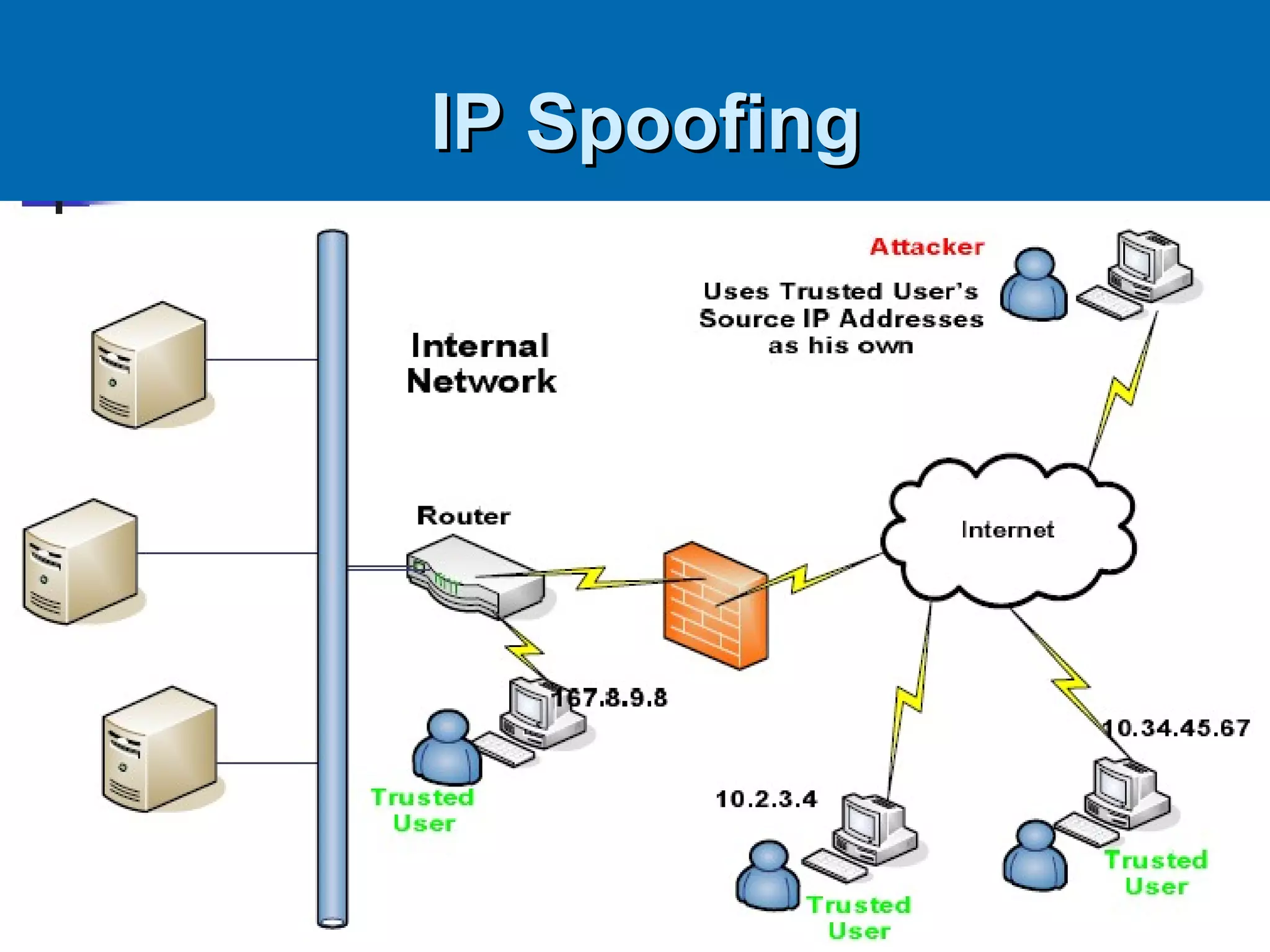
IP spoofingIP spoofing
 IP spoofing is a technique used to gainIP spoofing is a technique used to gain
unauthorized access to computers, where by theunauthorized access to computers, where by the
attacker sends messages to a computer with aattacker sends messages to a computer with a
forging IP address indicating that the message isforging IP address indicating that the message is
coming from a trusted host.coming from a trusted host.
 Attacker puts an internal, or trusted, IP addressAttacker puts an internal, or trusted, IP address
as its source. The access control device seesas its source. The access control device sees
the IP address as trusted and lets it through.the IP address as trusted and lets it through.
IP SpoofingIP Spoofing

IP spoofing occurs when a hacker inside or outside aIP spoofing occurs when a hacker inside or outside a
network impersonates the conversations of a trustednetwork impersonates the conversations of a trusted
computer.computer.

Two general techniques are used during IP spoofing:Two general techniques are used during IP spoofing:
• A hacker uses an IP address that is within the rangeA hacker uses an IP address that is within the range
of trusted IP addresses.of trusted IP addresses.
• A hacker uses an authorized external IP address thatA hacker uses an authorized external IP address that
is trusted.is trusted.

Uses for IP spoofing include the following:Uses for IP spoofing include the following:
• IP spoofing is usually limited to the injection ofIP spoofing is usually limited to the injection of
malicious data or commands into an existing streammalicious data or commands into an existing stream
of data.of data.
• A hacker changes the routing tables to point to theA hacker changes the routing tables to point to the
spoofed IP address, then the hacker can receive allspoofed IP address, then the hacker can receive all
the network packets that are addressed to thethe network packets that are addressed to the
spoofed address and reply just as any trusted userspoofed address and reply just as any trusted user
can.can.
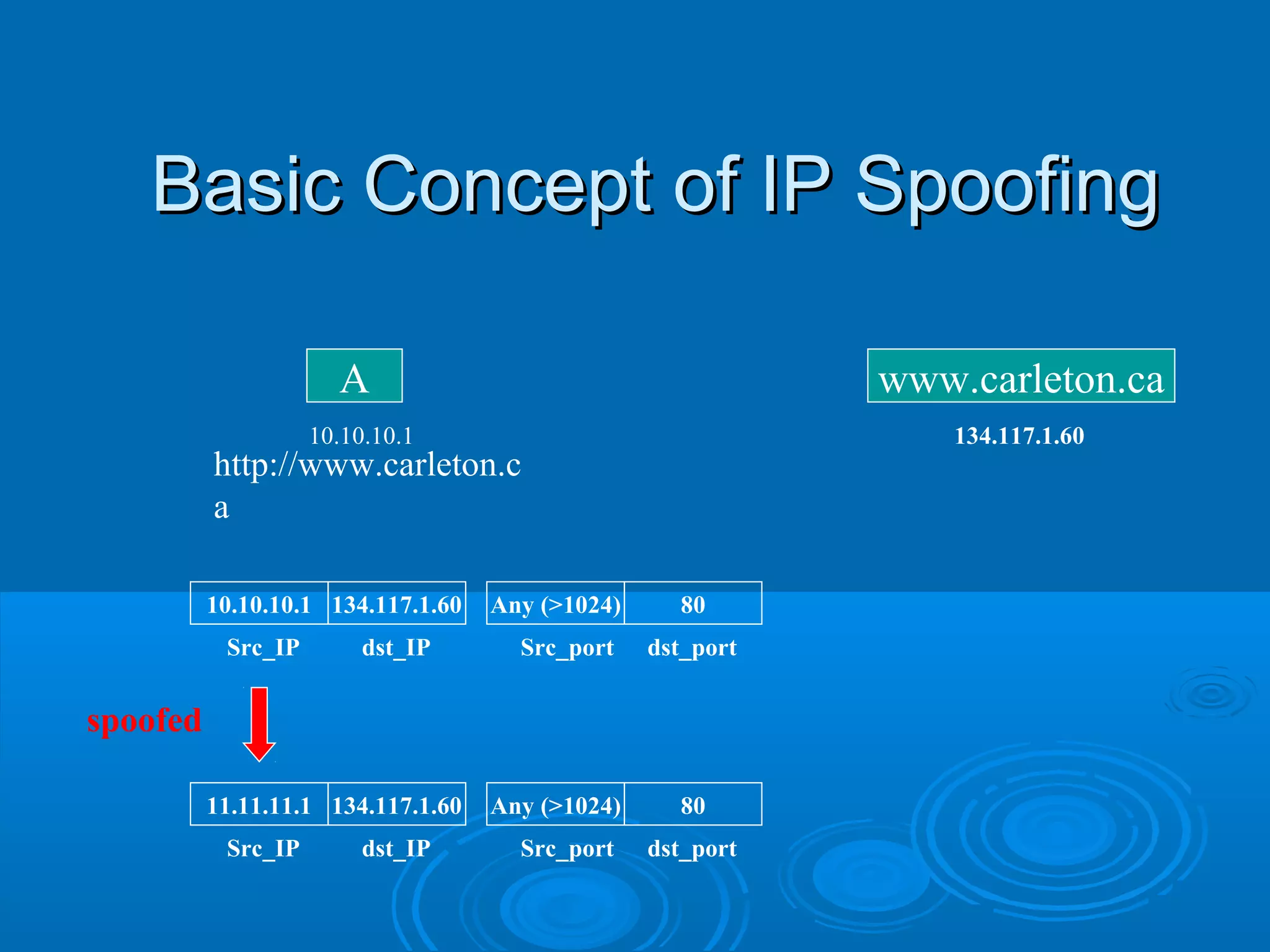
Basic Concept of IP SpoofingBasic Concept of IP Spoofing
A
10.10.10.1
www.carleton.ca
134.117.1.60
http://www.carleton.c
a
10.10.10.1
Src_IP
134.117.1.60
dst_IP
Any (>1024)
Src_port
80
dst_port
11.11.11.1
Src_IP
134.117.1.60
dst_IP
Any (>1024)
Src_port
80
dst_port
spoofed
IP SpoofingIP Spoofing
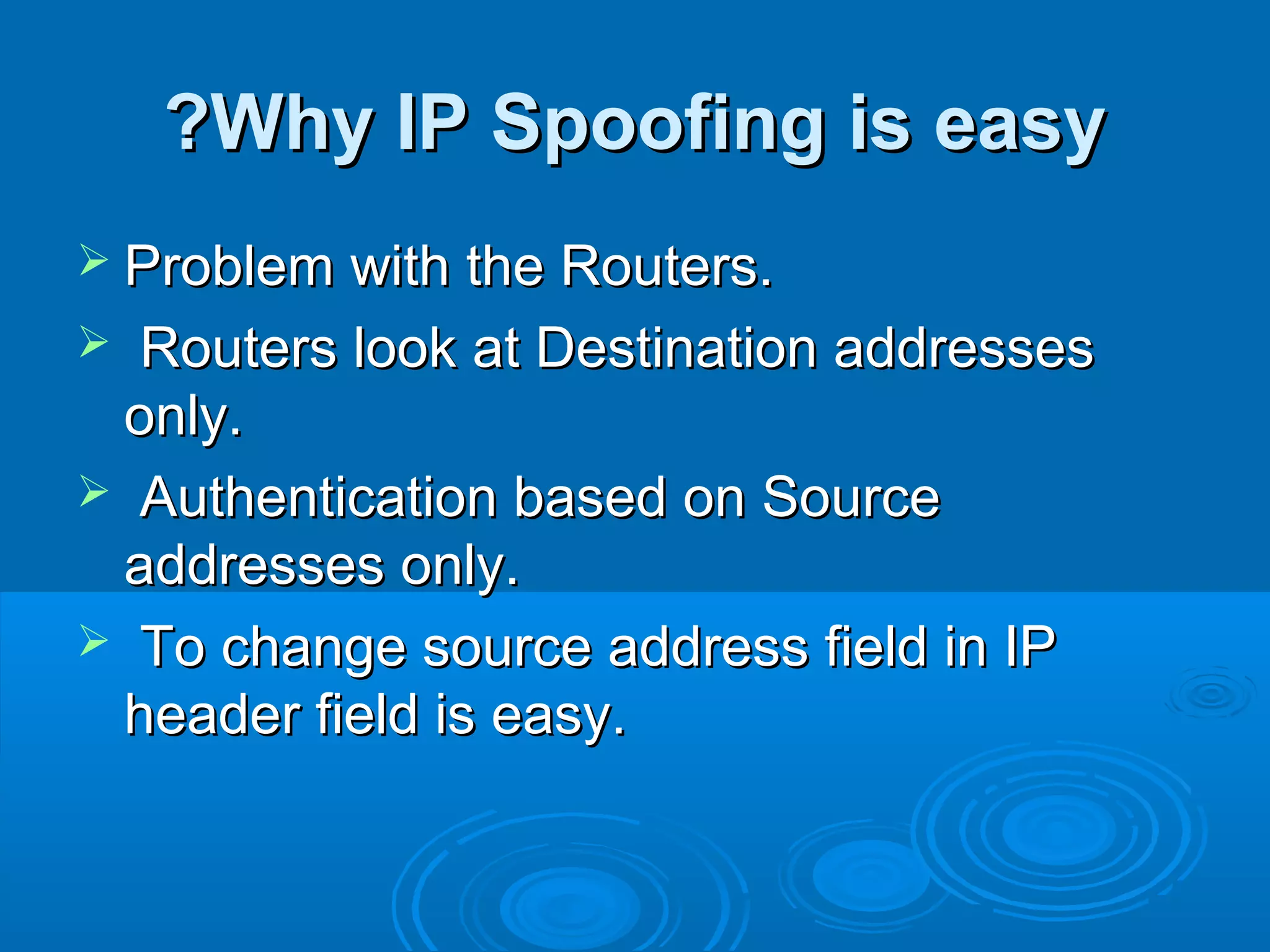
Why IP Spoofing is easyWhy IP Spoofing is easy??
 Problem with the Routers.Problem with the Routers.
 Routers look at Destination addressesRouters look at Destination addresses
only.only.
 Authentication based on SourceAuthentication based on Source
addresses only.addresses only.
 To change source address field in IPTo change source address field in IP
header field is easy.header field is easy.
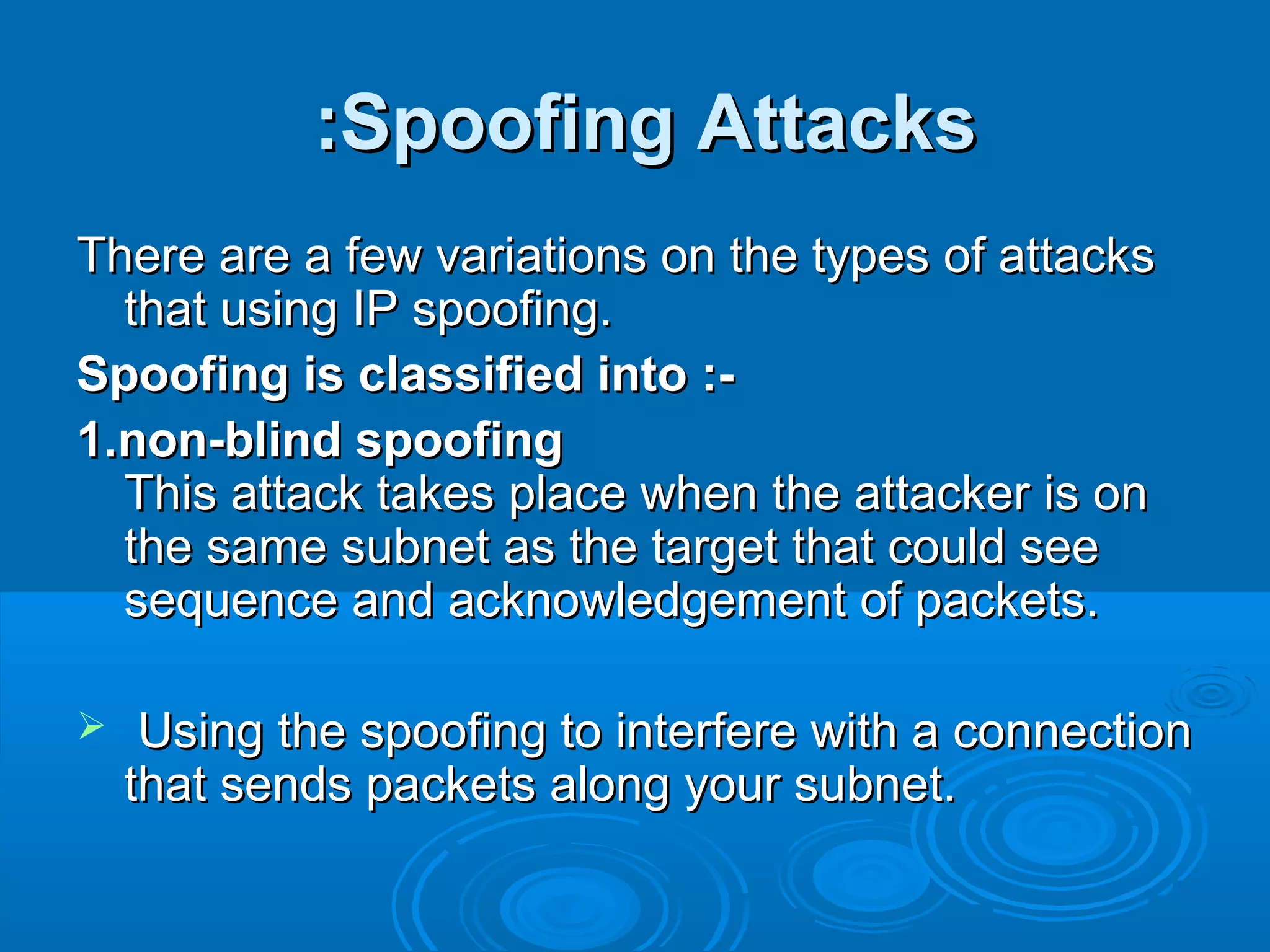
Spoofing AttacksSpoofing Attacks::
There are a few variations on the types of attacksThere are a few variations on the types of attacks
that using IP spoofing.that using IP spoofing.
Spoofing is classified into :-Spoofing is classified into :-
1.non-blind spoofing1.non-blind spoofing
This attack takes place when the attacker is onThis attack takes place when the attacker is on
the same subnet as the target that could seethe same subnet as the target that could see
sequence and acknowledgement of packets.sequence and acknowledgement of packets.
 Using the spoofing to interfere with a connectionUsing the spoofing to interfere with a connection
that sends packets along your subnet.that sends packets along your subnet.
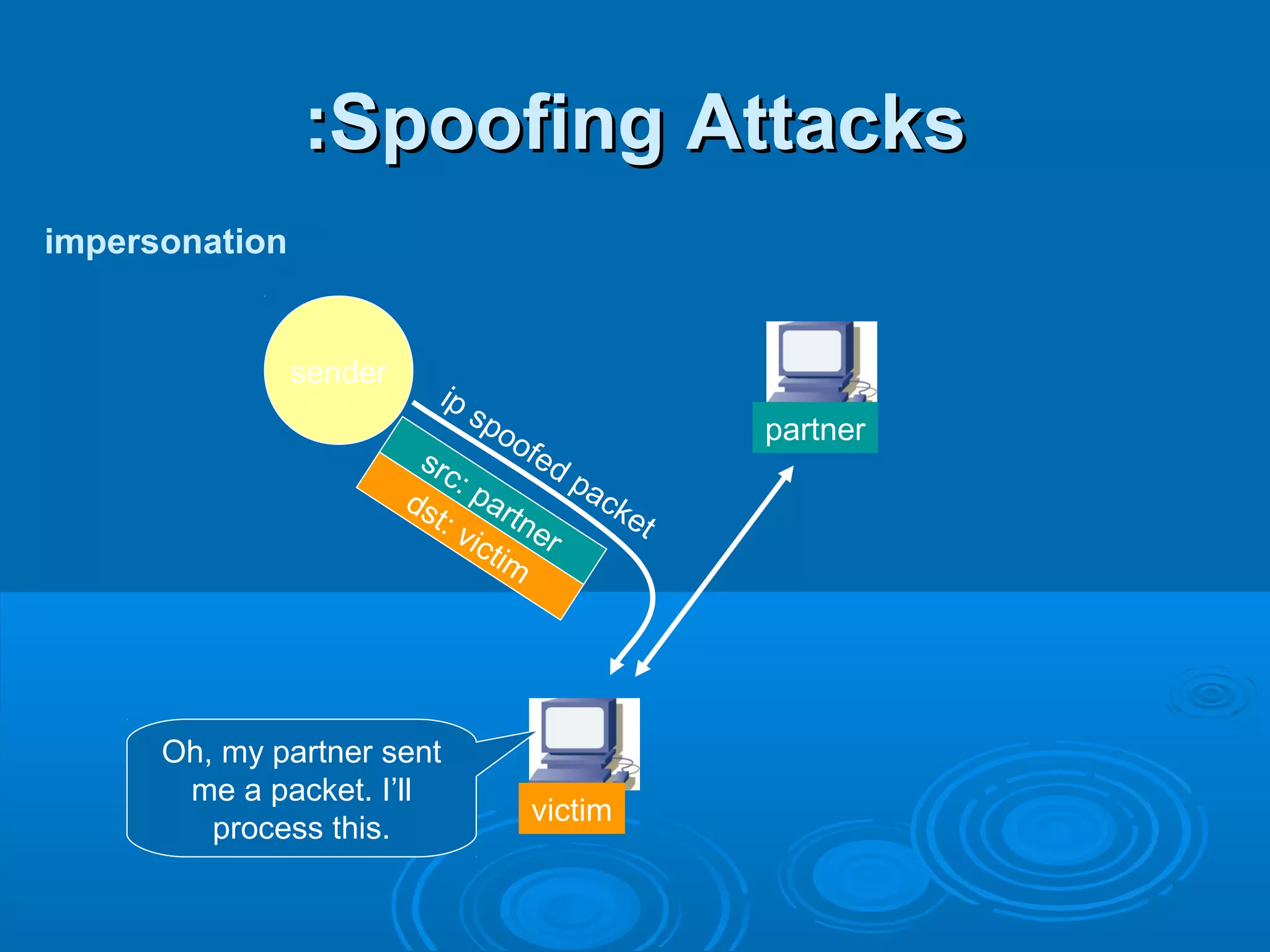
Spoofing AttacksSpoofing Attacks::
sender
ip spoofed packet
victim
partner
dst: victim
src: partner
Oh, my partner sent
me a packet. I’ll
process this.
impersonation
IP Spoofing
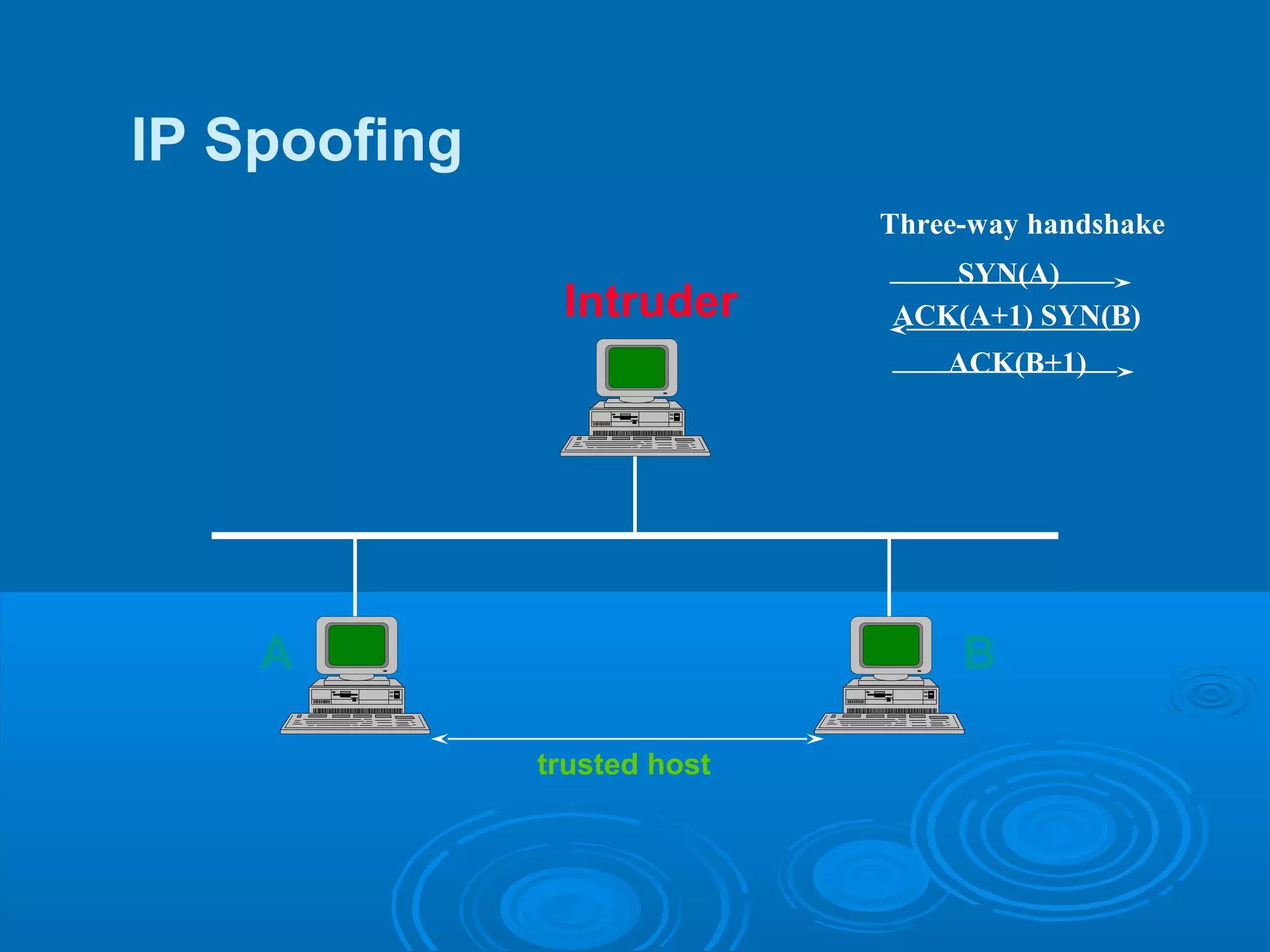
trusted host
A B
Intruder
Three-way handshake
SYN(A)
ACK(A+1) SYN(B)
ACK(B+1)
Spoofing AttacksSpoofing Attacks::
2. Blind spoofing2. Blind spoofing
This attack may take place from outside whereThis attack may take place from outside where
sequence and acknowledgement numbers aresequence and acknowledgement numbers are
unreachable. Attackers usually send severalunreachable. Attackers usually send several
packets to the target machine in order to samplepackets to the target machine in order to sample
sequence numbers, which is doable in oldersequence numbers, which is doable in older
days .days .
 Using the spoofing to interfere with a connectionUsing the spoofing to interfere with a connection
(or creating one), that does not send packets(or creating one), that does not send packets
along your cable.along your cable.
Spoofing AttacksSpoofing Attacks::
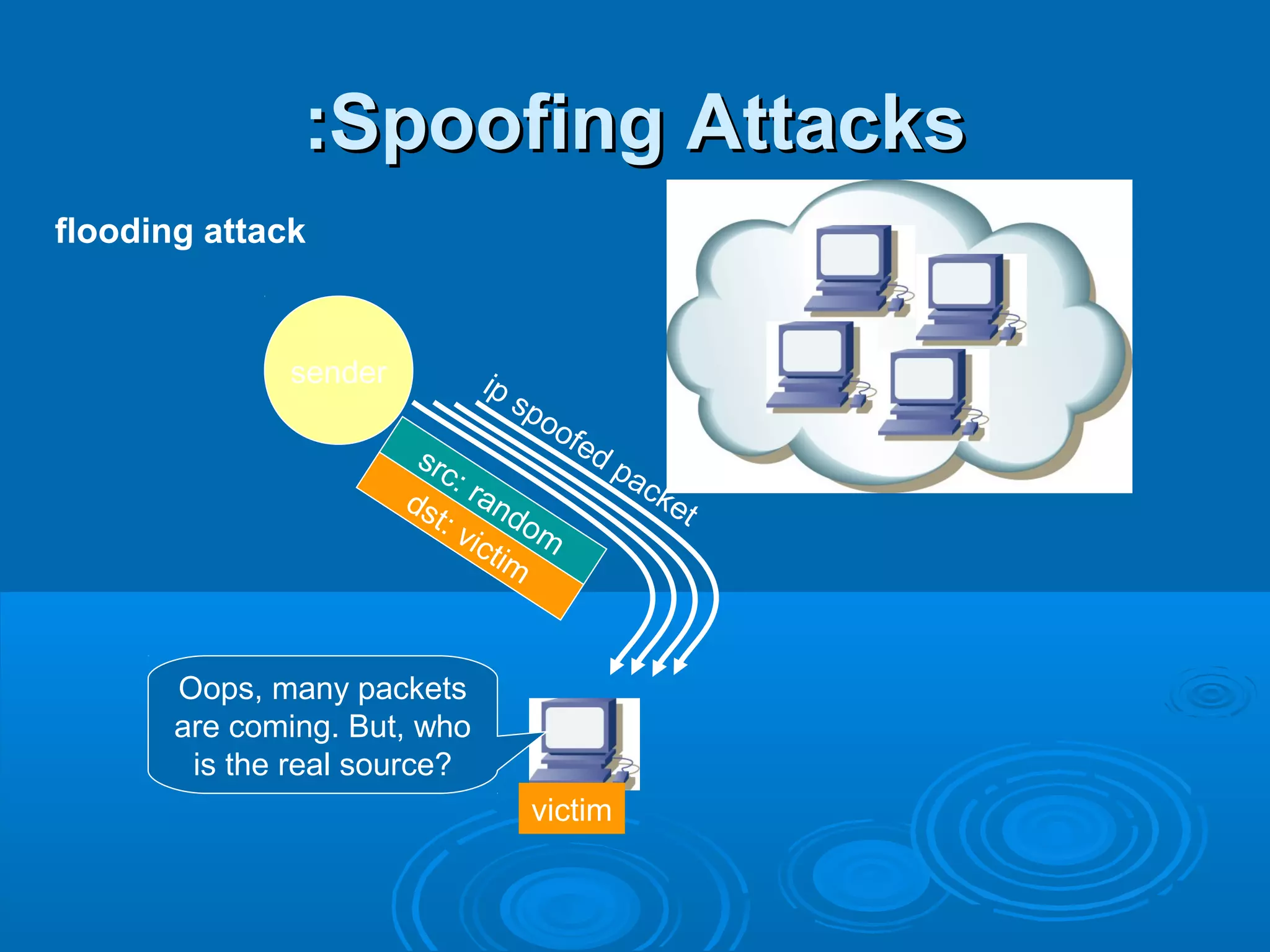
sender
victim
ip spoofed packetdst: victim
src: random
Oops, many packets
are coming. But, who
is the real source?
flooding attack
Spoofing AttacksSpoofing Attacks::
3.Man in the Middle Attack3.Man in the Middle Attack
This is also called connection hijacking. InThis is also called connection hijacking. In
this attacks, a malicious party intercepts athis attacks, a malicious party intercepts a
legitimate communication between twolegitimate communication between two
hosts to controls the flow ofhosts to controls the flow of
communication and to eliminate or altercommunication and to eliminate or alter
the information sent by one of the originalthe information sent by one of the original
participants without their knowledge.participants without their knowledge.
Spoofing AttacksSpoofing Attacks::
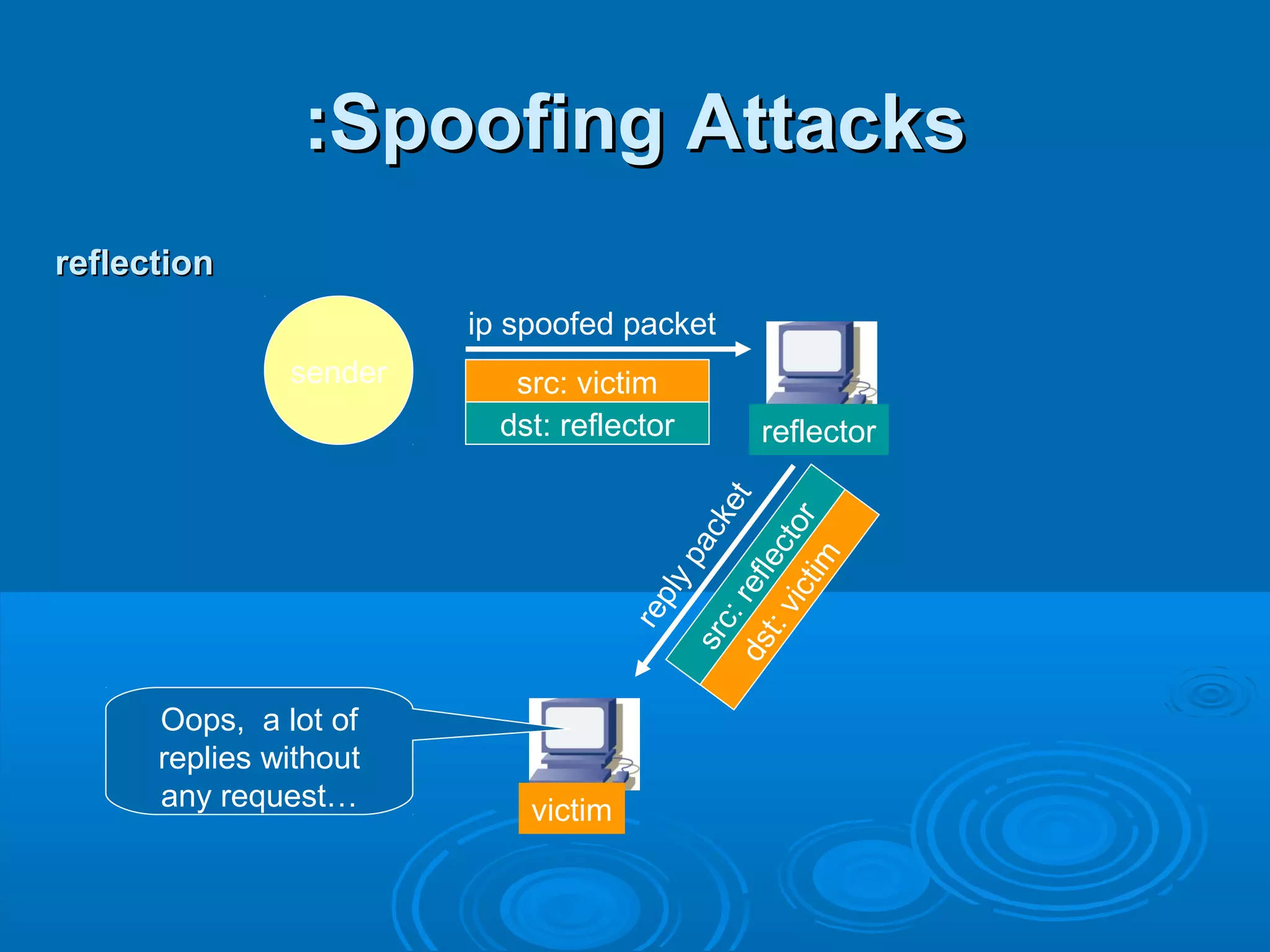
sender
ip spoofed packet
replypacket
victim
reflector
src: victim
dst: reflector
dst:victim
src:reflector
Oops, a lot of
replies without
any request…
reflectionreflection
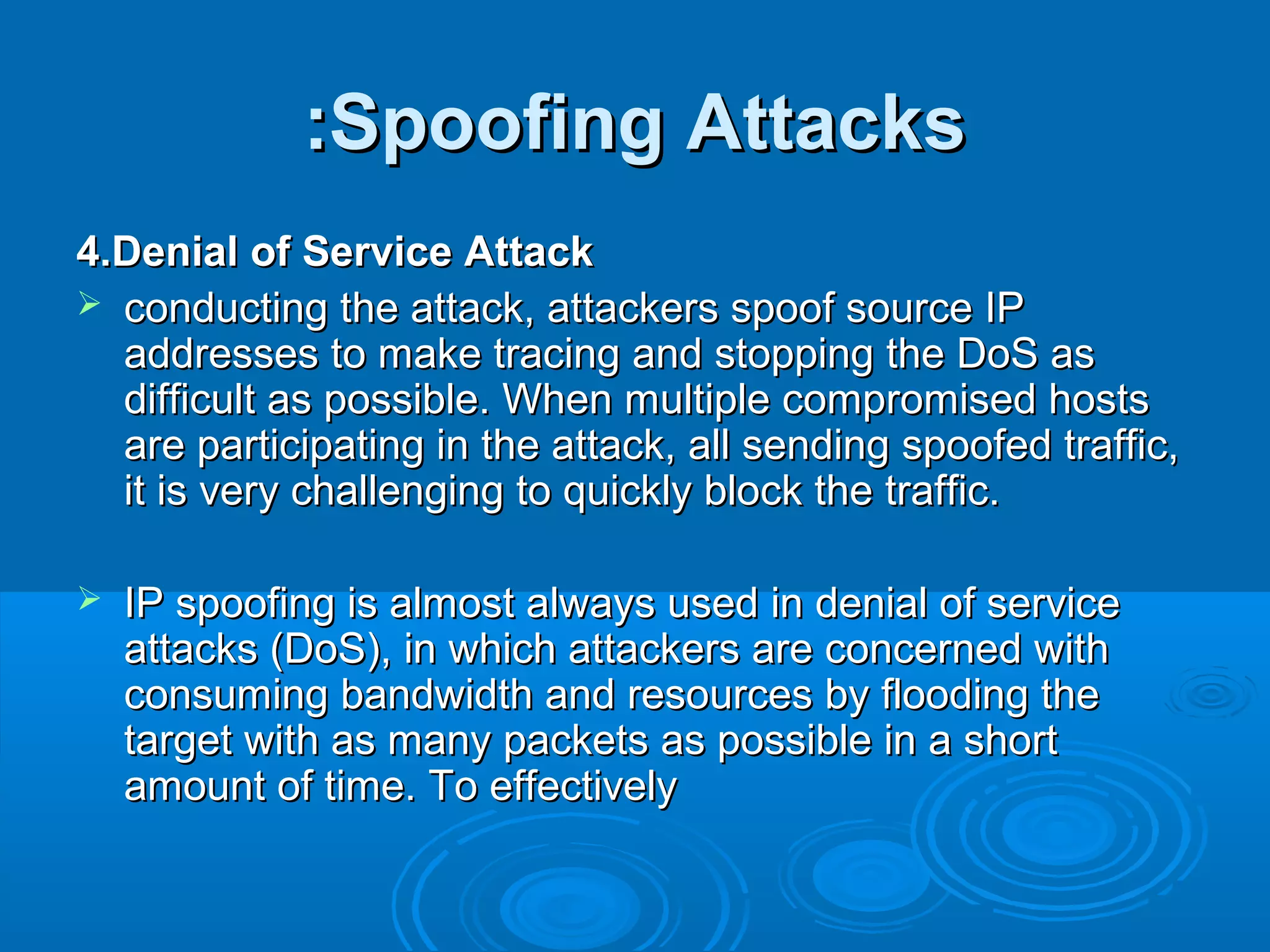
Spoofing AttacksSpoofing Attacks::
4.Denial of Service Attack4.Denial of Service Attack
 conducting the attack, attackers spoof source IPconducting the attack, attackers spoof source IP
addresses to make tracing and stopping the DoS asaddresses to make tracing and stopping the DoS as
difficult as possible. When multiple compromised hostsdifficult as possible. When multiple compromised hosts
are participating in the attack, all sending spoofed traffic,are participating in the attack, all sending spoofed traffic,
it is very challenging to quickly block the traffic.it is very challenging to quickly block the traffic.
 IP spoofing is almost always used in denial of serviceIP spoofing is almost always used in denial of service
attacks (DoS), in which attackers are concerned withattacks (DoS), in which attackers are concerned with
consuming bandwidth and resources by flooding theconsuming bandwidth and resources by flooding the
target with as many packets as possible in a shorttarget with as many packets as possible in a short
amount of time. To effectivelyamount of time. To effectively
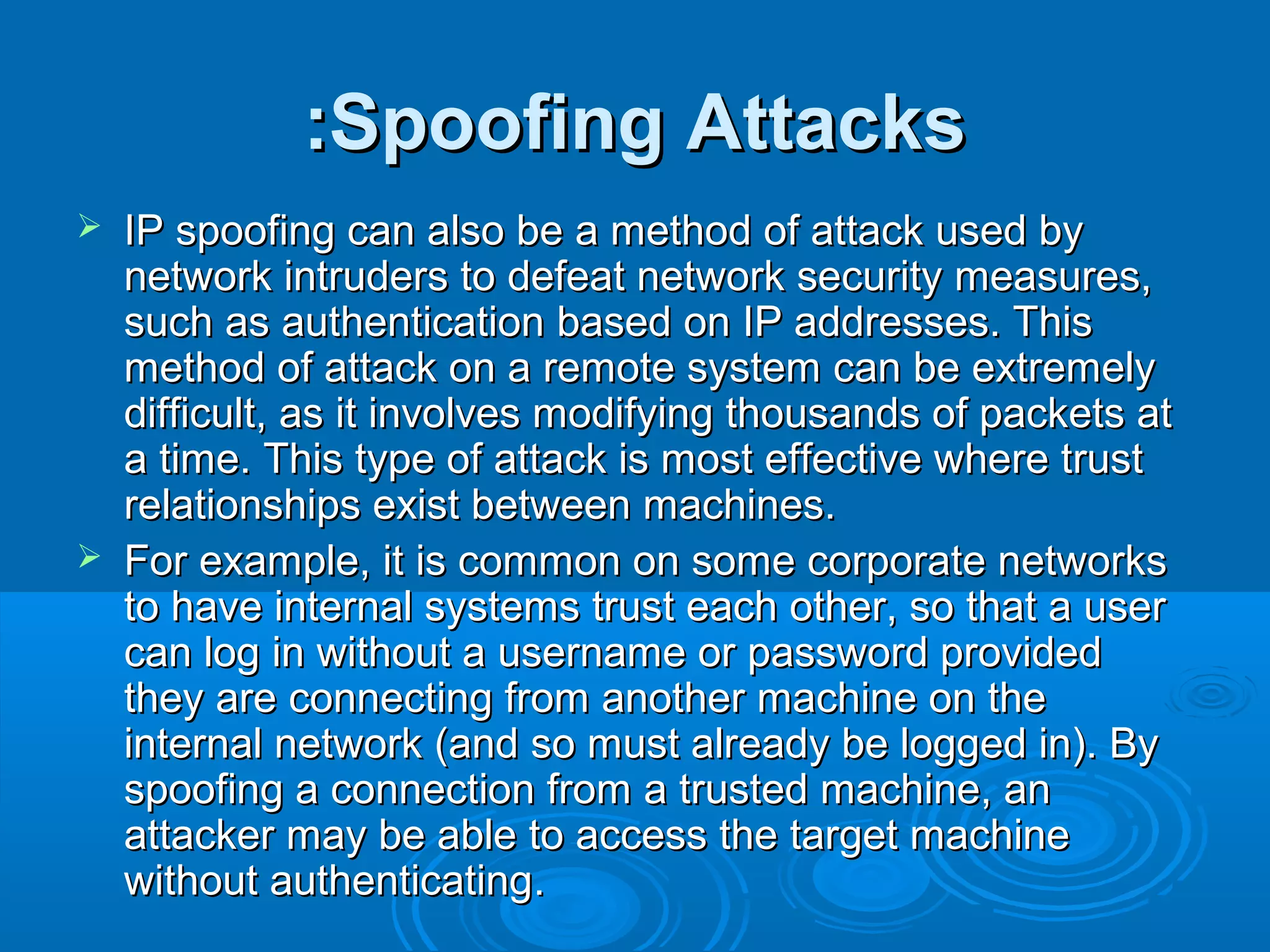
Spoofing AttacksSpoofing Attacks::
 IP spoofing can also be a method of attack used byIP spoofing can also be a method of attack used by
network intruders to defeat network security measures,network intruders to defeat network security measures,
such assuch as authenticationauthentication based on IP addresses. Thisbased on IP addresses. This
method of attack on a remote system can be extremelymethod of attack on a remote system can be extremely
difficult, as it involves modifying thousands of packets atdifficult, as it involves modifying thousands of packets at
a time. This type of attack is most effective where trusta time. This type of attack is most effective where trust
relationships exist between machines.relationships exist between machines.
 For example, it is common on some corporate networksFor example, it is common on some corporate networks
to have internal systems trust each other, so that a userto have internal systems trust each other, so that a user
can log in without a username or password providedcan log in without a username or password provided
they are connecting from another machine on thethey are connecting from another machine on the
internal network (and so must already be logged in). Byinternal network (and so must already be logged in). By
spoofing a connection from a trusted machine, anspoofing a connection from a trusted machine, an
attacker may be able to access the target machineattacker may be able to access the target machine
without authenticatingwithout authenticating..
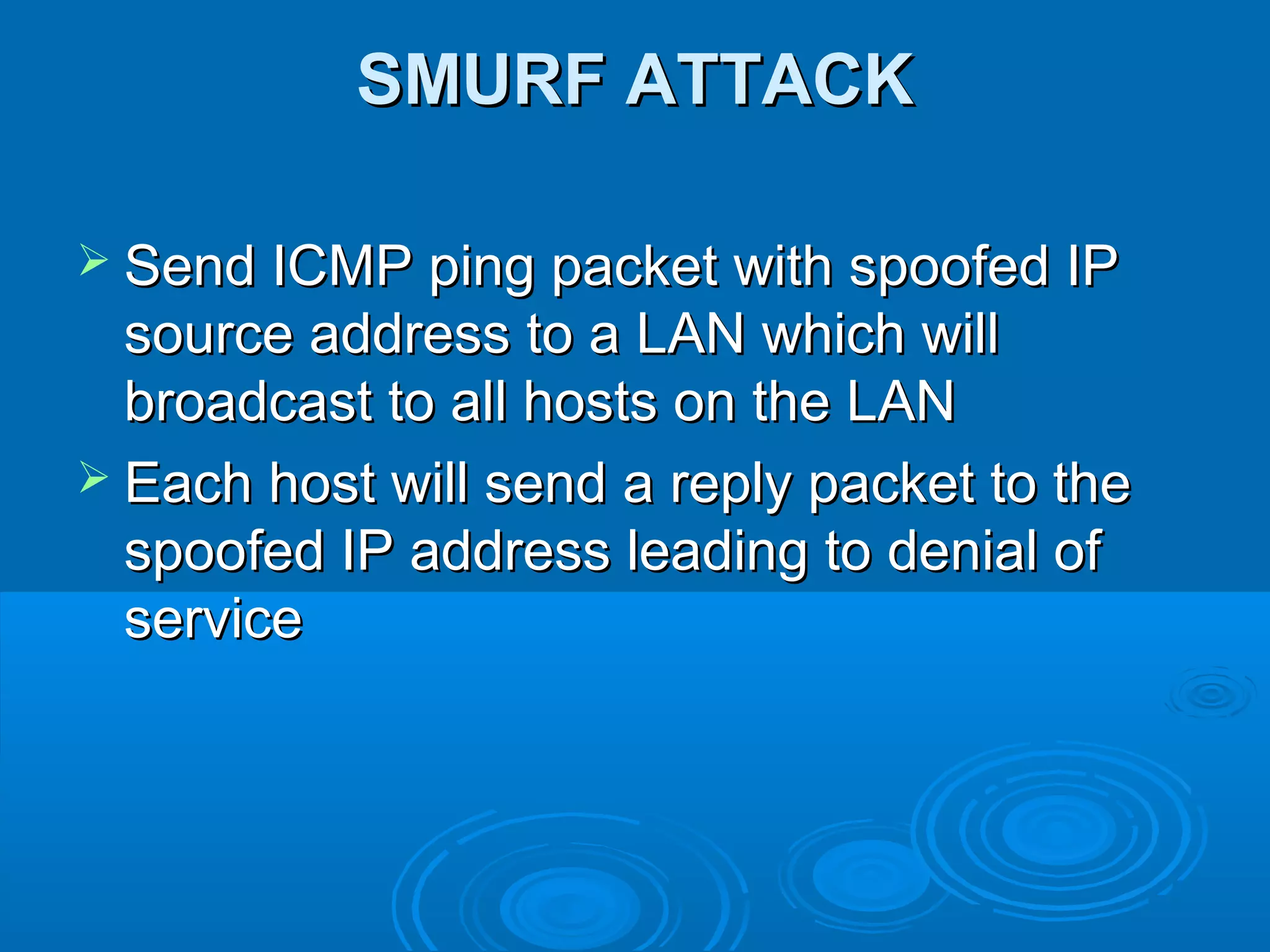
SMURF ATTACKSMURF ATTACK
 Send ICMP ping packet with spoofed IPSend ICMP ping packet with spoofed IP
source address to a LAN which willsource address to a LAN which will
broadcast to all hosts on the LANbroadcast to all hosts on the LAN
 Each host will send a reply packet to theEach host will send a reply packet to the
spoofed IP address leading to denial ofspoofed IP address leading to denial of
serviceservice
Misconception of IP SpoofingMisconception of IP Spoofing::
A common misconception is that "IP Spoofing" canA common misconception is that "IP Spoofing" can
be used to hide your IP address while surfing thebe used to hide your IP address while surfing the
Internet, chatting on-line, sending e-mail, and soInternet, chatting on-line, sending e-mail, and so
forth.forth.
This is generally not true. Forging the source IPThis is generally not true. Forging the source IP
address causes the responses to beaddress causes the responses to be
misdirected, meaning you cannot create amisdirected, meaning you cannot create a
normal network connection. However, IPnormal network connection. However, IP
spoofing is an integral part of many networksspoofing is an integral part of many networks
that do not need to see responses.that do not need to see responses.
ImpactImpact
Current intruder activity in spoofing sourceCurrent intruder activity in spoofing source
IP addresses can lead to unauthorizedIP addresses can lead to unauthorized
remote root access to systems behind aremote root access to systems behind a
filtering-router firewall. After gaining rootfiltering-router firewall. After gaining root
access and taking over existing terminalaccess and taking over existing terminal
and login connections, intruders can gainand login connections, intruders can gain
access to remote hosts.access to remote hosts.
Detection of IP SpoofingDetection of IP Spoofing::
1. If you monitor packets using network-1. If you monitor packets using network-
monitoring software such as netlog, lookmonitoring software such as netlog, look
for a packet on your external interface thatfor a packet on your external interface that
has both its source and destination IPhas both its source and destination IP
addresses in your local domain. If you findaddresses in your local domain. If you find
one, you are currently under attack.one, you are currently under attack.
Detection of IP SpoofingDetection of IP Spoofing::
2.2. Another way to detect IP spoofing is toAnother way to detect IP spoofing is to
compare the process accounting logscompare the process accounting logs
between systems on your internalbetween systems on your internal
network. If the IP spoofing attack hasnetwork. If the IP spoofing attack has
succeeded on one of your systems, yousucceeded on one of your systems, you
may get a log entry on the victim machinemay get a log entry on the victim machine
showing a remote access; on the apparentshowing a remote access; on the apparent
source machine, there will be nosource machine, there will be no
corresponding entry for initiating thatcorresponding entry for initiating that
remote access.remote access.
Source Address Validation :Source Address Validation :
 Check the source IP address of IPCheck the source IP address of IP
packetspackets

filter invalid source addressfilter invalid source address

filter close to the packets origin as possiblefilter close to the packets origin as possible

filter precisely as possiblefilter precisely as possible
 If no networks allow IP spoofing, we canIf no networks allow IP spoofing, we can
eliminate these kinds of attackseliminate these kinds of attacks
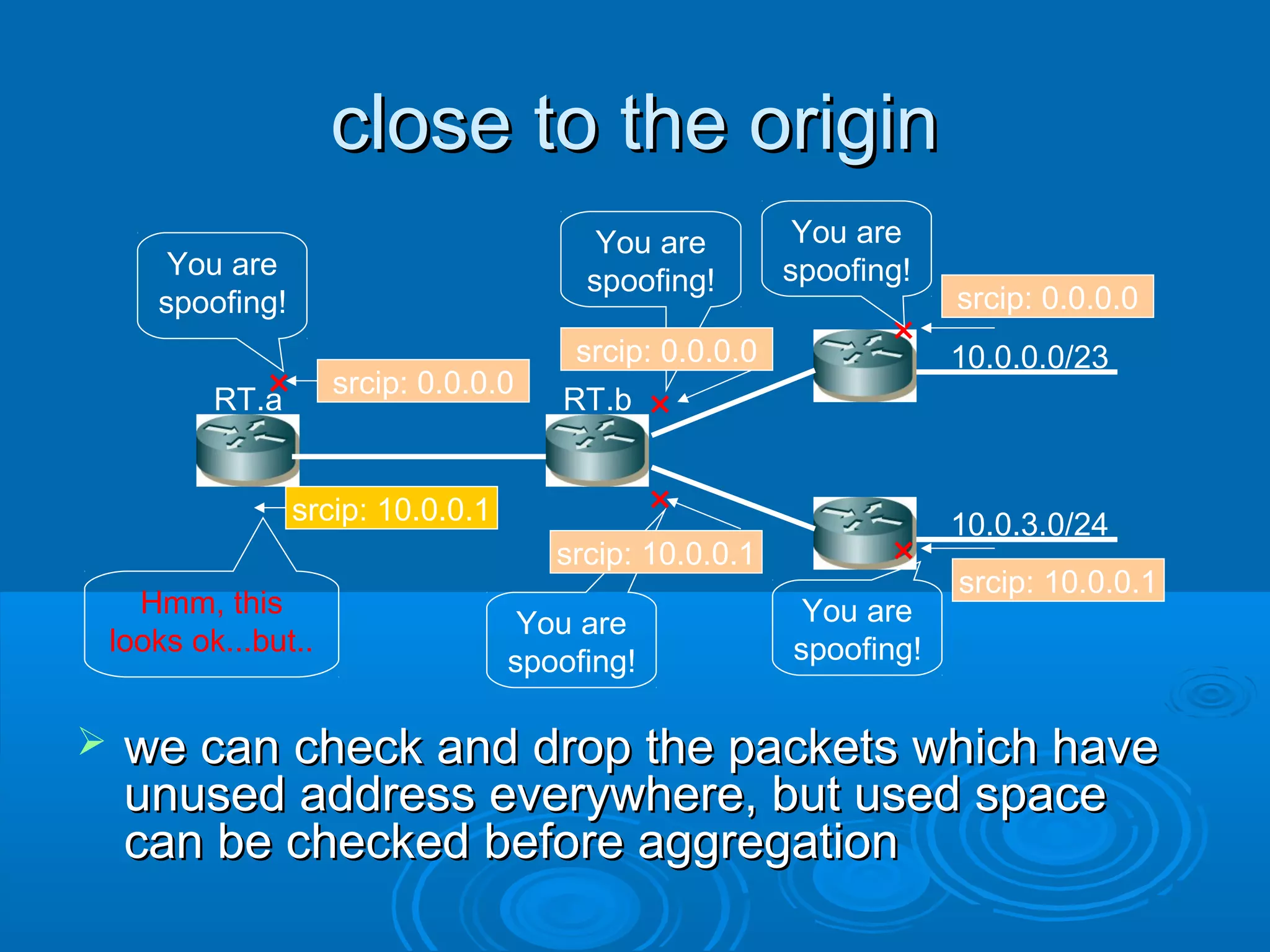
close to the originclose to the origin
 we can check and drop the packets which havewe can check and drop the packets which have
unused address everywhere, but used spaceunused address everywhere, but used space
can be checked before aggregationcan be checked before aggregation
10.0.0.0/23
10.0.3.0/24
You are
spoofing!
Hmm, this
looks ok...but..
RT.a RT.b
You are
spoofing!
You are
spoofing!
srcip: 10.0.0.1
srcip: 0.0.0.0
srcip: 10.0.0.1
srcip: 0.0.0.0
×
×
×
srcip: 0.0.0.0
×
You are
spoofing!
srcip: 10.0.0.1
×
You are
spoofing!
PreventionPrevention IP spoofingIP spoofing
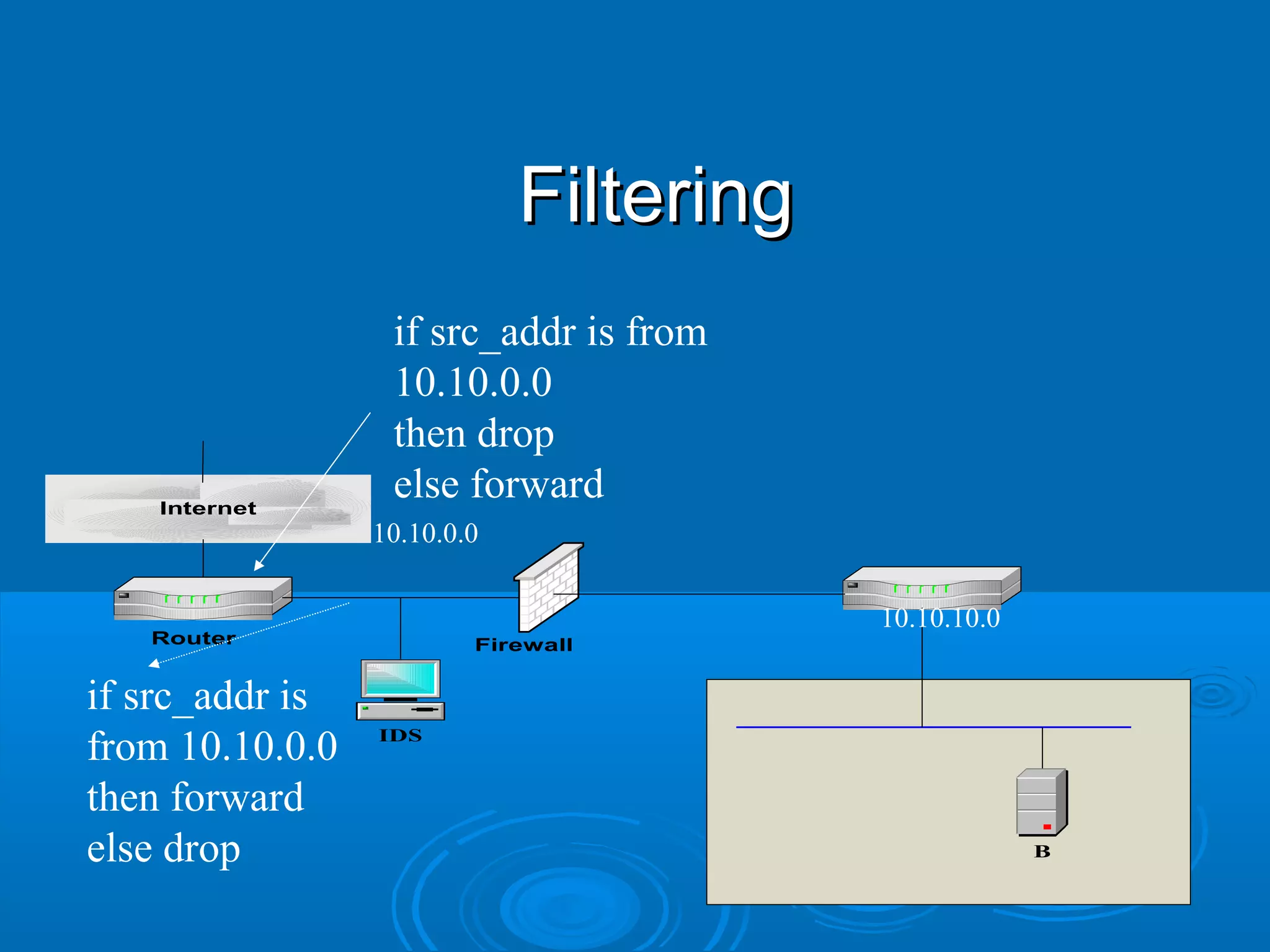
The best method of preventing the IP spoofingThe best method of preventing the IP spoofing
problem is to install a filtering router that restrictsproblem is to install a filtering router that restricts
the input to your external interface (known as anthe input to your external interface (known as an
input filter) by not allowing a packet through if itinput filter) by not allowing a packet through if it
has a source address from your internalhas a source address from your internal
network. In addition, you should filter outgoingnetwork. In addition, you should filter outgoing
packets that have a source address differentpackets that have a source address different
from your internal network in order to prevent afrom your internal network in order to prevent a
source IP spoofing attack originating from yoursource IP spoofing attack originating from your
site.site.
PreventionPrevention IP spoofingIP spoofing
If your vendor’s router does not support filtering onIf your vendor’s router does not support filtering on
the inbound side of the interface or if there willthe inbound side of the interface or if there will
be a delay in incorporating the feature into yourbe a delay in incorporating the feature into your
system, you may filter the spoofed IP packets bysystem, you may filter the spoofed IP packets by
using a second router between your externalusing a second router between your external
interface and your outside connection. Configureinterface and your outside connection. Configure
this router to block, on the outgoing interfacethis router to block, on the outgoing interface
connected to your original router, all packets thatconnected to your original router, all packets that
have a source address in your internal network.have a source address in your internal network.
Prevention of IP SpoofingPrevention of IP Spoofing::
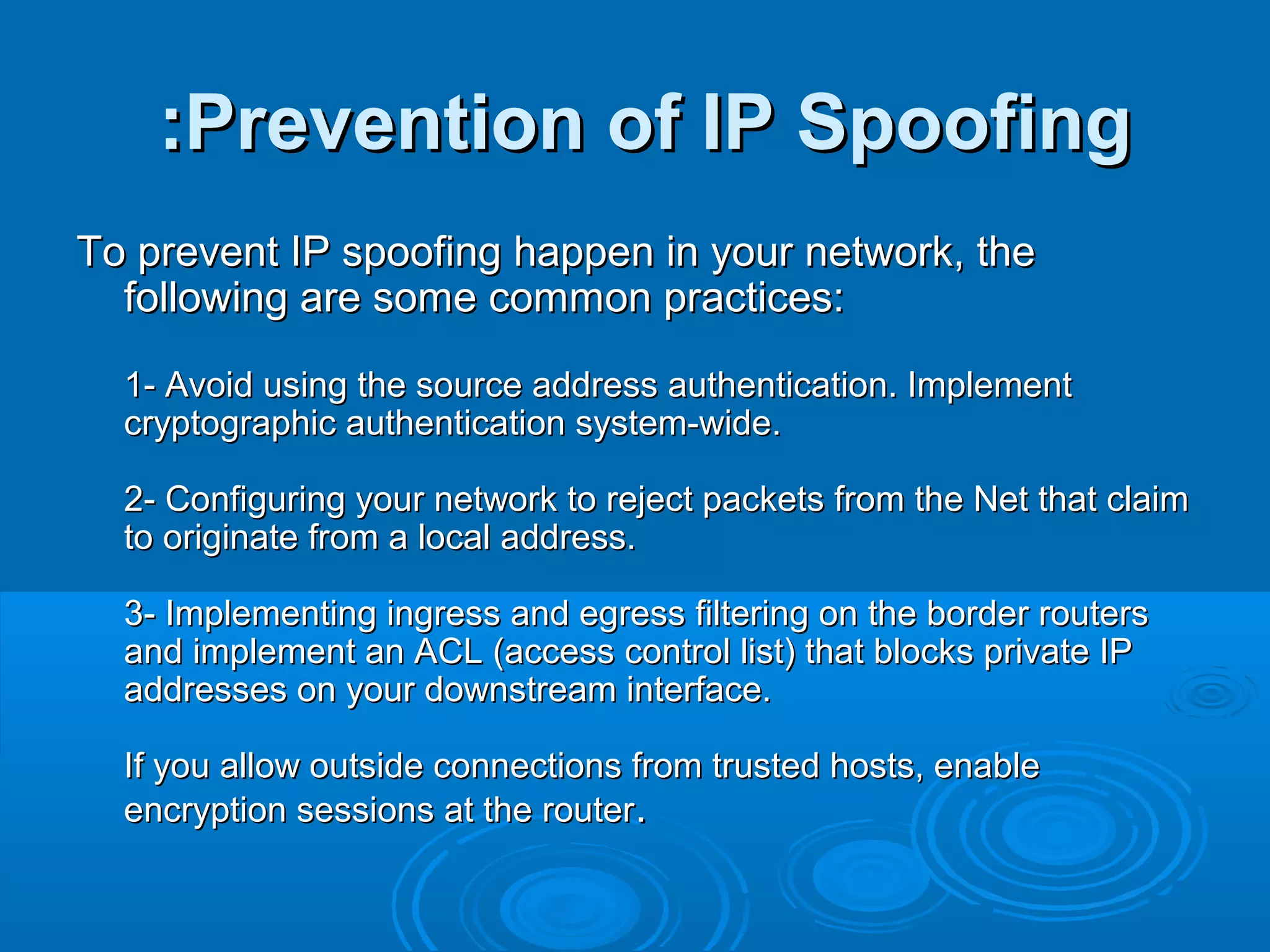
To prevent IP spoofing happen in your network, theTo prevent IP spoofing happen in your network, the
following are some common practices:following are some common practices:
1- Avoid using the source address authentication. Implement1- Avoid using the source address authentication. Implement
cryptographic authentication system-wide.cryptographic authentication system-wide.
2- Configuring your network to reject packets from the Net that claim2- Configuring your network to reject packets from the Net that claim
to originate from a local address.to originate from a local address.
3- Implementing ingress and egress filtering on the border routers3- Implementing ingress and egress filtering on the border routers
and implement an ACL (access control list) that blocks private IPand implement an ACL (access control list) that blocks private IP
addresses on your downstream interface.addresses on your downstream interface.
If you allow outside connections from trusted hosts, enableIf you allow outside connections from trusted hosts, enable
encryption sessions at the routerencryption sessions at the router..
FilteringFiltering
Internet
B
IDS
Router Firewall
10.10.10.0
10.10.0.0
if src_addr is
from 10.10.0.0
then forward
else drop
if src_addr is from
10.10.0.0
then drop
else forward

Spoofing

  • 1.
    Intrusion Detection andHackers ExploitsIntrusion Detection and Hackers Exploits IP Spoofing AttackIP Spoofing Attack ))ANAND KUMAR MISHRAANAND KUMAR MISHRA((
  • 2.
    IP spoofingIP spoofing IP spoofing is a technique used to gainIP spoofing is a technique used to gain unauthorized access to computers, where by theunauthorized access to computers, where by the attacker sends messages to a computer with aattacker sends messages to a computer with a forging IP address indicating that the message isforging IP address indicating that the message is coming from a trusted host.coming from a trusted host.  Attacker puts an internal, or trusted, IP addressAttacker puts an internal, or trusted, IP address as its source. The access control device seesas its source. The access control device sees the IP address as trusted and lets it through.the IP address as trusted and lets it through.
  • 3.
    IP SpoofingIP Spoofing  IPspoofing occurs when a hacker inside or outside aIP spoofing occurs when a hacker inside or outside a network impersonates the conversations of a trustednetwork impersonates the conversations of a trusted computer.computer.  Two general techniques are used during IP spoofing:Two general techniques are used during IP spoofing: • A hacker uses an IP address that is within the rangeA hacker uses an IP address that is within the range of trusted IP addresses.of trusted IP addresses. • A hacker uses an authorized external IP address thatA hacker uses an authorized external IP address that is trusted.is trusted.  Uses for IP spoofing include the following:Uses for IP spoofing include the following: • IP spoofing is usually limited to the injection ofIP spoofing is usually limited to the injection of malicious data or commands into an existing streammalicious data or commands into an existing stream of data.of data. • A hacker changes the routing tables to point to theA hacker changes the routing tables to point to the spoofed IP address, then the hacker can receive allspoofed IP address, then the hacker can receive all the network packets that are addressed to thethe network packets that are addressed to the spoofed address and reply just as any trusted userspoofed address and reply just as any trusted user can.can.
  • 4.
    Basic Concept ofIP SpoofingBasic Concept of IP Spoofing A 10.10.10.1 www.carleton.ca 134.117.1.60 http://www.carleton.c a 10.10.10.1 Src_IP 134.117.1.60 dst_IP Any (>1024) Src_port 80 dst_port 11.11.11.1 Src_IP 134.117.1.60 dst_IP Any (>1024) Src_port 80 dst_port spoofed
  • 5.
  • 6.
    Why IP Spoofingis easyWhy IP Spoofing is easy??  Problem with the Routers.Problem with the Routers.  Routers look at Destination addressesRouters look at Destination addresses only.only.  Authentication based on SourceAuthentication based on Source addresses only.addresses only.  To change source address field in IPTo change source address field in IP header field is easy.header field is easy.
  • 7.
    Spoofing AttacksSpoofing Attacks:: Thereare a few variations on the types of attacksThere are a few variations on the types of attacks that using IP spoofing.that using IP spoofing. Spoofing is classified into :-Spoofing is classified into :- 1.non-blind spoofing1.non-blind spoofing This attack takes place when the attacker is onThis attack takes place when the attacker is on the same subnet as the target that could seethe same subnet as the target that could see sequence and acknowledgement of packets.sequence and acknowledgement of packets.  Using the spoofing to interfere with a connectionUsing the spoofing to interfere with a connection that sends packets along your subnet.that sends packets along your subnet.
  • 8.
    Spoofing AttacksSpoofing Attacks:: sender ipspoofed packet victim partner dst: victim src: partner Oh, my partner sent me a packet. I’ll process this. impersonation
  • 9.
    IP Spoofing trusted host AB Intruder Three-way handshake SYN(A) ACK(A+1) SYN(B) ACK(B+1)
  • 10.
    Spoofing AttacksSpoofing Attacks:: 2.Blind spoofing2. Blind spoofing This attack may take place from outside whereThis attack may take place from outside where sequence and acknowledgement numbers aresequence and acknowledgement numbers are unreachable. Attackers usually send severalunreachable. Attackers usually send several packets to the target machine in order to samplepackets to the target machine in order to sample sequence numbers, which is doable in oldersequence numbers, which is doable in older days .days .  Using the spoofing to interfere with a connectionUsing the spoofing to interfere with a connection (or creating one), that does not send packets(or creating one), that does not send packets along your cable.along your cable.
  • 11.
    Spoofing AttacksSpoofing Attacks:: sender victim ipspoofed packetdst: victim src: random Oops, many packets are coming. But, who is the real source? flooding attack
  • 12.
    Spoofing AttacksSpoofing Attacks:: 3.Manin the Middle Attack3.Man in the Middle Attack This is also called connection hijacking. InThis is also called connection hijacking. In this attacks, a malicious party intercepts athis attacks, a malicious party intercepts a legitimate communication between twolegitimate communication between two hosts to controls the flow ofhosts to controls the flow of communication and to eliminate or altercommunication and to eliminate or alter the information sent by one of the originalthe information sent by one of the original participants without their knowledge.participants without their knowledge.
  • 13.
    Spoofing AttacksSpoofing Attacks:: sender ipspoofed packet replypacket victim reflector src: victim dst: reflector dst:victim src:reflector Oops, a lot of replies without any request… reflectionreflection
  • 14.
    Spoofing AttacksSpoofing Attacks:: 4.Denialof Service Attack4.Denial of Service Attack  conducting the attack, attackers spoof source IPconducting the attack, attackers spoof source IP addresses to make tracing and stopping the DoS asaddresses to make tracing and stopping the DoS as difficult as possible. When multiple compromised hostsdifficult as possible. When multiple compromised hosts are participating in the attack, all sending spoofed traffic,are participating in the attack, all sending spoofed traffic, it is very challenging to quickly block the traffic.it is very challenging to quickly block the traffic.  IP spoofing is almost always used in denial of serviceIP spoofing is almost always used in denial of service attacks (DoS), in which attackers are concerned withattacks (DoS), in which attackers are concerned with consuming bandwidth and resources by flooding theconsuming bandwidth and resources by flooding the target with as many packets as possible in a shorttarget with as many packets as possible in a short amount of time. To effectivelyamount of time. To effectively
  • 15.
    Spoofing AttacksSpoofing Attacks:: IP spoofing can also be a method of attack used byIP spoofing can also be a method of attack used by network intruders to defeat network security measures,network intruders to defeat network security measures, such assuch as authenticationauthentication based on IP addresses. Thisbased on IP addresses. This method of attack on a remote system can be extremelymethod of attack on a remote system can be extremely difficult, as it involves modifying thousands of packets atdifficult, as it involves modifying thousands of packets at a time. This type of attack is most effective where trusta time. This type of attack is most effective where trust relationships exist between machines.relationships exist between machines.  For example, it is common on some corporate networksFor example, it is common on some corporate networks to have internal systems trust each other, so that a userto have internal systems trust each other, so that a user can log in without a username or password providedcan log in without a username or password provided they are connecting from another machine on thethey are connecting from another machine on the internal network (and so must already be logged in). Byinternal network (and so must already be logged in). By spoofing a connection from a trusted machine, anspoofing a connection from a trusted machine, an attacker may be able to access the target machineattacker may be able to access the target machine without authenticatingwithout authenticating..
  • 16.
    SMURF ATTACKSMURF ATTACK Send ICMP ping packet with spoofed IPSend ICMP ping packet with spoofed IP source address to a LAN which willsource address to a LAN which will broadcast to all hosts on the LANbroadcast to all hosts on the LAN  Each host will send a reply packet to theEach host will send a reply packet to the spoofed IP address leading to denial ofspoofed IP address leading to denial of serviceservice
  • 17.
    Misconception of IPSpoofingMisconception of IP Spoofing:: A common misconception is that "IP Spoofing" canA common misconception is that "IP Spoofing" can be used to hide your IP address while surfing thebe used to hide your IP address while surfing the Internet, chatting on-line, sending e-mail, and soInternet, chatting on-line, sending e-mail, and so forth.forth. This is generally not true. Forging the source IPThis is generally not true. Forging the source IP address causes the responses to beaddress causes the responses to be misdirected, meaning you cannot create amisdirected, meaning you cannot create a normal network connection. However, IPnormal network connection. However, IP spoofing is an integral part of many networksspoofing is an integral part of many networks that do not need to see responses.that do not need to see responses.
  • 18.
    ImpactImpact Current intruder activityin spoofing sourceCurrent intruder activity in spoofing source IP addresses can lead to unauthorizedIP addresses can lead to unauthorized remote root access to systems behind aremote root access to systems behind a filtering-router firewall. After gaining rootfiltering-router firewall. After gaining root access and taking over existing terminalaccess and taking over existing terminal and login connections, intruders can gainand login connections, intruders can gain access to remote hosts.access to remote hosts.
  • 19.
    Detection of IPSpoofingDetection of IP Spoofing:: 1. If you monitor packets using network-1. If you monitor packets using network- monitoring software such as netlog, lookmonitoring software such as netlog, look for a packet on your external interface thatfor a packet on your external interface that has both its source and destination IPhas both its source and destination IP addresses in your local domain. If you findaddresses in your local domain. If you find one, you are currently under attack.one, you are currently under attack.
  • 20.
    Detection of IPSpoofingDetection of IP Spoofing:: 2.2. Another way to detect IP spoofing is toAnother way to detect IP spoofing is to compare the process accounting logscompare the process accounting logs between systems on your internalbetween systems on your internal network. If the IP spoofing attack hasnetwork. If the IP spoofing attack has succeeded on one of your systems, yousucceeded on one of your systems, you may get a log entry on the victim machinemay get a log entry on the victim machine showing a remote access; on the apparentshowing a remote access; on the apparent source machine, there will be nosource machine, there will be no corresponding entry for initiating thatcorresponding entry for initiating that remote access.remote access.
  • 21.
    Source Address Validation:Source Address Validation :  Check the source IP address of IPCheck the source IP address of IP packetspackets  filter invalid source addressfilter invalid source address  filter close to the packets origin as possiblefilter close to the packets origin as possible  filter precisely as possiblefilter precisely as possible  If no networks allow IP spoofing, we canIf no networks allow IP spoofing, we can eliminate these kinds of attackseliminate these kinds of attacks
  • 22.
    close to theoriginclose to the origin  we can check and drop the packets which havewe can check and drop the packets which have unused address everywhere, but used spaceunused address everywhere, but used space can be checked before aggregationcan be checked before aggregation 10.0.0.0/23 10.0.3.0/24 You are spoofing! Hmm, this looks ok...but.. RT.a RT.b You are spoofing! You are spoofing! srcip: 10.0.0.1 srcip: 0.0.0.0 srcip: 10.0.0.1 srcip: 0.0.0.0 × × × srcip: 0.0.0.0 × You are spoofing! srcip: 10.0.0.1 × You are spoofing!
  • 23.
    PreventionPrevention IP spoofingIPspoofing The best method of preventing the IP spoofingThe best method of preventing the IP spoofing problem is to install a filtering router that restrictsproblem is to install a filtering router that restricts the input to your external interface (known as anthe input to your external interface (known as an input filter) by not allowing a packet through if itinput filter) by not allowing a packet through if it has a source address from your internalhas a source address from your internal network. In addition, you should filter outgoingnetwork. In addition, you should filter outgoing packets that have a source address differentpackets that have a source address different from your internal network in order to prevent afrom your internal network in order to prevent a source IP spoofing attack originating from yoursource IP spoofing attack originating from your site.site.
  • 24.
    PreventionPrevention IP spoofingIPspoofing If your vendor’s router does not support filtering onIf your vendor’s router does not support filtering on the inbound side of the interface or if there willthe inbound side of the interface or if there will be a delay in incorporating the feature into yourbe a delay in incorporating the feature into your system, you may filter the spoofed IP packets bysystem, you may filter the spoofed IP packets by using a second router between your externalusing a second router between your external interface and your outside connection. Configureinterface and your outside connection. Configure this router to block, on the outgoing interfacethis router to block, on the outgoing interface connected to your original router, all packets thatconnected to your original router, all packets that have a source address in your internal network.have a source address in your internal network.
  • 25.
    Prevention of IPSpoofingPrevention of IP Spoofing:: To prevent IP spoofing happen in your network, theTo prevent IP spoofing happen in your network, the following are some common practices:following are some common practices: 1- Avoid using the source address authentication. Implement1- Avoid using the source address authentication. Implement cryptographic authentication system-wide.cryptographic authentication system-wide. 2- Configuring your network to reject packets from the Net that claim2- Configuring your network to reject packets from the Net that claim to originate from a local address.to originate from a local address. 3- Implementing ingress and egress filtering on the border routers3- Implementing ingress and egress filtering on the border routers and implement an ACL (access control list) that blocks private IPand implement an ACL (access control list) that blocks private IP addresses on your downstream interface.addresses on your downstream interface. If you allow outside connections from trusted hosts, enableIf you allow outside connections from trusted hosts, enable encryption sessions at the routerencryption sessions at the router..
  • 26.
    FilteringFiltering Internet B IDS Router Firewall 10.10.10.0 10.10.0.0 if src_addris from 10.10.0.0 then forward else drop if src_addr is from 10.10.0.0 then drop else forward

Editor's Notes

  • #3 1- The creation of IP packets with counterfeit (spoofed) IP source addresses. 2- A method of attack used by network intruders to defeat network security measures such as authentication based on IP addresses. There are attacks where the attacker “spoofs” the source IP address of a “trusted” IP address to slip by security measures in the network. This attack uses the trust relationships established by IP addresses that are considered trusted (usually internal) versus untrusted
  • #6 IP spoofing attack occurs when an attacker outside your network pretends to be a trusted user either by using an IP address that is within the range of IP addresses for your network or by using an authorized external IP address that you trust and to which you want to provide access to specified resources on your network. Should an attacker get access to your IPSec security parameters, that attacker can masquerade as the remote user authorized to connect to the corporate network.
  • #8 The threat of this type of spoofing is session hijacking and an attacker could bypass any authentication measures taken place to build the connection. This is accomplished by corrupting the DataStream of an established connection, then re-establishing it based on correct sequence and acknowledgement numbers with the attack machine.
  • #9 session hijack or reset TCP SESSION HIJACKING Send RST packet with spoofed source IP address and appropriate sequence number to one end SYN-flood that end send ACK packets to target at other end
  • #11 Today, most OSs implement random sequence number generation, making it difficult to predict them accurately. If, however, the sequence number was compromised, data could be sent to the target.
  • #12 hide
  • #13 A type of attack where a user gets between the sender and receiver of information and sniffs any information being sent. In some cases, users may be sending unencrypted data, which means the man-in-the-middle can easily obtain any unencrypted information. In other cases, a user may be able to obtain the information from the attack but have to unencrypt the information before it can be read.
  • #14 ip reflected attack
  • #17 ICMP datagrams • ICMP (Internet Control Message Protocol) datagrams are signaling messages, encapsulated within IP datagrams, used by the network layer to notify special events such as destinations unreachable, redirection, congestion control, testing network connectivity and others.
  • #20 We can monitor packets using network-monitoring software. A packet on an external interface that has both its source and destination IP addresses in the local domain is an indication of IP spoofing. Another way to detect IP spoofing is to compare the process accounting logs between systems on your internal network. If the IP spoofing attack has succeeded on one of your systems, you may get a log entry on the victim machine showing a remote access; on the apparent source machine, there will be no corresponding entry for initiating that remote access
  • #25 For this purpose, you can use a filtering router or a UNIX system with two interfaces that supports packet filtering. Disabling source routing at the router does not protect you from this attack, but it is still good security practice to do so.