Downloaded 251 times





![Methodology cont.
Specter, low interaction honeypot software
Next we will look into the deployment of a low interaction honeypot. McGrew et al deployed the low interaction
honeypot Specter ([GV06]). With this honeypot they tried to gather information on the network of the Mississippi State
University about the type and source of attacks as well as the amount of time that a machine can expect to be online
before being attacked. They deployed the honeypot on the network behind the university’s firewall and on an IP
address outside of the university’s firewall.
The results of the research done by are about two situations, the honeypot behind the firewall and the honeypot directly
connected to the internet. The results from the tests with the honeypot behind the firewall were not interesting. In the
two-week period no activity was logged by the low interaction honeypots behind the firewall.
More interesting were the results of the honeypots directly connected to the internet. The first week of the Solaris
honeypot, the first anomalous connection was observed after 2 hours and 40 minutes after connecting to the internet.
The second week the honeypot emulated a Windows XP host. After 14 minutes the first anomalous connection was
observed. The Solaris honeypot logged an average of one attack every 1 hour and 26 minutes, during a period of 7
days. The Windows XP honeypot also logged for a period of 7 days and had an average of one attack every 48 minutes.
The most attacks on the Windows XP honeypot were on the Microsoft IIS web server service.](https://image.slidesharecdn.com/introductiononhoneypot-150211024920-conversion-gate02/85/honey-pots-introduction-and-its-types-8-320.jpg)
![Honeyd, low interaction honeypot framework
Another research on low interaction honeypots has been done by Provos [PROV04]. Provos used the
Honeyd framework for their research. They limited attackers to interacting with their honeypots only at the
network level. They did not emulate every aspect of an operating system. Instead they choose to simulate
only the network stack of a certain operating system. The main reason for this approach is that an attacker
never gains complete access to the system even if he compromises a simulated service.
With this approach they are still able to capture connection and compromise attempts.](https://image.slidesharecdn.com/introductiononhoneypot-150211024920-conversion-gate02/85/honey-pots-introduction-and-its-types-9-320.jpg)
![A generation II high interaction honeypot
The most difficult issue of these honeypots is the provisions that must be made for data control and
data capture. Because these systems are complete operating systems, if an attacker takes control over
this system, appropriate measures must have been taken to limit the attacker’s ability to launch attacks
from this honeypot system. If attacks targeting other production machines, whether within the
organization or outside the organization, the honeypot becomes a major liability. That is why some put
a firewall in front of the high interaction honeypots, which blocks all outbound connections. These
limitations can hinder the progress of the attacker, resulting in less informative data being captured
and potentially alerting attackers to the possibility that they are being watched.
McGrew et al used “Generation II” techniques for data control ([HOG05]). This involves a machine
separate from the honeypot acting as a layer 2 bridging firewall, called a “Honeywall”. Out-bound
connections from the honeypot are restricted by this Honeywall. The Honeywall utilizes a special in-
line version of the Snort IDS to detect known attacks and either block or “mangle” them by modifying
key elements of the attack to prevent them from being successful. The Honeywall prevents the
honeypot from being used as a significant contribution to denial -of-service attacks by limiting the
bandwidth and the number of established connections of the honeypot.](https://image.slidesharecdn.com/introductiononhoneypot-150211024920-conversion-gate02/85/honey-pots-introduction-and-its-types-11-320.jpg)
![Virtual Honeypots
In the previous section we talked about high interaction honeypots. When you want to deploy a
complete honeynet with high interaction honeypots running different operating systems, this can
become quite expensive. Because you will need a physical machine for every honeypot. Today,
server virtualization is emerging as one of the most popular options for reducing costs ([ITB06]).
Virtualizations offers also some other useful possibilities for honeypots. This is why virtual
machines are becoming more common as honeypots. Software used for the virtualization include
VMWare ([VM06]), User Mode Linux ([UML06]), and Microsoft’s Virtual PC ([MSV06]).
One of the advantages of using virtual servers is
that they are easy to fix and isolate, and that you
can emulate several systems on a single
machine. Numbers like two or three virtual
systems per physical machine are very common.
This makes it possible to create a complete
honeynet on one physical machine, a virtual
honeynet](https://image.slidesharecdn.com/introductiononhoneypot-150211024920-conversion-gate02/85/honey-pots-introduction-and-its-types-13-320.jpg)
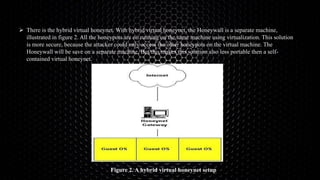
![ The Honeynet Project defines two types of virtual honeynets, self-contained and hybrid ([HOV03]). A self-
contained virtual honeynet is an entire honeynet network onto a single machine, see figure 1. This means that
both the Honeywall and the honeypots are on the same machine. This also brings a risk. If an attacker somehow
discovered the host machine andcompromised it, your complete honeynet will be useless. So you have a Single
Point of Failure. If something goes wrong with the hardware for example, your whole honeynet will be down.
Figure 1. A self-contained virtual honeynet setup](https://image.slidesharecdn.com/introductiononhoneypot-150211024920-conversion-gate02/85/honey-pots-introduction-and-its-types-14-320.jpg)


![References
[DVK+06] P. Defibaugh-Chavez, R. Veeraghattam, M.Kannappa, S. Mukkamala, A. H. Sung,
“NetworkBased Detection of Virtual Environments and low Interaction Honeypots”, In 2006 IEEE
InformationAssurance Workshop, pages 283-289, IEEE, 2006.
[GV06] R. McGrew, R.B. Vaughn, Experiences With HoneypotSystems: Development, Deployment, and
Analysis,System Sciences, 2006. Proceedings of the 39th Annual Hawaii International Conference, pages
220a-220a, IEEE, 2006.
[HOG05] The Honeynet Project, Know Your Enemy: GenIIHoneynets,
http://www.honeynet.nl/papers/gen2/index.html (07-12-2006), The Honeynet Project 2005.
[Hon06] Honeynet Project, “Know your Enemy: Honeynets”,
http://www.honeynet.nl/papers/honeynet/index.html, (3-10-2006), Honeynet Project, 2006.](https://image.slidesharecdn.com/introductiononhoneypot-150211024920-conversion-gate02/85/honey-pots-introduction-and-its-types-20-320.jpg)


This document evaluates various types of honeypots, focusing on low interaction, high interaction, and virtual honeypots, discussing their roles in capturing information about attackers and their methods. It highlights the advantages and limitations of each type of honeypot, as well as case studies showcasing their deployment and effectiveness. The paper concludes that honeypots are crucial for understanding attack strategies and enhancing security, while emphasizing the need for careful management to prevent them from becoming liabilities.


