Honeypots Jayant Kumar Gandhi - www.jkg.in Himanshu Bhatnagar Sachin Gajjar Sameek Banerjee Shashwat Agrawal http://www.jkg.in/eel702/presentation.ppt
Agenda Motivation Definition Advantages/ Disadvantages Types
Motivation Key to effective intrusion detection is information Learn more about past attacks Detect currently occurring attacks Identify new types of attacks Do all this in real time
Definition “ Any security resource who’s value lies in being probed, attacked, or compromised” – L. Spitzner,  Honeypots: Tracking Hackers , ISBN 0-321-10895-7
How honeypots work A resource that expects no data, so any traffic to or from it is most likely unauthorized activity
Advantages Reduce false positives and false negatives Data value Resources Simplicity
Disadvantages Narrow Field of View Fingerprinting Risk
Types Production (Law enforcement) Research (Counter-intelligence)
Production Honeypots Prevention Detection Response
Research Honeypots Early warning and prediction Discover new tools and tactics Understanding motives, behavior and organization Develop analysis and forensic skills
Level of Interaction Level of interaction determines the amount of functionality a honeypot provides Low Interaction Less learning, complexity and risk High Interaction High learning, complexity and risk
Risk Attacker can compromise your honeypot to harm, attack or infiltrate other systems and organizations
Low Interaction Provide emulated services No operating system to access Information limited to transactional information and attackers activities with the emulated services
High Interaction Provides actual Operating Systems Learn extensive amount of information Extensive risk
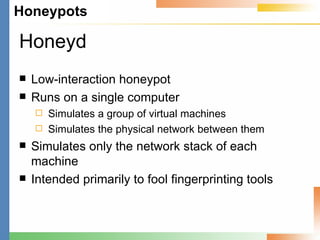
Honeyd Low-interaction honeypot Runs on a single computer Simulates a group of virtual machines Simulates the physical network between them Simulates only the network stack of each machine Intended primarily to fool fingerprinting tools
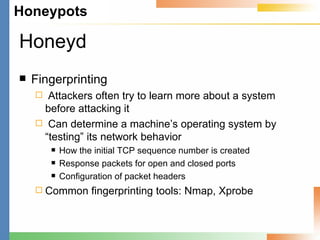
Honeyd Fingerprinting Attackers often try to learn more about a system before attacking it Can determine a machine’s operating system by “testing” its network behavior How the initial TCP sequence number is created Response packets for open and closed ports Configuration of packet headers Common fingerprinting tools: Nmap, Xprobe
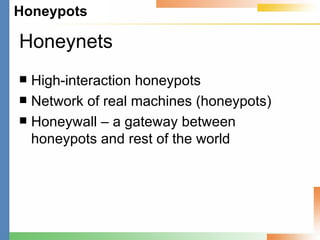
Honeynets High-interaction honeypots Network of real machines (honeypots) Honeywall – a gateway between honeypots and rest of the world
Legal issues Privacy Entrapment Liability
Legal Mumbo Jumbo Design template is Copyright © 2006 Jayant Kumar Gandhi (www.jkg.in) Clip art is Copyright © 2006 Microsoft Corporation All trademarks, registered trademarks are acknowledged and are property of their respective owners
Bibliography Robert Graham, Network intrusion detection systems, 2000. http://www.robertgraham.com/pubs/network-intrusion-detection.html David Klug, Honeypots and intrusion detection. http://www.sans.org./infosecFAQ/intrusion/honeypots.htm Christian Plattner Reto Baumann, White paper: Honeypots. http://www.rbaumann.net,http://www.christianplattner.net Lance Spitzner, Honeypots: Tracking hackers ISBN: 0-321-10895-7 Lance Spitzner, Intrusion detection, 2000. http://www.enteract.com/lspitz/ids.html Lance Spitzner, Know your enemy: I, ii and iii, 2000 http://www.project.honeynet.org/papers
Questions?
http://www.jkg.in/contact-me/ Uploaded on SlideShare.net for the public.

Honeypots

  • 1.
    Honeypots Jayant KumarGandhi - www.jkg.in Himanshu Bhatnagar Sachin Gajjar Sameek Banerjee Shashwat Agrawal http://www.jkg.in/eel702/presentation.ppt
  • 2.
    Agenda Motivation DefinitionAdvantages/ Disadvantages Types
  • 3.
    Motivation Key toeffective intrusion detection is information Learn more about past attacks Detect currently occurring attacks Identify new types of attacks Do all this in real time
  • 4.
    Definition “ Anysecurity resource who’s value lies in being probed, attacked, or compromised” – L. Spitzner, Honeypots: Tracking Hackers , ISBN 0-321-10895-7
  • 5.
    How honeypots workA resource that expects no data, so any traffic to or from it is most likely unauthorized activity
  • 6.
    Advantages Reduce falsepositives and false negatives Data value Resources Simplicity
  • 7.
    Disadvantages Narrow Fieldof View Fingerprinting Risk
  • 8.
    Types Production (Lawenforcement) Research (Counter-intelligence)
  • 9.
  • 10.
    Research Honeypots Earlywarning and prediction Discover new tools and tactics Understanding motives, behavior and organization Develop analysis and forensic skills
  • 11.
    Level of InteractionLevel of interaction determines the amount of functionality a honeypot provides Low Interaction Less learning, complexity and risk High Interaction High learning, complexity and risk
  • 12.
    Risk Attacker cancompromise your honeypot to harm, attack or infiltrate other systems and organizations
  • 13.
    Low Interaction Provideemulated services No operating system to access Information limited to transactional information and attackers activities with the emulated services
  • 14.
    High Interaction Providesactual Operating Systems Learn extensive amount of information Extensive risk
  • 15.
    Honeyd Low-interaction honeypotRuns on a single computer Simulates a group of virtual machines Simulates the physical network between them Simulates only the network stack of each machine Intended primarily to fool fingerprinting tools
  • 16.
    Honeyd Fingerprinting Attackersoften try to learn more about a system before attacking it Can determine a machine’s operating system by “testing” its network behavior How the initial TCP sequence number is created Response packets for open and closed ports Configuration of packet headers Common fingerprinting tools: Nmap, Xprobe
  • 17.
    Honeynets High-interaction honeypotsNetwork of real machines (honeypots) Honeywall – a gateway between honeypots and rest of the world
  • 18.
    Legal issues PrivacyEntrapment Liability
  • 19.
    Legal Mumbo JumboDesign template is Copyright © 2006 Jayant Kumar Gandhi (www.jkg.in) Clip art is Copyright © 2006 Microsoft Corporation All trademarks, registered trademarks are acknowledged and are property of their respective owners
  • 20.
    Bibliography Robert Graham,Network intrusion detection systems, 2000. http://www.robertgraham.com/pubs/network-intrusion-detection.html David Klug, Honeypots and intrusion detection. http://www.sans.org./infosecFAQ/intrusion/honeypots.htm Christian Plattner Reto Baumann, White paper: Honeypots. http://www.rbaumann.net,http://www.christianplattner.net Lance Spitzner, Honeypots: Tracking hackers ISBN: 0-321-10895-7 Lance Spitzner, Intrusion detection, 2000. http://www.enteract.com/lspitz/ids.html Lance Spitzner, Know your enemy: I, ii and iii, 2000 http://www.project.honeynet.org/papers
  • 21.
  • 22.
    http://www.jkg.in/contact-me/ Uploaded onSlideShare.net for the public.