HONEYPOT
INTRODUCTION
 The purposes of honeypot are to detected and
learn from attacks and use that information
provides network security.
 Honeypots are analyzed by their role of
application, which is meant it can be used for
production and research.
DEFINATION OF HONEYPOT:
 "A honeypot is security resource whose value lies
in being probed, attacked, or compromised”.
 A honeypot is a system that is built and set up in
order to be hacked.
HISTORY
1990-1991: first time , honeypot studies
released by Clifford Stoll and Bill Cheswick .
1997: Deception Toolkit version 0.1 was
introduced by Fred Cohen.
1998: First commercial honeypot was released
which is known as Cyber Cop Sting.
CONTINUED….
1998: Back Officer Friendly honeypot was
introduced. It was free and easy to configure. It
is working under Windows operating system.
1999: After Back Officer Friendly, people were
more into this new technology. Honeynet
project started at this year. people understood
the aim of the honeypots more.
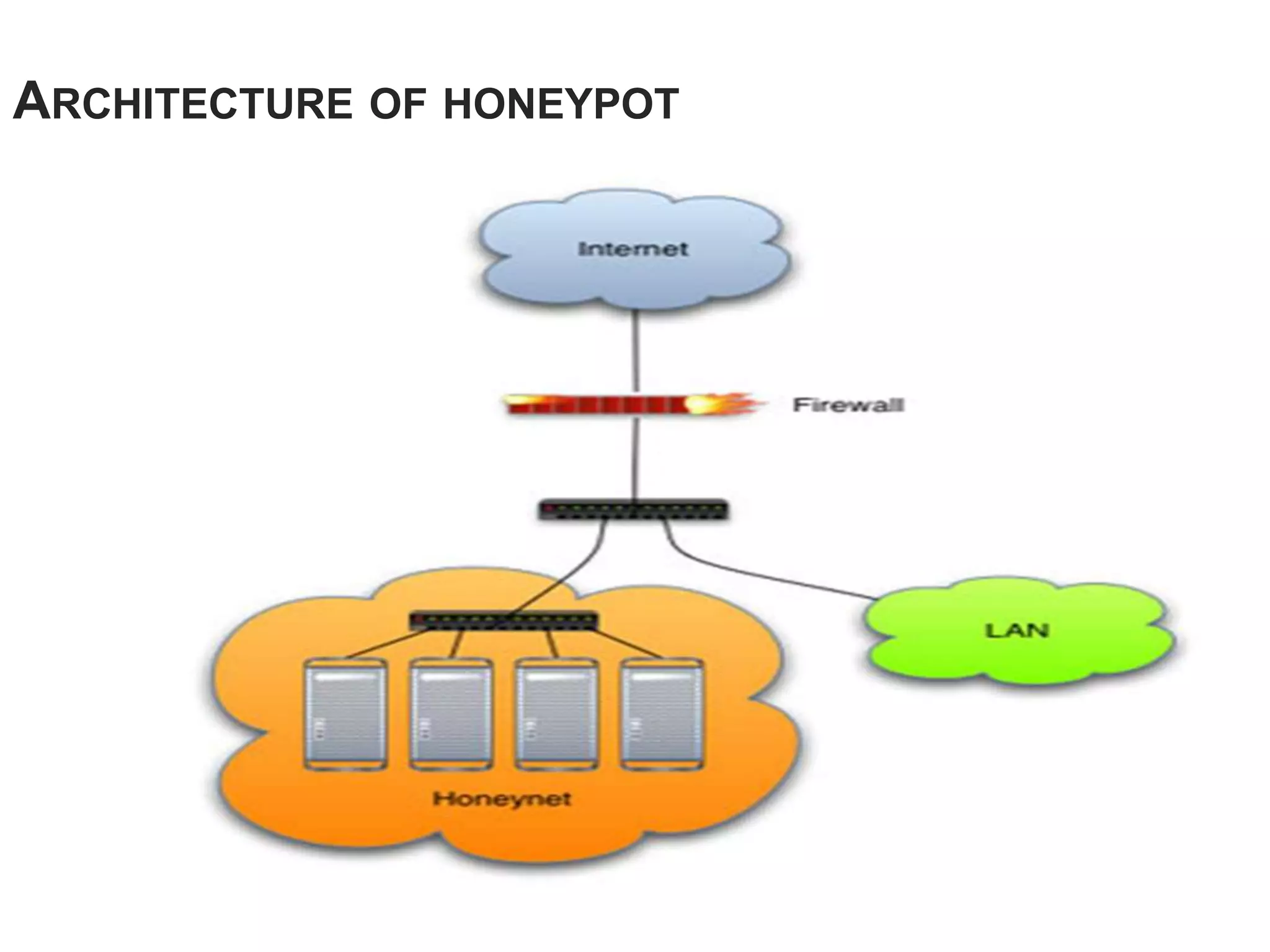
ARCHITECTURE OF HONEYPOT
HONEYPOT VALUE
• Prevention
prevent automated attacks:(Warms and auto-
rooters)
• Detection
identify a failure or breakdown in prevention
• Response
TYPES OF HONEYPOT
Research
 Complex to deploy and maintain.
 Captures extensive information.
 Run by a volunteer(non-profit).
 Used to research the threats organization face.
Production
 Easy to use
 Capture only limited information
 Used by companies or corporations
 Mitigates risks in organization
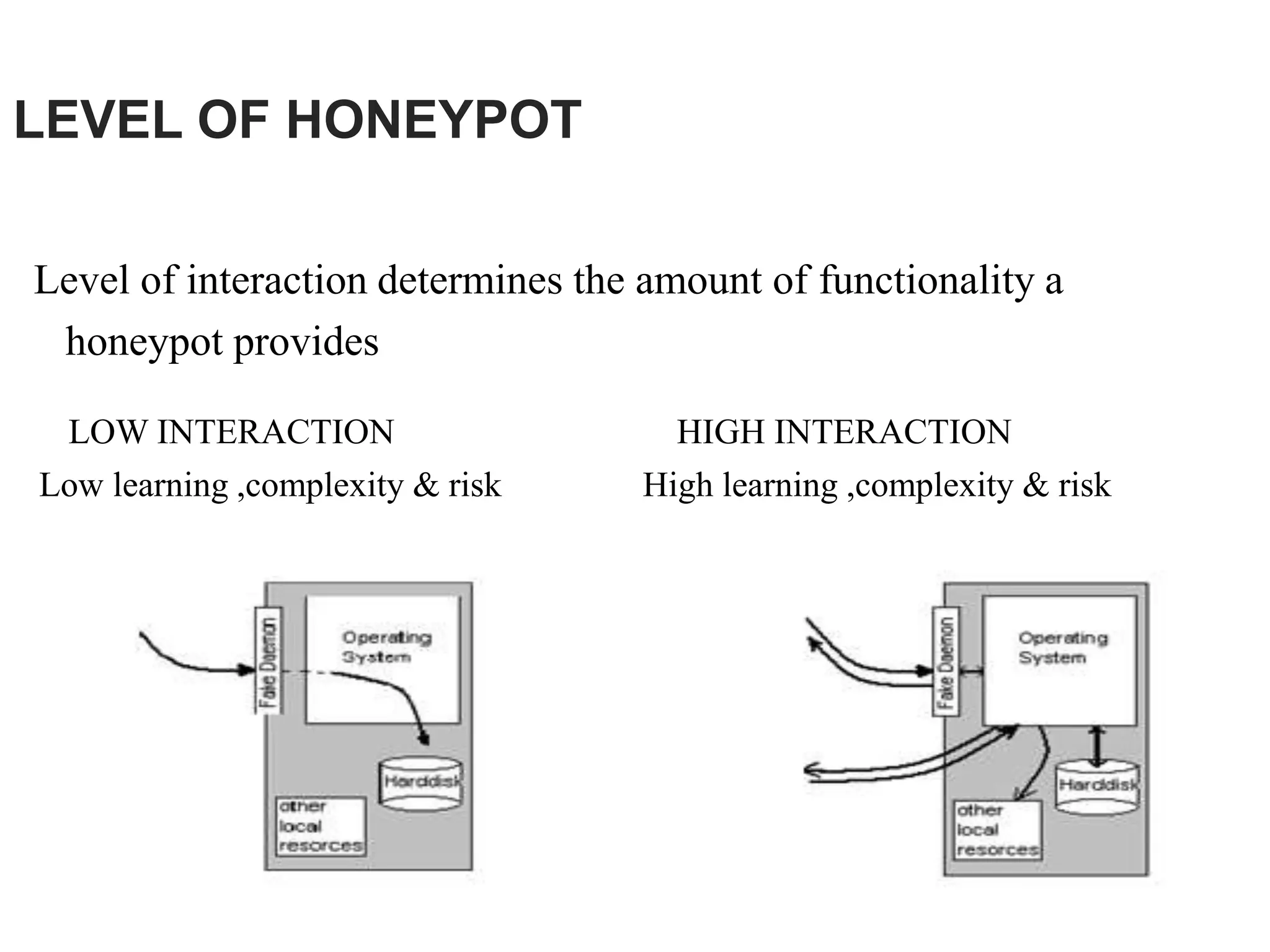
LEVEL OF HONEYPOT
Level of interaction determines the amount of functionality a
honeypot provides
LOW INTERACTION HIGH INTERACTION
Low learning ,complexity & risk High learning ,complexity & risk
HIGH LEVEL INTERACTION
 Load of high-interaction honeypots are reduced
by preprocessing the traffic using low-interaction
honeypots as much as possible.
 A high-interaction honeypot can be compromised
completely, allowing an adversary to gain full
access to the system and use it to launch further
network attacks.
 In High Interaction Honeypots nothing is
emulated everything is real.
 High Interaction Honeypots provide a far
more detailed picture of how an attack or
intrusion progresses or how a particular malware
execute in real-time.
LOW LEVEL INTERACTION
 This kind of honeypot has a small chance of
being compromised.
 It is production honeypot.
 Typical use of low-interaction honeypot
includes:
 port scans identification,
 generation of attack signatures,
 trend analysis and malware collection.
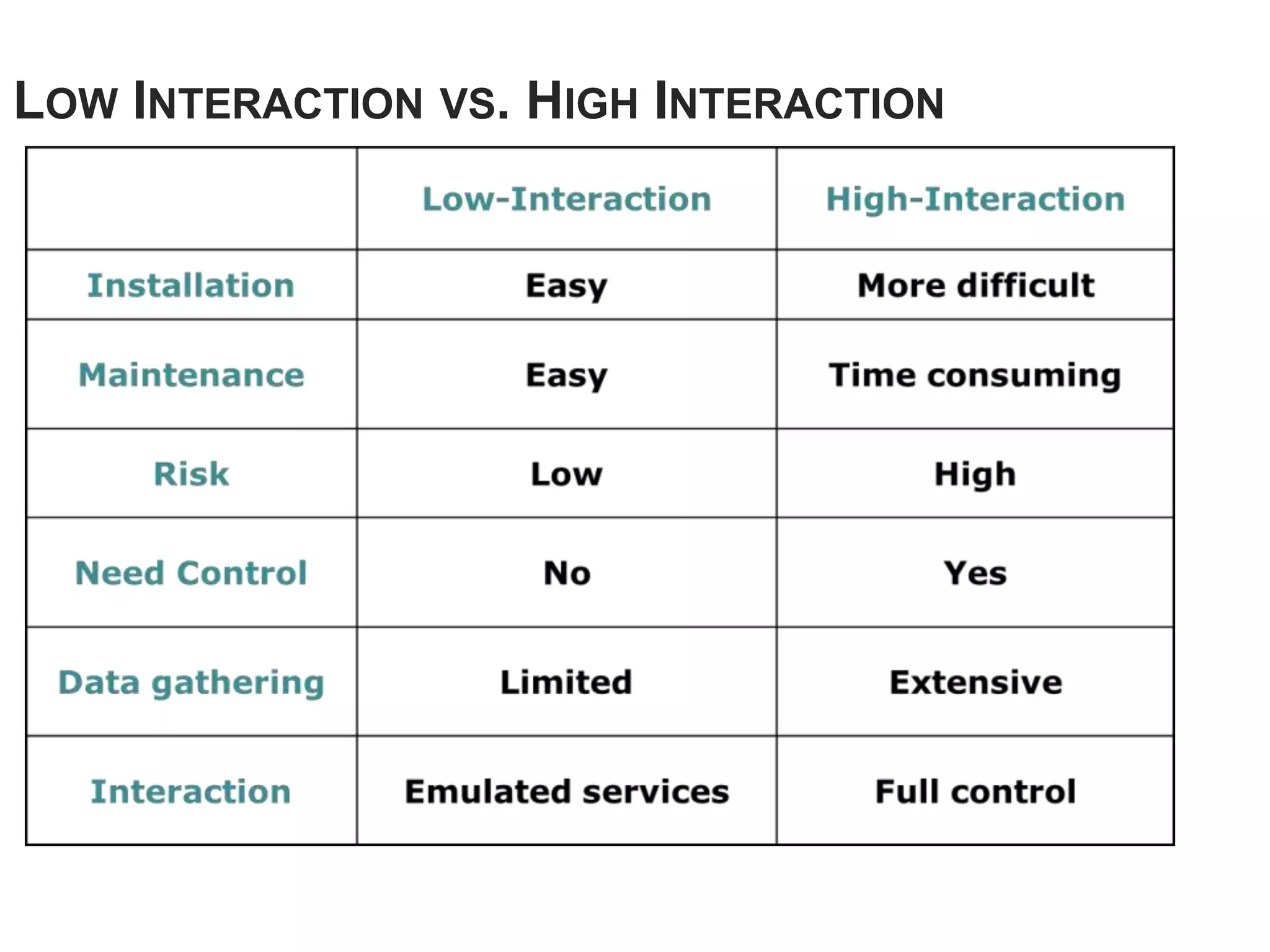
LOW INTERACTION VS. HIGH INTERACTION
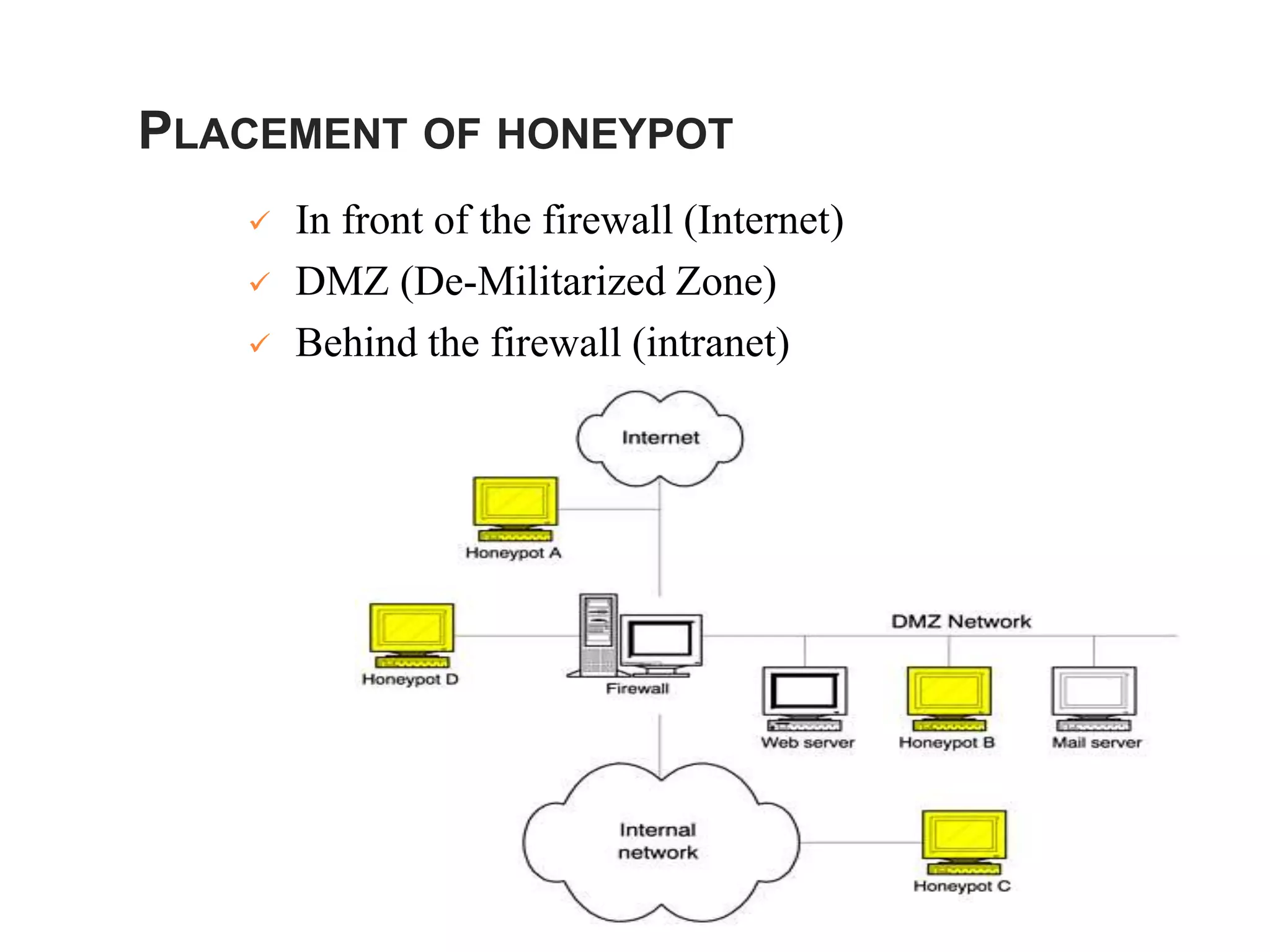
PLACEMENT OF HONEYPOT
 In front of the firewall (Internet)
 DMZ (De-Militarized Zone)
 Behind the firewall (intranet)
HONEYPOT TOPOLOGY
Mainly, There are two types of honeypot topologies:
 Honeynet
 Virtual Honeypot
Honeynet:
 Two or more honeypots on a network form a honeynet.
 Actual network of computers
 High-interaction honeypot
 Its an architecture, not a product
CONTINUED..
Honeynet work:
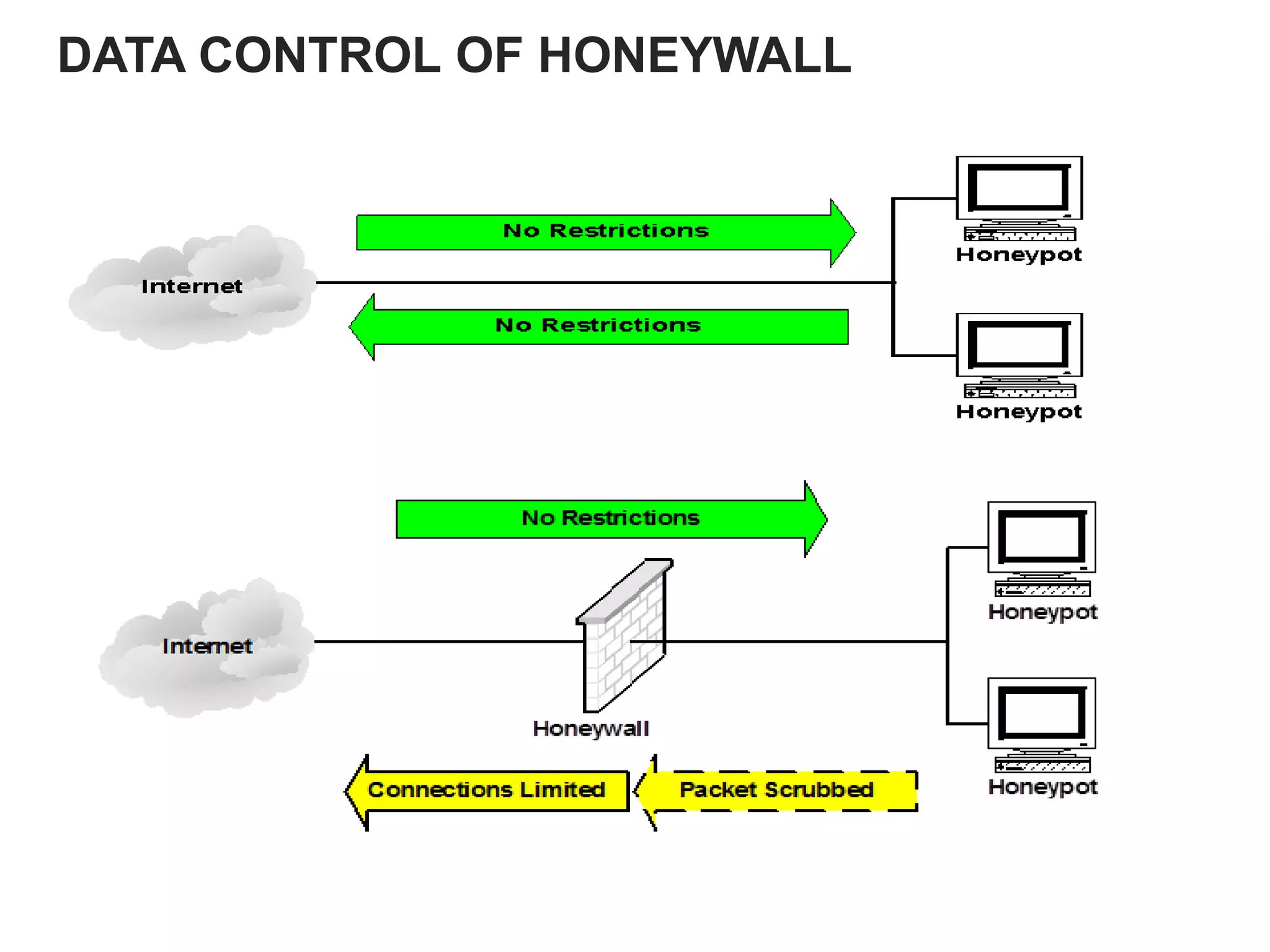
 Monitoring, capturing, and analyzing all the packets entering
or leaving through networks.
 All the traffic is entering or leaving through the Honeynet is
naturally suspect.
 Provides real systems, applications, and services for attackers to
interact with.
 Any traffic entering or leaving is suspect.
DATA CONTROL OF HONEYWALL
ADVANTAGES OF HONEYPOTS
 Honeypots are focused (small data sets)s
 Honeypots help to catch unknown attacks
 Honeypots can capture encrypted activity (cf. Sebek)
 Honeypots work with IPv6
 Honeypots are very flexible
(advantage/disadvantage?)
 Honeypots require minimal resources
DISADVANTAGES OF HONEYPOT
 Limited View: honeypots can only track and capture
activity that directly interacts with them.
 Specifically, honeypots have the risk of being taken over by
the bad guy and being used to harm other systems. This risk
various for different honeypots.
CONCLUSION
 The purpose of this topic was to define the what honeypots
are and their value to the security community. We
identified two different types of honeypots, low-
interaction and high-interaction honeypots.
 Honeypots are not a solution, they are a flexible tool with
different applications to security.
 Primary value in detection and information gathering.
 Just the beginning for honeypots.
“ The more you know about your enemy,
the better you can protect yourself”
Honeypot ppt1

Honeypot ppt1

  • 1.
  • 2.
    INTRODUCTION  The purposesof honeypot are to detected and learn from attacks and use that information provides network security.  Honeypots are analyzed by their role of application, which is meant it can be used for production and research. DEFINATION OF HONEYPOT:  "A honeypot is security resource whose value lies in being probed, attacked, or compromised”.  A honeypot is a system that is built and set up in order to be hacked.
  • 3.
    HISTORY 1990-1991: first time, honeypot studies released by Clifford Stoll and Bill Cheswick . 1997: Deception Toolkit version 0.1 was introduced by Fred Cohen. 1998: First commercial honeypot was released which is known as Cyber Cop Sting.
  • 4.
    CONTINUED…. 1998: Back OfficerFriendly honeypot was introduced. It was free and easy to configure. It is working under Windows operating system. 1999: After Back Officer Friendly, people were more into this new technology. Honeynet project started at this year. people understood the aim of the honeypots more.
  • 5.
  • 6.
    HONEYPOT VALUE • Prevention preventautomated attacks:(Warms and auto- rooters) • Detection identify a failure or breakdown in prevention • Response
  • 7.
    TYPES OF HONEYPOT Research Complex to deploy and maintain.  Captures extensive information.  Run by a volunteer(non-profit).  Used to research the threats organization face. Production  Easy to use  Capture only limited information  Used by companies or corporations  Mitigates risks in organization
  • 8.
    LEVEL OF HONEYPOT Levelof interaction determines the amount of functionality a honeypot provides LOW INTERACTION HIGH INTERACTION Low learning ,complexity & risk High learning ,complexity & risk
  • 9.
    HIGH LEVEL INTERACTION Load of high-interaction honeypots are reduced by preprocessing the traffic using low-interaction honeypots as much as possible.  A high-interaction honeypot can be compromised completely, allowing an adversary to gain full access to the system and use it to launch further network attacks.  In High Interaction Honeypots nothing is emulated everything is real.  High Interaction Honeypots provide a far more detailed picture of how an attack or intrusion progresses or how a particular malware execute in real-time.
  • 10.
    LOW LEVEL INTERACTION This kind of honeypot has a small chance of being compromised.  It is production honeypot.  Typical use of low-interaction honeypot includes:  port scans identification,  generation of attack signatures,  trend analysis and malware collection.
  • 11.
    LOW INTERACTION VS.HIGH INTERACTION
  • 12.
    PLACEMENT OF HONEYPOT In front of the firewall (Internet)  DMZ (De-Militarized Zone)  Behind the firewall (intranet)
  • 13.
    HONEYPOT TOPOLOGY Mainly, Thereare two types of honeypot topologies:  Honeynet  Virtual Honeypot Honeynet:  Two or more honeypots on a network form a honeynet.  Actual network of computers  High-interaction honeypot  Its an architecture, not a product
  • 14.
    CONTINUED.. Honeynet work:  Monitoring,capturing, and analyzing all the packets entering or leaving through networks.  All the traffic is entering or leaving through the Honeynet is naturally suspect.  Provides real systems, applications, and services for attackers to interact with.  Any traffic entering or leaving is suspect.
  • 15.
    DATA CONTROL OFHONEYWALL
  • 16.
    ADVANTAGES OF HONEYPOTS Honeypots are focused (small data sets)s  Honeypots help to catch unknown attacks  Honeypots can capture encrypted activity (cf. Sebek)  Honeypots work with IPv6  Honeypots are very flexible (advantage/disadvantage?)  Honeypots require minimal resources
  • 17.
    DISADVANTAGES OF HONEYPOT Limited View: honeypots can only track and capture activity that directly interacts with them.  Specifically, honeypots have the risk of being taken over by the bad guy and being used to harm other systems. This risk various for different honeypots.
  • 18.
    CONCLUSION  The purposeof this topic was to define the what honeypots are and their value to the security community. We identified two different types of honeypots, low- interaction and high-interaction honeypots.  Honeypots are not a solution, they are a flexible tool with different applications to security.  Primary value in detection and information gathering.  Just the beginning for honeypots. “ The more you know about your enemy, the better you can protect yourself”