W. F. Schneider CBE 40445
CBE 40445
Lecture 15
Introduction to Catalysis
William F. Schneider
Department of Chemical and Biomolecular Engineering
Department of Chemistry and Biochemistry
University of Notre Dame
wschneider@nd.edu
Fall Semester 2005
W. F. Schneider CBE 40445
● ○ ● ○ ● ○ ● ○ ● ○ ● ○ ● ○ ● ○ ● ○ ● ○ ● ○ ● ○ ● ○ ● ○ ● ○ ● ○ ● ○ ● ○ ● ○ ● ○ ● ○ ● ○ ● ○ ● ○ ● ○ ● ○ ● ○ ● ○ ●
○
What is a “Catalyst”
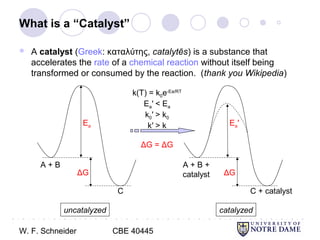
 A catalyst (Greek: καταλύτης, catalytēs) is a substance that
accelerates the rate of a chemical reaction without itself being
transformed or consumed by the reaction. (thank you Wikipedia)
A + B
C
ΔG
Ea
uncatalyzed
A + B +
catalyst
C + catalyst
ΔG
Ea′
catalyzed
k(T) = k0e-Ea/RT
Ea′ < Ea
k0′ > k0
k′ > k
ΔG = ΔG
W. F. Schneider CBE 40445
● ○ ● ○ ● ○ ● ○ ● ○ ● ○ ● ○ ● ○ ● ○ ● ○ ● ○ ● ○ ● ○ ● ○ ● ○ ● ○ ● ○ ● ○ ● ○ ● ○ ● ○ ● ○ ● ○ ● ○ ● ○ ● ○ ● ○ ● ○ ●
○
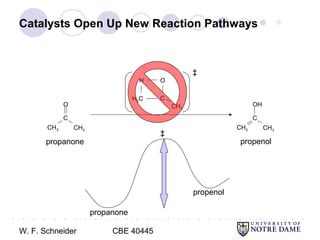
Catalysts Open Up New Reaction Pathways
CH3
C
CH3
O
CH2
C
CH3
OH
propanone propenol
H2C
H O
C
CH3
‡
‡
propanone
propenol
W. F. Schneider CBE 40445
● ○ ● ○ ● ○ ● ○ ● ○ ● ○ ● ○ ● ○ ● ○ ● ○ ● ○ ● ○ ● ○ ● ○ ● ○ ● ○ ● ○ ● ○ ● ○ ● ○ ● ○ ● ○ ● ○ ● ○ ● ○ ● ○ ● ○ ● ○ ●
○
Catalysts Open Up New Reaction Pathways
CH3
C
CH3
O
CH2
C
CH3
OH
propanone propenol
OH−
CH2
C
CH3
O−
+ H2O
−OH−
Base catalyzed
propanone
propenol
intermediate
‡ ‡
rate = k[OH−
][acetone]
W. F. Schneider CBE 40445
● ○ ● ○ ● ○ ● ○ ● ○ ● ○ ● ○ ● ○ ● ○ ● ○ ● ○ ● ○ ● ○ ● ○ ● ○ ● ○ ● ○ ● ○ ● ○ ● ○ ● ○ ● ○ ● ○ ● ○ ● ○ ● ○ ● ○ ● ○ ●
○
Catalysts Open Up New Reaction Pathways
CH3
C
CH3
O
CH2
C
CH3
OH
propanone
propenol
+ H2O
Acid catalyzed
H3O+
CH3
C
CH3
OH
+
−H3O+
propenol
different
intermediate
‡ ‡
propanone
rate = k[H3O+
][acetone]
W. F. Schneider CBE 40445
● ○ ● ○ ● ○ ● ○ ● ○ ● ○ ● ○ ● ○ ● ○ ● ○ ● ○ ● ○ ● ○ ● ○ ● ○ ● ○ ● ○ ● ○ ● ○ ● ○ ● ○ ● ○ ● ○ ● ○ ● ○ ● ○ ● ○ ● ○ ●
○
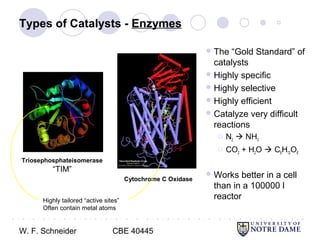
Types of Catalysts - Enzymes
The “Gold Standard” of
catalysts
Highly specific
Highly selective
Highly efficient
Catalyze very difficult
reactions
 N2  NH3
 CO2 + H2O  C6H12O6
Works better in a cell
than in a 100000 l
reactor
Triosephosphateisomerase
“TIM”
Cytochrome C Oxidase
Highly tailored “active sites”
Often contain metal atoms
W. F. Schneider CBE 40445
● ○ ● ○ ● ○ ● ○ ● ○ ● ○ ● ○ ● ○ ● ○ ● ○ ● ○ ● ○ ● ○ ● ○ ● ○ ● ○ ● ○ ● ○ ● ○ ● ○ ● ○ ● ○ ● ○ ● ○ ● ○ ● ○ ● ○ ● ○ ●
○
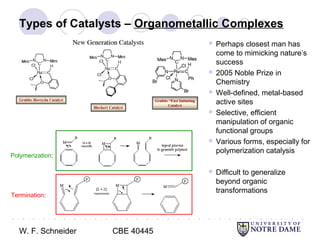
Types of Catalysts – Organometallic Complexes
 Perhaps closest man has
come to mimicking nature’s
success
 2005 Noble Prize in
Chemistry
 Well-defined, metal-based
active sites
 Selective, efficient
manipulation of organic
functional groups
 Various forms, especially for
polymerization catalysis
 Difficult to generalize
beyond organic
transformations
Polymerization:
Termination:
W. F. Schneider CBE 40445
● ○ ● ○ ● ○ ● ○ ● ○ ● ○ ● ○ ● ○ ● ○ ● ○ ● ○ ● ○ ● ○ ● ○ ● ○ ● ○ ● ○ ● ○ ● ○ ● ○ ● ○ ● ○ ● ○ ● ○ ● ○ ● ○ ● ○ ● ○ ●
○
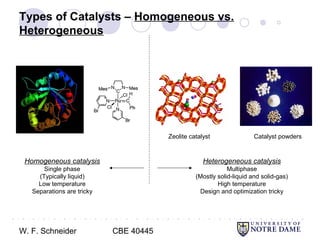
Types of Catalysts – Homogeneous vs.
Heterogeneous
Homogeneous catalysis
Single phase
(Typically liquid)
Low temperature
Separations are tricky
Heterogeneous catalysis
Multiphase
(Mostly solid-liquid and solid-gas)
High temperature
Design and optimization tricky
Zeolite catalyst Catalyst powders
W. F. Schneider CBE 40445
● ○ ● ○ ● ○ ● ○ ● ○ ● ○ ● ○ ● ○ ● ○ ● ○ ● ○ ● ○ ● ○ ● ○ ● ○ ● ○ ● ○ ● ○ ● ○ ● ○ ● ○ ● ○ ● ○ ● ○ ● ○ ● ○ ● ○ ● ○ ●
○
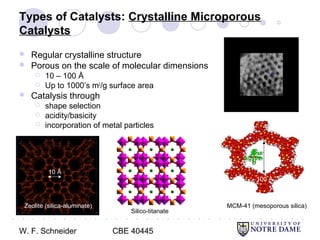
Types of Catalysts: Crystalline Microporous
Catalysts
 Regular crystalline structure
 Porous on the scale of molecular dimensions
 10 – 100 Å
 Up to 1000’s m2
/g surface area
 Catalysis through
 shape selection
 acidity/basicity
 incorporation of metal particles
10 Å
100 Å
Zeolite (silica-aluminate)
Silico-titanate
MCM-41 (mesoporous silica)
W. F. Schneider CBE 40445
● ○ ● ○ ● ○ ● ○ ● ○ ● ○ ● ○ ● ○ ● ○ ● ○ ● ○ ● ○ ● ○ ● ○ ● ○ ● ○ ● ○ ● ○ ● ○ ● ○ ● ○ ● ○ ● ○ ● ○ ● ○ ● ○ ● ○ ● ○ ●
○
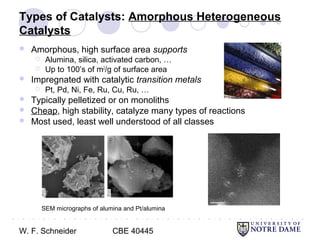
Types of Catalysts: Amorphous Heterogeneous
Catalysts
 Amorphous, high surface area supports
 Alumina, silica, activated carbon, …
 Up to 100’s of m2
/g of surface area
 Impregnated with catalytic transition metals
 Pt, Pd, Ni, Fe, Ru, Cu, Ru, …
 Typically pelletized or on monoliths
 Cheap, high stability, catalyze many types of reactions
 Most used, least well understood of all classes
SEM micrographs of alumina and Pt/alumina
W. F. Schneider CBE 40445
● ○ ● ○ ● ○ ● ○ ● ○ ● ○ ● ○ ● ○ ● ○ ● ○ ● ○ ● ○ ● ○ ● ○ ● ○ ● ○ ● ○ ● ○ ● ○ ● ○ ● ○ ● ○ ● ○ ● ○ ● ○ ● ○ ● ○ ● ○ ●
○
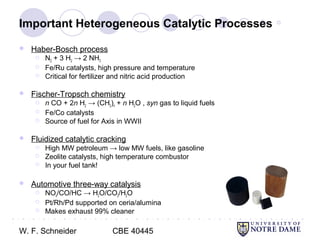
Important Heterogeneous Catalytic Processes
 Haber-Bosch process
 N2 + 3 H2 → 2 NH3
 Fe/Ru catalysts, high pressure and temperature
 Critical for fertilizer and nitric acid production
 Fischer-Tropsch chemistry
 n CO + 2n H2 → (CH2)n + n H2O , syn gas to liquid fuels
 Fe/Co catalysts
 Source of fuel for Axis in WWII
 Fluidized catalytic cracking
 High MW petroleum → low MW fuels, like gasoline
 Zeolite catalysts, high temperature combustor
 In your fuel tank!
 Automotive three-way catalysis
 NOx/CO/HC → H2O/CO2/H2O
 Pt/Rh/Pd supported on ceria/alumina
 Makes exhaust 99% cleaner
W. F. Schneider CBE 40445
● ○ ● ○ ● ○ ● ○ ● ○ ● ○ ● ○ ● ○ ● ○ ● ○ ● ○ ● ○ ● ○ ● ○ ● ○ ● ○ ● ○ ● ○ ● ○ ● ○ ● ○ ● ○ ● ○ ● ○ ● ○ ● ○ ● ○ ● ○ ●
○
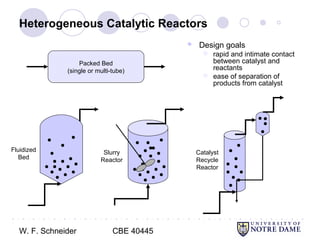
Heterogeneous Catalytic Reactors
 Design goals
 rapid and intimate contact
between catalyst and
reactants
 ease of separation of
products from catalyst
Packed Bed
(single or multi-tube)
Slurry
Reactor
Fluidized
Bed
Catalyst
Recycle
Reactor
W. F. Schneider CBE 40445
● ○ ● ○ ● ○ ● ○ ● ○ ● ○ ● ○ ● ○ ● ○ ● ○ ● ○ ● ○ ● ○ ● ○ ● ○ ● ○ ● ○ ● ○ ● ○ ● ○ ● ○ ● ○ ● ○ ● ○ ● ○ ● ○ ● ○ ● ○ ●
○
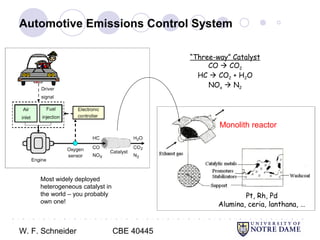
Automotive Emissions Control System
“Three-way” Catalyst
CO  CO2
HC  CO2 + H2O
NOx  N2
Pt, Rh, Pd
Alumina, ceria, lanthana, …
Most widely deployed
heterogeneous catalyst in
the world – you probably
own one!
Monolith reactor
W. F. Schneider CBE 40445
● ○ ● ○ ● ○ ● ○ ● ○ ● ○ ● ○ ● ○ ● ○ ● ○ ● ○ ● ○ ● ○ ● ○ ● ○ ● ○ ● ○ ● ○ ● ○ ● ○ ● ○ ● ○ ● ○ ● ○ ● ○ ● ○ ● ○ ● ○ ●
○
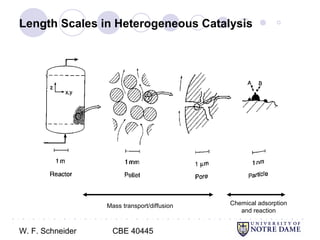
Length Scales in Heterogeneous Catalysis
Mass transport/diffusion Chemical adsorption
and reaction
W. F. Schneider CBE 40445
● ○ ● ○ ● ○ ● ○ ● ○ ● ○ ● ○ ● ○ ● ○ ● ○ ● ○ ● ○ ● ○ ● ○ ● ○ ● ○ ● ○ ● ○ ● ○ ● ○ ● ○ ● ○ ● ○ ● ○ ● ○ ● ○ ● ○ ● ○ ●
○
Characteristics of Heterogeneous Supported
Catalysts
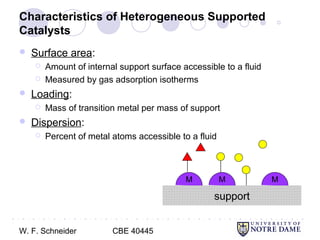
 Surface area:
 Amount of internal support surface accessible to a fluid
 Measured by gas adsorption isotherms
 Loading:
 Mass of transition metal per mass of support
 Dispersion:
 Percent of metal atoms accessible to a fluid
support
M M M
W. F. Schneider CBE 40445
● ○ ● ○ ● ○ ● ○ ● ○ ● ○ ● ○ ● ○ ● ○ ● ○ ● ○ ● ○ ● ○ ● ○ ● ○ ● ○ ● ○ ● ○ ● ○ ● ○ ● ○ ● ○ ● ○ ● ○ ● ○ ● ○ ● ○ ● ○ ●
○
Rates of Catalytic Reactions
 Pseudo-homogeneous reaction rate
 r = moles / volume · time
 Mass-based rate
 r′ = moles / masscat · time
 r′ = r / ρcat
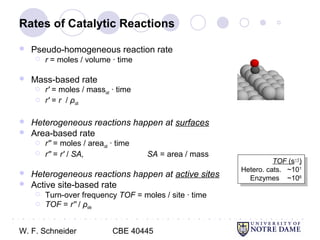
 Heterogeneous reactions happen at surfaces
 Area-based rate
 r′′ = moles / areacat · time
 r′′ = r′ / SA, SA = area / mass
 Heterogeneous reactions happen at active sites
 Active site-based rate
 Turn-over frequency TOF = moles / site · time
 TOF = r′′ / ρsite
TOF (s−1
)
Hetero. cats. ~101
Enzymes ~106
TOF (s−1
)
Hetero. cats. ~101
Enzymes ~106
W. F. Schneider CBE 40445
● ○ ● ○ ● ○ ● ○ ● ○ ● ○ ● ○ ● ○ ● ○ ● ○ ● ○ ● ○ ● ○ ● ○ ● ○ ● ○ ● ○ ● ○ ● ○ ● ○ ● ○ ● ○ ● ○ ● ○ ● ○ ● ○ ● ○ ● ○ ●
○
Adsorption and Reaction at Solid Surfaces
 Physisorption: weak van der Waals attraction of a fluid
(like N2 gas) for any surface
 Eads ~10 – 40 kJ/mol
 Low temperature phenomenon
 Exploited in measuring gross surface area
 Chemisorption: chemical bond formation between a fluid
molecule (like CO or ethylene) and a surface site
 Eads ~ 100 – 500 kJ/mol
 Essential element of catalytic activity
 Exploited in measuring catalytically active sites
W. F. Schneider CBE 40445
● ○ ● ○ ● ○ ● ○ ● ○ ● ○ ● ○ ● ○ ● ○ ● ○ ● ○ ● ○ ● ○ ● ○ ● ○ ● ○ ● ○ ● ○ ● ○ ● ○ ● ○ ● ○ ● ○ ● ○ ● ○ ● ○ ● ○ ● ○ ●
○
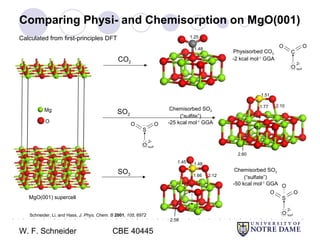
Comparing Physi- and Chemisorption on MgO(001)
1.77
1.51
2.10
2.60
CO2
SO2
Physisorbed CO2
-2 kcal mol-1
GGA
Chemisorbed SO2
(“sulfite”)
-25 kcal mol-1
GGA
SO3
Chemisorbed SO3
(“sulfate”)
-50 kcal mol-1
GGA
1.66
1.481.45
2.12
2.58
MgO(001) supercell
1.48
1.25
Mg
O
:O:surf
::
2-
C
OO
:O:surf
::
2-
S
OO
:
:O:surf
::
2-
S
OO
O
Schneider, Li, and Hass, J. Phys. Chem. B 2001, 105, 6972
Calculated from first-principles DFT
W. F. Schneider CBE 40445
● ○ ● ○ ● ○ ● ○ ● ○ ● ○ ● ○ ● ○ ● ○ ● ○ ● ○ ● ○ ● ○ ● ○ ● ○ ● ○ ● ○ ● ○ ● ○ ● ○ ● ○ ● ○ ● ○ ● ○ ● ○ ● ○ ● ○ ● ○ ●
○
Measuring Concentrations in Heterogeneous
Reactions Kinetics
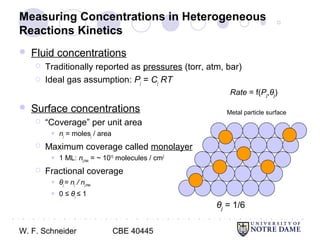
 Fluid concentrations
 Traditionally reported as pressures (torr, atm, bar)
 Ideal gas assumption: Pj = Cj RT
 Surface concentrations
 “Coverage” per unit area
 nj = molesj / area
 Maximum coverage called monolayer
 1 ML: nj,max = ~ 1015
molecules / cm2
 Fractional coverage
 θj = nj / nj,max
 0 ≤ θj ≤ 1
θj = 1/6
Rate = f(Pj,θj)
Metal particle surface
W. F. Schneider CBE 40445
● ○ ● ○ ● ○ ● ○ ● ○ ● ○ ● ○ ● ○ ● ○ ● ○ ● ○ ● ○ ● ○ ● ○ ● ○ ● ○ ● ○ ● ○ ● ○ ● ○ ● ○ ● ○ ● ○ ● ○ ● ○ ● ○ ● ○ ● ○ ●
○
Adsorption Isotherms
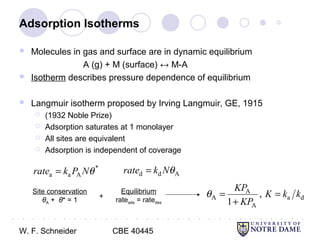
 Molecules in gas and surface are in dynamic equilibrium
A (g) + M (surface) ↔ M-A
 Isotherm describes pressure dependence of equilibrium
 Langmuir isotherm proposed by Irving Langmuir, GE, 1915
 (1932 Noble Prize)
 Adsorption saturates at 1 monolayer
 All sites are equivalent
 Adsorption is independent of coverage
Site conservation
θA + θ* = 1
+
Equilibrium
rateads = ratedes
A
A a d
A
,
1
KP
K k k
KP
θ = =
+
*
a a Arate k P Nθ= d d Arate k Nθ=
W. F. Schneider CBE 40445
● ○ ● ○ ● ○ ● ○ ● ○ ● ○ ● ○ ● ○ ● ○ ● ○ ● ○ ● ○ ● ○ ● ○ ● ○ ● ○ ● ○ ● ○ ● ○ ● ○ ● ○ ● ○ ● ○ ● ○ ● ○ ● ○ ● ○ ● ○ ●
○
Using the Langmuir Isotherm
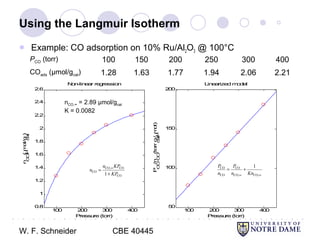
 Example: CO adsorption on 10% Ru/Al2O3 @ 100°C
PCO (torr) 100 150 200 250 300 400
COads (μmol/gcat) 1.28 1.63 1.77 1.94 2.06 2.21
100 200 300 400
0.8
1
1.2
1.4
1.6
1.8
2
2.2
2.4
2.6
Pressure (torr)
n
CO
(µmol/g
cat
)
COadsorption on Ru/Al
2
O
3
at 100°C
Non-linear regression
100 200 300 400
50
100
150
200
Pressure (torr)
P
CO
/n
CO
(torrg
cat
/µmol)
COadsorptionon Ru/Al
2
O
3
at 100°C
Linearized model
nCO,∞ = 2.89 μmol/gcat
K = 0.0082
CO, CO
CO
CO1
n KP
n
KP
∞
=
+
CO CO
CO CO, CO,
1P P
n n Kn∞ ∞
= +
W. F. Schneider CBE 40445
● ○ ● ○ ● ○ ● ○ ● ○ ● ○ ● ○ ● ○ ● ○ ● ○ ● ○ ● ○ ● ○ ● ○ ● ○ ● ○ ● ○ ● ○ ● ○ ● ○ ● ○ ● ○ ● ○ ● ○ ● ○ ● ○ ● ○ ● ○ ●
○
Brunauer-Emmett-Teller Isotherm (BET)
Solid Surface
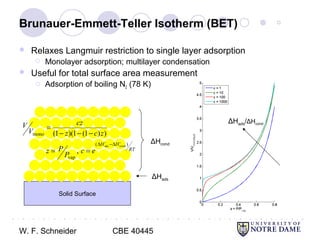
ΔHads
ΔHcond
ΔHads/ΔHcond
ads cond
mono
( )
vap
(1 )(1 (1 ) )
,
H H
RT
czV
V z c z
Pz c e
P
∆ −∆
=
− − −
= =
o o
 Relaxes Langmuir restriction to single layer adsorption
 Monolayer adsorption; multilayer condensation
 Useful for total surface area measurement
 Adsorption of boiling N2 (78 K)

Catalysis

  • 1.
    W. F. SchneiderCBE 40445 CBE 40445 Lecture 15 Introduction to Catalysis William F. Schneider Department of Chemical and Biomolecular Engineering Department of Chemistry and Biochemistry University of Notre Dame wschneider@nd.edu Fall Semester 2005
  • 2.
    W. F. SchneiderCBE 40445 ● ○ ● ○ ● ○ ● ○ ● ○ ● ○ ● ○ ● ○ ● ○ ● ○ ● ○ ● ○ ● ○ ● ○ ● ○ ● ○ ● ○ ● ○ ● ○ ● ○ ● ○ ● ○ ● ○ ● ○ ● ○ ● ○ ● ○ ● ○ ● ○ What is a “Catalyst”  A catalyst (Greek: καταλύτης, catalytēs) is a substance that accelerates the rate of a chemical reaction without itself being transformed or consumed by the reaction. (thank you Wikipedia) A + B C ΔG Ea uncatalyzed A + B + catalyst C + catalyst ΔG Ea′ catalyzed k(T) = k0e-Ea/RT Ea′ < Ea k0′ > k0 k′ > k ΔG = ΔG
  • 3.
    W. F. SchneiderCBE 40445 ● ○ ● ○ ● ○ ● ○ ● ○ ● ○ ● ○ ● ○ ● ○ ● ○ ● ○ ● ○ ● ○ ● ○ ● ○ ● ○ ● ○ ● ○ ● ○ ● ○ ● ○ ● ○ ● ○ ● ○ ● ○ ● ○ ● ○ ● ○ ● ○ Catalysts Open Up New Reaction Pathways CH3 C CH3 O CH2 C CH3 OH propanone propenol H2C H O C CH3 ‡ ‡ propanone propenol
  • 4.
    W. F. SchneiderCBE 40445 ● ○ ● ○ ● ○ ● ○ ● ○ ● ○ ● ○ ● ○ ● ○ ● ○ ● ○ ● ○ ● ○ ● ○ ● ○ ● ○ ● ○ ● ○ ● ○ ● ○ ● ○ ● ○ ● ○ ● ○ ● ○ ● ○ ● ○ ● ○ ● ○ Catalysts Open Up New Reaction Pathways CH3 C CH3 O CH2 C CH3 OH propanone propenol OH− CH2 C CH3 O− + H2O −OH− Base catalyzed propanone propenol intermediate ‡ ‡ rate = k[OH− ][acetone]
  • 5.
    W. F. SchneiderCBE 40445 ● ○ ● ○ ● ○ ● ○ ● ○ ● ○ ● ○ ● ○ ● ○ ● ○ ● ○ ● ○ ● ○ ● ○ ● ○ ● ○ ● ○ ● ○ ● ○ ● ○ ● ○ ● ○ ● ○ ● ○ ● ○ ● ○ ● ○ ● ○ ● ○ Catalysts Open Up New Reaction Pathways CH3 C CH3 O CH2 C CH3 OH propanone propenol + H2O Acid catalyzed H3O+ CH3 C CH3 OH + −H3O+ propenol different intermediate ‡ ‡ propanone rate = k[H3O+ ][acetone]
  • 6.
    W. F. SchneiderCBE 40445 ● ○ ● ○ ● ○ ● ○ ● ○ ● ○ ● ○ ● ○ ● ○ ● ○ ● ○ ● ○ ● ○ ● ○ ● ○ ● ○ ● ○ ● ○ ● ○ ● ○ ● ○ ● ○ ● ○ ● ○ ● ○ ● ○ ● ○ ● ○ ● ○ Types of Catalysts - Enzymes The “Gold Standard” of catalysts Highly specific Highly selective Highly efficient Catalyze very difficult reactions  N2  NH3  CO2 + H2O  C6H12O6 Works better in a cell than in a 100000 l reactor Triosephosphateisomerase “TIM” Cytochrome C Oxidase Highly tailored “active sites” Often contain metal atoms
  • 7.
    W. F. SchneiderCBE 40445 ● ○ ● ○ ● ○ ● ○ ● ○ ● ○ ● ○ ● ○ ● ○ ● ○ ● ○ ● ○ ● ○ ● ○ ● ○ ● ○ ● ○ ● ○ ● ○ ● ○ ● ○ ● ○ ● ○ ● ○ ● ○ ● ○ ● ○ ● ○ ● ○ Types of Catalysts – Organometallic Complexes  Perhaps closest man has come to mimicking nature’s success  2005 Noble Prize in Chemistry  Well-defined, metal-based active sites  Selective, efficient manipulation of organic functional groups  Various forms, especially for polymerization catalysis  Difficult to generalize beyond organic transformations Polymerization: Termination:
  • 8.
    W. F. SchneiderCBE 40445 ● ○ ● ○ ● ○ ● ○ ● ○ ● ○ ● ○ ● ○ ● ○ ● ○ ● ○ ● ○ ● ○ ● ○ ● ○ ● ○ ● ○ ● ○ ● ○ ● ○ ● ○ ● ○ ● ○ ● ○ ● ○ ● ○ ● ○ ● ○ ● ○ Types of Catalysts – Homogeneous vs. Heterogeneous Homogeneous catalysis Single phase (Typically liquid) Low temperature Separations are tricky Heterogeneous catalysis Multiphase (Mostly solid-liquid and solid-gas) High temperature Design and optimization tricky Zeolite catalyst Catalyst powders
  • 9.
    W. F. SchneiderCBE 40445 ● ○ ● ○ ● ○ ● ○ ● ○ ● ○ ● ○ ● ○ ● ○ ● ○ ● ○ ● ○ ● ○ ● ○ ● ○ ● ○ ● ○ ● ○ ● ○ ● ○ ● ○ ● ○ ● ○ ● ○ ● ○ ● ○ ● ○ ● ○ ● ○ Types of Catalysts: Crystalline Microporous Catalysts  Regular crystalline structure  Porous on the scale of molecular dimensions  10 – 100 Å  Up to 1000’s m2 /g surface area  Catalysis through  shape selection  acidity/basicity  incorporation of metal particles 10 Å 100 Å Zeolite (silica-aluminate) Silico-titanate MCM-41 (mesoporous silica)
  • 10.
    W. F. SchneiderCBE 40445 ● ○ ● ○ ● ○ ● ○ ● ○ ● ○ ● ○ ● ○ ● ○ ● ○ ● ○ ● ○ ● ○ ● ○ ● ○ ● ○ ● ○ ● ○ ● ○ ● ○ ● ○ ● ○ ● ○ ● ○ ● ○ ● ○ ● ○ ● ○ ● ○ Types of Catalysts: Amorphous Heterogeneous Catalysts  Amorphous, high surface area supports  Alumina, silica, activated carbon, …  Up to 100’s of m2 /g of surface area  Impregnated with catalytic transition metals  Pt, Pd, Ni, Fe, Ru, Cu, Ru, …  Typically pelletized or on monoliths  Cheap, high stability, catalyze many types of reactions  Most used, least well understood of all classes SEM micrographs of alumina and Pt/alumina
  • 11.
    W. F. SchneiderCBE 40445 ● ○ ● ○ ● ○ ● ○ ● ○ ● ○ ● ○ ● ○ ● ○ ● ○ ● ○ ● ○ ● ○ ● ○ ● ○ ● ○ ● ○ ● ○ ● ○ ● ○ ● ○ ● ○ ● ○ ● ○ ● ○ ● ○ ● ○ ● ○ ● ○ Important Heterogeneous Catalytic Processes  Haber-Bosch process  N2 + 3 H2 → 2 NH3  Fe/Ru catalysts, high pressure and temperature  Critical for fertilizer and nitric acid production  Fischer-Tropsch chemistry  n CO + 2n H2 → (CH2)n + n H2O , syn gas to liquid fuels  Fe/Co catalysts  Source of fuel for Axis in WWII  Fluidized catalytic cracking  High MW petroleum → low MW fuels, like gasoline  Zeolite catalysts, high temperature combustor  In your fuel tank!  Automotive three-way catalysis  NOx/CO/HC → H2O/CO2/H2O  Pt/Rh/Pd supported on ceria/alumina  Makes exhaust 99% cleaner
  • 12.
    W. F. SchneiderCBE 40445 ● ○ ● ○ ● ○ ● ○ ● ○ ● ○ ● ○ ● ○ ● ○ ● ○ ● ○ ● ○ ● ○ ● ○ ● ○ ● ○ ● ○ ● ○ ● ○ ● ○ ● ○ ● ○ ● ○ ● ○ ● ○ ● ○ ● ○ ● ○ ● ○ Heterogeneous Catalytic Reactors  Design goals  rapid and intimate contact between catalyst and reactants  ease of separation of products from catalyst Packed Bed (single or multi-tube) Slurry Reactor Fluidized Bed Catalyst Recycle Reactor
  • 13.
    W. F. SchneiderCBE 40445 ● ○ ● ○ ● ○ ● ○ ● ○ ● ○ ● ○ ● ○ ● ○ ● ○ ● ○ ● ○ ● ○ ● ○ ● ○ ● ○ ● ○ ● ○ ● ○ ● ○ ● ○ ● ○ ● ○ ● ○ ● ○ ● ○ ● ○ ● ○ ● ○ Automotive Emissions Control System “Three-way” Catalyst CO  CO2 HC  CO2 + H2O NOx  N2 Pt, Rh, Pd Alumina, ceria, lanthana, … Most widely deployed heterogeneous catalyst in the world – you probably own one! Monolith reactor
  • 14.
    W. F. SchneiderCBE 40445 ● ○ ● ○ ● ○ ● ○ ● ○ ● ○ ● ○ ● ○ ● ○ ● ○ ● ○ ● ○ ● ○ ● ○ ● ○ ● ○ ● ○ ● ○ ● ○ ● ○ ● ○ ● ○ ● ○ ● ○ ● ○ ● ○ ● ○ ● ○ ● ○ Length Scales in Heterogeneous Catalysis Mass transport/diffusion Chemical adsorption and reaction
  • 15.
    W. F. SchneiderCBE 40445 ● ○ ● ○ ● ○ ● ○ ● ○ ● ○ ● ○ ● ○ ● ○ ● ○ ● ○ ● ○ ● ○ ● ○ ● ○ ● ○ ● ○ ● ○ ● ○ ● ○ ● ○ ● ○ ● ○ ● ○ ● ○ ● ○ ● ○ ● ○ ● ○ Characteristics of Heterogeneous Supported Catalysts  Surface area:  Amount of internal support surface accessible to a fluid  Measured by gas adsorption isotherms  Loading:  Mass of transition metal per mass of support  Dispersion:  Percent of metal atoms accessible to a fluid support M M M
  • 16.
    W. F. SchneiderCBE 40445 ● ○ ● ○ ● ○ ● ○ ● ○ ● ○ ● ○ ● ○ ● ○ ● ○ ● ○ ● ○ ● ○ ● ○ ● ○ ● ○ ● ○ ● ○ ● ○ ● ○ ● ○ ● ○ ● ○ ● ○ ● ○ ● ○ ● ○ ● ○ ● ○ Rates of Catalytic Reactions  Pseudo-homogeneous reaction rate  r = moles / volume · time  Mass-based rate  r′ = moles / masscat · time  r′ = r / ρcat  Heterogeneous reactions happen at surfaces  Area-based rate  r′′ = moles / areacat · time  r′′ = r′ / SA, SA = area / mass  Heterogeneous reactions happen at active sites  Active site-based rate  Turn-over frequency TOF = moles / site · time  TOF = r′′ / ρsite TOF (s−1 ) Hetero. cats. ~101 Enzymes ~106 TOF (s−1 ) Hetero. cats. ~101 Enzymes ~106
  • 17.
    W. F. SchneiderCBE 40445 ● ○ ● ○ ● ○ ● ○ ● ○ ● ○ ● ○ ● ○ ● ○ ● ○ ● ○ ● ○ ● ○ ● ○ ● ○ ● ○ ● ○ ● ○ ● ○ ● ○ ● ○ ● ○ ● ○ ● ○ ● ○ ● ○ ● ○ ● ○ ● ○ Adsorption and Reaction at Solid Surfaces  Physisorption: weak van der Waals attraction of a fluid (like N2 gas) for any surface  Eads ~10 – 40 kJ/mol  Low temperature phenomenon  Exploited in measuring gross surface area  Chemisorption: chemical bond formation between a fluid molecule (like CO or ethylene) and a surface site  Eads ~ 100 – 500 kJ/mol  Essential element of catalytic activity  Exploited in measuring catalytically active sites
  • 18.
    W. F. SchneiderCBE 40445 ● ○ ● ○ ● ○ ● ○ ● ○ ● ○ ● ○ ● ○ ● ○ ● ○ ● ○ ● ○ ● ○ ● ○ ● ○ ● ○ ● ○ ● ○ ● ○ ● ○ ● ○ ● ○ ● ○ ● ○ ● ○ ● ○ ● ○ ● ○ ● ○ Comparing Physi- and Chemisorption on MgO(001) 1.77 1.51 2.10 2.60 CO2 SO2 Physisorbed CO2 -2 kcal mol-1 GGA Chemisorbed SO2 (“sulfite”) -25 kcal mol-1 GGA SO3 Chemisorbed SO3 (“sulfate”) -50 kcal mol-1 GGA 1.66 1.481.45 2.12 2.58 MgO(001) supercell 1.48 1.25 Mg O :O:surf :: 2- C OO :O:surf :: 2- S OO : :O:surf :: 2- S OO O Schneider, Li, and Hass, J. Phys. Chem. B 2001, 105, 6972 Calculated from first-principles DFT
  • 19.
    W. F. SchneiderCBE 40445 ● ○ ● ○ ● ○ ● ○ ● ○ ● ○ ● ○ ● ○ ● ○ ● ○ ● ○ ● ○ ● ○ ● ○ ● ○ ● ○ ● ○ ● ○ ● ○ ● ○ ● ○ ● ○ ● ○ ● ○ ● ○ ● ○ ● ○ ● ○ ● ○ Measuring Concentrations in Heterogeneous Reactions Kinetics  Fluid concentrations  Traditionally reported as pressures (torr, atm, bar)  Ideal gas assumption: Pj = Cj RT  Surface concentrations  “Coverage” per unit area  nj = molesj / area  Maximum coverage called monolayer  1 ML: nj,max = ~ 1015 molecules / cm2  Fractional coverage  θj = nj / nj,max  0 ≤ θj ≤ 1 θj = 1/6 Rate = f(Pj,θj) Metal particle surface
  • 20.
    W. F. SchneiderCBE 40445 ● ○ ● ○ ● ○ ● ○ ● ○ ● ○ ● ○ ● ○ ● ○ ● ○ ● ○ ● ○ ● ○ ● ○ ● ○ ● ○ ● ○ ● ○ ● ○ ● ○ ● ○ ● ○ ● ○ ● ○ ● ○ ● ○ ● ○ ● ○ ● ○ Adsorption Isotherms  Molecules in gas and surface are in dynamic equilibrium A (g) + M (surface) ↔ M-A  Isotherm describes pressure dependence of equilibrium  Langmuir isotherm proposed by Irving Langmuir, GE, 1915  (1932 Noble Prize)  Adsorption saturates at 1 monolayer  All sites are equivalent  Adsorption is independent of coverage Site conservation θA + θ* = 1 + Equilibrium rateads = ratedes A A a d A , 1 KP K k k KP θ = = + * a a Arate k P Nθ= d d Arate k Nθ=
  • 21.
    W. F. SchneiderCBE 40445 ● ○ ● ○ ● ○ ● ○ ● ○ ● ○ ● ○ ● ○ ● ○ ● ○ ● ○ ● ○ ● ○ ● ○ ● ○ ● ○ ● ○ ● ○ ● ○ ● ○ ● ○ ● ○ ● ○ ● ○ ● ○ ● ○ ● ○ ● ○ ● ○ Using the Langmuir Isotherm  Example: CO adsorption on 10% Ru/Al2O3 @ 100°C PCO (torr) 100 150 200 250 300 400 COads (μmol/gcat) 1.28 1.63 1.77 1.94 2.06 2.21 100 200 300 400 0.8 1 1.2 1.4 1.6 1.8 2 2.2 2.4 2.6 Pressure (torr) n CO (µmol/g cat ) COadsorption on Ru/Al 2 O 3 at 100°C Non-linear regression 100 200 300 400 50 100 150 200 Pressure (torr) P CO /n CO (torrg cat /µmol) COadsorptionon Ru/Al 2 O 3 at 100°C Linearized model nCO,∞ = 2.89 μmol/gcat K = 0.0082 CO, CO CO CO1 n KP n KP ∞ = + CO CO CO CO, CO, 1P P n n Kn∞ ∞ = +
  • 22.
    W. F. SchneiderCBE 40445 ● ○ ● ○ ● ○ ● ○ ● ○ ● ○ ● ○ ● ○ ● ○ ● ○ ● ○ ● ○ ● ○ ● ○ ● ○ ● ○ ● ○ ● ○ ● ○ ● ○ ● ○ ● ○ ● ○ ● ○ ● ○ ● ○ ● ○ ● ○ ● ○ Brunauer-Emmett-Teller Isotherm (BET) Solid Surface ΔHads ΔHcond ΔHads/ΔHcond ads cond mono ( ) vap (1 )(1 (1 ) ) , H H RT czV V z c z Pz c e P ∆ −∆ = − − − = = o o  Relaxes Langmuir restriction to single layer adsorption  Monolayer adsorption; multilayer condensation  Useful for total surface area measurement  Adsorption of boiling N2 (78 K)

Editor's Notes

  • #14 &amp;lt;number&amp;gt;
  • #19 &amp;lt;number&amp;gt;