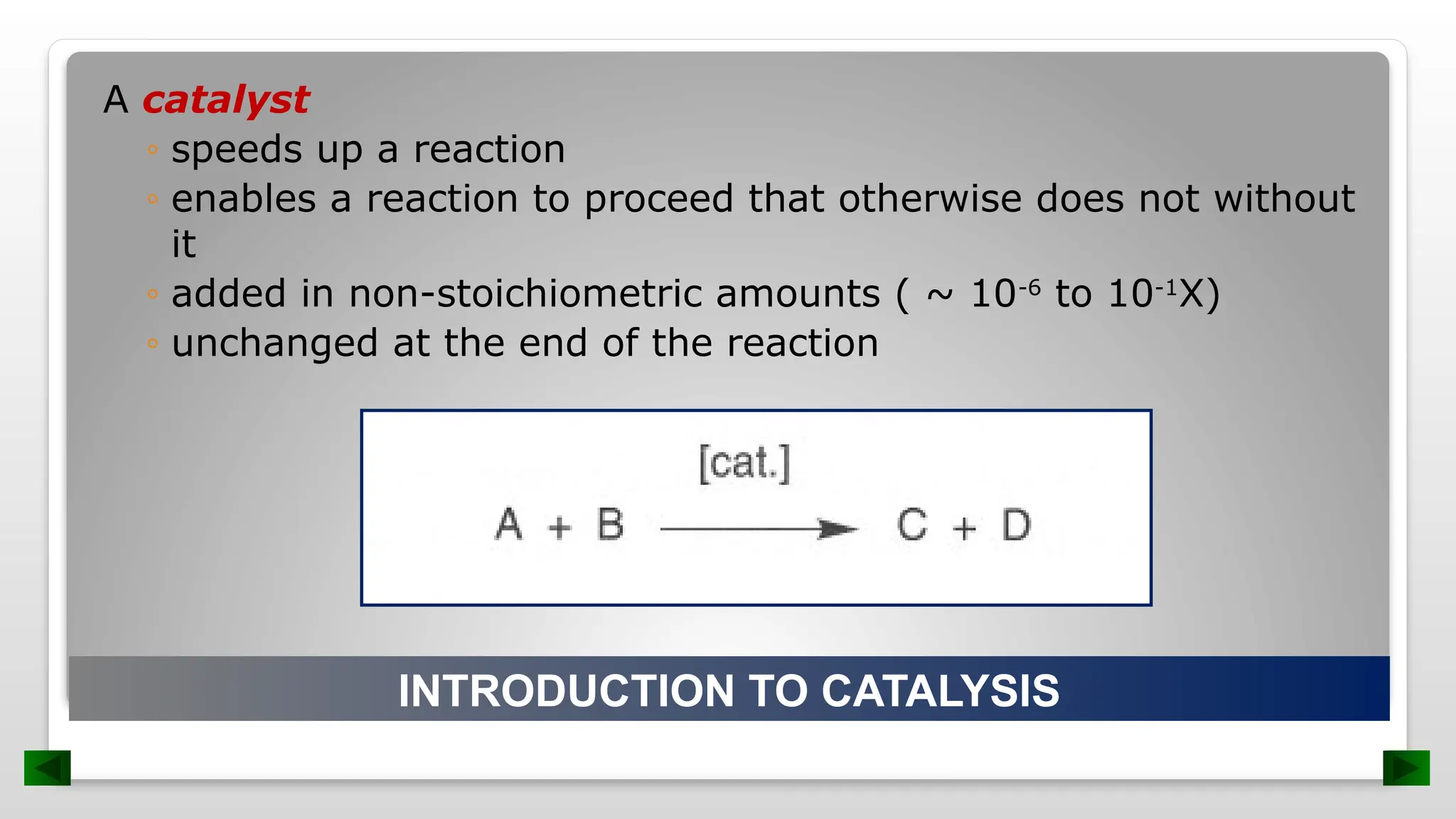
A catalyst
◦ speedsup a reaction
◦ enables a reaction to proceed that otherwise does not without
it
◦ added in non-stoichiometric amounts ( ~ 10-6
to 10-1
X)
◦ unchanged at the end of the reaction
INTRODUCTION TO CATALYSIS
2.
Catalysis is akinetic phenomenon:
INTRODUCTION TO CATALYSIS
A + B + [CAT] C
k1
k-1
K =
k1
k-1
Reaction Coordinate
G
G
Reactants
Products
Ea
Ea
catalyzed
Catalyzed rxn
proceeding through
an intermediate
3.
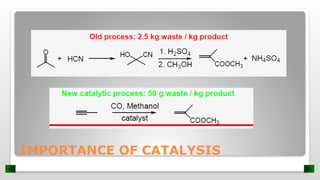
IMPORTANCE OF CATALYSIS
increasingly important in synthesis
selectivity in production of fine chemicals
clean processes, high atom economy (bulk processes)
production of high-tech products / materials
mild conditions (low energy consumption)
environmentally friendly
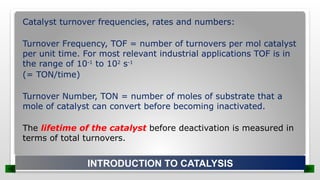
Catalyst turnover frequencies,rates and numbers:
Turnover Frequency, TOF = number of turnovers per mol catalyst
per unit time. For most relevant industrial applications TOF is in
the range of 10-1
to 102
s-1
(= TON/time)
Turnover Number, TON = number of moles of substrate that a
mole of catalyst can convert before becoming inactivated.
The lifetime of the catalyst before deactivation is measured in
terms of total turnovers.
INTRODUCTION TO CATALYSIS
6.
There are differenttypes of catalysis:
Acid-base catalysis
Electrocatalysis
Photocatalysis
Redox Catalysis
Homogeneous Catalysis
Enzymatic Catalysis
Heterogeneous catalysis
Supported Catalysis
Metallodendritic Catalysis
Biphasic Catalysis
INTRODUCTION TO CATALYSIS
7.
The catalystswe look at are soluble complexes, or
homogeneous catalysts, as opposed to catalysts such as
palladium on carbon, or heterogeneous catalysts.
These terms are used because the catalyst and substrates for
the reaction are in the same phase in the homogeneous, but not
in the heterogeneous, type, where catalysis takes place at the
surface of a solid catalyst.
Catalytic mechanisms are considerably easier to study in
homogeneous systems, where such powerful methods as NMR
can be used to both assign structures and follow reaction
kinetics.
HOMOGENEOUS CATALYSIS
8.
Homogeneous catalystshave the disadvantage that they can be
difficult to separate from the product.
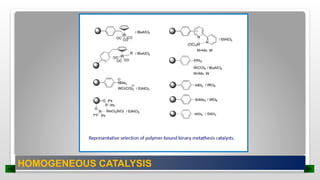
Homogeneous catalysts can also be chemically grafted on to
solid supports for greater ease of separation of the catalyst from
the reaction products.
Although the catalyst is now technically heterogeneous, it often
retains the characteristic reactivity pattern that it showed as a
homogeneous catalyst, and its properties are usually distinct
from those of any of the classical heterogeneous catalysts—
these are sometimes called “heterogenized” homogeneous
catalysts.
HOMOGENEOUS CATALYSIS
The mechanisticideas developed in homogeneous catalysis
are also becoming more influential in the field of classical
heterogeneous catalysis by suggesting structures for
intermediates and mechanisms for reaction steps.
By bringing about a reaction at lower temperature, a catalyst
can save energy in commercial applications. It often gives
higher selectivity for the desired product, minimizing product
separation problems and avoiding the need to discard the
undesired product as waste.
HOMOGENEOUS CATALYSIS
11.
Environmental concernshave promoted the idea of
atom economy, which values a process most highly
when all the atoms in the reagents are used to form
the product, minimizing waste.
Catalysis is Green Chemistry !!!!
HOMOGENEOUS CATALYSIS
12.
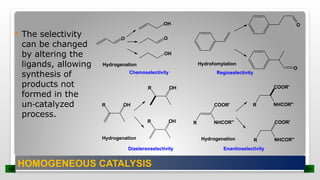
The selectivity
canbe changed
by altering the
ligands, allowing
synthesis of
products not
formed in the
un catalyzed
‐
process.
HOMOGENEOUS CATALYSIS
O
OH
O
OH
Chemoselectivity
O
O
Hydrogenation Hydrofomylation
Regioselectivity
OH
R
OH
R
OH
R
Diastereoselectivity
Hydrogenation
COOR'
R NHCOR"
COOR'
R NHCOR"
COOR'
R NHCOR"
Hydrogenation
Enantioselectivity
13.
With growingregulatory pressure to synthesize drugs
in enantiopure form, asymmetric catalysis has come to
the fore, along with enzyme catalysis, as the only
practical way to make such products on a large scale.
HOMOGENEOUS CATALYSIS
15.
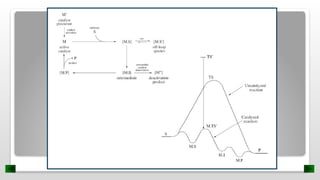
For mosttransition metal catalysts, the catalyzed pathway is
completely changed from the pathway of the uncatalyzed
reaction. Instead of passing by way of the high energy
‐
uncatalyzed transition state TS, the catalyzed reaction normally
goes by a multistep mechanism in which the metal stabilizes
intermediates that are stable only when bound to the metal.
Normally, the catalyst only increases the rate of a process but
does not alter its position of equilibrium, which is decided
by the relative thermodynamic stabilities of substrate and
products.
For example, if the substrate S is slightly less stable than the
product P, so the reaction will eventually reach an equilibrium
favoring P.
16.
The TSstructure in the absence of the metal would be
extremely unstable, but the energy of binding is so high that
M.TS is now much more favorable than TS and the reaction all
passes through the catalyzed route.
Different metal species may be able to stabilize other transition
states TS—which may lead to entirely different products—hence
different catalysts products can give different products from the
same starting materials.
The slow step in a catalytic process is called the turnover
limiting step. Any change that lowers the barrier for this
step will increase the turnover frequency (TOF).
17.
Changes inother barriers will not affect the TOF. For a high TOF,
we require that none of the intermediates be bound too strongly
(otherwise they may be too stable and not react further) and
that none of the transition states be prohibitively high in energy
Indeed, the whole reaction profile must not stray from a rather
narrow range of free energies, accessible at the reaction
temperature. Even if all this is arranged, a catalyst may
undergo a catalytic cycle only a few times and then “die.”
This happens if undesired deactivation reactions are faster than
the productive reactions of the catalytic cycle itself.
18.
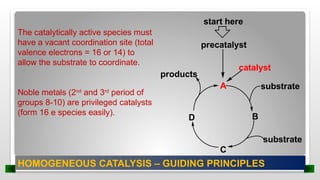
HOMOGENEOUS CATALYSIS –GUIDING PRINCIPLES
start here
precatalyst
A
B
C
D
catalyst
substrate
substrate
products
The catalytically active species must
have a vacant coordination site (total
valence electrons = 16 or 14) to
allow the substrate to coordinate.
Noble metals (2nd
and 3rd
period of
groups 8-10) are privileged catalysts
(form 16 e species easily).
19.
HOMOGENEOUS CATALYSIS –GUIDING PRINCIPLES
start here
precatalyst
A
B
C
D
catalyst
substrate
substrate
products
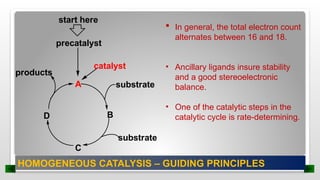
In general, the total electron count
alternates between 16 and 18.
• Ancillary ligands insure stability
and a good stereoelectronic
balance.
• One of the catalytic steps in the
catalytic cycle is rate-determining.
20.
Rh
Ar3P
Cl PAr3
PAr3
Rh
Cl
Ar3P S
PAr3
Rh
Cl
Ar3PH
PAr3
H
S
Rh
Cl
Ar3P H
PAr3
H
Rh
Cl
Ar3P CH2CH2H
PAr3
H
S
PAr3
S ligand dissociation
H-H
oxidative
addition
S
substrate
coordination
insertion/
migration
CH3CH3
reductive
elimination
S
rearrangement
irreversible
Ligand:
(4-ClC6H4)3P
PPh3
(4-CH3C6H4)3P
(4-CH3OC6H4)3P
Relative rates
for hydrogenation
of cyclohexene:
1.7
41
86
100
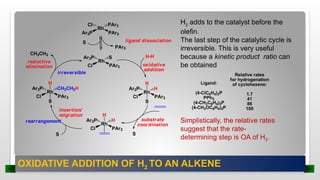
Simplistically, the relative rates
suggest that the rate-
determining step is OA of H2.
H2 adds to the catalyst before the
olefin.
The last step of the catalytic cycle is
irreversible. This is very useful
because a kinetic product ratio can
be obtained
OXIDATIVE ADDITION OF H2 TO AN ALKENE

![Catalysis is a kinetic phenomenon:
INTRODUCTION TO CATALYSIS
A + B + [CAT] C
k1
k-1
K =
k1
k-1
Reaction Coordinate
G
G
Reactants
Products
Ea
Ea
catalyzed
Catalyzed rxn
proceeding through
an intermediate](https://image.slidesharecdn.com/catalysisfundamentals-250326171951-e37bd130/85/Catalysis-Fundamentals-application-pptx-2-320.jpg)