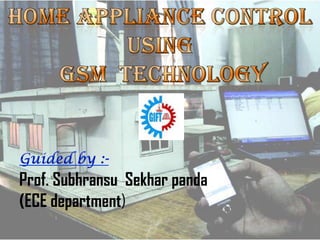
Prof. Subhransu Sekhar panda
(ECE department)
Team Members :-
Reasons for choosing this
 project :-
Objective of this project is to control our home appliance
from remote area.

 There are many home wireless based devices for
controlling processes, but they are more expensive.

 So here we are using all the basic components that are
used in our daily life like cell phones, Sim card, GSM modem
etc which make our project cheaper and very simple to use.
Project details :-
 Aim of the ‘project ‘ Is to develop a system based on
Embedded micro controller ,which is used for controlling various
appliances at home using GSM network and which provides a
security feature.

The major hardware interfaces to micro controller are LCD
display and a modem(GSM).Also the appliances are interfaced to
the micro controller that are to be controlled.

   A serial driver IC is used for serial data transmission.
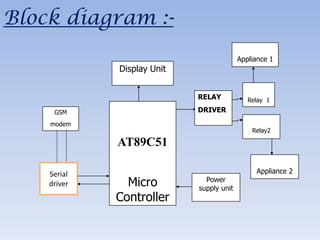
Block diagram :-
                                          Appliance 1
             Display Unit


                            RELAY            Relay 1
     GSM                    DRIVER
    modem
                                              Relay2

             AT89C51

    Serial                                     Appliance 2
    driver     Micro          Power
                            supply unit
             Controller
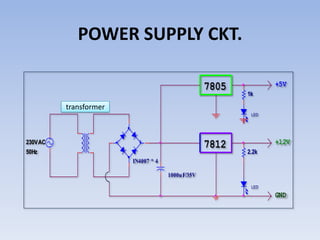
POWER SUPPLY CKT.
                POWER SUPPLY

                                                         7805          +5V
                                                                1k

         transformer
          9-0-9Vac/1Amp
                                                                 LED


230VAC                    -     +
                                                         7812          +12V
50Hz                                                            2.2k
                              IN4007 * 4

                                           1000u F/35V
                                                                 LED
                                                                       GND
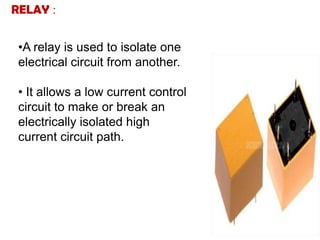
RELAY :


 •A relay is used to isolate one
 electrical circuit from another.

 • It allows a low current control
 circuit to make or break an
 electrically isolated high
 current circuit path.
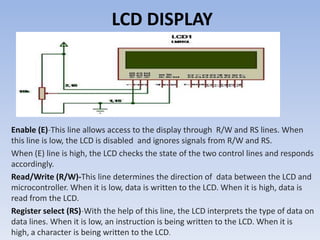
LCD DISPLAY


Enable (E)-This line allows access to the display through R/W and RS lines. When
this line is low, the LCD is disabled and ignores signals from R/W and RS.
When (E) line is high, the LCD checks the state of the two control lines and responds
accordingly.
Read/Write (R/W)-This line determines the direction of data between the LCD and
microcontroller. When it is low, data is written to the LCD. When it is high, data is
read from the LCD.
Register select (RS)-With the help of this line, the LCD interprets the type of data on
data lines. When it is low, an instruction is being written to the LCD. When it is
high, a character is being written to the LCD.
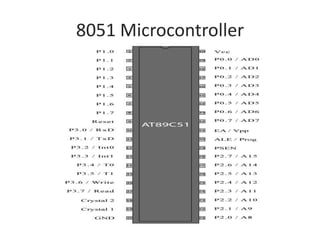
8051 Microcontroller
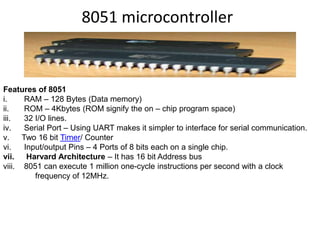
8051 microcontroller


Features of 8051
i.     RAM – 128 Bytes (Data memory)
ii.    ROM – 4Kbytes (ROM signify the on – chip program space)
iii.   32 I/O lines.
iv.    Serial Port – Using UART makes it simpler to interface for serial communication.
v.    Two 16 bit Timer/ Counter
vi.    Input/output Pins – 4 Ports of 8 bits each on a single chip.
vii. Harvard Architecture – It has 16 bit Address bus
viii. 8051 can execute 1 million one-cycle instructions per second with a clock
          frequency of 12MHz.
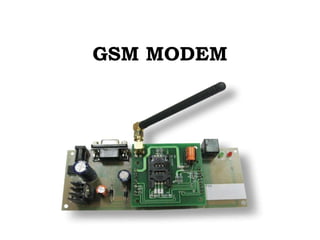
GSM MODEM
GSM is the most popular standard for mobile phones in the
world. It is based on TDMA (time division multiple access)
technology.

We are using the SIMCOM 300, a GSM modem . This is a
powerful GSM/GPRS Terminal with self-contained unit.

This has standard connector interfaces and has an integral SIM
card reader. The modem has a RJ9 connector through which a
speaker and microphone can be connected allowing audio calls
being established, but this feature is not utilized in this project
as only data transfer is needed.
Software used :-

   Windows 2000 & onwards version

 Embedded c

 Keil software (Programming language for the communication between
       the Micro controller and the GSM modem)


 Proteus software(simulation)
Hardware used :-
 AT89C51 microcontroller

Relay circuit

Relay drive

 Serial communication RS 232 protocol

 GSM modem

 LCD
Lab setup:-
Setup is in such a way that it contains proper atmosphere
and safe instrumentation.

The GSM module was properly aligned with microcontroller.

 Soldering has been firmly done to reduce loose connection
and short circuit.

All safety measures are taken to prevent electric hazard.

 A pc with all the software

Measuring instrument
Application :-
Appliance control

Control of doors and windows shutters

Home entertainment system

Security system
Advantages:-
 simple and easy to access

 Accessed from remote area

 Low power consumption

 Taking measures to reduce the electricity bill.

 portability
Future enhancement :-
It can be used as

•Controlling speed of fan
•Controlling room
temperature
• Recording our favorite TV
program when we are outside
from our home.

It can be used for security
proposes
•burglary
•gas detection
•smoke detection
conclusion:-

 This document presents a mobile controlled and user-
 friendly approach to the available home automation
 system. This system can easily be implemented because
 of its wireless communication standards.

 Till now, we have researched the literatures for all the
 topics that include GSM automation system using SMS.
 Then we have to built the main control program, hardware
 and the warning system via GSM network (with SMS).
Bibliography :-
  Microcontroller ( theroy and application ) By Ajay V Deshmukh
    The tata McGraw-Hill companies

  “The 8051 Microcontroller and Embedded systems” by Muhammad
     Ali Mazidi and Janice Gillispie Mazidi , Pearson Education

  Circuitstoday.com

  Edaboard.com

  Vegarobokit.com

  Electronics.com

  Developershome.com

  Seminarproject.com
home appliance control using gsm

home appliance control using gsm

  • 1.
    Prof. Subhransu Sekharpanda (ECE department)
  • 2.
  • 3.
    Reasons for choosingthis project :- Objective of this project is to control our home appliance from remote area.  There are many home wireless based devices for controlling processes, but they are more expensive.  So here we are using all the basic components that are used in our daily life like cell phones, Sim card, GSM modem etc which make our project cheaper and very simple to use.
  • 4.
    Project details :- Aim of the ‘project ‘ Is to develop a system based on Embedded micro controller ,which is used for controlling various appliances at home using GSM network and which provides a security feature. The major hardware interfaces to micro controller are LCD display and a modem(GSM).Also the appliances are interfaced to the micro controller that are to be controlled.  A serial driver IC is used for serial data transmission.
  • 5.
    Block diagram :- Appliance 1 Display Unit RELAY Relay 1 GSM DRIVER modem Relay2 AT89C51 Serial Appliance 2 driver Micro Power supply unit Controller
  • 6.
    POWER SUPPLY CKT. POWER SUPPLY 7805 +5V 1k transformer 9-0-9Vac/1Amp LED 230VAC - + 7812 +12V 50Hz 2.2k IN4007 * 4 1000u F/35V LED GND
  • 7.
    RELAY : •Arelay is used to isolate one electrical circuit from another. • It allows a low current control circuit to make or break an electrically isolated high current circuit path.
  • 8.
    LCD DISPLAY Enable (E)-Thisline allows access to the display through R/W and RS lines. When this line is low, the LCD is disabled and ignores signals from R/W and RS. When (E) line is high, the LCD checks the state of the two control lines and responds accordingly. Read/Write (R/W)-This line determines the direction of data between the LCD and microcontroller. When it is low, data is written to the LCD. When it is high, data is read from the LCD. Register select (RS)-With the help of this line, the LCD interprets the type of data on data lines. When it is low, an instruction is being written to the LCD. When it is high, a character is being written to the LCD.
  • 9.
  • 10.
    8051 microcontroller Features of8051 i. RAM – 128 Bytes (Data memory) ii. ROM – 4Kbytes (ROM signify the on – chip program space) iii. 32 I/O lines. iv. Serial Port – Using UART makes it simpler to interface for serial communication. v. Two 16 bit Timer/ Counter vi. Input/output Pins – 4 Ports of 8 bits each on a single chip. vii. Harvard Architecture – It has 16 bit Address bus viii. 8051 can execute 1 million one-cycle instructions per second with a clock frequency of 12MHz.
  • 11.
  • 12.
    GSM is themost popular standard for mobile phones in the world. It is based on TDMA (time division multiple access) technology. We are using the SIMCOM 300, a GSM modem . This is a powerful GSM/GPRS Terminal with self-contained unit. This has standard connector interfaces and has an integral SIM card reader. The modem has a RJ9 connector through which a speaker and microphone can be connected allowing audio calls being established, but this feature is not utilized in this project as only data transfer is needed.
  • 13.
    Software used :-  Windows 2000 & onwards version  Embedded c  Keil software (Programming language for the communication between the Micro controller and the GSM modem)  Proteus software(simulation)
  • 14.
    Hardware used :- AT89C51 microcontroller Relay circuit Relay drive  Serial communication RS 232 protocol  GSM modem  LCD
  • 15.
    Lab setup:- Setup isin such a way that it contains proper atmosphere and safe instrumentation. The GSM module was properly aligned with microcontroller.  Soldering has been firmly done to reduce loose connection and short circuit. All safety measures are taken to prevent electric hazard.  A pc with all the software Measuring instrument
  • 16.
    Application :- Appliance control Controlof doors and windows shutters Home entertainment system Security system
  • 17.
    Advantages:-  simple andeasy to access  Accessed from remote area  Low power consumption  Taking measures to reduce the electricity bill.  portability
  • 18.
    Future enhancement :- Itcan be used as •Controlling speed of fan •Controlling room temperature • Recording our favorite TV program when we are outside from our home. It can be used for security proposes •burglary •gas detection •smoke detection
  • 19.
    conclusion:- This documentpresents a mobile controlled and user- friendly approach to the available home automation system. This system can easily be implemented because of its wireless communication standards. Till now, we have researched the literatures for all the topics that include GSM automation system using SMS. Then we have to built the main control program, hardware and the warning system via GSM network (with SMS).
  • 20.
    Bibliography :- Microcontroller ( theroy and application ) By Ajay V Deshmukh The tata McGraw-Hill companies “The 8051 Microcontroller and Embedded systems” by Muhammad Ali Mazidi and Janice Gillispie Mazidi , Pearson Education Circuitstoday.com Edaboard.com Vegarobokit.com Electronics.com Developershome.com Seminarproject.com