SUBMITTED BY,
M.ARUN KUMAR      (05E111)
 T.S.HARISHANKAR (05E122)
S.VEDAPRAKASH (05E166)
                III B.E EEE
why this project ?
   The present days many houses are secure less
    and all appliances are operated manually.
   The objective of this project is to enable users to
    remotely control their home appliances and
    systems using a cell phone-based interface via a
    simple SMS .
   Over the last decade, this problem has been
    overcome by using the Internet and through
    power-line modems.
DESCRIPTION
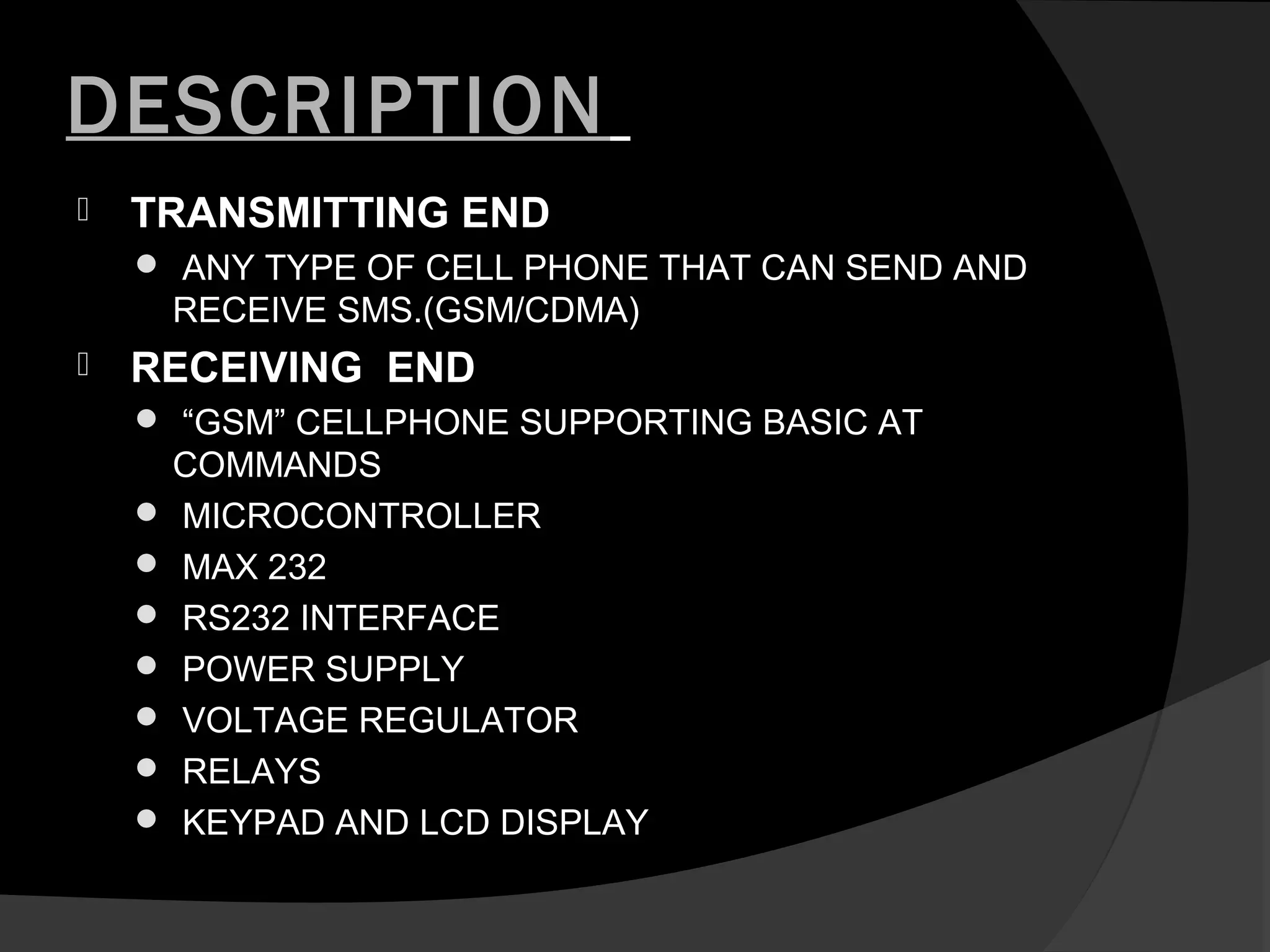
   TRANSMITTING END
     ANY TYPE OF CELL PHONE THAT CAN SEND AND
     RECEIVE SMS.(GSM/CDMA)
   RECEIVING END
     “GSM” CELLPHONE SUPPORTING BASIC AT
     COMMANDS
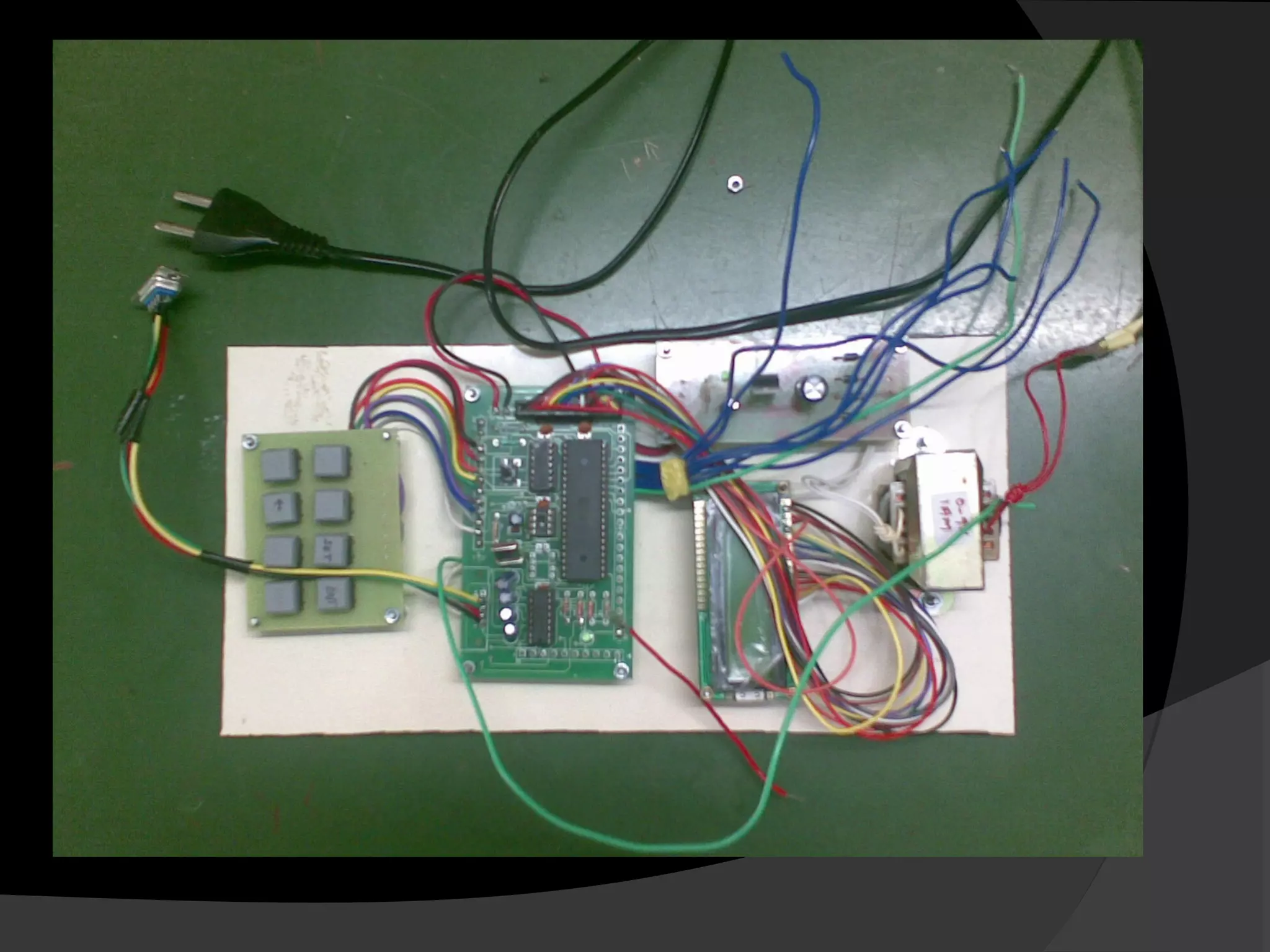
     MICROCONTROLLER
     MAX 232
     RS232 INTERFACE
     POWER SUPPLY
     VOLTAGE REGULATOR
     RELAYS
     KEYPAD AND LCD DISPLAY
Wireless?
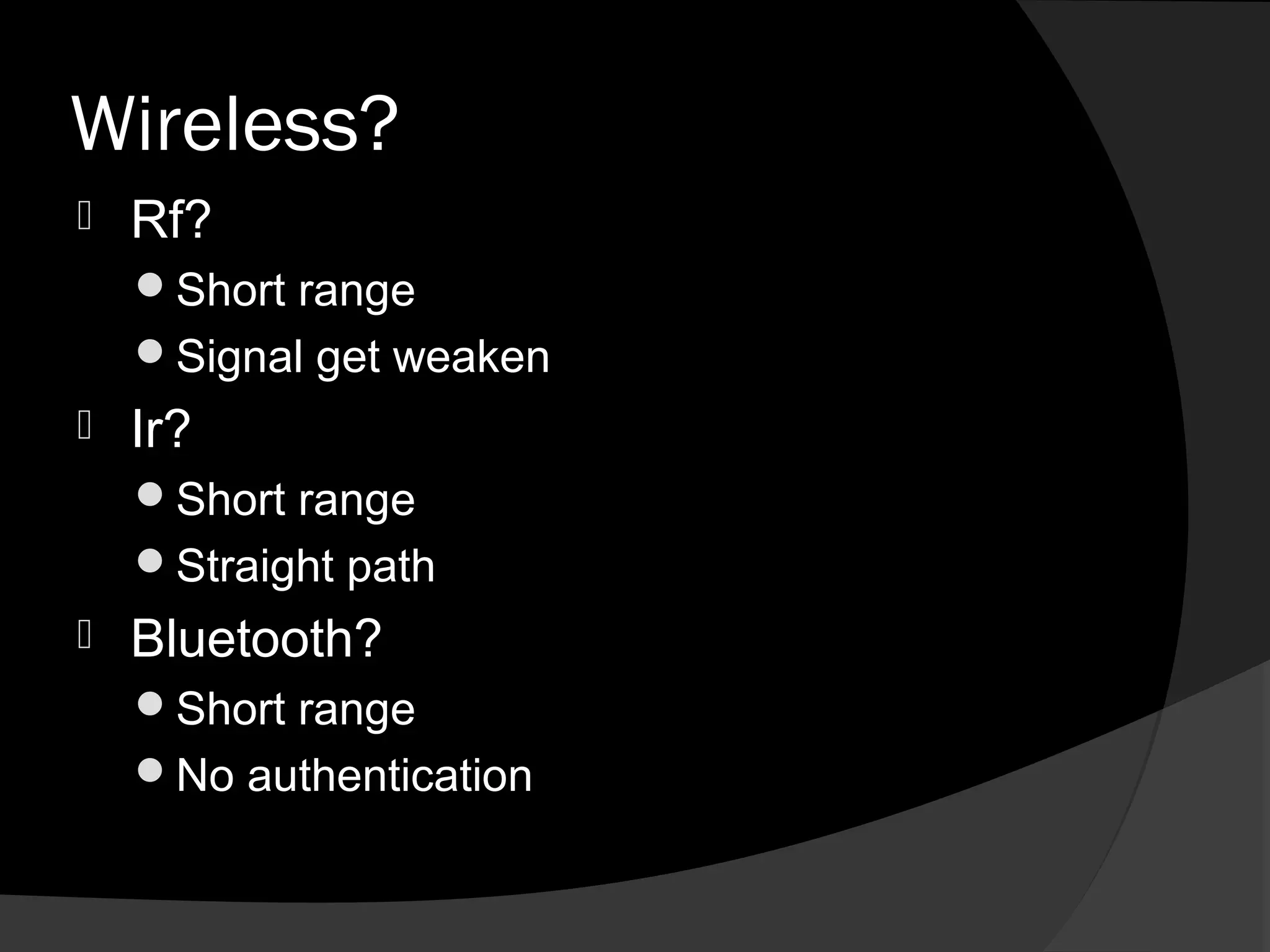
   Rf?
    Short range
    Signal get weaken
   Ir?
    Short range
    Straight path
   Bluetooth?
    Short range
    No authentication
Wireless?
   Wifi?
    Need of hot spots
    Internet connection
    a separate dedicated system
    Expensive
Wireless - GSM
   Global system of mobile communication
   Available in all parts of the world
   No distance limit
   Needs only a dedicated GSM cellphone
    and a interface cable
   Minimum power consumption
   Not expensive
    Because we use the SMS for communicating
controller?
   A PC?
    Expensive
    Power consumption is more
   A Microprocessor?
    Needs External RAM,TIMER,ROM…..
    Serial Interfacing is difficult
   A FPGA?
    Expensive
    Programming is difficult
A Microcontoller
   It has in built RAM,ROM,TIMER….
   Serial interfacing is easy
   Programming is easy
   Power consumption is minimum
   cheap
   Does not occupy much space
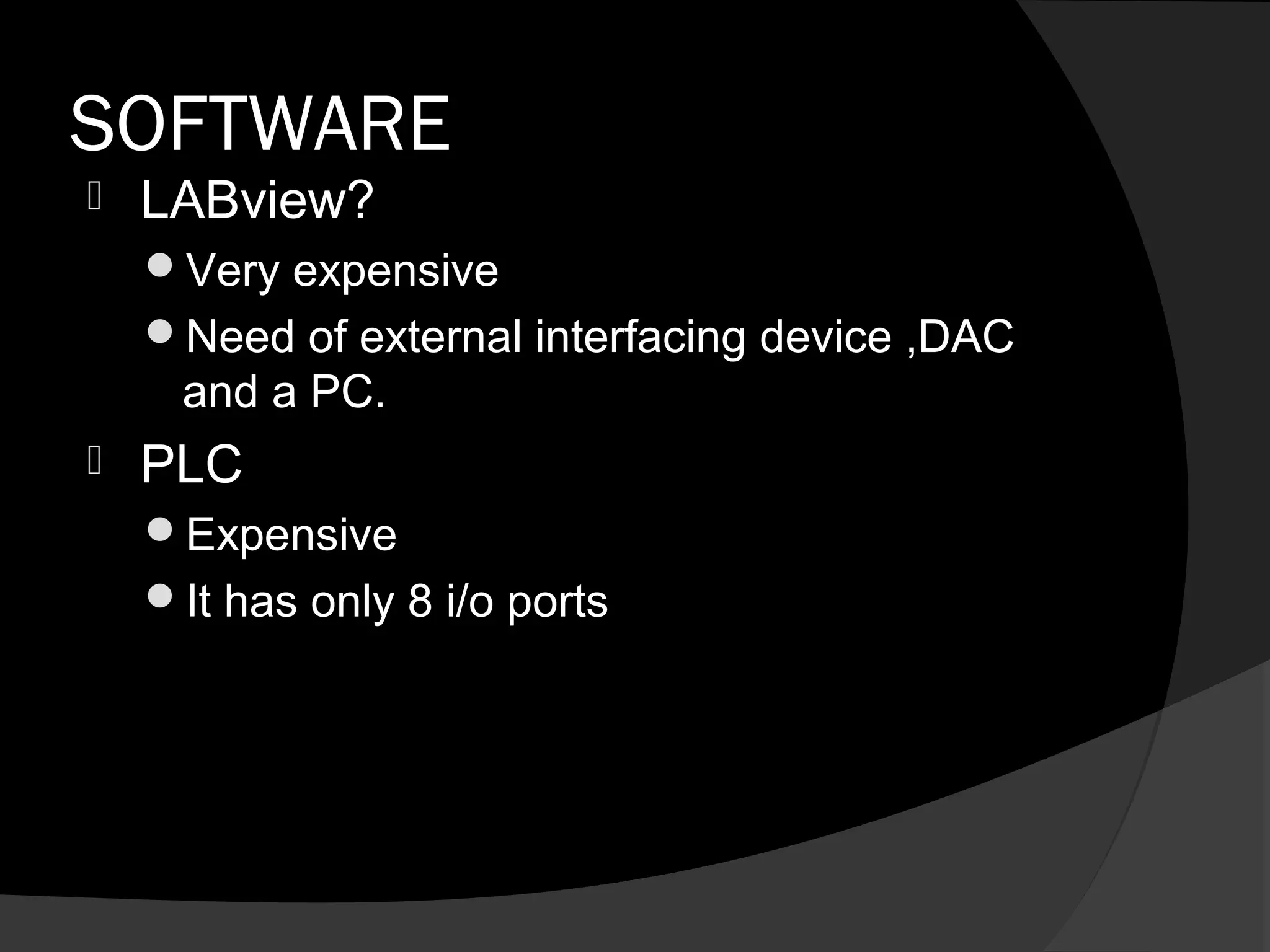
SOFTWARE
   LABview?
    Very expensive
    Need of external interfacing device ,DAC
     and a PC.
   PLC
    Expensive
    It has only 8 i/o ports
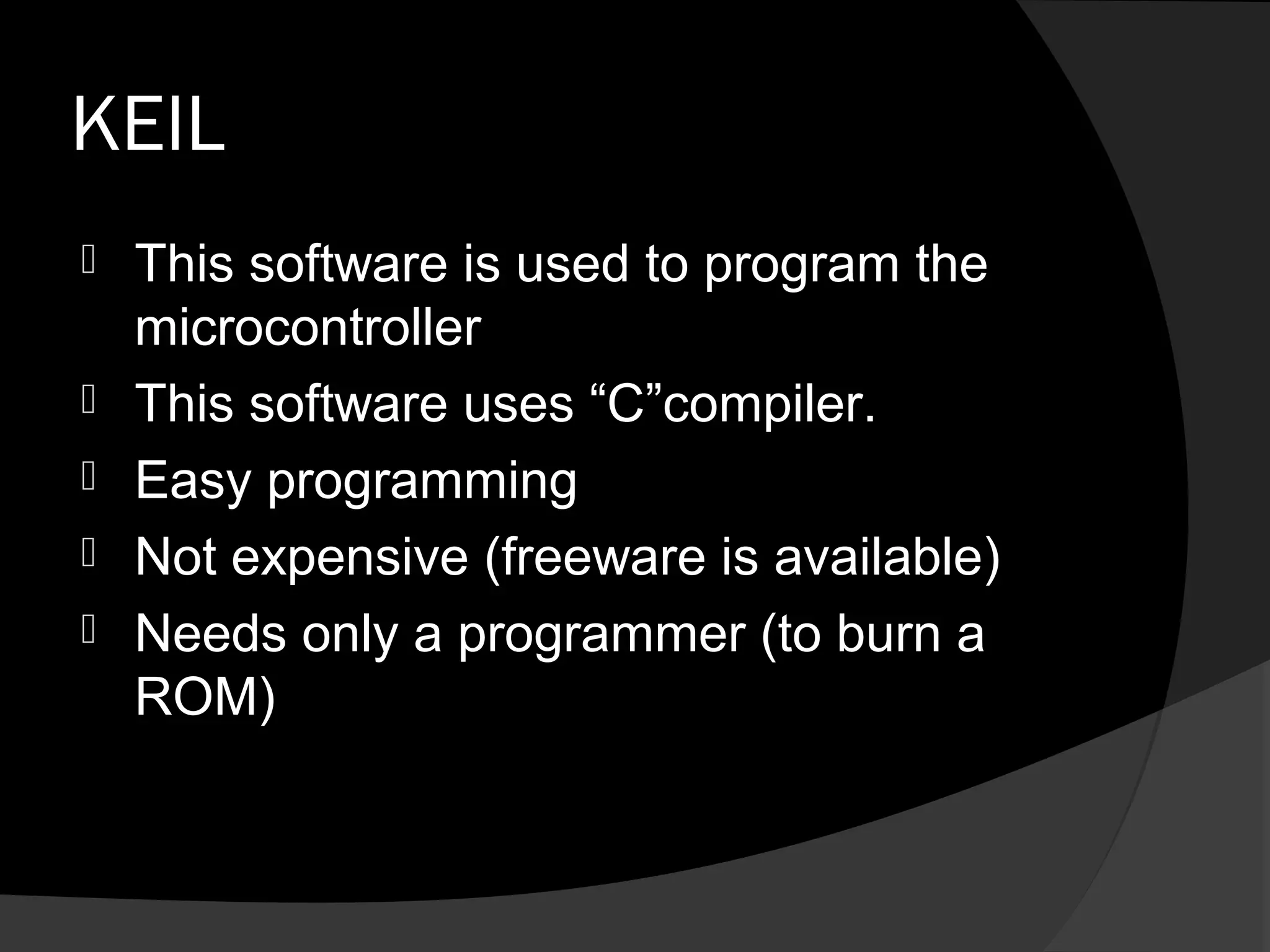
KEIL
   This software is used to program the
    microcontroller
   This software uses “C”compiler.
   Easy programming
   Not expensive (freeware is available)
   Needs only a programmer (to burn a
    ROM)
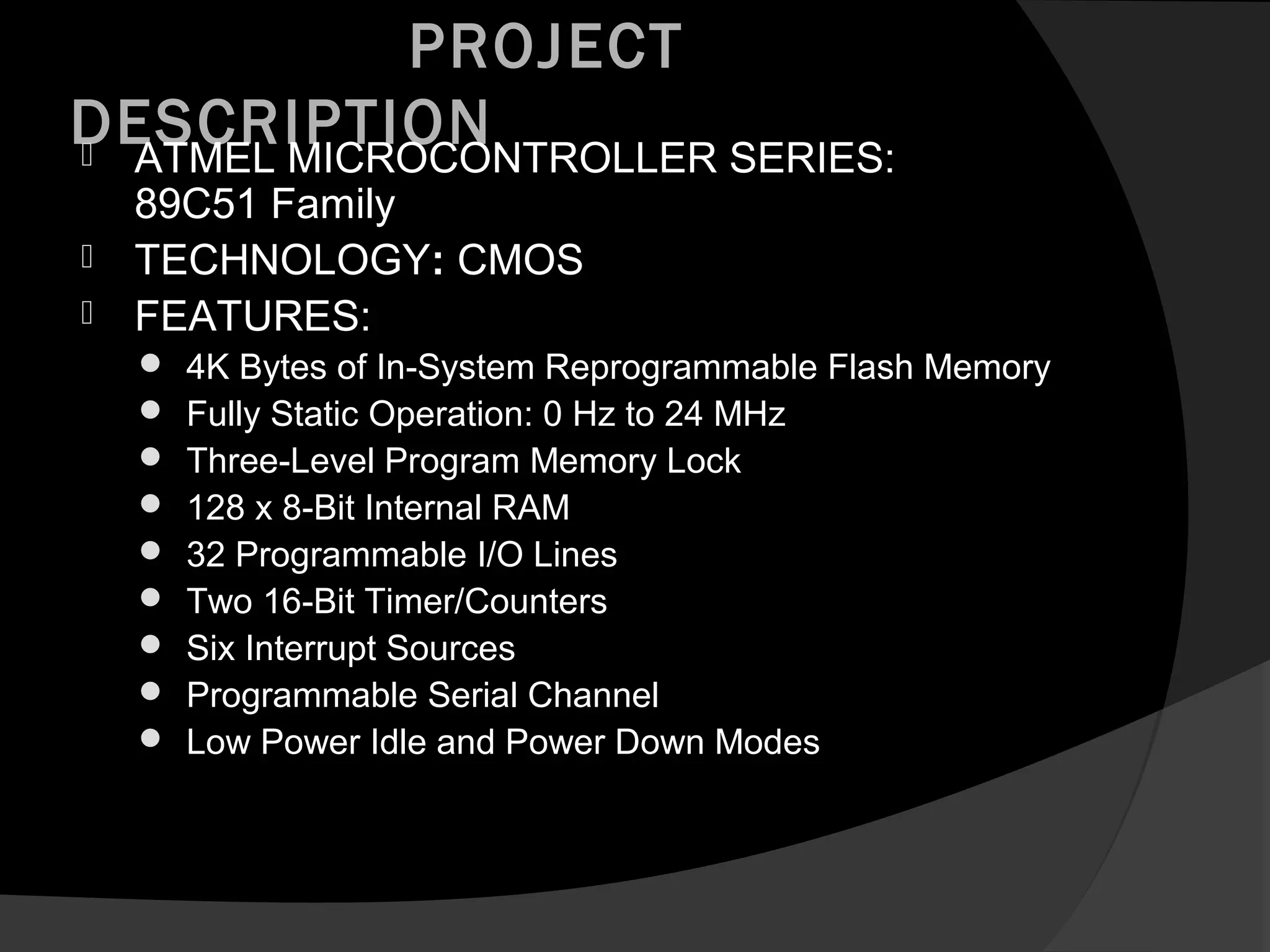
PROJECT
DESCRIPTION
 ATMEL MICROCONTROLLER SERIES:
    89C51 Family
   TECHNOLOGY: CMOS
   FEATURES:
       4K Bytes of In-System Reprogrammable Flash Memory
       Fully Static Operation: 0 Hz to 24 MHz
       Three-Level Program Memory Lock
       128 x 8-Bit Internal RAM
       32 Programmable I/O Lines
       Two 16-Bit Timer/Counters
       Six Interrupt Sources
       Programmable Serial Channel
       Low Power Idle and Power Down Modes
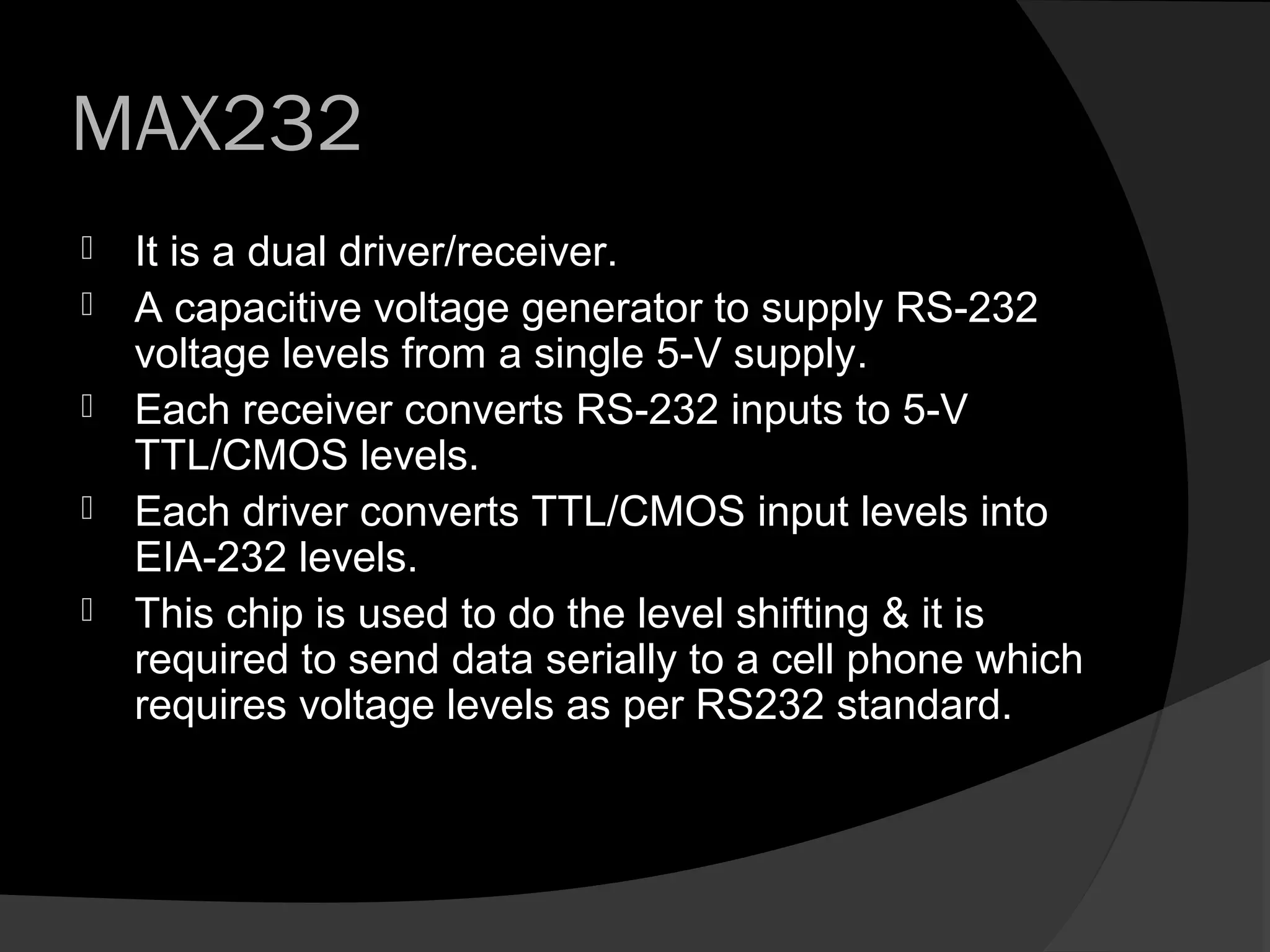
MAX232
   It is a dual driver/receiver.
   A capacitive voltage generator to supply RS-232
    voltage levels from a single 5-V supply.
   Each receiver converts RS-232 inputs to 5-V
    TTL/CMOS levels.
   Each driver converts TTL/CMOS input levels into
    EIA-232 levels.
   This chip is used to do the level shifting & it is
    required to send data serially to a cell phone which
    requires voltage levels as per RS232 standard.
RS232 STANDARD
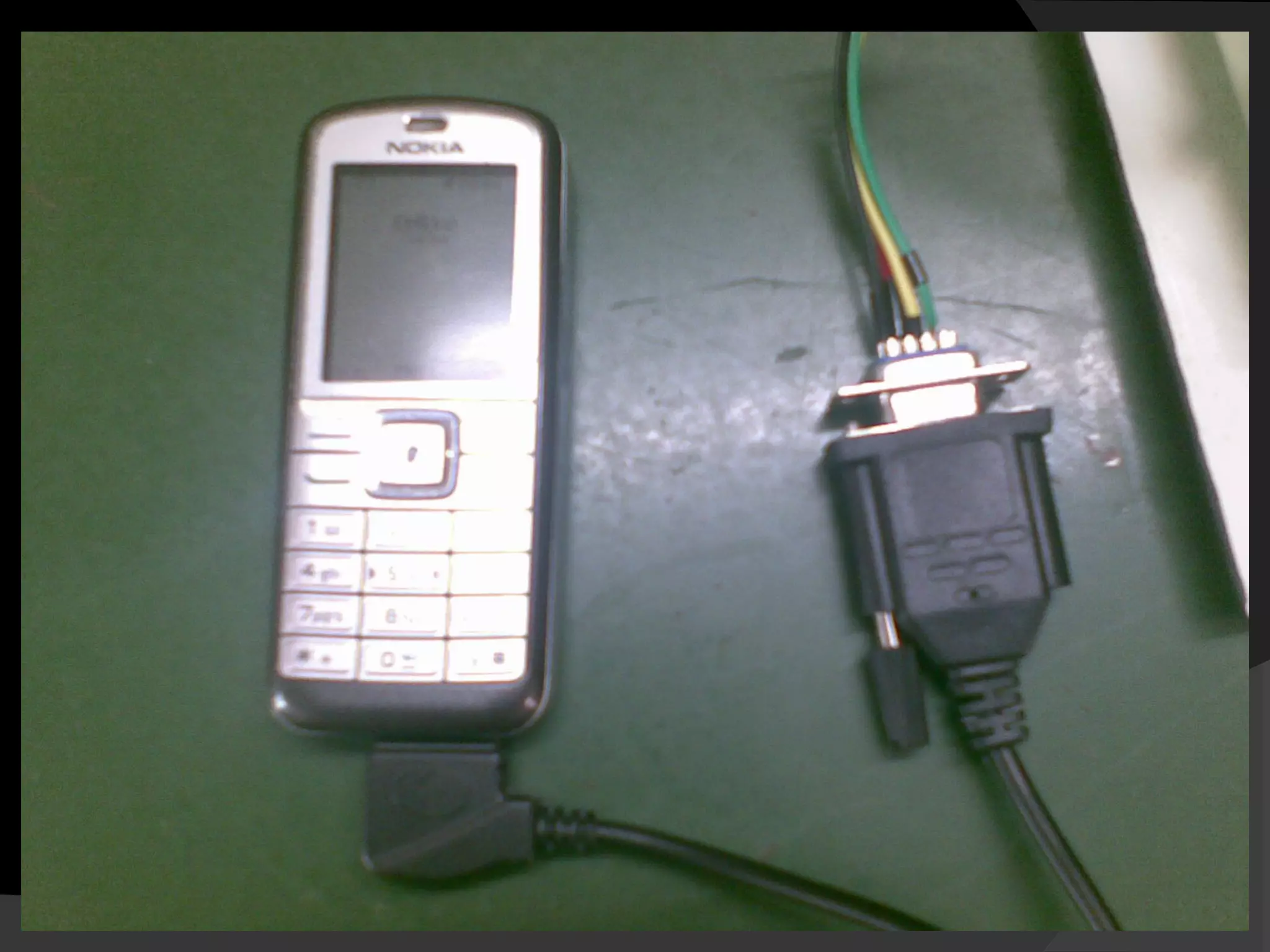
   RS232 is an interface cable used for serial
    communication.
   9-pin (DB9) connector cable.
   Voltage level:
              +12v(logic 0)
              -12v(logic1)
    the signal encoding used here is NRZ-L
   It uses only two levels.
AT COMMANDS
   A GSM cellphone is a wireless modem
   The instructions used for controlling the mobile
    phone or GSM/GPRS modem are called AT
    commands.
   One use of the AT commands is to control the
    sending and receiving of SMS messages.
Important AT command
   ATD To dial a voice call from the modem.
   AT+CLIR For calling line Identification Restriction.
   AT+CNMI To set the mode of the mobile.
   AT+CMGR To read the message at particular
    location.
   AT+CMGD To delete the received message
   AT+CMGS To send the message.
   AT+CMGF To change the message format to PDU
    or Text mode.
   AT+CMGL To see all the list of messages.
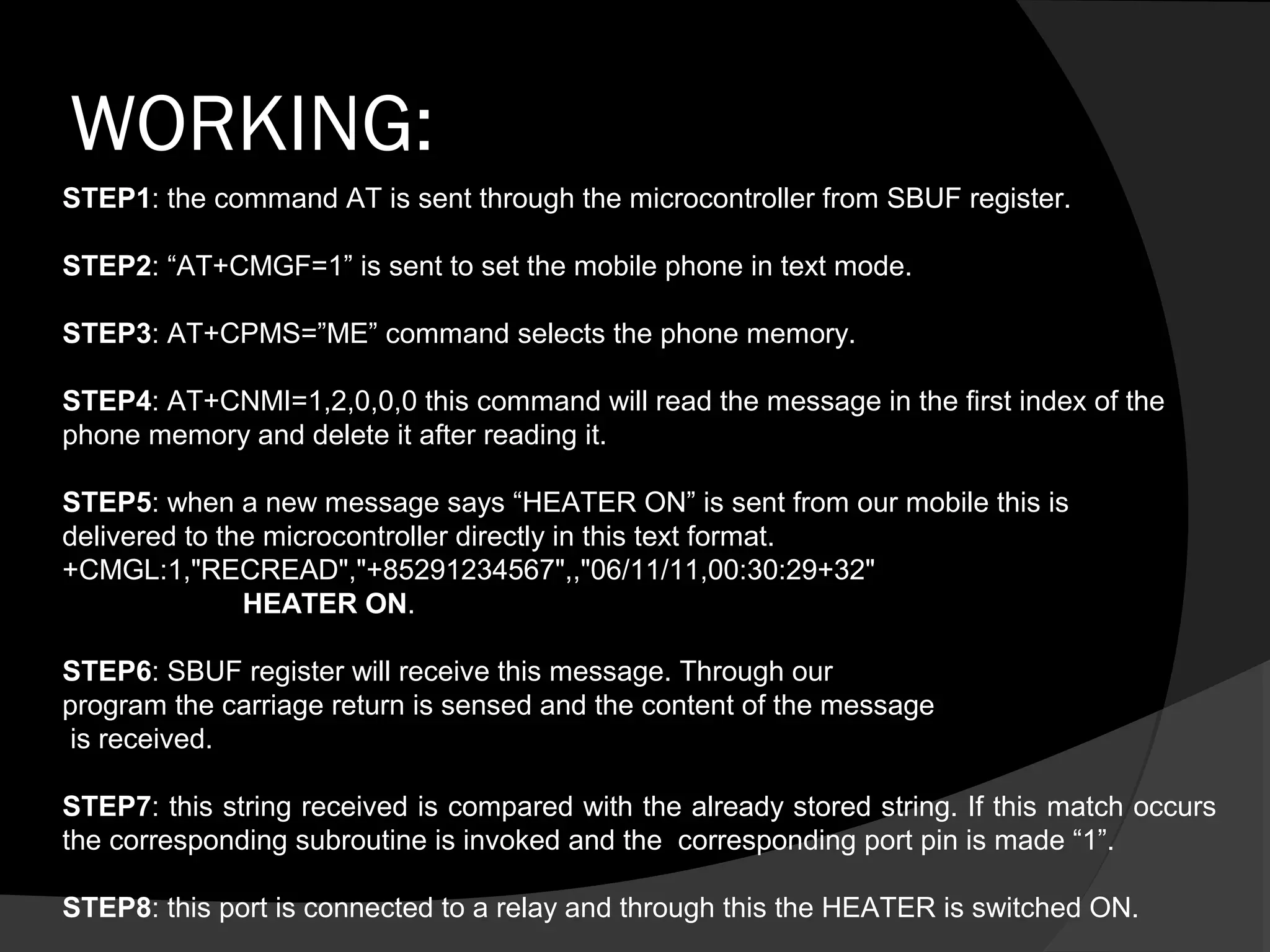
WORKING:
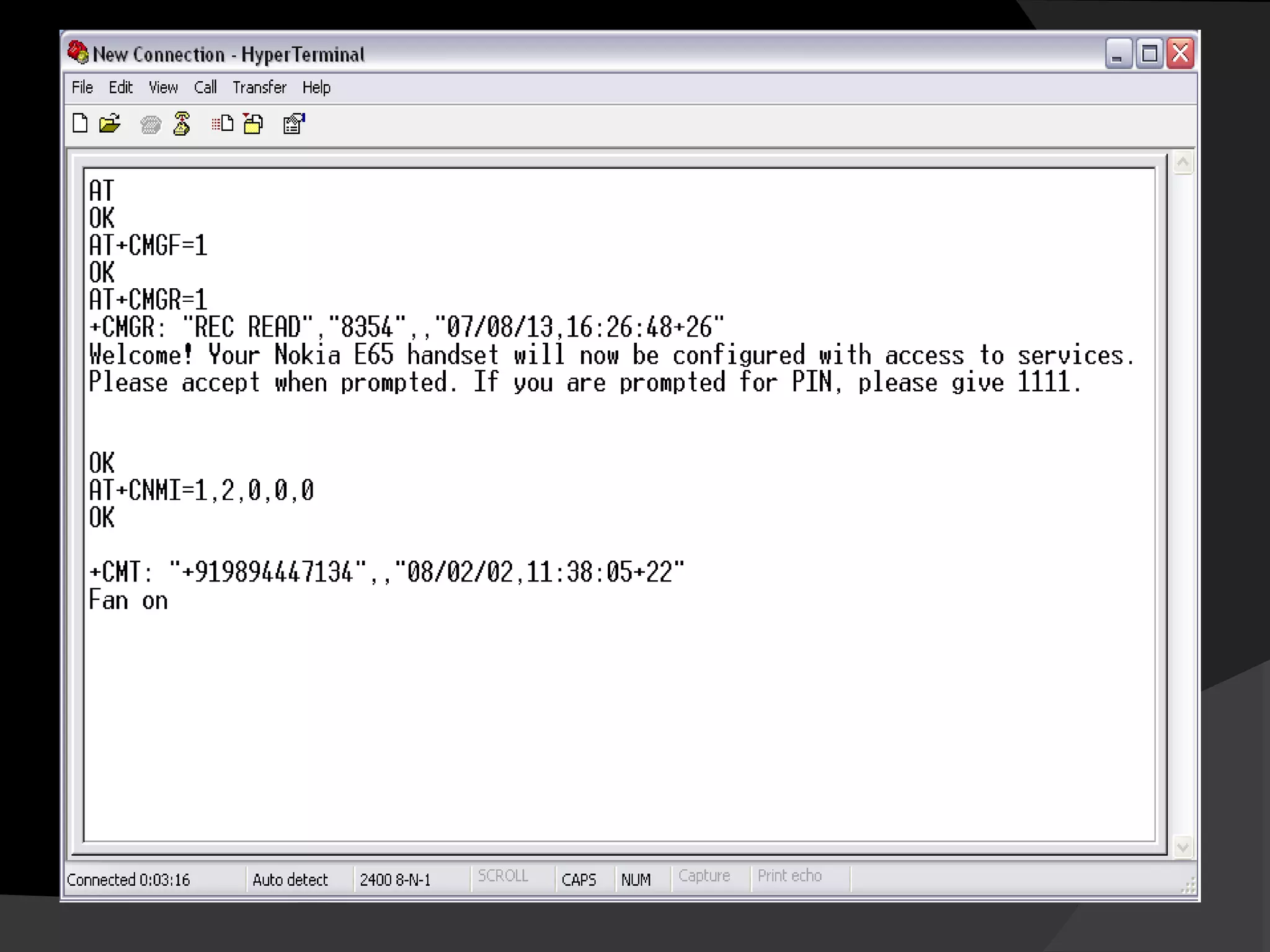
STEP1: the command AT is sent through the microcontroller from SBUF register.

STEP2: “AT+CMGF=1” is sent to set the mobile phone in text mode.

STEP3: AT+CPMS=”ME” command selects the phone memory.

STEP4: AT+CNMI=1,2,0,0,0 this command will read the message in the first index of the
phone memory and delete it after reading it.

STEP5: when a new message says “HEATER ON” is sent from our mobile this is
delivered to the microcontroller directly in this text format.
+CMGL:1,"RECREAD","+85291234567",,"06/11/11,00:30:29+32"
               HEATER ON.

STEP6: SBUF register will receive this message. Through our
program the carriage return is sensed and the content of the message
 is received.

STEP7: this string received is compared with the already stored string. If this match occurs
the corresponding subroutine is invoked and the corresponding port pin is made “1”.

STEP8: this port is connected to a relay and through this the HEATER is switched ON.
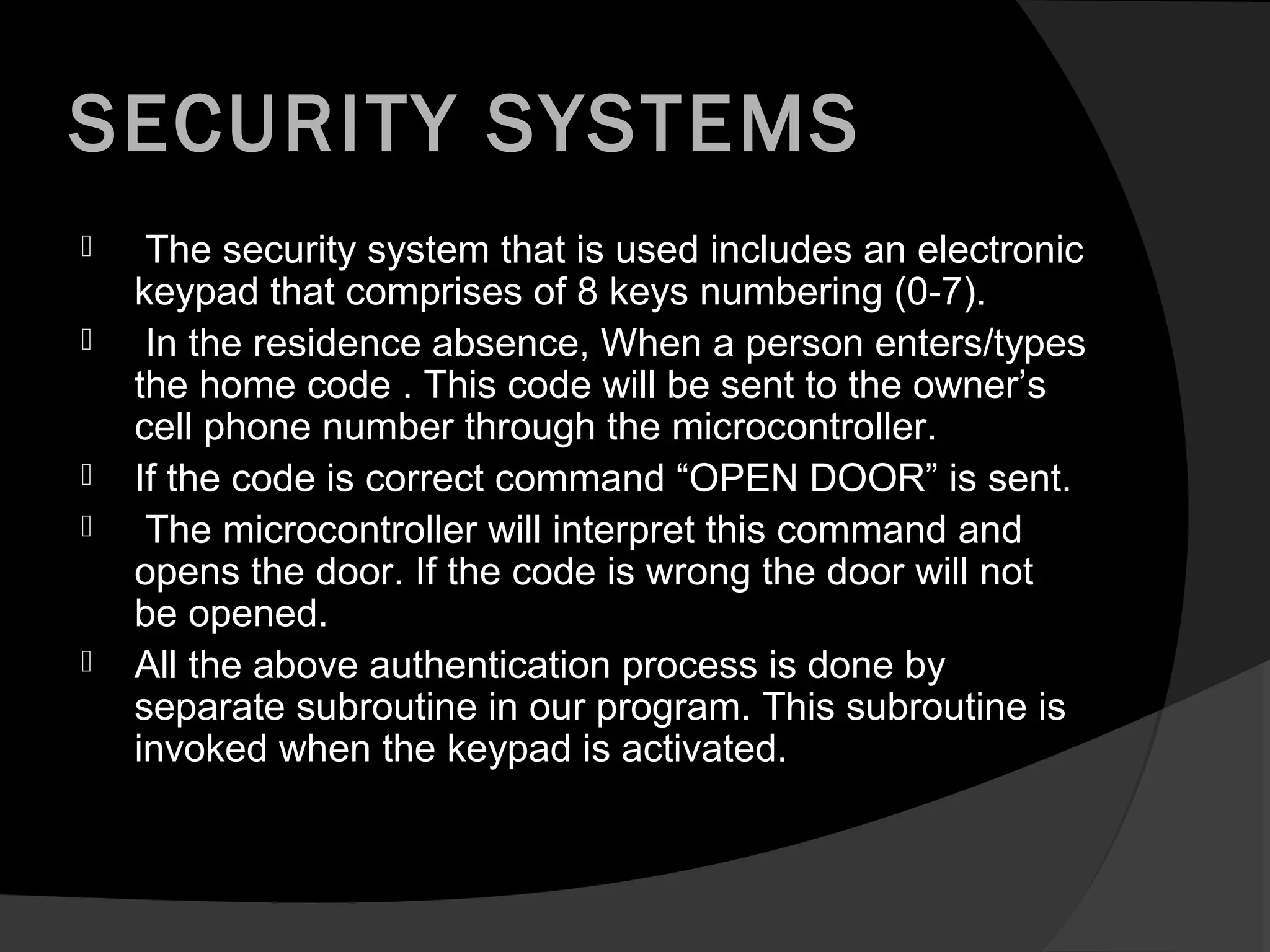
SECURITY SYSTEMS
    The security system that is used includes an electronic
    keypad that comprises of 8 keys numbering (0-7).
    In the residence absence, When a person enters/types
    the home code . This code will be sent to the owner’s
    cell phone number through the microcontroller.
   If the code is correct command “OPEN DOOR” is sent.
    The microcontroller will interpret this command and
    opens the door. If the code is wrong the door will not
    be opened.
   All the above authentication process is done by
    separate subroutine in our program. This subroutine is
    invoked when the keypad is activated.
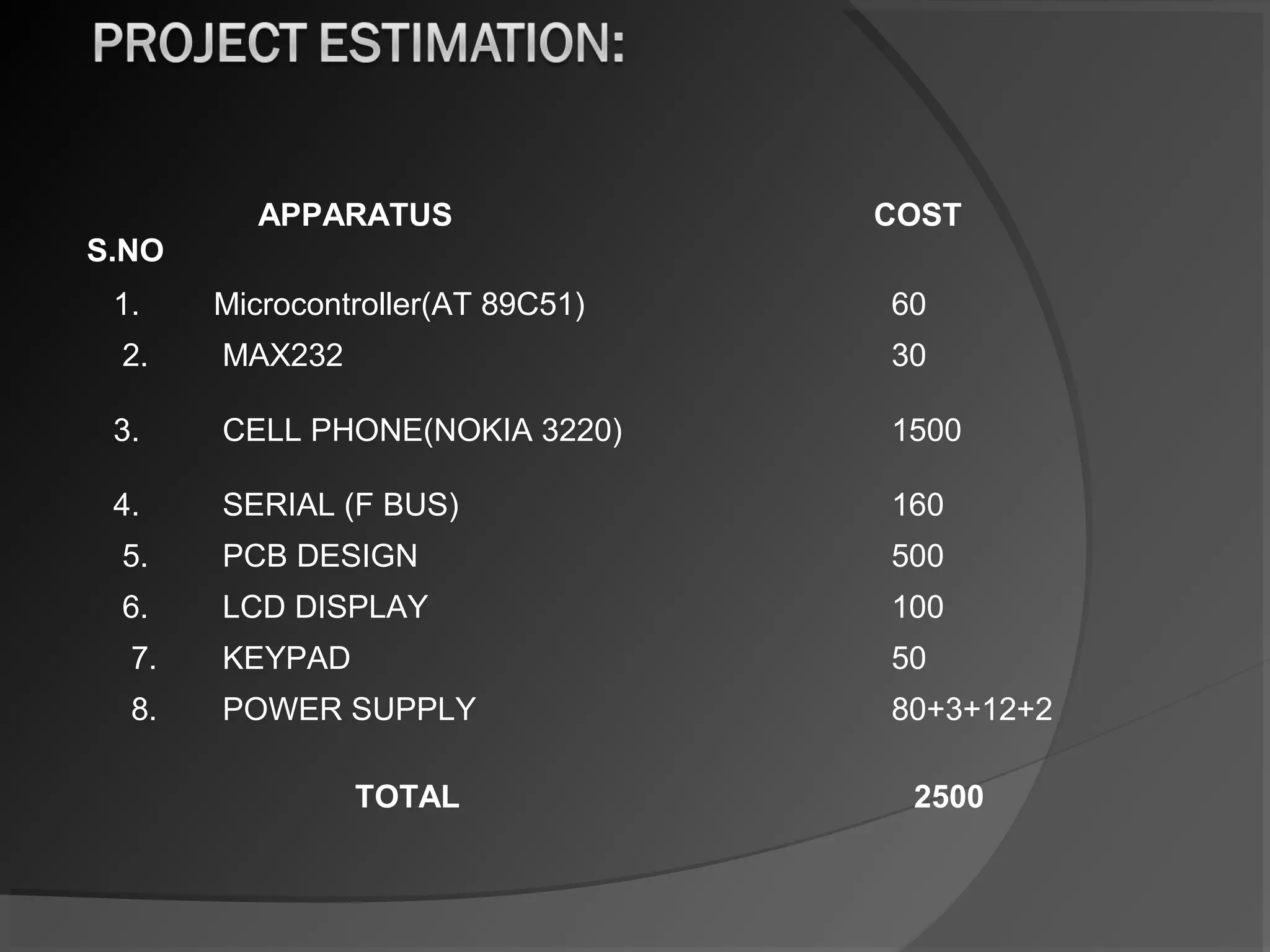
APPARATUS                 COST
S.NO
 1.    Microcontroller(AT 89C51)   60
 2.    MAX232                      30

 3.    CELL PHONE(NOKIA 3220)      1500

 4.    SERIAL (F BUS)              160
 5.    PCB DESIGN                  500
 6.    LCD DISPLAY                 100
  7.   KEYPAD                      50
  8.   POWER SUPPLY                80+3+12+2

                TOTAL               2500
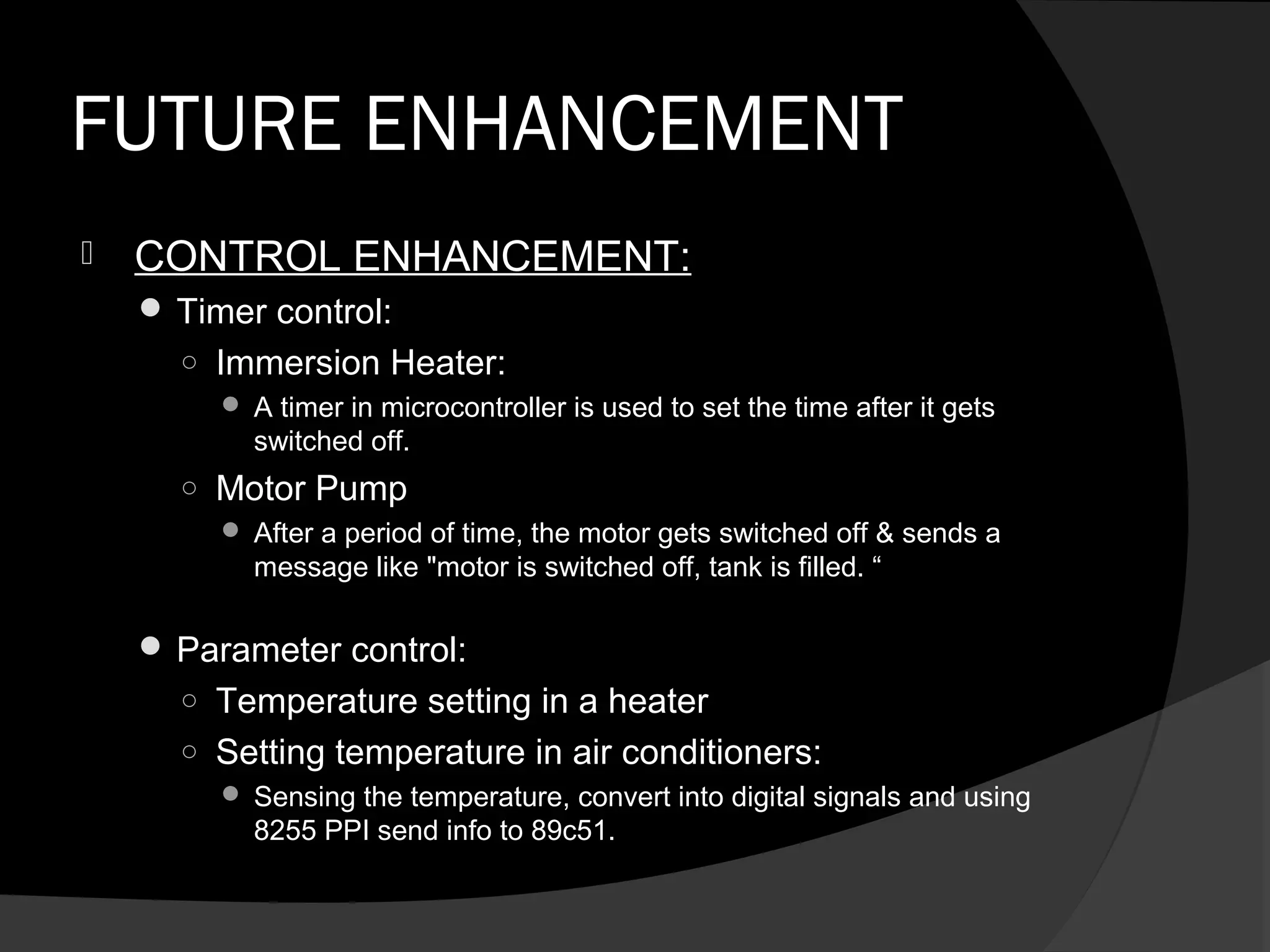
FUTURE ENHANCEMENT
   CONTROL ENHANCEMENT:
     Timer control:
      ○ Immersion Heater:
          A timer in microcontroller is used to set the time after it gets
           switched off.
      ○ Motor Pump
          After a period of time, the motor gets switched off & sends a
           message like "motor is switched off, tank is filled. “

     Parameter control:
      ○ Temperature setting in a heater
      ○ Setting temperature in air conditioners:
          Sensing the temperature, convert into digital signals and using
           8255 PPI send info to 89c51.
   SECURITY ENHANCEMENT
     Sensors:
       ○ When a moving object is sensed, all the hidden cameras would get
         switched ON.
     Hidden Cameras:
       ○ Taking photographs & sending via MMS.
     Energy Meter:
       ○ When speed of rotation exceeds, it will intimate certain devices to turn
         OFF.
     Sound Meter:
      ○ When a sound is sensed, it would send message.
Home automation and securty using wireless networks

Home automation and securty using wireless networks

  • 1.
    SUBMITTED BY, M.ARUN KUMAR (05E111) T.S.HARISHANKAR (05E122) S.VEDAPRAKASH (05E166) III B.E EEE
  • 2.
    why this project?  The present days many houses are secure less and all appliances are operated manually.  The objective of this project is to enable users to remotely control their home appliances and systems using a cell phone-based interface via a simple SMS .  Over the last decade, this problem has been overcome by using the Internet and through power-line modems.
  • 3.
    DESCRIPTION  TRANSMITTING END  ANY TYPE OF CELL PHONE THAT CAN SEND AND RECEIVE SMS.(GSM/CDMA)  RECEIVING END  “GSM” CELLPHONE SUPPORTING BASIC AT COMMANDS  MICROCONTROLLER  MAX 232  RS232 INTERFACE  POWER SUPPLY  VOLTAGE REGULATOR  RELAYS  KEYPAD AND LCD DISPLAY
  • 4.
    Wireless?  Rf? Short range Signal get weaken  Ir? Short range Straight path  Bluetooth? Short range No authentication
  • 5.
    Wireless?  Wifi? Need of hot spots Internet connection a separate dedicated system Expensive
  • 6.
    Wireless - GSM  Global system of mobile communication  Available in all parts of the world  No distance limit  Needs only a dedicated GSM cellphone and a interface cable  Minimum power consumption  Not expensive Because we use the SMS for communicating
  • 7.
    controller?  A PC? Expensive Power consumption is more  A Microprocessor? Needs External RAM,TIMER,ROM….. Serial Interfacing is difficult  A FPGA? Expensive Programming is difficult
  • 8.
    A Microcontoller  It has in built RAM,ROM,TIMER….  Serial interfacing is easy  Programming is easy  Power consumption is minimum  cheap  Does not occupy much space
  • 9.
    SOFTWARE  LABview? Very expensive Need of external interfacing device ,DAC and a PC.  PLC Expensive It has only 8 i/o ports
  • 10.
    KEIL  This software is used to program the microcontroller  This software uses “C”compiler.  Easy programming  Not expensive (freeware is available)  Needs only a programmer (to burn a ROM)
  • 11.
    PROJECT DESCRIPTION  ATMEL MICROCONTROLLERSERIES: 89C51 Family  TECHNOLOGY: CMOS  FEATURES:  4K Bytes of In-System Reprogrammable Flash Memory  Fully Static Operation: 0 Hz to 24 MHz  Three-Level Program Memory Lock  128 x 8-Bit Internal RAM  32 Programmable I/O Lines  Two 16-Bit Timer/Counters  Six Interrupt Sources  Programmable Serial Channel  Low Power Idle and Power Down Modes
  • 12.
    MAX232  It is a dual driver/receiver.  A capacitive voltage generator to supply RS-232 voltage levels from a single 5-V supply.  Each receiver converts RS-232 inputs to 5-V TTL/CMOS levels.  Each driver converts TTL/CMOS input levels into EIA-232 levels.  This chip is used to do the level shifting & it is required to send data serially to a cell phone which requires voltage levels as per RS232 standard.
  • 13.
    RS232 STANDARD  RS232 is an interface cable used for serial communication.  9-pin (DB9) connector cable.  Voltage level: +12v(logic 0) -12v(logic1)  the signal encoding used here is NRZ-L  It uses only two levels.
  • 14.
    AT COMMANDS  A GSM cellphone is a wireless modem  The instructions used for controlling the mobile phone or GSM/GPRS modem are called AT commands.  One use of the AT commands is to control the sending and receiving of SMS messages.
  • 16.
    Important AT command  ATD To dial a voice call from the modem.  AT+CLIR For calling line Identification Restriction.  AT+CNMI To set the mode of the mobile.  AT+CMGR To read the message at particular location.  AT+CMGD To delete the received message  AT+CMGS To send the message.  AT+CMGF To change the message format to PDU or Text mode.  AT+CMGL To see all the list of messages.
  • 17.
    WORKING: STEP1: the commandAT is sent through the microcontroller from SBUF register. STEP2: “AT+CMGF=1” is sent to set the mobile phone in text mode. STEP3: AT+CPMS=”ME” command selects the phone memory. STEP4: AT+CNMI=1,2,0,0,0 this command will read the message in the first index of the phone memory and delete it after reading it. STEP5: when a new message says “HEATER ON” is sent from our mobile this is delivered to the microcontroller directly in this text format. +CMGL:1,"RECREAD","+85291234567",,"06/11/11,00:30:29+32" HEATER ON. STEP6: SBUF register will receive this message. Through our program the carriage return is sensed and the content of the message is received. STEP7: this string received is compared with the already stored string. If this match occurs the corresponding subroutine is invoked and the corresponding port pin is made “1”. STEP8: this port is connected to a relay and through this the HEATER is switched ON.
  • 18.
    SECURITY SYSTEMS  The security system that is used includes an electronic keypad that comprises of 8 keys numbering (0-7).  In the residence absence, When a person enters/types the home code . This code will be sent to the owner’s cell phone number through the microcontroller.  If the code is correct command “OPEN DOOR” is sent.  The microcontroller will interpret this command and opens the door. If the code is wrong the door will not be opened.  All the above authentication process is done by separate subroutine in our program. This subroutine is invoked when the keypad is activated.
  • 19.
    APPARATUS COST S.NO 1. Microcontroller(AT 89C51) 60 2. MAX232 30 3. CELL PHONE(NOKIA 3220) 1500 4. SERIAL (F BUS) 160 5. PCB DESIGN 500 6. LCD DISPLAY 100 7. KEYPAD 50 8. POWER SUPPLY 80+3+12+2 TOTAL 2500
  • 20.
    FUTURE ENHANCEMENT  CONTROL ENHANCEMENT:  Timer control: ○ Immersion Heater:  A timer in microcontroller is used to set the time after it gets switched off. ○ Motor Pump  After a period of time, the motor gets switched off & sends a message like "motor is switched off, tank is filled. “  Parameter control: ○ Temperature setting in a heater ○ Setting temperature in air conditioners:  Sensing the temperature, convert into digital signals and using 8255 PPI send info to 89c51.
  • 21.
    SECURITY ENHANCEMENT  Sensors: ○ When a moving object is sensed, all the hidden cameras would get switched ON.  Hidden Cameras: ○ Taking photographs & sending via MMS.  Energy Meter: ○ When speed of rotation exceeds, it will intimate certain devices to turn OFF.  Sound Meter: ○ When a sound is sensed, it would send message.