BLUETOOTH BASED
HOME APPLIANCE
SYSTEM
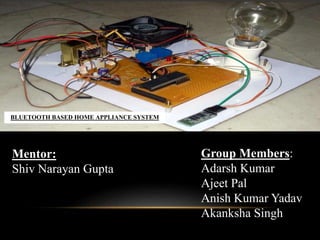
BLUETOOTH BASED HOME APPLIANCE SYSTEM
Group Members:
Adarsh Kumar
Ajeet Pal
Anish Kumar Yadav
Akanksha Singh
Mentor:
Shiv Narayan Gupta
INTRODUCTION
Realize the concept of a smart home.
Wireless home network .
Appliances can communicate with each other in
network.
Use in a cost-effective manner.
Provide secured network.
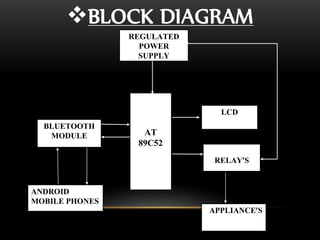
BLOCK DIAGRAM
AT
89C52
REGULATED
POWER
SUPPLY
BLUETOOTH
MODULE
LCD
RELAY’S
APPLIANCE’S
ANDROID
MOBILE PHONES
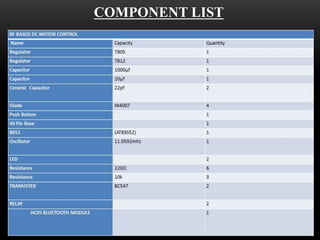
COMPONENT LIST
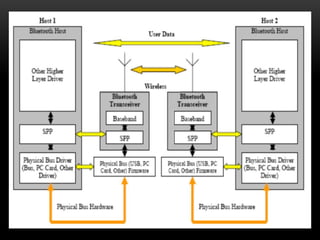
 INTRODUCTION TO BLUETOOTH
 Bluetooth Technology is standard for short-range radio
communication.
 It is a low cost bi-directional (2 ways) wireless interface
between mobile devices that provides low power
consumption.
 Bluetooth Transceiver referring to Bluetooth Transmitter
and Receiver and every Bluetooth node have Bluetooth
Transceiver.
 The aim is to eliminate the usage of cables. Bluetooth
system operates in worldwide unlicensed 2.4GHz
Industrial-Scientific-Medical (ISM) frequency band.
Bluetooth devices can form a network.
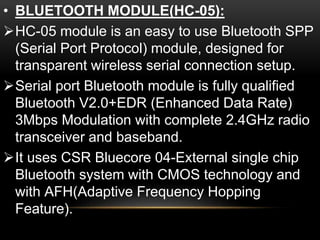
• BLUETOOTH MODULE(HC-05):
HC-05 module is an easy to use Bluetooth SPP
(Serial Port Protocol) module, designed for
transparent wireless serial connection setup.
Serial port Bluetooth module is fully qualified
Bluetooth V2.0+EDR (Enhanced Data Rate)
3Mbps Modulation with complete 2.4GHz radio
transceiver and baseband.
It uses CSR Bluecore 04-External single chip
Bluetooth system with CMOS technology and
with AFH(Adaptive Frequency Hopping
Feature).
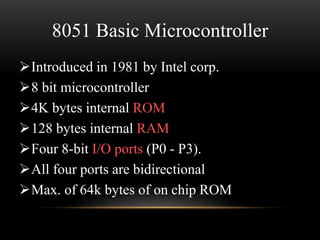
8051 Basic Microcontroller
Introduced in 1981 by Intel corp.
8 bit microcontroller
4K bytes internal ROM
128 bytes internal RAM
Four 8-bit I/O ports (P0 - P3).
All four ports are bidirectional
Max. of 64k bytes of on chip ROM
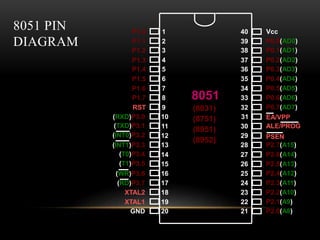
8051 PIN
DIAGRAM
1
2
3
4
5
6
7
8
9
10
11
12
13
14
15
16
17
18
19
20
40
39
38
37
36
35
34
33
32
31
30
29
28
27
26
25
24
23
22
21
P1.0
P1.2
P1.3
P1.4
P1.5
P1.6
P1.7
RST
XTAL1
Vcc
P0.0(AD0)
P0.2(AD2)
P0.3(AD3)
P0.4(AD4)
P0.5(AD5)
P0.7(AD7)
EA/VPP
P2.6(A14)
P2.5(A13)
P2.4(A12)
P2.3(A11)
P2.2(A10)
P2.1(A9)
P2.0(A8)
8051
(8031)
(8751)
(8951)
(8952)
P1.1
GND
P0.1(AD1)
P0.6(AD6)
ALE/PROG
PSEN
P2.7(A15)
(RXD)P3.0
(TXD)P3.1
(INT0)P3.2
(INT1)P3.3
(T0)P3.4
(T1)P3.5
(WR)P3.6
(RD)P3.7
XTAL2
HARDWARE DISCRIPTION
POWER SUPPLY:
• A device or system that supplies
electrical or other types of energy to an
output load or group of loads is called a
power supply unit or PSU.
• Here in our application we need a 5v
DC power supply for all electronics
involved in the project.
• This requires step down transformer,
rectifier, voltage regulator, and filter
circuit for generation of 5v DC power.
 UART
• UARTs (Universal Asynchronous Receiver
Transmitter) are serial chips on your PC
motherboard (or on an internal modem card).
• The UART function may also be done on a chip
that does other things as well.
RELAY
• The relay takes advantage of the fact that
when electricity flows through a coil, it
becomes an electromagnet.
• The electromagnetic coil attracts a steel
plate, which is attached to a switch.
• So the switch's motion (ON and OFF) is
controlled by the current flowing to the coil,
or not, respectively.
ABOUT KIEL UVISION 5
Keil Software to provide you with software
development tools for 8051 based
microcontrollers.
 With the Keil tools, you can generate
embedded applications for virtually every
8051 derivative.
Keil software converts the C-codes into
the Intel Hex code.
ADVANTAGES AND DISADVANTAGES
 Embedded systems are
designed to do some
specific task, rather than
be a general-purpose
computer for multiple
tasks.
 Bluetooth is actually
inexpensive.
 Low energy
consumption.
 The only real downsides
are the data rate and
security.
 Bluetooth only offers 1
MBps speed.
Bluetooth controlled home appliances

Bluetooth controlled home appliances