OSCE QUESTION & ANSWERS –
MAY 2022 – PART 4
Dr Gururaja MD,DNB(Paed)
Station-1
• A full term neonate with Down’s syndrome and
esophageal atresia admitted in NICU. Parents
want “no interference approach”.
• As in-charge of the case what will be your best
approach?
• What is beneficence in medical ethics?
• What is nonmalefience in medical ethics?
• What is autonomy in medical practice?
Station -1
• Beneficence – action that promote well being of others
• Nonmaleficence – to do no harm
• Respect for autonomy
• The patient has right to choose or refuse their
treatment
• Paediatrician is an advocate of children
• Nelson – action in the best interest of child takes
precedence over patient wishes
• Involve local hospital committee to protect the child
• Local legal policy???
Station 2
• What is the Typhoid vaccination
recommendation in a child recovered from
Typhoid?
• When is influenza vaccine ideally
recommended (season) in India?
• Write updated Thai Red cross Regimen for
post exposure prophylaxis of Rabies.
Station -2
• Infection – no life long immunity
• 4 weeks after recovery from typhoid
• March –April or two weeks before mansoon
• Vaccine for southern and northern hemisphere
released by WHO – March and Sept respectively
• India –SE Asia – southern
• Two peaks in India – Jan to March ----Aug to Oct
• 2-2-2-0-2-2 - --- 0.1 ml----i.d
• 0,3,7,14,30,90
Station - 3
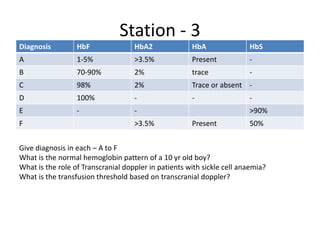
Diagnosis HbF HbA2 HbA HbS
A 1-5% >3.5% Present -
B 70-90% 2% trace -
C 98% 2% Trace or absent -
D 100% - - -
E - - >90%
F >3.5% Present 50%
Give diagnosis in each – A to F
What is the normal hemoglobin pattern of a 10 yr old boy?
What is the role of Transcranial doppler in patients with sickle cell anaemia?
What is the transfusion threshold based on transcranial doppler?
Station 3
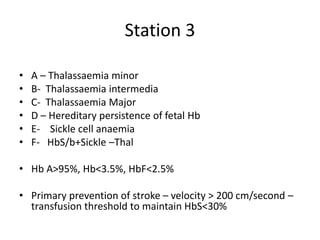
• A – Thalassaemia minor
• B- Thalassaemia intermedia
• C- Thalassaemia Major
• D – Hereditary persistence of fetal Hb
• E- Sickle cell anaemia
• F- HbS/b+Sickle –Thal
• Hb A>95%, Hb<3.5%, HbF<2.5%
• Primary prevention of stroke – velocity > 200 cm/second –
transfusion threshold to maintain HbS<30%
Station - 4
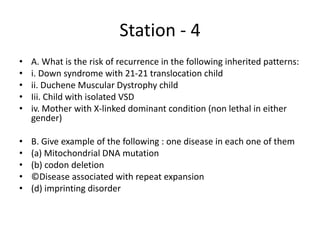
• A. What is the risk of recurrence in the following inherited patterns:
• i. Down syndrome with 21-21 translocation child
• ii. Duchene Muscular Dystrophy child
• Iii. Child with isolated VSD
• iv. Mother with X-linked dominant condition (non lethal in either
gender)
• B. Give example of the following : one disease in each one of them
• (a) Mitochondrial DNA mutation
• (b) codon deletion
• ©Disease associated with repeat expansion
• (d) imprinting disorder
Station - 4
• A – i. 100%
– ii. Boy -50%, Girl – nil
– iii. 3-5%
– iv. Boys -50%, Girls – 50%
B
- (a) MELAS/ MERRF/Leber’s
- (b) DMD
- ©Huntington disease/Fragile X/SPA
- (d) Praderwilli/Angelman
Station - 5
• 11 yr old boy is brought for progressive muscular weakness.
• The weakness was mild at onset and progressed.
• O/E: Temporal wasting, thin cheeks, inverted V shaped
upper lip, atrophy of thenar and hypothenar eminences,
emaciated limbs.
• Positive Gower sign.
• Senastion /DTJ/Plantars normal.
• 1. write your clinical impression.
• 2. any other clinical examination that should be performed?
• 3. Name the pattern of inheritance.
• 4. Name any two non CNS manifestation of this condition?
Station - 5
• Myotonic muscular dystrophy
• “hand shake” with patient : delayed relaxation
• Autosomal dominant
• Diabetes, hypothyroidism, testicular atrophy
Station -6
• A 10 yr old girl brought with h/o rapidly progressive, both lower limb weakness
since 3 days. She was apparently normal except for a history of “ sore throat and
b/l neck swelling with fever 20 days back.
• She started with difficulty while walking and not being able to pass urine despite
of the sensation being there.
• O/E , normal sensorium and cranial nerves. Upper limbs – normal, symmetrical
lower limb paralysis, distal>proximal, DTJ – exaggerated, plantars – extensor
• There was a sensory discrepancy below T8 – Temp/light touch were affected.
Vibration and position were normal. Her urinary bladder was palpable.
• What is your differential diagnosis/diagnosis?
• What is investigation of choice?
• Treatment ?
• Name (any 3) causative factors for this condition.
Station - 6
• Acute Transverse myelitis/SOL Spine/TB
Spine/vascular infarct/bleed
• MRI Spine
• IV steroid pulse
• Post/para infectious/SLE with
thrombosis/Lyme disease
Station - 7
With regard to palliative care & ethics in pediatric
care : what do the following abbreviations stable
for:
1.LSMT
2.DDE
3.DNAR
4.DBNC
5.DDCD
6.POLST
Station - 7
• LSMT – Life Sustaining Medical Treatment
• DDE – Doctrine of Double Effect
• DNAR – Do Not Assisted Resuscitation
• DBNC – Death By Neurological Criteria
• DDCD – Donation (organ) after Determination
of Circulatory Death
• POLST – Physician Orders for Life Sustenance
Treatment
Station - 8
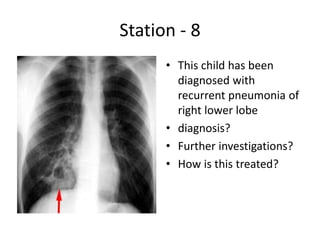
• This child has been
diagnosed with
recurrent pneumonia of
right lower lobe
• diagnosis?
• Further investigations?
• How is this treated?
Station -8
• Pulmonary sequestration
• Documentation of systemic arterial supply by
CT, MRI
• Lobectomy
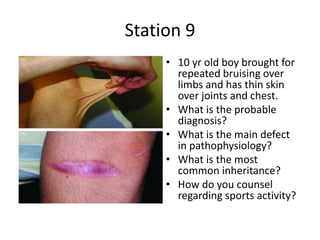
Station 9
• 10 yr old boy brought for
repeated bruising over
limbs and has thin skin
over joints and chest.
• What is the probable
diagnosis?
• What is the main defect
in pathophysiology?
• What is the most
common inheritance?
• How do you counsel
regarding sports activity?
Station 9
Station -9
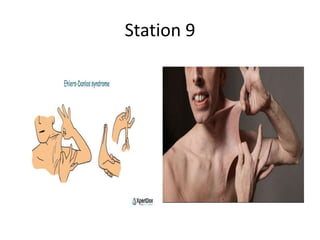
• Ehler danlos syndrome
• Defect in collagen synthesis
• Autosomal dominant
• Avoid contact sports and weight lifting to
avoid vessel rupture
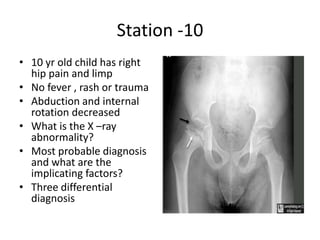
Station -10
• 10 yr old child has right
hip pain and limp
• No fever , rash or trauma
• Abduction and internal
rotation decreased
• What is the X –ray
abnormality?
• Most probable diagnosis
and what are the
implicating factors?
• Three differential
diagnosis
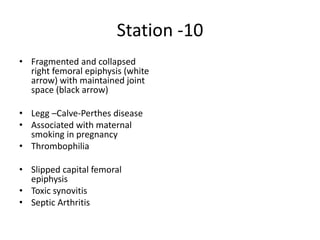
Station -10
• Fragmented and collapsed
right femoral epiphysis (white
arrow) with maintained joint
space (black arrow)
• Legg –Calve-Perthes disease
• Associated with maternal
smoking in pregnancy
• Thrombophilia
• Slipped capital femoral
epiphysis
• Toxic synovitis
• Septic Arthritis
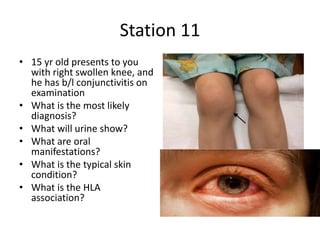
Station 11
• 15 yr old presents to you
with right swollen knee, and
he has b/l conjunctivitis on
examination
• What is the most likely
diagnosis?
• What will urine show?
• What are oral
manifestations?
• What is the typical skin
condition?
• What is the HLA
association?
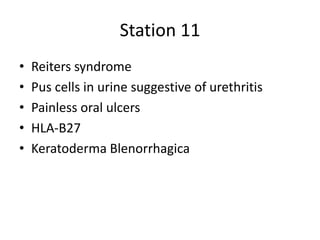
Station 11
• Reiters syndrome
• Pus cells in urine suggestive of urethritis
• Painless oral ulcers
• HLA-B27
• Keratoderma Blenorrhagica
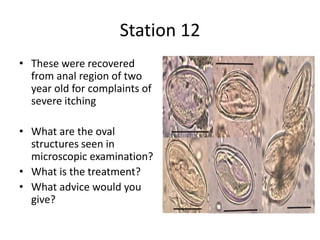
Station 12
• These were recovered
from anal region of two
year old for complaints of
severe itching
• What are the oval
structures seen in
microscopic examination?
• What is the treatment?
• What advice would you
give?
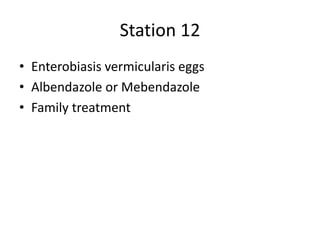
Station 12
• Enterobiasis vermicularis eggs
• Albendazole or Mebendazole
• Family treatment
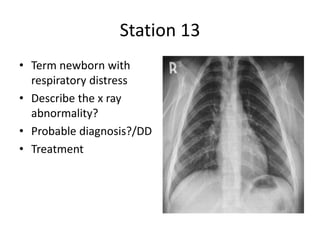
Station 13
• Term newborn with
respiratory distress
• Describe the x ray
abnormality?
• Probable diagnosis?/DD
• Treatment
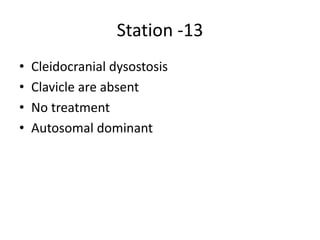
Station -13
• Cleidocranial dysostosis
• Clavicle are absent
• No treatment
• Autosomal dominant
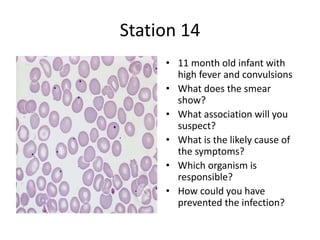
Station 14
• 11 month old infant with
high fever and convulsions
• What does the smear
show?
• What association will you
suspect?
• What is the likely cause of
the symptoms?
• Which organism is
responsible?
• How could you have
prevented the infection?
Station 14
• Howell Jolly bodies (nuclear fragments of
condensed DNA)
• Absence of Spleen
• Bacterial Meningitis
• Streptococcus Pneumoniae
• Pneumococcal conjugate vaccine
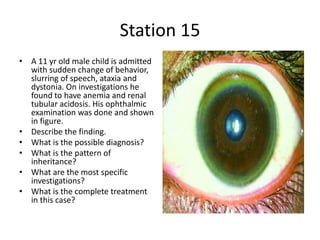
Station 15
• A 11 yr old male child is admitted
with sudden change of behavior,
slurring of speech, ataxia and
dystonia. On investigations he
found to have anemia and renal
tubular acidosis. His ophthalmic
examination was done and shown
in figure.
• Describe the finding.
• What is the possible diagnosis?
• What is the pattern of
inheritance?
• What are the most specific
investigations?
• What is the complete treatment
in this case?
Station 15
• Brownish discoloration at outer margin of
cornea
• KF ring
• Wilson disease with lenticular degeneration
• Autosomal recessive
• Hepatic copper content - >250microgram/gm
dry weight
• D-Penicillamine with zinc
Station 16
• 14 yr old boy has sustained injury to the neck due
to a road traffic accident. He is breathing but
cannot move or feel his arms and legs.
• What is the recommended maneuver for opening
the airway in this case?
• X-ray of cervical spine shows no bony injury. Is it
still possible for the boy to have a spinal cord
injury? Name the condition and mode of
diagnosis?
• What is the emergency drug treatment that can
be offered to this boy?
Station 16
• Jaw thrust without head tilt
• YES
• SCIWORA – Spinal Cord Injury With Out
Radiographic bone Abnormalities
• MRI Spine
• High dose methyl prednisolone 30mg/kg
within 8 hrs of injury followed by a 23 hr
infusion (5.4 mg/kg/hr)
Station 17
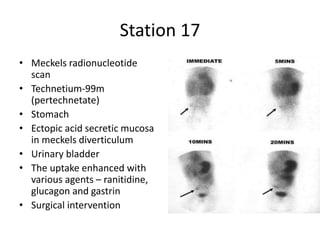
• 2 yr old boy brought with h/o
intermittent painless rectal
bleeding for last few months. The
stool is described as brick colour
or currant jelly colour. There is
anaemia. Following study was
performed.
• What is the test performed?
• Name the isotope used in the
test?
• Identify the dark areas on the
film.
• How do you enhance the yield of
the test?
• What is the treatment in this
case?
Station 17
• Meckels radionucleotide
scan
• Technetium-99m
(pertechnetate)
• Stomach
• Ectopic acid secretic mucosa
in meckels diverticulum
• Urinary bladder
• The uptake enhanced with
various agents – ranitidine,
glucagon and gastrin
• Surgical intervention
Station 18
• Term
• 3.5 kg
• No risk factors
• Routine TSH(by
Dried Blood Spot)
screening on day 3-
66
• What is your next
action?
Station 18
• TSH > 80 ----- Immediate venous sample and start
treatment
• TSH 40-80------Venous sample immediately and
interpret with in 72 hrs
• If venous sample >20 (<2 weeks)
• >10 (>2 weeks)
• fT4<1.1ng/dL
• T4<8microgram/dL
• TREAT
Station 18
• TSH<20 (< 2 weeks)
• TSH <10 (>2 weeks)
• And T4 > 10 microgram/dL
• Free T4 > 1.17 ng/dL
• NORMAL
• If TSH high and T4/Ft4-NORMAL-----
Repeat TSH after 2 weeks---TSH<10 –
normal
• TSH> 10 and persistent after 3 weeks
of age ---start treatment and reassess
after 3 yrs of age
• If T4/fT4 below above range any time
start treatment irrespective of TSH
• If TSH 20-40
• Recall after 7-10 days
• Repeat TSH
• If venous sample is taken along with
TSH ----T4/fT4 value should be sent
simultaneously
• To avoid repeated venepuncture
• It serves as confirmatory sample
Station 19
• 12 yr old boy, a case of Haemophilia A, is
admitted with spontaneous haemathrosis.
• 1.What is the expected level of factor VIII?
• 2. What is the level of factor VIII to be achieved
and dose of factor VIII?
• 3.If this patient has to undergo surgery,what is
the level of factor VIII to be achieved and dose?
• 4.what is the role of DDAVP in haemophilia A?
Station 19
• 1. <1%
• 2. 35-40%
• 20 Units/kg repeat daily till joint normalises.
• 3.100%
• 50 Units/kg , infuse 2-3 units/kg/hr to maintain level at
100% for 24 hrs and then >50% for 7 days
• 4. Desmopressin acetate: release of factor VIII in mild
cases
Station 20
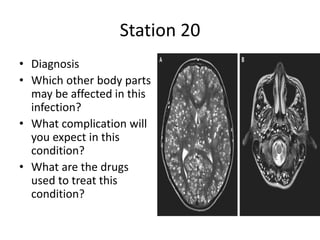
• Diagnosis
• Which other body parts
may be affected in this
infection?
• What complication will
you expect in this
condition?
• What are the drugs
used to treat this
condition?
Station 20
• Starry sky appearance
• Neurocysticercosis
• Eyes and muscle
• Focal convulsion, focal neurological deficit,
sudden increase in ICT
• Steroids, Albendazole, praziquantel
•THANK YOU

OSCE MAY 2022-PART-4 -PAED.pptx

  • 1.
    OSCE QUESTION &ANSWERS – MAY 2022 – PART 4 Dr Gururaja MD,DNB(Paed)
  • 2.
    Station-1 • A fullterm neonate with Down’s syndrome and esophageal atresia admitted in NICU. Parents want “no interference approach”. • As in-charge of the case what will be your best approach? • What is beneficence in medical ethics? • What is nonmalefience in medical ethics? • What is autonomy in medical practice?
  • 3.
    Station -1 • Beneficence– action that promote well being of others • Nonmaleficence – to do no harm • Respect for autonomy • The patient has right to choose or refuse their treatment • Paediatrician is an advocate of children • Nelson – action in the best interest of child takes precedence over patient wishes • Involve local hospital committee to protect the child • Local legal policy???
  • 4.
    Station 2 • Whatis the Typhoid vaccination recommendation in a child recovered from Typhoid? • When is influenza vaccine ideally recommended (season) in India? • Write updated Thai Red cross Regimen for post exposure prophylaxis of Rabies.
  • 5.
    Station -2 • Infection– no life long immunity • 4 weeks after recovery from typhoid • March –April or two weeks before mansoon • Vaccine for southern and northern hemisphere released by WHO – March and Sept respectively • India –SE Asia – southern • Two peaks in India – Jan to March ----Aug to Oct • 2-2-2-0-2-2 - --- 0.1 ml----i.d • 0,3,7,14,30,90
  • 6.
    Station - 3 DiagnosisHbF HbA2 HbA HbS A 1-5% >3.5% Present - B 70-90% 2% trace - C 98% 2% Trace or absent - D 100% - - - E - - >90% F >3.5% Present 50% Give diagnosis in each – A to F What is the normal hemoglobin pattern of a 10 yr old boy? What is the role of Transcranial doppler in patients with sickle cell anaemia? What is the transfusion threshold based on transcranial doppler?
  • 7.
    Station 3 • A– Thalassaemia minor • B- Thalassaemia intermedia • C- Thalassaemia Major • D – Hereditary persistence of fetal Hb • E- Sickle cell anaemia • F- HbS/b+Sickle –Thal • Hb A>95%, Hb<3.5%, HbF<2.5% • Primary prevention of stroke – velocity > 200 cm/second – transfusion threshold to maintain HbS<30%
  • 8.
    Station - 4 •A. What is the risk of recurrence in the following inherited patterns: • i. Down syndrome with 21-21 translocation child • ii. Duchene Muscular Dystrophy child • Iii. Child with isolated VSD • iv. Mother with X-linked dominant condition (non lethal in either gender) • B. Give example of the following : one disease in each one of them • (a) Mitochondrial DNA mutation • (b) codon deletion • ©Disease associated with repeat expansion • (d) imprinting disorder
  • 9.
    Station - 4 •A – i. 100% – ii. Boy -50%, Girl – nil – iii. 3-5% – iv. Boys -50%, Girls – 50% B - (a) MELAS/ MERRF/Leber’s - (b) DMD - ©Huntington disease/Fragile X/SPA - (d) Praderwilli/Angelman
  • 10.
    Station - 5 •11 yr old boy is brought for progressive muscular weakness. • The weakness was mild at onset and progressed. • O/E: Temporal wasting, thin cheeks, inverted V shaped upper lip, atrophy of thenar and hypothenar eminences, emaciated limbs. • Positive Gower sign. • Senastion /DTJ/Plantars normal. • 1. write your clinical impression. • 2. any other clinical examination that should be performed? • 3. Name the pattern of inheritance. • 4. Name any two non CNS manifestation of this condition?
  • 11.
    Station - 5 •Myotonic muscular dystrophy • “hand shake” with patient : delayed relaxation • Autosomal dominant • Diabetes, hypothyroidism, testicular atrophy
  • 12.
    Station -6 • A10 yr old girl brought with h/o rapidly progressive, both lower limb weakness since 3 days. She was apparently normal except for a history of “ sore throat and b/l neck swelling with fever 20 days back. • She started with difficulty while walking and not being able to pass urine despite of the sensation being there. • O/E , normal sensorium and cranial nerves. Upper limbs – normal, symmetrical lower limb paralysis, distal>proximal, DTJ – exaggerated, plantars – extensor • There was a sensory discrepancy below T8 – Temp/light touch were affected. Vibration and position were normal. Her urinary bladder was palpable. • What is your differential diagnosis/diagnosis? • What is investigation of choice? • Treatment ? • Name (any 3) causative factors for this condition.
  • 13.
    Station - 6 •Acute Transverse myelitis/SOL Spine/TB Spine/vascular infarct/bleed • MRI Spine • IV steroid pulse • Post/para infectious/SLE with thrombosis/Lyme disease
  • 14.
    Station - 7 Withregard to palliative care & ethics in pediatric care : what do the following abbreviations stable for: 1.LSMT 2.DDE 3.DNAR 4.DBNC 5.DDCD 6.POLST
  • 15.
    Station - 7 •LSMT – Life Sustaining Medical Treatment • DDE – Doctrine of Double Effect • DNAR – Do Not Assisted Resuscitation • DBNC – Death By Neurological Criteria • DDCD – Donation (organ) after Determination of Circulatory Death • POLST – Physician Orders for Life Sustenance Treatment
  • 16.
    Station - 8 •This child has been diagnosed with recurrent pneumonia of right lower lobe • diagnosis? • Further investigations? • How is this treated?
  • 17.
    Station -8 • Pulmonarysequestration • Documentation of systemic arterial supply by CT, MRI • Lobectomy
  • 18.
    Station 9 • 10yr old boy brought for repeated bruising over limbs and has thin skin over joints and chest. • What is the probable diagnosis? • What is the main defect in pathophysiology? • What is the most common inheritance? • How do you counsel regarding sports activity?
  • 19.
  • 20.
    Station -9 • Ehlerdanlos syndrome • Defect in collagen synthesis • Autosomal dominant • Avoid contact sports and weight lifting to avoid vessel rupture
  • 21.
    Station -10 • 10yr old child has right hip pain and limp • No fever , rash or trauma • Abduction and internal rotation decreased • What is the X –ray abnormality? • Most probable diagnosis and what are the implicating factors? • Three differential diagnosis
  • 22.
    Station -10 • Fragmentedand collapsed right femoral epiphysis (white arrow) with maintained joint space (black arrow) • Legg –Calve-Perthes disease • Associated with maternal smoking in pregnancy • Thrombophilia • Slipped capital femoral epiphysis • Toxic synovitis • Septic Arthritis
  • 23.
    Station 11 • 15yr old presents to you with right swollen knee, and he has b/l conjunctivitis on examination • What is the most likely diagnosis? • What will urine show? • What are oral manifestations? • What is the typical skin condition? • What is the HLA association?
  • 24.
    Station 11 • Reiterssyndrome • Pus cells in urine suggestive of urethritis • Painless oral ulcers • HLA-B27 • Keratoderma Blenorrhagica
  • 25.
    Station 12 • Thesewere recovered from anal region of two year old for complaints of severe itching • What are the oval structures seen in microscopic examination? • What is the treatment? • What advice would you give?
  • 26.
    Station 12 • Enterobiasisvermicularis eggs • Albendazole or Mebendazole • Family treatment
  • 27.
    Station 13 • Termnewborn with respiratory distress • Describe the x ray abnormality? • Probable diagnosis?/DD • Treatment
  • 28.
    Station -13 • Cleidocranialdysostosis • Clavicle are absent • No treatment • Autosomal dominant
  • 29.
    Station 14 • 11month old infant with high fever and convulsions • What does the smear show? • What association will you suspect? • What is the likely cause of the symptoms? • Which organism is responsible? • How could you have prevented the infection?
  • 30.
    Station 14 • HowellJolly bodies (nuclear fragments of condensed DNA) • Absence of Spleen • Bacterial Meningitis • Streptococcus Pneumoniae • Pneumococcal conjugate vaccine
  • 31.
    Station 15 • A11 yr old male child is admitted with sudden change of behavior, slurring of speech, ataxia and dystonia. On investigations he found to have anemia and renal tubular acidosis. His ophthalmic examination was done and shown in figure. • Describe the finding. • What is the possible diagnosis? • What is the pattern of inheritance? • What are the most specific investigations? • What is the complete treatment in this case?
  • 32.
    Station 15 • Brownishdiscoloration at outer margin of cornea • KF ring • Wilson disease with lenticular degeneration • Autosomal recessive • Hepatic copper content - >250microgram/gm dry weight • D-Penicillamine with zinc
  • 33.
    Station 16 • 14yr old boy has sustained injury to the neck due to a road traffic accident. He is breathing but cannot move or feel his arms and legs. • What is the recommended maneuver for opening the airway in this case? • X-ray of cervical spine shows no bony injury. Is it still possible for the boy to have a spinal cord injury? Name the condition and mode of diagnosis? • What is the emergency drug treatment that can be offered to this boy?
  • 34.
    Station 16 • Jawthrust without head tilt • YES • SCIWORA – Spinal Cord Injury With Out Radiographic bone Abnormalities • MRI Spine • High dose methyl prednisolone 30mg/kg within 8 hrs of injury followed by a 23 hr infusion (5.4 mg/kg/hr)
  • 35.
    Station 17 • 2yr old boy brought with h/o intermittent painless rectal bleeding for last few months. The stool is described as brick colour or currant jelly colour. There is anaemia. Following study was performed. • What is the test performed? • Name the isotope used in the test? • Identify the dark areas on the film. • How do you enhance the yield of the test? • What is the treatment in this case?
  • 36.
    Station 17 • Meckelsradionucleotide scan • Technetium-99m (pertechnetate) • Stomach • Ectopic acid secretic mucosa in meckels diverticulum • Urinary bladder • The uptake enhanced with various agents – ranitidine, glucagon and gastrin • Surgical intervention
  • 37.
    Station 18 • Term •3.5 kg • No risk factors • Routine TSH(by Dried Blood Spot) screening on day 3- 66 • What is your next action?
  • 38.
    Station 18 • TSH> 80 ----- Immediate venous sample and start treatment • TSH 40-80------Venous sample immediately and interpret with in 72 hrs • If venous sample >20 (<2 weeks) • >10 (>2 weeks) • fT4<1.1ng/dL • T4<8microgram/dL • TREAT
  • 39.
    Station 18 • TSH<20(< 2 weeks) • TSH <10 (>2 weeks) • And T4 > 10 microgram/dL • Free T4 > 1.17 ng/dL • NORMAL • If TSH high and T4/Ft4-NORMAL----- Repeat TSH after 2 weeks---TSH<10 – normal • TSH> 10 and persistent after 3 weeks of age ---start treatment and reassess after 3 yrs of age • If T4/fT4 below above range any time start treatment irrespective of TSH • If TSH 20-40 • Recall after 7-10 days • Repeat TSH • If venous sample is taken along with TSH ----T4/fT4 value should be sent simultaneously • To avoid repeated venepuncture • It serves as confirmatory sample
  • 40.
    Station 19 • 12yr old boy, a case of Haemophilia A, is admitted with spontaneous haemathrosis. • 1.What is the expected level of factor VIII? • 2. What is the level of factor VIII to be achieved and dose of factor VIII? • 3.If this patient has to undergo surgery,what is the level of factor VIII to be achieved and dose? • 4.what is the role of DDAVP in haemophilia A?
  • 41.
    Station 19 • 1.<1% • 2. 35-40% • 20 Units/kg repeat daily till joint normalises. • 3.100% • 50 Units/kg , infuse 2-3 units/kg/hr to maintain level at 100% for 24 hrs and then >50% for 7 days • 4. Desmopressin acetate: release of factor VIII in mild cases
  • 42.
    Station 20 • Diagnosis •Which other body parts may be affected in this infection? • What complication will you expect in this condition? • What are the drugs used to treat this condition?
  • 43.
    Station 20 • Starrysky appearance • Neurocysticercosis • Eyes and muscle • Focal convulsion, focal neurological deficit, sudden increase in ICT • Steroids, Albendazole, praziquantel
  • 44.