Abnormal CBCs
National Pediatric Nighttime Curriculum
Written by Kathleen Ostrom, MD and Ansley
Splinter, MD
Children’s Hospital Los Angeles
LEARNING OBJECTIVES
 Identify common abnormalities of complete blood
counts and interpret them using the available
indices
 Formulate a complete differential diagnosis for
anemia and thrombocytopenia
 Recognize when additional studies might be
needed to further clarify the diagnosis when the
CBC is abnormal
CASE 1
 You have just admitted a 2 year-old boy with a history of
intermittent blood streaked stools. On exam he has
pallor, tachycardia, and a 2/6 systolic ejection murmur at
the upper left sternal border. His hemoglobin is 3.1 g/dL.
 What additional historical information would you want
to know?
 What else would you like to know about his initial
assessment?
 How will this information change management?
 What other lab values would you like and what
additional testing would you consider?
THE FULL CBC WITH INDICES
7.5
3.1
12.8
280
MCV 53.8 fL
RBC 2.38 M/microL
MCH 13 pg
MCHC 24.2 %
RDW 24.1 %
MPV 8 fL
Reticulocyte 0.9%
Peripheral Smear: slight polychromasia, marked hypochromasia
and microcytosis
Neut 40 Bands 0 Lymphs 48 Mono 10 Eos 2 Baso 0 ANC 3
Without additional testing, is there a way to predict the type of anemia using the
CBC and indices?
A FEW FACTS ABOUT RED
BLOOD CELLS
 Fetal hematopoiesis initially occurs in the yolk sac, then transitions to
the liver before ultimately residing in the bone marrow.
 Red cell production is under the control of Erythropoietin (EPO)
which is produced in the kidneys in response to both hypoxia and
anemia.
 Hemoglobin is a protein that consists of iron-containing heme groups
and a protein globin chains.
 Hemoglobin has the vital role of reversibly transporting oxygen.
 The average RBC life span is 60-90 days in neonates and 120 days
in children and adults.
 Anemia is defined as reduction of RBC volume or Hemoglobin
concentration below the lower limit of normal for age and sex.
 In general, 6 months old-puberty Hgb < 11 g/dL is abnormal.
APPROACH TO ANEMIA
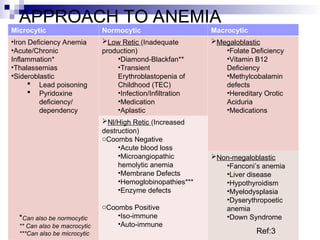
Microcytic Normocytic Macrocytic
•Iron Deficiency Anemia
•Acute/Chronic
Inflammation*
•Thalassemias
•Sideroblastic
 Lead poisoning
 Pyridoxine
deficiency/
dependency
Low Retic (Inadequate
production)
•Diamond-Blackfan**
•Transient
Erythroblastopenia of
Childhood (TEC)
•Infection/Infiltration
•Medication
•Aplastic
Megaloblastic
•Folate Deficiency
•Vitamin B12
Deficiency
•Methylcobalamin
defects
•Hereditary Orotic
Aciduria
•Medications
Nl/High Retic (Increased
destruction)
oCoombs Negative
•Acute blood loss
•Microangiopathic
hemolytic anemia
•Membrane Defects
•Hemoglobinopathies***
•Enzyme defects
oCoombs Positive
•Iso-immune
•Auto-immune
Non-megaloblastic
•Fanconi’s anemia
•Liver disease
•Hypothyroidism
•Myelodysplasia
•Dyserythropoetic
anemia
•Down Syndrome
*Can also be normocytic
** Can also be macrocytic
***Can also be microcytic Ref:3
PERIPHERAL BLOOD SMEAR
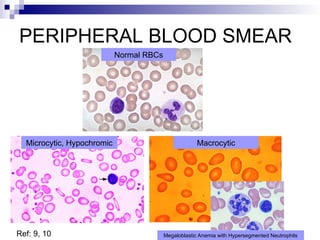
Ref: 9, 10
Normal RBCs
Microcytic, Hypochromic Macrocytic
Megaloblastic Anemia with Hypersegmented Neutrophils
HOW DOES THE RETICULOCYTE
COUNT HELP YOU?
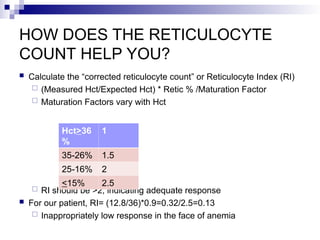
 Calculate the “corrected reticulocyte count” or Reticulocyte Index (RI)
 (Measured Hct/Expected Hct) * Retic % /Maturation Factor
 Maturation Factors vary with Hct
 RI should be >2, indicating adequate response
 For our patient, RI= (12.8/36)*0.9=0.32/2.5=0.13
 Inappropriately low response in the face of anemia
Hct>36
%
1
35-26% 1.5
25-16% 2
<15% 2.5
WHAT TYPE OF ANEMIA DOES YOUR
PATIENT HAVE AND WHAT IS YOUR
DIAGNOSIS?
Microcytic, hypochromic anemia
Inappropriately low reticulocyte count
Probably due to a mix of blood loss and
dietary related iron deficiency anemia
(IDA)
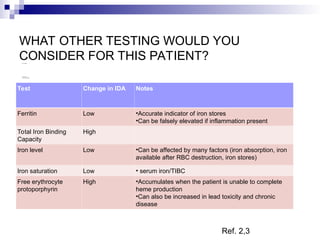
WHAT OTHER TESTING WOULD YOU
CONSIDER FOR THIS PATIENT?
Test Change in IDA Notes
Ferritin Low •Accurate indicator of iron stores
•Can be falsely elevated if inflammation present
Total Iron Binding
Capacity
High
Iron level Low •Can be affected by many factors (iron absorption, iron
available after RBC destruction, iron stores)
Iron saturation Low • serum iron/TIBC
Free erythrocyte
protoporphyrin
High •Accumulates when the patient is unable to complete
heme production
•Can also be increased in lead toxicity and chronic
disease
 Iron Studies
 Lead Level
 Fecal Occult Blood
Ref. 2,3
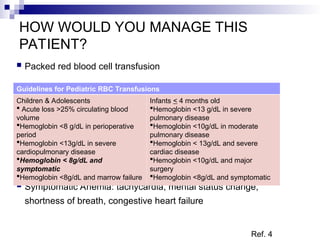
HOW WOULD YOU MANAGE THIS
PATIENT?
 Packed red blood cell transfusion
 Symptomatic Anemia: tachycardia, mental status change,
shortness of breath, congestive heart failure
Guidelines for Pediatric RBC Transfusions
Children & Adolescents
 Acute loss >25% circulating blood
volume
Hemoglobin <8 g/dL in perioperative
period
Hemoglobin <13g/dL in severe
cardiopulmonary disease
Hemoglobin < 8g/dL and
symptomatic
Hemoglobin <8g/dL and marrow failure
Infants < 4 months old
Hemoglobin <13 g/dL in severe
pulmonary disease
Hemoglobin <10g/dL in moderate
pulmonary disease
Hemoglobin < 13g/dL and severe
cardiac disease
Hemoglobin <10g/dL and major
surgery
Hemoglobin <8g/dL and symptomatic
Ref. 4
TREATMENT OF IRON DEFICIENCY ANEMIA- FOR
PATIENTS WITHOUT SYMPTOMS OF SEVERE ANEMIA
 Iron supplementation
 Treatment for severe anemia 6mg/kg/day of oral ferrous sulfate (dosing
based on elemental iron)
 Should be administered with vitamin C containing food or beverage to
enhance absorption
 Treatment length ~2-3 months to replace stores
 Follow-up
 For severe anemia, reticulocyte count should be re-checked to ensure
response and should respond in 7-10 days
 For mild-moderate anemia, repeat Hgb in 1 month should increase by at
least 1g/dL
 Most likely cause of treatment failure is due to non-compliance with iron
supplementation
 If patient compliant, but not responding then need to consider other
diagnoses, like Thalassemia or ongoing blood loss
Ref. 2,3
CASE 2
 You have just admitted a 12 year-old girl with new onset bruising and
petechiae. She also reported easy bleeding from the gums while
brushing her teeth. She has had one prolonged episode of epistaxis,
still ongoing, which is what brought her to the Emergency
Department. She thinks she remembers having a cold a few weeks
ago. She is otherwise well appearing with normal vital signs.
 What additional historical information would you want to know?
 What else would you like to know about her initial assessment?
 How will this information change management?
 What diagnoses are you suspecting?
 What initial labs would you like and what additional testing would
you consider?
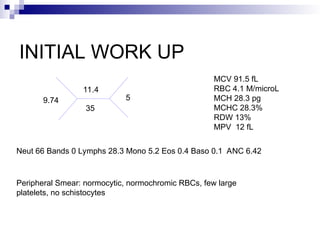
INITIAL WORK UP
11.4
35
9.74 5
MCV 91.5 fL
RBC 4.1 M/microL
MCH 28.3 pg
MCHC 28.3%
RDW 13%
MPV 12 fL
Neut 66 Bands 0 Lymphs 28.3 Mono 5.2 Eos 0.4 Baso 0.1 ANC 6.42
Peripheral Smear: normocytic, normochromic RBCs, few large
platelets, no schistocytes
A FEW FACTS ABOUT PLATELETS
 Platelets are released from megakaryocytes in the
bone marrow
 They are anucleate cellular fragments that effect
primary hemostasis
 Normal Mean Platelet Volume (MPV) is 7-11fL
 The average platelet lives for 9-14 days
 Platelet production is controlled by Thrombopoiten
(TPO), which is produced by the liver and
regulated by presence of TPO receptors in
circulation
Ref. 4,5
HOW DO YOU DEFINE
THROMBOCYTOPENIA?
 Platelet count <150,000 per microL
 Can present with symptoms of primary hemostasis, including:
 Mucocutaneous bleeding, bruising and petechiae
 The risk of intra-cranial hemorrhage is low with platelet counts
above 20,000
 Risk increases with head trauma and with use of anti-
platelet medications.
 Thrombocytopenia can result from multiple causes:
 Decreased platelet production
 Sequestration of platelets
 Increased platelet destruction
Ref. 4, 7
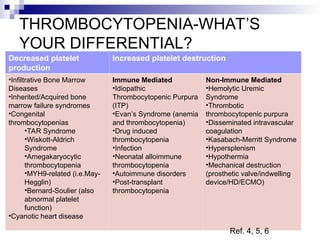
THROMBOCYTOPENIA-WHAT’S
YOUR DIFFERENTIAL?
Decreased platelet
production
Increased platelet destruction
•Infiltrative Bone Marrow
Diseases
•Inherited/Acquired bone
marrow failure syndromes
•Congenital
thrombocytopenias
•TAR Syndrome
•Wiskott-Aldrich
Syndrome
•Amegakaryocytic
thrombocytopenia
•MYH9-related (i.e.May-
Hegglin)
•Bernard-Soulier (also
abnormal platelet
function)
•Cyanotic heart disease
Immune Mediated
•Idiopathic
Thrombocytopenic Purpura
(ITP)
•Evan’s Syndrome (anemia
and thrombocytopenia)
•Drug induced
thrombocytopenia
•Infection
•Neonatal alloimmune
thrombocytopenia
•Autoimmune disorders
•Post-transplant
thrombocytopenia
Non-Immune Mediated
•Hemolytic Uremic
Syndrome
•Thrombotic
thrombocytopenic purpura
•Disseminated intravascular
coagulation
•Kasabach-Merritt Syndrome
•Hypersplenism
•Hypothermia
•Mechanical destruction
(prosthetic valve/indwelling
device/HD/ECMO)
Ref. 4, 5, 6
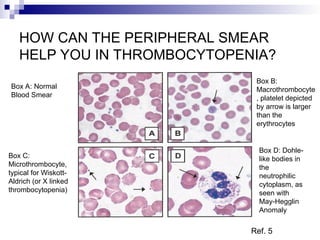
HOW CAN THE PERIPHERAL SMEAR
HELP YOU IN THROMBOCYTOPENIA?
Box A: Normal
Blood Smear
Box B:
Macrothrombocyte
, platelet depicted
by arrow is larger
than the
erythrocytes
Box C:
Microthrombocyte,
typical for Wiskott-
Aldrich (or X linked
thrombocytopenia)
Box D: Dohle-
like bodies in
the
neutrophilic
cytoplasm, as
seen with
May-Hegglin
Anomaly
Ref. 5
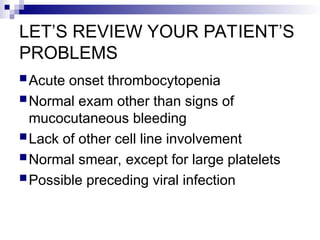
LET’S REVIEW YOUR PATIENT’S
PROBLEMS
Acute onset thrombocytopenia
Normal exam other than signs of
mucocutaneous bleeding
Lack of other cell line involvement
Normal smear, except for large platelets
Possible preceding viral infection
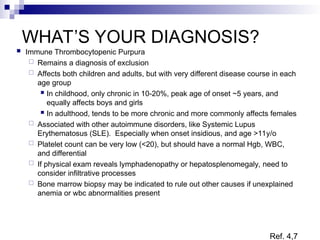
WHAT’S YOUR DIAGNOSIS?
 Immune Thrombocytopenic Purpura
 Remains a diagnosis of exclusion
 Affects both children and adults, but with very different disease course in each
age group
 In childhood, only chronic in 10-20%, peak age of onset ~5 years, and
equally affects boys and girls
 In adulthood, tends to be more chronic and more commonly affects females
 Associated with other autoimmune disorders, like Systemic Lupus
Erythematosus (SLE). Especially when onset insidious, and age >11y/o
 Platelet count can be very low (<20), but should have a normal Hgb, WBC,
and differential
 If physical exam reveals lymphadenopathy or hepatosplenomegaly, need to
consider infiltrative processes
 Bone marrow biopsy may be indicated to rule out other causes if unexplained
anemia or wbc abnormalities present
Ref. 4,7
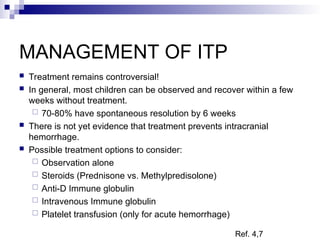
MANAGEMENT OF ITP
 Treatment remains controversial!
 In general, most children can be observed and recover within a few
weeks without treatment.
 70-80% have spontaneous resolution by 6 weeks
 There is not yet evidence that treatment prevents intracranial
hemorrhage.
 Possible treatment options to consider:
 Observation alone
 Steroids (Prednisone vs. Methylpredisolone)
 Anti-D Immune globulin
 Intravenous Immune globulin
 Platelet transfusion (only for acute hemorrhage)
Ref. 4,7
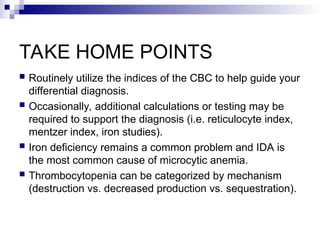
TAKE HOME POINTS
 Routinely utilize the indices of the CBC to help guide your
differential diagnosis.
 Occasionally, additional calculations or testing may be
required to support the diagnosis (i.e. reticulocyte index,
mentzer index, iron studies).
 Iron deficiency remains a common problem and IDA is
the most common cause of microcytic anemia.
 Thrombocytopenia can be categorized by mechanism
(destruction vs. decreased production vs. sequestration).
REFERENCES
 1. Novak RW. Red blood cell distribution width in pediatric microcytic anemias. Pediatrics 1987;
80:251.
 2. Pappas DE, Cheng TL. Iron Deficiency Anemia. Pediatrics in Review 1998; 19: 321-322.
 3. Glader B. “Anemias of Inadequate Production.” Nelson Textbook of Pediatrics 17th
Edition.
Saunders: Philadelphia, 2004.
 4. Montgomery RR, Scott JP. “Hemorrhagic and Thrombotic Diseases.” Nelson Textbook of
Pediatrics 17th
Edition. Saunders: Philadelphia, 2004.
 5. Drachman JG. Inherited thrombocytopenia: when a low platelet count does not mean ITP.
Blood 2004; 103:390-398.
 6. Chan KM, Beard K. A Patient with recurrent hypothermia associated with thrombocytopenia.
Postgrad Med J 1993; 69:227-229.
 7. Clines DB, Blanchette VS. Immune Thrombocytopenic Purpura. New Enl J Med; 346:995-
1008.
 8. Richardson M. Microcytic Anemia. Pediatrics in Review 2007; 28: 5-14.
 9. Bongaars, L. “Approach to the child with anemia.” Uptodate.com. (2010). Retrieved March
11, 2011. http://www.uptodate.com/contents/approach-to-the-child-with-anemia?
source=search_result&selectedTitle=2%7E150
 10. “Hypersegmented neutrophil, buffycoat of pernicious anemia.” Image.bloodline.net . (2010).
Retrieved March 11, 2011. http://image.bloodline.net/stories/storyReader$1537
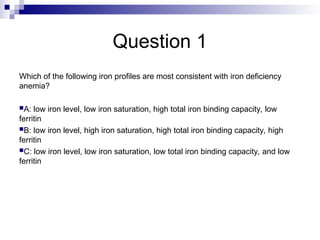
Question 1
Which of the following iron profiles are most consistent with iron deficiency
anemia?
A: low iron level, low iron saturation, high total iron binding capacity, low
ferritin
B: low iron level, high iron saturation, high total iron binding capacity, high
ferritin
C: low iron level, low iron saturation, low total iron binding capacity, and low
ferritin
Question 2
True or False? The Mentzer index can be
used to distinguish between iron deficiency
anemia and hemolytic anemia.
Question 3
You are admitting a patient to the hospital for severe anemia. He was
prescribed oral ferrous sulfate two months ago for presumed iron
deficiency anemia. You are trying to determine if he has been taking his
iron properly. What questions do you want to ask the family related to his
medication and diet history?
Question 4
A 13-year-old girl presented to an outside facility with petechiae and epistaxis.
She is being transferred to your service for further evaluation of an abnormally
low platelet count. The presumed diagnosis from the other facility was
idiopathic thrombocytopenic purpura (ITP). What abnormalities on the CBC
might cause you to consider other diagnoses?
Question 5
True or False? Patients with
thrombocytopenia are more likely to present
with mucocutaneous bleeding and petechiae
than they are to present with hemarthroses.
Question 6
Of the following disorders that result in thrombocytopenia, which one can be
attributed to decreased platelet production?
A. Infiltrative bone marrow diseases
B. Drug-induced thrombocytopenia
C. Neonatal alloimmune thrombocytopenia
D. Kasabach-Merritt syndrome
E. Idiopathic Thrombocytopenic Purpura (ITP)

5701103 (2)CCCCCCCCCCCCCCCCCCCCCCCCC.ppt

  • 1.
    Abnormal CBCs National PediatricNighttime Curriculum Written by Kathleen Ostrom, MD and Ansley Splinter, MD Children’s Hospital Los Angeles
  • 2.
    LEARNING OBJECTIVES  Identifycommon abnormalities of complete blood counts and interpret them using the available indices  Formulate a complete differential diagnosis for anemia and thrombocytopenia  Recognize when additional studies might be needed to further clarify the diagnosis when the CBC is abnormal
  • 3.
    CASE 1  Youhave just admitted a 2 year-old boy with a history of intermittent blood streaked stools. On exam he has pallor, tachycardia, and a 2/6 systolic ejection murmur at the upper left sternal border. His hemoglobin is 3.1 g/dL.  What additional historical information would you want to know?  What else would you like to know about his initial assessment?  How will this information change management?  What other lab values would you like and what additional testing would you consider?
  • 4.
    THE FULL CBCWITH INDICES 7.5 3.1 12.8 280 MCV 53.8 fL RBC 2.38 M/microL MCH 13 pg MCHC 24.2 % RDW 24.1 % MPV 8 fL Reticulocyte 0.9% Peripheral Smear: slight polychromasia, marked hypochromasia and microcytosis Neut 40 Bands 0 Lymphs 48 Mono 10 Eos 2 Baso 0 ANC 3 Without additional testing, is there a way to predict the type of anemia using the CBC and indices?
  • 5.
    A FEW FACTSABOUT RED BLOOD CELLS  Fetal hematopoiesis initially occurs in the yolk sac, then transitions to the liver before ultimately residing in the bone marrow.  Red cell production is under the control of Erythropoietin (EPO) which is produced in the kidneys in response to both hypoxia and anemia.  Hemoglobin is a protein that consists of iron-containing heme groups and a protein globin chains.  Hemoglobin has the vital role of reversibly transporting oxygen.  The average RBC life span is 60-90 days in neonates and 120 days in children and adults.  Anemia is defined as reduction of RBC volume or Hemoglobin concentration below the lower limit of normal for age and sex.  In general, 6 months old-puberty Hgb < 11 g/dL is abnormal.
  • 6.
    APPROACH TO ANEMIA MicrocyticNormocytic Macrocytic •Iron Deficiency Anemia •Acute/Chronic Inflammation* •Thalassemias •Sideroblastic  Lead poisoning  Pyridoxine deficiency/ dependency Low Retic (Inadequate production) •Diamond-Blackfan** •Transient Erythroblastopenia of Childhood (TEC) •Infection/Infiltration •Medication •Aplastic Megaloblastic •Folate Deficiency •Vitamin B12 Deficiency •Methylcobalamin defects •Hereditary Orotic Aciduria •Medications Nl/High Retic (Increased destruction) oCoombs Negative •Acute blood loss •Microangiopathic hemolytic anemia •Membrane Defects •Hemoglobinopathies*** •Enzyme defects oCoombs Positive •Iso-immune •Auto-immune Non-megaloblastic •Fanconi’s anemia •Liver disease •Hypothyroidism •Myelodysplasia •Dyserythropoetic anemia •Down Syndrome *Can also be normocytic ** Can also be macrocytic ***Can also be microcytic Ref:3
  • 7.
    PERIPHERAL BLOOD SMEAR Ref:9, 10 Normal RBCs Microcytic, Hypochromic Macrocytic Megaloblastic Anemia with Hypersegmented Neutrophils
  • 8.
    HOW DOES THERETICULOCYTE COUNT HELP YOU?  Calculate the “corrected reticulocyte count” or Reticulocyte Index (RI)  (Measured Hct/Expected Hct) * Retic % /Maturation Factor  Maturation Factors vary with Hct  RI should be >2, indicating adequate response  For our patient, RI= (12.8/36)*0.9=0.32/2.5=0.13  Inappropriately low response in the face of anemia Hct>36 % 1 35-26% 1.5 25-16% 2 <15% 2.5
  • 9.
    WHAT TYPE OFANEMIA DOES YOUR PATIENT HAVE AND WHAT IS YOUR DIAGNOSIS? Microcytic, hypochromic anemia Inappropriately low reticulocyte count Probably due to a mix of blood loss and dietary related iron deficiency anemia (IDA)
  • 10.
    WHAT OTHER TESTINGWOULD YOU CONSIDER FOR THIS PATIENT? Test Change in IDA Notes Ferritin Low •Accurate indicator of iron stores •Can be falsely elevated if inflammation present Total Iron Binding Capacity High Iron level Low •Can be affected by many factors (iron absorption, iron available after RBC destruction, iron stores) Iron saturation Low • serum iron/TIBC Free erythrocyte protoporphyrin High •Accumulates when the patient is unable to complete heme production •Can also be increased in lead toxicity and chronic disease  Iron Studies  Lead Level  Fecal Occult Blood Ref. 2,3
  • 11.
    HOW WOULD YOUMANAGE THIS PATIENT?  Packed red blood cell transfusion  Symptomatic Anemia: tachycardia, mental status change, shortness of breath, congestive heart failure Guidelines for Pediatric RBC Transfusions Children & Adolescents  Acute loss >25% circulating blood volume Hemoglobin <8 g/dL in perioperative period Hemoglobin <13g/dL in severe cardiopulmonary disease Hemoglobin < 8g/dL and symptomatic Hemoglobin <8g/dL and marrow failure Infants < 4 months old Hemoglobin <13 g/dL in severe pulmonary disease Hemoglobin <10g/dL in moderate pulmonary disease Hemoglobin < 13g/dL and severe cardiac disease Hemoglobin <10g/dL and major surgery Hemoglobin <8g/dL and symptomatic Ref. 4
  • 12.
    TREATMENT OF IRONDEFICIENCY ANEMIA- FOR PATIENTS WITHOUT SYMPTOMS OF SEVERE ANEMIA  Iron supplementation  Treatment for severe anemia 6mg/kg/day of oral ferrous sulfate (dosing based on elemental iron)  Should be administered with vitamin C containing food or beverage to enhance absorption  Treatment length ~2-3 months to replace stores  Follow-up  For severe anemia, reticulocyte count should be re-checked to ensure response and should respond in 7-10 days  For mild-moderate anemia, repeat Hgb in 1 month should increase by at least 1g/dL  Most likely cause of treatment failure is due to non-compliance with iron supplementation  If patient compliant, but not responding then need to consider other diagnoses, like Thalassemia or ongoing blood loss Ref. 2,3
  • 13.
    CASE 2  Youhave just admitted a 12 year-old girl with new onset bruising and petechiae. She also reported easy bleeding from the gums while brushing her teeth. She has had one prolonged episode of epistaxis, still ongoing, which is what brought her to the Emergency Department. She thinks she remembers having a cold a few weeks ago. She is otherwise well appearing with normal vital signs.  What additional historical information would you want to know?  What else would you like to know about her initial assessment?  How will this information change management?  What diagnoses are you suspecting?  What initial labs would you like and what additional testing would you consider?
  • 14.
    INITIAL WORK UP 11.4 35 9.745 MCV 91.5 fL RBC 4.1 M/microL MCH 28.3 pg MCHC 28.3% RDW 13% MPV 12 fL Neut 66 Bands 0 Lymphs 28.3 Mono 5.2 Eos 0.4 Baso 0.1 ANC 6.42 Peripheral Smear: normocytic, normochromic RBCs, few large platelets, no schistocytes
  • 15.
    A FEW FACTSABOUT PLATELETS  Platelets are released from megakaryocytes in the bone marrow  They are anucleate cellular fragments that effect primary hemostasis  Normal Mean Platelet Volume (MPV) is 7-11fL  The average platelet lives for 9-14 days  Platelet production is controlled by Thrombopoiten (TPO), which is produced by the liver and regulated by presence of TPO receptors in circulation Ref. 4,5
  • 16.
    HOW DO YOUDEFINE THROMBOCYTOPENIA?  Platelet count <150,000 per microL  Can present with symptoms of primary hemostasis, including:  Mucocutaneous bleeding, bruising and petechiae  The risk of intra-cranial hemorrhage is low with platelet counts above 20,000  Risk increases with head trauma and with use of anti- platelet medications.  Thrombocytopenia can result from multiple causes:  Decreased platelet production  Sequestration of platelets  Increased platelet destruction Ref. 4, 7
  • 17.
    THROMBOCYTOPENIA-WHAT’S YOUR DIFFERENTIAL? Decreased platelet production Increasedplatelet destruction •Infiltrative Bone Marrow Diseases •Inherited/Acquired bone marrow failure syndromes •Congenital thrombocytopenias •TAR Syndrome •Wiskott-Aldrich Syndrome •Amegakaryocytic thrombocytopenia •MYH9-related (i.e.May- Hegglin) •Bernard-Soulier (also abnormal platelet function) •Cyanotic heart disease Immune Mediated •Idiopathic Thrombocytopenic Purpura (ITP) •Evan’s Syndrome (anemia and thrombocytopenia) •Drug induced thrombocytopenia •Infection •Neonatal alloimmune thrombocytopenia •Autoimmune disorders •Post-transplant thrombocytopenia Non-Immune Mediated •Hemolytic Uremic Syndrome •Thrombotic thrombocytopenic purpura •Disseminated intravascular coagulation •Kasabach-Merritt Syndrome •Hypersplenism •Hypothermia •Mechanical destruction (prosthetic valve/indwelling device/HD/ECMO) Ref. 4, 5, 6
  • 18.
    HOW CAN THEPERIPHERAL SMEAR HELP YOU IN THROMBOCYTOPENIA? Box A: Normal Blood Smear Box B: Macrothrombocyte , platelet depicted by arrow is larger than the erythrocytes Box C: Microthrombocyte, typical for Wiskott- Aldrich (or X linked thrombocytopenia) Box D: Dohle- like bodies in the neutrophilic cytoplasm, as seen with May-Hegglin Anomaly Ref. 5
  • 19.
    LET’S REVIEW YOURPATIENT’S PROBLEMS Acute onset thrombocytopenia Normal exam other than signs of mucocutaneous bleeding Lack of other cell line involvement Normal smear, except for large platelets Possible preceding viral infection
  • 20.
    WHAT’S YOUR DIAGNOSIS? Immune Thrombocytopenic Purpura  Remains a diagnosis of exclusion  Affects both children and adults, but with very different disease course in each age group  In childhood, only chronic in 10-20%, peak age of onset ~5 years, and equally affects boys and girls  In adulthood, tends to be more chronic and more commonly affects females  Associated with other autoimmune disorders, like Systemic Lupus Erythematosus (SLE). Especially when onset insidious, and age >11y/o  Platelet count can be very low (<20), but should have a normal Hgb, WBC, and differential  If physical exam reveals lymphadenopathy or hepatosplenomegaly, need to consider infiltrative processes  Bone marrow biopsy may be indicated to rule out other causes if unexplained anemia or wbc abnormalities present Ref. 4,7
  • 21.
    MANAGEMENT OF ITP Treatment remains controversial!  In general, most children can be observed and recover within a few weeks without treatment.  70-80% have spontaneous resolution by 6 weeks  There is not yet evidence that treatment prevents intracranial hemorrhage.  Possible treatment options to consider:  Observation alone  Steroids (Prednisone vs. Methylpredisolone)  Anti-D Immune globulin  Intravenous Immune globulin  Platelet transfusion (only for acute hemorrhage) Ref. 4,7
  • 22.
    TAKE HOME POINTS Routinely utilize the indices of the CBC to help guide your differential diagnosis.  Occasionally, additional calculations or testing may be required to support the diagnosis (i.e. reticulocyte index, mentzer index, iron studies).  Iron deficiency remains a common problem and IDA is the most common cause of microcytic anemia.  Thrombocytopenia can be categorized by mechanism (destruction vs. decreased production vs. sequestration).
  • 23.
    REFERENCES  1. NovakRW. Red blood cell distribution width in pediatric microcytic anemias. Pediatrics 1987; 80:251.  2. Pappas DE, Cheng TL. Iron Deficiency Anemia. Pediatrics in Review 1998; 19: 321-322.  3. Glader B. “Anemias of Inadequate Production.” Nelson Textbook of Pediatrics 17th Edition. Saunders: Philadelphia, 2004.  4. Montgomery RR, Scott JP. “Hemorrhagic and Thrombotic Diseases.” Nelson Textbook of Pediatrics 17th Edition. Saunders: Philadelphia, 2004.  5. Drachman JG. Inherited thrombocytopenia: when a low platelet count does not mean ITP. Blood 2004; 103:390-398.  6. Chan KM, Beard K. A Patient with recurrent hypothermia associated with thrombocytopenia. Postgrad Med J 1993; 69:227-229.  7. Clines DB, Blanchette VS. Immune Thrombocytopenic Purpura. New Enl J Med; 346:995- 1008.  8. Richardson M. Microcytic Anemia. Pediatrics in Review 2007; 28: 5-14.  9. Bongaars, L. “Approach to the child with anemia.” Uptodate.com. (2010). Retrieved March 11, 2011. http://www.uptodate.com/contents/approach-to-the-child-with-anemia? source=search_result&selectedTitle=2%7E150  10. “Hypersegmented neutrophil, buffycoat of pernicious anemia.” Image.bloodline.net . (2010). Retrieved March 11, 2011. http://image.bloodline.net/stories/storyReader$1537
  • 24.
    Question 1 Which ofthe following iron profiles are most consistent with iron deficiency anemia? A: low iron level, low iron saturation, high total iron binding capacity, low ferritin B: low iron level, high iron saturation, high total iron binding capacity, high ferritin C: low iron level, low iron saturation, low total iron binding capacity, and low ferritin
  • 25.
    Question 2 True orFalse? The Mentzer index can be used to distinguish between iron deficiency anemia and hemolytic anemia.
  • 26.
    Question 3 You areadmitting a patient to the hospital for severe anemia. He was prescribed oral ferrous sulfate two months ago for presumed iron deficiency anemia. You are trying to determine if he has been taking his iron properly. What questions do you want to ask the family related to his medication and diet history?
  • 27.
    Question 4 A 13-year-oldgirl presented to an outside facility with petechiae and epistaxis. She is being transferred to your service for further evaluation of an abnormally low platelet count. The presumed diagnosis from the other facility was idiopathic thrombocytopenic purpura (ITP). What abnormalities on the CBC might cause you to consider other diagnoses?
  • 28.
    Question 5 True orFalse? Patients with thrombocytopenia are more likely to present with mucocutaneous bleeding and petechiae than they are to present with hemarthroses.
  • 29.
    Question 6 Of thefollowing disorders that result in thrombocytopenia, which one can be attributed to decreased platelet production? A. Infiltrative bone marrow diseases B. Drug-induced thrombocytopenia C. Neonatal alloimmune thrombocytopenia D. Kasabach-Merritt syndrome E. Idiopathic Thrombocytopenic Purpura (ITP)

Editor's Notes

  • #3 Teacher’s Notes: Take a detailed history of blood loss: how much blood?, how frequently?, mixed in stool/on outside of stool/bright red blood per rectum, are there any other sites of bleeding/bruising?. Is there a history of constipation?. Take a detailed dietary history: length of breastfeeding?, timing of introduction of cow’s milk and quantity?, any other types of milk that the child has been given (i.e. goat’s milk), what types of other foods does the child eat? Any pica (eating dirt/clay) or pagophagia (eating ice)? Was the child premature? Has there been a history of jaundice? Family history of abdominal surgeries ? (i.e. splenectomy, cholecystectomy) Are there any known lead exposures?
  • #4 Teacher’s Notes: Classification of anemia (see next slide) Without additional testing, is there a way to predict what type of anemia using the cbc & indices? Calculate the Mentzer Index = MCV/RBC= 22.6. Typically >13 c/w iron deficiency anemia (small cells and small number produced) vs. Mentzer <13 c/w Thalassemia, small cells, but making large number. The red cell distribution width (RDW) can also help discriminate between iron deficiency anemia (IDA) and Thalassemia. Increasing RDW can be the earliest detectable laboratory change in IDA. An RDW>14 supports the diagnosis of IDA.
  • #6 Teacher’s Notes: Anemias can be classified based on morphology. Mean Corpuscular Volume (RBC size) has been used, see chart above. Normal values for MCV depend on age. Also, remember that MCV can be influenced by reticulocytosis.
  • #7 Teacher’s Notes: What’s normal? The diameter of the normal red cell is about the size of the nucleus of lymphocyte. The red cell central pallor is about one-third of its diameter.
  • #8 Teacher’s Notes: Reticulocyte count can be misleading in anemia since it is a percentage, rather than an absolute count. You should calculate the reticulocyte index.
  • #9 Teacher’s Notes: Additional history revealed cow’s milk intake ~25-30oz/day, low intake of iron rich foods
  • #10 Teacher’s Notes: If the dietary history is consistent or there is a history of blood loss, and the CBC is consistent with IDA, then treatment can be initiated without iron studies. Iron studies can be used in situations where the clinical history or laboratory findings are conflicting. Some other tests to consider if chronic blood loss from GI tract suspected: Stool H Pylori, GI consult for endoscopy
  • #11 Teacher’s Notes: It is not uncommon for patients with severe IDA to have Hgb as low as 5-6. If they are asymptomatic, then treatment with oral iron supplementation and very close follow-up is appropriate. Transfusion is reserved for those patients with symptoms or co-morbidities. When transfusing a patient with a very low hemoglobin that has been due to a chronic process, it is generally recommended to give the transfusion slowly. i.e.) instead of 10mL/kg given at once, divide into two 5mL/kg transfusions, each given over 4 hrs.
  • #13 Teacher’s Notes: Based on this brief history, what laboratory abnormalities are you expecting? Take a detailed history of preceding infections, drug exposures, travel history and thorough review of systems to rule out other cell line involvement. You will want to ask about excessive bleeding after routine procedures, and family history of bleeding problems. A good physical exam will help further confirm that the bleeding is localized to mucocutaneous areas only. Look for pallor (conjunctiva, oral mucosa, nail beds). Feel for lymphadenopathy and hepatosplenomegaly. Look for other signs of systemic illness: (i.e.) rashes, arthritis, etc. Additional history: ENT has evaluated and placed nasal packing
  • #14 Teacher’s Notes: Let’s interpret this CBC. Aside from platelet number, what else can be helpful in evaluating a child with bleeding? What diagnosis are you suspecting? Make sure you check the smear to rule out pseudothrombocytopenia, which can occur with older specimens from platelet clumping.
  • #17 Teacher’s Notes: The differential can be organized in several ways: acquired vs. congenital, by platelet size (small, normal, large) or by mechanism. Breaking down the differential into things that cause decreased production and increased destruction is the most widely used method. What are some of the common drugs that can cause thrombocytopenia in children? Valproic acid, phenytoin, sulfonamides, and trimethoprim-sulfamethoxazole. Heparin has also been associated with thrombocytopenia, but this is rare in children.
  • #18 Teacher’s Notes: Remember that our patient had slightly enlarged platelets.
  • #20 Teacher’s Notes: if anemia also present, consider other diagnoses: Evan’s syndrome (autoimmune hemolytic anemia and thrombocytopenia), or SLE could consider sending a coombs test or ANA. Other secondary forms: Anti-phospholipid antibody syndrome, IgA deficiency, lymphoproliferative diseases, Hepatitis C and HIV. Especially need to consider HIV in sexually active adolescents, as thrombocytopenia is a common finding with HIV infection.
  • #21 Teacher’s Notes: If using Anti-D: 1) you must be Rh+, and 2) you should anticipate a Hgb drop of ~1-2g, thus cannot be used if significant anemia present.
  • #24 Answer A is correct. In iron deficiency anemia the iron level and the iron saturation will be low. The iron saturation is calculated by dividing the iron level by the total iron binding capacity. The total iron binding capacity will be high and the ferritin, which is a marker or iron stores, will be low. One must keep in mind that ferritin is an acute phase reactant, and could be elevated if there is inflammation in the body due to other processes.
  • #25 False. The Mentzer index is calculated by dividing the MCV by the RBC count. It is used to help determine if a microcytic anemia is more consistent with iron deficiency or Thalassemia. Typically a value >13 is more consistent with iron deficiency anemia. In iron deficiency the bone marrow is producing a small quantity or small sized cells. A value <13 is more consistent with Thalassemia because the marrow is making a large number of cells (larger denominator) but the volume of the cells are small.
  • #26 Compliance with oral iron therapy be affected by numerous factors. You will want to ask detailed information about dosing to ensure that the family is giving an adequate amount of iron. For severe anemia, the targeted dose should be 6mg/kg/day of elemental iron. Dietary factors can affect iron absorption. Milk based products can decrease absorption. Food or drinks that are high in Vitamin C can enhance absorption. Gastrointestinal side effects (constipation or upset stomach) may decrease compliance as well.
  • #27 Idiopathic thrombocytopenic purpura (ITP) is typically associated with a very low platelet count (often less than 20) but an otherwise normal hemoglobin, white cell count and white cell differential. Therefore, if the hemoglobin or white cells are abnormal, one must consider other diagnoses that could affect multiple cell lines. The differential diagnoses would include oncologic processes, infectious processes and autoimmune disorders.
  • #28   True. If bleeding is to occur due to abnormalities of platelets (either defects in quantity or quality), the bleeding usually manifests as mucocutaneous bleeding, bruising or petechiae. Deeper bleeding, such as hemarthroses or intramuscular bleeding, is more typical of diseases from other abnormalities of the clotting cascade.
  • #29 The correct answer is A. The differential diagnosis of thrombocytopenia is often categorized by processes that decrease platelet production, increase platelet destruction, or cause platelet sequestration. Infiltrative bone marrow diseases can cause decreased production of platelets. Drug-induced thrombocytopenia, neonatal alloimmune thrombocytopenia, Kasabach-Merritt syndrome and Idiopathic Thrombocytopenic Purpura (ITP) are all due to increased platelet destruction.