DEPENDENT PERSONALITY
DISORDER
By- Mridusmita Bhagawati
B.Sc. 4th Sem
• PERSONALITY- An individual’s unique and relatively stable
patterns of behavior, thoughts and emotions.
• PERSONALITY DISORDER- Personality Disorders are a
heterogeneous group of disorders defined by long-standing,
pervasive and inflexible patterns of behavior and inner
experience that deviate from the expectations of a person’s
culture.
• The DSM-IV-TR personality disorders are grouped into three
clusters-
 Cluster A (odd/eccentric)
• Paranoid- Distrust and suspiciousness of others.
• Schizoid- Detachment from social relationships and restricted
range of emotional expression.
• Schizotypal- lack of capacity for close relationships, cognitive
distortions and eccentric behavior
 Cluster B
• Antisocial- Disregard for and violation of the rights of others.
• Borderline- Instability of interpersonal relationships, self-
image and affect, as well as marked impulsivity.
• Histrionic- Excessive emotionality and attention seeking.
• Narcissistic- Grandiosity, need for admiration and lack of
empathy.
 Cluster C
• Avoidant- Social inhibition, feelings of inadequacy and
hypersensitivity to negative evaluation.
• Dependent- Excessive need to be taken care of , submissive
behavior and fears of separation.
• Obsessive-Compulsive- Preoccupation with order, perfection
and control.
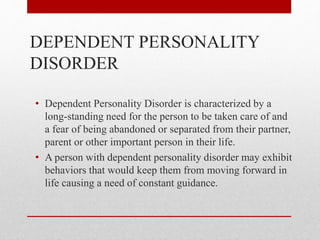
DEPENDENT PERSONALITY
DISORDER
• Dependent Personality Disorder is characterized by a
long-standing need for the person to be taken care of and
a fear of being abandoned or separated from their partner,
parent or other important person in their life.
• A person with dependent personality disorder may exhibit
behaviors that would keep them from moving forward in
life causing a need of constant guidance.
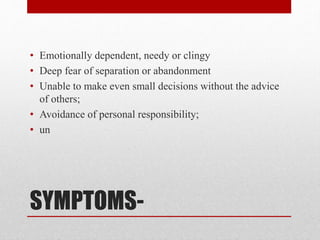
SYMPTOMS-
• Emotionally dependent, needy or clingy
• Deep fear of separation or abandonment
• Unable to make even small decisions without the advice
of others;
• Avoidance of personal responsibility;
• un
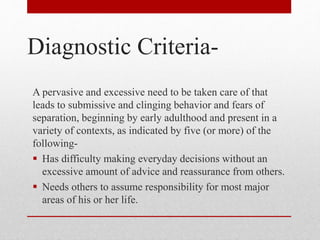
Diagnostic Criteria-
A pervasive and excessive need to be taken care of that
leads to submissive and clinging behavior and fears of
separation, beginning by early adulthood and present in a
variety of contexts, as indicated by five (or more) of the
following-
 Has difficulty making everyday decisions without an
excessive amount of advice and reassurance from others.
 Needs others to assume responsibility for most major
areas of his or her life.
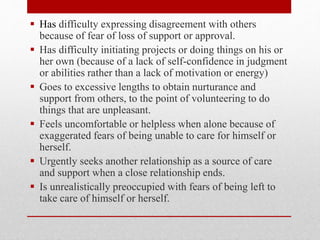
 Has difficulty expressing disagreement with others
because of fear of loss of support or approval.
 Has difficulty initiating projects or doing things on his or
her own (because of a lack of self-confidence in judgment
or abilities rather than a lack of motivation or energy)
 Goes to excessive lengths to obtain nurturance and
support from others, to the point of volunteering to do
things that are unpleasant.
 Feels uncomfortable or helpless when alone because of
exaggerated fears of being unable to care for himself or
herself.
 Urgently seeks another relationship as a source of care
and support when a close relationship ends.
 Is unrealistically preoccupied with fears of being left to
take care of himself or herself.
• Prevalence-
present in about 0.6% of the general population
more common among women
Higher in Asian countries like India and Japan
TREATMENT
• PSYCHOTHERAPY- Insight-oriented therapists enable
patients to understand the antecedents of their behavior,
and with the support of a therapist, patients can become
more independent, assertive, and self-reliant.Behavioral
therapy, assertiveness training, family therapy, and group
therapy have all been used, with successful outcomes in
many cases.
• PHARMACOTHERAPY-Benzodiazepines and
serotonergic agents.
• Psychostimulants.

Dependent Personality Disorder

  • 1.
  • 2.
    • PERSONALITY- Anindividual’s unique and relatively stable patterns of behavior, thoughts and emotions. • PERSONALITY DISORDER- Personality Disorders are a heterogeneous group of disorders defined by long-standing, pervasive and inflexible patterns of behavior and inner experience that deviate from the expectations of a person’s culture.
  • 3.
    • The DSM-IV-TRpersonality disorders are grouped into three clusters-  Cluster A (odd/eccentric) • Paranoid- Distrust and suspiciousness of others. • Schizoid- Detachment from social relationships and restricted range of emotional expression. • Schizotypal- lack of capacity for close relationships, cognitive distortions and eccentric behavior
  • 4.
     Cluster B •Antisocial- Disregard for and violation of the rights of others. • Borderline- Instability of interpersonal relationships, self- image and affect, as well as marked impulsivity. • Histrionic- Excessive emotionality and attention seeking. • Narcissistic- Grandiosity, need for admiration and lack of empathy.  Cluster C • Avoidant- Social inhibition, feelings of inadequacy and hypersensitivity to negative evaluation. • Dependent- Excessive need to be taken care of , submissive behavior and fears of separation. • Obsessive-Compulsive- Preoccupation with order, perfection and control.
  • 5.
    DEPENDENT PERSONALITY DISORDER • DependentPersonality Disorder is characterized by a long-standing need for the person to be taken care of and a fear of being abandoned or separated from their partner, parent or other important person in their life. • A person with dependent personality disorder may exhibit behaviors that would keep them from moving forward in life causing a need of constant guidance.
  • 6.
    SYMPTOMS- • Emotionally dependent,needy or clingy • Deep fear of separation or abandonment • Unable to make even small decisions without the advice of others; • Avoidance of personal responsibility; • un
  • 7.
    Diagnostic Criteria- A pervasiveand excessive need to be taken care of that leads to submissive and clinging behavior and fears of separation, beginning by early adulthood and present in a variety of contexts, as indicated by five (or more) of the following-  Has difficulty making everyday decisions without an excessive amount of advice and reassurance from others.  Needs others to assume responsibility for most major areas of his or her life.
  • 8.
     Has difficultyexpressing disagreement with others because of fear of loss of support or approval.  Has difficulty initiating projects or doing things on his or her own (because of a lack of self-confidence in judgment or abilities rather than a lack of motivation or energy)  Goes to excessive lengths to obtain nurturance and support from others, to the point of volunteering to do things that are unpleasant.  Feels uncomfortable or helpless when alone because of exaggerated fears of being unable to care for himself or herself.  Urgently seeks another relationship as a source of care and support when a close relationship ends.  Is unrealistically preoccupied with fears of being left to take care of himself or herself.
  • 9.
    • Prevalence- present inabout 0.6% of the general population more common among women Higher in Asian countries like India and Japan
  • 10.
    TREATMENT • PSYCHOTHERAPY- Insight-orientedtherapists enable patients to understand the antecedents of their behavior, and with the support of a therapist, patients can become more independent, assertive, and self-reliant.Behavioral therapy, assertiveness training, family therapy, and group therapy have all been used, with successful outcomes in many cases. • PHARMACOTHERAPY-Benzodiazepines and serotonergic agents. • Psychostimulants.