1

The understanding of personality and its
disorders distinguishes psychiatry
fundamentally from all other branches of
medicine.
A person is a self-aware human being not “a
machine-like object that lacks self-awareness.”
(C. Robert Cloninger)
2
Introduction

Personality
 Is the dynamic organization of the psychobiological
systems by which a person shapes and adapts in a
unique way to changing internal and external
environments.
 personality develops through the interaction of hereditary
dispositions and environmental influences.
 Basic functions of personality are to feel, think, and
perceive and to incorporate these into purposeful 3
Introduction

 The totality of somebody's attitudes, interests,
behavioral patterns, emotional responses, social roles,
and other individual traits that endure over long
periods of time.
 Are enduring patterns of perceiving and thinking about
the environment and oneself that are exhibited in a
wide range of social and personal contexts 4
Introduction

 DSM 5 defines personality disorders as
 Enduring pattern of behaviour and inner experience
that deviate from cultural standards,
 are rigidly pervasive,
 have an onset in adolescence or early adulthood,
 are stable through time, and lead to unhappiness and
impairment.
5
Personality disorder

• It manifests in at least two of the following four
areas: cognition, affectivity, interpersonal function,
or impulse control.
• When personality traits are rigid and maladaptive
and produce functional impairment or subjective
distress, a personality disorder may be diagnosed.
6

Personality disorder
 Common and chronic disorder.
 Occur in 10 to 20 % of the general population and in
about half of psychiatric patients.
 Generally considered to have poor prognosis.
 It is a predisposing factor for other psychiatric disorders.
7
Cont’d…

 Persons with personality disorders are far more likely to
refuse psychiatric help and to deny their problems .
 Personality disorder symptoms are alloplastic (i.e., able
to adapt to, and alter, the external environment) and ego-
syntonic (i.e., acceptable to the ego).
8
Cont’d…

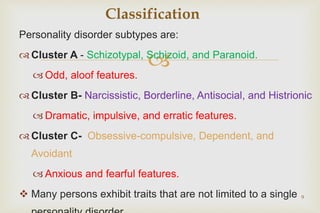
Personality disorder subtypes are:
 Cluster A - Schizotypal, Schizoid, and Paranoid.
 Odd, aloof features.
 Cluster B- Narcissistic, Borderline, Antisocial, and Histrionic
 Dramatic, impulsive, and erratic features.
 Cluster C- Obsessive-compulsive, Dependent, and
Avoidant
 Anxious and fearful features.
 Many persons exhibit traits that are not limited to a single 9
Classification

Genetic Factors
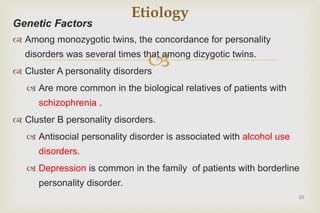
 Among monozygotic twins, the concordance for personality
disorders was several times that among dizygotic twins.
 Cluster A personality disorders
 Are more common in the biological relatives of patients with
schizophrenia .
 Cluster B personality disorders.
 Antisocial personality disorder is associated with alcohol use
disorders.
 Depression is common in the family of patients with borderline
personality disorder.
10
Etiology

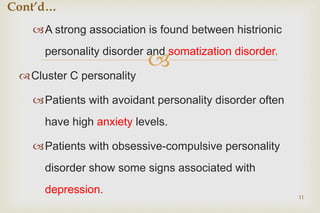
A strong association is found between histrionic
personality disorder and somatization disorder.
Cluster C personality
Patients with avoidant personality disorder often
have high anxiety levels.
Patients with obsessive-compulsive personality
disorder show some signs associated with
depression.
11
Cont’d…

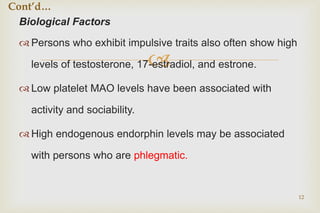
Biological Factors
 Persons who exhibit impulsive traits also often show high
levels of testosterone, 17-estradiol, and estrone.
 Low platelet MAO levels have been associated with
activity and sociability.
 High endogenous endorphin levels may be associated
with persons who are phlegmatic.
12
Cont’d…

Psychoanalytic factor
 Sigmund Freud suggested that personality traits are
related to a fixation at one psychosexual stage of
development. For example,
 Those who fixated at the oral stage are passive and
dependent.
 Those with an anal character are stubborn,
parsimonious, and highly conscientious because of
struggles over toilet training during the anal period.
13
Cont’d…

 Individuals with these disorders often appear odd or
eccentric /aloof
 Paranoid PD
 Schizoid PD
 Schizotypal Personality Disorders
14
Cluster A includes

 characterized by long-standing suspiciousness and
mistrust of persons in general.
 They are often hostile, irritable, and angry.
 such persons often are pathologically jealous
 This tendency begins by early adulthood and appears in
a variety of contexts.
 Almost invariably, those with the disorder expect to be
exploited or harmed by others in some way.
15
Paranoid Personality Disorder

 The prevalence is 2 to 4 percent in general population.
 More common in men and does not appear to have a
familial pattern.
 Higher among minority groups, immigrants, and persons who
are deaf than it is in the general population.
16
Cont’d….

 A pervasive pattern of detachment from social
relationships
 Neither desires nor enjoys close relationships, including
being part of a family
 Almost always chooses solitary activities
 Has little, if any, interest in having sexual experiences with
another person
17
Schizoid Personality Disorder

The prevalence is not clearly established, but the disorder
may affect 7.5% of the general population.
The sex ratio of the disorder is unknown; some studies
report a 2:1 male-to-female ratio.
The onset ,usually occurs in early childhood.
The disorder is long lasting, but not necessarily lifelong.
18
Cont’d…

 Are strikingly odd or strange, even to laypersons.
 Magical thinking, peculiar notions, ideas of reference,
illusions, and derealization are part of a schizotypal
person's everyday world.
 They exhibit disturbed thinking and communicating.
19
Schizotypal Personality Disorder

 Are sensitive to, and aware of, the feelings of others,
especially negative affects such as anger.
 Their inner world may be filled with vivid imaginary
relationships and child-like fears and fantasies.
 Have poor interpersonal relationships and may act
inappropriately.
20
Cont’d…

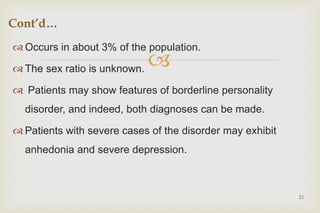
 Occurs in about 3% of the population.
 The sex ratio is unknown.
 Patients may show features of borderline personality
disorder, and indeed, both diagnoses can be made.
 Patients with severe cases of the disorder may exhibit
anhedonia and severe depression.
21
Cont’d…

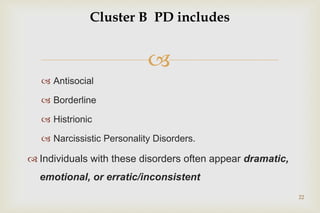
 Antisocial
 Borderline
 Histrionic
 Narcissistic Personality Disorders.
 Individuals with these disorders often appear dramatic,
emotional, or erratic/inconsistent
22
Cluster B PD includes

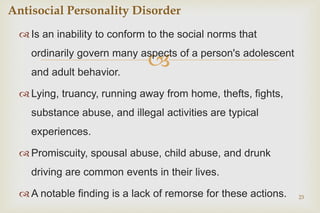
 Is an inability to conform to the social norms that
ordinarily govern many aspects of a person's adolescent
and adult behavior.
 Lying, truancy, running away from home, thefts, fights,
substance abuse, and illegal activities are typical
experiences.
 Promiscuity, spousal abuse, child abuse, and drunk
driving are common events in their lives.
 A notable finding is a lack of remorse for these actions. 23
Antisocial Personality Disorder

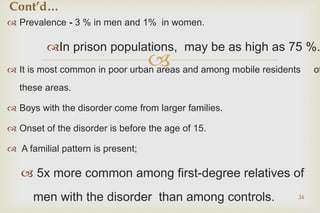
 Prevalence - 3 % in men and 1% in women.
In prison populations, may be as high as 75 %.
 It is most common in poor urban areas and among mobile residents of
these areas.
 Boys with the disorder come from larger families.
 Onset of the disorder is before the age of 15.
 A familial pattern is present;
 5x more common among first-degree relatives of
men with the disorder than among controls. 24
Cont’d…

 They are characterized by extraordinarily unstable affect,
mood, behavior, object relations, and self-image.
 Patients can be argumentative at one moment,
depressed the next, and later complain of having no
feelings
 unstable and intense interpersonal relationships
 Almost always appear to be in a state of crisis.
25
Borderline Personality Disorder

26
Cont’d…
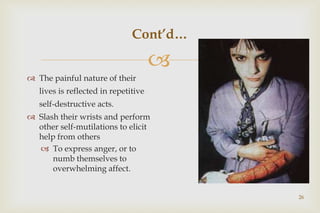
 The painful nature of their
lives is reflected in repetitive
self-destructive acts.
 Slash their wrists and perform
other self-mutilations to elicit
help from others
 To express anger, or to
numb themselves to
overwhelming affect.

 It is thought to be present in about 1 to 2% of the
population
 Common in women(2x).
 An increased prevalence of
 Major depressive disorder, alcohol use disorders, and
substance abuse is found in first-degree relatives.
27
Cont…

 Characterized by excitable and emotional and behave in a
colorful, dramatic, extroverted fashion.
 Show a high degree of attention-seeking behavior
 They tend to exaggerate their thoughts and feelings and
make everything sound more important than it really is.
28
Histrionic Personality Disorder

 They display temper tantrums, tears, and accusations
when they are not the center of attention or are not
receiving praise or approval.
 Prevalence - 2 to 3% in general population
 Common in female
29
Cont’d…

30
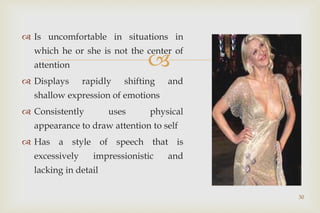
 Is uncomfortable in situations in
which he or she is not the center of
attention
 Displays rapidly shifting and
shallow expression of emotions
 Consistently uses physical
appearance to draw attention to self
 Has a style of speech that is
excessively impressionistic and
lacking in detail

 Characterized by a heightened sense of self-importance and
grandiose feelings of uniqueness.
 They consider themselves special and expect special
treatment.
 Their sense of entitlement is striking.
31
Narcissistic Personality Disorder

 They handle criticism poorly, or they may appear completely
indifferent to criticism.
 Frequently ambitious to achieve fame and fortune.
 Prevalence - 2 -16 % in the clinical population, < 1 % in the
general population.
 Offspring of such parents may have a higher than usual risk for
developing the disorder themselves.
32
Cont’d…

 Avoidant
 Dependent
 Obsessive-Compulsive Personality Disorders.
 Individuals with these disorders often appear anxious
or fearful.
33
Cluster C PD includes

 Avoidant personality disorder is common.
 Are extremely sensitivity to rejection and may lead a
socially withdrawn life.
 Such persons are commonly described as having an
inferiority complex.
34
Avoidant Personality Disorder

 Hypersensitivity to rejection by others is the central
clinical feature, and patients' main personality trait is
timidity(fear)
 They often have no close friends or confidants.
 The prevalence - 1 to 10% the general population.
 No information is available on sex ratio or familial
pattern.
35
Cont’d…

36
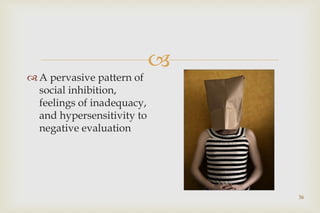
 A pervasive pattern of
social inhibition,
feelings of inadequacy,
and hypersensitivity to
negative evaluation

 Has been called passive-dependent personality.
 Characterized by a pervasive pattern of dependent and
submissive behavior.
 They cannot make decisions without an excessive amount
of advice and reassurance from others.
 They avoid positions of responsibility and become
anxious if asked to assume a leadership role.
 Pessimism, self-doubt, passivity, and fears of expressing
sexual and aggressive feelings. 37
Dependent Personality Disorder

 An abusive, unfaithful, or alcoholic spouse may be
tolerated for long periods to avoid disturbing the sense of
attachment.
 More common in women
 Prevalence- 2.5%
 Persons with chronic physical illness in childhood may be
most susceptible to the disorder.
38
Cont’d…

 Characterized by emotional constriction, orderliness,
perseverance, stubbornness, and indecisiveness.
 The essential feature of the disorder is a pervasive pattern of
perfectionism and inflexibility
 They are preoccupied with rules, regulations, orderliness,
neatness, details, and the achievement of perfection.
 Have limited interpersonal skills.
 They are capable of prolonged work, provided it is routinized
and does not require changes to which they cannot adapt.
39
Obsessive-Compulsive Personality Disorder

The prevalence disorder is unknown.
It is more common in men and is diagnosed most often
in oldest children.
 Occurs more frequently in first-degree biological
relatives of persons with the disorder than in the
general population.
 Patients often have backgrounds characterized by
harsh discipline.
40
Cont’d…

Pharmacotherapy
 In general, no single pharmacologic treatment is effective in the
treatment of a particular personality disorder.
 Medications may be of use in reducing certain features of the
disorders, but they are generally limited and are typically ineffective
in alleviating other symptoms.
• Because of the enduring nature of the problems
associated with these disorders, symptoms that
have responded to pharmacologic treatment often
return when the medication is stopped.
41
Treatment

 The effect of somatic treatments may be limited as a
result of the large psychosocial component.
Psychotherapy
 Patients with personality disorders tend to be challenging
to therapists.
 The fixedness and duration of their problems makes these
problems difficult to alter in a brief treatment.
42
Cont’d…

Alliance between therapist and patient is critical.
• Giving direct advice on personal and social problems
should be avoided .
Many of these patients appear to benefit from
supportive and cognitive therapy that is focused
more on current life issues than on past concerns
43
Cont’d…

Management of personality change disorder
involves treatment of the underlying organic
condition when possible.
Psychopharmacological treatment of specific
symptoms.
44

45

9 Personality Disorders.pptx

  • 1.
  • 2.
     The understanding ofpersonality and its disorders distinguishes psychiatry fundamentally from all other branches of medicine. A person is a self-aware human being not “a machine-like object that lacks self-awareness.” (C. Robert Cloninger) 2 Introduction
  • 3.
     Personality  Is thedynamic organization of the psychobiological systems by which a person shapes and adapts in a unique way to changing internal and external environments.  personality develops through the interaction of hereditary dispositions and environmental influences.  Basic functions of personality are to feel, think, and perceive and to incorporate these into purposeful 3 Introduction
  • 4.
      The totalityof somebody's attitudes, interests, behavioral patterns, emotional responses, social roles, and other individual traits that endure over long periods of time.  Are enduring patterns of perceiving and thinking about the environment and oneself that are exhibited in a wide range of social and personal contexts 4 Introduction
  • 5.
      DSM 5defines personality disorders as  Enduring pattern of behaviour and inner experience that deviate from cultural standards,  are rigidly pervasive,  have an onset in adolescence or early adulthood,  are stable through time, and lead to unhappiness and impairment. 5 Personality disorder
  • 6.
     • It manifestsin at least two of the following four areas: cognition, affectivity, interpersonal function, or impulse control. • When personality traits are rigid and maladaptive and produce functional impairment or subjective distress, a personality disorder may be diagnosed. 6
  • 7.
     Personality disorder  Commonand chronic disorder.  Occur in 10 to 20 % of the general population and in about half of psychiatric patients.  Generally considered to have poor prognosis.  It is a predisposing factor for other psychiatric disorders. 7 Cont’d…
  • 8.
      Persons withpersonality disorders are far more likely to refuse psychiatric help and to deny their problems .  Personality disorder symptoms are alloplastic (i.e., able to adapt to, and alter, the external environment) and ego- syntonic (i.e., acceptable to the ego). 8 Cont’d…
  • 9.
     Personality disorder subtypesare:  Cluster A - Schizotypal, Schizoid, and Paranoid.  Odd, aloof features.  Cluster B- Narcissistic, Borderline, Antisocial, and Histrionic  Dramatic, impulsive, and erratic features.  Cluster C- Obsessive-compulsive, Dependent, and Avoidant  Anxious and fearful features.  Many persons exhibit traits that are not limited to a single 9 Classification
  • 10.
     Genetic Factors  Amongmonozygotic twins, the concordance for personality disorders was several times that among dizygotic twins.  Cluster A personality disorders  Are more common in the biological relatives of patients with schizophrenia .  Cluster B personality disorders.  Antisocial personality disorder is associated with alcohol use disorders.  Depression is common in the family of patients with borderline personality disorder. 10 Etiology
  • 11.
     A strong associationis found between histrionic personality disorder and somatization disorder. Cluster C personality Patients with avoidant personality disorder often have high anxiety levels. Patients with obsessive-compulsive personality disorder show some signs associated with depression. 11 Cont’d…
  • 12.
     Biological Factors  Personswho exhibit impulsive traits also often show high levels of testosterone, 17-estradiol, and estrone.  Low platelet MAO levels have been associated with activity and sociability.  High endogenous endorphin levels may be associated with persons who are phlegmatic. 12 Cont’d…
  • 13.
     Psychoanalytic factor  SigmundFreud suggested that personality traits are related to a fixation at one psychosexual stage of development. For example,  Those who fixated at the oral stage are passive and dependent.  Those with an anal character are stubborn, parsimonious, and highly conscientious because of struggles over toilet training during the anal period. 13 Cont’d…
  • 14.
      Individuals withthese disorders often appear odd or eccentric /aloof  Paranoid PD  Schizoid PD  Schizotypal Personality Disorders 14 Cluster A includes
  • 15.
      characterized bylong-standing suspiciousness and mistrust of persons in general.  They are often hostile, irritable, and angry.  such persons often are pathologically jealous  This tendency begins by early adulthood and appears in a variety of contexts.  Almost invariably, those with the disorder expect to be exploited or harmed by others in some way. 15 Paranoid Personality Disorder
  • 16.
      The prevalenceis 2 to 4 percent in general population.  More common in men and does not appear to have a familial pattern.  Higher among minority groups, immigrants, and persons who are deaf than it is in the general population. 16 Cont’d….
  • 17.
      A pervasivepattern of detachment from social relationships  Neither desires nor enjoys close relationships, including being part of a family  Almost always chooses solitary activities  Has little, if any, interest in having sexual experiences with another person 17 Schizoid Personality Disorder
  • 18.
     The prevalence isnot clearly established, but the disorder may affect 7.5% of the general population. The sex ratio of the disorder is unknown; some studies report a 2:1 male-to-female ratio. The onset ,usually occurs in early childhood. The disorder is long lasting, but not necessarily lifelong. 18 Cont’d…
  • 19.
      Are strikinglyodd or strange, even to laypersons.  Magical thinking, peculiar notions, ideas of reference, illusions, and derealization are part of a schizotypal person's everyday world.  They exhibit disturbed thinking and communicating. 19 Schizotypal Personality Disorder
  • 20.
      Are sensitiveto, and aware of, the feelings of others, especially negative affects such as anger.  Their inner world may be filled with vivid imaginary relationships and child-like fears and fantasies.  Have poor interpersonal relationships and may act inappropriately. 20 Cont’d…
  • 21.
      Occurs inabout 3% of the population.  The sex ratio is unknown.  Patients may show features of borderline personality disorder, and indeed, both diagnoses can be made.  Patients with severe cases of the disorder may exhibit anhedonia and severe depression. 21 Cont’d…
  • 22.
      Antisocial  Borderline Histrionic  Narcissistic Personality Disorders.  Individuals with these disorders often appear dramatic, emotional, or erratic/inconsistent 22 Cluster B PD includes
  • 23.
      Is aninability to conform to the social norms that ordinarily govern many aspects of a person's adolescent and adult behavior.  Lying, truancy, running away from home, thefts, fights, substance abuse, and illegal activities are typical experiences.  Promiscuity, spousal abuse, child abuse, and drunk driving are common events in their lives.  A notable finding is a lack of remorse for these actions. 23 Antisocial Personality Disorder
  • 24.
      Prevalence -3 % in men and 1% in women. In prison populations, may be as high as 75 %.  It is most common in poor urban areas and among mobile residents of these areas.  Boys with the disorder come from larger families.  Onset of the disorder is before the age of 15.  A familial pattern is present;  5x more common among first-degree relatives of men with the disorder than among controls. 24 Cont’d…
  • 25.
      They arecharacterized by extraordinarily unstable affect, mood, behavior, object relations, and self-image.  Patients can be argumentative at one moment, depressed the next, and later complain of having no feelings  unstable and intense interpersonal relationships  Almost always appear to be in a state of crisis. 25 Borderline Personality Disorder
  • 26.
     26 Cont’d…  The painfulnature of their lives is reflected in repetitive self-destructive acts.  Slash their wrists and perform other self-mutilations to elicit help from others  To express anger, or to numb themselves to overwhelming affect.
  • 27.
      It isthought to be present in about 1 to 2% of the population  Common in women(2x).  An increased prevalence of  Major depressive disorder, alcohol use disorders, and substance abuse is found in first-degree relatives. 27 Cont…
  • 28.
      Characterized byexcitable and emotional and behave in a colorful, dramatic, extroverted fashion.  Show a high degree of attention-seeking behavior  They tend to exaggerate their thoughts and feelings and make everything sound more important than it really is. 28 Histrionic Personality Disorder
  • 29.
      They displaytemper tantrums, tears, and accusations when they are not the center of attention or are not receiving praise or approval.  Prevalence - 2 to 3% in general population  Common in female 29 Cont’d…
  • 30.
     30  Is uncomfortablein situations in which he or she is not the center of attention  Displays rapidly shifting and shallow expression of emotions  Consistently uses physical appearance to draw attention to self  Has a style of speech that is excessively impressionistic and lacking in detail
  • 31.
      Characterized bya heightened sense of self-importance and grandiose feelings of uniqueness.  They consider themselves special and expect special treatment.  Their sense of entitlement is striking. 31 Narcissistic Personality Disorder
  • 32.
      They handlecriticism poorly, or they may appear completely indifferent to criticism.  Frequently ambitious to achieve fame and fortune.  Prevalence - 2 -16 % in the clinical population, < 1 % in the general population.  Offspring of such parents may have a higher than usual risk for developing the disorder themselves. 32 Cont’d…
  • 33.
      Avoidant  Dependent Obsessive-Compulsive Personality Disorders.  Individuals with these disorders often appear anxious or fearful. 33 Cluster C PD includes
  • 34.
      Avoidant personalitydisorder is common.  Are extremely sensitivity to rejection and may lead a socially withdrawn life.  Such persons are commonly described as having an inferiority complex. 34 Avoidant Personality Disorder
  • 35.
      Hypersensitivity torejection by others is the central clinical feature, and patients' main personality trait is timidity(fear)  They often have no close friends or confidants.  The prevalence - 1 to 10% the general population.  No information is available on sex ratio or familial pattern. 35 Cont’d…
  • 36.
     36  A pervasivepattern of social inhibition, feelings of inadequacy, and hypersensitivity to negative evaluation
  • 37.
      Has beencalled passive-dependent personality.  Characterized by a pervasive pattern of dependent and submissive behavior.  They cannot make decisions without an excessive amount of advice and reassurance from others.  They avoid positions of responsibility and become anxious if asked to assume a leadership role.  Pessimism, self-doubt, passivity, and fears of expressing sexual and aggressive feelings. 37 Dependent Personality Disorder
  • 38.
      An abusive,unfaithful, or alcoholic spouse may be tolerated for long periods to avoid disturbing the sense of attachment.  More common in women  Prevalence- 2.5%  Persons with chronic physical illness in childhood may be most susceptible to the disorder. 38 Cont’d…
  • 39.
      Characterized byemotional constriction, orderliness, perseverance, stubbornness, and indecisiveness.  The essential feature of the disorder is a pervasive pattern of perfectionism and inflexibility  They are preoccupied with rules, regulations, orderliness, neatness, details, and the achievement of perfection.  Have limited interpersonal skills.  They are capable of prolonged work, provided it is routinized and does not require changes to which they cannot adapt. 39 Obsessive-Compulsive Personality Disorder
  • 40.
     The prevalence disorderis unknown. It is more common in men and is diagnosed most often in oldest children.  Occurs more frequently in first-degree biological relatives of persons with the disorder than in the general population.  Patients often have backgrounds characterized by harsh discipline. 40 Cont’d…
  • 41.
     Pharmacotherapy  In general,no single pharmacologic treatment is effective in the treatment of a particular personality disorder.  Medications may be of use in reducing certain features of the disorders, but they are generally limited and are typically ineffective in alleviating other symptoms. • Because of the enduring nature of the problems associated with these disorders, symptoms that have responded to pharmacologic treatment often return when the medication is stopped. 41 Treatment
  • 42.
      The effectof somatic treatments may be limited as a result of the large psychosocial component. Psychotherapy  Patients with personality disorders tend to be challenging to therapists.  The fixedness and duration of their problems makes these problems difficult to alter in a brief treatment. 42 Cont’d…
  • 43.
     Alliance between therapistand patient is critical. • Giving direct advice on personal and social problems should be avoided . Many of these patients appear to benefit from supportive and cognitive therapy that is focused more on current life issues than on past concerns 43 Cont’d…
  • 44.
     Management of personalitychange disorder involves treatment of the underlying organic condition when possible. Psychopharmacological treatment of specific symptoms. 44
  • 45.

Editor's Notes

  • #4 Psycho biological -means that personality is neither exclusively mental nor exclusively neural but a combination of the two. unique adjustment to the environment” has both functional and evolutionary significance in pointing to personality as a mode of survival and, more generally, of learning and adaptation, which is unique to each individual
  • #9 The exceptions to this are patients with Dependent and Avoidant Personality –ego dystonic Avoidant and Schizoid Personality Disorders-not alloplastic( try to change others
  • #11 Less correlation exists between paranoid or schizoid personality disorder and schizophrenia.
  • #13 In many persons, serotonin reduces depression, impulsiveness, and rumination, and can produce a sense of general well-being Increased dopamine concentrations in the central nervous system, produced by certain psychostimulants (e.g., amphetamines) can induce euphoria.
  • #17 patients attribute their own unacknowledged feelings to others
  • #20 While the sex ratio of schizotypal personality disorder is unknown, it is frequently diagnosed in women with fragile X syndrome.
  • #22 A long-term study by Thomas McGlashan reported that 10 percent of those with schizotypal personality disorder eventually committed suicide
  • #24 Antisocial patients are at increased risk for impulse control disorders, major depression, substance abuse or dependence, pathological gambling, anxiety disorders, and somatization disorder. The most common co-occurring personality disorders are narcissistic, borderline, and histrionic.
  • #30 Dissociation or denial is a Pollyanna-like replacement of unpleasant affects with pleasant ones.
  • #41 reaction formation-Unconscious defense mechanism in which a person develops a socialized attitude or interest that is the direct antithesis of some infantile wish or impulse that is harbored consciously or unconsciously. Rationalization-An unconscious defense mechanism in which irrational or unacceptable behavior, motives, or feelings are logically justified or made consciously tolerable by plausible means. Repression-munacceptable mental contents are banished or kept out of consciousness Undoing- repetitive in nature, by which a person symbolically acts out in reverse something unacceptable that has already been done or against which the ego must defend itself