

Borderline Personality Disorder Lucia Merino
Borderline Personality Disorder
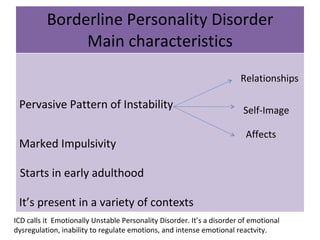
Borderline Personality Disorder Main characteristics Pervasive Pattern of Instability Relationships Self-Image Affects Marked Impulsivity Starts in early adulthood It’s present in a variety of contexts ICD calls it  Emotionally Unstable Personality Disorder. It’s a disorder of emotional dysregulation, inability to regulate emotions, and intense emotional reactvity.
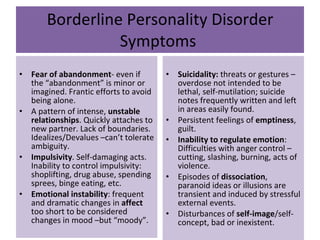
Borderline Personality Disorder Symptoms  Fear of abandonment - even if the “abandonment” is minor or imagined. Frantic efforts to avoid being alone.  A pattern of intense,  unstable relationships . Quickly attaches to new partner. Lack of boundaries. Idealizes/Devalues –can’t tolerate ambiguity. Impulsivity . Self-damaging acts. Inability to control impulsivity: shoplifting, drug abuse, spending sprees, binge eating, etc. Emotional instability : frequent and dramatic changes in  affect  too short to be considered changes in mood –but “moody”. Suicidality:  threats or gestures –overdose not intended to be lethal, self-mutilation; suicide notes frequently written and left in areas easily found. Persistent feelings of  emptiness , guilt. Inability to regulate emotion : Difficulties with anger control –cutting, slashing, burning, acts of violence. Episodes of  dissociation , paranoid ideas or illusions are  transient and induced by stressful external events. Disturbances of  self-image /self-concept, bad or inexistent.
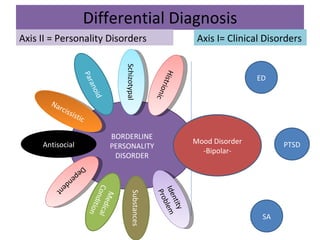
Differential Diagnosis BORDERLINE PERSONALITY DISORDER Schizotypal Paranoid Mood Disorder -Bipolar- Axis I= Clinical Disorders Axis II = Personality Disorders Antisocial Histrionic Identity Problem Substances Medical Condition Dependent Narcissistic ED SA PTSD
 
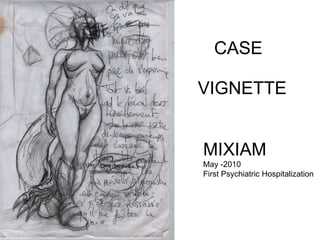
CASE VIGNETTE MIXIAM   May -2010 First Psychiatric Hospitalization
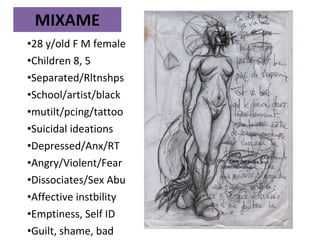
MIXAME 28 y/old F M female Children 8, 5 Separated/Rltnshps School/artist/black mutilt/pcing/tattoo Suicidal ideations Depressed/Anx/RT Angry/Violent/Fear Dissociates/Sex Abu Affective instbility Emptiness, Self ID Guilt, shame, bad
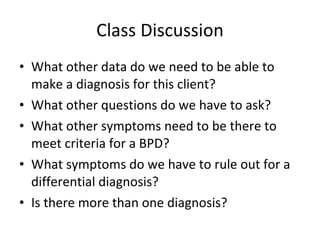
Class Discussion What other data do we need to be able to make a diagnosis for this client? What other questions do we have to ask? What other symptoms need to be there to meet criteria for a BPD? What symptoms do we have to rule out for a differential diagnosis? Is there more than one diagnosis?
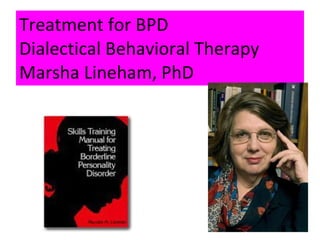
Treatment for BPD Dialectical Behavioral Therapy Marsha Lineham, PhD
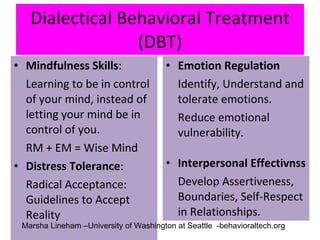
Dialectical Behavioral Treatment (DBT) Mindfulness Skills : Learning to be in control of your mind, instead of letting your mind be in control of you. RM + EM = Wise Mind  Distress Tolerance : Radical Acceptance: Guidelines to Accept Reality Emotion Regulation Identify, Understand and tolerate emotions. Reduce emotional vulnerability. Interpersonal Effectivnss Develop Assertiveness, Boundaries, Self-Respect in Relationships. Marsha Lineham –University of Washington at Seattle  -behavioraltech.org
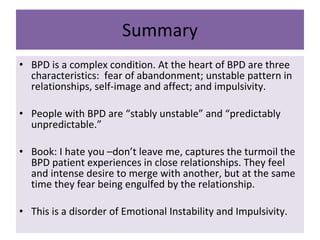
Summary BPD is a complex condition. At the heart of BPD are three characteristics:  fear of abandonment; unstable pattern in relationships, self-image and affect; and impulsivity. People with BPD are “stably unstable” and “predictably unpredictable.” Book: I hate you –don’t leave me, captures the turmoil the BPD patient experiences in close relationships. They feel and intense desire to merge with another, but at the same time they fear being engulfed by the relationship. This is a disorder of Emotional Instability and Impulsivity.
Celebrities with  Borderline Personality Disorder
You are the doctor! How would you feel if you had this person in your office? Notice your visceral reaction. What is that you like from this person? What is that you dislike from this person? What are behaviors you know of this person evidencing borderline traits? What would you ask in order to find out if s/he has borderline personality disorder?
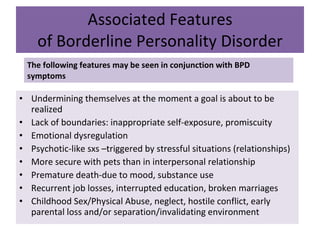
Associated Features of Borderline Personality Disorder The following features may be seen in conjunction with BPD symptoms Undermining themselves at the moment a goal is about to be realized Lack of boundaries: inappropriate self-exposure, promiscuity Emotional dysregulation Psychotic-like sxs –triggered by stressful situations (relationships) More secure with pets than in interpersonal relationship Premature death-due to mood, substance use Recurrent job losses, interrupted education, broken marriages Childhood Sex/Physical Abuse, neglect, hostile conflict, early parental loss and/or separation/invalidating environment
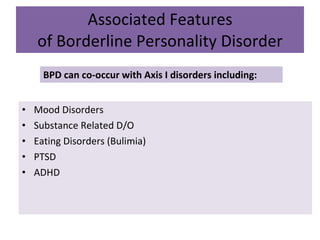
Associated Features of Borderline Personality Disorder BPD can co-occur with Axis I disorders including: Mood Disorders Substance Related D/O Eating Disorders (Bulimia) PTSD ADHD
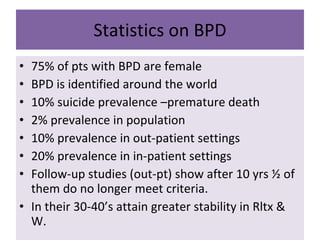
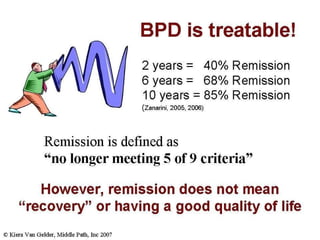
Statistics on BPD 75% of pts with BPD are female BPD is identified around the world 10% suicide prevalence –premature death 2% prevalence in population 10% prevalence in out-patient settings 20% prevalence in in-patient settings Follow-up studies (out-pt) show after 10 yrs ½ of them do no longer meet criteria. In their 30-40’s attain greater stability in Rltx & W.
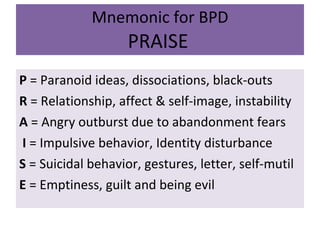
Mnemonic for BPD PRAISE   P  = Paranoid ideas, dissociations, black-outs R  = Relationship, affect & self-image, instability A  = Angry outburst due to abandonment fears I  = Impulsive behavior, Identity disturbance S  = Suicidal behavior, gestures, letter, self-mutil E  = Emptiness, guilt and being evil
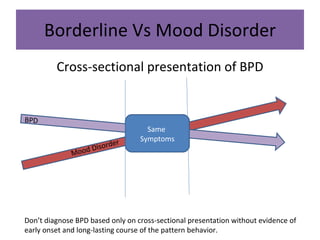
Borderline Vs Mood Disorder Cross-sectional presentation of BPD Bi B BPD Mood Disorder Same  Symptoms Don’t diagnose BPD based only on cross-sectional presentation without evidence of early onset and long-lasting course of the pattern behavior.
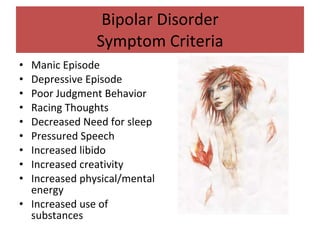
Bipolar Disorder Symptom Criteria Manic Episode Depressive Episode Poor Judgment Behavior Racing Thoughts Decreased Need for sleep Pressured Speech Increased libido Increased creativity Increased physical/mental energy Increased use of substances
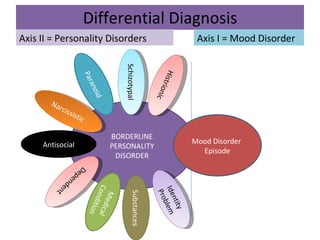
Differential Diagnosis BORDERLINE PERSONALITY DISORDER Schizotypal Paranoid Mood Disorder  Episode Axis I = Mood Disorder Axis II = Personality Disorders Antisocial Histrionic Identity Problem Substances Medical Condition Dependent Narcissistic
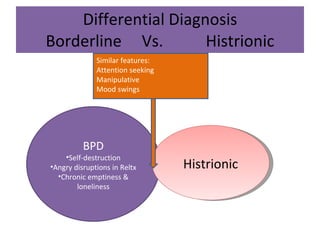
Differential Diagnosis Borderline  Vs.  Histrionic BPD Self-destruction Angry disruptions in Reltx Chronic emptiness & loneliness Histrionic Similar features: Attention seeking Manipulative Mood swings
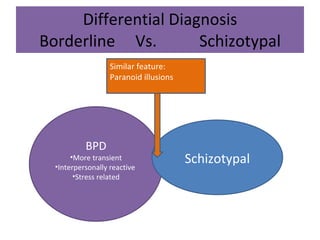
Differential Diagnosis Borderline  Vs.  Schizotypal BPD More transient Interpersonally reactive  Stress related Similar feature: Paranoid illusions Schizotypal
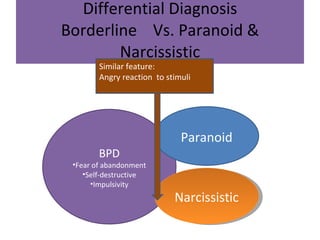
Differential Diagnosis Borderline  Vs. Paranoid & Narcissistic BPD Fear of abandonment Self-destructive Impulsivity Paranoid Narcissistic Similar feature: Angry reaction  to stimuli
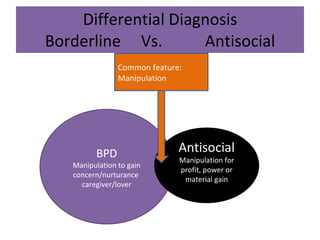
Differential Diagnosis Borderline  Vs.  Antisocial BPD Manipulation to gain concern/nurturance  caregiver/lover Antisocial Manipulation for profit, power or material gain Common feature: Manipulation
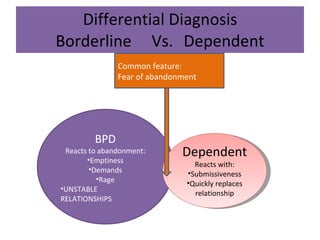
Differential Diagnosis Borderline  Vs.  Dependent BPD Reacts to abandonment: Emptiness Demands Rage UNSTABLE RELATIONSHIPS Dependent Reacts with: Submissiveness Quickly replaces relationship Common feature: Fear of abandonment
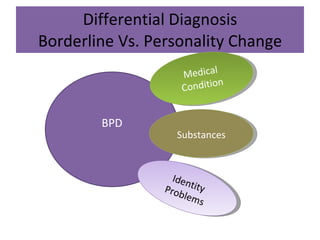
Differential Diagnosis Borderline Vs. Personality Change BPD Medical Condition Substances Identity Problems
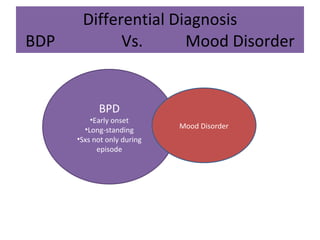
Differential Diagnosis BDP   Vs.  Mood Disorder BPD Early onset Long-standing Sxs not only during episode Mood Disorder
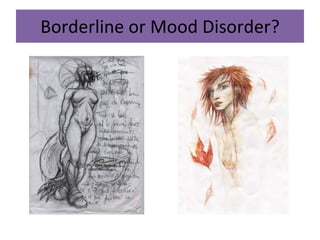
Borderline or Mood Disorder?
 

Borderline personality disorder presentation

  • 1.
  • 2.
  • 3.
    Borderline Personality DisorderMain characteristics Pervasive Pattern of Instability Relationships Self-Image Affects Marked Impulsivity Starts in early adulthood It’s present in a variety of contexts ICD calls it Emotionally Unstable Personality Disorder. It’s a disorder of emotional dysregulation, inability to regulate emotions, and intense emotional reactvity.
  • 4.
    Borderline Personality DisorderSymptoms Fear of abandonment - even if the “abandonment” is minor or imagined. Frantic efforts to avoid being alone. A pattern of intense, unstable relationships . Quickly attaches to new partner. Lack of boundaries. Idealizes/Devalues –can’t tolerate ambiguity. Impulsivity . Self-damaging acts. Inability to control impulsivity: shoplifting, drug abuse, spending sprees, binge eating, etc. Emotional instability : frequent and dramatic changes in affect too short to be considered changes in mood –but “moody”. Suicidality: threats or gestures –overdose not intended to be lethal, self-mutilation; suicide notes frequently written and left in areas easily found. Persistent feelings of emptiness , guilt. Inability to regulate emotion : Difficulties with anger control –cutting, slashing, burning, acts of violence. Episodes of dissociation , paranoid ideas or illusions are transient and induced by stressful external events. Disturbances of self-image /self-concept, bad or inexistent.
  • 5.
    Differential Diagnosis BORDERLINEPERSONALITY DISORDER Schizotypal Paranoid Mood Disorder -Bipolar- Axis I= Clinical Disorders Axis II = Personality Disorders Antisocial Histrionic Identity Problem Substances Medical Condition Dependent Narcissistic ED SA PTSD
  • 6.
  • 7.
    CASE VIGNETTE MIXIAM May -2010 First Psychiatric Hospitalization
  • 8.
    MIXAME 28 y/oldF M female Children 8, 5 Separated/Rltnshps School/artist/black mutilt/pcing/tattoo Suicidal ideations Depressed/Anx/RT Angry/Violent/Fear Dissociates/Sex Abu Affective instbility Emptiness, Self ID Guilt, shame, bad
  • 9.
    Class Discussion Whatother data do we need to be able to make a diagnosis for this client? What other questions do we have to ask? What other symptoms need to be there to meet criteria for a BPD? What symptoms do we have to rule out for a differential diagnosis? Is there more than one diagnosis?
  • 10.
    Treatment for BPDDialectical Behavioral Therapy Marsha Lineham, PhD
  • 11.
    Dialectical Behavioral Treatment(DBT) Mindfulness Skills : Learning to be in control of your mind, instead of letting your mind be in control of you. RM + EM = Wise Mind Distress Tolerance : Radical Acceptance: Guidelines to Accept Reality Emotion Regulation Identify, Understand and tolerate emotions. Reduce emotional vulnerability. Interpersonal Effectivnss Develop Assertiveness, Boundaries, Self-Respect in Relationships. Marsha Lineham –University of Washington at Seattle -behavioraltech.org
  • 12.
    Summary BPD isa complex condition. At the heart of BPD are three characteristics: fear of abandonment; unstable pattern in relationships, self-image and affect; and impulsivity. People with BPD are “stably unstable” and “predictably unpredictable.” Book: I hate you –don’t leave me, captures the turmoil the BPD patient experiences in close relationships. They feel and intense desire to merge with another, but at the same time they fear being engulfed by the relationship. This is a disorder of Emotional Instability and Impulsivity.
  • 13.
    Celebrities with Borderline Personality Disorder
  • 14.
    You are thedoctor! How would you feel if you had this person in your office? Notice your visceral reaction. What is that you like from this person? What is that you dislike from this person? What are behaviors you know of this person evidencing borderline traits? What would you ask in order to find out if s/he has borderline personality disorder?
  • 15.
    Associated Features ofBorderline Personality Disorder The following features may be seen in conjunction with BPD symptoms Undermining themselves at the moment a goal is about to be realized Lack of boundaries: inappropriate self-exposure, promiscuity Emotional dysregulation Psychotic-like sxs –triggered by stressful situations (relationships) More secure with pets than in interpersonal relationship Premature death-due to mood, substance use Recurrent job losses, interrupted education, broken marriages Childhood Sex/Physical Abuse, neglect, hostile conflict, early parental loss and/or separation/invalidating environment
  • 16.
    Associated Features ofBorderline Personality Disorder BPD can co-occur with Axis I disorders including: Mood Disorders Substance Related D/O Eating Disorders (Bulimia) PTSD ADHD
  • 17.
    Statistics on BPD75% of pts with BPD are female BPD is identified around the world 10% suicide prevalence –premature death 2% prevalence in population 10% prevalence in out-patient settings 20% prevalence in in-patient settings Follow-up studies (out-pt) show after 10 yrs ½ of them do no longer meet criteria. In their 30-40’s attain greater stability in Rltx & W.
  • 18.
    Mnemonic for BPDPRAISE P = Paranoid ideas, dissociations, black-outs R = Relationship, affect & self-image, instability A = Angry outburst due to abandonment fears I = Impulsive behavior, Identity disturbance S = Suicidal behavior, gestures, letter, self-mutil E = Emptiness, guilt and being evil
  • 19.
    Borderline Vs MoodDisorder Cross-sectional presentation of BPD Bi B BPD Mood Disorder Same Symptoms Don’t diagnose BPD based only on cross-sectional presentation without evidence of early onset and long-lasting course of the pattern behavior.
  • 20.
    Bipolar Disorder SymptomCriteria Manic Episode Depressive Episode Poor Judgment Behavior Racing Thoughts Decreased Need for sleep Pressured Speech Increased libido Increased creativity Increased physical/mental energy Increased use of substances
  • 21.
    Differential Diagnosis BORDERLINEPERSONALITY DISORDER Schizotypal Paranoid Mood Disorder Episode Axis I = Mood Disorder Axis II = Personality Disorders Antisocial Histrionic Identity Problem Substances Medical Condition Dependent Narcissistic
  • 22.
    Differential Diagnosis Borderline Vs. Histrionic BPD Self-destruction Angry disruptions in Reltx Chronic emptiness & loneliness Histrionic Similar features: Attention seeking Manipulative Mood swings
  • 23.
    Differential Diagnosis Borderline Vs. Schizotypal BPD More transient Interpersonally reactive Stress related Similar feature: Paranoid illusions Schizotypal
  • 24.
    Differential Diagnosis Borderline Vs. Paranoid & Narcissistic BPD Fear of abandonment Self-destructive Impulsivity Paranoid Narcissistic Similar feature: Angry reaction to stimuli
  • 25.
    Differential Diagnosis Borderline Vs. Antisocial BPD Manipulation to gain concern/nurturance caregiver/lover Antisocial Manipulation for profit, power or material gain Common feature: Manipulation
  • 26.
    Differential Diagnosis Borderline Vs. Dependent BPD Reacts to abandonment: Emptiness Demands Rage UNSTABLE RELATIONSHIPS Dependent Reacts with: Submissiveness Quickly replaces relationship Common feature: Fear of abandonment
  • 27.
    Differential Diagnosis BorderlineVs. Personality Change BPD Medical Condition Substances Identity Problems
  • 28.
    Differential Diagnosis BDP Vs. Mood Disorder BPD Early onset Long-standing Sxs not only during episode Mood Disorder
  • 29.
  • 30.

Editor's Notes

  • #2 Talk about the stigma associated with this diagnosis because of their labile affect, reactive emotionality, sense of entitlement, blaming others for their predicament. Making you feel that you have to give them something. Their anger and manipulation. They are labeled as “difficult patients” Name of “borderline” came to be because first there was this classification of normal, psychotic and neurotic. There was a group of people that would not fall into any of these categories, so they created the borderline because it was between the neurotic and the psychotic.
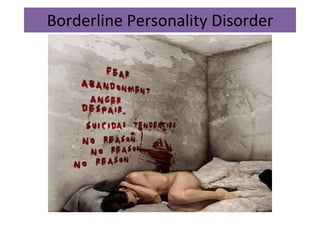
  • #3 This patient live in continuous inner turmoil.
  • #4 International Classification of Disease calls it Emotionally Unstable Personality Disorder because it is a disorder of emotional dysregulation and intense emotionality. These people are very sensitive to emotions and get too engrossed in them. They don’t have enough tolerance for distress.
  • #5 Must have 5 + to meet criteria
  • #6 “ The Great Impersonator” because it looks like other diagnosis. Read from book about BPD being as Syphilis: manifests in many other areas of the body.
  • #7 But Bipolar Disorder is characterized by Inflated Self-Esteem, Grandiosity, Racing Thoughts, Talkativeness, decreased need for sleep, etc. The major distinction is that they are not afraid of rejection or engage in these behaviors as a frantic effort to avoid being abandoned like the Borderline Personality client. The impulsivity in during the episode not like BPD that is continuous, long standing, not episodic.
  • #8 Give Picture with translation-
  • #9 This is Mixame first psychiatric hospitalization. She was suicidal and her boyfriend brought her in. She has been depressed for the last months, disassociates, feels guilty, empty and afraid or her thoughts when she sees a knife in the kitchen.
  • #11 Marsha Lineham, PhD –founder of DBT. Professor at the University of Washington at Seattle.
  • #16 Lack of boundaries: SWF –not even after 2 weeks of having moved in, she undresses and shows her naked body to roommate.
  • #19 Refer to handout –and explain the PRAISE mnemonic. Go to Statistics.
  • #21 BPD is very often confused with Bipolar disorder because its presentation is similar in symptomatology.
  • #22 She keeps reading and finds out about other personality disorders and finds that she meets some of the criteria for those also. She gets very confused.
  • #23 Other PD can be confused with BPD b/c they have common features. Therefore, must distinguish them based in their differences. Look at the differences in their characteristic features. Can diagnose more than one if it meets criteria. BPD and HPD both share attention seeking behavior, but BPD have other flavor. For instance, Attention seeking through suicidal gestures, notes, self-mutilation. Manipulation through angry disruption in relationships, for instance, getting up in the middle of a romantic dinner because not getting her way in a discussion. Mood swings with a flawor of emptiness, guilt and utter feelings of being bad/evil. Mostly related to stress with caregiver or lover.
  • #24 BPD related to relationships. For instance, in the movie White Single Female, Hedra thinks they want to get rid of her.
  • #25 BPD the stimuli is real or imagined abandonment. Becomes self-destructive (the paranoid or narcissistic don’t).
  • #27 Both characterized by fear of Abandonment. Key difference is that BPD has unstable relationships.
  • #28 Identity concerns related to a developmental phase (e.g. adolescence) do not qualify for a mental disorder.
  • #29 BPD often co-occurs with Mood Disorders, and when criteria for both are met, both may be diagnosed. Because of the cross-sectional presentation of BDP can mimicked by an episode of Mood Disorder, the clinician should avoid giving an additional diagnosis of BDP based only on cross-sectional presentation without having documented that he patter of behavior has an early onset and a long-standing course.
  • #30 She has been reading about mental disorders and identifies with Borderline and Bipolar. She thinks she is bipolar.