Lesson

Exploring the History of Wildlife
         Management
Learning Objectives
• Explain the history of wildlife conservation.
• Describing the national policies that impact
  wildlife conservation.
• Identify historical people related to wildlife
  conservation.
Explain the history of wildlife conservation

• In the 1600’s, when the pilgrims
  arrived, wildlife was plentiful and was able to
  meet the needs of the people.
• Needs turned into wants, which led to
  exploitation—the use of natural resources
  for profit.
• By the 1800’s, people began to see a need
  for conservation of our natural resources
Important Dates in Conservation
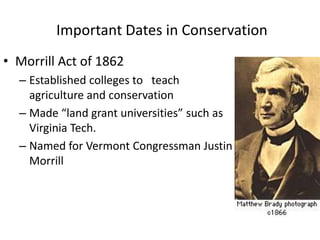
• Morrill Act of 1862
  – Established colleges to teach
    agriculture and conservation
  – Made “land grant universities” such as
    Virginia Tech.
  – Named for Vermont Congressman Justin
    Morrill
Important Dates in Conservation

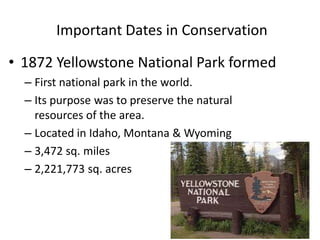
• 1872 Yellowstone National Park formed
  – First national park in the world.
  – Its purpose was to preserve the natural
    resources of the area.
  – Located in Idaho, Montana & Wyoming
  – 3,472 sq. miles
  – 2,221,773 sq. acres
Important Dates in Conservation
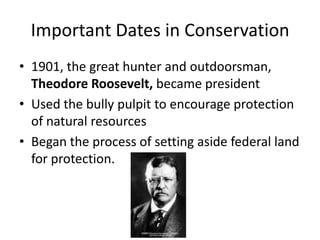
• 1901, the great hunter and outdoorsman,
  Theodore Roosevelt, became president
• Used the bully pulpit to encourage protection
  of natural resources
• Began the process of setting aside federal land
  for protection.
National policies that impact wildlife conservation?

• Lacey Act – 1900
  – Regulates the shipment of illegally killed
    animals.
  – Made it illegal to trade protected wildlife.
• National Park Service
  – Established in 1916.
  – Federal agency responsible for the care of the
    national parks.
What are the national policies that impact wildlife
                 conservation?

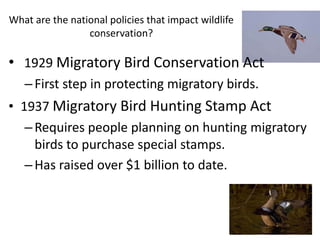
• 1929 Migratory Bird Conservation Act
   – First step in protecting migratory birds.
• 1937 Migratory Bird Hunting Stamp Act
   – Requires people planning on hunting migratory
     birds to purchase special stamps.
   – Has raised over $1 billion to date.
What are the national policies that impact
            wildlife conservation?
• 1937 Pittman-Robertson Act
   – Raises money in the form of 11% tax on hunting
     equipment and ammunition
   – Tax revenue used to maintain and purchase
     wildlife areas
   – Virginia congressman Absalom Robertson was a
     co-sponsor
What are the national policies that impact wildlife
                    conservation?

• 1966 Wildlife Refuge System
  – A system of wildlife refuges across
    the United States.
  – A part of the US Fish and Wildlife
    Service.
What are the national policies that
   impact wildlife conservation?
• 1973 Endangered Species Act
  – Identifies and manages rare, threatened and
    endangered species.
     • Threatened-population is in danger of becoming
       endangered.
     • Endangered-population is in danger of becoming
       extinct.
• Prevents activities that can jeopardize listed
  species
What are the national policies that impact wildlife conservation?


• Forest Service
  – Part of the USDA that manages 156 forests
    covering 191 million acres of forests and
    grassland.
Historical People in Wildlife Conservation

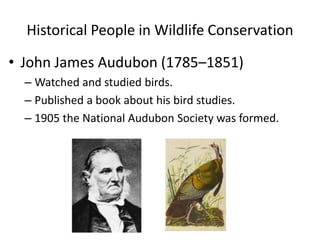
• John James Audubon (1785–1851)
  – Watched and studied birds.
  – Published a book about his bird studies.
  – 1905 the National Audubon Society was formed.
Historical People in Wildlife Conservation

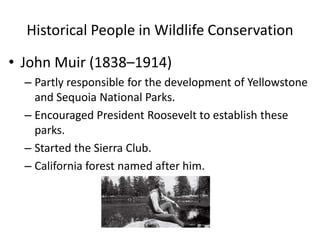
• John Muir (1838–1914)
  – Partly responsible for the development of Yellowstone
    and Sequoia National Parks.
  – Encouraged President Roosevelt to establish these
    parks.
  – Started the Sierra Club.
  – California forest named after him.
Historical People in Wildlife Conservation

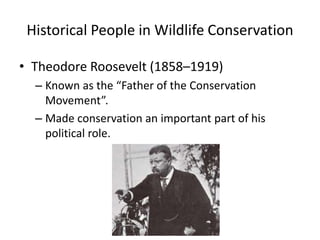
• Theodore Roosevelt (1858–1919)
  – Known as the “Father of the Conservation
    Movement”.
  – Made conservation an important part of his
    political role.
Historical People in Wildlife Conservation

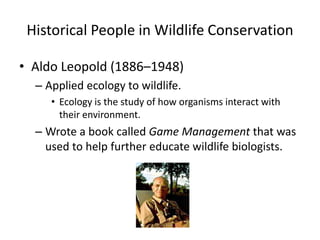
• Aldo Leopold (1886–1948)
  – Applied ecology to wildlife.
     • Ecology is the study of how organisms interact with
       their environment.
  – Wrote a book called Game Management that was
    used to help further educate wildlife biologists.
Historical People in Wildlife Conservation

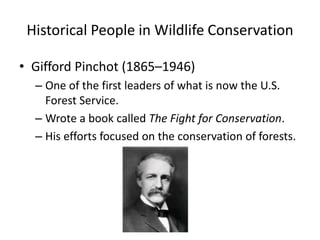
• Gifford Pinchot (1865–1946)
  – One of the first leaders of what is now the U.S.
    Forest Service.
  – Wrote a book called The Fight for Conservation.
  – His efforts focused on the conservation of forests.
Historical People in Wildlife Conservation
• Hugh Bennett (1881–1960)
  – Father of soil conservation.
  – First person to run the Soil Conservation
    Service.
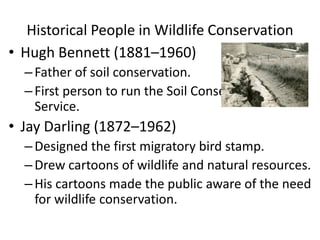
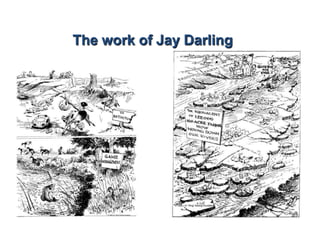
• Jay Darling (1872–1962)
  – Designed the first migratory bird stamp.
  – Drew cartoons of wildlife and natural resources.
  – His cartoons made the public aware of the need
    for wildlife conservation.
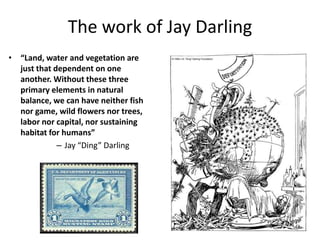
The work of Jay Darling
• “Land, water and vegetation are
  just that dependent on one
  another. Without these three
  primary elements in natural
  balance, we can have neither fish
  nor game, wild flowers nor trees,
  labor nor capital, nor sustaining
  habitat for humans”
             – Jay “Ding” Darling
The work of Jay Darling

History of conservation

  • 1.
    Lesson Exploring the Historyof Wildlife Management
  • 2.
    Learning Objectives • Explainthe history of wildlife conservation. • Describing the national policies that impact wildlife conservation. • Identify historical people related to wildlife conservation.
  • 3.
    Explain the historyof wildlife conservation • In the 1600’s, when the pilgrims arrived, wildlife was plentiful and was able to meet the needs of the people. • Needs turned into wants, which led to exploitation—the use of natural resources for profit. • By the 1800’s, people began to see a need for conservation of our natural resources
  • 4.
    Important Dates inConservation • Morrill Act of 1862 – Established colleges to teach agriculture and conservation – Made “land grant universities” such as Virginia Tech. – Named for Vermont Congressman Justin Morrill
  • 5.
    Important Dates inConservation • 1872 Yellowstone National Park formed – First national park in the world. – Its purpose was to preserve the natural resources of the area. – Located in Idaho, Montana & Wyoming – 3,472 sq. miles – 2,221,773 sq. acres
  • 6.
    Important Dates inConservation • 1901, the great hunter and outdoorsman, Theodore Roosevelt, became president • Used the bully pulpit to encourage protection of natural resources • Began the process of setting aside federal land for protection.
  • 7.
    National policies thatimpact wildlife conservation? • Lacey Act – 1900 – Regulates the shipment of illegally killed animals. – Made it illegal to trade protected wildlife. • National Park Service – Established in 1916. – Federal agency responsible for the care of the national parks.
  • 8.
    What are thenational policies that impact wildlife conservation? • 1929 Migratory Bird Conservation Act – First step in protecting migratory birds. • 1937 Migratory Bird Hunting Stamp Act – Requires people planning on hunting migratory birds to purchase special stamps. – Has raised over $1 billion to date.
  • 9.
    What are thenational policies that impact wildlife conservation? • 1937 Pittman-Robertson Act – Raises money in the form of 11% tax on hunting equipment and ammunition – Tax revenue used to maintain and purchase wildlife areas – Virginia congressman Absalom Robertson was a co-sponsor
  • 10.
    What are thenational policies that impact wildlife conservation? • 1966 Wildlife Refuge System – A system of wildlife refuges across the United States. – A part of the US Fish and Wildlife Service.
  • 11.
    What are thenational policies that impact wildlife conservation? • 1973 Endangered Species Act – Identifies and manages rare, threatened and endangered species. • Threatened-population is in danger of becoming endangered. • Endangered-population is in danger of becoming extinct. • Prevents activities that can jeopardize listed species
  • 12.
    What are thenational policies that impact wildlife conservation? • Forest Service – Part of the USDA that manages 156 forests covering 191 million acres of forests and grassland.
  • 13.
    Historical People inWildlife Conservation • John James Audubon (1785–1851) – Watched and studied birds. – Published a book about his bird studies. – 1905 the National Audubon Society was formed.
  • 14.
    Historical People inWildlife Conservation • John Muir (1838–1914) – Partly responsible for the development of Yellowstone and Sequoia National Parks. – Encouraged President Roosevelt to establish these parks. – Started the Sierra Club. – California forest named after him.
  • 15.
    Historical People inWildlife Conservation • Theodore Roosevelt (1858–1919) – Known as the “Father of the Conservation Movement”. – Made conservation an important part of his political role.
  • 16.
    Historical People inWildlife Conservation • Aldo Leopold (1886–1948) – Applied ecology to wildlife. • Ecology is the study of how organisms interact with their environment. – Wrote a book called Game Management that was used to help further educate wildlife biologists.
  • 17.
    Historical People inWildlife Conservation • Gifford Pinchot (1865–1946) – One of the first leaders of what is now the U.S. Forest Service. – Wrote a book called The Fight for Conservation. – His efforts focused on the conservation of forests.
  • 18.
    Historical People inWildlife Conservation • Hugh Bennett (1881–1960) – Father of soil conservation. – First person to run the Soil Conservation Service. • Jay Darling (1872–1962) – Designed the first migratory bird stamp. – Drew cartoons of wildlife and natural resources. – His cartoons made the public aware of the need for wildlife conservation.
  • 19.
    The work ofJay Darling • “Land, water and vegetation are just that dependent on one another. Without these three primary elements in natural balance, we can have neither fish nor game, wild flowers nor trees, labor nor capital, nor sustaining habitat for humans” – Jay “Ding” Darling
  • 20.
    The work ofJay Darling