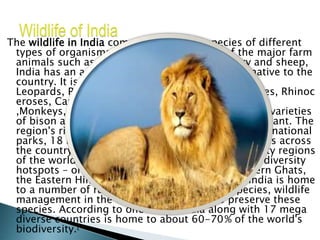
The wildlife in India comprises a mix of species of different
types of organisms. Apart from a handful of the major farm
animals such as cows, buffaloes, goats, poultry and sheep,
India has an amazingly wide variety of animals native to the
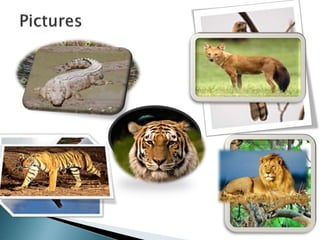
country. It is home to Tigers, Lions,
Leopards, Pythons, Wolves, Foxes, Bears, Crocodiles, Rhinoc
eroses, Camels, Wild dogs
,Monkeys, Snakes, Antelope species, Deer species, varieties
of bison and not to mention the mighty Asian elephant. The
region's rich and diverse wildlife is preserved in 89 national
parks, 18 Bio reserves and 400+ wildlife sanctuaries across
the country. India has some of the most biodiversity regions
of the world and hosts three of the world’s 34 biodiversity
hotspots – or treasure-houses – that is the Western Ghats,
the Eastern Himalayas and Indo- Burma. Since India is home
to a number of rare and threatened animal species, wildlife
management in the country is essential to preserve these
species. According to one study, India along with 17 mega
diverse countries is home to about 60-70 % of the world's
biodiversity.[
 Wildlife conservation is the practice of
protecting endangered plant and animal species and
their habitats. Among the goals of wildlife conservation are
to ensure that nature will be around for future generations
to enjoy and to recognize the importance of wildlife and
wilderness lands to humans. Many nations have government
agencies dedicated to wildlife conservation, which help to
implement policies designed to protect wildlife. Numerous
independent nonprofit organizations also promote various
wildlife conservation causes.
 Wildlife conservation has become an increasingly important
practice due to the negative effects of human
activity on wildlife. The science of extinction. An
endangered species is defined as a population of a living
being that is at the danger of becoming extinct because of
several reasons. Either they are few in number or are
threatened by the varying environmental or predation
parameters.
 The North American Model of Wildlife Conservation is a set
of principles that has guided management and
conservation decisions in the United States and
Canada. Although not formally articulated until 2001, the
model has its origins in 19th century conservation
movements, the near extinction of several species of
wildlife (including the American Bison) and the rise of
sportsmen with the middle class. Beginning in the 1860s
sportsmen began to organize and advocate for the
preservation of wilderness areas and wildlife. The North
American Model of Wildlife Conservation rests on two
basic principles – fish and wildlife are for the non-
commercial use of citizens, and should be managed such
that they are available at optimum population levels
forever. These core principles are elaborated upon in the
seven major tenets of the model:
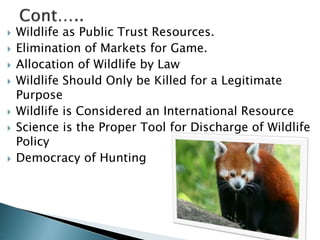
 Wildlife as Public Trust Resources.
 Elimination of Markets for Game.
 Allocation of Wildlife by Law
 Wildlife Should Only be Killed for a Legitimate
Purpose
 Wildlife is Considered an International Resource
 Science is the Proper Tool for Discharge of Wildlife
Policy
 Democracy of Hunting
The Wildlife Conservation Act was enacted by the Government of
India in 1972. Soon after the trend of policy makers enacting
regulations on conservation a strategy was developed to allow
actors, both government and non-government, to follow a
detailed "framework" to successful conservation. The World
Conservation Strategy was developed in 1980 by the
"International Union for Conservation of Nature and Natural
Resources "(IUCN) with advice, cooperation and financial
assistance of the United Nations Environment Programmed
(UNEP) and the World Wildlife Fund and in collaboration with the
Food and Agriculture Organization of the United Nations (FAO)
and the United Nations Educational, Scientific and Cultural
Organization (Enesco)" The strategy aims to "provide an
intellectual framework and practical guidance for conservation
actions."This thorough guidebook covers everything from the
intended "users" of the strategy to its very priorities and even a
map section containing areas that have large seafood
consumption therefore endangering the area to over fishing. The
main sections are as follows:
 The objectives of conservation and requirements for their
achievement:
 Maintenance of essential ecological processes and life-support
systems.
 Preservation of genetic diversity that is flora and fauna.
 Sustainable utilization of species and ecosystems.
 Priorities for national action:
 A framework for national and sub national conservation
strategies.
 Policy making and the integration of conservation and
development.
 Environmental planning and rational use allocation.
 Priorities for international action:
 International action: law and assistance.
 Tropical forests and dry lands.
 A global programmed for the protection of genetic resource
areas.
 Map sections:
 Tropical forests
 Deserts and areas subject to desertification.
As “major development agencies” became “discouraged with the
public sector” of environmental conservation in the late 1980s,
these agencies began to lean their support towards the “private
sector” or non-government organizations (NGOs). In a World Bank
Discussion Paper it is made apparent that “the explosive
emergence of nongovernmental organizations” was widely known
to government policy makers. Seeing this rise in NGO support,
the U.S. Congress made amendments to the Foreign Assistance
Act in 1979 and 1986 “earmarking U.S. Agency for International
Development (USAID) funds for biodiversity”. From 1990 moving
through recent years environmental conservation in the NGO
sector has become increasingly more focused on the political and
economic impact of USAID given towards the “Environment and
Natural Resources”. After the terror attacks on the World Trade
Centers on September 11, 2001 and the start of former President
Bush’s War on Terror, maintaining and improving the quality of
the environment and natural resources became a “priority” to
“prevent international tensions” according to the Legislation on
Foreign Relations Through 2002 and section 117 of the 1961
Foreign Assistance Act. Furthermore in 2002 U.S. Congress
modified the section on endangered species of the previously
amended Foreign Assistance Act.
wildlife
wildlife

wildlife

  • 2.
    The wildlife inIndia comprises a mix of species of different types of organisms. Apart from a handful of the major farm animals such as cows, buffaloes, goats, poultry and sheep, India has an amazingly wide variety of animals native to the country. It is home to Tigers, Lions, Leopards, Pythons, Wolves, Foxes, Bears, Crocodiles, Rhinoc eroses, Camels, Wild dogs ,Monkeys, Snakes, Antelope species, Deer species, varieties of bison and not to mention the mighty Asian elephant. The region's rich and diverse wildlife is preserved in 89 national parks, 18 Bio reserves and 400+ wildlife sanctuaries across the country. India has some of the most biodiversity regions of the world and hosts three of the world’s 34 biodiversity hotspots – or treasure-houses – that is the Western Ghats, the Eastern Himalayas and Indo- Burma. Since India is home to a number of rare and threatened animal species, wildlife management in the country is essential to preserve these species. According to one study, India along with 17 mega diverse countries is home to about 60-70 % of the world's biodiversity.[
  • 3.
     Wildlife conservationis the practice of protecting endangered plant and animal species and their habitats. Among the goals of wildlife conservation are to ensure that nature will be around for future generations to enjoy and to recognize the importance of wildlife and wilderness lands to humans. Many nations have government agencies dedicated to wildlife conservation, which help to implement policies designed to protect wildlife. Numerous independent nonprofit organizations also promote various wildlife conservation causes.  Wildlife conservation has become an increasingly important practice due to the negative effects of human activity on wildlife. The science of extinction. An endangered species is defined as a population of a living being that is at the danger of becoming extinct because of several reasons. Either they are few in number or are threatened by the varying environmental or predation parameters.
  • 4.
     The NorthAmerican Model of Wildlife Conservation is a set of principles that has guided management and conservation decisions in the United States and Canada. Although not formally articulated until 2001, the model has its origins in 19th century conservation movements, the near extinction of several species of wildlife (including the American Bison) and the rise of sportsmen with the middle class. Beginning in the 1860s sportsmen began to organize and advocate for the preservation of wilderness areas and wildlife. The North American Model of Wildlife Conservation rests on two basic principles – fish and wildlife are for the non- commercial use of citizens, and should be managed such that they are available at optimum population levels forever. These core principles are elaborated upon in the seven major tenets of the model:
  • 5.
     Wildlife asPublic Trust Resources.  Elimination of Markets for Game.  Allocation of Wildlife by Law  Wildlife Should Only be Killed for a Legitimate Purpose  Wildlife is Considered an International Resource  Science is the Proper Tool for Discharge of Wildlife Policy  Democracy of Hunting
  • 6.
    The Wildlife ConservationAct was enacted by the Government of India in 1972. Soon after the trend of policy makers enacting regulations on conservation a strategy was developed to allow actors, both government and non-government, to follow a detailed "framework" to successful conservation. The World Conservation Strategy was developed in 1980 by the "International Union for Conservation of Nature and Natural Resources "(IUCN) with advice, cooperation and financial assistance of the United Nations Environment Programmed (UNEP) and the World Wildlife Fund and in collaboration with the Food and Agriculture Organization of the United Nations (FAO) and the United Nations Educational, Scientific and Cultural Organization (Enesco)" The strategy aims to "provide an intellectual framework and practical guidance for conservation actions."This thorough guidebook covers everything from the intended "users" of the strategy to its very priorities and even a map section containing areas that have large seafood consumption therefore endangering the area to over fishing. The main sections are as follows:
  • 7.
     The objectivesof conservation and requirements for their achievement:  Maintenance of essential ecological processes and life-support systems.  Preservation of genetic diversity that is flora and fauna.  Sustainable utilization of species and ecosystems.  Priorities for national action:  A framework for national and sub national conservation strategies.  Policy making and the integration of conservation and development.  Environmental planning and rational use allocation.  Priorities for international action:  International action: law and assistance.  Tropical forests and dry lands.  A global programmed for the protection of genetic resource areas.  Map sections:  Tropical forests  Deserts and areas subject to desertification.
  • 8.
    As “major developmentagencies” became “discouraged with the public sector” of environmental conservation in the late 1980s, these agencies began to lean their support towards the “private sector” or non-government organizations (NGOs). In a World Bank Discussion Paper it is made apparent that “the explosive emergence of nongovernmental organizations” was widely known to government policy makers. Seeing this rise in NGO support, the U.S. Congress made amendments to the Foreign Assistance Act in 1979 and 1986 “earmarking U.S. Agency for International Development (USAID) funds for biodiversity”. From 1990 moving through recent years environmental conservation in the NGO sector has become increasingly more focused on the political and economic impact of USAID given towards the “Environment and Natural Resources”. After the terror attacks on the World Trade Centers on September 11, 2001 and the start of former President Bush’s War on Terror, maintaining and improving the quality of the environment and natural resources became a “priority” to “prevent international tensions” according to the Legislation on Foreign Relations Through 2002 and section 117 of the 1961 Foreign Assistance Act. Furthermore in 2002 U.S. Congress modified the section on endangered species of the previously amended Foreign Assistance Act.