Neoclassical
Architecture of
the 18th Century
Amara Amado & Rowena Disbarro DFR1A
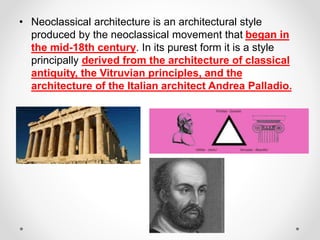
• Neoclassical architecture is an architectural style
produced by the neoclassical movement that began in
the mid-18th century. In its purest form it is a style
principally derived from the architecture of classical
antiquity, the Vitruvian principles, and the
architecture of the Italian architect Andrea Palladio.
• In form, Neoclassical architecture emphasizes the wall
rather than chiaroscuro and maintains separate identities
to each of its parts. The style is manifested both in its
details as a reaction against the Rococo style of
naturalistic ornament, and in its architectural
formulae as an outgrowth of some classicising
features of Late Baroque. Neoclassical architecture is
still designed today, but may be labelled New Classical
Architecture for contemporary buildings.
*Chiaroscuro is an Italian
artistic term used to describe
the dramatic effect of
contrasting areas of light and
dark in an artwork,
particularly paintings.
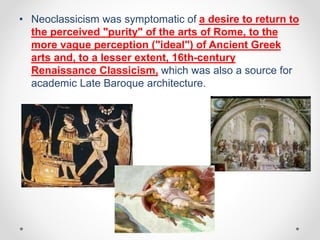
• Neoclassicism was symptomatic of a desire to return to
the perceived "purity" of the arts of Rome, to the
more vague perception ("ideal") of Ancient Greek
arts and, to a lesser extent, 16th-century
Renaissance Classicism, which was also a source for
academic Late Baroque architecture.
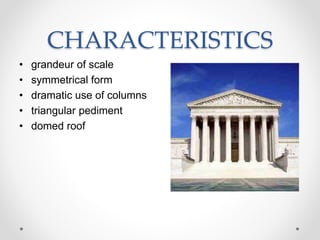
CHARACTERISTICS
• grandeur of scale
• symmetrical form
• dramatic use of columns
• triangular pediment
• domed roof
People who contributed to
Neoclassical Architecture
1. Giovanni Battista Piranesi
2. Claude Perrault
3. Andrea Palladio
Giovanni Battista Piranesi
(1720-1778)
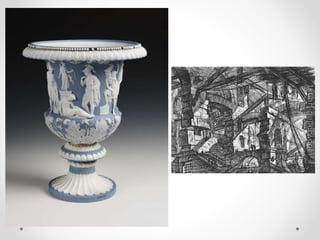
• was an Italian artist famous for his etchings of Rome and of
fictitious and atmospheric "prisons" (Le Carceri d'Invenzione).
• architect and printmaker who helped to pioneer this rediscovery
of Roman remains and he was one of the leading figures in the
development of the Neoclassical style
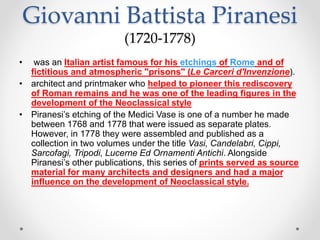
• Piranesi’s etching of the Medici Vase is one of a number he made
between 1768 and 1778 that were issued as separate plates.
However, in 1778 they were assembled and published as a
collection in two volumes under the title Vasi, Candelabri, Cippi,
Sarcofagi, Tripodi, Lucerne Ed Ornamenti Antichi. Alongside
Piranesi’s other publications, this series of prints served as source
material for many architects and designers and had a major
influence on the development of Neoclassical style.
Claude Perrault
(25 September 1613 – 9 October 1688)
• was a French architect, best known for his
participation in the design of the east
facade of the Louvre in Paris. He also
achieved success as a physician and
anatomist, and as an author, who wrote
treatises on physics and natural history
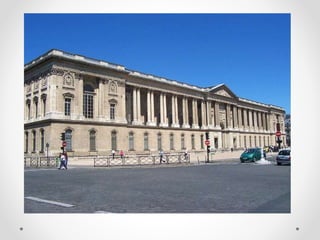
• Claude Perrault's Colonnade is the
easternmost façade of the Palais du
Louvre in Paris. It has been celebrated as
the foremost masterpiece of French
Architectural Classicism since its
construction, mostly between 1667 and
1670. Cast in a restrained classicizing
baroque manner, it interprets rules laid
down by the ancient Roman
architect Vitruvius, whose works Perrault
had translated into French.
Andrea Palladio
( 30 November 1508 -19 August 1580)
• was an Italian architect active in the Republic of Venice
• inspired Palladian architecture
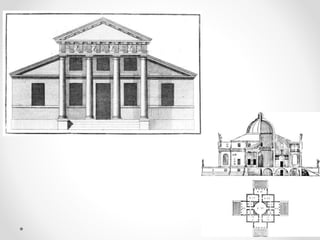
 Palladio's work was strongly based on the symmetry,
perspective and values of the formal classical
temple architecture of the Ancient Greeks and
Romans.
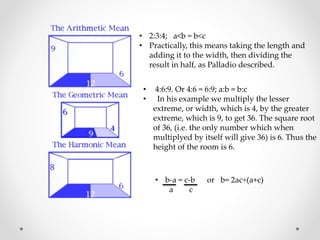
• 2:3:4; a<b = b<c
• Practically, this means taking the length and
adding it to the width, then dividing the
result in half, as Palladio described.
• 4:6:9. Or 4:6 = 6:9; a:b = b:c
• In his example we multiply the lesser
extreme, or width, which is 4, by the greater
extreme, which is 9, to get 36. The square root
of 36, (i.e. the only number which when
multiplyed by itself will give 36) is 6. Thus the
height of the room is 6.
• b-a = c-b or b= 2ac÷(a+c)
a c
École des Beaux-Arts
• School that taught Beaux-Arts architecture which
expresses the academic neoclassical architectural style
• The Beaux-Arts training emphasized the mainstream
examples of Imperial Roman
architecture between Augustus and the Severan
emperors, Italian Renaissance, and French and
Italian Baroque models especially, but the training could
then be applied to a broader range of
models: Quattrocento Florentine palace fronts or French
late Gothic.
Beaux-Arts architecture
Characteristics
• Beaux-Arts architecture depended on sculptural decoration along conservative modern
lines, employing French and Italian Baroque and Rococo formulas combined with an
impressionistic finish and realism.
• Flat roof
• Rusticated and raised first story
• Hierarchy of spaces, from "noble spaces"—grand entrances and staircases— to utilitarian
ones
• Arched windows
• Arched and pedimented doors
• Classical details: references to a synthesis of historicist styles and a tendency
to eclecticism; fluently in a number of "manners"
• Symmetry
• Statuary, sculpture (bas-relief panels, figural sculptures, sculptural groups), murals,
mosaics, and other artwork, all coordinated in theme to assert the identity of the building
• Classical architectural details: balustrades, pilasters, garlands, cartouches, acroteria, with a
prominent display of richly detailed clasps (agrafes), brackets and supporting consoles
• Subtle polychromy
• https://en.wikipedia.org/wiki/Beaux-Arts_architecture
• http://www.aboutscotland.com/harmony/prop5.html
• https://en.wikipedia.org/wiki/Neoclassical_architecture

HISTORY: Neoclassical Architecture

  • 1.
    Neoclassical Architecture of the 18thCentury Amara Amado & Rowena Disbarro DFR1A
  • 2.
    • Neoclassical architectureis an architectural style produced by the neoclassical movement that began in the mid-18th century. In its purest form it is a style principally derived from the architecture of classical antiquity, the Vitruvian principles, and the architecture of the Italian architect Andrea Palladio.
  • 3.
    • In form,Neoclassical architecture emphasizes the wall rather than chiaroscuro and maintains separate identities to each of its parts. The style is manifested both in its details as a reaction against the Rococo style of naturalistic ornament, and in its architectural formulae as an outgrowth of some classicising features of Late Baroque. Neoclassical architecture is still designed today, but may be labelled New Classical Architecture for contemporary buildings. *Chiaroscuro is an Italian artistic term used to describe the dramatic effect of contrasting areas of light and dark in an artwork, particularly paintings.
  • 4.
    • Neoclassicism wassymptomatic of a desire to return to the perceived "purity" of the arts of Rome, to the more vague perception ("ideal") of Ancient Greek arts and, to a lesser extent, 16th-century Renaissance Classicism, which was also a source for academic Late Baroque architecture.
  • 5.
    CHARACTERISTICS • grandeur ofscale • symmetrical form • dramatic use of columns • triangular pediment • domed roof
  • 6.
    People who contributedto Neoclassical Architecture 1. Giovanni Battista Piranesi 2. Claude Perrault 3. Andrea Palladio
  • 7.
    Giovanni Battista Piranesi (1720-1778) •was an Italian artist famous for his etchings of Rome and of fictitious and atmospheric "prisons" (Le Carceri d'Invenzione). • architect and printmaker who helped to pioneer this rediscovery of Roman remains and he was one of the leading figures in the development of the Neoclassical style • Piranesi’s etching of the Medici Vase is one of a number he made between 1768 and 1778 that were issued as separate plates. However, in 1778 they were assembled and published as a collection in two volumes under the title Vasi, Candelabri, Cippi, Sarcofagi, Tripodi, Lucerne Ed Ornamenti Antichi. Alongside Piranesi’s other publications, this series of prints served as source material for many architects and designers and had a major influence on the development of Neoclassical style.
  • 9.
    Claude Perrault (25 September1613 – 9 October 1688) • was a French architect, best known for his participation in the design of the east facade of the Louvre in Paris. He also achieved success as a physician and anatomist, and as an author, who wrote treatises on physics and natural history
  • 10.
    • Claude Perrault'sColonnade is the easternmost façade of the Palais du Louvre in Paris. It has been celebrated as the foremost masterpiece of French Architectural Classicism since its construction, mostly between 1667 and 1670. Cast in a restrained classicizing baroque manner, it interprets rules laid down by the ancient Roman architect Vitruvius, whose works Perrault had translated into French.
  • 12.
    Andrea Palladio ( 30November 1508 -19 August 1580) • was an Italian architect active in the Republic of Venice • inspired Palladian architecture  Palladio's work was strongly based on the symmetry, perspective and values of the formal classical temple architecture of the Ancient Greeks and Romans.
  • 14.
    • 2:3:4; a<b= b<c • Practically, this means taking the length and adding it to the width, then dividing the result in half, as Palladio described. • 4:6:9. Or 4:6 = 6:9; a:b = b:c • In his example we multiply the lesser extreme, or width, which is 4, by the greater extreme, which is 9, to get 36. The square root of 36, (i.e. the only number which when multiplyed by itself will give 36) is 6. Thus the height of the room is 6. • b-a = c-b or b= 2ac÷(a+c) a c
  • 15.
    École des Beaux-Arts •School that taught Beaux-Arts architecture which expresses the academic neoclassical architectural style • The Beaux-Arts training emphasized the mainstream examples of Imperial Roman architecture between Augustus and the Severan emperors, Italian Renaissance, and French and Italian Baroque models especially, but the training could then be applied to a broader range of models: Quattrocento Florentine palace fronts or French late Gothic.
  • 16.
    Beaux-Arts architecture Characteristics • Beaux-Artsarchitecture depended on sculptural decoration along conservative modern lines, employing French and Italian Baroque and Rococo formulas combined with an impressionistic finish and realism. • Flat roof • Rusticated and raised first story • Hierarchy of spaces, from "noble spaces"—grand entrances and staircases— to utilitarian ones • Arched windows • Arched and pedimented doors • Classical details: references to a synthesis of historicist styles and a tendency to eclecticism; fluently in a number of "manners" • Symmetry • Statuary, sculpture (bas-relief panels, figural sculptures, sculptural groups), murals, mosaics, and other artwork, all coordinated in theme to assert the identity of the building • Classical architectural details: balustrades, pilasters, garlands, cartouches, acroteria, with a prominent display of richly detailed clasps (agrafes), brackets and supporting consoles • Subtle polychromy
  • 17.