
JOSEPH E. CAJOTE 
Masters in Management 
Engineering
WHAT IS HISTORICAL RESEARCH? 
• The systematic collection of 
data to describe, explain 
and thereby understand 
actions or events that 
occurred sometimes in the 
past. 
• No manipulation or control 
of variables - differ with 
experimental research. 
• Focuses primarily on the 
PAST.
PURPOSES OF HISTORICAL RESEARCH 
1. To make people aware of 
what has happened in the 
past so they may learn from 
past failures and successes. 
2. To learn how things were 
done in the past to see if 
they might be applicable to 
present-day problems and 
concerns. 
3. To assist in prediction. 
4. To test hypothesis 
concerns relationships or 
trends. 
5. To understand present 
educational practices and 
policies more fully.
STEPS INVOLVED IN HISTORICAL RESEARCH 
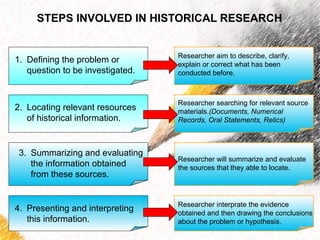
1. Defining the problem or 
question to be investigated. 
2. Locating relevant resources 
of historical information. 
3. Summarizing and evaluating 
the information obtained 
from these sources. 
4. Presenting and interpreting 
this information. 
Researcher aim to describe, clarify, 
explain or correct what has been 
conducted before. 
Researcher searching for relevant source 
materials.(Documents, Numerical 
Records, Oral Statements, Relics) 
Researcher will summarize and evaluate 
the sources that they able to locate. 
Researcher interprate the evidence 
obtained and then drawing the conclusions 
about the problem or hypothesis.
STEPS INVOLVED IN HISTORICAL RESEARCH 
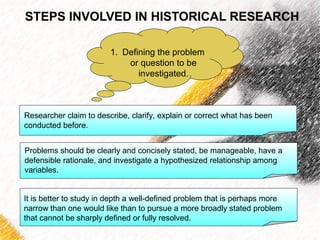
1. Defining the problem 
or question to be 
investigated. 
Researcher claim to describe, clarify, explain or correct what has been 
conducted before. 
Problems should be clearly and concisely stated, be manageable, have a 
defensible rationale, and investigate a hypothesized relationship among 
variables. 
It is better to study in depth a well-defined problem that is perhaps more 
narrow than one would like than to pursue a more broadly stated problem 
that cannot be sharply defined or fully resolved.
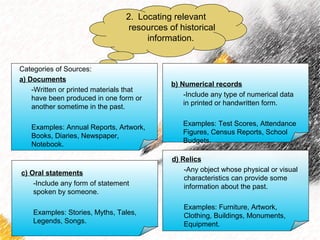
2. Locating relevant 
resources of historical 
information. 
Categories of Sources: 
a) Documents 
-Written or printed materials that 
have been produced in one form or 
another sometime in the past. 
Examples: Annual Reports, Artwork, 
Books, Diaries, Newspaper, 
Notebook. 
c) Oral statements 
-Include any form of statement 
spoken by someone. 
Examples: Stories, Myths, Tales, 
Legends, Songs. 
b) Numerical records 
-Include any type of numerical data 
in printed or handwritten form. 
Examples: Test Scores, Attendance 
Figures, Census Reports, School 
Budgets. 
d) Relics 
-Any object whose physical or visual 
characteristics can provide some 
information about the past. 
Examples: Furniture, Artwork, 
Clothing, Buildings, Monuments, 
Equipment.
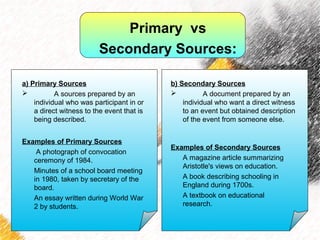
Primary vs 
Secondary Sources: 
a) Primary Sources 
 A sources prepared by an 
individual who was participant in or 
a direct witness to the event that is 
being described. 
b) Secondary Sources 
 A document prepared by an 
individual who want a direct witness 
to an event but obtained description 
of the event from someone else. 
Examples of Primary Sources 
A photograph of convocation 
ceremony of 1984. 
Minutes of a school board meeting 
in 1980, taken by secretary of the 
board. 
An essay written during World War 
2 by students. 
Examples of Secondary Sources 
A magazine article summarizing 
Aristotle's views on education. 
A book describing schooling in 
England during 1700s. 
A textbook on educational 
research.
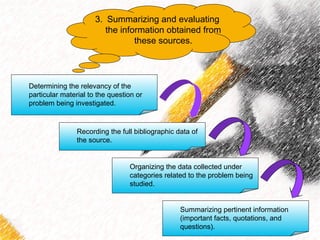
3. Summarizing and evaluating 
the information obtained from 
these sources. 
Determining the relevancy of the 
particular material to the question or 
problem being investigated. 
Recording the full bibliographic data of 
the source. 
Organizing the data collected under 
categories related to the problem being 
studied. 
Summarizing pertinent information 
(important facts, quotations, and 
questions).
4. Presenting and interpreting 
this information. 
is a primary method of data analysis in 
External Criticism 
 Refers to the geniuses of the 
Content Analysis 
historical research. 
documents a researcher uses in a 
historical study. 
 Has to do with the authenticity of a 
document 
Internal Criticism 
 Refer to the accuracy of the contents of 
a document. 
 Internal criticism has to do with what 
the document says. 
 Who wrote this document? 
 For what purpose was the document written? 
 When was the document written? 
 Is the date on the document accurate? 
 Where was the document written? 
 Do different forms or versions of the 
document exist? 
• Was the author present at the event he or 
she is describing? 
• Was the author a participant in or an 
observer of the event? 
• Was the author competent to describe the 
event? 
• Does the language of the document suggest 
a bias of any sort? 
• Do other version of the event exist?
ADVANTAGES & DISADVANTAGES OF HISTORICAL 
RESEARCH 
Advantages 
Permits the investigation of topics 
that could be studies in no other 
way. 
The only research method that can 
study evidence from the past. 
Disadvantages 
Controlling for many of the threats to 
internal validity is not possible in 
historical research. 
Many of the treats to internal validity 
are likely to exist in historicla studies.
Reference: 
• How to Design and Evaluate 
Research in Education 7th 
Edition(2009) 
– Jack R. Fraenkel 
• San Francisco State 
University 
– Norman E. Wallen 
• San Francisco State 
University

Historical Research

  • 1.
    JOSEPH E. CAJOTE Masters in Management Engineering
  • 2.
    WHAT IS HISTORICALRESEARCH? • The systematic collection of data to describe, explain and thereby understand actions or events that occurred sometimes in the past. • No manipulation or control of variables - differ with experimental research. • Focuses primarily on the PAST.
  • 3.
    PURPOSES OF HISTORICALRESEARCH 1. To make people aware of what has happened in the past so they may learn from past failures and successes. 2. To learn how things were done in the past to see if they might be applicable to present-day problems and concerns. 3. To assist in prediction. 4. To test hypothesis concerns relationships or trends. 5. To understand present educational practices and policies more fully.
  • 4.
    STEPS INVOLVED INHISTORICAL RESEARCH 1. Defining the problem or question to be investigated. 2. Locating relevant resources of historical information. 3. Summarizing and evaluating the information obtained from these sources. 4. Presenting and interpreting this information. Researcher aim to describe, clarify, explain or correct what has been conducted before. Researcher searching for relevant source materials.(Documents, Numerical Records, Oral Statements, Relics) Researcher will summarize and evaluate the sources that they able to locate. Researcher interprate the evidence obtained and then drawing the conclusions about the problem or hypothesis.
  • 5.
    STEPS INVOLVED INHISTORICAL RESEARCH 1. Defining the problem or question to be investigated. Researcher claim to describe, clarify, explain or correct what has been conducted before. Problems should be clearly and concisely stated, be manageable, have a defensible rationale, and investigate a hypothesized relationship among variables. It is better to study in depth a well-defined problem that is perhaps more narrow than one would like than to pursue a more broadly stated problem that cannot be sharply defined or fully resolved.
  • 6.
    2. Locating relevant resources of historical information. Categories of Sources: a) Documents -Written or printed materials that have been produced in one form or another sometime in the past. Examples: Annual Reports, Artwork, Books, Diaries, Newspaper, Notebook. c) Oral statements -Include any form of statement spoken by someone. Examples: Stories, Myths, Tales, Legends, Songs. b) Numerical records -Include any type of numerical data in printed or handwritten form. Examples: Test Scores, Attendance Figures, Census Reports, School Budgets. d) Relics -Any object whose physical or visual characteristics can provide some information about the past. Examples: Furniture, Artwork, Clothing, Buildings, Monuments, Equipment.
  • 7.
    Primary vs SecondarySources: a) Primary Sources  A sources prepared by an individual who was participant in or a direct witness to the event that is being described. b) Secondary Sources  A document prepared by an individual who want a direct witness to an event but obtained description of the event from someone else. Examples of Primary Sources A photograph of convocation ceremony of 1984. Minutes of a school board meeting in 1980, taken by secretary of the board. An essay written during World War 2 by students. Examples of Secondary Sources A magazine article summarizing Aristotle's views on education. A book describing schooling in England during 1700s. A textbook on educational research.
  • 8.
    3. Summarizing andevaluating the information obtained from these sources. Determining the relevancy of the particular material to the question or problem being investigated. Recording the full bibliographic data of the source. Organizing the data collected under categories related to the problem being studied. Summarizing pertinent information (important facts, quotations, and questions).
  • 9.
    4. Presenting andinterpreting this information. is a primary method of data analysis in External Criticism  Refers to the geniuses of the Content Analysis historical research. documents a researcher uses in a historical study.  Has to do with the authenticity of a document Internal Criticism  Refer to the accuracy of the contents of a document.  Internal criticism has to do with what the document says.  Who wrote this document?  For what purpose was the document written?  When was the document written?  Is the date on the document accurate?  Where was the document written?  Do different forms or versions of the document exist? • Was the author present at the event he or she is describing? • Was the author a participant in or an observer of the event? • Was the author competent to describe the event? • Does the language of the document suggest a bias of any sort? • Do other version of the event exist?
  • 10.
    ADVANTAGES & DISADVANTAGESOF HISTORICAL RESEARCH Advantages Permits the investigation of topics that could be studies in no other way. The only research method that can study evidence from the past. Disadvantages Controlling for many of the threats to internal validity is not possible in historical research. Many of the treats to internal validity are likely to exist in historicla studies.
  • 11.
    Reference: • Howto Design and Evaluate Research in Education 7th Edition(2009) – Jack R. Fraenkel • San Francisco State University – Norman E. Wallen • San Francisco State University