GROUP 10
HISTORICAL RESEARCH
HISTORICAL RESEARCH
WHATEVENT/S WOULDYOU LIKE TO
RECALL IN THE PAST AND STUDY?
WHY?
WHAT IS HISTORICAL RESEARCH
• The systematic collection and evaluation of data to describe,
explain, and understand actions or events that occurred sometime
in the past.
• There is no manipulation or control of variables as in experimental
research.
• An attempt is made to reconstruct what happened during a certain
period of time as completely and accurately as possible
PURPOSES
• To make people aware of what has happened in the past in order
to:
• Learn from past failures and successes
• Apply them to present-day problems
• Make predictions
• Test hypotheses concerning relationships or trends
• Understand present educational practices and policies more fully
• Period History: often focuses on events and developments that occur in
particular blocks of time.
• World History: study of major civilizations over the last 3000 years or so.
• Regional History: study of certain areas of the world over a period of time or
focusing on a period of time.
• Military History: concentrating on historical wars and warfare, including
battles, military strategies and weaponry, including tribal.
• Social History: study of how societies adapt and change over periods of time.
AREAS OF HISTORICAL RESEARCH
• Cultural History: combines the approaches of anthropology and history to
look at language, popular cultural traditions and cultural interpretations of
historical experience.
• Diplomatic History: focuses on politics, politicians and other high rulers and
views them as being the driving force of continuity and change in history.
• Peoples History: attempts to account for historical events from the
perspective of common people.
• Gender History: looks at the past from the perspective of gender and is, in
many ways, an outgrowth of women's history.
• Historiography: the study of the history and methodology of the discipline of
history.
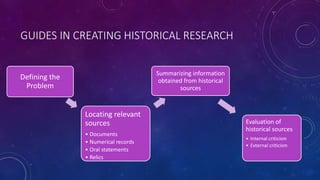
GUIDES IN CREATING HISTORICAL RESEARCH
Defining the
Problem
Locating relevant
sources
• Documents
• Numerical records
• Oral statements
• Relics
Summarizing information
obtained from historical
sources
Evaluation of
historical sources
• Internal criticism
• External criticism
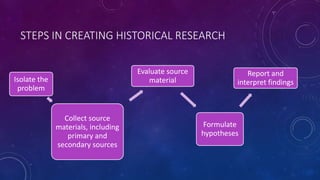
STEPS IN CREATING HISTORICAL RESEARCH
Isolate the
problem
Collect source
materials, including
primary and
secondary sources
Evaluate source
material
Formulate
hypotheses
Report and
interpret findings
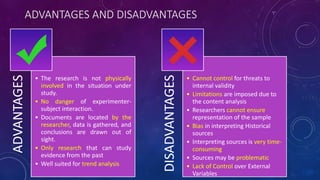
ADVANTAGES AND DISADVANTAGESADVANTAGES
• The research is not physically
involved in the situation under
study.
• No danger of experimenter-
subject interaction.
• Documents are located by the
researcher, data is gathered, and
conclusions are drawn out of
sight.
• Only research that can study
evidence from the past
• Well suited for trend analysis
DISADVANTAGES
• Cannot control for threats to
internal validity
• Limitations are imposed due to
the content analysis
• Researchers cannot ensure
representation of the sample
• Bias in interpreting Historical
sources
• Interpreting sources is very time-
consuming
• Sources may be problematic
• Lack of Control over External
Variables
SAMPLE STUDY
SOURCES
• http://www.bcps.org/offices/lis/researchcourse/history_research.html
• https://www.okstate.edu/ag/agedcm4h/academic/aged5980a/5980/newpage19.htm
• Celestial Template by Microsoft Office Powerpoint 2016

Historical Research

  • 1.
  • 2.
    HISTORICAL RESEARCH WHATEVENT/S WOULDYOULIKE TO RECALL IN THE PAST AND STUDY? WHY?
  • 3.
    WHAT IS HISTORICALRESEARCH • The systematic collection and evaluation of data to describe, explain, and understand actions or events that occurred sometime in the past. • There is no manipulation or control of variables as in experimental research. • An attempt is made to reconstruct what happened during a certain period of time as completely and accurately as possible
  • 4.
    PURPOSES • To makepeople aware of what has happened in the past in order to: • Learn from past failures and successes • Apply them to present-day problems • Make predictions • Test hypotheses concerning relationships or trends • Understand present educational practices and policies more fully
  • 5.
    • Period History:often focuses on events and developments that occur in particular blocks of time. • World History: study of major civilizations over the last 3000 years or so. • Regional History: study of certain areas of the world over a period of time or focusing on a period of time. • Military History: concentrating on historical wars and warfare, including battles, military strategies and weaponry, including tribal. • Social History: study of how societies adapt and change over periods of time. AREAS OF HISTORICAL RESEARCH
  • 6.
    • Cultural History:combines the approaches of anthropology and history to look at language, popular cultural traditions and cultural interpretations of historical experience. • Diplomatic History: focuses on politics, politicians and other high rulers and views them as being the driving force of continuity and change in history. • Peoples History: attempts to account for historical events from the perspective of common people. • Gender History: looks at the past from the perspective of gender and is, in many ways, an outgrowth of women's history. • Historiography: the study of the history and methodology of the discipline of history.
  • 7.
    GUIDES IN CREATINGHISTORICAL RESEARCH Defining the Problem Locating relevant sources • Documents • Numerical records • Oral statements • Relics Summarizing information obtained from historical sources Evaluation of historical sources • Internal criticism • External criticism
  • 8.
    STEPS IN CREATINGHISTORICAL RESEARCH Isolate the problem Collect source materials, including primary and secondary sources Evaluate source material Formulate hypotheses Report and interpret findings
  • 9.
    ADVANTAGES AND DISADVANTAGESADVANTAGES •The research is not physically involved in the situation under study. • No danger of experimenter- subject interaction. • Documents are located by the researcher, data is gathered, and conclusions are drawn out of sight. • Only research that can study evidence from the past • Well suited for trend analysis DISADVANTAGES • Cannot control for threats to internal validity • Limitations are imposed due to the content analysis • Researchers cannot ensure representation of the sample • Bias in interpreting Historical sources • Interpreting sources is very time- consuming • Sources may be problematic • Lack of Control over External Variables
  • 10.
  • 11.