






DR. MAHESWARI JAIKUMAR
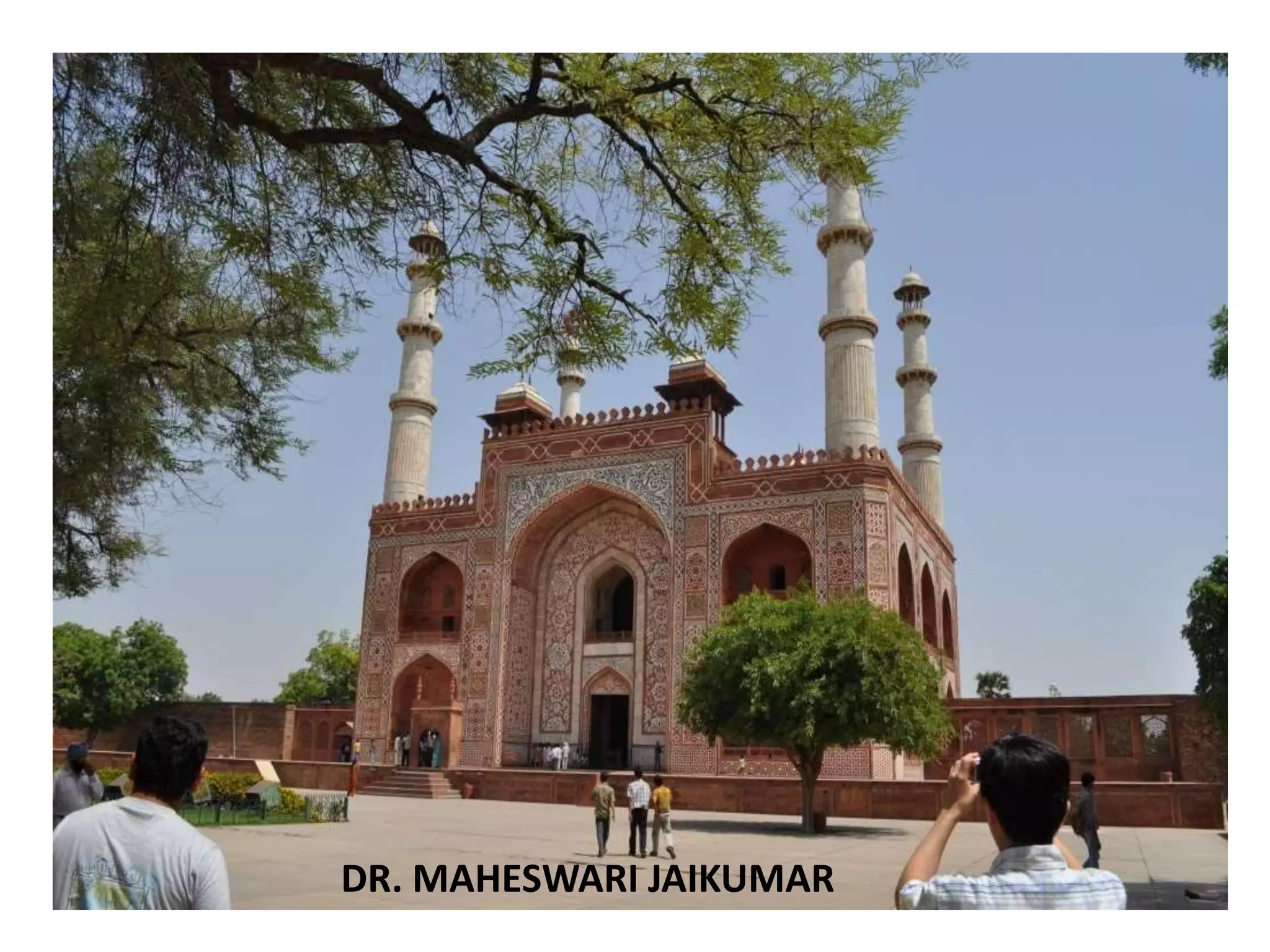
KING AKBAR
HISTORICAL RESEARCH
• Historical research is undertaken
to answer questions concerning
causes, effects or trends relating
to past events that may shed
light on the present practices or
behaviour
• Historical research involves a
systematic collection & a
critical evaluation of data
relating to past occurrences of
a particular phenomenon
CHARACTERISTICS
Historical research focuses on a careful
study & analysis of data about past
events.
Historical research is a critical
investigation of events, their
development, & experiences of the past
& a careful weighing of evidence of the
validity of information of the past &
interpretation of the evidence.
• The purpose of historical research is
to gain a clear understanding of the
impact of the past on the present &
future events related to the life
process.
• It involves detailed analysis of what
has been written or done & is used
to describe, explain or interpret
these events.
• Historical research involves the
review of written materials but
many include oral documentation as
well.
• Historical research relies on
available data usually in the form of
written narrative records of the
past, diaries, letters, newspapers,
minutes of meetings, reports etc.
• The results of historical research
studies contribute to a clear
understanding of past, present or
future events.
• Historical method of research also
covers categories such as historical,
legal, documentary, bibliographical,
bio graphical, ideational,
institutional & organizational
• Sources for historical research are
hospital records, order sheets,
purchases orders. Records are an
economical & convenient source of
information.
STEPS OF HISTORICAL
RESEARCH
1.DATA COLLECTION.
2.CRITICISM OF THE DATA.
3.PRESENTATION OF THE FACTS.
STEP I-DATA COLLECTION
• Comprehensive gathering of data is
undertaken.
• Historical sources of data may either
be PRIMARY or SECONDARY.
PRIMARY SOURCES
• Are first handed information.
• They include : remains or relic
associated with persons, groups,
periods or events.
• Fossils, skeletons, tools, weapons,
utensils, clothing, buildings, furniture,
pictures, paintings, coins & art objects.
• Documents classified as primary are :
characters, law, court rulings, official
records, autobiographic letters, dairies,
deeds, wills, licenses, declarations,
certificates, bills, receipts, newspapers,
magazines, advertisements, maps,
inscriptions, diagrams, books,
pamphlets, films, paintings, recordings,
& research reports.
SECONDARY SOURCES
• The writer of the secondary source
was not on the scene of the event.
• Secondary sources of data are
usually limited worth because of the
usual errors that results when
information is passed on from one
person to another. E.g.. History
books.
STEP II- CRITICISM
• The second step necessitates a
comprehensive review of gathered
materials.
• The process of document review has
a two pronged activity.
• 1. EXTERNAL CRITICISM.
• 2. INTERNAL CRITICISM.
EXTERNAL CRITICISM
• Establishes the validity by
determining the authenticity of the
course.
• It is a preliminary & preparatory
step, providing data to be used in
the second phase known as internal
criticism
• External criticism primarily deals
with relating to form &
appearances rather than meaning of
contents.
• While internal criticism weighs the
testimony of the document in
relation to the truth.
•
INTERNAL CRITICISM
• Determines the reliability by correctly
interpreting the contents of the
document.
• The use of original, authentic sources;
awareness of one’s own biases; the
substantiation of the document in
question by another collaborative
sources are few safeguards used to
ensure that interpretations are correct.
• To ensure reliability, the researcher
examines each document to make sure
that the meaning of facts & statements
was clearly understood.
• This process is entails seeking
collaboration with individuals who bay
have witnessed the events in question
as well as determining the meaning of
words, phrases & colloquialism unique
to that time period.
• Once authenticity is established,
the next step is to establish the
validity of the contents &
determine the accuracy of the
statement.
STEP 111 – PRESENTATION
OF THE FACTS
• A well written history provides
information on the conditions of
the past.
• The writing of history demands a
careful avoidance of the
following facts.
• Over signifying of the facts.
• Over generalization from
insufficient evidence.
• Failure to establish difference
between significant & trivial
facts.
• Tendency to use secondary data.
• Personal bias.
• A dull & colourless style.
• Failure to interpret words &
expressions in the light of their
usage in earlier times.
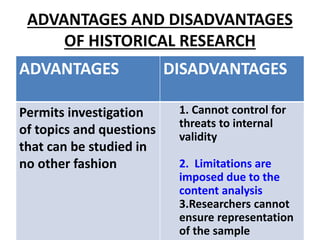
ADVANTAGES AND DISADVANTAGES
OF HISTORICAL RESEARCH
ADVANTAGES DISADVANTAGES
Permits investigation
of topics and questions
that can be studied in
no other fashion
1. Cannot control for
threats to internal
validity
2. Limitations are
imposed due to the
content analysis
3.Researchers cannot
ensure representation
of the sample
AREAS OF HISTORICAL
RESEARCH
• 1.PERIODS.
• 2.GEOGRAPHICAL LOCATIONS.
• 3.MILITARY HISTORY.
METHODS & TOOLS
• 1.CONTEMPORANEOUS
CORROBORATION.
• 2.PHOTOGRAPHY.
• 3.HISTORICAL REVIONISM.
• 4.CHANGE LOG.
• 5.HUMAN EVOLUTION
• 6.SOCIAL CHANGE
• 1.CONTEMPORANEOUS
CORROBORATION : Is a further support
provided by the existing evidences
about the past events.
• 2.PHOTOGRAPHY: A methodological
tool for the collection of all known
information about individuals in a given
period.
• 3.HISTORICAL REVIONISM: Is a
traditionally used tool in a completely
natural sense to describe the work on
idea of historian who has revised a
previously accepted view of a particular
topic.
• 4.CHANGE LOG: Log or record of
changes made to a project, such as a
website or software project.
• 5.HUMAN EVOLUTION : Process of
change & development or evolution by
which human beings emerged as a
distinct special.
• 6. SOCIAL CHANGE : Studies change in
the nature of institutions, the social
behaviour or social relations.
EXAMPLE
• A researcher studying the medical
records of 200 patients who
experienced in hospital
cardiopulmonary arrest.
KING AKBAR

HISTORICAL RESEARCH

  • 1.
  • 2.
  • 3.
    HISTORICAL RESEARCH • Historicalresearch is undertaken to answer questions concerning causes, effects or trends relating to past events that may shed light on the present practices or behaviour
  • 4.
    • Historical researchinvolves a systematic collection & a critical evaluation of data relating to past occurrences of a particular phenomenon
  • 5.
    CHARACTERISTICS Historical research focuseson a careful study & analysis of data about past events. Historical research is a critical investigation of events, their development, & experiences of the past & a careful weighing of evidence of the validity of information of the past & interpretation of the evidence.
  • 6.
    • The purposeof historical research is to gain a clear understanding of the impact of the past on the present & future events related to the life process. • It involves detailed analysis of what has been written or done & is used to describe, explain or interpret these events.
  • 7.
    • Historical researchinvolves the review of written materials but many include oral documentation as well. • Historical research relies on available data usually in the form of written narrative records of the past, diaries, letters, newspapers, minutes of meetings, reports etc.
  • 8.
    • The resultsof historical research studies contribute to a clear understanding of past, present or future events. • Historical method of research also covers categories such as historical, legal, documentary, bibliographical, bio graphical, ideational, institutional & organizational
  • 9.
    • Sources forhistorical research are hospital records, order sheets, purchases orders. Records are an economical & convenient source of information.
  • 10.
    STEPS OF HISTORICAL RESEARCH 1.DATACOLLECTION. 2.CRITICISM OF THE DATA. 3.PRESENTATION OF THE FACTS.
  • 11.
    STEP I-DATA COLLECTION •Comprehensive gathering of data is undertaken. • Historical sources of data may either be PRIMARY or SECONDARY.
  • 12.
    PRIMARY SOURCES • Arefirst handed information. • They include : remains or relic associated with persons, groups, periods or events. • Fossils, skeletons, tools, weapons, utensils, clothing, buildings, furniture, pictures, paintings, coins & art objects.
  • 13.
    • Documents classifiedas primary are : characters, law, court rulings, official records, autobiographic letters, dairies, deeds, wills, licenses, declarations, certificates, bills, receipts, newspapers, magazines, advertisements, maps, inscriptions, diagrams, books, pamphlets, films, paintings, recordings, & research reports.
  • 14.
    SECONDARY SOURCES • Thewriter of the secondary source was not on the scene of the event. • Secondary sources of data are usually limited worth because of the usual errors that results when information is passed on from one person to another. E.g.. History books.
  • 15.
    STEP II- CRITICISM •The second step necessitates a comprehensive review of gathered materials. • The process of document review has a two pronged activity. • 1. EXTERNAL CRITICISM. • 2. INTERNAL CRITICISM.
  • 16.
    EXTERNAL CRITICISM • Establishesthe validity by determining the authenticity of the course. • It is a preliminary & preparatory step, providing data to be used in the second phase known as internal criticism
  • 17.
    • External criticismprimarily deals with relating to form & appearances rather than meaning of contents. • While internal criticism weighs the testimony of the document in relation to the truth. •
  • 18.
    INTERNAL CRITICISM • Determinesthe reliability by correctly interpreting the contents of the document. • The use of original, authentic sources; awareness of one’s own biases; the substantiation of the document in question by another collaborative sources are few safeguards used to ensure that interpretations are correct.
  • 19.
    • To ensurereliability, the researcher examines each document to make sure that the meaning of facts & statements was clearly understood. • This process is entails seeking collaboration with individuals who bay have witnessed the events in question as well as determining the meaning of words, phrases & colloquialism unique to that time period.
  • 20.
    • Once authenticityis established, the next step is to establish the validity of the contents & determine the accuracy of the statement.
  • 21.
    STEP 111 –PRESENTATION OF THE FACTS • A well written history provides information on the conditions of the past. • The writing of history demands a careful avoidance of the following facts.
  • 22.
    • Over signifyingof the facts. • Over generalization from insufficient evidence. • Failure to establish difference between significant & trivial facts. • Tendency to use secondary data.
  • 23.
    • Personal bias. •A dull & colourless style. • Failure to interpret words & expressions in the light of their usage in earlier times.
  • 24.
    ADVANTAGES AND DISADVANTAGES OFHISTORICAL RESEARCH ADVANTAGES DISADVANTAGES Permits investigation of topics and questions that can be studied in no other fashion 1. Cannot control for threats to internal validity 2. Limitations are imposed due to the content analysis 3.Researchers cannot ensure representation of the sample
  • 25.
    AREAS OF HISTORICAL RESEARCH •1.PERIODS. • 2.GEOGRAPHICAL LOCATIONS. • 3.MILITARY HISTORY.
  • 26.
    METHODS & TOOLS •1.CONTEMPORANEOUS CORROBORATION. • 2.PHOTOGRAPHY. • 3.HISTORICAL REVIONISM. • 4.CHANGE LOG. • 5.HUMAN EVOLUTION • 6.SOCIAL CHANGE
  • 27.
    • 1.CONTEMPORANEOUS CORROBORATION :Is a further support provided by the existing evidences about the past events. • 2.PHOTOGRAPHY: A methodological tool for the collection of all known information about individuals in a given period.
  • 28.
    • 3.HISTORICAL REVIONISM:Is a traditionally used tool in a completely natural sense to describe the work on idea of historian who has revised a previously accepted view of a particular topic. • 4.CHANGE LOG: Log or record of changes made to a project, such as a website or software project.
  • 29.
    • 5.HUMAN EVOLUTION: Process of change & development or evolution by which human beings emerged as a distinct special. • 6. SOCIAL CHANGE : Studies change in the nature of institutions, the social behaviour or social relations.
  • 30.
    EXAMPLE • A researcherstudying the medical records of 200 patients who experienced in hospital cardiopulmonary arrest.
  • 31.