The views expressed in this presentation are the views of the author/s and do not necessarily reflect the views or policies of the Asian
Development Bank, or its Board of Governors, or the governments they represent. ADB does not guarantee the accuracy of the data included
in this presentation and accepts no responsibility for any consequence of their use. The countries listed in this presentation do not imply any
view on ADB's part as to sovereignty or independent status or necessarily conform to ADB's terminology.
Practicing Moral Courage
Olivier Serrat
2015
Define: Moral Courage
Courage is the ability to confront danger, fear, intimidation, pain,
or uncertainty.
Physical courage is fortitude in the face of death (and its threat),
hardship, or physical pain. Moral courage, the form the attribute
nowadays refers to, is the ability to act rightly in the face of
discouragement or opposition, possibly and knowingly running
the risk of adverse personal consequences.
Few men are willing to brave the disapproval of their fellows, the censure of
their colleagues, the wrath of their society. Moral courage is a rarer
commodity than bravery in battle or great intelligence. Yet it is the one
essential, vital quality of those who seek to change a world which yields most
painfully to change.—John F. Kennedy
Define: Moral Courage
Springing from ethics—notably integrity, responsibility,
compassion, and forgiveness—moral courage is the quality of
mind or spirit that enables a person to withstand danger,
difficulty, or fear; persevere; and venture. Comprehensively, it is
a willful, intentional act, executed after mindful deliberation,
involving objective substantial risk to the bearer, and primarily
motivated to bring about a noble good or worthy end despite,
perhaps, the presence of the emotion of fear.
Operationally, moral courage entails: (i) discerning what is right
or wrong; (ii) acting on what one has discerned, even at a
personal cost; and (iii) saying openly that one is acting on one's
understanding of right and wrong.
The Bureaucratic Experience
In modern society most work is done by organizations.
Luban et al. charge that collectivization has replaced individual
responsibility and internal norms with group identification and
external norms. They see that bureaucracy makes four
knowledge conditions difficult to satisfy, whereby a decision
maker (i) recognizes that he/she has come to a fork in the road;
(ii) knows that he/she must make the choice in a fairly short,
distinct period; (iii) confronts a small number of well-defined
options; and (iv) possesses the information needed to decide.
They put forward five obligations to offset the risk that an
individual will do harm: (i) investigation, (ii) communication, (iii)
protection, (iv) prevention, and (v) precaution.
De Minimis
At its most basic, moral courage helps cultivate mindful
organizational environments that, among others, offset
groupthink; mitigate hypocrisy and "nod-and-wink" cultures;
educate mechanical conformity and compliance; bridge
organizational silos; and check irregularities, misconduct,
injustice, and corruption. Learning organizations put a premium
on critical thinking and effective questioning, embrace failure,
and generally conduce moral and corporate values to achieve
enduring success that also holds social good.
More profoundly, moral courage consolidates the trust,
enshrined in formal contracts, oral contracts, and psychological
contracts, that organizations depend on.
The Growing Need for Moral
Courage
Globalization and the opportunity and competition it stimulates
are heightening tensions and some deficiencies of the free
market and the economic models it underpins are manifest.
The organizations the world needs are not those of the 20th
century, when a tall hierarchy was the model of choice: they are
fluid and networked to compete on the edge with distributed
leadership, anticipation, and reactivity. In their bewilderment,
yesterday's organizations are becoming morally complex
environments that impose significant ethical demands and
challenges on stakeholders: they must renounce ethical
mediocrity and transit through minimum ethics to display
honesty and authenticity.
From Ethical Challenge to Action
The desire to act with moral courage is influenced by personal
factors, say, conscious self-regulation, that are in turn impacted
by situational and contextual factors, e.g., organizational
directives and rewards; social norms; and social pressure. So,
moral courage is not automatic. Marrying cognitive, technical,
and emotional intelligence, only by going through a process of
analysis, interpretation, debate, and judgment enlightened by
ethics can people sharpen their skills in moral reasoning and
develop moral intelligence. Beyond statements of corporate
values, organizations also need to recruit for values and reinforce
these from the top.
A great part of courage is the courage of having done the thing before.—Ralph
Waldo Emerson
Further Reading
• ADB. 2009. Overcoming Roadblocks to Learning. Manila.
www.adb.org/publications/overcoming-roadblocks-learning
• ADB. 2009. Building Trust in the Workplace. Manila.
www.adb.org/publications/building-trust-workplace
• ADB. 2010. A Primer on Corporate Values. Manila.
www.adb.org/publications/primer-corporate-values
• ADB. 2010. Bridging Organizational Silos. Manila.
www.adb.org/publications/bridging-organizational-silos
• ADB. 2010. A Primer on Social Neuroscience. Manila.
www.adb.org/publications/primer-social-neuroscience
• ADB. 2011. A Primer on Corporate Governance. Manila.
www.adb.org/publications/primer-corporate-governance
Further Reading
• ADB. 2011. Critical Thinking. Manila.
www.adb.org/publications/critical-thinking
• ADB. 2011. Managing Corporate Reputation. Manila.
www.adb.org/publications/managing-corporate-reputation
• ADB. 2011. Moral Courage in Organizations. Manila.
www.adb.org/publications/moral-courage-organizations
• ADB. 2011. Conflict in Organizations. Manila.
www.adb.org/publications/conflict-organizations
• David Luban, Alan Strudler, and David Wasserman. 1992.
Moral Responsibility in the Age of Bureaucracy. Michigan Law
Review. 90 (8). pp. 2348–2392.
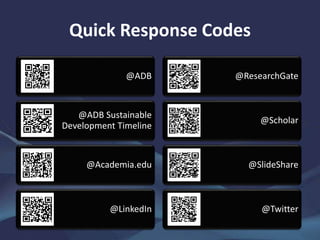
Quick Response Codes
@ADB
@ADB Sustainable
Development Timeline
@Academia.edu
@LinkedIn
@ResearchGate
@Scholar
@SlideShare
@Twitter

Practicing Moral Courage

  • 1.
    The views expressedin this presentation are the views of the author/s and do not necessarily reflect the views or policies of the Asian Development Bank, or its Board of Governors, or the governments they represent. ADB does not guarantee the accuracy of the data included in this presentation and accepts no responsibility for any consequence of their use. The countries listed in this presentation do not imply any view on ADB's part as to sovereignty or independent status or necessarily conform to ADB's terminology. Practicing Moral Courage Olivier Serrat 2015
  • 2.
    Define: Moral Courage Courageis the ability to confront danger, fear, intimidation, pain, or uncertainty. Physical courage is fortitude in the face of death (and its threat), hardship, or physical pain. Moral courage, the form the attribute nowadays refers to, is the ability to act rightly in the face of discouragement or opposition, possibly and knowingly running the risk of adverse personal consequences. Few men are willing to brave the disapproval of their fellows, the censure of their colleagues, the wrath of their society. Moral courage is a rarer commodity than bravery in battle or great intelligence. Yet it is the one essential, vital quality of those who seek to change a world which yields most painfully to change.—John F. Kennedy
  • 3.
    Define: Moral Courage Springingfrom ethics—notably integrity, responsibility, compassion, and forgiveness—moral courage is the quality of mind or spirit that enables a person to withstand danger, difficulty, or fear; persevere; and venture. Comprehensively, it is a willful, intentional act, executed after mindful deliberation, involving objective substantial risk to the bearer, and primarily motivated to bring about a noble good or worthy end despite, perhaps, the presence of the emotion of fear. Operationally, moral courage entails: (i) discerning what is right or wrong; (ii) acting on what one has discerned, even at a personal cost; and (iii) saying openly that one is acting on one's understanding of right and wrong.
  • 4.
    The Bureaucratic Experience Inmodern society most work is done by organizations. Luban et al. charge that collectivization has replaced individual responsibility and internal norms with group identification and external norms. They see that bureaucracy makes four knowledge conditions difficult to satisfy, whereby a decision maker (i) recognizes that he/she has come to a fork in the road; (ii) knows that he/she must make the choice in a fairly short, distinct period; (iii) confronts a small number of well-defined options; and (iv) possesses the information needed to decide. They put forward five obligations to offset the risk that an individual will do harm: (i) investigation, (ii) communication, (iii) protection, (iv) prevention, and (v) precaution.
  • 5.
    De Minimis At itsmost basic, moral courage helps cultivate mindful organizational environments that, among others, offset groupthink; mitigate hypocrisy and "nod-and-wink" cultures; educate mechanical conformity and compliance; bridge organizational silos; and check irregularities, misconduct, injustice, and corruption. Learning organizations put a premium on critical thinking and effective questioning, embrace failure, and generally conduce moral and corporate values to achieve enduring success that also holds social good. More profoundly, moral courage consolidates the trust, enshrined in formal contracts, oral contracts, and psychological contracts, that organizations depend on.
  • 6.
    The Growing Needfor Moral Courage Globalization and the opportunity and competition it stimulates are heightening tensions and some deficiencies of the free market and the economic models it underpins are manifest. The organizations the world needs are not those of the 20th century, when a tall hierarchy was the model of choice: they are fluid and networked to compete on the edge with distributed leadership, anticipation, and reactivity. In their bewilderment, yesterday's organizations are becoming morally complex environments that impose significant ethical demands and challenges on stakeholders: they must renounce ethical mediocrity and transit through minimum ethics to display honesty and authenticity.
  • 7.
    From Ethical Challengeto Action The desire to act with moral courage is influenced by personal factors, say, conscious self-regulation, that are in turn impacted by situational and contextual factors, e.g., organizational directives and rewards; social norms; and social pressure. So, moral courage is not automatic. Marrying cognitive, technical, and emotional intelligence, only by going through a process of analysis, interpretation, debate, and judgment enlightened by ethics can people sharpen their skills in moral reasoning and develop moral intelligence. Beyond statements of corporate values, organizations also need to recruit for values and reinforce these from the top. A great part of courage is the courage of having done the thing before.—Ralph Waldo Emerson
  • 8.
    Further Reading • ADB.2009. Overcoming Roadblocks to Learning. Manila. www.adb.org/publications/overcoming-roadblocks-learning • ADB. 2009. Building Trust in the Workplace. Manila. www.adb.org/publications/building-trust-workplace • ADB. 2010. A Primer on Corporate Values. Manila. www.adb.org/publications/primer-corporate-values • ADB. 2010. Bridging Organizational Silos. Manila. www.adb.org/publications/bridging-organizational-silos • ADB. 2010. A Primer on Social Neuroscience. Manila. www.adb.org/publications/primer-social-neuroscience • ADB. 2011. A Primer on Corporate Governance. Manila. www.adb.org/publications/primer-corporate-governance
  • 9.
    Further Reading • ADB.2011. Critical Thinking. Manila. www.adb.org/publications/critical-thinking • ADB. 2011. Managing Corporate Reputation. Manila. www.adb.org/publications/managing-corporate-reputation • ADB. 2011. Moral Courage in Organizations. Manila. www.adb.org/publications/moral-courage-organizations • ADB. 2011. Conflict in Organizations. Manila. www.adb.org/publications/conflict-organizations • David Luban, Alan Strudler, and David Wasserman. 1992. Moral Responsibility in the Age of Bureaucracy. Michigan Law Review. 90 (8). pp. 2348–2392.
  • 10.
    Quick Response Codes @ADB @ADBSustainable Development Timeline @Academia.edu @LinkedIn @ResearchGate @Scholar @SlideShare @Twitter