The Public
Administration
Theory
Presented at PSU January 2016
Primer by H. George
Frederickson
and Kevin B. Smith, 2003
I. Why Do We Need PA
Theory?
• All the great human events in history
were probably achieved by what we
would today call PA.
• Organization and management
practices in collective or public
settings are as old as civilization.
• Measured from the Federalist, PA is 230
years old; 23 decades; > 7 generations.
• Measured from the publication of Wilson’s
founding essay (1887) , PA is 129 years
old; 12 decades; > 3 generations.
• As a separate and self-conscious collection
of concepts, ideas, reforms, courses and
degrees, and professed answers to public
problems, PA is a young adult.
Old as civilization . . .
• James Wilson (1989) claims to have
little interest in theory and expresses
the opinion that theory has little to
offer in understanding bureaucracy.
• Despite Wilson’s disclaimer, theory is
the bedrock of understanding PA. In
many ways, Wilson’s own work is a
profoundly important theoretical
contribution.
Old as civilization . . .
The practices of PA are,
then, as old as civilization and
essential to development of
civilization.
I. Why Do We Need PA Theory?
• The transition of feudal society to the
extended nation-state was made possible
by the centralization of policy on one hand
and the decentralization of policy
implementation on the other. (Tout 1937;
Ellud 1955; Chrimes 1952).
• The colonial era would be described the
same way, but on a worldwide scale.
(Gladden 1972)
colonial era 1521 to 1898, also known as the Spanish Colonial Era,
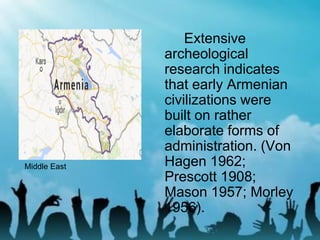
Extensive
archeological
research indicates
that early Armenian
civilizations were
built on rather
elaborate forms of
administration. (Von
Hagen 1962;
Prescott 1908;
Mason 1957; Morley
1956).
Middle East
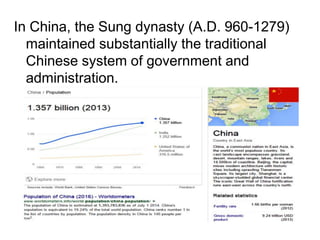
In China, the Sung dynasty (A.D. 960-1279)
maintained substantially the traditional
Chinese system of government and
administration.
• The Emperor, who was supreme, was advised
and assisted by a Council of State whose
members, varying from 5 to 9, supervised
individually the several organs of Administration,
which were grouped into: (1) Secretariat-
Chancellery; (2) Finance Commission; and (3)
Bureau of Military Affairs. (Gladden 1972).
• In these and countless examples, the elemental
features of PA permeated social development;
indeed, it is argued that civilization requires the
elemental features of PA. (Waldo 1946/1954)
• The elemental features of PA would include,
following Weber (1952):
o Some basis of formal authority with claims to
obedience;
o Intentionally established laws and rules,
which apply to all;
o Specific spheres of individual competence,
which include task differentiation,
specialization, expertise and/or
professionalization;
o The organization of persons into groups or
categories according to specialization;
Elemental Features of PA . . .
o Coordination by hierarchy;
oContinuity through rules and records;
oThe organization as distinct from the
persons holding positions or offices in it;
and
oThe development of particular and
specific organizational technologies.
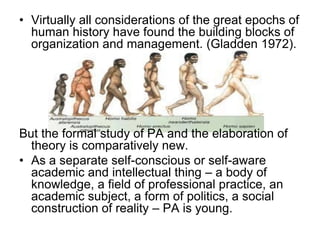
• Virtually all considerations of the great epochs of
human history have found the building blocks of
organization and management. (Gladden 1972).
But the formal study of PA and the elaboration of
theory is comparatively new.
• As a separate self-conscious or self-aware
academic and intellectual thing – a body of
knowledge, a field of professional practice, an
academic subject, a form of politics, a social
construction of reality – PA is young.
• All theories have weaknesses, and
denying theory while doing theory has the
big advantage of not having to defend
those weaknesses.
• Denying theory while doing theory helps to
avoid the stereotypes of, say, decision
theorists or rational choice theorists.
• To claim to be atheoretical skirts the truth-
in-labeling test.
Advantage
• Increase in
Productivity
• Job satisfaction
• Motivation
• Improved Quality
• Reduced Cost
Participative Management
Disadvantage
• Decision
making slows
down
• Security Issue
• Without acknowledging a theory or
expressing an interest in a theory,
the scholar can attempt to avoid
labels and stereotypes.
• These all are compelling reasons to
avoid theoretical boxes and
categories; but these reasons do not
diminish the centrality of theory in all
of PA.
• In the past 30 years, PA has developed
more systematic patters of inquiry about the
substance of public organization behavior,
public management, and public policy
implementation.
• This work has contributed to an increasing
reliability in understanding PA. The work of
public organizations has been examined
with improved conceptual, methodological,
and theoretical forms of analysis.
• These forms of analysis seek to create
knowledge that is retraceable, cumulative,
and, at least at some level, replicable.
• These forms of analysis aspire to be
scientific; using the word “scientific” here to
mean a kind of formal rationality by which
the insights and discoveries of one
generation form the foundation for the
inquiries of the next generation.
• Knowledge then becomes collective and
cumulative “The art and science of PA”
• The science and art of policy administration
is definable, describable, replicable, and
cumulative.
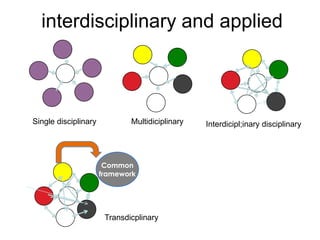
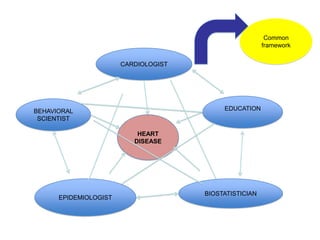
• Because the field is both interdisciplinary
and applied, a single theory derived from a
contributing discipline, i.e. market model
from economics, many be informative and
useful.
interdisciplinary and applied
Single disciplinary Multidiciplinary Interdicipl;inary disciplinary
Common
framework
Transdicplinary
BEHAVIORAL
SCIENTIST
HEART
DISEASE
EPIDEMIOLOGIST
BIOSTATISTICIAN
EDUCATION
CARDIOLOGIST
Common
framework
• But much of PA cannot be described,
explained, or accounted for by using the
market model.
• No theory standing alone is capable of
accounting for the complexity of the field.
• Taken together, however, the theories
significantly contribute to what we know and
understand PA to be.
II. The Use of Theory
• The validity and usefulness of any theory
depends on its capacity to describe, to explain,
and to predict.
• A theory, to be useful, should accurately describe
or depict a real world event or phenomenon.
• Most important PA phenomena are complex,
therefore description is an abstract representation
of phenomena.
II. The Use of Theory
• All descriptions require that the
analyst decide which elements in a
complex phenomenon to
emphasize.
• All descriptions are distortions of
reality and are relative to the
circumstances prevailing at the time
of the description.
o In the same way that motion photography
is an advancement on still photography, in
PA our descriptive technologies are still
relatively primitive still photos.
o Because of limitation of descriptions, a
useful theory will explain the phenomenon
being described.
oDescriptions are often like a still photo or a
series of still photos, and often fuzzy
photos at that; description is less often like
a video tape.
• Explanation can also account for why
the analyst sees some factors in an
event or phenomenon as more
important than others.
• A description also asks what
happened or what is happening, but
even the best description of what is
happening may fail to answer equally
important questions.
• As Ansel Adams demonstrated with his
black-and-white still photography, there is
an important difference between seeing
and understanding a picture.
• In PA, the descriptive features of theory
helps us to see; the explanatory features
of theory helps us understand.
• If theory helps us to see and understand
PA phenomena, should theory, therefore,
help us to predict?
• Yes. Herbert Kaufman’s (969) theory of
cyclical change from a professionally
based and neutrally competent PA to a
politically responsive and partisan PA.
Kaufman’s theory contains strong
properties.
• Although less specific to PA, Albert
Hershman’s theory (1982) of change in the
social and political world is similar and
equally as useful.
• The tendency is to expect too much of
prediction in theory. Because PA is
practical and applied, some seek a theory
which, if followed, will achieve a
predictable result.
• Prediction should be interpreted largely to
account for patterns, probabilities, and
likely outcomes, not specific results
flowing inexorably from the application of a
particular theory.
• When prediction is loosely defined to
account for a range of situations over time,
its capacity can be impressive, i.e.
Simon’s bounded rationality is powerfully
predictive.
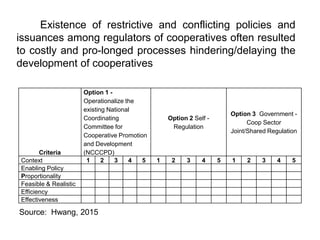
Existence of restrictive and conflicting policies and
issuances among regulators of cooperatives often resulted
to costly and pro-longed processes hindering/delaying the
development of cooperatives
Criteria
Option 1 -
Operationalize the
existing National
Coordinating
Committee for
Cooperative Promotion
and Development
(NCCCPD)
Option 2 Self -
Regulation
Option 3 Government -
Coop Sector
Joint/Shared Regulation
Context 1 2 3 4 5 1 2 3 4 5 1 2 3 4 5
Enabling Policy
Proportionality
Feasible & Realistic
Efficiency
Effectiveness
Source: Hwang, 2015
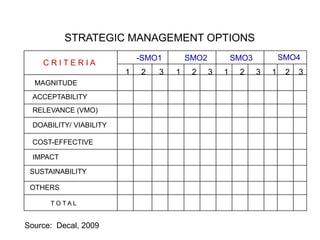
STRATEGIC MANAGEMENT OPTIONS
C R I T E R I A
-SMO1 SMO2 SMO3 SMO4
1 2 3 1 2 3 1 2 3 1 2 3
MAGNITUDE
ACCEPTABILITY
RELEVANCE (VMO)
DOABILITY/ VIABILITY
COST-EFFECTIVE
IMPACT
SUSTAINABILITY
OTHERS
T O T A L
Source: Decal, 2009
• In PA theory, issues of precision vs.
generality are important.
• Greater precision and specificity in
the description and explanation of a
PA phenomenon is always purchased
at the price of generalization.
• The more a theory is precise or, as is
presently popular to say, contingent, the
more the power to account for a broad
pattern of events, and therefore to predict
a range of like phenomena, is reduced.
• The problem is that big theory, grand
overarching theory, is usually made so
general by simplifications and
assumptions as to render it unable to
explain anything but the most obvious
occurrences.
• Systems theory comes to mind; so do
simplified applications of market
economics to PA.
• The richness, texture, and substance of
events and phenomena can be lost in big
theory.
• Precise theory, on the other hand, can be
so rich and contextual as to be bereft of
generalizing potential.
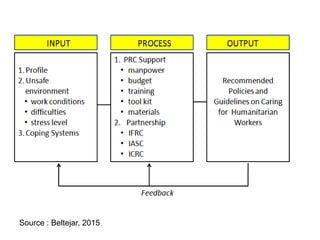
Source : Beltejar, 2015
Defining Theory in PA
At a loose and almost casual level,
theory is simply an orientation,
framework, technique, or approach.
Theory, however, more formally
means:
Defining Theory in PA
o First, in the natural and physical sciences,
theory means a rigorous testing of predictive
theorems or hypotheses using observable and
comparable data. These hypotheses, once
tested and verified, form the basis of theories,
assertions, or representations of reality. Theory
here can claim considerable accuracy in
representing reality because the classification
of order in the physical world is advanced, as
are capacities to recognize and measure
natural phenomena. In the social world, like
PA, the problems of recognizing patterns,
designing categories, and measuring and
comparing phenomena are much greater.
Therefore, the aim of theory in PA are different,
even lower.
• Physical Sciences encourages innovative,
fundamental, strategic and applied research in
astronomy, computer science and mathematics.
These are indispensible for obtaining an
understanding of the nature, origin and future of
human beings, the world and the universe.
• Physical Sciences wants to make a major
contribution to the realization and retention of a
superb scientific climate with special attention for
the application of knowledge. Knowledge
utilization increases the contribution of scientific
research to welfare and prosperity.
• Results from the research benefit science, public
and civil society organizations and industry.
•
o Second, theory in the social sciences and in PA
means the ordering of factual material (history,
events, cases, stories, measures of opinion,
observation) so as to present evidence thru
definitions, concepts, and metaphors that
promote understanding. This theory is based on
rigorous and intuitive observation of social
behavior, organizational behavior, institutional
dynamics, political systems and behavior,
patterns of communication, and culture.
• Social Sciences/Humanities is the study of
human society. It includes a group of
diverse academic disciplines including
history, sociology, political science,
anthropology, law, geography, economics
and education.
oThird, theory in PA is normative –
theories of what ought to be. These
theories form the bridges between PA,
political science, and philosophy. Waldo
(1946) taught us that all theories of PA
are also theories of politics. Theories of
PA guide the authoritative allocation of
public goods. The task of theorist is
often to discovery theory that accounts
for or describes observable regularities
in behavior and to evaluate the
normative implications of such behavior.
• It is often true that PA theorists use a mix
of the 2nd and 3rd definitions of theory.
• The meaning of theory in PA is more than
just a question of how rigorous the
measurement and how precise the
observation. Theory is classified by the
form, degree, or nature of its elaboration.
• Much of rational choice theory are good
examples of this kind of theory.
• The great appeal of law and economics has
been its use of a coherent theory of human
decision making (rational choice theory) to
examine legal rules and institutions. While the
innovations and accomplishments of that theory
in the analysis of the law have been many and
important, there has been a great deal of
dissatisfaction among more traditional legal
scholars with the rational-choice foundation of
law and economics
Theory may also vary in scope, some
theory being broad and presuming to
account for, say, all public
organizations; or narrow, to account
for, say, law enforcement
organizations.
Further, theory in PA can differ
depending on whether the subject is
generally organizational, operational,
managerial, or generally policy-
specific.
• Finally, in PA there is a special test of theory –
how useful is it? Because of this test, the degree
of measuring, rigor and precision and the level
of elaboration in a theory may be less important
than the question of usefulness.
• Good or useful theory presumes to organize and
classify data in such a way as to screen facts
and then focus on only the most important.
• The test of a theory’s usefulness is often its
criteria in selecting and classifying facts, and if
these are accurate the theory will enhance
understanding, guide research, and powerfully
describe, explain, and predict.
III. Is a Useful and Reliable PA
Theory Possible?
• In the 1960s, at the time of the so-called
behavioral revolution in political in science, there
were essentially two positions regarding the
prospects for a rigorous empirically based theory
or set of theories to explain political behavior.
• Although political behavior is not exactly the
same thing, as PA, the parallels, particularly with
regard to theory development, are strong.
• In PA, there were, and some would say still are,
essentially the same two positions regarding
empirically based theory – the classical or
traditional, and the scientific or behavioral.
• The essence of traditional position is that
PA involves purposes and authority in a
way physical science does not. In the
social world, facts can be measured, but
they are transitory.
• Further, in issues of collective human
purposes, wisdom intuition, and judgment
are of surpassing importance, but they are
difficult to measure and classify.
Therefore, many elements of PA are
essentially subjective.
• The traditional position also argues
that proponents of the behavioral
position, to the extent they confine
themselves to analysis of those things
that can be verified by known
measurement techniques, deny
themselves some of the most
important tools presently available for
coming to grips with the substance of
PA.
• By denying the importance of intuitive
guesses, judgment, and wisdom,
theorists working exclusively from the
scientific and behavioral perspectives
can make themselves remote from all
that is important in PA.
• This argument is especially strong when
it comes to issues of ethics and morality
in policy and public management.
• Traditionalists argue that by being more
scientific, PA shies away from the big
question of right and wrong. The tidy
models of the behavioral theorist, they
argue, can lend a specious air of authority
to such work.
• By contrast, the behaviorists’ argument
takes the positivist position that collective
human behavior exhibits enough order to
justify a rigorous search, measurement,
classification, and depiction of that order.
• This can be done by separating facts
from values –logical positivism - and
theorizing about the facts, or by
explicitly dealing with the value
implications of factually derived
theory.
• The behaviorists’ position claims that
simplifying models based on explicit
assumptions furthers the
development of experimentation and
reliable findings.
• Besides, if there is disagreement
regarding the theorists’ assumptions,
theory in the long run will be the better for
it.
• As for issues of ethics, morality, wisdom,
and other fuzzy concepts, the behaviorist
position is that such variables are not
beyond the reach of empirically derived
theory.
• Max Weber (1952) was a social scientist in
the positivist tradition who argued that
human behavior, particularly bureaucratic
behavior, exhibits observable and
describable patterns that can be
scientifically verified.
• But he also argued that social reality is
composed of the ideas and beliefs of
social actors. The task of social science
must, therefore be the interpretation of
action in terms of subjective meaning.
• Today, a fully developed theory of
interpretive social science (Weber 1952)
argued that in the social context humans
act intentionally according to shared ideas
and beliefs and shared meanings
associated with those ideas and beliefs.
• This argument has evolved to the widely
supported view that reality is socially
constructed.
• It is further suggested that it is useful to
think of organizations as shared meanings
or understandings.
• Interpretative social science can include
interpretation of the past – history; interpretation
of events - case studies; and interpretations of
decisions and actions by participant observations.
• Some argue that interpretive and positivist or
behavioral, social science are competitive and
irreconcilable (Winch 1995).
• But in Frederickson’s view, and the dominant
perspective in contemporary social theory
(MacIntyre 1984), that there can be theory that
describes empirically observed regularities in the
social world as well as interpretations of those
regularities.
• Today, the traditional and behavioral
positions in PA are in many ways
reconciled.
• Both positions are essentially right in that
they acknowledge the importance of
observation and categorization and the
central place of theory as the appropriate
means to express reality and guide
actions.
• PA theory derives from historical analyses,
institutional study, and philosophy is now
understood to be as legitimate as PA
theory derived from statistical analysis and
mathematical models.
• Fuzzy phenomena such as leadership and
the “principles of public administration” are
now the subject of empirical analysis and
theory-building. (Ben 1991; Hood and
Jackson 1991)
• The reconciliation and behavioral PA
reflects this perspective: “Science is not a
substitute for insight, and methodological
rigor is not a substitute for wisdom.
Research that is merely rigorous may well
be routine, mechanical, trivial, and of little
theoretical or policy value. However, in the
absence of such rigorous and controlled
analysis even the most operational data
are of little value. (Singer, 1961)
• Even with this reconciliation, theory-
building in PA is influenced by tastes and
fashions. There is always the law of the
instrument. When the theorists has a
methodological or conceptual hammer,
everything begins to look like a nail.
• In the policy schools, the case method has
taken on some aspects of a hammer; the
market model and mathematical
conclusions so derived have been applied
to a lot of nails lately.
• From the traditionalist and behavioralist
positions of 30 years ago, PA has evolved
to a field enjoying a considerable
theoretical richness.
• A single dominant theory, an intellectual
hegemony, would have impoverished the
field. Instead, there are several strong and
important theories and many important
theorists, a condition befitting a field as
applied and interdisciplinary as PA.
• Finally, we come to the uses or purposes
to which theory in PA may be put. There
are countless examples of a theory
applied to less than wholesome purposes,
i.e. the program-planning-budgeting
system devised to make it appear that US
was winning the war in Vietnam
• Bottoms Up Budgeting,
• The willingness of the field to embrace and
rationalize cut-back management without
being forthright about a resulting
diminution in organizational capacity is
another example.
• Our predictive capacities are limited, and
even when we can predict, predictions
sometimes run counter to the PA wisdom
of the day
• Although we cannot control the uses to
which PA theory will be put, PA can often
influence the use of theory.
• It would be the aim of good PA scholarship
to arm public administrators with the most
reliable available theory.
• Research and theory builders in PA must
meet the ultimate and most difficult
challenge to PA theory.
• They must do their best to provide
reliable theory, always with the hope
that public officials will use that theory
to make democratic government as
effective as possible.
• Even though politics is more difficult
that physics, politics in the past 50
years has managed, so far, to keep
atomic energy from destroying us.
Institutional Environment and Public Officials' Performance ..., Volumes 23-506 World Bank - free PDF
Amazon.com National Bookstore Powerbooks.
https://books.google.com.ph/books?id=X1G3EQ5yh90C&pg=PA10&lpg=PA10&dq=Good+or+useful+theory++for+public+officials&source=bl
&ots=3Y4_tmtUZ1&sig=kH3F8Ck8qKLUEJJY-
wv5LyINH0Q&hl=en&sa=X&ved=0ahUKEwiin5qRta7KAhVCE5QKHYc9AG0Q6AEIKDAD#v=onepage&q=Good%20or%20useful%20theory
%20%20for%20public%20officials&f=false
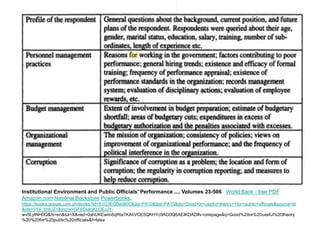
Training on integrity, ethics and anti-
corruption is provided in many countries around
the world, including countries with relatively high
levels of integrity in public administration as well
as countries where corruption is widespread.
However, there are not enough data and
research on good practices in this area.
Designing and delivering ethics training is a long
term investment; it can be expensive, especially
when it targets thousands of civil servants. It is
also a high risk investment, as training alone will
not be able to increase integrity. It is therefore
important to know which programs have the best
design and produce the best results
• Insofar as theories of PA are also theories
of politics, the application of PA theory is
always difficult, particularly in the context
of democratic government.
• PA theory is increasingly sophisticated
and reliable, and thereby it holds some
promise of continuing to make important
contributions to the day-to-day
effectiveness of democratic government.
IV. Some Contemporary Theories of PA
• PA is not a tidy field, and no two theorists
would presume to tidy it up in the same way.
• Each theory or families of theories connects
with one another. That connection is what
makes PA a field, a separate self-conscious
body of knowledge.
• Part of doing theory is to disaggregate the
subject and examine the parts in detail; but
an equally important part of doing theory is
to put together again.
• The public in public administration is to be
broadly defined here. Public is used in its
pregovernmental meaning to include
governments and nonprofit, not-for-profit,
nongovernmental, parastatal, and other
organizations having a clear public
purpose other than what is generally
understood to be commerce or business.
Parastatal - having some political
authority and serving the state indirectly,

The Public Administration Theory

  • 1.
  • 2.
    Primer by H.George Frederickson and Kevin B. Smith, 2003
  • 3.
    I. Why DoWe Need PA Theory? • All the great human events in history were probably achieved by what we would today call PA. • Organization and management practices in collective or public settings are as old as civilization.
  • 4.
    • Measured fromthe Federalist, PA is 230 years old; 23 decades; > 7 generations. • Measured from the publication of Wilson’s founding essay (1887) , PA is 129 years old; 12 decades; > 3 generations. • As a separate and self-conscious collection of concepts, ideas, reforms, courses and degrees, and professed answers to public problems, PA is a young adult. Old as civilization . . .
  • 5.
    • James Wilson(1989) claims to have little interest in theory and expresses the opinion that theory has little to offer in understanding bureaucracy. • Despite Wilson’s disclaimer, theory is the bedrock of understanding PA. In many ways, Wilson’s own work is a profoundly important theoretical contribution. Old as civilization . . .
  • 7.
    The practices ofPA are, then, as old as civilization and essential to development of civilization.
  • 8.
    I. Why DoWe Need PA Theory? • The transition of feudal society to the extended nation-state was made possible by the centralization of policy on one hand and the decentralization of policy implementation on the other. (Tout 1937; Ellud 1955; Chrimes 1952). • The colonial era would be described the same way, but on a worldwide scale. (Gladden 1972) colonial era 1521 to 1898, also known as the Spanish Colonial Era,
  • 9.
    Extensive archeological research indicates that earlyArmenian civilizations were built on rather elaborate forms of administration. (Von Hagen 1962; Prescott 1908; Mason 1957; Morley 1956). Middle East
  • 10.
    In China, theSung dynasty (A.D. 960-1279) maintained substantially the traditional Chinese system of government and administration.
  • 11.
    • The Emperor,who was supreme, was advised and assisted by a Council of State whose members, varying from 5 to 9, supervised individually the several organs of Administration, which were grouped into: (1) Secretariat- Chancellery; (2) Finance Commission; and (3) Bureau of Military Affairs. (Gladden 1972). • In these and countless examples, the elemental features of PA permeated social development; indeed, it is argued that civilization requires the elemental features of PA. (Waldo 1946/1954)
  • 12.
    • The elementalfeatures of PA would include, following Weber (1952): o Some basis of formal authority with claims to obedience; o Intentionally established laws and rules, which apply to all; o Specific spheres of individual competence, which include task differentiation, specialization, expertise and/or professionalization; o The organization of persons into groups or categories according to specialization;
  • 13.
    Elemental Features ofPA . . . o Coordination by hierarchy; oContinuity through rules and records; oThe organization as distinct from the persons holding positions or offices in it; and oThe development of particular and specific organizational technologies.
  • 14.
    • Virtually allconsiderations of the great epochs of human history have found the building blocks of organization and management. (Gladden 1972). But the formal study of PA and the elaboration of theory is comparatively new. • As a separate self-conscious or self-aware academic and intellectual thing – a body of knowledge, a field of professional practice, an academic subject, a form of politics, a social construction of reality – PA is young.
  • 15.
    • All theorieshave weaknesses, and denying theory while doing theory has the big advantage of not having to defend those weaknesses. • Denying theory while doing theory helps to avoid the stereotypes of, say, decision theorists or rational choice theorists. • To claim to be atheoretical skirts the truth- in-labeling test.
  • 16.
    Advantage • Increase in Productivity •Job satisfaction • Motivation • Improved Quality • Reduced Cost Participative Management Disadvantage • Decision making slows down • Security Issue
  • 17.
    • Without acknowledginga theory or expressing an interest in a theory, the scholar can attempt to avoid labels and stereotypes. • These all are compelling reasons to avoid theoretical boxes and categories; but these reasons do not diminish the centrality of theory in all of PA.
  • 18.
    • In thepast 30 years, PA has developed more systematic patters of inquiry about the substance of public organization behavior, public management, and public policy implementation. • This work has contributed to an increasing reliability in understanding PA. The work of public organizations has been examined with improved conceptual, methodological, and theoretical forms of analysis.
  • 19.
    • These formsof analysis seek to create knowledge that is retraceable, cumulative, and, at least at some level, replicable. • These forms of analysis aspire to be scientific; using the word “scientific” here to mean a kind of formal rationality by which the insights and discoveries of one generation form the foundation for the inquiries of the next generation.
  • 20.
    • Knowledge thenbecomes collective and cumulative “The art and science of PA” • The science and art of policy administration is definable, describable, replicable, and cumulative. • Because the field is both interdisciplinary and applied, a single theory derived from a contributing discipline, i.e. market model from economics, many be informative and useful.
  • 21.
    interdisciplinary and applied Singledisciplinary Multidiciplinary Interdicipl;inary disciplinary Common framework Transdicplinary
  • 22.
  • 23.
    • But muchof PA cannot be described, explained, or accounted for by using the market model. • No theory standing alone is capable of accounting for the complexity of the field. • Taken together, however, the theories significantly contribute to what we know and understand PA to be.
  • 24.
    II. The Useof Theory • The validity and usefulness of any theory depends on its capacity to describe, to explain, and to predict. • A theory, to be useful, should accurately describe or depict a real world event or phenomenon. • Most important PA phenomena are complex, therefore description is an abstract representation of phenomena.
  • 25.
    II. The Useof Theory • All descriptions require that the analyst decide which elements in a complex phenomenon to emphasize. • All descriptions are distortions of reality and are relative to the circumstances prevailing at the time of the description.
  • 26.
    o In thesame way that motion photography is an advancement on still photography, in PA our descriptive technologies are still relatively primitive still photos. o Because of limitation of descriptions, a useful theory will explain the phenomenon being described. oDescriptions are often like a still photo or a series of still photos, and often fuzzy photos at that; description is less often like a video tape.
  • 27.
    • Explanation canalso account for why the analyst sees some factors in an event or phenomenon as more important than others. • A description also asks what happened or what is happening, but even the best description of what is happening may fail to answer equally important questions.
  • 28.
    • As AnselAdams demonstrated with his black-and-white still photography, there is an important difference between seeing and understanding a picture. • In PA, the descriptive features of theory helps us to see; the explanatory features of theory helps us understand.
  • 29.
    • If theoryhelps us to see and understand PA phenomena, should theory, therefore, help us to predict? • Yes. Herbert Kaufman’s (969) theory of cyclical change from a professionally based and neutrally competent PA to a politically responsive and partisan PA. Kaufman’s theory contains strong properties.
  • 30.
    • Although lessspecific to PA, Albert Hershman’s theory (1982) of change in the social and political world is similar and equally as useful. • The tendency is to expect too much of prediction in theory. Because PA is practical and applied, some seek a theory which, if followed, will achieve a predictable result.
  • 31.
    • Prediction shouldbe interpreted largely to account for patterns, probabilities, and likely outcomes, not specific results flowing inexorably from the application of a particular theory. • When prediction is loosely defined to account for a range of situations over time, its capacity can be impressive, i.e. Simon’s bounded rationality is powerfully predictive.
  • 32.
    Existence of restrictiveand conflicting policies and issuances among regulators of cooperatives often resulted to costly and pro-longed processes hindering/delaying the development of cooperatives Criteria Option 1 - Operationalize the existing National Coordinating Committee for Cooperative Promotion and Development (NCCCPD) Option 2 Self - Regulation Option 3 Government - Coop Sector Joint/Shared Regulation Context 1 2 3 4 5 1 2 3 4 5 1 2 3 4 5 Enabling Policy Proportionality Feasible & Realistic Efficiency Effectiveness Source: Hwang, 2015
  • 33.
    STRATEGIC MANAGEMENT OPTIONS CR I T E R I A -SMO1 SMO2 SMO3 SMO4 1 2 3 1 2 3 1 2 3 1 2 3 MAGNITUDE ACCEPTABILITY RELEVANCE (VMO) DOABILITY/ VIABILITY COST-EFFECTIVE IMPACT SUSTAINABILITY OTHERS T O T A L Source: Decal, 2009
  • 34.
    • In PAtheory, issues of precision vs. generality are important. • Greater precision and specificity in the description and explanation of a PA phenomenon is always purchased at the price of generalization.
  • 35.
    • The morea theory is precise or, as is presently popular to say, contingent, the more the power to account for a broad pattern of events, and therefore to predict a range of like phenomena, is reduced. • The problem is that big theory, grand overarching theory, is usually made so general by simplifications and assumptions as to render it unable to explain anything but the most obvious occurrences.
  • 36.
    • Systems theorycomes to mind; so do simplified applications of market economics to PA. • The richness, texture, and substance of events and phenomena can be lost in big theory. • Precise theory, on the other hand, can be so rich and contextual as to be bereft of generalizing potential.
  • 37.
  • 38.
    Defining Theory inPA At a loose and almost casual level, theory is simply an orientation, framework, technique, or approach. Theory, however, more formally means:
  • 39.
    Defining Theory inPA o First, in the natural and physical sciences, theory means a rigorous testing of predictive theorems or hypotheses using observable and comparable data. These hypotheses, once tested and verified, form the basis of theories, assertions, or representations of reality. Theory here can claim considerable accuracy in representing reality because the classification of order in the physical world is advanced, as are capacities to recognize and measure natural phenomena. In the social world, like PA, the problems of recognizing patterns, designing categories, and measuring and comparing phenomena are much greater. Therefore, the aim of theory in PA are different, even lower.
  • 40.
    • Physical Sciencesencourages innovative, fundamental, strategic and applied research in astronomy, computer science and mathematics. These are indispensible for obtaining an understanding of the nature, origin and future of human beings, the world and the universe. • Physical Sciences wants to make a major contribution to the realization and retention of a superb scientific climate with special attention for the application of knowledge. Knowledge utilization increases the contribution of scientific research to welfare and prosperity. • Results from the research benefit science, public and civil society organizations and industry. •
  • 41.
    o Second, theoryin the social sciences and in PA means the ordering of factual material (history, events, cases, stories, measures of opinion, observation) so as to present evidence thru definitions, concepts, and metaphors that promote understanding. This theory is based on rigorous and intuitive observation of social behavior, organizational behavior, institutional dynamics, political systems and behavior, patterns of communication, and culture.
  • 42.
    • Social Sciences/Humanitiesis the study of human society. It includes a group of diverse academic disciplines including history, sociology, political science, anthropology, law, geography, economics and education.
  • 43.
    oThird, theory inPA is normative – theories of what ought to be. These theories form the bridges between PA, political science, and philosophy. Waldo (1946) taught us that all theories of PA are also theories of politics. Theories of PA guide the authoritative allocation of public goods. The task of theorist is often to discovery theory that accounts for or describes observable regularities in behavior and to evaluate the normative implications of such behavior.
  • 44.
    • It isoften true that PA theorists use a mix of the 2nd and 3rd definitions of theory. • The meaning of theory in PA is more than just a question of how rigorous the measurement and how precise the observation. Theory is classified by the form, degree, or nature of its elaboration.
  • 45.
    • Much ofrational choice theory are good examples of this kind of theory. • The great appeal of law and economics has been its use of a coherent theory of human decision making (rational choice theory) to examine legal rules and institutions. While the innovations and accomplishments of that theory in the analysis of the law have been many and important, there has been a great deal of dissatisfaction among more traditional legal scholars with the rational-choice foundation of law and economics
  • 46.
    Theory may alsovary in scope, some theory being broad and presuming to account for, say, all public organizations; or narrow, to account for, say, law enforcement organizations. Further, theory in PA can differ depending on whether the subject is generally organizational, operational, managerial, or generally policy- specific.
  • 47.
    • Finally, inPA there is a special test of theory – how useful is it? Because of this test, the degree of measuring, rigor and precision and the level of elaboration in a theory may be less important than the question of usefulness. • Good or useful theory presumes to organize and classify data in such a way as to screen facts and then focus on only the most important. • The test of a theory’s usefulness is often its criteria in selecting and classifying facts, and if these are accurate the theory will enhance understanding, guide research, and powerfully describe, explain, and predict.
  • 48.
    III. Is aUseful and Reliable PA Theory Possible? • In the 1960s, at the time of the so-called behavioral revolution in political in science, there were essentially two positions regarding the prospects for a rigorous empirically based theory or set of theories to explain political behavior. • Although political behavior is not exactly the same thing, as PA, the parallels, particularly with regard to theory development, are strong. • In PA, there were, and some would say still are, essentially the same two positions regarding empirically based theory – the classical or traditional, and the scientific or behavioral.
  • 49.
    • The essenceof traditional position is that PA involves purposes and authority in a way physical science does not. In the social world, facts can be measured, but they are transitory. • Further, in issues of collective human purposes, wisdom intuition, and judgment are of surpassing importance, but they are difficult to measure and classify. Therefore, many elements of PA are essentially subjective.
  • 50.
    • The traditionalposition also argues that proponents of the behavioral position, to the extent they confine themselves to analysis of those things that can be verified by known measurement techniques, deny themselves some of the most important tools presently available for coming to grips with the substance of PA.
  • 51.
    • By denyingthe importance of intuitive guesses, judgment, and wisdom, theorists working exclusively from the scientific and behavioral perspectives can make themselves remote from all that is important in PA. • This argument is especially strong when it comes to issues of ethics and morality in policy and public management.
  • 52.
    • Traditionalists arguethat by being more scientific, PA shies away from the big question of right and wrong. The tidy models of the behavioral theorist, they argue, can lend a specious air of authority to such work. • By contrast, the behaviorists’ argument takes the positivist position that collective human behavior exhibits enough order to justify a rigorous search, measurement, classification, and depiction of that order.
  • 53.
    • This canbe done by separating facts from values –logical positivism - and theorizing about the facts, or by explicitly dealing with the value implications of factually derived theory. • The behaviorists’ position claims that simplifying models based on explicit assumptions furthers the development of experimentation and reliable findings.
  • 54.
    • Besides, ifthere is disagreement regarding the theorists’ assumptions, theory in the long run will be the better for it. • As for issues of ethics, morality, wisdom, and other fuzzy concepts, the behaviorist position is that such variables are not beyond the reach of empirically derived theory.
  • 55.
    • Max Weber(1952) was a social scientist in the positivist tradition who argued that human behavior, particularly bureaucratic behavior, exhibits observable and describable patterns that can be scientifically verified. • But he also argued that social reality is composed of the ideas and beliefs of social actors. The task of social science must, therefore be the interpretation of action in terms of subjective meaning.
  • 56.
    • Today, afully developed theory of interpretive social science (Weber 1952) argued that in the social context humans act intentionally according to shared ideas and beliefs and shared meanings associated with those ideas and beliefs. • This argument has evolved to the widely supported view that reality is socially constructed. • It is further suggested that it is useful to think of organizations as shared meanings or understandings.
  • 57.
    • Interpretative socialscience can include interpretation of the past – history; interpretation of events - case studies; and interpretations of decisions and actions by participant observations. • Some argue that interpretive and positivist or behavioral, social science are competitive and irreconcilable (Winch 1995). • But in Frederickson’s view, and the dominant perspective in contemporary social theory (MacIntyre 1984), that there can be theory that describes empirically observed regularities in the social world as well as interpretations of those regularities.
  • 58.
    • Today, thetraditional and behavioral positions in PA are in many ways reconciled. • Both positions are essentially right in that they acknowledge the importance of observation and categorization and the central place of theory as the appropriate means to express reality and guide actions.
  • 59.
    • PA theoryderives from historical analyses, institutional study, and philosophy is now understood to be as legitimate as PA theory derived from statistical analysis and mathematical models. • Fuzzy phenomena such as leadership and the “principles of public administration” are now the subject of empirical analysis and theory-building. (Ben 1991; Hood and Jackson 1991)
  • 60.
    • The reconciliationand behavioral PA reflects this perspective: “Science is not a substitute for insight, and methodological rigor is not a substitute for wisdom. Research that is merely rigorous may well be routine, mechanical, trivial, and of little theoretical or policy value. However, in the absence of such rigorous and controlled analysis even the most operational data are of little value. (Singer, 1961)
  • 61.
    • Even withthis reconciliation, theory- building in PA is influenced by tastes and fashions. There is always the law of the instrument. When the theorists has a methodological or conceptual hammer, everything begins to look like a nail. • In the policy schools, the case method has taken on some aspects of a hammer; the market model and mathematical conclusions so derived have been applied to a lot of nails lately.
  • 62.
    • From thetraditionalist and behavioralist positions of 30 years ago, PA has evolved to a field enjoying a considerable theoretical richness. • A single dominant theory, an intellectual hegemony, would have impoverished the field. Instead, there are several strong and important theories and many important theorists, a condition befitting a field as applied and interdisciplinary as PA.
  • 63.
    • Finally, wecome to the uses or purposes to which theory in PA may be put. There are countless examples of a theory applied to less than wholesome purposes, i.e. the program-planning-budgeting system devised to make it appear that US was winning the war in Vietnam • Bottoms Up Budgeting,
  • 64.
    • The willingnessof the field to embrace and rationalize cut-back management without being forthright about a resulting diminution in organizational capacity is another example. • Our predictive capacities are limited, and even when we can predict, predictions sometimes run counter to the PA wisdom of the day
  • 65.
    • Although wecannot control the uses to which PA theory will be put, PA can often influence the use of theory. • It would be the aim of good PA scholarship to arm public administrators with the most reliable available theory. • Research and theory builders in PA must meet the ultimate and most difficult challenge to PA theory.
  • 66.
    • They mustdo their best to provide reliable theory, always with the hope that public officials will use that theory to make democratic government as effective as possible. • Even though politics is more difficult that physics, politics in the past 50 years has managed, so far, to keep atomic energy from destroying us.
  • 67.
    Institutional Environment andPublic Officials' Performance ..., Volumes 23-506 World Bank - free PDF Amazon.com National Bookstore Powerbooks. https://books.google.com.ph/books?id=X1G3EQ5yh90C&pg=PA10&lpg=PA10&dq=Good+or+useful+theory++for+public+officials&source=bl &ots=3Y4_tmtUZ1&sig=kH3F8Ck8qKLUEJJY- wv5LyINH0Q&hl=en&sa=X&ved=0ahUKEwiin5qRta7KAhVCE5QKHYc9AG0Q6AEIKDAD#v=onepage&q=Good%20or%20useful%20theory %20%20for%20public%20officials&f=false
  • 68.
    Training on integrity,ethics and anti- corruption is provided in many countries around the world, including countries with relatively high levels of integrity in public administration as well as countries where corruption is widespread. However, there are not enough data and research on good practices in this area. Designing and delivering ethics training is a long term investment; it can be expensive, especially when it targets thousands of civil servants. It is also a high risk investment, as training alone will not be able to increase integrity. It is therefore important to know which programs have the best design and produce the best results
  • 69.
    • Insofar astheories of PA are also theories of politics, the application of PA theory is always difficult, particularly in the context of democratic government. • PA theory is increasingly sophisticated and reliable, and thereby it holds some promise of continuing to make important contributions to the day-to-day effectiveness of democratic government.
  • 70.
    IV. Some ContemporaryTheories of PA • PA is not a tidy field, and no two theorists would presume to tidy it up in the same way. • Each theory or families of theories connects with one another. That connection is what makes PA a field, a separate self-conscious body of knowledge. • Part of doing theory is to disaggregate the subject and examine the parts in detail; but an equally important part of doing theory is to put together again.
  • 71.
    • The publicin public administration is to be broadly defined here. Public is used in its pregovernmental meaning to include governments and nonprofit, not-for-profit, nongovernmental, parastatal, and other organizations having a clear public purpose other than what is generally understood to be commerce or business. Parastatal - having some political authority and serving the state indirectly,