Historical-Comparative
Research
Famous Examples
 Karl Marx and Capital (1867)
 Emile Durkheim and Suicide (1897)
 Max Weber and The Protestant Ethic and the
Spirit of Capitalism (1905)
 C. Wright Mills on history in the Sociological
Imagination (1959)
 “Let us not forget what it is we are studying and
how little we know of man, of history, of
biography, and of the societies of which we are at
once creatures and creators”
Value of Historical Research
 It throws light on present and future trends.
 It enables understanding of and solutions to
contemporary problems to be sought in the past.
 It can illuminate the effects of key interactions within a
culture or sub-culture.
 It allows for the revaluation of data in relation to
selected hypotheses, theories and generalizations that
are presently held about the past and the present.
Steps in a Historical-Comparative
Research Project
 1. Conceptualization of an idea, topic, or
research question
 2. Locate evidence and do background
literature review
 3. Evaluate evidence
 4. Organize evidence
 5. Synthesize evidence and develop general
explanatory model
 6. Develop a narrative exposition of the
findings
Data Sources
 Primary Sources:
 first-hand or eyewitness observations of
phenomenon
 Secondary Sources:
 second-hand observation, i.e. the author collected
the data from eyewitnesses.
 Running Records
 Statistics, gov’t data
 Recollections
What is Oral History?
Video clip:
The Oral History Research Method
Oral History
 Oral history interviewing is valuable for history,
anthropology, and folklore.
 Collects information about the past from observers
and participants in that past.
 Gathers data not available in written records about
events, people, decisions, and processes.
 Can show how individual values and actions shaped
the past, and how the past shapes present-day
values and actions.
 Methodological problem:
 Oral history interviews are grounded in memory, and
memory is a subjective instrument for recording the past,
always shaped by the present moment and the individual
psyche.
Why Collect Oral Histories?
 Listen to Ann Nixon Cooper (104 years old)
and her recollections of the American south
and “the Jim Crow days”
Evaluating Sources
 External Criticism:
 Appraises the authenticity and authorship of the
data source
 Internal Criticism:
 Appraises the meaning and intent of the data
source
Types Of Historical Research
 A. Historical Events Research
 examines particular events or processes that
occurred over short spans of time
 Methodological problems
 Meanings may have changed
 Information may not be complete
Types (cont.)
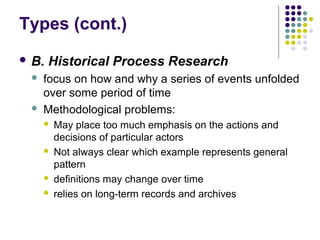
 B. Historical Process Research
 focus on how and why a series of events unfolded
over some period of time
 Methodological problems:
 May place too much emphasis on the actions and
decisions of particular actors
 Not always clear which example represents general
pattern
 definitions may change over time
 relies on long-term records and archives
Types (cont.)
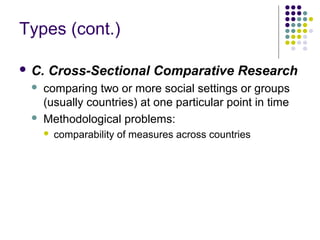
 C. Cross-Sectional Comparative Research
 comparing two or more social settings or groups
(usually countries) at one particular point in time
 Methodological problems:
 comparability of measures across countries
Types (cont.)
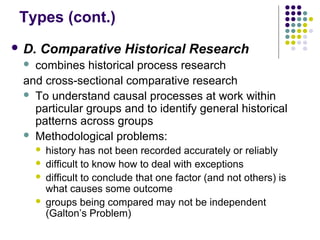
 D. Comparative Historical Research
 combines historical process research
and cross-sectional comparative research
 To understand causal processes at work within
particular groups and to identify general historical
patterns across groups
 Methodological problems:
 history has not been recorded accurately or reliably
 difficult to know how to deal with exceptions
 difficult to conclude that one factor (and not others) is
what causes some outcome
 groups being compared may not be independent
(Galton’s Problem)
Equivalence in Historical
Research
 How can we make comparisons across
diverse contexts (both in time and
geography)?
 Lexicon equivalence
 Contextual equivalence
 Conceptual equivalence
 Measurement equivalence
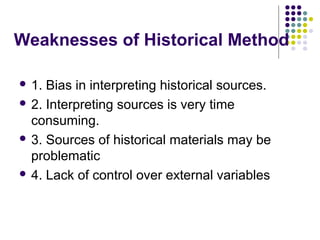
Weaknesses of Historical Method
 1. Bias in interpreting historical sources.
 2. Interpreting sources is very time
consuming.
 3. Sources of historical materials may be
problematic
 4. Lack of control over external variables
Strengths of Historical Method
 1. The historical method is unobtrusive
 2. The historical method is well suited for
trend analysis.
 3. There is no possibility of researcher-
subject interaction.
Interesting Internet Sites on
Historical Research
 Library and Archives Canada
http://www.bac-lac.gc.ca/eng/Pages/home.aspx
 Where To Do Historical Research (Links)
http://www.wheretodoresearch.com/History.htm
 Oral History Digital Collection Youngstown State
http://www.maag.ysu.edu/oralhistory/oral_hist.html
 Oral History Project List Columbia University
http://www.columbia.edu/cu/lweb/indiv/oral/projects.html

Historical comparative research

  • 1.
  • 2.
    Famous Examples  KarlMarx and Capital (1867)  Emile Durkheim and Suicide (1897)  Max Weber and The Protestant Ethic and the Spirit of Capitalism (1905)  C. Wright Mills on history in the Sociological Imagination (1959)  “Let us not forget what it is we are studying and how little we know of man, of history, of biography, and of the societies of which we are at once creatures and creators”
  • 3.
    Value of HistoricalResearch  It throws light on present and future trends.  It enables understanding of and solutions to contemporary problems to be sought in the past.  It can illuminate the effects of key interactions within a culture or sub-culture.  It allows for the revaluation of data in relation to selected hypotheses, theories and generalizations that are presently held about the past and the present.
  • 4.
    Steps in aHistorical-Comparative Research Project  1. Conceptualization of an idea, topic, or research question  2. Locate evidence and do background literature review  3. Evaluate evidence  4. Organize evidence  5. Synthesize evidence and develop general explanatory model  6. Develop a narrative exposition of the findings
  • 5.
    Data Sources  PrimarySources:  first-hand or eyewitness observations of phenomenon  Secondary Sources:  second-hand observation, i.e. the author collected the data from eyewitnesses.  Running Records  Statistics, gov’t data  Recollections
  • 6.
    What is OralHistory? Video clip: The Oral History Research Method
  • 7.
    Oral History  Oralhistory interviewing is valuable for history, anthropology, and folklore.  Collects information about the past from observers and participants in that past.  Gathers data not available in written records about events, people, decisions, and processes.  Can show how individual values and actions shaped the past, and how the past shapes present-day values and actions.  Methodological problem:  Oral history interviews are grounded in memory, and memory is a subjective instrument for recording the past, always shaped by the present moment and the individual psyche.
  • 8.
    Why Collect OralHistories?  Listen to Ann Nixon Cooper (104 years old) and her recollections of the American south and “the Jim Crow days”
  • 9.
    Evaluating Sources  ExternalCriticism:  Appraises the authenticity and authorship of the data source  Internal Criticism:  Appraises the meaning and intent of the data source
  • 10.
    Types Of HistoricalResearch  A. Historical Events Research  examines particular events or processes that occurred over short spans of time  Methodological problems  Meanings may have changed  Information may not be complete
  • 11.
    Types (cont.)  B.Historical Process Research  focus on how and why a series of events unfolded over some period of time  Methodological problems:  May place too much emphasis on the actions and decisions of particular actors  Not always clear which example represents general pattern  definitions may change over time  relies on long-term records and archives
  • 12.
    Types (cont.)  C.Cross-Sectional Comparative Research  comparing two or more social settings or groups (usually countries) at one particular point in time  Methodological problems:  comparability of measures across countries
  • 13.
    Types (cont.)  D.Comparative Historical Research  combines historical process research and cross-sectional comparative research  To understand causal processes at work within particular groups and to identify general historical patterns across groups  Methodological problems:  history has not been recorded accurately or reliably  difficult to know how to deal with exceptions  difficult to conclude that one factor (and not others) is what causes some outcome  groups being compared may not be independent (Galton’s Problem)
  • 14.
    Equivalence in Historical Research How can we make comparisons across diverse contexts (both in time and geography)?  Lexicon equivalence  Contextual equivalence  Conceptual equivalence  Measurement equivalence
  • 15.
    Weaknesses of HistoricalMethod  1. Bias in interpreting historical sources.  2. Interpreting sources is very time consuming.  3. Sources of historical materials may be problematic  4. Lack of control over external variables
  • 16.
    Strengths of HistoricalMethod  1. The historical method is unobtrusive  2. The historical method is well suited for trend analysis.  3. There is no possibility of researcher- subject interaction.
  • 17.
    Interesting Internet Siteson Historical Research  Library and Archives Canada http://www.bac-lac.gc.ca/eng/Pages/home.aspx  Where To Do Historical Research (Links) http://www.wheretodoresearch.com/History.htm  Oral History Digital Collection Youngstown State http://www.maag.ysu.edu/oralhistory/oral_hist.html  Oral History Project List Columbia University http://www.columbia.edu/cu/lweb/indiv/oral/projects.html