EthicalConsiderations
Reporter:Ms. Janyssa Mariae
R. Buenafe
What is Ethics?
• Rules of behavior based on ideas
about what is morally good and bad.
• It is concerned with a set of social and
moral principles that guide research.
Ethics in research provides rules that
specify and appropriate and
inappropriate behavior in the conduct
of research and application of
findings.
“All researchers has
been challenged to
meet ethical principles
and underlie the
research endeavour.”
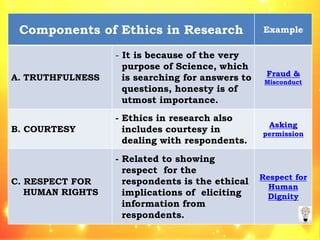
Components of Ethics in Research Example
A. TRUTHFULNESS
- It is because of the very
purpose of Science, which
is searching for answers to
questions, honesty is of
utmost importance.
Fraud &
Misconduct
B. COURTESY
- Ethics in research also
includes courtesy in
dealing with respondents.
Asking
permission
C. RESPECT FOR
HUMAN RIGHTS
- Related to showing
respect for the
respondents is the ethical
implications of eliciting
information from
respondents.
Respect for
Human
Dignity
Components of Ethics in
Research
A. TRUTHFULNESS
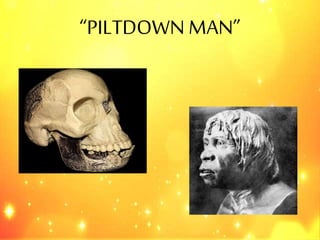
“PILTDOWN MAN”
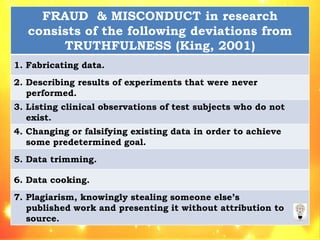
FRAUD & MISCONDUCT in research
consists of the following deviations from
TRUTHFULNESS (King, 2001)
1. Fabricating data.
2. Describing results of experiments that were never
performed.
3. Listing clinical observations of test subjects who do not
exist.
4. Changing or falsifying existing data in order to achieve
some predetermined goal.
5. Data trimming.
6. Data cooking.
7. Plagiarism, knowingly stealing someone else’s
published work and presenting it without attribution to
source.
Components of Ethics in
Research
B. COURTESY
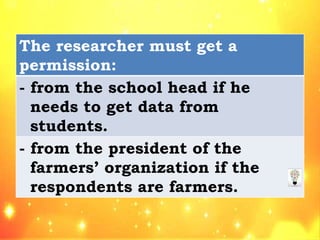
The researcher must get a
permission:
- from the school head if he
needs to get data from
students.
- from the president of the
farmers’ organization if the
respondents are farmers.
Components of Ethics in
Research
C. RESPECT FOR HUMAN RIGHTS
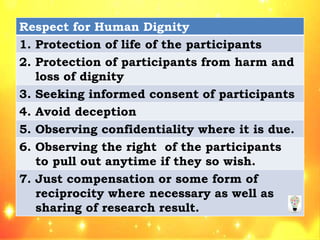
Respect for Human Dignity
1. Protection of life of the participants
2. Protection of participants from harm and
loss of dignity
3. Seeking informed consent of participants
4. Avoid deception
5. Observing confidentiality where it is due.
6. Observing the right of the participants
to pull out anytime if they so wish.
7. Just compensation or some form of
reciprocity where necessary as well as
sharing of research result.
Thank You!

Ethical considerations in making a Research

  • 1.
  • 3.
    What is Ethics? •Rules of behavior based on ideas about what is morally good and bad. • It is concerned with a set of social and moral principles that guide research. Ethics in research provides rules that specify and appropriate and inappropriate behavior in the conduct of research and application of findings.
  • 4.
    “All researchers has beenchallenged to meet ethical principles and underlie the research endeavour.”
  • 5.
    Components of Ethicsin Research Example A. TRUTHFULNESS - It is because of the very purpose of Science, which is searching for answers to questions, honesty is of utmost importance. Fraud & Misconduct B. COURTESY - Ethics in research also includes courtesy in dealing with respondents. Asking permission C. RESPECT FOR HUMAN RIGHTS - Related to showing respect for the respondents is the ethical implications of eliciting information from respondents. Respect for Human Dignity
  • 6.
    Components of Ethicsin Research A. TRUTHFULNESS
  • 7.
  • 8.
    FRAUD & MISCONDUCTin research consists of the following deviations from TRUTHFULNESS (King, 2001) 1. Fabricating data. 2. Describing results of experiments that were never performed. 3. Listing clinical observations of test subjects who do not exist. 4. Changing or falsifying existing data in order to achieve some predetermined goal. 5. Data trimming. 6. Data cooking. 7. Plagiarism, knowingly stealing someone else’s published work and presenting it without attribution to source.
  • 9.
    Components of Ethicsin Research B. COURTESY
  • 10.
    The researcher mustget a permission: - from the school head if he needs to get data from students. - from the president of the farmers’ organization if the respondents are farmers.
  • 11.
    Components of Ethicsin Research C. RESPECT FOR HUMAN RIGHTS
  • 12.
    Respect for HumanDignity 1. Protection of life of the participants 2. Protection of participants from harm and loss of dignity 3. Seeking informed consent of participants 4. Avoid deception 5. Observing confidentiality where it is due. 6. Observing the right of the participants to pull out anytime if they so wish. 7. Just compensation or some form of reciprocity where necessary as well as sharing of research result.
  • 13.