1
S. Selvakkunapalan LL.B., LL.M.
Attorney-at-Law, Additional Draftsman
Visiting Lecturer – Sri Lanka Law College.
https://selvakunapalan.blogspot.com/2019/
LAW OF TRUSTS
CHAPTER VI
CHARITABLE TRUSTS
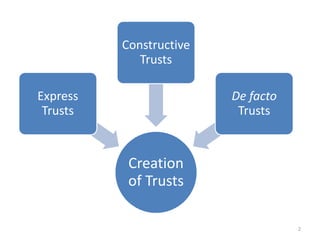
Creation
of Trusts
Express
Trusts
Constructive
Trusts
De facto
Trusts
2
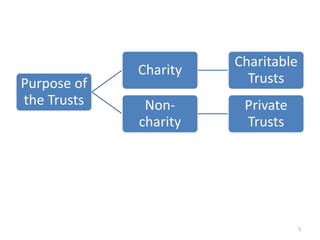
Purpose of
the Trusts
Charity
Charitable
Trusts
Non-
charity
Private
Trusts
3
A charitable trust is intended to benefit society
as a whole or an appreciable part of society
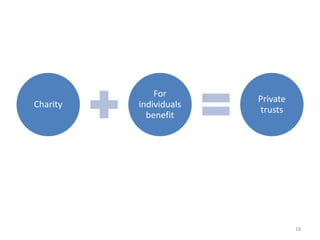
whereas a private trust is intended to benefit
defined persons or defined class of persons.
Charitable trusts are not subject to that aspect
of the Rule against Perpetuities. Section
110(5) provides that the restriction of that
section shall not apply to charitable trusts as
defined by section 99.
4
Charities are not bound by this rule and may
therefore last forever. There are many charities
of considerable age which continue to operate.
Thus, where a gift is made of the income from a
particular fund to a charity in perpetuity, it will
never be possible to release the capital from the
fund: Re Levy [1960] Ch 346
5
In terms of section 57 of the Inland Revenue
Act 2017-
• A trust shall be liable to tax separately from its
beneficiaries.
• A beneficiary of a trust shall be liable to tax on
the income of the trust to which that
beneficiary is entitled for as individual.
• Distributions of a resident trust shall be
exempt in the hands of the trust’s
beneficiaries.
6
Where any charitable institution provides
institutionalized care for the sick or the needy
and where the Commissioner-General is
satisfied that the cost of provision of such care
is borne by such charitable institution, the
Commissioner-General may reduce the tax
payable. –section 68(3) of the Inland Revenue
Act 2017.
7
Since section 6 of the Trusts Ordinance is
expressly subject to section 107, it may be
argued that 107 gives the court power to
ignore the requirement of certainty of
beneficiary in relation to the charitable trusts.
It is also relevant that most of the decisions have
ignored the requirement specified in section 6
that beneficiaries must be indicated with
reasonable certainty in a valid charitable
trusts.
8
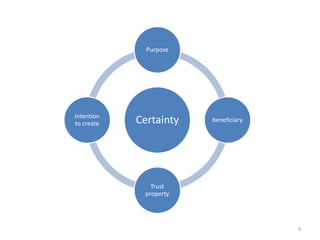
Certainty
Purpose
beneficiary
Trust
property
Intention
to create
9
A charitable trust will not fail for uncertainty of
objects provided that the settlor clearly
intended the fund to go exclusively to charity.
Even a trust fails, the doctrine of cy-pres will
be made to make the objects more precise.
10
To constitute the valid trust, it is necessary that
its objects or purposes are certain and that the
directions to the trustees are given in imperative
terms. If the testator leaves a discretion to the
trustee to apply a fund to a charitable or non-
charitable purpose at his option, no valid
charitable trust can be created.
11
It however, does not mean that the trustee
cannot be given any discretion under a charitable
trust. In Manorama vs. Kalicharan (1904) it has
been held that gift for a purpose which can be
regarded as charitable or to charity generally,
would be a valid trust even though a wide
discretion is given to the trustee.
In Gangabai Charities vs. CIT (1992) 197 ITR 27,
the object of the trust were described in the
Deed of Trust as “religious, charitable, cultural
and social” purposes. There was no …
12
mention in the Deed as to how the trust income
was to be utilized. There was no mandate that
the income was to be spent on religious or
charitable purposes. In these circumstances, it
was held that it was not possible to cull out in
clear terms any specific charitable or religious
objects from the trust deed to conclude that the
trust was set up wholly for religious or
charitable purposes.
13
Where there is a specific intention to create a
charitable trusts defined by section 99,
uncertainty as to the manner in which the trust
is to be administered may be cured either, by
reference to sections 99(2) and 100 or 101(1)(e)
or 102(1)(a) or by the discretion given to the
trustee by the settlor.
14
It has been stated that purpose of the trusts will
fail, if the purpose is not stated with sufficient
certainty. This rule does not apply to charities. It
does not matter that the charitable purpose is
only vaguely stated, or that no purpose is stated
at all. Thus, a gift simply ‘for charitable purposes’
or, as in Moggridge v Thackwell (1792) 1 Ves Jr
464, a gift to A ‘to dispose of to such charities as
he shall think fit’ will be valid.
15
In construing instrument in circumstances where
the settlor intended to set up a charitable
trust but did so ambiguously, it is established
that a “benignant” construction shall be given
if possible.
16
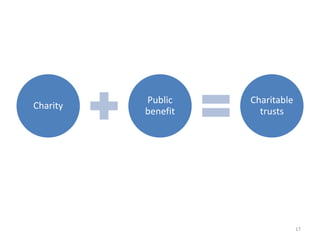
Charity
Public
benefit
Charitable
trusts
17
Charity
For
individuals
benefit
Private
trusts
18
The charitable trusts in section 99 may be
explained by reference to section 3. Because of
the words “unless the context or the subject
matter otherwise implies,” the implication in
section 3 as amended by Trusts (Amendment)
Act, No. 6 of 2018 that a beneficiary must be a
person or, defined or definitely ascertainable
class of persons can be modified by section
99(1) (a) to (d).
19
Dedication to Trust
The mere declaration of a trust or execution of a
deed is not enough to constitute a valid
endowment; it is necessary for the validity of a
deed that the executor should divest himself of
the property. Whether he had done or not, is to
be determined by his subsequent acts or
conduct.- Dharma Raja vs. Raja Ammal (1978) 1
Mad. LT 492.
20
In order that a dedication must be real, the
following are essential requirements:-
(a) Subject matter of the dedication must be
specific and well defined;
(b)The words employed for the dedicating the
property for the endowment must be
unambiguous and certain;
(c) The object of the charity should be certain;
(d)The dedication should be made by an
unambiguous expression of intention to
divest.
21
Once a valid trust has been created, the
subsequent conduct of the founder contrary
to the dedication cannot invalidate or affect
the trust.
If a trust had been validly created, any deviation
by founder of the trust would amount only to
a breach of trust.- Thanthi Trust vs. ITO (1973)
91 ITR 261 (Mad.)
22
De facto trusts
In dealing with any property alleged to be
subject to a charitable trust, the court shall not
be debarred from exercising any of its powers by
the absence of evidence of the formal
constitution of the trust, if it shall be of opinion
from all the circumstances of the case that a
trust in fact exists, or ought to be deemed to
exist- section 107
23
Charitable trusts where these formalities had
not been observed were nonetheless held to be
valid because of section 107.
Section 107 appears to be retrospective and has
been assumed without argument to apply to
trusts arising before 1918.
24
Charities
25
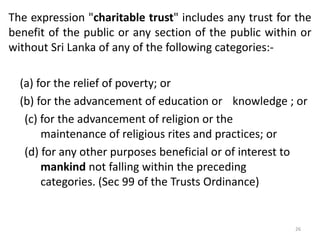
The expression "charitable trust" includes any trust for the
benefit of the public or any section of the public within or
without Sri Lanka of any of the following categories:-
(a) for the relief of poverty; or
(b) for the advancement of education or knowledge ; or
(c) for the advancement of religion or the
maintenance of religious rites and practices; or
(d) for any other purposes beneficial or of interest to
mankind not falling within the preceding
categories. (Sec 99 of the Trusts Ordinance)
26
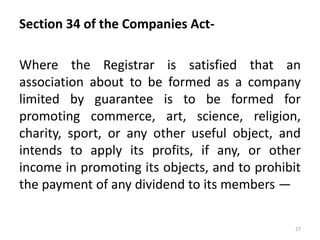
Section 34 of the Companies Act-
Where the Registrar is satisfied that an
association about to be formed as a company
limited by guarantee is to be formed for
promoting commerce, art, science, religion,
charity, sport, or any other useful object, and
intends to apply its profits, if any, or other
income in promoting its objects, and to prohibit
the payment of any dividend to its members —
27
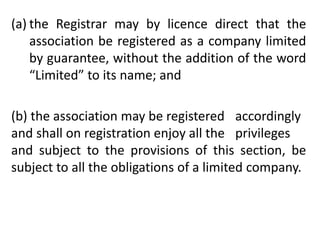
(a) the Registrar may by licence direct that the
association be registered as a company limited
by guarantee, without the addition of the word
“Limited” to its name; and
(b) the association may be registered accordingly
and shall on registration enjoy all the privileges
and subject to the provisions of this section, be
subject to all the obligations of a limited company.
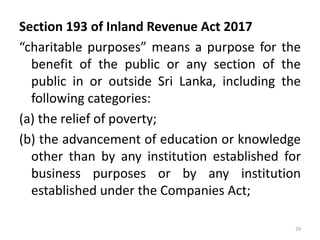
Section 193 of Inland Revenue Act 2017
“charitable purposes” means a purpose for the
benefit of the public or any section of the
public in or outside Sri Lanka, including the
following categories:
(a) the relief of poverty;
(b) the advancement of education or knowledge
other than by any institution established for
business purposes or by any institution
established under the Companies Act;
29
(c) activities for the protection of the
environment or eco-friendly activities;
(d) the advancement of religion or the
maintenance of religious rites and practices or
the administration of a place of public
worship;
(e) any other purpose beneficial to the
community, not falling within any of the above
categories;
30
Act of Parliament –
In terms of Standing Order 53, a trust fund may
be incorporated by an Act of Parliament, if
such trust fund created under section 5 of the
Trusts Ordinance. However, names of certain
incorporations include the word ‘trust’ but in
reality, it is not a trust fund under the
provisions of Trusts Ordinance.
e.g.-Hampton Village Sri Lanka Trust
(Incorporation) Act, No. 3 of 2010;
Zam Trust (Incorporation) Act, No. 72 of 2009
31
Charities Act 2011 (UK)
For the purposes of the law of England and
Wales, a charitable purpose is a purpose which—
(a) falls within section 3(1), and
(b) is for the public benefit (see section 4).
32
A purpose falls within this section 3(1), if it falls
within any of the following descriptions of
purposes—
(a) the prevention or relief of poverty;
(b) the advancement of education;
(c) the advancement of religion;
(d) the advancement of health or the saving of
lives;
33
(e) the advancement of citizenship or community
development;
(f) the advancement of the arts, culture, heritage
or science;
(g) the advancement of amateur sport;
(h) the advancement of human rights, conflict
resolution or reconciliation or the promotion
of religious or racial harmony or equality and
diversity;
(i) the advancement of environmental protection
or improvement;
34
(j) the relief of those in need because of youth,
age, ill-health, disability, financial hardship or
other disadvantage;
(k) the advancement of animal welfare;
(l) the promotion of the efficiency of the armed
forces of the Crown or of the efficiency of the
police, fire and rescue services or ambulance
services;
(m) any other purposes that are not within
paragraphs (a) to (l) but are recognized as
charitable purposes.
35
(a) in paragraph (c), “religion” includes—
(i) a religion which involves belief in more
than one god, and
(ii) a religion which does not involve belief
in a god,
36
Lord Macnaghten in Income Tax Commissioner
vs. Pemsel that,
“Charity in its legal sense comprises four
principal divisions: (1) trusts for the relief of
poverty; (2) trusts for the advancement of
education; (3) trusts for the advancement of
religion; and (4) trusts for other purposes
beneficial to the community, not falling under
any of the preceding heads.”
37
It has been pointed out in relation to the word
“include” in section 99 that the effect of this
word in a statutory definition is that prima facie
the enumeration following the word is not
exhaustive.
38
BENEFIT OF THE PUBLIC OR ANY
SECTION OF THE PUBLIC
39
The public benefit rule is very important aspect
in a trust to qualify as charitable trust.
Re Compton [1945] Ch. 123] where a trust for
the education of the descendants of three
named persons was held not to be a valid
charitable trust, because the beneficiaries
were defined by reference to a personal
relationship and the trust therefore lacked the
quality of a public trust; the trust was in
reality a family trust and not for the benefit of
a section of the public.
40
Oppenheim v. Tobacco Securities Trust Co.
[1951 A.C. 297] where the trustees were
directed to apply funds in providing for the
education of children of employees or ex-
employees of British American Tobacco
company. The employees numbered over
110,000. A majority of House of Lords held
that although the group of persons indicated
was numerous, the nexus between them was
employment by a particular employer and this
trust did not satisfy the test of public benefit.
41
An aggregate of individuals ascertained by
reference to some personal tie, for example,
blood, contract, such as relations of a
particular individuals, the members of the
particular family or the members of a
particular association does not amount to the
public or section of the public for the purpose
of general rule.
42
On the other hand, if the trust is construed in
such a way as merely to grant a preference to
a limited class such as employees or relations
the trust will qualify as charitable trust.
In Re Koettgen’s Will Trust [1954] Ch 252 a
testatrix instructed that her residuary estate
should be held by her trustees ‘as a fund for
the promotion and furtherance of commercial
education’.
43
Furthermore, the persons eligible as
beneficiaries under the fund shall be the
persons of either sex who are British born
subjects & etc. Moreover, ‘in selecting
beneficiaries, it is my wish that the trustees
shall give preference to any employees of J B &
Co or any members of the families of such
employees’. The main issue was whether the
trust was in the public interest and therefore
charitable. It was held that the trust was
charitable trust for the public benefit.
44
Re Martin [1977] where a trust to establish a
home for old people, with a right for either or
both of the testator’s daughters to reside
there, was held not to be charitable.
Even though the requirement of public benefit is
must, it may differ from head to head
specified in section 99(1).
45
There is a dual test to be satisfied. The purposes
of the trust must –
(i) fall within legal definition of charity, and
(i) be for the public benefit, if it is to be valid
charitable trust.
46
In Commissioner of Income Tax vs. The Trustees of
Abdul Caffoor Trust H.N.G Fernando J thought that
section 99,
“…. Does not require a trust to be solely for the
public benefit, so that a trust which is essentially
and substantially for the public benefit may
reasonably be considered to fall within the
definition.”
H.N.G Fernando J. essayed in some detail to define
the words “the public or section thereof.” The test
of the public benefit laid down by the House of
Lords in Oppenheim vs. Tobacco Securities Ltd. has
been adopted in Sri Lanka.
47
According to this test an aggregate of individuals
ascertain by reference to some tie. (e.g blood or
contract), such as the relations of particular
individual or family, or the employees of the
particular firm, do not constitute a section of
public.
In the Abdul Gaffoor case a trust for the
deserving youths of the following Islamic faith,
which contained a discretion to the trustees to
give preference to descendants of the testator’s
family was held to be not for the benefit of the
public.
48
In the Abdul Caffoor case, the English case of Re
Koettgen’s Trust was not followed. In Re
Koettgen’s Trust, an educational trust for
“British born subjects,” contained a clause that
in selecting beneficiaries preference should be
given to the employees and the members of
their families. This trust was held to be for the
public benefit.
In Sri Lanka, there are different minorities
groups and religions. So, a trust for a group may
be qualified as valid charitable trust.
49
Trust for the Relief of Poverty
50
Poverty may mean different things to different
people. Those who have been wealthy, but are
no longer so, may regard themselves as poor,
even though still comparatively well off.
Support for the relative approach is to be found
in the words of Sir Raymond Evershed in Re
Coulthurst [1951] Ch 661.
51
Sir Raymond Evershed stated that “poverty, of
course, does not mean destitution... it [means]
persons who have to 'go short'... due regard being
had to their status in life and so forth".
Two points may be elucidated from this
statement. First, a person may in legal terms be
poor without being entirely without means. The
term is wide enough to embrace anyone who
does not have enough.
52
The relief of the poor must not be relief to a
body of private individuals but must have a
public character.- In re, Mercantile bank of India
(Agency) Ltd (1942)10ITR 512(Cal.).
Relief of a group of individuals like “poor
relations” of the donor or the poor employee of
a company would not amount to the charitable
trust.- Trustees of Gordhandas Gonidram family
Charity Trust vs. CIT (1952) 21 ITR 231 (Bom.)
53
Trusts for the relief of poverty form a major
exception to the usual rule as laid down in Re
Oppenheim. The courts have long accepted the
so-called ‘poor relation’ exception, whereby a
valid trust can be established for the relief of
poverty among the settlor’s poor relations. This
is valid so long as the class of beneficiaries is not
further restricted, for example, to a group of
named relations. The question was reviewed in
Dingle v Turner [1972] 1 All ER 878.
54
In Dingle v Turner [1972] 1 All ER 878, a trust was
established for the benefit of poor employees of
Dingle & Co. At the time of the testator’s death,
the company employed over 600 persons.
Moreover, there were many ex-employees. The
court held that the trust was charitable.
The trusts for the relief of poverty requires a
different test from other forms of a charitable
trust which did not require a public benefit.
55
A trust for poor persons may take effect as
private trust rather as a charitable trust; the
distinction is, as a matter of construction,
whether the gift is for the relief of poverty
amongst poor people of the particular
description or merely a gift to particular poor
persons for the purpose of relieving poverty
among them. In the former case, the trust will
be charitable, in the latter it will be private.
56
The essential difference between charitable and
private trusts in this area is between gifts for the
relief of poverty among poor people of a
particular description (which is charitable), and
gifts to particular persons, the relief of poverty
being the motive of the gift (which is not
charitable). A gift for the relief of poverty in a
particular class of relations could therefore be
charitable: in Re Scarisbrick’s Will Trust [1951] 1
All ER 822, the class named was ‘the relations of
my son and daughter’.
57
It appears that even a selected group of
relations may qualify, in the light of Re
Segelman [1995] 1 All ER 676. In that case the
testator listed some, but not all, of his siblings,
and stated that they, together with their issue,
formed the class to be benefited.
Accordingly, there might be circumstances
where a narrow beneficial class, such as
employees of a firm or relations of an individual,
is a sufficient section of the public for relief of
poverty.
58
In Commissioner of Income Tax vs. The Trustees
of the Abdul Gaffoor Trust a trust for “charity
once a year during the month of Ramalhan” was
held to be charitable because of the significance
to Muslims of the month of Ramalhan and their
practice of distributing alms to the poor during
that month. The trust was regarded as one for
the relief of poverty.
59
Trust for the Advancement of
Education and Knowledge
60
Lord Hailsham, in IRC v McMullen [1980] 1 All
ER 884, said of education –
when applied to the young [it] is complex and
varied . . . It is a balanced and systematic
process of instruction, training and practice
containing spiritual, moral, mental and physical
elements.
61
It may be assumed that anything which forms
part of the normal educational process and which
can be said to fall within that definition, will be
regarded as education and, that any trust for the
advancement of such things will be charitable,
subject to the requirement of public benefit.
The courts will reserve to themselves the right to
exclude things which they regard as harmful.
Harman J in Re Shaw [1957] 1 All ER 748 stated
that schools for prostitutes or pickpockets would
not be regarded as charitable.
62
Attempts to disseminate political propaganda
under the guise of education have been
consistently rebuffed by the courts. Similarly,
educational charities will be restrained from using
their resources for political purposes. In Baldry v
Feintuck [1972] 2 All ER 81, Sussex University
Students’ Union, a registered charity, was
restrained from spending money on a campaign to
restore free school milk. Since this was an attempt
to challenge government policy, it was regarded
by the courts as political and not charitable.
63
In McGovern v A-G [1981] 3 All ER 493, the
court stated –
(1) A trust for research will ordinarily qualify as a
charitable trust if, but only if (a) the subject
matter of the proposed research is a useful
object of study; (b) it is contemplated that the
knowledge acquired as a result of the research
will be disseminated to others; and (c) the trust
is for the benefit of the public, or a sufficiently
important section of the public.
64
(2) In the absence of a contrary context, however,
the court will be readily inclined to construe a
trust for research as importing subsequent
dissemination of the results thereof.
(3) Furthermore, if a trust for research is to
constitute a valid trust for the advancement of
education, it is not necessary either (a) that the
teacher/pupil relationship should be in
contemplation, or (b) that the persons to benefit
from the knowledge to be acquired should be
persons who are already in the course of
receiving ‘education’ in the conventional sense.
65
In the case advancement of education,
unfettered by English precedents the Sri Lanka
courts are free to hold that research and
learning at least in scientific subjects are
unquestionably in the public benefit.
In Falil caffoor vs. Commissioner of Income Tax
(1961 63 NLR 59) the trust was for an
educational purpose and the recipients of the
benefit were “deserving youths of the Islamic
faith”. The primary disposition of the trust
income was in favour of the family of the
grantor. So, not for charitable purposes.
66
The Supreme Court of India has however, confined
the meaning of the word “education” to connote
the process of systematic instruction, developing
the knowledge, skill, mind and character of the
students by formal schooling.- Sole Trustee, Lok
ShikshanaTrust vs. CIT (1975)101 ITR 234 (SC)
Education in order to charitable, must relate to the
public and a trust created for the education of the
members of a family or the descendants of a
certain named individual are not for charitable
purposes.- D.V. Arur vs. CIT (1945) 13 ITR 465
(Bom.).
67
The promotion of search for the truth and
diffusion of useful knowledge, promotion
conferences and discussion, the foundation and
maintenance of conference centres and reading
room for the general use among the members
and others are objects directly relating to
education,- Ecumenical Charistian Centre vs. CIT
(1983)139 ITR 226. (Karn.)
68
Trust for the advancement of
religion or maintenance of
religious rites and practices
69
The Pemsel definition refers to “trusts for the
advancement of religion”. Section 99 has the
additional words “or the maintenance of
religious rites and practices”.
The trusts for the maintenance of religious rites
and practices may be invalid in England. The
inclusion of extra words in section 99 was
perhaps intended to widen this category
because Buddhism, Hinduism and Islam which
are practiced in Sri Lanka are heavily ritualistic.
70
A charitable or religious endowment, in order to
be a charity in the legal sense, will have to be for
the purpose of the public nature, in other words
for the benefit of the community or some part of
it.- Ram Sarup Dasi vs. Sahi (AIR 1959 SC 951).
When the beneficiaries of a trust constitute
general public or a section of public, as
distinguished from private individuals, and when
the trust is meant to perform a public charity, it is
a public charitable.
71
The House of Lords in Gilmour vs. Coats [1949] 1
All ER 848 held that the requirement of public
benefit is not satisfied, and a trust will fail as
charity, if the trust is created for the performance
of private ceremonies.
In Fernando vs. Sivasubramanium (61NLR241) a
trust was created by a Hindu testator, “desirous of
my soul’s attainment of salvation” for the
performance of religious ceremonies. Pulle J held
that the facts in two cases were very different and
therefore Gilmour case was not a relevant
authority.
72
That purely private religious services are not
charitable has been confirmed in Re Le Cren
Clarke [1996] 1 All ER 715. The contrast
between this case and Re Hetherington [1989] 2
All ER 129 was that in Re Hetherington the
services could be conducted either in public or
in private and the judge was entitled to take a
benignant view of the gift and assume that they
would be held in public. In Re Le Cren Clarke, on
the other hand, evidence clearly indicated that…
73
the services were conducted in private, so there
was no room for a benignant assumption where
the facts were clear (though it was also held on
the facts that the services were merely ancillary,
so the gift as a whole was upheld as charitable).
The case appears also to recognize faith healing
as charitable within this heading of charity.
74
English authorities regarding the element of
public benefit have not generally been even
cited in local decisions except in Fernando case.
Trusts for observing various ways Hindu festival
days, for the bathing of idols and the offering of
eatables to a deity on the festival days, for
keeping a lamp burning in a temple, for
performing ceremonies at the Hindu shine, or
for the maintenance of Buddhist rites.
75
In Bhupati Nath vs. Ram Lal (1910) 37 Cal. 128) it was
stated that a religious endowment is one which has for
its object the establishment, maintenance or worship,
of an idol or deity, or any object or purpose subservient
to the religion. A charitable endowment is one which
has its object the benefit of the public or of mankind.
In CIT vs. Jamal Mohammed Sahib (1941) 9ITR 375
(mad) it was said that there might be a private trust for
religious purposes, but there can be no private
charitable trust.
76
In Bihar State Board of religious Trust vs. Palat Lal.
(AIR 1972 SC 57) it was said that if an endowment is
not intended to benefit the general body of
worshippers but only for the members of family or
specified individuals it is a private endowment.
But where the beneficiaries are not members of a
family or specified individual, then the endowment
can only be regarded as public, intended to benefit
the general body of worshippers.-Kannika
Parameswari vs. Educational Institution (1990)
1MLJ 293)
77
Public or Private Temple
A public temple is one where a considerable
portion of the public or a section thereof has a
beneficial interest. A gift for the purpose of
such a temple must therefore benefit the
public.- Mahant Ram Swaroop Dasji vs. S.P.
Sahi. (AIR 1956 SC 951)
78
The main characteristic of a public temple is that
it is intended for the use of pubic at large or
specified class, who are entitled the right of
worshipping in it.- Smt. Charusila Dassi, in re.
(1946) 14ITR 362 (Cal.)
79
In brief, the origin of the temple, the manner in
which its affairs are managed, the nature and
extent of the gift received by it, expenses of the
temple being met by public contribution, rights
exercised by the devotees in regard to the
worship therein, the consciences of the manager
and the consciences of the devotees themselves
as to the character of the temple are factors that
go to establish whether a temple is a public or
private temple.- T.D. Gopalan vs. Commir. Of
Hindu Religious and Charitable endowments
(AIR1972 SC1716)
80
In Narayanan Bhawant Rao Gosavi Balajiwale
vs. Gopal Vinayak Gosavi (AIR 1960 SC100) the
Supreme Court of India held that the vastness of
the temple, the mode of its construction, the
long user of public as of right, grant of land and
cash by the Rulers taken along with the other
factors, were consistent with the public nature of
the temple.
81
Trust for any other purposes
beneficial or of interest to
mankind
82
The words “beneficial or of interest to mankind”
in section 99 differ from the words used in the
Pemsel classification.
In England, a trust only for the benefit of animals
may not be charitable. Public benefit must be
there. (section 2(2)(k) read with section 2(1)(b)
of the Charities Act 2006)
83
In Re Wedgewood ([1915] 1 Ch 113) A gift for
the benefit and protection of animals tends to
promote and encourage kindness towards them,
to discourage cruelty, and to ameliorate the
condition of brute creation, and thus to
stimulate humane and generous sentiments in
man towards the lower animals; and by these
means promote feelings of humanity and
morality generally, repress brutality, and thus
elevate the human race.
84
it is the indirect benefit to the community as a
whole.
It is necessary that the example of kindly
behaviour is a public one.
85
An attempt to protect animals in isolation from
humans thus lacks the necessary benefit, as
emerged in Re Grove-Grady [1929] 1 Ch 557. In
this case, the testator left money to provide a
refuge or refuges for the preservation of all
animals, birds or other creatures not human . . .
So that, they shall be safe from molestation and
destruction by man’. Since man was entirely
excluded, he had no opportunity to be elevated
and so, there was no public benefit.
86
The charitable purpose listed by the Charity
Commission of UK as follows-
1. provision of public works and services such as
the repair of bridges, ports and the provision
for water and lighting;
2. relief of unemployment; The promotion of
mental or moral improvement;
3. preservation of public order;
87
4. promoting of the sound administration and
development of law;
5. Rehabilitation of ex-offenders and prevention
of crime.
88
within or outside Sri Lanka
89
In the case of Whicker vs. Hulme (1858), The
House of Lords upheld a trust, “for the benefit
and advancement and propagation, of
education and learning in every part of world as
far as circumstances will permit”.
90
In Camille and Henry Dreyfus Foundation Inc.
Vs. IRC, (1953-1956) 36 TC 126. it was stated ‘it
may be that, on very broad and general grounds,
relief of poverty or distress in any part of the
world would be regarded as being for benefit of
the community in the UK.’
91
A more cautious tack is to be adopted.
Accordingly, other purposes deemed charitable
if carried out at home, can be charitable when
carried out overseas provided that there is no
offence to public policy.
In McGovern vs. AG (1982) it was stated that in
addition, there must be some benefit to the UK
community, however indirect or an accepted,
identifiable benefit to the community abroad.
92
The Cy-Pres Doctrine
Where the object of a charitable trust specified by
the settlor or subsequently becomes impossible,
impracticable or unlawful, the trust will not
necessarily fail, but the court has power to apply
the trust to some other charitable object as nearly
as possible resembling the intention of the donor.
93
In other words, in the particular mode of charity
indicated by the donor is not capable of being
carried out, yet if the donor had expressed a
general intention of charity, the court would
execute it “cy-pres”, in a way as nearly as
possible to that which the testator specified.
This is known as ‘doctrine of cy-pres’.
94
The cy-pres doctrine applies, if the nature of the
charitable object is general and not specific.-
State of U.P. vs. Bansi Dhar (AIR 1974 SC1084).
Where the donor has specified a special object or
mode for the course of his beneficiation, the
court cannot innovate and undo, but where a
general charitable goal is projected and particular
objects and modes are indicated, the court fulfills
the broader benevolence of the donor,…
95
averts the frustration of the good to the
community, and reconstructs as nearly as may
be the charitable intent and make viable what
otherwise may die.
Where the doctrine of cy-pres can be applied, a
charitable trust shall not be held void for the
uncertainty of the object.- Hidayat Beg vs.
Beharilal (AIR 1941 All. 225).
Where the paramount general intention of the
charity is manifested, the certainty of the
charitable object is not essential to its validity.
96
The twin conditions to be satisfied for the
application of ‘doctrine of cy-pres’ are-
(a) The settlor must have expressed a general
intention of charity;
(b)It has become impossible to carried out
the settlor’s intention or some surplus has
remained after application to objects
specified by settlor.
The doctrine of cy-pres applies only in
relation to the public charitable trusts not
private charities.
97
In England, if non-charitable trust fails, there will
be a resulting trust. But if a charitable trust fails
the court will direct that trust fund be applied
cy-pres, provided, it is possible to discover a
general charitable intention in the original gift.
The English rule that the cy-pres doctrine may
be invoked only where a general charitable
intention is present has not been applied in a
local decision.
98
The expression "adaptation " with reference to
a trust means adaptation of the trust in such a
manner as to carry out the wishes of the author
of the trust as nearly as practicable, according to
the doctrine of cy-pres, where it is not possible
to carry out those wishes in the exact manner
prescribed by the instrument of trust- 99(2)
The expression "settlement of a scheme"
includes variation of a scheme previously settled
–section 99(3).
99
The court shall have the same power for the
establishment, regulation, protection, and
adaptation of all "charitable trusts" (as defined
by this Ordinance) as are exercised for the time
being with reference to "charitable trusts"
within the meaning of English law by the High
Court of Justice in England –sec 100.
100
Disputes settlement mechanism
101
Scope of sections 101 and 102
Section 101 applies to all types of charitable
trust and section 102 to religious trusts.
In terms of section 101(4), that section shall not
apply to trusts governed by the next succeeding
section. In terms of section 102(8), section 102
shall not apply to any Christian religious trust.
Therefore, section 101 shall apply to Christian
trusts.
102
Chapter X (sections 99 to 109) shall not apply-
(a) to religious trusts regulated by the Buddhist
Temporalities Ordinance;
(b) to religious trusts regulated by the Muslim
Mosques and Charitable Trusts or Wakfs Act,
No. 51 of 1956, in so far as this Chapter is
inconsistent with the provisions of that Act.
103
• Buddhist trusts may be regulated by the
Buddhist Temporalities Ordinance or Trusts
Ordinance. If the trust is regulated by Trusts
Ordinance, Chapter X of the Trusts Ordinance
is applicable to such trusts.
• Basically, Muslim trusts are governed by
Muslim Mosques and Charitable Trusts or
Wakfs Act, No. 51 of 1956. If there are similar
provisions in Trusts Ordinance, to such extent
it may be governed by Trusts Ordinance.
104
In Wijewardena vs. Buddharakkita Thera
(59NLR121) it has been held that 109 does not
prevent a Buddhist creating a trust for the
benefit of a temple regulated by the Buddhist
Temporalities Ordinance.
In Mapitagama vs. Wijeyawardena (62NLR49) it
was stated that section 109 merely prevents
actions brought under sections 101 and 102 in
respect of property which is vested in the
trustee appointed under Buddhist Temporalities
Ordinance.
105
Who can institute action and
How?
• In terms of sections 101 and 102, trustee or
author of any charitable trust shall have full
power to institute action for such direction or
relief or for the purpose of invoking the
assistance of the Court or for regulating its
administration or the succession to the
trusteeship.-section 101(2)
• No limitation or restriction is on trustee or
author.
106
• In terms of section 101, the Attorney-General
or two or more persons having an interest in
the trust, and having obtained the consent in
writing of the Attorney-General may institute
action.
• In terms of section 102, subject to the
conditions of subsection (3), any five persons
interested may institute action.
107
Kurukkal v. Kurukkal
[1982] 2 SLR 562
• The court stated that section 101(2) permits a
trustee to apply to a court "by action or
otherwise".
• There are therefore many options open to a
trustee. He can bring an “action’’. Thus he can
institute an action adopting either “regular"
procedure or “summary” procedure. (Sec.7
Civil Procedure Code)…
108
• If he adopts the former, he must file plaint and
conform to the provisions of Chapters III to VII
of the Civil Procedure Code and summons will
issue under Chapter VIII. If he adopts the
latter course, he must file a petition and
affidavit and conform to the same provisions,
but the order that would be made would be
either an order nisi in terms of section 377(a)
of the Civil Procedure Code or an interlocutory
order in terms of section 377(b) of the Civil
Procedure Code.
109
• Trustee referred to in section 101(2) is in a
more advantageous position. He has the
liberty of adopting other modes known to the
law.
• He can thus institute proceedings by petition
or by affidavit alone or by petition and
affidavit without resorting to summary
procedure or by mere application. These
would all be covered by the word “otherwise"
in the subsection.
110
Ambalavanar v. Somasundera Kurukkal
(48 NLR 66)
Where the plaintiff who was the hereditary
trustee of a madam brought action in respect
of two lands belonging to the madam and
sought order the plaintiff to be placed in
possession of the lands.
111
Argued : The plaintiff was precluded by sections
101 and 102 of the Trusts Ordinance from
obtaining relief. An action against a trespasser
for recovery of possession of trust property
and damages consequent on the trespass is
not an action within section 101 of the
Ordinance
• Held that in the case of certain religious trusts
an action charging the trustee, manager,
superintendent, or member of a committee …
112
with misfeasance, breach of trust or neglect of
duty, or for the removal of any such person, or
for getting some act performed by any such
person may be brought under the provisions
of section 102.
Certain other actions, one being for vesting any
property in the trustees, can also be brought
with similar leave.
113
Murugeso v. Chellia
[58 NLR 463 at 467]
There is a sufficient indication of the
beneficiaries, since it is clear that any trust for
the benefit of a temple is in reality for the
benefit of the worshippers in that temple who
will, if necessary, be entitled to avail
themselves of the remedies provided for
beneficiaries in Chapter X of the Trusts
Ordinance.
114
Who are the persons interested
The interest required in order to entitle a person
to sue under this section need not be a
pecuniary or immediate interest, or such an
interest as would entitle the person suing to
take any part in the management or
superintendence of the trust. Any person who
is connected with the trust as donor, or by
family or hereditary interests, or …
115
who for a period of not less than twelve months
has been in the habit of attending at the
performance of the worship or services or of
contributing to the expenses incidental to such
worship or services, or of partaking in the
benefit of any distribution of alms or of
otherwise enjoying the benefit of the trust,
shall be deemed to be a person interested
within the meaning of this section.- section
102(2).
116
In terms of section 101, interpretation of the
terms of expression “two or more persons
having an interest in the trust” is not given.
117
Action to obtain a decree
In terms of section 101-
(a) removing any trustees or trustee of the
charity and, if necessary, appointing new
trustees thereof;
(b) directing accounts and inquiries;
(c) declaring what proportion of the trust
property or of the interest therein shall be
allocated to any particular object of the trust;
118
(d) authorising the whole or any part of the trust
property to be let, sold, mortgaged, or
exchanged;
(e) settling a scheme for the management of the
trust;
(f) granting such further or other relief as the
nature of the case may require.
119
In terms of section 102-
(a) settling a scheme for the management of the
trusts thereof;
(b) vesting any property in the trustee;
(c) enumerating the properties comprised in the
trust, or declaring that any property is trust
property comprised in the trust;
(d) directing accounts and inquiries;
(e) declaring what proportion of the trust
property or of any interest therein shall be
allocated to any particular object of the trust;
120
(f) declaring any trustee, manager, or
superintendent of such place or
establishment, or member of any committee
of management, guilty of any misfeasance,
breach of Trust, or neglect of duty;
(g) awarding damages and costs against any
such trustee, manager, superintendent, or
member of a committee in respect of any such
misfeasance, breach of trust, or neglect of
duty;
121
(h) directing the removal of any trustee,
manager, superintendent, or member of a
committee, and, if necessary, directing the
appointment of any new trustee, manager,
superintendent, or member of a committee;
(i) directing the specific performance of any act
by any trustee, manager, superintendent, or
member of a committee;
(j) granting such further or other relief as the
nature of the case may require.
122
Pre-condition to institute action
• The pre-condition is applicable to the religious
trusts other than Christian trusts.
• the plaintiffs shall have previously presented a
petition to the Divisional Secretary praying for
the appointment of a Commissioner or
Commissioners to inquire into the subject-
matter of the plaint.
123
• The Divisional Secretary shall have certified that
an inquiry has been held in pursuance of the
said petition.
• The Commissioner has reported—
(a) that the subject-matter of the plaint is one
that calls for the consideration of the Court; and
(b) either that it has not proved possible to bring
about an amicable settlement or that the
assistance of the Court is required for the
purpose of giving effect to any amicable
settlement that has been arrived at.
124
• Divisional Secretary must satisfy that the
persons presenting such petition are persons
interested for which purpose he may require
to be satisfied by affidavit or otherwise.
• Divisional Secretary appoints persons of
acknowledged standing and repute in the
general or local religious community
concerned as Commissioners. Divisional
Secretary may be a Commissioner or one of
the Commissioners.
125
Powers of the Commissioner-
to summon witnesses;
to administer oaths or affirmations; and
to require the trustee or any witness summoned
for the purpose to give all particulars, the
offerings received for the purposes of the
trust, the expenses incidental to its
administration.
126
• Any person who makes default in complying
with any summons, or who refuses to answer
to the best of his ability be guilty of an
offence, and shall be liable on summary
conviction to a fine not exceeding two
hundred rupees.
127
• the Divisional Secretary may require the
petitioners to deposit with him an amount
sufficient to cover the reasonable expenses of
travelling and subsistence incidental to the
inquiry.
• The Commissioner must render a report to
Divisional Secretary.
• The report shall be filed in the office of the DS,
and the petitioners and the trustee shall be
entitled to a copy of the report on payment.
128
Kurukkal v. Kurukkal
[1982] 2 SLR 562
The court stated that section101(1) deals with
all kinds of charitable trusts and empowers
two persons having an interest in the trust to
institute an action in court with the prior
permission of the Attorney-General. Section
102 deals with religious trusts and empowers
five persons interested in the trust to institute
an action in court provided …
129
they first obtain the necessary certificate from
the Divisional Secretary in terms of section
102(3). But for these provisions the two
categories of persons mentioned in these
sections would not have the legal status and
right to institute such actions. Furthermore
they have no right or power to institute
actions as and when they please. They must
first obtain the approval of the government
officers mentioned.
130
The action referred to in section 101(2) has no
such fetters because the trustee has a legal
right and status to bring an action. Fetters that
are binding under sections 101(1) and 102 do
not bind a trustee for the simple reason that
the trustee has a legal right arising from his
status as trustee of a charitable trust. His legal
personality is recognized in law.
131
Ramesh and another v Chettiar
[2004] 1 SLR 355]
The plaintiff-petitioners instituted action against
the defendant who was a trustee of a Kovil
Trust. The court stated that it appears that the
plaintiffs have not submitted the plaint, to the
Divisional Secretary before filing it, to obtain a
certificate from the Divisional Secretary. ..
132
The plaintiffs have no legal right or status to
institute this action as they have failed to
comply with section 102(3). It is a condition
precedent to obtain the approval of the
Divisional Secretary concerned to file action in
terms of section 102(3).
133
Thiyagarajah and others v Gopalakrishnanath
and other [2007] 2 SLR 245]
If the plaintiffs have any complaint against the
defendants as trustees with regard to any
matter such as mismanagement, negligence,
breach of trust or removal of trustees, the
proper remedy is to seek the jurisdiction of
the District Court in terms of section 102 of
the Trusts Ordinance, and further a certificate
of the Divisional Secretary is imperative
under and in terms of section 102(3).
134
Velautham v. Velauther
[1957] 61 NLR 203
An action under section 102(3) of the Trusts
Ordinance will not be entertained unless it
appears from the certificate issued by the
Divisional Secretary that a copy of the plaint
had been presented to him along with the
petition.
135
Arbitration or inquiry
• In terms of section 102, upon the institution
of action, the court –
(a) on the application of the parties, to order
any matter to be referred for decision to one
or more arbitrators;
(b) to appoint a committee for an inquiry and
reporting to the Court or for the purpose of
assisting the court.
136
Application of religious law.
In terms of section 101, with respect to any
religious trust, regard shall be had to the
statutory or other powers belonging to, or
customarily exercised by, the authorities of
any religious body or society concerned in the
administration of the trust.
137
In terms of section 102, the Court shall have
regard—
(i) to the instrument of trust (if any);
(ii) to the religious law and custom of the
community concerned;
(iii) to the local custom or practice of the trust;
and may have regard to any arrangement de
facto in force for the purpose of the
administration of the trust.
138
Special powers of Court
• In settling any scheme for the management of
a charitable trust, the Court shall have the
powers following—
(a) to provide for the periodical auditing of the
accounts of the trust property by auditors;
(b) to provide for the visitation of the charity;
(c) to provide for the settlement of the
remuneration of the trustee: shall not exceed
10% of gross income; …
139
(d) to devote any surplus income that may be
available after the reasonable satisfaction of
the objects of the trust to the extension of
such objects, or, if the court see fit, to
purposes of education.
140

Charitable Trusts VI.pptx

  • 1.
    1 S. Selvakkunapalan LL.B.,LL.M. Attorney-at-Law, Additional Draftsman Visiting Lecturer – Sri Lanka Law College. https://selvakunapalan.blogspot.com/2019/ LAW OF TRUSTS CHAPTER VI CHARITABLE TRUSTS
  • 2.
  • 3.
  • 4.
    A charitable trustis intended to benefit society as a whole or an appreciable part of society whereas a private trust is intended to benefit defined persons or defined class of persons. Charitable trusts are not subject to that aspect of the Rule against Perpetuities. Section 110(5) provides that the restriction of that section shall not apply to charitable trusts as defined by section 99. 4
  • 5.
    Charities are notbound by this rule and may therefore last forever. There are many charities of considerable age which continue to operate. Thus, where a gift is made of the income from a particular fund to a charity in perpetuity, it will never be possible to release the capital from the fund: Re Levy [1960] Ch 346 5
  • 6.
    In terms ofsection 57 of the Inland Revenue Act 2017- • A trust shall be liable to tax separately from its beneficiaries. • A beneficiary of a trust shall be liable to tax on the income of the trust to which that beneficiary is entitled for as individual. • Distributions of a resident trust shall be exempt in the hands of the trust’s beneficiaries. 6
  • 7.
    Where any charitableinstitution provides institutionalized care for the sick or the needy and where the Commissioner-General is satisfied that the cost of provision of such care is borne by such charitable institution, the Commissioner-General may reduce the tax payable. –section 68(3) of the Inland Revenue Act 2017. 7
  • 8.
    Since section 6of the Trusts Ordinance is expressly subject to section 107, it may be argued that 107 gives the court power to ignore the requirement of certainty of beneficiary in relation to the charitable trusts. It is also relevant that most of the decisions have ignored the requirement specified in section 6 that beneficiaries must be indicated with reasonable certainty in a valid charitable trusts. 8
  • 9.
  • 10.
    A charitable trustwill not fail for uncertainty of objects provided that the settlor clearly intended the fund to go exclusively to charity. Even a trust fails, the doctrine of cy-pres will be made to make the objects more precise. 10
  • 11.
    To constitute thevalid trust, it is necessary that its objects or purposes are certain and that the directions to the trustees are given in imperative terms. If the testator leaves a discretion to the trustee to apply a fund to a charitable or non- charitable purpose at his option, no valid charitable trust can be created. 11
  • 12.
    It however, doesnot mean that the trustee cannot be given any discretion under a charitable trust. In Manorama vs. Kalicharan (1904) it has been held that gift for a purpose which can be regarded as charitable or to charity generally, would be a valid trust even though a wide discretion is given to the trustee. In Gangabai Charities vs. CIT (1992) 197 ITR 27, the object of the trust were described in the Deed of Trust as “religious, charitable, cultural and social” purposes. There was no … 12
  • 13.
    mention in theDeed as to how the trust income was to be utilized. There was no mandate that the income was to be spent on religious or charitable purposes. In these circumstances, it was held that it was not possible to cull out in clear terms any specific charitable or religious objects from the trust deed to conclude that the trust was set up wholly for religious or charitable purposes. 13
  • 14.
    Where there isa specific intention to create a charitable trusts defined by section 99, uncertainty as to the manner in which the trust is to be administered may be cured either, by reference to sections 99(2) and 100 or 101(1)(e) or 102(1)(a) or by the discretion given to the trustee by the settlor. 14
  • 15.
    It has beenstated that purpose of the trusts will fail, if the purpose is not stated with sufficient certainty. This rule does not apply to charities. It does not matter that the charitable purpose is only vaguely stated, or that no purpose is stated at all. Thus, a gift simply ‘for charitable purposes’ or, as in Moggridge v Thackwell (1792) 1 Ves Jr 464, a gift to A ‘to dispose of to such charities as he shall think fit’ will be valid. 15
  • 16.
    In construing instrumentin circumstances where the settlor intended to set up a charitable trust but did so ambiguously, it is established that a “benignant” construction shall be given if possible. 16
  • 17.
  • 18.
  • 19.
    The charitable trustsin section 99 may be explained by reference to section 3. Because of the words “unless the context or the subject matter otherwise implies,” the implication in section 3 as amended by Trusts (Amendment) Act, No. 6 of 2018 that a beneficiary must be a person or, defined or definitely ascertainable class of persons can be modified by section 99(1) (a) to (d). 19
  • 20.
    Dedication to Trust Themere declaration of a trust or execution of a deed is not enough to constitute a valid endowment; it is necessary for the validity of a deed that the executor should divest himself of the property. Whether he had done or not, is to be determined by his subsequent acts or conduct.- Dharma Raja vs. Raja Ammal (1978) 1 Mad. LT 492. 20
  • 21.
    In order thata dedication must be real, the following are essential requirements:- (a) Subject matter of the dedication must be specific and well defined; (b)The words employed for the dedicating the property for the endowment must be unambiguous and certain; (c) The object of the charity should be certain; (d)The dedication should be made by an unambiguous expression of intention to divest. 21
  • 22.
    Once a validtrust has been created, the subsequent conduct of the founder contrary to the dedication cannot invalidate or affect the trust. If a trust had been validly created, any deviation by founder of the trust would amount only to a breach of trust.- Thanthi Trust vs. ITO (1973) 91 ITR 261 (Mad.) 22
  • 23.
    De facto trusts Indealing with any property alleged to be subject to a charitable trust, the court shall not be debarred from exercising any of its powers by the absence of evidence of the formal constitution of the trust, if it shall be of opinion from all the circumstances of the case that a trust in fact exists, or ought to be deemed to exist- section 107 23
  • 24.
    Charitable trusts wherethese formalities had not been observed were nonetheless held to be valid because of section 107. Section 107 appears to be retrospective and has been assumed without argument to apply to trusts arising before 1918. 24
  • 25.
  • 26.
    The expression "charitabletrust" includes any trust for the benefit of the public or any section of the public within or without Sri Lanka of any of the following categories:- (a) for the relief of poverty; or (b) for the advancement of education or knowledge ; or (c) for the advancement of religion or the maintenance of religious rites and practices; or (d) for any other purposes beneficial or of interest to mankind not falling within the preceding categories. (Sec 99 of the Trusts Ordinance) 26
  • 27.
    Section 34 ofthe Companies Act- Where the Registrar is satisfied that an association about to be formed as a company limited by guarantee is to be formed for promoting commerce, art, science, religion, charity, sport, or any other useful object, and intends to apply its profits, if any, or other income in promoting its objects, and to prohibit the payment of any dividend to its members — 27
  • 28.
    (a) the Registrarmay by licence direct that the association be registered as a company limited by guarantee, without the addition of the word “Limited” to its name; and (b) the association may be registered accordingly and shall on registration enjoy all the privileges and subject to the provisions of this section, be subject to all the obligations of a limited company.
  • 29.
    Section 193 ofInland Revenue Act 2017 “charitable purposes” means a purpose for the benefit of the public or any section of the public in or outside Sri Lanka, including the following categories: (a) the relief of poverty; (b) the advancement of education or knowledge other than by any institution established for business purposes or by any institution established under the Companies Act; 29
  • 30.
    (c) activities forthe protection of the environment or eco-friendly activities; (d) the advancement of religion or the maintenance of religious rites and practices or the administration of a place of public worship; (e) any other purpose beneficial to the community, not falling within any of the above categories; 30
  • 31.
    Act of Parliament– In terms of Standing Order 53, a trust fund may be incorporated by an Act of Parliament, if such trust fund created under section 5 of the Trusts Ordinance. However, names of certain incorporations include the word ‘trust’ but in reality, it is not a trust fund under the provisions of Trusts Ordinance. e.g.-Hampton Village Sri Lanka Trust (Incorporation) Act, No. 3 of 2010; Zam Trust (Incorporation) Act, No. 72 of 2009 31
  • 32.
    Charities Act 2011(UK) For the purposes of the law of England and Wales, a charitable purpose is a purpose which— (a) falls within section 3(1), and (b) is for the public benefit (see section 4). 32
  • 33.
    A purpose fallswithin this section 3(1), if it falls within any of the following descriptions of purposes— (a) the prevention or relief of poverty; (b) the advancement of education; (c) the advancement of religion; (d) the advancement of health or the saving of lives; 33
  • 34.
    (e) the advancementof citizenship or community development; (f) the advancement of the arts, culture, heritage or science; (g) the advancement of amateur sport; (h) the advancement of human rights, conflict resolution or reconciliation or the promotion of religious or racial harmony or equality and diversity; (i) the advancement of environmental protection or improvement; 34
  • 35.
    (j) the reliefof those in need because of youth, age, ill-health, disability, financial hardship or other disadvantage; (k) the advancement of animal welfare; (l) the promotion of the efficiency of the armed forces of the Crown or of the efficiency of the police, fire and rescue services or ambulance services; (m) any other purposes that are not within paragraphs (a) to (l) but are recognized as charitable purposes. 35
  • 36.
    (a) in paragraph(c), “religion” includes— (i) a religion which involves belief in more than one god, and (ii) a religion which does not involve belief in a god, 36
  • 37.
    Lord Macnaghten inIncome Tax Commissioner vs. Pemsel that, “Charity in its legal sense comprises four principal divisions: (1) trusts for the relief of poverty; (2) trusts for the advancement of education; (3) trusts for the advancement of religion; and (4) trusts for other purposes beneficial to the community, not falling under any of the preceding heads.” 37
  • 38.
    It has beenpointed out in relation to the word “include” in section 99 that the effect of this word in a statutory definition is that prima facie the enumeration following the word is not exhaustive. 38
  • 39.
    BENEFIT OF THEPUBLIC OR ANY SECTION OF THE PUBLIC 39
  • 40.
    The public benefitrule is very important aspect in a trust to qualify as charitable trust. Re Compton [1945] Ch. 123] where a trust for the education of the descendants of three named persons was held not to be a valid charitable trust, because the beneficiaries were defined by reference to a personal relationship and the trust therefore lacked the quality of a public trust; the trust was in reality a family trust and not for the benefit of a section of the public. 40
  • 41.
    Oppenheim v. TobaccoSecurities Trust Co. [1951 A.C. 297] where the trustees were directed to apply funds in providing for the education of children of employees or ex- employees of British American Tobacco company. The employees numbered over 110,000. A majority of House of Lords held that although the group of persons indicated was numerous, the nexus between them was employment by a particular employer and this trust did not satisfy the test of public benefit. 41
  • 42.
    An aggregate ofindividuals ascertained by reference to some personal tie, for example, blood, contract, such as relations of a particular individuals, the members of the particular family or the members of a particular association does not amount to the public or section of the public for the purpose of general rule. 42
  • 43.
    On the otherhand, if the trust is construed in such a way as merely to grant a preference to a limited class such as employees or relations the trust will qualify as charitable trust. In Re Koettgen’s Will Trust [1954] Ch 252 a testatrix instructed that her residuary estate should be held by her trustees ‘as a fund for the promotion and furtherance of commercial education’. 43
  • 44.
    Furthermore, the personseligible as beneficiaries under the fund shall be the persons of either sex who are British born subjects & etc. Moreover, ‘in selecting beneficiaries, it is my wish that the trustees shall give preference to any employees of J B & Co or any members of the families of such employees’. The main issue was whether the trust was in the public interest and therefore charitable. It was held that the trust was charitable trust for the public benefit. 44
  • 45.
    Re Martin [1977]where a trust to establish a home for old people, with a right for either or both of the testator’s daughters to reside there, was held not to be charitable. Even though the requirement of public benefit is must, it may differ from head to head specified in section 99(1). 45
  • 46.
    There is adual test to be satisfied. The purposes of the trust must – (i) fall within legal definition of charity, and (i) be for the public benefit, if it is to be valid charitable trust. 46
  • 47.
    In Commissioner ofIncome Tax vs. The Trustees of Abdul Caffoor Trust H.N.G Fernando J thought that section 99, “…. Does not require a trust to be solely for the public benefit, so that a trust which is essentially and substantially for the public benefit may reasonably be considered to fall within the definition.” H.N.G Fernando J. essayed in some detail to define the words “the public or section thereof.” The test of the public benefit laid down by the House of Lords in Oppenheim vs. Tobacco Securities Ltd. has been adopted in Sri Lanka. 47
  • 48.
    According to thistest an aggregate of individuals ascertain by reference to some tie. (e.g blood or contract), such as the relations of particular individual or family, or the employees of the particular firm, do not constitute a section of public. In the Abdul Gaffoor case a trust for the deserving youths of the following Islamic faith, which contained a discretion to the trustees to give preference to descendants of the testator’s family was held to be not for the benefit of the public. 48
  • 49.
    In the AbdulCaffoor case, the English case of Re Koettgen’s Trust was not followed. In Re Koettgen’s Trust, an educational trust for “British born subjects,” contained a clause that in selecting beneficiaries preference should be given to the employees and the members of their families. This trust was held to be for the public benefit. In Sri Lanka, there are different minorities groups and religions. So, a trust for a group may be qualified as valid charitable trust. 49
  • 50.
    Trust for theRelief of Poverty 50
  • 51.
    Poverty may meandifferent things to different people. Those who have been wealthy, but are no longer so, may regard themselves as poor, even though still comparatively well off. Support for the relative approach is to be found in the words of Sir Raymond Evershed in Re Coulthurst [1951] Ch 661. 51
  • 52.
    Sir Raymond Evershedstated that “poverty, of course, does not mean destitution... it [means] persons who have to 'go short'... due regard being had to their status in life and so forth". Two points may be elucidated from this statement. First, a person may in legal terms be poor without being entirely without means. The term is wide enough to embrace anyone who does not have enough. 52
  • 53.
    The relief ofthe poor must not be relief to a body of private individuals but must have a public character.- In re, Mercantile bank of India (Agency) Ltd (1942)10ITR 512(Cal.). Relief of a group of individuals like “poor relations” of the donor or the poor employee of a company would not amount to the charitable trust.- Trustees of Gordhandas Gonidram family Charity Trust vs. CIT (1952) 21 ITR 231 (Bom.) 53
  • 54.
    Trusts for therelief of poverty form a major exception to the usual rule as laid down in Re Oppenheim. The courts have long accepted the so-called ‘poor relation’ exception, whereby a valid trust can be established for the relief of poverty among the settlor’s poor relations. This is valid so long as the class of beneficiaries is not further restricted, for example, to a group of named relations. The question was reviewed in Dingle v Turner [1972] 1 All ER 878. 54
  • 55.
    In Dingle vTurner [1972] 1 All ER 878, a trust was established for the benefit of poor employees of Dingle & Co. At the time of the testator’s death, the company employed over 600 persons. Moreover, there were many ex-employees. The court held that the trust was charitable. The trusts for the relief of poverty requires a different test from other forms of a charitable trust which did not require a public benefit. 55
  • 56.
    A trust forpoor persons may take effect as private trust rather as a charitable trust; the distinction is, as a matter of construction, whether the gift is for the relief of poverty amongst poor people of the particular description or merely a gift to particular poor persons for the purpose of relieving poverty among them. In the former case, the trust will be charitable, in the latter it will be private. 56
  • 57.
    The essential differencebetween charitable and private trusts in this area is between gifts for the relief of poverty among poor people of a particular description (which is charitable), and gifts to particular persons, the relief of poverty being the motive of the gift (which is not charitable). A gift for the relief of poverty in a particular class of relations could therefore be charitable: in Re Scarisbrick’s Will Trust [1951] 1 All ER 822, the class named was ‘the relations of my son and daughter’. 57
  • 58.
    It appears thateven a selected group of relations may qualify, in the light of Re Segelman [1995] 1 All ER 676. In that case the testator listed some, but not all, of his siblings, and stated that they, together with their issue, formed the class to be benefited. Accordingly, there might be circumstances where a narrow beneficial class, such as employees of a firm or relations of an individual, is a sufficient section of the public for relief of poverty. 58
  • 59.
    In Commissioner ofIncome Tax vs. The Trustees of the Abdul Gaffoor Trust a trust for “charity once a year during the month of Ramalhan” was held to be charitable because of the significance to Muslims of the month of Ramalhan and their practice of distributing alms to the poor during that month. The trust was regarded as one for the relief of poverty. 59
  • 60.
    Trust for theAdvancement of Education and Knowledge 60
  • 61.
    Lord Hailsham, inIRC v McMullen [1980] 1 All ER 884, said of education – when applied to the young [it] is complex and varied . . . It is a balanced and systematic process of instruction, training and practice containing spiritual, moral, mental and physical elements. 61
  • 62.
    It may beassumed that anything which forms part of the normal educational process and which can be said to fall within that definition, will be regarded as education and, that any trust for the advancement of such things will be charitable, subject to the requirement of public benefit. The courts will reserve to themselves the right to exclude things which they regard as harmful. Harman J in Re Shaw [1957] 1 All ER 748 stated that schools for prostitutes or pickpockets would not be regarded as charitable. 62
  • 63.
    Attempts to disseminatepolitical propaganda under the guise of education have been consistently rebuffed by the courts. Similarly, educational charities will be restrained from using their resources for political purposes. In Baldry v Feintuck [1972] 2 All ER 81, Sussex University Students’ Union, a registered charity, was restrained from spending money on a campaign to restore free school milk. Since this was an attempt to challenge government policy, it was regarded by the courts as political and not charitable. 63
  • 64.
    In McGovern vA-G [1981] 3 All ER 493, the court stated – (1) A trust for research will ordinarily qualify as a charitable trust if, but only if (a) the subject matter of the proposed research is a useful object of study; (b) it is contemplated that the knowledge acquired as a result of the research will be disseminated to others; and (c) the trust is for the benefit of the public, or a sufficiently important section of the public. 64
  • 65.
    (2) In theabsence of a contrary context, however, the court will be readily inclined to construe a trust for research as importing subsequent dissemination of the results thereof. (3) Furthermore, if a trust for research is to constitute a valid trust for the advancement of education, it is not necessary either (a) that the teacher/pupil relationship should be in contemplation, or (b) that the persons to benefit from the knowledge to be acquired should be persons who are already in the course of receiving ‘education’ in the conventional sense. 65
  • 66.
    In the caseadvancement of education, unfettered by English precedents the Sri Lanka courts are free to hold that research and learning at least in scientific subjects are unquestionably in the public benefit. In Falil caffoor vs. Commissioner of Income Tax (1961 63 NLR 59) the trust was for an educational purpose and the recipients of the benefit were “deserving youths of the Islamic faith”. The primary disposition of the trust income was in favour of the family of the grantor. So, not for charitable purposes. 66
  • 67.
    The Supreme Courtof India has however, confined the meaning of the word “education” to connote the process of systematic instruction, developing the knowledge, skill, mind and character of the students by formal schooling.- Sole Trustee, Lok ShikshanaTrust vs. CIT (1975)101 ITR 234 (SC) Education in order to charitable, must relate to the public and a trust created for the education of the members of a family or the descendants of a certain named individual are not for charitable purposes.- D.V. Arur vs. CIT (1945) 13 ITR 465 (Bom.). 67
  • 68.
    The promotion ofsearch for the truth and diffusion of useful knowledge, promotion conferences and discussion, the foundation and maintenance of conference centres and reading room for the general use among the members and others are objects directly relating to education,- Ecumenical Charistian Centre vs. CIT (1983)139 ITR 226. (Karn.) 68
  • 69.
    Trust for theadvancement of religion or maintenance of religious rites and practices 69
  • 70.
    The Pemsel definitionrefers to “trusts for the advancement of religion”. Section 99 has the additional words “or the maintenance of religious rites and practices”. The trusts for the maintenance of religious rites and practices may be invalid in England. The inclusion of extra words in section 99 was perhaps intended to widen this category because Buddhism, Hinduism and Islam which are practiced in Sri Lanka are heavily ritualistic. 70
  • 71.
    A charitable orreligious endowment, in order to be a charity in the legal sense, will have to be for the purpose of the public nature, in other words for the benefit of the community or some part of it.- Ram Sarup Dasi vs. Sahi (AIR 1959 SC 951). When the beneficiaries of a trust constitute general public or a section of public, as distinguished from private individuals, and when the trust is meant to perform a public charity, it is a public charitable. 71
  • 72.
    The House ofLords in Gilmour vs. Coats [1949] 1 All ER 848 held that the requirement of public benefit is not satisfied, and a trust will fail as charity, if the trust is created for the performance of private ceremonies. In Fernando vs. Sivasubramanium (61NLR241) a trust was created by a Hindu testator, “desirous of my soul’s attainment of salvation” for the performance of religious ceremonies. Pulle J held that the facts in two cases were very different and therefore Gilmour case was not a relevant authority. 72
  • 73.
    That purely privatereligious services are not charitable has been confirmed in Re Le Cren Clarke [1996] 1 All ER 715. The contrast between this case and Re Hetherington [1989] 2 All ER 129 was that in Re Hetherington the services could be conducted either in public or in private and the judge was entitled to take a benignant view of the gift and assume that they would be held in public. In Re Le Cren Clarke, on the other hand, evidence clearly indicated that… 73
  • 74.
    the services wereconducted in private, so there was no room for a benignant assumption where the facts were clear (though it was also held on the facts that the services were merely ancillary, so the gift as a whole was upheld as charitable). The case appears also to recognize faith healing as charitable within this heading of charity. 74
  • 75.
    English authorities regardingthe element of public benefit have not generally been even cited in local decisions except in Fernando case. Trusts for observing various ways Hindu festival days, for the bathing of idols and the offering of eatables to a deity on the festival days, for keeping a lamp burning in a temple, for performing ceremonies at the Hindu shine, or for the maintenance of Buddhist rites. 75
  • 76.
    In Bhupati Nathvs. Ram Lal (1910) 37 Cal. 128) it was stated that a religious endowment is one which has for its object the establishment, maintenance or worship, of an idol or deity, or any object or purpose subservient to the religion. A charitable endowment is one which has its object the benefit of the public or of mankind. In CIT vs. Jamal Mohammed Sahib (1941) 9ITR 375 (mad) it was said that there might be a private trust for religious purposes, but there can be no private charitable trust. 76
  • 77.
    In Bihar StateBoard of religious Trust vs. Palat Lal. (AIR 1972 SC 57) it was said that if an endowment is not intended to benefit the general body of worshippers but only for the members of family or specified individuals it is a private endowment. But where the beneficiaries are not members of a family or specified individual, then the endowment can only be regarded as public, intended to benefit the general body of worshippers.-Kannika Parameswari vs. Educational Institution (1990) 1MLJ 293) 77
  • 78.
    Public or PrivateTemple A public temple is one where a considerable portion of the public or a section thereof has a beneficial interest. A gift for the purpose of such a temple must therefore benefit the public.- Mahant Ram Swaroop Dasji vs. S.P. Sahi. (AIR 1956 SC 951) 78
  • 79.
    The main characteristicof a public temple is that it is intended for the use of pubic at large or specified class, who are entitled the right of worshipping in it.- Smt. Charusila Dassi, in re. (1946) 14ITR 362 (Cal.) 79
  • 80.
    In brief, theorigin of the temple, the manner in which its affairs are managed, the nature and extent of the gift received by it, expenses of the temple being met by public contribution, rights exercised by the devotees in regard to the worship therein, the consciences of the manager and the consciences of the devotees themselves as to the character of the temple are factors that go to establish whether a temple is a public or private temple.- T.D. Gopalan vs. Commir. Of Hindu Religious and Charitable endowments (AIR1972 SC1716) 80
  • 81.
    In Narayanan BhawantRao Gosavi Balajiwale vs. Gopal Vinayak Gosavi (AIR 1960 SC100) the Supreme Court of India held that the vastness of the temple, the mode of its construction, the long user of public as of right, grant of land and cash by the Rulers taken along with the other factors, were consistent with the public nature of the temple. 81
  • 82.
    Trust for anyother purposes beneficial or of interest to mankind 82
  • 83.
    The words “beneficialor of interest to mankind” in section 99 differ from the words used in the Pemsel classification. In England, a trust only for the benefit of animals may not be charitable. Public benefit must be there. (section 2(2)(k) read with section 2(1)(b) of the Charities Act 2006) 83
  • 84.
    In Re Wedgewood([1915] 1 Ch 113) A gift for the benefit and protection of animals tends to promote and encourage kindness towards them, to discourage cruelty, and to ameliorate the condition of brute creation, and thus to stimulate humane and generous sentiments in man towards the lower animals; and by these means promote feelings of humanity and morality generally, repress brutality, and thus elevate the human race. 84
  • 85.
    it is theindirect benefit to the community as a whole. It is necessary that the example of kindly behaviour is a public one. 85
  • 86.
    An attempt toprotect animals in isolation from humans thus lacks the necessary benefit, as emerged in Re Grove-Grady [1929] 1 Ch 557. In this case, the testator left money to provide a refuge or refuges for the preservation of all animals, birds or other creatures not human . . . So that, they shall be safe from molestation and destruction by man’. Since man was entirely excluded, he had no opportunity to be elevated and so, there was no public benefit. 86
  • 87.
    The charitable purposelisted by the Charity Commission of UK as follows- 1. provision of public works and services such as the repair of bridges, ports and the provision for water and lighting; 2. relief of unemployment; The promotion of mental or moral improvement; 3. preservation of public order; 87
  • 88.
    4. promoting ofthe sound administration and development of law; 5. Rehabilitation of ex-offenders and prevention of crime. 88
  • 89.
    within or outsideSri Lanka 89
  • 90.
    In the caseof Whicker vs. Hulme (1858), The House of Lords upheld a trust, “for the benefit and advancement and propagation, of education and learning in every part of world as far as circumstances will permit”. 90
  • 91.
    In Camille andHenry Dreyfus Foundation Inc. Vs. IRC, (1953-1956) 36 TC 126. it was stated ‘it may be that, on very broad and general grounds, relief of poverty or distress in any part of the world would be regarded as being for benefit of the community in the UK.’ 91
  • 92.
    A more cautioustack is to be adopted. Accordingly, other purposes deemed charitable if carried out at home, can be charitable when carried out overseas provided that there is no offence to public policy. In McGovern vs. AG (1982) it was stated that in addition, there must be some benefit to the UK community, however indirect or an accepted, identifiable benefit to the community abroad. 92
  • 93.
    The Cy-Pres Doctrine Wherethe object of a charitable trust specified by the settlor or subsequently becomes impossible, impracticable or unlawful, the trust will not necessarily fail, but the court has power to apply the trust to some other charitable object as nearly as possible resembling the intention of the donor. 93
  • 94.
    In other words,in the particular mode of charity indicated by the donor is not capable of being carried out, yet if the donor had expressed a general intention of charity, the court would execute it “cy-pres”, in a way as nearly as possible to that which the testator specified. This is known as ‘doctrine of cy-pres’. 94
  • 95.
    The cy-pres doctrineapplies, if the nature of the charitable object is general and not specific.- State of U.P. vs. Bansi Dhar (AIR 1974 SC1084). Where the donor has specified a special object or mode for the course of his beneficiation, the court cannot innovate and undo, but where a general charitable goal is projected and particular objects and modes are indicated, the court fulfills the broader benevolence of the donor,… 95
  • 96.
    averts the frustrationof the good to the community, and reconstructs as nearly as may be the charitable intent and make viable what otherwise may die. Where the doctrine of cy-pres can be applied, a charitable trust shall not be held void for the uncertainty of the object.- Hidayat Beg vs. Beharilal (AIR 1941 All. 225). Where the paramount general intention of the charity is manifested, the certainty of the charitable object is not essential to its validity. 96
  • 97.
    The twin conditionsto be satisfied for the application of ‘doctrine of cy-pres’ are- (a) The settlor must have expressed a general intention of charity; (b)It has become impossible to carried out the settlor’s intention or some surplus has remained after application to objects specified by settlor. The doctrine of cy-pres applies only in relation to the public charitable trusts not private charities. 97
  • 98.
    In England, ifnon-charitable trust fails, there will be a resulting trust. But if a charitable trust fails the court will direct that trust fund be applied cy-pres, provided, it is possible to discover a general charitable intention in the original gift. The English rule that the cy-pres doctrine may be invoked only where a general charitable intention is present has not been applied in a local decision. 98
  • 99.
    The expression "adaptation" with reference to a trust means adaptation of the trust in such a manner as to carry out the wishes of the author of the trust as nearly as practicable, according to the doctrine of cy-pres, where it is not possible to carry out those wishes in the exact manner prescribed by the instrument of trust- 99(2) The expression "settlement of a scheme" includes variation of a scheme previously settled –section 99(3). 99
  • 100.
    The court shallhave the same power for the establishment, regulation, protection, and adaptation of all "charitable trusts" (as defined by this Ordinance) as are exercised for the time being with reference to "charitable trusts" within the meaning of English law by the High Court of Justice in England –sec 100. 100
  • 101.
  • 102.
    Scope of sections101 and 102 Section 101 applies to all types of charitable trust and section 102 to religious trusts. In terms of section 101(4), that section shall not apply to trusts governed by the next succeeding section. In terms of section 102(8), section 102 shall not apply to any Christian religious trust. Therefore, section 101 shall apply to Christian trusts. 102
  • 103.
    Chapter X (sections99 to 109) shall not apply- (a) to religious trusts regulated by the Buddhist Temporalities Ordinance; (b) to religious trusts regulated by the Muslim Mosques and Charitable Trusts or Wakfs Act, No. 51 of 1956, in so far as this Chapter is inconsistent with the provisions of that Act. 103
  • 104.
    • Buddhist trustsmay be regulated by the Buddhist Temporalities Ordinance or Trusts Ordinance. If the trust is regulated by Trusts Ordinance, Chapter X of the Trusts Ordinance is applicable to such trusts. • Basically, Muslim trusts are governed by Muslim Mosques and Charitable Trusts or Wakfs Act, No. 51 of 1956. If there are similar provisions in Trusts Ordinance, to such extent it may be governed by Trusts Ordinance. 104
  • 105.
    In Wijewardena vs.Buddharakkita Thera (59NLR121) it has been held that 109 does not prevent a Buddhist creating a trust for the benefit of a temple regulated by the Buddhist Temporalities Ordinance. In Mapitagama vs. Wijeyawardena (62NLR49) it was stated that section 109 merely prevents actions brought under sections 101 and 102 in respect of property which is vested in the trustee appointed under Buddhist Temporalities Ordinance. 105
  • 106.
    Who can instituteaction and How? • In terms of sections 101 and 102, trustee or author of any charitable trust shall have full power to institute action for such direction or relief or for the purpose of invoking the assistance of the Court or for regulating its administration or the succession to the trusteeship.-section 101(2) • No limitation or restriction is on trustee or author. 106
  • 107.
    • In termsof section 101, the Attorney-General or two or more persons having an interest in the trust, and having obtained the consent in writing of the Attorney-General may institute action. • In terms of section 102, subject to the conditions of subsection (3), any five persons interested may institute action. 107
  • 108.
    Kurukkal v. Kurukkal [1982]2 SLR 562 • The court stated that section 101(2) permits a trustee to apply to a court "by action or otherwise". • There are therefore many options open to a trustee. He can bring an “action’’. Thus he can institute an action adopting either “regular" procedure or “summary” procedure. (Sec.7 Civil Procedure Code)… 108
  • 109.
    • If headopts the former, he must file plaint and conform to the provisions of Chapters III to VII of the Civil Procedure Code and summons will issue under Chapter VIII. If he adopts the latter course, he must file a petition and affidavit and conform to the same provisions, but the order that would be made would be either an order nisi in terms of section 377(a) of the Civil Procedure Code or an interlocutory order in terms of section 377(b) of the Civil Procedure Code. 109
  • 110.
    • Trustee referredto in section 101(2) is in a more advantageous position. He has the liberty of adopting other modes known to the law. • He can thus institute proceedings by petition or by affidavit alone or by petition and affidavit without resorting to summary procedure or by mere application. These would all be covered by the word “otherwise" in the subsection. 110
  • 111.
    Ambalavanar v. SomasunderaKurukkal (48 NLR 66) Where the plaintiff who was the hereditary trustee of a madam brought action in respect of two lands belonging to the madam and sought order the plaintiff to be placed in possession of the lands. 111
  • 112.
    Argued : Theplaintiff was precluded by sections 101 and 102 of the Trusts Ordinance from obtaining relief. An action against a trespasser for recovery of possession of trust property and damages consequent on the trespass is not an action within section 101 of the Ordinance • Held that in the case of certain religious trusts an action charging the trustee, manager, superintendent, or member of a committee … 112
  • 113.
    with misfeasance, breachof trust or neglect of duty, or for the removal of any such person, or for getting some act performed by any such person may be brought under the provisions of section 102. Certain other actions, one being for vesting any property in the trustees, can also be brought with similar leave. 113
  • 114.
    Murugeso v. Chellia [58NLR 463 at 467] There is a sufficient indication of the beneficiaries, since it is clear that any trust for the benefit of a temple is in reality for the benefit of the worshippers in that temple who will, if necessary, be entitled to avail themselves of the remedies provided for beneficiaries in Chapter X of the Trusts Ordinance. 114
  • 115.
    Who are thepersons interested The interest required in order to entitle a person to sue under this section need not be a pecuniary or immediate interest, or such an interest as would entitle the person suing to take any part in the management or superintendence of the trust. Any person who is connected with the trust as donor, or by family or hereditary interests, or … 115
  • 116.
    who for aperiod of not less than twelve months has been in the habit of attending at the performance of the worship or services or of contributing to the expenses incidental to such worship or services, or of partaking in the benefit of any distribution of alms or of otherwise enjoying the benefit of the trust, shall be deemed to be a person interested within the meaning of this section.- section 102(2). 116
  • 117.
    In terms ofsection 101, interpretation of the terms of expression “two or more persons having an interest in the trust” is not given. 117
  • 118.
    Action to obtaina decree In terms of section 101- (a) removing any trustees or trustee of the charity and, if necessary, appointing new trustees thereof; (b) directing accounts and inquiries; (c) declaring what proportion of the trust property or of the interest therein shall be allocated to any particular object of the trust; 118
  • 119.
    (d) authorising thewhole or any part of the trust property to be let, sold, mortgaged, or exchanged; (e) settling a scheme for the management of the trust; (f) granting such further or other relief as the nature of the case may require. 119
  • 120.
    In terms ofsection 102- (a) settling a scheme for the management of the trusts thereof; (b) vesting any property in the trustee; (c) enumerating the properties comprised in the trust, or declaring that any property is trust property comprised in the trust; (d) directing accounts and inquiries; (e) declaring what proportion of the trust property or of any interest therein shall be allocated to any particular object of the trust; 120
  • 121.
    (f) declaring anytrustee, manager, or superintendent of such place or establishment, or member of any committee of management, guilty of any misfeasance, breach of Trust, or neglect of duty; (g) awarding damages and costs against any such trustee, manager, superintendent, or member of a committee in respect of any such misfeasance, breach of trust, or neglect of duty; 121
  • 122.
    (h) directing theremoval of any trustee, manager, superintendent, or member of a committee, and, if necessary, directing the appointment of any new trustee, manager, superintendent, or member of a committee; (i) directing the specific performance of any act by any trustee, manager, superintendent, or member of a committee; (j) granting such further or other relief as the nature of the case may require. 122
  • 123.
    Pre-condition to instituteaction • The pre-condition is applicable to the religious trusts other than Christian trusts. • the plaintiffs shall have previously presented a petition to the Divisional Secretary praying for the appointment of a Commissioner or Commissioners to inquire into the subject- matter of the plaint. 123
  • 124.
    • The DivisionalSecretary shall have certified that an inquiry has been held in pursuance of the said petition. • The Commissioner has reported— (a) that the subject-matter of the plaint is one that calls for the consideration of the Court; and (b) either that it has not proved possible to bring about an amicable settlement or that the assistance of the Court is required for the purpose of giving effect to any amicable settlement that has been arrived at. 124
  • 125.
    • Divisional Secretarymust satisfy that the persons presenting such petition are persons interested for which purpose he may require to be satisfied by affidavit or otherwise. • Divisional Secretary appoints persons of acknowledged standing and repute in the general or local religious community concerned as Commissioners. Divisional Secretary may be a Commissioner or one of the Commissioners. 125
  • 126.
    Powers of theCommissioner- to summon witnesses; to administer oaths or affirmations; and to require the trustee or any witness summoned for the purpose to give all particulars, the offerings received for the purposes of the trust, the expenses incidental to its administration. 126
  • 127.
    • Any personwho makes default in complying with any summons, or who refuses to answer to the best of his ability be guilty of an offence, and shall be liable on summary conviction to a fine not exceeding two hundred rupees. 127
  • 128.
    • the DivisionalSecretary may require the petitioners to deposit with him an amount sufficient to cover the reasonable expenses of travelling and subsistence incidental to the inquiry. • The Commissioner must render a report to Divisional Secretary. • The report shall be filed in the office of the DS, and the petitioners and the trustee shall be entitled to a copy of the report on payment. 128
  • 129.
    Kurukkal v. Kurukkal [1982]2 SLR 562 The court stated that section101(1) deals with all kinds of charitable trusts and empowers two persons having an interest in the trust to institute an action in court with the prior permission of the Attorney-General. Section 102 deals with religious trusts and empowers five persons interested in the trust to institute an action in court provided … 129
  • 130.
    they first obtainthe necessary certificate from the Divisional Secretary in terms of section 102(3). But for these provisions the two categories of persons mentioned in these sections would not have the legal status and right to institute such actions. Furthermore they have no right or power to institute actions as and when they please. They must first obtain the approval of the government officers mentioned. 130
  • 131.
    The action referredto in section 101(2) has no such fetters because the trustee has a legal right and status to bring an action. Fetters that are binding under sections 101(1) and 102 do not bind a trustee for the simple reason that the trustee has a legal right arising from his status as trustee of a charitable trust. His legal personality is recognized in law. 131
  • 132.
    Ramesh and anotherv Chettiar [2004] 1 SLR 355] The plaintiff-petitioners instituted action against the defendant who was a trustee of a Kovil Trust. The court stated that it appears that the plaintiffs have not submitted the plaint, to the Divisional Secretary before filing it, to obtain a certificate from the Divisional Secretary. .. 132
  • 133.
    The plaintiffs haveno legal right or status to institute this action as they have failed to comply with section 102(3). It is a condition precedent to obtain the approval of the Divisional Secretary concerned to file action in terms of section 102(3). 133
  • 134.
    Thiyagarajah and othersv Gopalakrishnanath and other [2007] 2 SLR 245] If the plaintiffs have any complaint against the defendants as trustees with regard to any matter such as mismanagement, negligence, breach of trust or removal of trustees, the proper remedy is to seek the jurisdiction of the District Court in terms of section 102 of the Trusts Ordinance, and further a certificate of the Divisional Secretary is imperative under and in terms of section 102(3). 134
  • 135.
    Velautham v. Velauther [1957]61 NLR 203 An action under section 102(3) of the Trusts Ordinance will not be entertained unless it appears from the certificate issued by the Divisional Secretary that a copy of the plaint had been presented to him along with the petition. 135
  • 136.
    Arbitration or inquiry •In terms of section 102, upon the institution of action, the court – (a) on the application of the parties, to order any matter to be referred for decision to one or more arbitrators; (b) to appoint a committee for an inquiry and reporting to the Court or for the purpose of assisting the court. 136
  • 137.
    Application of religiouslaw. In terms of section 101, with respect to any religious trust, regard shall be had to the statutory or other powers belonging to, or customarily exercised by, the authorities of any religious body or society concerned in the administration of the trust. 137
  • 138.
    In terms ofsection 102, the Court shall have regard— (i) to the instrument of trust (if any); (ii) to the religious law and custom of the community concerned; (iii) to the local custom or practice of the trust; and may have regard to any arrangement de facto in force for the purpose of the administration of the trust. 138
  • 139.
    Special powers ofCourt • In settling any scheme for the management of a charitable trust, the Court shall have the powers following— (a) to provide for the periodical auditing of the accounts of the trust property by auditors; (b) to provide for the visitation of the charity; (c) to provide for the settlement of the remuneration of the trustee: shall not exceed 10% of gross income; … 139
  • 140.
    (d) to devoteany surplus income that may be available after the reasonable satisfaction of the objects of the trust to the extension of such objects, or, if the court see fit, to purposes of education. 140