Marx was a German philosopher, economist, 
sociologist, historian, journalist, and 
revolutionary socialist. Marx's work in 
economics laid the basis for the current 
understanding of labour and its relation to 
capital, and has influenced much of subsequent 
economic thought.
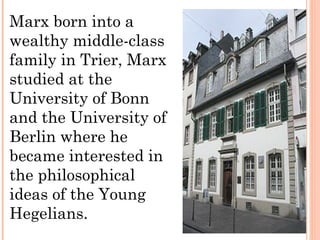
Marx born into a 
wealthy middle-class 
family in Trier, Marx 
studied at the 
University of Bonn 
and the University of 
Berlin where he 
became interested in 
the philosophical 
ideas of the Young 
Hegelians.
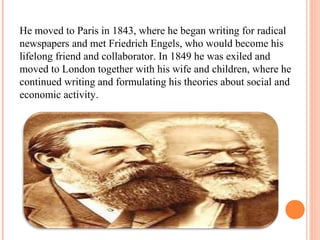
He moved to Paris in 1843, where he began writing for radical 
newspapers and met Friedrich Engels, who would become his 
lifelong friend and collaborator. In 1849 he was exiled and 
moved to London together with his wife and children, where he 
continued writing and formulating his theories about social and 
economic activity.
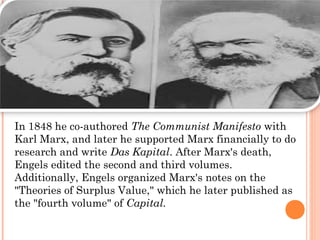
was a German social 
scientist, author, 
political theorist, 
philosopher, and father 
of Marxist theory, 
together with Karl 
Marx.
In 1848 he co-authored The Communist Manifesto with 
Karl Marx, and later he supported Marx financially to do 
research and write Das Kapital. After Marx's death, 
Engels edited the second and third volumes. 
Additionally, Engels organized Marx's notes on the 
"Theories of Surplus Value," which he later published as 
the "fourth volume" of Capital.
The Communist Manifesto: one of 
the most influential political 
manuscripts published in 1848. It 
presents an analytical approach to the 
class struggle, the problems of 
capitalism and the capitalist mode of 
production. 
The book contains Marx and Engels' 
theories about the nature of society 
and politics, that in their own words, 
"The history of all hitherto existing 
society is the history of class 
struggles".
Capital: Critique of Political 
Economy is a critical analysis of 
political economy published in 1867 
intended to reveal the economic laws 
of the capitalist mode of production. 
Karl Marx proposes that the 
motivating force of capitalism is in 
the exploitation of labor, whose 
unpaid work is the ultimate source of 
surplus value and then profit both of 
which concepts have a specific 
meaning for Marx.
Marxism 
??????
Marxists believe that they and they 
alone have an empirical, scientific 
approach to human history and society
All societies are ddiivviiddeedd iinnttoo ttwwoo ggrroouuppss::
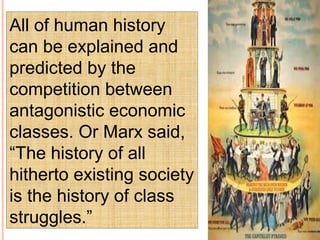
All of human history 
can be explained and 
predicted by the 
competition between 
antagonistic economic 
classes. Or Marx said, 
“The history of all 
hitherto existing society 
is the history of class 
struggles.”
Owners eexxppllooiitt wwoorrkkeerrss aanndd lliivvee ooffff tthhee 
mmoonneeyy wwhhiicchh tthhee wwoorrkkeerrss eeaarrnn.. 
WWoorrkkeerrss ppuutt uupp wwiitthh tthhiiss iinneeqquuaalliittyy bbeeccaauussee:: 
11..TThheeyy aarree oopppprreesssseedd wwaaggee ssllaavveess aanndd 
ccaannnnoott ffiigghhtt tthhee ssyysstteemm.. 
22..TThheeyy aarree iinnddooccttrriinnaatteedd bbyy iiddeeoollooggyy aanndd 
rreelliiggiioonn iinnttoo bbeelliieevviinngg wwhhaatt tthheeyy aarree ttoolldd bbyy 
tthhee ppoowweerrffuull..
 Social classes are competing in essence for control 
of the state. 
 As Marxists would put it: the class that controls the 
Mode of Production also controls the State. 
 Marx did not spend much time examining the state 
or political institutions. Political life is an illusion or 
distortion of reality, so why study that distortion? It is 
better to concentrate on the reality behind the veil of 
politics: the economic structure of society.
 Power was held by a minority (the elite or 
bourgeoisie) who had access to capital and could use 
their money and power to generate more wealth. 
 The majority of the population (the mass or 
proletariat) had only their labor (strength and time) to 
help them make a living. 
 Industrialization had meant that the elite were the 
only ones who had access to the means of production.
Without the ability to produce for 
themselves, the mass were dependent on the 
elite for survival. 
 To maximize profits, the elite needed to 
get as much labor from the mass for as little 
cost as possible. 
The elite needed the mass to accept their 
position as powerless workers.
What is 
communism?
Communism is a political philosophy 
which argues that all men (and women) 
should have equal rights to wealth. 
Communism is a political philosophy 
which argues that all men (and women) 
should have equal rights to wealth. 
A theoretical economic system 
characterized by the collective ownership 
of property and by the organization of labor 
for the common advantage of all members.
Communist symbolism consists of a series of symbols 
that represent (either literally or figuratively) a variety 
of themes associated with communism. These themes 
may include: 
 Revolution 
 The proletariat 
 The peasantry 
 Agriculture 
 International solidarity.
The hammer stands for the 
industrial working-class while 
the sickle represents the 
agricultural workers; together 
the hammer and sickle 
represent the unity of these 
two groups.
The five-pointed red star: It sometimes 
understood to represent the five fingers of 
the worker's hand, as well as the five 
continents. Or it represents the five social 
groups that would lead Russia to 
communism: the youth, the military, the 
industrial laborers, the agricultural 
workers or peasantry, and the 
intelligentsia.
Capitalism is an economic system in which trade, 
industry, and the means of production are largely 
owned and operated for profit. 
Capitalism generates inequalities of 
income and wealth.
Disadvantages 
Rich get richer, the poor get poorer. 
It’s not accepted in most societies. 
People in power limit diversity and 
competition (weakens the system as a 
whole). 
The consumer holds power in the 
economy.
Marx’s 6 stages of history 
Marx thought all of Communism 
history is a STRUGGLE 
between haves and have 
nots. 
Primitive 
Communis 
m 
Slave 
society 
Capitalism 
Socialism 
Feudalism
Primitive Communism: this is how humans first 
lived together – in small tribes. Primitive means 
‘not very advanced’ e.g. hunting and gathering. 
Communism means that everything was shared 
amongst the tribe – food, jobs, belongings. No-one 
owned land.
Slave Societies = Greeks & 
Romans, this is the beginning 
of class struggle between 
the haves and have nots.
The king becomes the ruler 
over all the people. He gives 
land and privileges to ‘nobles’ 
who rule the people for him. 
The people are kept 
uneducated and told that God 
chose the king to rule. The 
church helps the king this way. 
As trade develops, some people 
get richer. This leads to 
Capitalism…..
The business owners or capitalists get 
richer while the workers do all the hard 
work. The capitalists get more power to 
serve their own interests 
Capitalism creates a huge 
working-class of people who soon 
get angry at the way they are 
treated. They organize in unions 
and demand changes. This will 
lead to a revolution and 
Socialism…
In the Socialist 
revolution all 
the rulers – 
kings, churches, 
capitalists are 
got rid of. 
The workers take control of 
the country to produce 
things for everyone. So 
nothing is made for profit, all 
people benefit from 
education and health. These 
ideas spread across the 
world to create Communism….
Communism = No government 
controls the means of 
production…no classes in 
society 
Means of Production = All 
of the expensive goods 
that you need to be 
wealthy in a capitalist 
society.
Marx's theory
Marx's theory
Marx's theory

Marx's theory

  • 2.
    Marx was aGerman philosopher, economist, sociologist, historian, journalist, and revolutionary socialist. Marx's work in economics laid the basis for the current understanding of labour and its relation to capital, and has influenced much of subsequent economic thought.
  • 3.
    Marx born intoa wealthy middle-class family in Trier, Marx studied at the University of Bonn and the University of Berlin where he became interested in the philosophical ideas of the Young Hegelians.
  • 4.
    He moved toParis in 1843, where he began writing for radical newspapers and met Friedrich Engels, who would become his lifelong friend and collaborator. In 1849 he was exiled and moved to London together with his wife and children, where he continued writing and formulating his theories about social and economic activity.
  • 5.
    was a Germansocial scientist, author, political theorist, philosopher, and father of Marxist theory, together with Karl Marx.
  • 6.
    In 1848 heco-authored The Communist Manifesto with Karl Marx, and later he supported Marx financially to do research and write Das Kapital. After Marx's death, Engels edited the second and third volumes. Additionally, Engels organized Marx's notes on the "Theories of Surplus Value," which he later published as the "fourth volume" of Capital.
  • 7.
    The Communist Manifesto:one of the most influential political manuscripts published in 1848. It presents an analytical approach to the class struggle, the problems of capitalism and the capitalist mode of production. The book contains Marx and Engels' theories about the nature of society and politics, that in their own words, "The history of all hitherto existing society is the history of class struggles".
  • 8.
    Capital: Critique ofPolitical Economy is a critical analysis of political economy published in 1867 intended to reveal the economic laws of the capitalist mode of production. Karl Marx proposes that the motivating force of capitalism is in the exploitation of labor, whose unpaid work is the ultimate source of surplus value and then profit both of which concepts have a specific meaning for Marx.
  • 9.
  • 11.
    Marxists believe thatthey and they alone have an empirical, scientific approach to human history and society
  • 13.
    All societies areddiivviiddeedd iinnttoo ttwwoo ggrroouuppss::
  • 14.
    All of humanhistory can be explained and predicted by the competition between antagonistic economic classes. Or Marx said, “The history of all hitherto existing society is the history of class struggles.”
  • 15.
    Owners eexxppllooiitt wwoorrkkeerrssaanndd lliivvee ooffff tthhee mmoonneeyy wwhhiicchh tthhee wwoorrkkeerrss eeaarrnn.. WWoorrkkeerrss ppuutt uupp wwiitthh tthhiiss iinneeqquuaalliittyy bbeeccaauussee:: 11..TThheeyy aarree oopppprreesssseedd wwaaggee ssllaavveess aanndd ccaannnnoott ffiigghhtt tthhee ssyysstteemm.. 22..TThheeyy aarree iinnddooccttrriinnaatteedd bbyy iiddeeoollooggyy aanndd rreelliiggiioonn iinnttoo bbeelliieevviinngg wwhhaatt tthheeyy aarree ttoolldd bbyy tthhee ppoowweerrffuull..
  • 16.
     Social classesare competing in essence for control of the state.  As Marxists would put it: the class that controls the Mode of Production also controls the State.  Marx did not spend much time examining the state or political institutions. Political life is an illusion or distortion of reality, so why study that distortion? It is better to concentrate on the reality behind the veil of politics: the economic structure of society.
  • 17.
     Power washeld by a minority (the elite or bourgeoisie) who had access to capital and could use their money and power to generate more wealth.  The majority of the population (the mass or proletariat) had only their labor (strength and time) to help them make a living.  Industrialization had meant that the elite were the only ones who had access to the means of production.
  • 18.
    Without the abilityto produce for themselves, the mass were dependent on the elite for survival.  To maximize profits, the elite needed to get as much labor from the mass for as little cost as possible. The elite needed the mass to accept their position as powerless workers.
  • 19.
  • 20.
    Communism is apolitical philosophy which argues that all men (and women) should have equal rights to wealth. Communism is a political philosophy which argues that all men (and women) should have equal rights to wealth. A theoretical economic system characterized by the collective ownership of property and by the organization of labor for the common advantage of all members.
  • 21.
    Communist symbolism consistsof a series of symbols that represent (either literally or figuratively) a variety of themes associated with communism. These themes may include:  Revolution  The proletariat  The peasantry  Agriculture  International solidarity.
  • 22.
    The hammer standsfor the industrial working-class while the sickle represents the agricultural workers; together the hammer and sickle represent the unity of these two groups.
  • 23.
    The five-pointed redstar: It sometimes understood to represent the five fingers of the worker's hand, as well as the five continents. Or it represents the five social groups that would lead Russia to communism: the youth, the military, the industrial laborers, the agricultural workers or peasantry, and the intelligentsia.
  • 25.
    Capitalism is aneconomic system in which trade, industry, and the means of production are largely owned and operated for profit. Capitalism generates inequalities of income and wealth.
  • 26.
    Disadvantages Rich getricher, the poor get poorer. It’s not accepted in most societies. People in power limit diversity and competition (weakens the system as a whole). The consumer holds power in the economy.
  • 27.
    Marx’s 6 stagesof history Marx thought all of Communism history is a STRUGGLE between haves and have nots. Primitive Communis m Slave society Capitalism Socialism Feudalism
  • 28.
    Primitive Communism: thisis how humans first lived together – in small tribes. Primitive means ‘not very advanced’ e.g. hunting and gathering. Communism means that everything was shared amongst the tribe – food, jobs, belongings. No-one owned land.
  • 29.
    Slave Societies =Greeks & Romans, this is the beginning of class struggle between the haves and have nots.
  • 30.
    The king becomesthe ruler over all the people. He gives land and privileges to ‘nobles’ who rule the people for him. The people are kept uneducated and told that God chose the king to rule. The church helps the king this way. As trade develops, some people get richer. This leads to Capitalism…..
  • 31.
    The business ownersor capitalists get richer while the workers do all the hard work. The capitalists get more power to serve their own interests Capitalism creates a huge working-class of people who soon get angry at the way they are treated. They organize in unions and demand changes. This will lead to a revolution and Socialism…
  • 32.
    In the Socialist revolution all the rulers – kings, churches, capitalists are got rid of. The workers take control of the country to produce things for everyone. So nothing is made for profit, all people benefit from education and health. These ideas spread across the world to create Communism….
  • 33.
    Communism = Nogovernment controls the means of production…no classes in society Means of Production = All of the expensive goods that you need to be wealthy in a capitalist society.