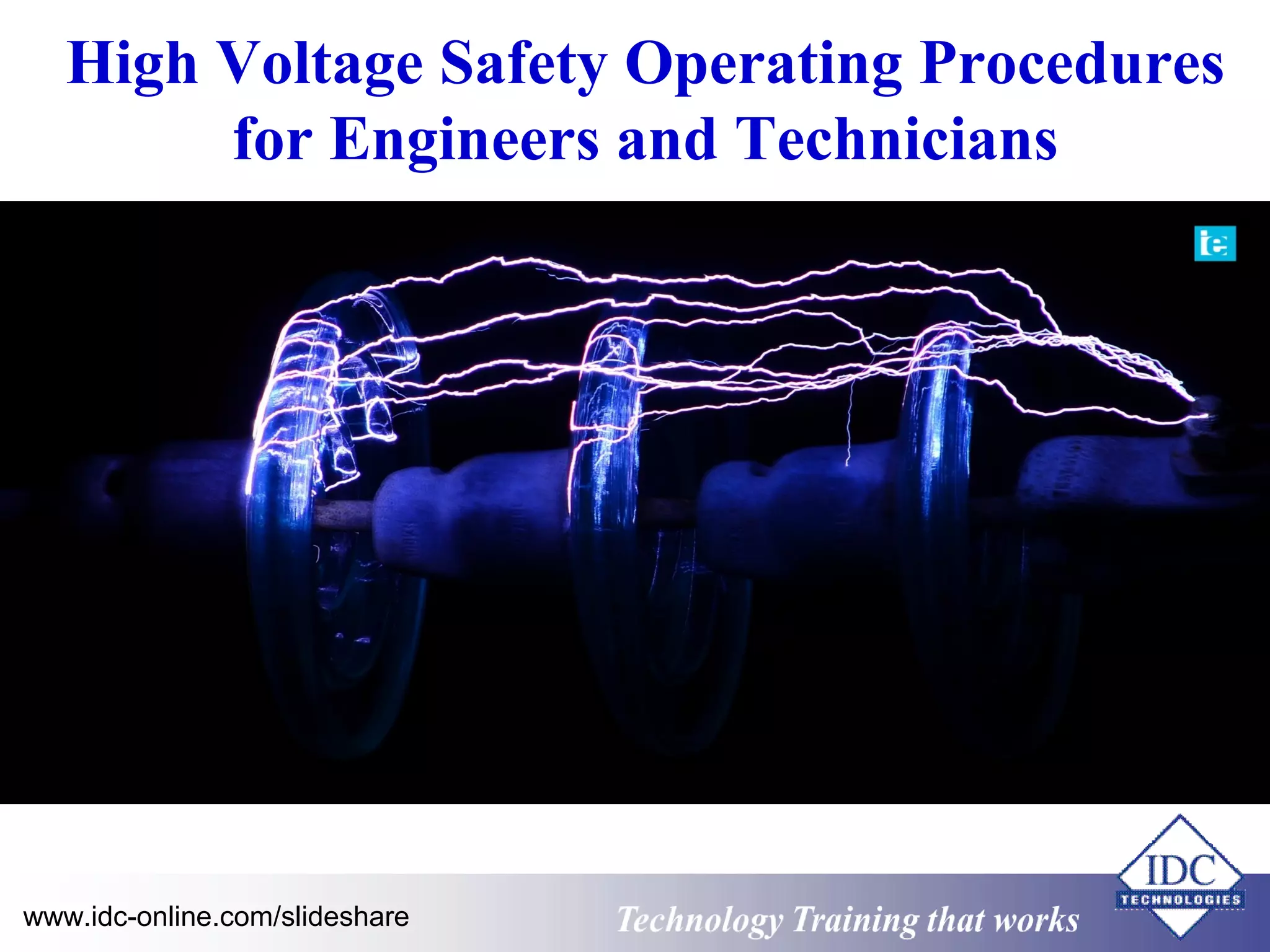
High Voltage Safety Operating Procedures 
for Engineers and Technicians 
www.idc-online.com/slideshare Technology TTrraaiinniinngg tthhaatt WWoorrkkss
Voltage classification 
• High Voltage: Any voltage exceeding 1000 
V rms or 1000 V dc with current capability 
exceeding 2 mA ac or 3 mA dc, or for an 
impulse voltage generator having a stored 
energy in excess of 10 mJ 
• Moderate Voltage : Any voltage exceeding 
120 V rms (nominal power line voltage) or 
120 V dc, but not exceeding 1000 V (rms or 
dc), with a current capability exceeding 2 
mA ac or 3 mA dc 
www.idc-online.com/slideshare Technology TTrraaiinniinngg tthhaatt WWoorrkkss
Life threatening effects of current 
• Currents in excess of human's "let-go" current (>16 mA at 60 Hz) 
passing through chest can produce collapse, unconsciousness, 
asphyxia, even death 
• Currents (>30 mA at 60 Hz) flowing through nerve centers that 
control breathing can produce respiratory inhibition, which could 
last long after interruption of current 
• Cardiac arrest can be caused by current > to 1 A at 60 Hz 
flowing in region of heart 
• Relatively high currents (0.25-1 A) can produce fatal damage to 
the central nervous system 
• Currents > 5 A can produce deep body and organ burns, 
substantially raise body temperature, and cause immediate death 
www.idc-online.com/slideshare Technology TTrraaiinniinngg tthhaatt WWoorrkkss
Hazards from electrical equipment 
• Internal organ damage due to passage of electricity through 
body 
• Burns on skin at point of contact 
• Injuries by electric shock combined with fall 
• Arc flash causing external burns and injuries by explosive 
expansion of air due to the arc. 
• Fall from heights 
• Corrosive liquids used in electrical equipment 
• Hazards resulting from explosive atmosphere 
• Hazards due to high temperature 
www.idc-online.com/slideshare Technology TTrraaiinniinngg tthhaatt WWoorrkkss
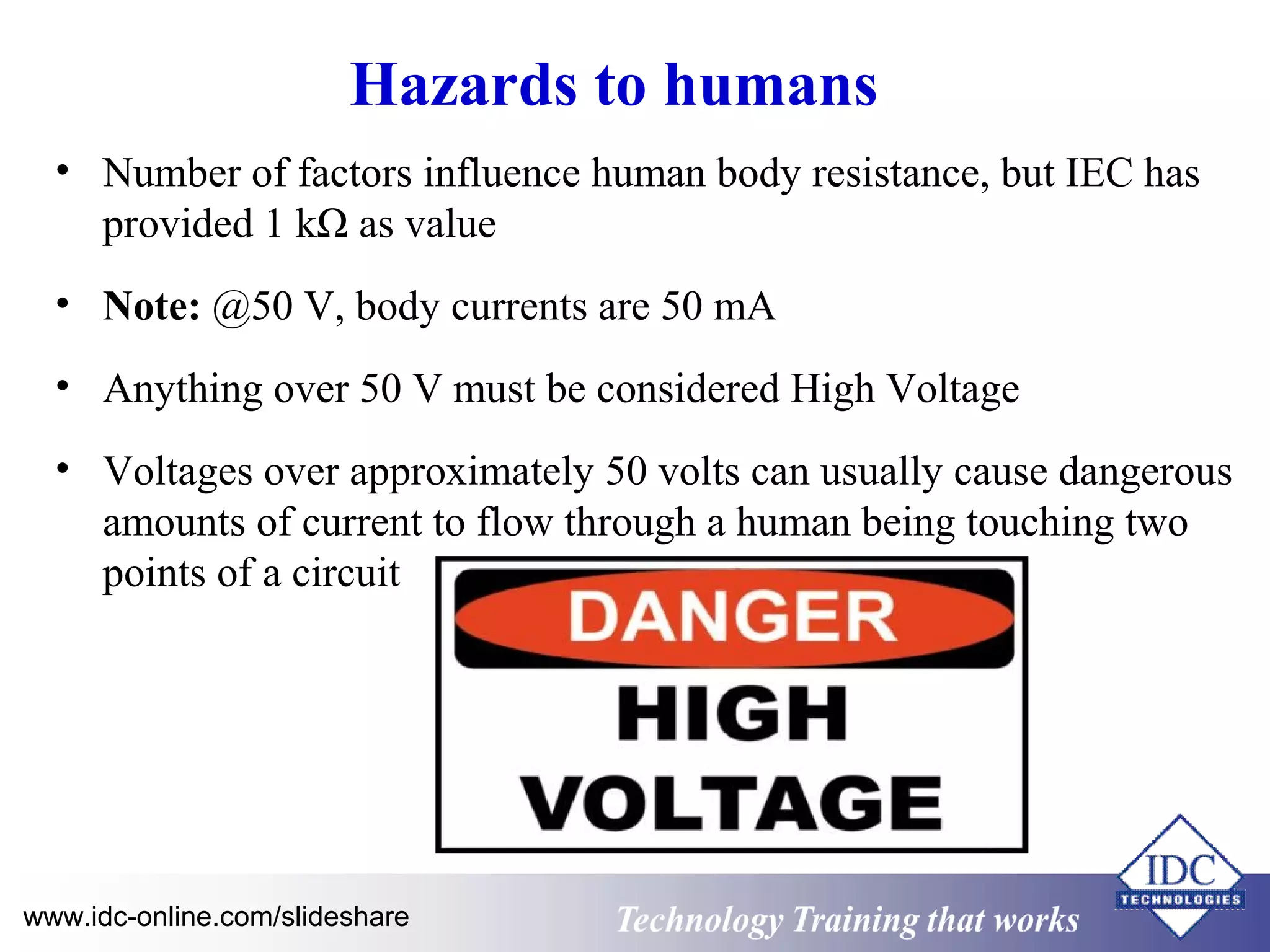
Hazards to humans 
• Number of factors influence human body resistance, but IEC has 
provided 1 kΩ as value 
• Note: @50 V, body currents are 50 mA 
• Anything over 50 V must be considered High Voltage 
• Voltages over approximately 50 volts can usually cause dangerous 
amounts of current to flow through a human being touching two 
points of a circuit 
www.idc-online.com/slideshare Technology TTrraaiinniinngg tthhaatt WWoorrkkss
Effect of temperature on body 
Skin 
Temperature 
Time 
Duration 
Effect 
on skin 
1100 F 6 Sec Cell breakdown begins 
1580 F 1 Sec Complete cell destruction 
1760 F 0.1 Sec Curable burn 
2050 F 0.1 Sec Incurable burn 
www.idc-online.com/slideshare Technology TTrraaiinniinngg tthhaatt WWoorrkkss
Electric burns 
• Current generates intense heat often in excess of 2000°F along its 
path through body - Can lead to severe muscle, nerve and blood 
vessel damage 
• Arcing - Heat generated in arc can be as high as 4,000°C, can 
vaporize metal. Causes a patient’s clothing to ignite, cause flame 
burns 
• Skin burn caused by flash - Flash can result from power source or 
from ignition of clothing or surroundings 
• Traumatic injury caused by intense muscle spasm with current or 
from fall 
• Variety of cardiac, lung muscle, nerve and internal organ injuries 
which can occur, some being immediately life threatening 
www.idc-online.com/slideshare Technology TTrraaiinniinngg tthhaatt WWoorrkkss
Burn classifications 
Burn classification-First degree 
• Red and very sensitive to touch, 
• Skin will appear blanched when light pressure is applied 
• Involve minimal tissue damage 
• Involve the epidermis (skin surface) 
• Affect the outer-layer of skin causing pain, redness and 
swelling 
• Sunburn is a good example of a first-degree burn 
www.idc-online.com/slideshare Technology TTrraaiinniinngg tthhaatt WWoorrkkss
Burn classifications 
Burn classification-Second degree 
• Affect both the outer-layer (epidermis) and the 
underlying layer of skin (dermis) 
• Cause redness, pain, swelling and blisters 
• Often affect sweat glands, and hair follicles 
www.idc-online.com/slideshare Technology TTrraaiinniinngg tthhaatt WWoorrkkss
Burn classifications 
Burn classification-Third degree 
• Affect the epidermis, dermis and hypodermis 
• Cause charring of skin or a translucent white color 
• Burn areas may be numb 
• Any pain is usually because of second-degree burns 
• Very slow healing due to the skin tissue and structures being 
destroyed Usually results in extensive scarring 
www.idc-online.com/slideshare Technology TTrraaiinniinngg tthhaatt WWoorrkkss
Common complications of electric burns 
www.idc-online.com/slideshare Technology TTrraaiinniinngg tthhaatt WWoorrkkss
Arc Faults 
• An arc is produced by flow of electrical current through 
ionized air after initial flashover or short circuit 
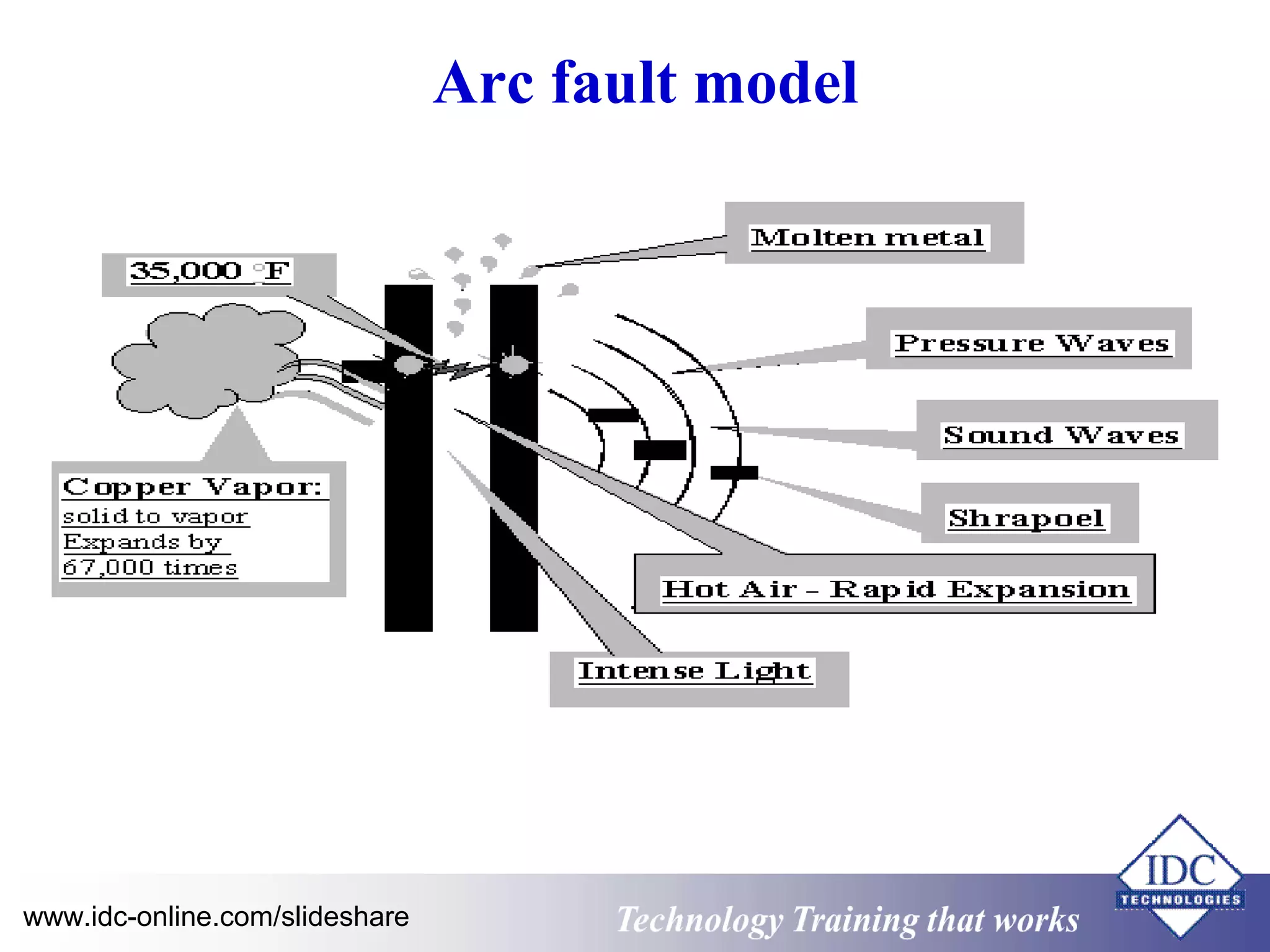
• Arcs produce some of highest temperatures known to occur on 
earth – up to 35,000 deg F 
• This is four times the surface temperature of sun 
• All known materials are vaporized at this temperature 
• Intense heat from arc causes a sudden expansion of air. This 
results in a blast with a very strong air pressure 
www.idc-online.com/slideshare Technology TTrraaiinniinngg tthhaatt WWoorrkkss
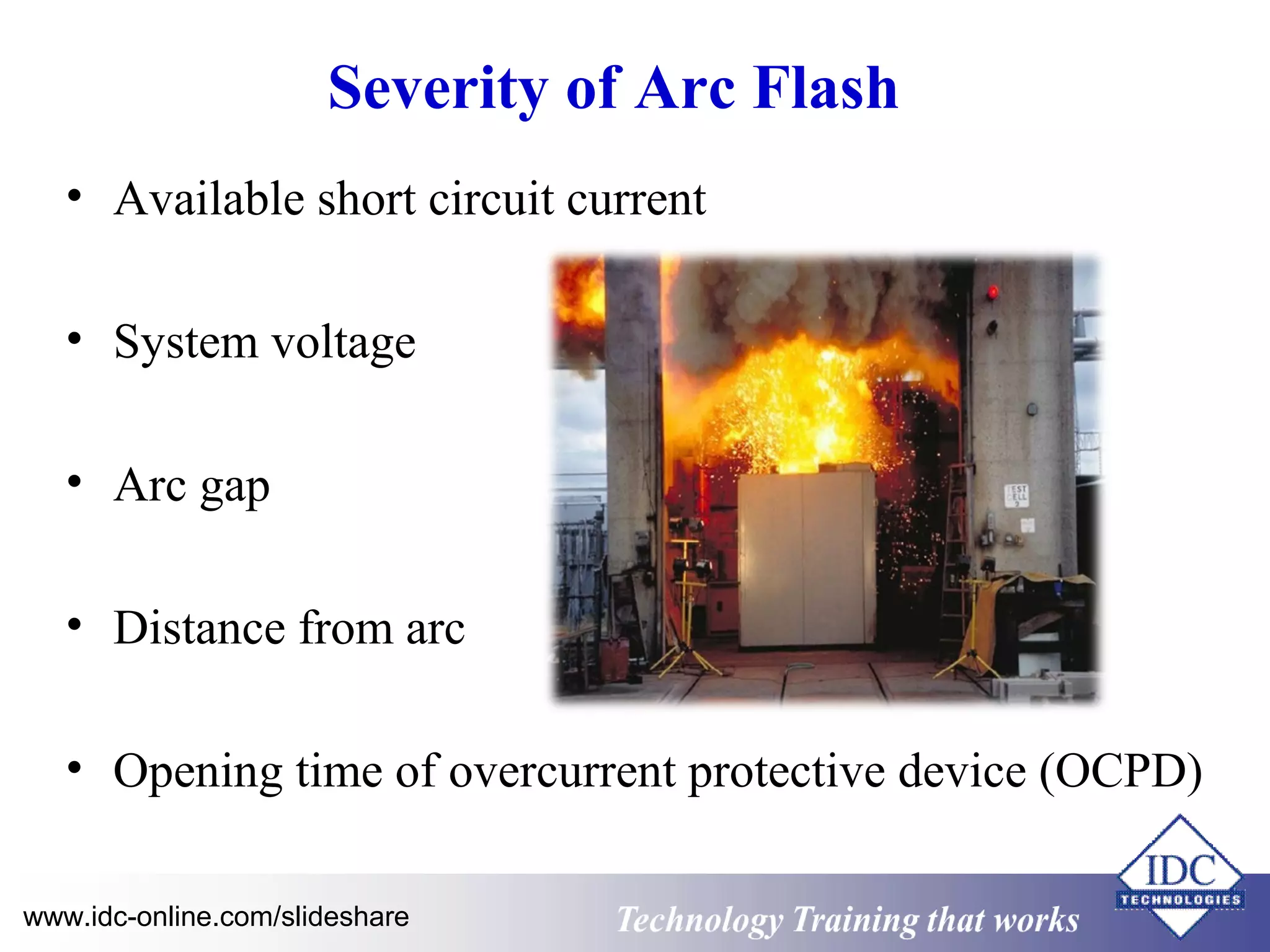
Severity of Arc Flash 
• Available short circuit current 
• System voltage 
• Arc gap 
• Distance from arc 
• Opening time of overcurrent protective device (OCPD) 
www.idc-online.com/slideshare Technology TTrraaiinniinngg tthhaatt WWoorrkkss
Effects of Arc Flash 
• For low voltage system, 3 to 4 inch arc can become stabilized and 
can persist for extended period of time 
• Energy released is function of arc voltage, fault current and fault 
duration 
• Arcs in enclosures, such as Motor Control Centers or 
switchgears, magnify blast and energy is transmitted towards 
worker as blast is forced to open side of enclosure 
• Intense light generated by Arc-Flash emits dangerous ultraviolet 
rays, which may cause temporary or permanent blindness 
• Sound energy from blasts and pressure waves can reach 160 Db 
easily rupturing eardrums, causing permanent hearing loss 
www.idc-online.com/slideshare Technology TTrraaiinniinngg tthhaatt WWoorrkkss
Arc fault model 
www.idc-online.com/slideshare Technology TTrraaiinniinngg tthhaatt WWoorrkkss
Hazards of arcing fault 
• Objects: Arcs spray droplets of molten metal at high-speed 
pressure - Blast shrapnel can penetrate the body. Tools, loose 
nuts and bolts, and similar items in the path of an arc blast may 
become projectiles. 
• Clothing can be ignited from several feet away - Clothed areas 
can be burned more severely than exposed skin 
• Pressure: Total force on worker standing in front of enclosure 
may exceed 1000 pounds 
• Such forces may crush a worker’s chest breaking bones, 
puncturing lungs or other organs or even propel workers into 
equipment, walls, windows, etc, causing additional trauma 
www.idc-online.com/slideshare Technology TTrraaiinniinngg tthhaatt WWoorrkkss
Common causes of Arc-Flash 
• Worn or broken conductor insulation 
• Exposed live parts 
• Loose wire connections 
• Improperly maintained switches and circuit breakers 
• Obstructed disconnect panels 
• Water or liquid near electrical equipment 
• High voltage cables 
• Static electricity 
• Damaged tools and equipment 
www.idc-online.com/slideshare Technology TTrraaiinniinngg tthhaatt WWoorrkkss
Shock protection boundary 
• Limited Approach Boundary: unqualified persons 
must be accompanied by a qualified person and use PPE 
• Restricted Approach Boundary: Only qualified 
persons are allowed in this boundary and they must use 
PPE. 
• Prohibited Approach Boundary: Work in this 
boundary is considered the same as making direct 
contact with an energized part. 
www.idc-online.com/slideshare Technology TTrraaiinniinngg tthhaatt WWoorrkkss
IEEE 1584 Arc-Flash Hazard Calculation 
• IEEE 1584 - Guide for Performing Arc-Flash Hazard Calculations 
• Contains detailed methods, data that can be used to calculate Arc- 
Flash Hazards 
• Petroleum and Chemical Industry committee of the IEEE spent 
many years developing these methods 
• Based on empirical testing of Class RK1 and Class L fuses, Low 
Voltage Molded Case Circuit Breakers, Insulated Case Circuit 
Breakers and Low Voltage Power Circuit Breakers as well as 
theoretical modeling 
www.idc-online.com/slideshare Technology TTrraaiinniinngg tthhaatt WWoorrkkss
Design a safer system 
• Provide maximum protection to personnel, equipment, property 
• Meet all applicable code requirements (OSHA, NFPA, Building 
and Insurance codes, etc.) 
• Utilize current-limiting overcurrent protective devices to minimize 
Arc-Flash hazards 
• Utilize “touch-safe” components to minimize exposure to 
energized components 
• Utilize fuses with blown fuse indication to minimize exposure to 
energized components while trouble-shooting the circuit 
• Provide selective coordination (only the area where the fault 
occurs is shut-off) 
• Provide a system that is safe to service and maintain 
www.idc-online.com/slideshare Technology TTrraaiinniinngg tthhaatt WWoorrkkss
Maintenance 
• Safe maintenance practices and procedures 
• Training employees in knowledge of equipment 
and tools 
• Disconnect Operation 
• Proper Service or Repair of All Equipment or 
Devices 
• Placing equipment in service 
• Lockout/tagout Procedures 
www.idc-online.com/slideshare Technology TTrraaiinniinngg tthhaatt WWoorrkkss
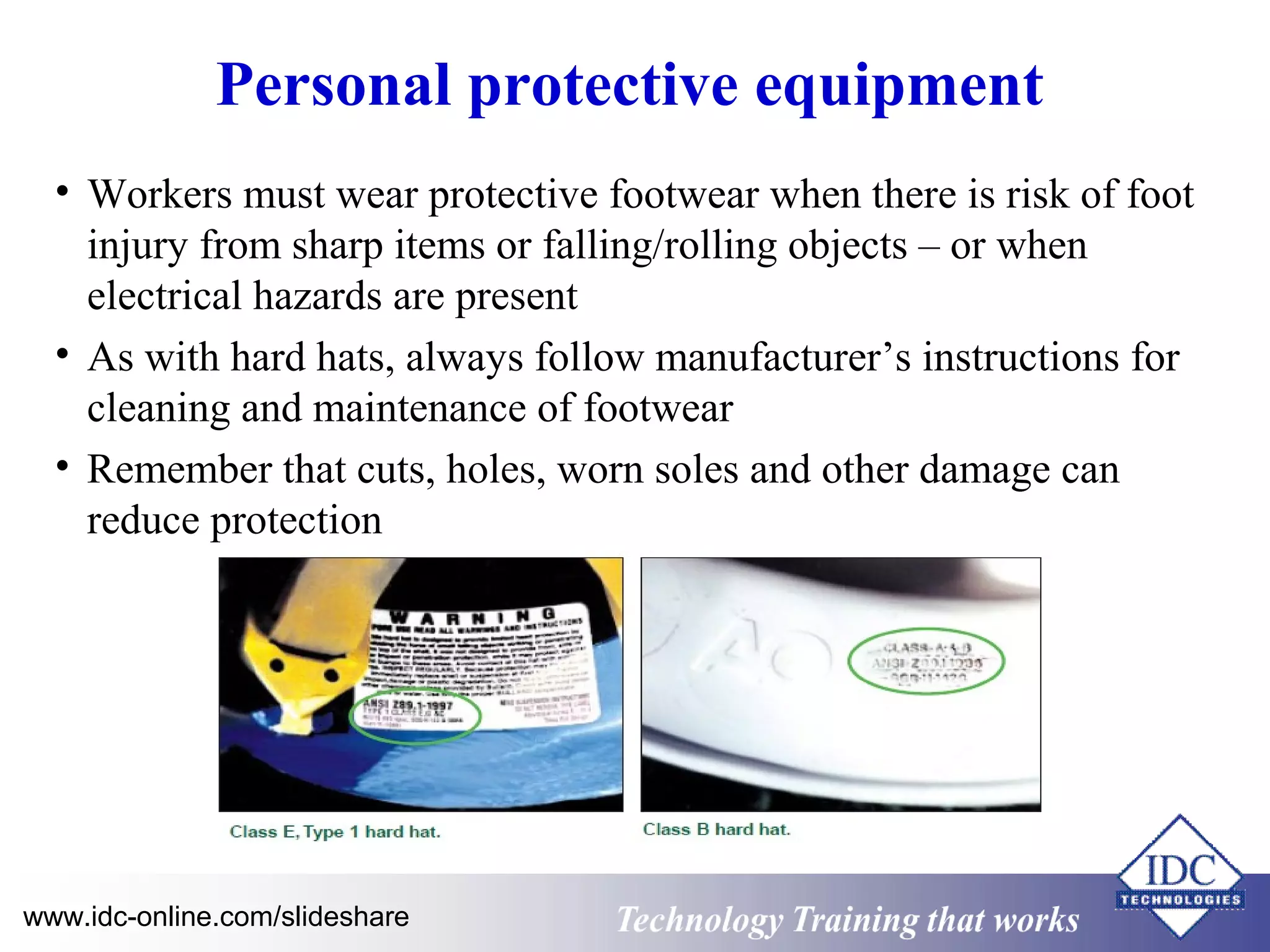
Personal protective equipment 
• Workers must wear protective footwear when there is risk of foot 
injury from sharp items or falling/rolling objects – or when 
electrical hazards are present 
• As with hard hats, always follow manufacturer’s instructions for 
cleaning and maintenance of footwear 
• Remember that cuts, holes, worn soles and other damage can 
reduce protection 
www.idc-online.com/slideshare Technology TTrraaiinniinngg tthhaatt WWoorrkkss
Electrical hazards in different equipment 
Type of equipment Hazards 
Generation equipment Electric shock, arc flash, mechanical hazards 
Transformers Electric shock, arc flash, fire hazard, fall from 
heights 
Overhead Transmission/distribution lines Electric shock, arc flash, fall from heights 
Cables Electric shock, arc flash, fire hazard 
Bus ducts Electric shock, arc flash, thermal hazard, fall from 
heights 
Switchgear Electric shock, arc flash, thermal hazard, fire 
hazard, mechanical hazard 
Motive equipment Electric shock, arc flash, thermal hazard, 
mechanical hazards 
Heating equipment Electric shock, arc flash, thermal hazard 
Lighting equipment Electric shock, arc flash, thermal hazard, fall from 
heights 
Uninterrupted power supplies with battery Electric shock, arc flash, hazards from corrosive 
liquids and explosive gases 
www.idc-online.com/slideshare Technology TTrraaiinniinngg tthhaatt WWoorrkkss
Additional hazards 
• Induction from other circuits and communications 
equipment such as radio transmitters 
• Build up of static charges due to weather conditions 
• Feedback from secondary or tertiary systems 
• Stored energy in high voltage capacitor banks 
• Working under or over other live conductors 
www.idc-online.com/slideshare Technology TTrraaiinniinngg tthhaatt WWoorrkkss
Causes for electrical accidents 
• Failure to isolate or inadequate or insecure 
isolation of live parts 
• Poor maintenance and faulty equipment 
• Insufficient information about the system being 
worked on 
• Carelessness and lack of safety procedures 
www.idc-online.com/slideshare Technology TTrraaiinniinngg tthhaatt WWoorrkkss
General safety measures 
• Safe design/installation of plant and equipment as per 
applicable codes and regulations 
• Safe operating and maintenance practices established 
through documented procedures and instructions 
• Appropriate knowledge on the part of workers by 
proper training and certification 
• Posting clear warning signs at points of hazard 
www.idc-online.com/slideshare Technology TTrraaiinniinngg tthhaatt WWoorrkkss
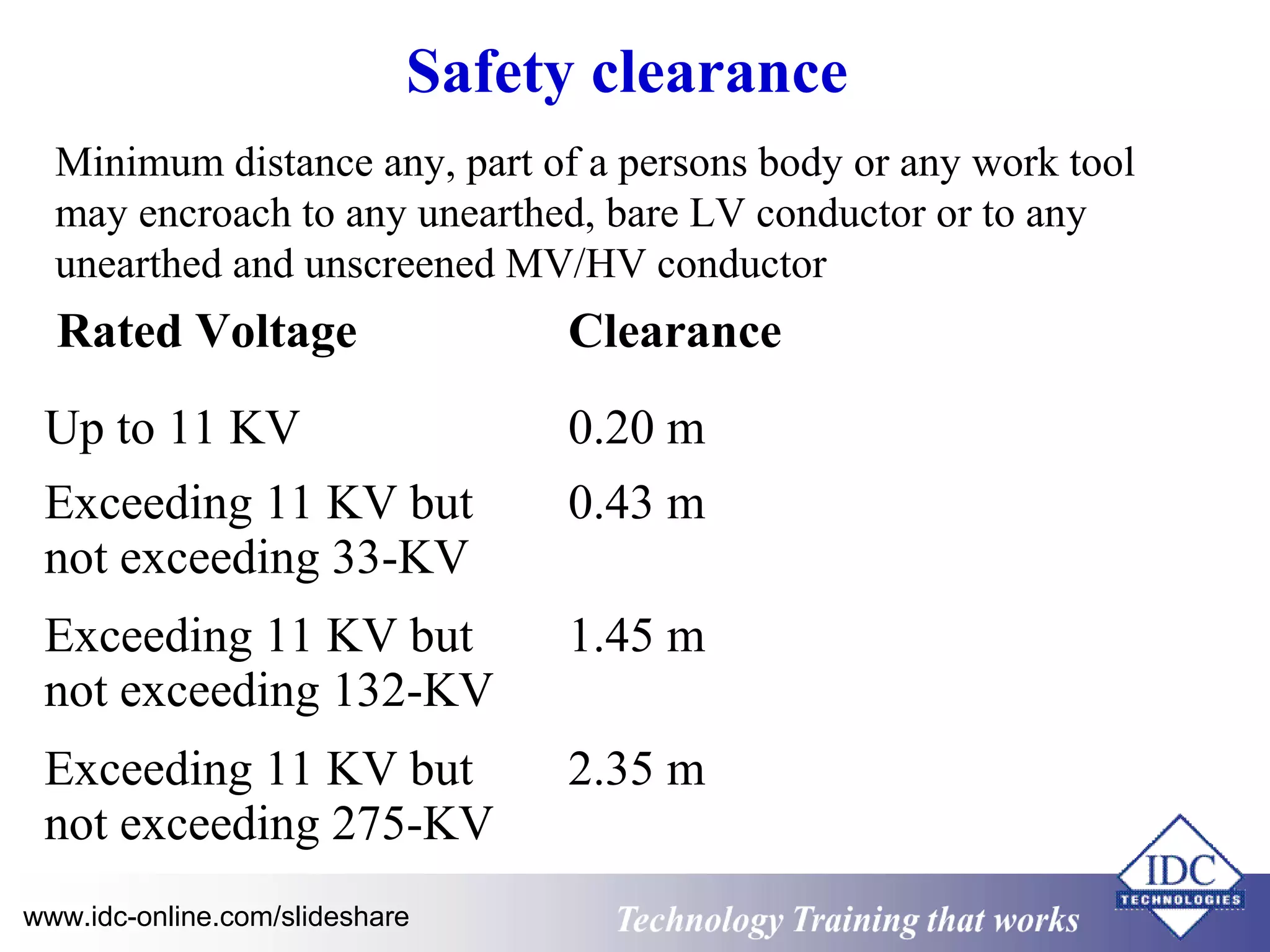
Safety clearance 
Minimum distance any, part of a persons body or any work tool 
may encroach to any unearthed, bare LV conductor or to any 
unearthed and unscreened MV/HV conductor 
Rated Voltage Clearance 
Up to 11 KV 0.20 m 
Exceeding 11 KV but 
0.43 m 
not exceeding 33-KV 
Exceeding 11 KV but 
not exceeding 132-KV 
1.45 m 
Exceeding 11 KV but 
not exceeding 275-KV 
2.35 m 
www.idc-online.com/slideshare Technology TTrraaiinniinngg tthhaatt WWoorrkkss
Basic safety requirements 
• Plan the job from start to finish, & think about things could go wrong 
• Use procedures, drawings & other documents as tools to help you do the 
job properly 
• Don't work alone - in the event of an emergency another person's presence 
may be essential 
• Know the emergency procedures to follow in case of an accident i.e. put 
any emergency buzzer available or call for ambulance etc. 
• Never enter alone into an area containing exposed electrical energy sources 
• Use only test instruments, and insulated tools rated for the voltage and 
current specified 
www.idc-online.com/slideshare Technology TTrraaiinniinngg tthhaatt WWoorrkkss
Basic safety procedures 
• De-energize the equipment at least twice prior to beginning work. 
Make sure that the controls applied will prevent operation of the 
equipment and that all hazardous energy, including residual or 
stored energy, is blocked, discharged, or relieved prior to starting 
work 
• Open and lockout the main input power circuit breaker 
• Check for auxiliary power circuits that could still be energized 
• Inspect automatic shorting devices for proper operation. 
• Short the power supply with grounding hooks 
www.idc-online.com/slideshare Technology TTrraaiinniinngg tthhaatt WWoorrkkss
Electrical insulation 
• Retaining voltage at terminals to drive necessary current 
with minimum loss 
• Preventing short circuits between phases and phase to 
ground and consequent arcs 
• Avoiding Electrocution 
• Insulation types: 
• Air insulation 
• Oil Insulation 
• Gas Insulation 
• Solid insulation 
www.idc-online.com/slideshare Technology TTrraaiinniinngg tthhaatt WWoorrkkss
Air insulation 
• Very common insulation in enclosures with dielectric strength of 
app. 3kV/mm 
• Air starts conducting due to ionization of air space separating 
terminals at different voltages. Pollution, moisture (altitude, 
climate changes) are main reasons 
• Air break down voltage depends on: 
– Source voltage magnitude 
– Distance between two different voltage points 
• More spacing needed to avoid air insulation breakdown 
– In case of LV applications, it is limited to enclosed switchgears 
– Cost effective HV insulation for outdoor switchyards and cross country 
transmission lines 
– Increased clearances based on pollution levels to avoid arcing/ flashover 
www.idc-online.com/slideshare Technology TTrraaiinniinngg tthhaatt WWoorrkkss
Oil insulation 
• Oil used as insulation and cooling medium 
• Characteristics determined by dielectric breakdown voltage 
• Insulation properties affected by impurities 
• Formation of dissolved gases due to arcing, higher 
temperatures 
• Oil is Inflammable 
• Leakages should be monitored 
• Oil insulation requires continuous monitoring to ensure safe 
operation 
• More commonly used for HV transformers 
• Used in HV cables, CT, PT, etc 
www.idc-online.com/slideshare Technology TTrraaiinniinngg tthhaatt WWoorrkkss
Gas insulation 
• SF6 is most common insulating medium in HV installations 
• Has much higher dielectric breakdown compared to oil and air. 
Dielectric breakdown 5 times that of air at pressure of few tenths 
of MPa 
• Non toxic and non inflammable 
• Ensures power transmission and control with reduced clearances 
• Equipment becomes compact and hence there is saving in space 
• Requires pressurized enclosures 
• Leakages and pressure loss could be disastrous 
www.idc-online.com/slideshare Technology TTrraaiinniinngg tthhaatt WWoorrkkss
Solid insulation 
• Plastic, rubber and porcelain-based solid materials are commonly 
used as insulation between current carrying conductors and earth 
to prevent shock and flash hazards 
• They are mainly used in air insulation medium 
• PVC, XLPE are the common insulation materials used in cables 
• Porcelain insulators are used to support bare conductors 
www.idc-online.com/slideshare Technology TTrraaiinniinngg tthhaatt WWoorrkkss
Operating temperatures of insulating materials 
Class Material Operating 
temperature 
Class A Insulation: 
mm 
Cotton, silk, paper and similar organic 
materials, impregnated or immersed in oil, 
and enamel applied on wires. 
Hot-spot temperature 
105°C 
Class E Insulation An intermediate class of insulating 
materials between Class A and Class B 
insulation material 
- 
Class B Insulation Mica, asbestos, glass fiber, and similar 
inorganic materials, in built-up form with 
organic binding substances 
130°C 
Class F Insulation Mica, asbestos or glass fiber base with a 
silicone or a similar high temperature 
resistant binding material 
155°C 
Class H Insulation Mica, asbestos, or glass fiber base with a 
silicone or a similar high temperature 
resistant binding material 
180°C 
www.idc-online.com/slideshare Technology TTrraaiinniinngg tthhaatt WWoorrkkss
DO YOU WANT TO KNOW MORE? 
If you are interested in further training or information, 
please visit: 
http://idc-online.com/slideshare 
www.idc-online.com/slideshare Technology TTrraaiinniinngg tthhaatt WWoorrkkss

High Voltage Safety Operating Procedures for Engineers and Technicians

  • 1.
    High Voltage SafetyOperating Procedures for Engineers and Technicians www.idc-online.com/slideshare Technology TTrraaiinniinngg tthhaatt WWoorrkkss
  • 2.
    Voltage classification •High Voltage: Any voltage exceeding 1000 V rms or 1000 V dc with current capability exceeding 2 mA ac or 3 mA dc, or for an impulse voltage generator having a stored energy in excess of 10 mJ • Moderate Voltage : Any voltage exceeding 120 V rms (nominal power line voltage) or 120 V dc, but not exceeding 1000 V (rms or dc), with a current capability exceeding 2 mA ac or 3 mA dc www.idc-online.com/slideshare Technology TTrraaiinniinngg tthhaatt WWoorrkkss
  • 3.
    Life threatening effectsof current • Currents in excess of human's "let-go" current (>16 mA at 60 Hz) passing through chest can produce collapse, unconsciousness, asphyxia, even death • Currents (>30 mA at 60 Hz) flowing through nerve centers that control breathing can produce respiratory inhibition, which could last long after interruption of current • Cardiac arrest can be caused by current > to 1 A at 60 Hz flowing in region of heart • Relatively high currents (0.25-1 A) can produce fatal damage to the central nervous system • Currents > 5 A can produce deep body and organ burns, substantially raise body temperature, and cause immediate death www.idc-online.com/slideshare Technology TTrraaiinniinngg tthhaatt WWoorrkkss
  • 4.
    Hazards from electricalequipment • Internal organ damage due to passage of electricity through body • Burns on skin at point of contact • Injuries by electric shock combined with fall • Arc flash causing external burns and injuries by explosive expansion of air due to the arc. • Fall from heights • Corrosive liquids used in electrical equipment • Hazards resulting from explosive atmosphere • Hazards due to high temperature www.idc-online.com/slideshare Technology TTrraaiinniinngg tthhaatt WWoorrkkss
  • 5.
    Hazards to humans • Number of factors influence human body resistance, but IEC has provided 1 kΩ as value • Note: @50 V, body currents are 50 mA • Anything over 50 V must be considered High Voltage • Voltages over approximately 50 volts can usually cause dangerous amounts of current to flow through a human being touching two points of a circuit www.idc-online.com/slideshare Technology TTrraaiinniinngg tthhaatt WWoorrkkss
  • 6.
    Effect of temperatureon body Skin Temperature Time Duration Effect on skin 1100 F 6 Sec Cell breakdown begins 1580 F 1 Sec Complete cell destruction 1760 F 0.1 Sec Curable burn 2050 F 0.1 Sec Incurable burn www.idc-online.com/slideshare Technology TTrraaiinniinngg tthhaatt WWoorrkkss
  • 7.
    Electric burns •Current generates intense heat often in excess of 2000°F along its path through body - Can lead to severe muscle, nerve and blood vessel damage • Arcing - Heat generated in arc can be as high as 4,000°C, can vaporize metal. Causes a patient’s clothing to ignite, cause flame burns • Skin burn caused by flash - Flash can result from power source or from ignition of clothing or surroundings • Traumatic injury caused by intense muscle spasm with current or from fall • Variety of cardiac, lung muscle, nerve and internal organ injuries which can occur, some being immediately life threatening www.idc-online.com/slideshare Technology TTrraaiinniinngg tthhaatt WWoorrkkss
  • 8.
    Burn classifications Burnclassification-First degree • Red and very sensitive to touch, • Skin will appear blanched when light pressure is applied • Involve minimal tissue damage • Involve the epidermis (skin surface) • Affect the outer-layer of skin causing pain, redness and swelling • Sunburn is a good example of a first-degree burn www.idc-online.com/slideshare Technology TTrraaiinniinngg tthhaatt WWoorrkkss
  • 9.
    Burn classifications Burnclassification-Second degree • Affect both the outer-layer (epidermis) and the underlying layer of skin (dermis) • Cause redness, pain, swelling and blisters • Often affect sweat glands, and hair follicles www.idc-online.com/slideshare Technology TTrraaiinniinngg tthhaatt WWoorrkkss
  • 10.
    Burn classifications Burnclassification-Third degree • Affect the epidermis, dermis and hypodermis • Cause charring of skin or a translucent white color • Burn areas may be numb • Any pain is usually because of second-degree burns • Very slow healing due to the skin tissue and structures being destroyed Usually results in extensive scarring www.idc-online.com/slideshare Technology TTrraaiinniinngg tthhaatt WWoorrkkss
  • 11.
    Common complications ofelectric burns www.idc-online.com/slideshare Technology TTrraaiinniinngg tthhaatt WWoorrkkss
  • 12.
    Arc Faults •An arc is produced by flow of electrical current through ionized air after initial flashover or short circuit • Arcs produce some of highest temperatures known to occur on earth – up to 35,000 deg F • This is four times the surface temperature of sun • All known materials are vaporized at this temperature • Intense heat from arc causes a sudden expansion of air. This results in a blast with a very strong air pressure www.idc-online.com/slideshare Technology TTrraaiinniinngg tthhaatt WWoorrkkss
  • 13.
    Severity of ArcFlash • Available short circuit current • System voltage • Arc gap • Distance from arc • Opening time of overcurrent protective device (OCPD) www.idc-online.com/slideshare Technology TTrraaiinniinngg tthhaatt WWoorrkkss
  • 14.
    Effects of ArcFlash • For low voltage system, 3 to 4 inch arc can become stabilized and can persist for extended period of time • Energy released is function of arc voltage, fault current and fault duration • Arcs in enclosures, such as Motor Control Centers or switchgears, magnify blast and energy is transmitted towards worker as blast is forced to open side of enclosure • Intense light generated by Arc-Flash emits dangerous ultraviolet rays, which may cause temporary or permanent blindness • Sound energy from blasts and pressure waves can reach 160 Db easily rupturing eardrums, causing permanent hearing loss www.idc-online.com/slideshare Technology TTrraaiinniinngg tthhaatt WWoorrkkss
  • 15.
    Arc fault model www.idc-online.com/slideshare Technology TTrraaiinniinngg tthhaatt WWoorrkkss
  • 16.
    Hazards of arcingfault • Objects: Arcs spray droplets of molten metal at high-speed pressure - Blast shrapnel can penetrate the body. Tools, loose nuts and bolts, and similar items in the path of an arc blast may become projectiles. • Clothing can be ignited from several feet away - Clothed areas can be burned more severely than exposed skin • Pressure: Total force on worker standing in front of enclosure may exceed 1000 pounds • Such forces may crush a worker’s chest breaking bones, puncturing lungs or other organs or even propel workers into equipment, walls, windows, etc, causing additional trauma www.idc-online.com/slideshare Technology TTrraaiinniinngg tthhaatt WWoorrkkss
  • 17.
    Common causes ofArc-Flash • Worn or broken conductor insulation • Exposed live parts • Loose wire connections • Improperly maintained switches and circuit breakers • Obstructed disconnect panels • Water or liquid near electrical equipment • High voltage cables • Static electricity • Damaged tools and equipment www.idc-online.com/slideshare Technology TTrraaiinniinngg tthhaatt WWoorrkkss
  • 18.
    Shock protection boundary • Limited Approach Boundary: unqualified persons must be accompanied by a qualified person and use PPE • Restricted Approach Boundary: Only qualified persons are allowed in this boundary and they must use PPE. • Prohibited Approach Boundary: Work in this boundary is considered the same as making direct contact with an energized part. www.idc-online.com/slideshare Technology TTrraaiinniinngg tthhaatt WWoorrkkss
  • 19.
    IEEE 1584 Arc-FlashHazard Calculation • IEEE 1584 - Guide for Performing Arc-Flash Hazard Calculations • Contains detailed methods, data that can be used to calculate Arc- Flash Hazards • Petroleum and Chemical Industry committee of the IEEE spent many years developing these methods • Based on empirical testing of Class RK1 and Class L fuses, Low Voltage Molded Case Circuit Breakers, Insulated Case Circuit Breakers and Low Voltage Power Circuit Breakers as well as theoretical modeling www.idc-online.com/slideshare Technology TTrraaiinniinngg tthhaatt WWoorrkkss
  • 20.
    Design a safersystem • Provide maximum protection to personnel, equipment, property • Meet all applicable code requirements (OSHA, NFPA, Building and Insurance codes, etc.) • Utilize current-limiting overcurrent protective devices to minimize Arc-Flash hazards • Utilize “touch-safe” components to minimize exposure to energized components • Utilize fuses with blown fuse indication to minimize exposure to energized components while trouble-shooting the circuit • Provide selective coordination (only the area where the fault occurs is shut-off) • Provide a system that is safe to service and maintain www.idc-online.com/slideshare Technology TTrraaiinniinngg tthhaatt WWoorrkkss
  • 21.
    Maintenance • Safemaintenance practices and procedures • Training employees in knowledge of equipment and tools • Disconnect Operation • Proper Service or Repair of All Equipment or Devices • Placing equipment in service • Lockout/tagout Procedures www.idc-online.com/slideshare Technology TTrraaiinniinngg tthhaatt WWoorrkkss
  • 22.
    Personal protective equipment • Workers must wear protective footwear when there is risk of foot injury from sharp items or falling/rolling objects – or when electrical hazards are present • As with hard hats, always follow manufacturer’s instructions for cleaning and maintenance of footwear • Remember that cuts, holes, worn soles and other damage can reduce protection www.idc-online.com/slideshare Technology TTrraaiinniinngg tthhaatt WWoorrkkss
  • 23.
    Electrical hazards indifferent equipment Type of equipment Hazards Generation equipment Electric shock, arc flash, mechanical hazards Transformers Electric shock, arc flash, fire hazard, fall from heights Overhead Transmission/distribution lines Electric shock, arc flash, fall from heights Cables Electric shock, arc flash, fire hazard Bus ducts Electric shock, arc flash, thermal hazard, fall from heights Switchgear Electric shock, arc flash, thermal hazard, fire hazard, mechanical hazard Motive equipment Electric shock, arc flash, thermal hazard, mechanical hazards Heating equipment Electric shock, arc flash, thermal hazard Lighting equipment Electric shock, arc flash, thermal hazard, fall from heights Uninterrupted power supplies with battery Electric shock, arc flash, hazards from corrosive liquids and explosive gases www.idc-online.com/slideshare Technology TTrraaiinniinngg tthhaatt WWoorrkkss
  • 24.
    Additional hazards •Induction from other circuits and communications equipment such as radio transmitters • Build up of static charges due to weather conditions • Feedback from secondary or tertiary systems • Stored energy in high voltage capacitor banks • Working under or over other live conductors www.idc-online.com/slideshare Technology TTrraaiinniinngg tthhaatt WWoorrkkss
  • 25.
    Causes for electricalaccidents • Failure to isolate or inadequate or insecure isolation of live parts • Poor maintenance and faulty equipment • Insufficient information about the system being worked on • Carelessness and lack of safety procedures www.idc-online.com/slideshare Technology TTrraaiinniinngg tthhaatt WWoorrkkss
  • 26.
    General safety measures • Safe design/installation of plant and equipment as per applicable codes and regulations • Safe operating and maintenance practices established through documented procedures and instructions • Appropriate knowledge on the part of workers by proper training and certification • Posting clear warning signs at points of hazard www.idc-online.com/slideshare Technology TTrraaiinniinngg tthhaatt WWoorrkkss
  • 27.
    Safety clearance Minimumdistance any, part of a persons body or any work tool may encroach to any unearthed, bare LV conductor or to any unearthed and unscreened MV/HV conductor Rated Voltage Clearance Up to 11 KV 0.20 m Exceeding 11 KV but 0.43 m not exceeding 33-KV Exceeding 11 KV but not exceeding 132-KV 1.45 m Exceeding 11 KV but not exceeding 275-KV 2.35 m www.idc-online.com/slideshare Technology TTrraaiinniinngg tthhaatt WWoorrkkss
  • 28.
    Basic safety requirements • Plan the job from start to finish, & think about things could go wrong • Use procedures, drawings & other documents as tools to help you do the job properly • Don't work alone - in the event of an emergency another person's presence may be essential • Know the emergency procedures to follow in case of an accident i.e. put any emergency buzzer available or call for ambulance etc. • Never enter alone into an area containing exposed electrical energy sources • Use only test instruments, and insulated tools rated for the voltage and current specified www.idc-online.com/slideshare Technology TTrraaiinniinngg tthhaatt WWoorrkkss
  • 29.
    Basic safety procedures • De-energize the equipment at least twice prior to beginning work. Make sure that the controls applied will prevent operation of the equipment and that all hazardous energy, including residual or stored energy, is blocked, discharged, or relieved prior to starting work • Open and lockout the main input power circuit breaker • Check for auxiliary power circuits that could still be energized • Inspect automatic shorting devices for proper operation. • Short the power supply with grounding hooks www.idc-online.com/slideshare Technology TTrraaiinniinngg tthhaatt WWoorrkkss
  • 30.
    Electrical insulation •Retaining voltage at terminals to drive necessary current with minimum loss • Preventing short circuits between phases and phase to ground and consequent arcs • Avoiding Electrocution • Insulation types: • Air insulation • Oil Insulation • Gas Insulation • Solid insulation www.idc-online.com/slideshare Technology TTrraaiinniinngg tthhaatt WWoorrkkss
  • 31.
    Air insulation •Very common insulation in enclosures with dielectric strength of app. 3kV/mm • Air starts conducting due to ionization of air space separating terminals at different voltages. Pollution, moisture (altitude, climate changes) are main reasons • Air break down voltage depends on: – Source voltage magnitude – Distance between two different voltage points • More spacing needed to avoid air insulation breakdown – In case of LV applications, it is limited to enclosed switchgears – Cost effective HV insulation for outdoor switchyards and cross country transmission lines – Increased clearances based on pollution levels to avoid arcing/ flashover www.idc-online.com/slideshare Technology TTrraaiinniinngg tthhaatt WWoorrkkss
  • 32.
    Oil insulation •Oil used as insulation and cooling medium • Characteristics determined by dielectric breakdown voltage • Insulation properties affected by impurities • Formation of dissolved gases due to arcing, higher temperatures • Oil is Inflammable • Leakages should be monitored • Oil insulation requires continuous monitoring to ensure safe operation • More commonly used for HV transformers • Used in HV cables, CT, PT, etc www.idc-online.com/slideshare Technology TTrraaiinniinngg tthhaatt WWoorrkkss
  • 33.
    Gas insulation •SF6 is most common insulating medium in HV installations • Has much higher dielectric breakdown compared to oil and air. Dielectric breakdown 5 times that of air at pressure of few tenths of MPa • Non toxic and non inflammable • Ensures power transmission and control with reduced clearances • Equipment becomes compact and hence there is saving in space • Requires pressurized enclosures • Leakages and pressure loss could be disastrous www.idc-online.com/slideshare Technology TTrraaiinniinngg tthhaatt WWoorrkkss
  • 34.
    Solid insulation •Plastic, rubber and porcelain-based solid materials are commonly used as insulation between current carrying conductors and earth to prevent shock and flash hazards • They are mainly used in air insulation medium • PVC, XLPE are the common insulation materials used in cables • Porcelain insulators are used to support bare conductors www.idc-online.com/slideshare Technology TTrraaiinniinngg tthhaatt WWoorrkkss
  • 35.
    Operating temperatures ofinsulating materials Class Material Operating temperature Class A Insulation: mm Cotton, silk, paper and similar organic materials, impregnated or immersed in oil, and enamel applied on wires. Hot-spot temperature 105°C Class E Insulation An intermediate class of insulating materials between Class A and Class B insulation material - Class B Insulation Mica, asbestos, glass fiber, and similar inorganic materials, in built-up form with organic binding substances 130°C Class F Insulation Mica, asbestos or glass fiber base with a silicone or a similar high temperature resistant binding material 155°C Class H Insulation Mica, asbestos, or glass fiber base with a silicone or a similar high temperature resistant binding material 180°C www.idc-online.com/slideshare Technology TTrraaiinniinngg tthhaatt WWoorrkkss
  • 36.
    DO YOU WANTTO KNOW MORE? If you are interested in further training or information, please visit: http://idc-online.com/slideshare www.idc-online.com/slideshare Technology TTrraaiinniinngg tthhaatt WWoorrkkss