ENGINEER’S RESPONSIBILITY
FOR SAFETY
By
M.Dhilsath Fathima
TOPICS TO COVER..
• Safety and Risk
• Assessment of Safety and Risk
• Risk-Benefit Analysis-Reducing Risk
• The Government Regulator’s Approach to Risk
SAFETY AND RISK
• Imagine you are a fresh graduate.
– You get a job as an engineer in a large atomic power
plant.
• Would you take it or not?
• Under what conditions would you take it?
• Under what conditions would you not?
• Why?
SAFETY AND RISK
• One of the main duties of an engineer is to ensure the
safety of the people who will be affected by the products
that he designs.
• The code of ethics of the professional engineering
societies make it clear that safety is of paramount
importance to the engineer.
• The engineering codes of ethics show that engineers
have a responsibility to society to produce products that
are safe.
• Nothing can be 100% safe, but engineers are required to
make products as safe as reasonably possible.
• Thus safety should be an integral part of any engineering
design.
SAFETY AND RISK(Cont..)
• What may be safe for one person may not be safe for
another person.
– Ex 1: A Power Saw in the hands of a child is unsafe, but it is safe
in hand of adult.
– Ex 2:A sick adult is more prone to ill effects from air pollution
than a healthy adult.
• What is safe to Entrepreneurs, may not be so to Engineers.
e.g., Pilots: "Indian Airports are not safe; Low Vision in Fog“
• What is safe to Engineers, may not be so to Public.
• Typically several groups of people are involved in safety
matters but have their own interests at stake. Each group
may differ in what is safe and what is not.
Concept of Safety
• “A ship in harbor is safe, but that is not what ships are built
for”
• ‘A thing is safe if its risks are judged to be acceptable’
• Definition for Safety
– “A thing is safe (to a certain degree) with respect to a given person or
group at a given time if, were they fully aware of its risks and
expressing their most settled values, they would judge those risks to
be acceptable (to that certain degree.
– Safety: Safe operation of system and the prevention of natural or
human caused disaster.
Ex 1 : We judge fluoride in water can kill lots of people ->
Overestimating risk.
Ex2: We hire a taxi, without thinking about its safety ->
Not estimating risk
• A thing is NOT SAFE if it exposes us to unacceptable danger
or hazard
Concept of Risk
• Risk in technology could include dangers of
– bodily harm,
– economic loss, or
– environmental degradation.
– a situation involving exposure to danger
• Absolute safety is not possible .Any improvement in
making a product safe involves an increase in the cost
of production.
• It is very important for the manufacturer and the user to have
some understanding to know about the risk connected with any
product and know how much it will cost to reduce those risk.
• RISK is the potential that something unwanted and harmful may
occur.
– We take a risk when we undertake something or use a product that is not
safe.
Types of Risk
• Acceptable Risk
• Voluntary risk and Control
• JOB RELATED RISKS
Acceptable Risk
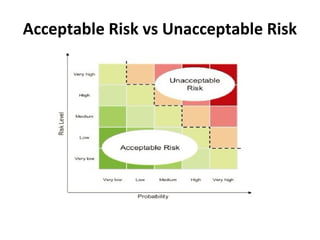
• Acceptable risk refers to the level of human and property injury or loss
from an industrial process that is considered to be tolerable by an
individual, household, group, organization, community, region, state, or
nation in view of the social, political, and economic cost-benefit analysis.
• Example: For instance, the risk of flooding can be accepted once every
500 years but it is not unacceptable in every ten years.
• it is management's responsibility to set their company's level of risk. As a
security professional, it is your responsibility to work with management
and help them understand what it means to define an acceptable level of
risk.
• Each company has its own acceptable risk level, which is derived from its
legal and regulatory compliance responsibilities.
Acceptable Risk vs Unacceptable Risk
Voluntary risk
• A person is said to take ‘VOLUNTARY RISK’
• - when he is subjected to risk by either his own actions or action
taken by others
• -volunteers to take that risk without any apprehension.
• Ex: over rough ground for amusement
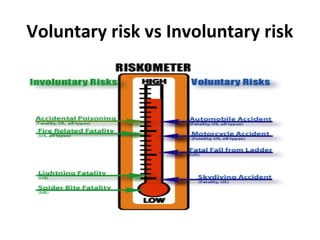
• Voluntary risks have to do with lifestyle choices. They are the risks
that people take knowing that they may have consequences. These
risks include smoking tobacco, driving a car, skydiving, and climbing a
ladder.
• Involuntary risks are risks that people take either not knowing that
they are at risk, or they are unable to control the fact that they are at
risk, such as secondhand smoke. These risks often include
environmental hazards such as lightning, tsunamis, and tornadoes.
•
Voluntary risk vs Involuntary risk
JOB RELATED RISKS
• Many workers are taking risks in their jobs in their stride like
being exposed to asbestos.
• Exposure to risks on a job is in one sense of voluntary nature
since one can always refuse to submit to the work or may have
control over how the job is done.
• But generally workers have no choice other than what they are
told to do since they want to stick to the only job available to
them.
• But they are not generally informed about the exposure to toxic
substances and other dangers which are not readily seen, smelt,
heard or otherwise sensed.
• Occupational health and safety regulations and unions can have
a better say in correcting these situations but still things are far
below expected safety standards.
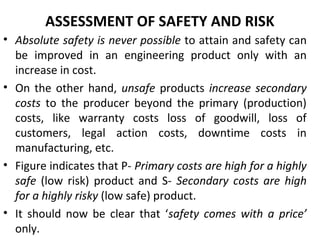
ASSESSMENT OF SAFETY AND RISK
• Absolute safety is never possible to attain and safety can
be improved in an engineering product only with an
increase in cost.
• On the other hand, unsafe products increase secondary
costs to the producer beyond the primary (production)
costs, like warranty costs loss of goodwill, loss of
customers, legal action costs, downtime costs in
manufacturing, etc.
• Figure indicates that P- Primary costs are high for a highly
safe (low risk) product and S- Secondary costs are high
for a highly risky (low safe) product.
• It should now be clear that ‘safety comes with a price’
only.
ASSESSMENT OF SAFETY AND RISK
What is the goal of risk assessment?
• The aim of the risk assessment process is to
remove a hazard or reduce the level of its risk
by adding precautions or control measures, as
necessary. By doing so, you have created a
safer and healthier workplace.
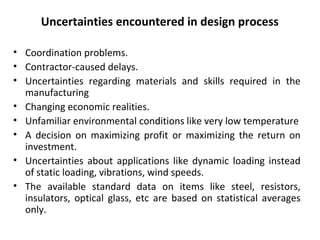
Uncertainties encountered in design process
 
• Coordination problems.
• Contractor-caused delays.
• Uncertainties  regarding  materials  and  skills  required  in  the 
manufacturing
• Changing economic realities.
• Unfamiliar environmental conditions like very low temperature
• A  decision  on  maximizing  profit  or  maximizing  the  return  on 
investment.
• Uncertainties about applications  like dynamic loading instead 
of static loading, vibrations, wind speeds.
• The  available  standard  data  on  items  like  steel,  resistors, 
insulators,  optical  glass,  etc  are  based  on  statistical  averages 
only.
Testing strategies for safety
Some commonly used testing methods:
• Using  the  past experience in  checking  the  design  and 
performance.
• Prototype testing. Here the one product tested may not 
be representative of the population of products.
• Tests simulated under approximately actual conditions to 
know the performance flaws on safety.
• Routine quality assurance tests on production runs.
Testing strategies for safety
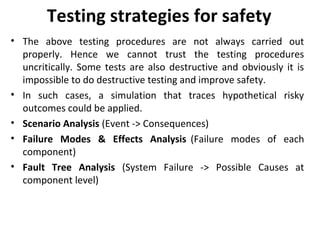
• The  above  testing  procedures  are  not  always  carried  out 
properly.  Hence  we  cannot  trust  the  testing  procedures 
uncritically. Some tests are also destructive and obviously it is 
impossible to do destructive testing and improve safety.
• In  such  cases,  a  simulation  that  traces  hypothetical  risky 
outcomes could be applied.
• Scenario Analysis (Event -> Consequences)
• Failure Modes & Effects Analysis (Failure  modes  of  each 
component)
• Fault Tree Analysis (System  Failure  ->  Possible  Causes  at 
component level) 
Example of Testing for safety
• Failure modes and effect analysis (FMEA) :
• This  approach  systematically  examines  the  failure  modes  of  each 
component,  without  however,  focusing  on  relationships  among  the 
elements of a complex system.
• Fault Tree Analysis (FTA) :
• A system failure is proposed and then events are traced back to possible 
causes  at  the  component  level.  The  reverse  of  the  fault-tree  analysis  is 
‘event  –  tree  analysis’.  This  method  most  effectively  illustrates  the 
disciplined  approach  required  to  capture  as  much  as  possible  of 
everything  that  affects  proper  functioning  and  safety  of  a  complex 
system.
Risk Benefit Analysis
• Risk-benefit  analysis  involving  studies,  testing  about  the  comparison  of 
the risk of a situation to its related benefits. 
• Risk Benefit analysis (RBA) is an approach to risk assessment that focuses 
not just on the risks of the activity, but on the benefits of the activity. 
• Risk–benefit  analysis is analysis that  seeks  to  quantify  the risk and 
benefits and hence their ratio. Exposure to personal risk is recognized as a 
normal  aspect  of  everyday  life.  A  certain  level  of risk in  our  lives  is 
accepted as necessary to achieve certain benefits.
• Risk  is  an  essential  element  in  the  development  of  children’s  physical, 
emotional and intellectual development. 
• Risk  isn’t  just  about  physical  actions  –  for  example  climbing  a  tree  or 
skateboarding.  It’s also about taking intellectual risks – trying anything for 
the first time, testing new ideas, accepting other people’s opinions (even 
if you don’t agree with them).
• Ex:For example, driving an automobile is a risk most people take daily.
RISK BENEFIT ASSESSMENT-Example
ACTIVITY How will young
people BENEFIT
from this
activity?
Possible
hazards
Who is
at risk?
PRECAUTIONS in place
to reduce the risk of
injury
Overall risk
RATING:
L/M/H
POND 
DIPPING: 
Slippery 
pond 
decking
The decking allows 
close access to the 
contents of the pond 
and is an essential 
component of 
exploring this habitat.
Slips, trips 
and falls.
Cuts, grazes 
and 
abrasions.
Drowning
(die through 
submersion 
in and 
inhalation of 
water).
Young 
people; 
adults
• Banks shallow and planted 
to prevent accidental 
entry.
• No access to banks for 
young people; use decking 
or ‘beach’ area only.
• Deepest area is centre of 
pond– keep to edges.
• Dipping platform kept 
clear of trip hazards (e.g. 
nets, trays)
• Pond use rules clearly 
displayed and reviewed at 
the start of each session.
Low
Example-Pond dipping
• Pond dipping is a fun and 
simple  way  for  children 
to  explore  an  aquatic 
habitat. 
• Children  will  be  able  to 
observe  a  diversity  of 
different  creatures  from 
leeches  to  dragonfly 
nymphs.
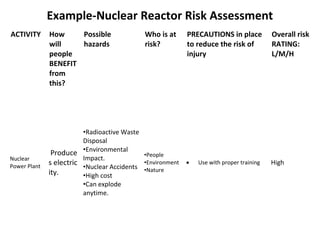
Example-Nuclear Reactor Risk Assessment
ACTIVITY How
will
people
BENEFIT
from
this?
Possible
hazards
Who is at
risk?
PRECAUTIONS in place
to reduce the risk of
injury
Overall risk
RATING:
L/M/H
Nuclear 
Power Plant
 Produce
s electric
ity.
•Radioactive Waste 
Disposal
•Environmental 
Impact.
•Nuclear Accidents
•High cost
•Can explode 
anytime.
•People
•Environment
•Nature
• Use with proper training High
The Government Regulator
approach to risk
Two approaches to acceptable risk
• Layperson: wants to protect himself or
herself from risk.
• The government regulator: wants as
much assurance as possible that the public
is not being exposed to unexpected harm.
Example(Fire accident)
Example(Flooding)-Before Flooding
Example(Flooding)-During Flooding

engineer's are responsible for safety

  • 1.
  • 2.
    TOPICS TO COVER.. •Safety and Risk • Assessment of Safety and Risk • Risk-Benefit Analysis-Reducing Risk • The Government Regulator’s Approach to Risk
  • 3.
    SAFETY AND RISK •Imagine you are a fresh graduate. – You get a job as an engineer in a large atomic power plant. • Would you take it or not? • Under what conditions would you take it? • Under what conditions would you not? • Why?
  • 4.
    SAFETY AND RISK •One of the main duties of an engineer is to ensure the safety of the people who will be affected by the products that he designs. • The code of ethics of the professional engineering societies make it clear that safety is of paramount importance to the engineer. • The engineering codes of ethics show that engineers have a responsibility to society to produce products that are safe. • Nothing can be 100% safe, but engineers are required to make products as safe as reasonably possible. • Thus safety should be an integral part of any engineering design.
  • 5.
    SAFETY AND RISK(Cont..) •What may be safe for one person may not be safe for another person. – Ex 1: A Power Saw in the hands of a child is unsafe, but it is safe in hand of adult. – Ex 2:A sick adult is more prone to ill effects from air pollution than a healthy adult. • What is safe to Entrepreneurs, may not be so to Engineers. e.g., Pilots: "Indian Airports are not safe; Low Vision in Fog“ • What is safe to Engineers, may not be so to Public. • Typically several groups of people are involved in safety matters but have their own interests at stake. Each group may differ in what is safe and what is not.
  • 6.
    Concept of Safety •“A ship in harbor is safe, but that is not what ships are built for” • ‘A thing is safe if its risks are judged to be acceptable’ • Definition for Safety – “A thing is safe (to a certain degree) with respect to a given person or group at a given time if, were they fully aware of its risks and expressing their most settled values, they would judge those risks to be acceptable (to that certain degree. – Safety: Safe operation of system and the prevention of natural or human caused disaster. Ex 1 : We judge fluoride in water can kill lots of people -> Overestimating risk. Ex2: We hire a taxi, without thinking about its safety -> Not estimating risk • A thing is NOT SAFE if it exposes us to unacceptable danger or hazard
  • 7.
    Concept of Risk •Risk in technology could include dangers of – bodily harm, – economic loss, or – environmental degradation. – a situation involving exposure to danger • Absolute safety is not possible .Any improvement in making a product safe involves an increase in the cost of production. • It is very important for the manufacturer and the user to have some understanding to know about the risk connected with any product and know how much it will cost to reduce those risk. • RISK is the potential that something unwanted and harmful may occur. – We take a risk when we undertake something or use a product that is not safe.
  • 8.
    Types of Risk •Acceptable Risk • Voluntary risk and Control • JOB RELATED RISKS
  • 9.
    Acceptable Risk • Acceptablerisk refers to the level of human and property injury or loss from an industrial process that is considered to be tolerable by an individual, household, group, organization, community, region, state, or nation in view of the social, political, and economic cost-benefit analysis. • Example: For instance, the risk of flooding can be accepted once every 500 years but it is not unacceptable in every ten years. • it is management's responsibility to set their company's level of risk. As a security professional, it is your responsibility to work with management and help them understand what it means to define an acceptable level of risk. • Each company has its own acceptable risk level, which is derived from its legal and regulatory compliance responsibilities.
  • 10.
    Acceptable Risk vsUnacceptable Risk
  • 11.
    Voluntary risk • Aperson is said to take ‘VOLUNTARY RISK’ • - when he is subjected to risk by either his own actions or action taken by others • -volunteers to take that risk without any apprehension. • Ex: over rough ground for amusement • Voluntary risks have to do with lifestyle choices. They are the risks that people take knowing that they may have consequences. These risks include smoking tobacco, driving a car, skydiving, and climbing a ladder. • Involuntary risks are risks that people take either not knowing that they are at risk, or they are unable to control the fact that they are at risk, such as secondhand smoke. These risks often include environmental hazards such as lightning, tsunamis, and tornadoes. •
  • 12.
    Voluntary risk vsInvoluntary risk
  • 13.
    JOB RELATED RISKS •Many workers are taking risks in their jobs in their stride like being exposed to asbestos. • Exposure to risks on a job is in one sense of voluntary nature since one can always refuse to submit to the work or may have control over how the job is done. • But generally workers have no choice other than what they are told to do since they want to stick to the only job available to them. • But they are not generally informed about the exposure to toxic substances and other dangers which are not readily seen, smelt, heard or otherwise sensed. • Occupational health and safety regulations and unions can have a better say in correcting these situations but still things are far below expected safety standards.
  • 14.
    ASSESSMENT OF SAFETYAND RISK • Absolute safety is never possible to attain and safety can be improved in an engineering product only with an increase in cost. • On the other hand, unsafe products increase secondary costs to the producer beyond the primary (production) costs, like warranty costs loss of goodwill, loss of customers, legal action costs, downtime costs in manufacturing, etc. • Figure indicates that P- Primary costs are high for a highly safe (low risk) product and S- Secondary costs are high for a highly risky (low safe) product. • It should now be clear that ‘safety comes with a price’ only.
  • 15.
  • 16.
    What is thegoal of risk assessment? • The aim of the risk assessment process is to remove a hazard or reduce the level of its risk by adding precautions or control measures, as necessary. By doing so, you have created a safer and healthier workplace.
  • 17.
    Uncertainties encountered indesign process   • Coordination problems. • Contractor-caused delays. • Uncertainties  regarding  materials  and  skills  required  in  the  manufacturing • Changing economic realities. • Unfamiliar environmental conditions like very low temperature • A  decision  on  maximizing  profit  or  maximizing  the  return  on  investment. • Uncertainties about applications  like dynamic loading instead  of static loading, vibrations, wind speeds. • The  available  standard  data  on  items  like  steel,  resistors,  insulators,  optical  glass,  etc  are  based  on  statistical  averages  only.
  • 18.
    Testing strategies forsafety Some commonly used testing methods: • Using  the  past experience in  checking  the  design  and  performance. • Prototype testing. Here the one product tested may not  be representative of the population of products. • Tests simulated under approximately actual conditions to  know the performance flaws on safety. • Routine quality assurance tests on production runs.
  • 19.
    Testing strategies forsafety • The  above  testing  procedures  are  not  always  carried  out  properly.  Hence  we  cannot  trust  the  testing  procedures  uncritically. Some tests are also destructive and obviously it is  impossible to do destructive testing and improve safety. • In  such  cases,  a  simulation  that  traces  hypothetical  risky  outcomes could be applied. • Scenario Analysis (Event -> Consequences) • Failure Modes & Effects Analysis (Failure  modes  of  each  component) • Fault Tree Analysis (System  Failure  ->  Possible  Causes  at  component level) 
  • 20.
    Example of Testingfor safety • Failure modes and effect analysis (FMEA) : • This  approach  systematically  examines  the  failure  modes  of  each  component,  without  however,  focusing  on  relationships  among  the  elements of a complex system. • Fault Tree Analysis (FTA) : • A system failure is proposed and then events are traced back to possible  causes  at  the  component  level.  The  reverse  of  the  fault-tree  analysis  is  ‘event  –  tree  analysis’.  This  method  most  effectively  illustrates  the  disciplined  approach  required  to  capture  as  much  as  possible  of  everything  that  affects  proper  functioning  and  safety  of  a  complex  system.
  • 21.
    Risk Benefit Analysis •Risk-benefit  analysis  involving  studies,  testing  about  the  comparison  of  the risk of a situation to its related benefits.  • Risk Benefit analysis (RBA) is an approach to risk assessment that focuses  not just on the risks of the activity, but on the benefits of the activity.  • Risk–benefit  analysis is analysis that  seeks  to  quantify  the risk and  benefits and hence their ratio. Exposure to personal risk is recognized as a  normal  aspect  of  everyday  life.  A  certain  level  of risk in  our  lives  is  accepted as necessary to achieve certain benefits. • Risk  is  an  essential  element  in  the  development  of  children’s  physical,  emotional and intellectual development.  • Risk  isn’t  just  about  physical  actions  –  for  example  climbing  a  tree  or  skateboarding.  It’s also about taking intellectual risks – trying anything for  the first time, testing new ideas, accepting other people’s opinions (even  if you don’t agree with them). • Ex:For example, driving an automobile is a risk most people take daily.
  • 22.
    RISK BENEFIT ASSESSMENT-Example ACTIVITYHow will young people BENEFIT from this activity? Possible hazards Who is at risk? PRECAUTIONS in place to reduce the risk of injury Overall risk RATING: L/M/H POND  DIPPING:  Slippery  pond  decking The decking allows  close access to the  contents of the pond  and is an essential  component of  exploring this habitat. Slips, trips  and falls. Cuts, grazes  and  abrasions. Drowning (die through  submersion  in and  inhalation of  water). Young  people;  adults • Banks shallow and planted  to prevent accidental  entry. • No access to banks for  young people; use decking  or ‘beach’ area only. • Deepest area is centre of  pond– keep to edges. • Dipping platform kept  clear of trip hazards (e.g.  nets, trays) • Pond use rules clearly  displayed and reviewed at  the start of each session. Low
  • 23.
    Example-Pond dipping • Ponddipping is a fun and  simple  way  for  children  to  explore  an  aquatic  habitat.  • Children  will  be  able  to  observe  a  diversity  of  different  creatures  from  leeches  to  dragonfly  nymphs.
  • 24.
    Example-Nuclear Reactor RiskAssessment ACTIVITY How will people BENEFIT from this? Possible hazards Who is at risk? PRECAUTIONS in place to reduce the risk of injury Overall risk RATING: L/M/H Nuclear  Power Plant  Produce s electric ity. •Radioactive Waste  Disposal •Environmental  Impact. •Nuclear Accidents •High cost •Can explode  anytime. •People •Environment •Nature • Use with proper training High
  • 25.
  • 26.
    Two approaches toacceptable risk • Layperson: wants to protect himself or herself from risk. • The government regulator: wants as much assurance as possible that the public is not being exposed to unexpected harm.
  • 27.
  • 28.
  • 29.