January 2008 Ver 1.1
Basic
Electrical Safety
Faculty of Science & Health
Safe Lab Module
January 2008
January 2008 Ver 1.1
Electrical Safety
at DCU
 Electrical Safety Awareness
 Electricity basics & few simple pointers
 Specific laboratory examples,
A few Do’s & Don’ts & Watch out for’s
January 2008 Ver 1.1 3
Content
 [ I ] Basic Electrical Theory [ Ladybird version, no maths ! ]
 Voltage & current
 Electricity in the body & effects on the body
 Electricity & associated hazards
 [ II ] Electrical Appliances
 Safety features, cables, connections, design
 General Electrical Guidelines & Precautions
 Electrocution
 [ III ] Specific Hazards & Personal Safety
January 2008 Ver 1.1 4
[ I ]
Electricity
January 2008 Ver 1.1 5
Basic Electrical Theory
 Voltage [driving force] causes current [e -
] to flow
 AC / DC - from safety perspective - negligible difference
 Single Phase / Three Phase. 3φ get a professional
 Circuit / loop is necessary for current to flow
 a start point - a route - an end point
January 2008 Ver 1.1 6
Voltage, Current and Resistance
 Voltage increases => Current increases
 Resistance decreases => Current increases
Voltage = Current / Resistance - Ohms Law
January 2008 Ver 1.1 7
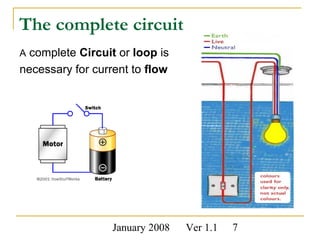
The complete circuit
A complete Circuit or loop is
necessary for current to flow
January 2008 Ver 1.1 8
A complete circuit
complete Circuit or loop
is necessary for current to flow
Current takes the path of least resistance
January 2008 Ver 1.1 9
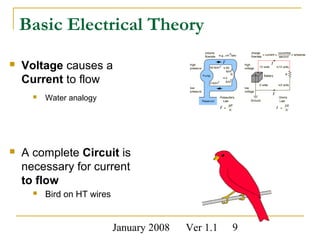
Basic Electrical Theory
 Voltage causes a
Current to flow
 Water analogy
 A complete Circuit is
necessary for current
to flow
 Bird on HT wires
January 2008 Ver 1.1 10
Voltages
 Low Tension 0 => 50V
 Batteries: AA, AAA, MP3 player
 Car, trucks, busses 12 / 24 / 48
 Garden lights, domestic halogen lights
 High Tension 100 => 300V
 EU Mains, Electrophoresis, DART, Capacitors SM PSUs
 Very High Tension 1KV +
 ESB pylons, TV tubes, photocopiers, X-Ray machines, Mass
Spectrometers
January 2008 Ver 1.1 11
Electricity
in the body
January 2008 Ver 1.1 12
Electricity in the body
 Muscles
 Muscles control all the body movements
 Including & importantly those that keep us alive -
Breathing and Heart
 The brain controls voluntary muscles using
Current pulses along nerves
January 2008 Ver 1.1 13
Electricity in the body
 External current through the body causes
 Loss of muscle control
 Spasms & Involuntary movement
 Inability to let go
 Burns - external & internal
January 2008 Ver 1.1 14
Electricity
&
associated hazards
January 2008 Ver 1.1 15
Electricity - associated Hazards
 Indirect Injury
 Falls from ladder
 Thrown back. Fall to ground, onto sharp edge
 Drop objects
 Thermal burns – Very hot equipment surface, explosion
 Wires & cables - Trailing leads => trips & damage,
Re-route, tidy up, cover over
 Life Support muscles
 Diaphragm and breathing
 Heart Fibrillation Random, uncoordinated heart contractions
 De-fribrillation: High voltages (3000 V at 20 A) fraction of a second
 Burns - death of tissue
 Internal [organs]
 External [skin]
January 2008 Ver 1.1 16
END
[ I ] Electrical Theory Section
January 2008 Ver 1.1 18
Electrical Appliances
Safety guiding principle
“keep currents and voltages inside apparatus and away
from our bodies”
 Inherently safe - Low voltage / low current
 Enclosures
 Insulation
 Safe & secure connections
January 2008 Ver 1.1 19
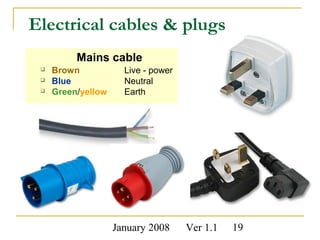
Electrical cables & plugs
Mains cable
 Brown Live - power
 Blue Neutral
 Green/yellow Earth
January 2008 Ver 1.1 20
Electrical cables & plugs
Mains cable
 Brown Live power
 Blue Neutral
 Green/yellow Earth
L
N
January 2008 Ver 1.1 21
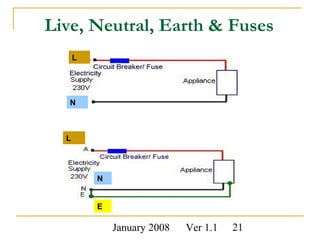
Live, Neutral, Earth & Fuses
L
N
L
N
E
January 2008 Ver 1.1 22
Live, Neutral, Earth & Fuses
L
N
January 2008 Ver 1.1 23
RCD Residual Current Device
RCCB Residual Current Circuit Breaker
ELCB Electric Leakage Circuit Breaker
MCB Magnetic Circuit Breakers
RCBO Residual Current Breaker
with Overcurrent protection
 current difference of >30 mA
 for a duration of >30 ms
L
N
E
L
N
January 2008 Ver 1.1 24
Live, Neutral, Earth & Fuses
 The Live and Neutral wires carry current around the circuit
 The Earth wire is there to protect you.
 The Earth wire can act like a back-up Neutral wire,
 Many appliances have metal cases e.g. kettles, toasters,
dishwashers, washing machines etc.
 The Fuse is very thin piece of wire.
 The wire has a quite low melting point. As current flows through the
wire it heats up.
 If too large a current flows it melts, thus breaking the circuit
 Use appropriate fuse size/rating
 Additional safety devices - RCDs, ELCBs, MCBs
January 2008 Ver 1.1 26
Guidelines
 Use low & safe voltages
 EU 230 VAC / US 110 VAC Hz
 Select equipment appropriate for environment & use
 Use equipment as per manufacturer’s instruction & design
 Ensure adequate maintenance
 Insulate and enclose live parts
 Prevent conducting parts from becoming live. Earth, double
insulation separate supply from earth, limit electric power
 Avoid electricity where its use could be dangerous.
Rubbing, Induction & Capacitance effects can build up
static electricity
 Toxic - Berilium heat sinking, Incomplete burning can
produce carbon monoxide
January 2008 Ver 1.1 27
END
[ II ] Electrical Appliances
January 2008 Ver 1.1 30
Electrocution
 Prevention & Training : Where are red mushroom
switches ?
 Response: Immediately cut power, red buttons / switch / plug
 If in any doubt - Do not touch victim.
 One hand behind back, stand on insulation, tip with back
of hand
 Use insulating rod / stick to move wires from victim.
 Call for assistance
 Talk & reassure victim
 If unconscious then use first aid, CPR
January 2008 Ver 1.1 31
Electrical Hazards & Personal Safety
 Where
 Office & home 95%
 Laboratory 5%
 Trailing wires, faulty wires
 Mains
 Avoid direct working with mains. Use only low voltages (tension )
 Check all leads for: Fraying, Proper clamping, Proper earthing.
 Repairing
 Do not repair, competency required
 One hand behind back, tip cautiously with back of hand
 Trust nobody, remove fuse, use phase tester
Note: Switch Mode PSU, laptop chargers, CF lamps
[high voltages persists on capacitors long after switch off]
January 2008 Ver 1.1 32
Specific Hazards & Personal Safety
 Medical / sports equipment
 Very strict regulations on equipment operation, design, repair
 Never modify or tamper with such equipment
 ECG measurements. even a few micro amps in a susceptible location
can have massive consequences [Basis of Heart pacemaker ]
 Pace makers
 Susceptible to strong magnetic fields [NMR! ],
 Possibly RF & Micro waves
 Solvent
 Flammable environments require specialised electrical equipment
E.g. Fridge storage of samples stored in solvents
 Cold rooms / water cooling
 Equipment moved from a cold room with get condensation on its internal
electrical
 circuits Avoid this movement, Use LT, give lots of time to acclimatise
January 2008 Ver 1.1 33
Specific Hazards & Personal Safety
 RF & µW
 Capacitive coupling, no need to touch,
 Both can burn severely internally and externally depending on how
focused. Think of them like an open air μ-wave oven
 HT
 Static, OK [Very low current, moderate power]

Will jump considerable distances, beware of capacitors
 Power
 Heating effect in body => internal burns / damage
 Contact burns, deep burns & necrosis
 Trailing power and signal wires - Protect & Tidy them up
January 2008 Ver 1.1 34
Specific Hazards & Personal Safety
 Other Laboratory Situations
 Other Office Situations
 Other Home Situations
January 2008 Ver 1.1 35
Where to get more Information
 Your Supervisor, Manager, Head of Department
 Department Safety Statements
 Department Safety Committees & Safety Officer
 DCU safety - WEB
 Edinburgh H&S - WEB
 University London H&S - WEB
January 2008 Ver 1.1 36
Summary
 Awareness of the need for electrical safety
 Introduction to the source of electrical dangers
 Your responsibility to take care
of yourself and others
January 2008 Ver 1.1 37
END
January 2008 Ver 1.1 38
What’s the problem?

Electrical safety

  • 1.
    January 2008 Ver1.1 Basic Electrical Safety Faculty of Science & Health Safe Lab Module January 2008
  • 2.
    January 2008 Ver1.1 Electrical Safety at DCU  Electrical Safety Awareness  Electricity basics & few simple pointers  Specific laboratory examples, A few Do’s & Don’ts & Watch out for’s
  • 3.
    January 2008 Ver1.1 3 Content  [ I ] Basic Electrical Theory [ Ladybird version, no maths ! ]  Voltage & current  Electricity in the body & effects on the body  Electricity & associated hazards  [ II ] Electrical Appliances  Safety features, cables, connections, design  General Electrical Guidelines & Precautions  Electrocution  [ III ] Specific Hazards & Personal Safety
  • 4.
    January 2008 Ver1.1 4 [ I ] Electricity
  • 5.
    January 2008 Ver1.1 5 Basic Electrical Theory  Voltage [driving force] causes current [e - ] to flow  AC / DC - from safety perspective - negligible difference  Single Phase / Three Phase. 3φ get a professional  Circuit / loop is necessary for current to flow  a start point - a route - an end point
  • 6.
    January 2008 Ver1.1 6 Voltage, Current and Resistance  Voltage increases => Current increases  Resistance decreases => Current increases Voltage = Current / Resistance - Ohms Law
  • 7.
    January 2008 Ver1.1 7 The complete circuit A complete Circuit or loop is necessary for current to flow
  • 8.
    January 2008 Ver1.1 8 A complete circuit complete Circuit or loop is necessary for current to flow Current takes the path of least resistance
  • 9.
    January 2008 Ver1.1 9 Basic Electrical Theory  Voltage causes a Current to flow  Water analogy  A complete Circuit is necessary for current to flow  Bird on HT wires
  • 10.
    January 2008 Ver1.1 10 Voltages  Low Tension 0 => 50V  Batteries: AA, AAA, MP3 player  Car, trucks, busses 12 / 24 / 48  Garden lights, domestic halogen lights  High Tension 100 => 300V  EU Mains, Electrophoresis, DART, Capacitors SM PSUs  Very High Tension 1KV +  ESB pylons, TV tubes, photocopiers, X-Ray machines, Mass Spectrometers
  • 11.
    January 2008 Ver1.1 11 Electricity in the body
  • 12.
    January 2008 Ver1.1 12 Electricity in the body  Muscles  Muscles control all the body movements  Including & importantly those that keep us alive - Breathing and Heart  The brain controls voluntary muscles using Current pulses along nerves
  • 13.
    January 2008 Ver1.1 13 Electricity in the body  External current through the body causes  Loss of muscle control  Spasms & Involuntary movement  Inability to let go  Burns - external & internal
  • 14.
    January 2008 Ver1.1 14 Electricity & associated hazards
  • 15.
    January 2008 Ver1.1 15 Electricity - associated Hazards  Indirect Injury  Falls from ladder  Thrown back. Fall to ground, onto sharp edge  Drop objects  Thermal burns – Very hot equipment surface, explosion  Wires & cables - Trailing leads => trips & damage, Re-route, tidy up, cover over  Life Support muscles  Diaphragm and breathing  Heart Fibrillation Random, uncoordinated heart contractions  De-fribrillation: High voltages (3000 V at 20 A) fraction of a second  Burns - death of tissue  Internal [organs]  External [skin]
  • 16.
    January 2008 Ver1.1 16 END [ I ] Electrical Theory Section
  • 17.
    January 2008 Ver1.1 18 Electrical Appliances Safety guiding principle “keep currents and voltages inside apparatus and away from our bodies”  Inherently safe - Low voltage / low current  Enclosures  Insulation  Safe & secure connections
  • 18.
    January 2008 Ver1.1 19 Electrical cables & plugs Mains cable  Brown Live - power  Blue Neutral  Green/yellow Earth
  • 19.
    January 2008 Ver1.1 20 Electrical cables & plugs Mains cable  Brown Live power  Blue Neutral  Green/yellow Earth L N
  • 20.
    January 2008 Ver1.1 21 Live, Neutral, Earth & Fuses L N L N E
  • 21.
    January 2008 Ver1.1 22 Live, Neutral, Earth & Fuses L N
  • 22.
    January 2008 Ver1.1 23 RCD Residual Current Device RCCB Residual Current Circuit Breaker ELCB Electric Leakage Circuit Breaker MCB Magnetic Circuit Breakers RCBO Residual Current Breaker with Overcurrent protection  current difference of >30 mA  for a duration of >30 ms L N E L N
  • 23.
    January 2008 Ver1.1 24 Live, Neutral, Earth & Fuses  The Live and Neutral wires carry current around the circuit  The Earth wire is there to protect you.  The Earth wire can act like a back-up Neutral wire,  Many appliances have metal cases e.g. kettles, toasters, dishwashers, washing machines etc.  The Fuse is very thin piece of wire.  The wire has a quite low melting point. As current flows through the wire it heats up.  If too large a current flows it melts, thus breaking the circuit  Use appropriate fuse size/rating  Additional safety devices - RCDs, ELCBs, MCBs
  • 24.
    January 2008 Ver1.1 26 Guidelines  Use low & safe voltages  EU 230 VAC / US 110 VAC Hz  Select equipment appropriate for environment & use  Use equipment as per manufacturer’s instruction & design  Ensure adequate maintenance  Insulate and enclose live parts  Prevent conducting parts from becoming live. Earth, double insulation separate supply from earth, limit electric power  Avoid electricity where its use could be dangerous. Rubbing, Induction & Capacitance effects can build up static electricity  Toxic - Berilium heat sinking, Incomplete burning can produce carbon monoxide
  • 25.
    January 2008 Ver1.1 27 END [ II ] Electrical Appliances
  • 26.
    January 2008 Ver1.1 30 Electrocution  Prevention & Training : Where are red mushroom switches ?  Response: Immediately cut power, red buttons / switch / plug  If in any doubt - Do not touch victim.  One hand behind back, stand on insulation, tip with back of hand  Use insulating rod / stick to move wires from victim.  Call for assistance  Talk & reassure victim  If unconscious then use first aid, CPR
  • 27.
    January 2008 Ver1.1 31 Electrical Hazards & Personal Safety  Where  Office & home 95%  Laboratory 5%  Trailing wires, faulty wires  Mains  Avoid direct working with mains. Use only low voltages (tension )  Check all leads for: Fraying, Proper clamping, Proper earthing.  Repairing  Do not repair, competency required  One hand behind back, tip cautiously with back of hand  Trust nobody, remove fuse, use phase tester Note: Switch Mode PSU, laptop chargers, CF lamps [high voltages persists on capacitors long after switch off]
  • 28.
    January 2008 Ver1.1 32 Specific Hazards & Personal Safety  Medical / sports equipment  Very strict regulations on equipment operation, design, repair  Never modify or tamper with such equipment  ECG measurements. even a few micro amps in a susceptible location can have massive consequences [Basis of Heart pacemaker ]  Pace makers  Susceptible to strong magnetic fields [NMR! ],  Possibly RF & Micro waves  Solvent  Flammable environments require specialised electrical equipment E.g. Fridge storage of samples stored in solvents  Cold rooms / water cooling  Equipment moved from a cold room with get condensation on its internal electrical  circuits Avoid this movement, Use LT, give lots of time to acclimatise
  • 29.
    January 2008 Ver1.1 33 Specific Hazards & Personal Safety  RF & µW  Capacitive coupling, no need to touch,  Both can burn severely internally and externally depending on how focused. Think of them like an open air μ-wave oven  HT  Static, OK [Very low current, moderate power]  Will jump considerable distances, beware of capacitors  Power  Heating effect in body => internal burns / damage  Contact burns, deep burns & necrosis  Trailing power and signal wires - Protect & Tidy them up
  • 30.
    January 2008 Ver1.1 34 Specific Hazards & Personal Safety  Other Laboratory Situations  Other Office Situations  Other Home Situations
  • 31.
    January 2008 Ver1.1 35 Where to get more Information  Your Supervisor, Manager, Head of Department  Department Safety Statements  Department Safety Committees & Safety Officer  DCU safety - WEB  Edinburgh H&S - WEB  University London H&S - WEB
  • 32.
    January 2008 Ver1.1 36 Summary  Awareness of the need for electrical safety  Introduction to the source of electrical dangers  Your responsibility to take care of yourself and others
  • 33.
    January 2008 Ver1.1 37 END
  • 34.
    January 2008 Ver1.1 38 What’s the problem?