MICROWAVE ASSISTED
EXTRACTION
Prepared by:-
Nikhita Yadav
Shubham Sharma
Jaison Sam Joys
Under the guidance of:-
Dr. Sushil Kumar
Associate Professor
Chemical Engineering Department
MNNIT Allahabad
EXTRACTION
Extraction is a process in which one or more components are separated selectively from a
liquid or solid mixture by means of a liquid immiscible solvent.
Solvent used for extraction is called
MENSTRUM.
The inert fibrous and other insoluble
materials remaining after extraction is
called MARC.
Its major application is isolation of
phtyoconstituents and nutraceuticles
2
CONVENTIONAL METHODS
OF EXTRACTION
◍ Infusion
◍ Decoction
◍ Percolation
◍ Maceration
◍ Digestion
◍ Soxhlet Extraction
3
Infusion
It consists of pouring water
over the drugs and then
allowing it to keep in contact
with water for the stated
period, usually 15 minutes,
with occasional stirring and
finally filtering off the liquid.
The boiling water is
commonly used as a solvent,
since it has a greater solvent
action than cold water.
Decoction
In this process, the crude
drug is boiled in a specified
volume of water for a defined
time; it is then cooled and
strained or filtered. This
procedure is suitable for
extracting water-soluble, heat
stable constituents. e.g. Tea,
Coffee
Maceration
In this process solid
ingredients are soaked in a
stoppered container with
the whole of the solvent
and allowed to stand for a
period of at least 3 days
with frequent agitation,
until soluble matter is
dissolved. The mixture is
then strained through the
sieves, the marc pressed
and the combined liquids
are clarified (filtration or
decantation) after standing.
CONVENTIONAL METHODS OF
EXTRACTION
4
Percolation
It consists of pouring water
over the drugs and then
allowing it to keep in contact
with water for the stated
period, usually 15 minutes,
with occasional stirring and
finally filtering off the liquid.
The boiling water is
commonly used as a solvent,
since it has a greater solvent
action than cold water.
Soxhlet Extraction
the sample is placed in a thimble-
holder and during operation is
gradually filled with condensed
fresh solvent from a distillation
flask. When the liquid reaches an
overflow level, a siphon aspirates
the whole contents of the
thimble-holder and unloads it
back into the distillation flask,
carrying the extracted analytes in
the bulk liquid. This operation is
repeated until complete
extraction is achieved.
Digestion
It is a form of maceration with
slight warming during provided
that the temperature does not
alter the active ingredients of
plant material The most used
temperatures are between 35 °
and 40 ° C., This process is
used with the tougher plant parts
or those that contain poorly
soluble substances.
CONVENTIONAL METHODS
OF EXTRACTION
5
DRAWBACKS
◍ Time consuming
◍ Rate of mass transfer goes on decreasing because
solvent is continuously enriched with solute.
◍ Large amount of solvent required
◍ Difficulties in solvent recovery
◍ Thermolabile components cannot be extracted in case
of Infusion, Decoction
6
ADVANCED EXTRACTION
TECHNIQUES
◍ Microwave Assisted Extraction
◍ Ultrasound Assisted Extraction
◍ Supercritical Fluid Extraction
◍ Accelerated Fluid Extraction
7
MICROWAVE ASSISTED
EXTRACTION
◍ Microwaves (frequency between 300 MHz to 300 GHz)
heat up the molecules by dual mechanism of ionic
conduction and dipole rotation
◍ The two types of oscillating perpendicular fields that
generate microwaves are the electric field and magnetic
field.
◍ Both The ionic conduction and dipole rotation are
responsible for heating of substances.
◍ At a frequency of 2450 MHz the process of heating
occurs.
8
MAE PROCESS
◍ Penetration of the solvent into the solid matrix.
◍ Solubilization and breakdown of components.
◍ Transport of the solute out of the solid matrix.
◍ Migration of the extracted solute from the external
surface of the solid into the bulk solution.
◍ Movement of the extract with respect to the solid.
◍ Separation and discharge of the extract and solid
9
FACTORS AFFECTING MAE
1. Solvent: the choice of the solvent will be based upon the
solubility of the wanted analyte, the solvent matrix
interaction and the property of the solvent to absorb
microwaves
2. Microwave Power: optimized to minimize extraction time
and prevent thermal deterioration due to excessive heating
3. Extraction time: The amount of analyte extracted can be
improved with an increase in the extraction time; however,
there is an associated risk of degradation of thermolabile
components
10
11
4. Temperature: increases solubility and causes
cellular pressure build up leading to cell rupture and
opening of the cell matrix and hence increased
accessibility to the constituent to be extracted
5. Stirring/Agitation: The use of agitation in MAE
quickens the extraction by enhancing desorption and
dissolution of active compounds bound to the sample
matrix
6. Effect of contact surface area and water
content/Matrix Characteristics: higher the contact
surface area higher is the extraction efficiency. Finer
particles allow improved penetration of the
microwave.
COMPONENTS OF
INSTRUMENTS USED FOR MAE
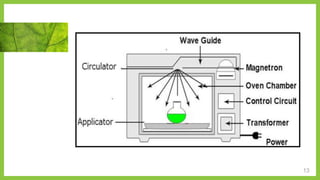
1. Magnetron/Microwave Generator: generates
microwave
2. Wave guide: directs the waves from source to cavity
3. Applicator: sample holder and sample are placed
here
4. Circulator: regulates the movements of microwave in
forward direction
12
13
TYPES OF MAE
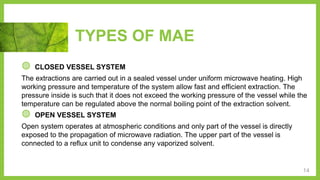
◍ CLOSED VESSEL SYSTEM
The extractions are carried out in a sealed vessel under uniform microwave heating. High
working pressure and temperature of the system allow fast and efficient extraction. The
pressure inside is such that it does not exceed the working pressure of the vessel while the
temperature can be regulated above the normal boiling point of the extraction solvent.
◍ OPEN VESSEL SYSTEM
Open system operates at atmospheric conditions and only part of the vessel is directly
exposed to the propagation of microwave radiation. The upper part of the vessel is
connected to a reflux unit to condense any vaporized solvent.
14
15
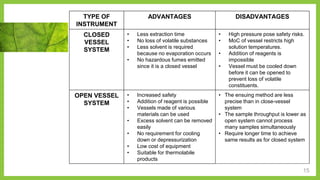
TYPE OF
INSTRUMENT
ADVANTAGES DISADVANTAGES
CLOSED
VESSEL
SYSTEM
• Less extraction time
• No loss of volatile substances
• Less solvent is required
because no evaporation occurs
• No hazardous fumes emitted
since it is a closed vessel
• High pressure pose safety risks.
• MoC of vessel restricts high
solution temperatures.
• Addition of reagents is
impossible
• Vessel must be cooled down
before it can be opened to
prevent loss of volatile
constituents.
OPEN VESSEL
SYSTEM
• Increased safety
• Addition of reagent is possible
• Vessels made of various
materials can be used
• Excess solvent can be removed
easily
• No requirement for cooling
down or depressurization
• Low cost of equipment
• Suitable for thermolabile
products
• The ensuing method are less
precise than in close-vessel
system
• The sample throughput is lower as
open system cannot process
many samples simultaneously
• Require longer time to achieve
same results as for closed system
CONCLUSION
◍ MAE is more effective and cheaper than conventional
methods.
◍ In this technique, time required for complete extraction
is less as compared to the conventional techniques.
◍ Solvent required for extraction is less than the other
techniques.
◍ The main advantage of MAE reside in the
performance of the heating source.
◍ MAE is now widely accepted in analytical laboratories.
16
THANK YOU
17

MICROWAVE ASSISTED EXTRACTION

  • 1.
    MICROWAVE ASSISTED EXTRACTION Prepared by:- NikhitaYadav Shubham Sharma Jaison Sam Joys Under the guidance of:- Dr. Sushil Kumar Associate Professor Chemical Engineering Department MNNIT Allahabad
  • 2.
    EXTRACTION Extraction is aprocess in which one or more components are separated selectively from a liquid or solid mixture by means of a liquid immiscible solvent. Solvent used for extraction is called MENSTRUM. The inert fibrous and other insoluble materials remaining after extraction is called MARC. Its major application is isolation of phtyoconstituents and nutraceuticles 2
  • 3.
    CONVENTIONAL METHODS OF EXTRACTION ◍Infusion ◍ Decoction ◍ Percolation ◍ Maceration ◍ Digestion ◍ Soxhlet Extraction 3
  • 4.
    Infusion It consists ofpouring water over the drugs and then allowing it to keep in contact with water for the stated period, usually 15 minutes, with occasional stirring and finally filtering off the liquid. The boiling water is commonly used as a solvent, since it has a greater solvent action than cold water. Decoction In this process, the crude drug is boiled in a specified volume of water for a defined time; it is then cooled and strained or filtered. This procedure is suitable for extracting water-soluble, heat stable constituents. e.g. Tea, Coffee Maceration In this process solid ingredients are soaked in a stoppered container with the whole of the solvent and allowed to stand for a period of at least 3 days with frequent agitation, until soluble matter is dissolved. The mixture is then strained through the sieves, the marc pressed and the combined liquids are clarified (filtration or decantation) after standing. CONVENTIONAL METHODS OF EXTRACTION 4
  • 5.
    Percolation It consists ofpouring water over the drugs and then allowing it to keep in contact with water for the stated period, usually 15 minutes, with occasional stirring and finally filtering off the liquid. The boiling water is commonly used as a solvent, since it has a greater solvent action than cold water. Soxhlet Extraction the sample is placed in a thimble- holder and during operation is gradually filled with condensed fresh solvent from a distillation flask. When the liquid reaches an overflow level, a siphon aspirates the whole contents of the thimble-holder and unloads it back into the distillation flask, carrying the extracted analytes in the bulk liquid. This operation is repeated until complete extraction is achieved. Digestion It is a form of maceration with slight warming during provided that the temperature does not alter the active ingredients of plant material The most used temperatures are between 35 ° and 40 ° C., This process is used with the tougher plant parts or those that contain poorly soluble substances. CONVENTIONAL METHODS OF EXTRACTION 5
  • 6.
    DRAWBACKS ◍ Time consuming ◍Rate of mass transfer goes on decreasing because solvent is continuously enriched with solute. ◍ Large amount of solvent required ◍ Difficulties in solvent recovery ◍ Thermolabile components cannot be extracted in case of Infusion, Decoction 6
  • 7.
    ADVANCED EXTRACTION TECHNIQUES ◍ MicrowaveAssisted Extraction ◍ Ultrasound Assisted Extraction ◍ Supercritical Fluid Extraction ◍ Accelerated Fluid Extraction 7
  • 8.
    MICROWAVE ASSISTED EXTRACTION ◍ Microwaves(frequency between 300 MHz to 300 GHz) heat up the molecules by dual mechanism of ionic conduction and dipole rotation ◍ The two types of oscillating perpendicular fields that generate microwaves are the electric field and magnetic field. ◍ Both The ionic conduction and dipole rotation are responsible for heating of substances. ◍ At a frequency of 2450 MHz the process of heating occurs. 8
  • 9.
    MAE PROCESS ◍ Penetrationof the solvent into the solid matrix. ◍ Solubilization and breakdown of components. ◍ Transport of the solute out of the solid matrix. ◍ Migration of the extracted solute from the external surface of the solid into the bulk solution. ◍ Movement of the extract with respect to the solid. ◍ Separation and discharge of the extract and solid 9
  • 10.
    FACTORS AFFECTING MAE 1.Solvent: the choice of the solvent will be based upon the solubility of the wanted analyte, the solvent matrix interaction and the property of the solvent to absorb microwaves 2. Microwave Power: optimized to minimize extraction time and prevent thermal deterioration due to excessive heating 3. Extraction time: The amount of analyte extracted can be improved with an increase in the extraction time; however, there is an associated risk of degradation of thermolabile components 10
  • 11.
    11 4. Temperature: increasessolubility and causes cellular pressure build up leading to cell rupture and opening of the cell matrix and hence increased accessibility to the constituent to be extracted 5. Stirring/Agitation: The use of agitation in MAE quickens the extraction by enhancing desorption and dissolution of active compounds bound to the sample matrix 6. Effect of contact surface area and water content/Matrix Characteristics: higher the contact surface area higher is the extraction efficiency. Finer particles allow improved penetration of the microwave.
  • 12.
    COMPONENTS OF INSTRUMENTS USEDFOR MAE 1. Magnetron/Microwave Generator: generates microwave 2. Wave guide: directs the waves from source to cavity 3. Applicator: sample holder and sample are placed here 4. Circulator: regulates the movements of microwave in forward direction 12
  • 13.
  • 14.
    TYPES OF MAE ◍CLOSED VESSEL SYSTEM The extractions are carried out in a sealed vessel under uniform microwave heating. High working pressure and temperature of the system allow fast and efficient extraction. The pressure inside is such that it does not exceed the working pressure of the vessel while the temperature can be regulated above the normal boiling point of the extraction solvent. ◍ OPEN VESSEL SYSTEM Open system operates at atmospheric conditions and only part of the vessel is directly exposed to the propagation of microwave radiation. The upper part of the vessel is connected to a reflux unit to condense any vaporized solvent. 14
  • 15.
    15 TYPE OF INSTRUMENT ADVANTAGES DISADVANTAGES CLOSED VESSEL SYSTEM •Less extraction time • No loss of volatile substances • Less solvent is required because no evaporation occurs • No hazardous fumes emitted since it is a closed vessel • High pressure pose safety risks. • MoC of vessel restricts high solution temperatures. • Addition of reagents is impossible • Vessel must be cooled down before it can be opened to prevent loss of volatile constituents. OPEN VESSEL SYSTEM • Increased safety • Addition of reagent is possible • Vessels made of various materials can be used • Excess solvent can be removed easily • No requirement for cooling down or depressurization • Low cost of equipment • Suitable for thermolabile products • The ensuing method are less precise than in close-vessel system • The sample throughput is lower as open system cannot process many samples simultaneously • Require longer time to achieve same results as for closed system
  • 16.
    CONCLUSION ◍ MAE ismore effective and cheaper than conventional methods. ◍ In this technique, time required for complete extraction is less as compared to the conventional techniques. ◍ Solvent required for extraction is less than the other techniques. ◍ The main advantage of MAE reside in the performance of the heating source. ◍ MAE is now widely accepted in analytical laboratories. 16
  • 17.