Highlights on  Pulmonary Tuberculosis Prof.  Dr. Saad S Al-Ani Senior Pediatric Consultant Head of Pediatric department Khorfakkan Hospital
TB Diagnosis “ The first rule of TB diagnosis: is to think of TB….” Include TB in your differential diagnosis when history, symptoms are consistent with TB diagnosis Order the appropriate diagnostic tests
Pulmonary infections Predisposing factors 1.Decreased cough reflex 2.Injury to cilia 3.Decreased   function of alveolar macrophages 4.Edema or congestion 5.Retention of secretions
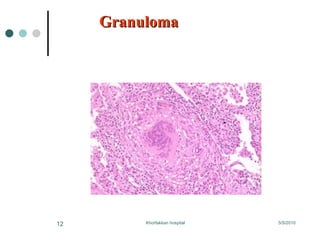
3.Progressive primary pneumonia Miliary dissemination ( blood stream ). Pulmonary tuberculosis Primary 1.Single granuloma  within parenchyma and hilar lymph nodes ( Ghon complex ). 2.Infection does not progress (most common).
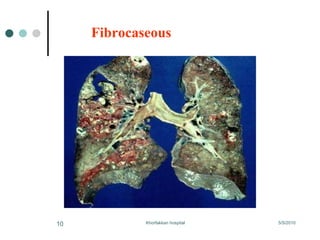
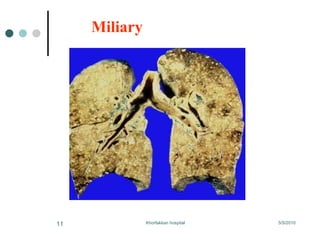
Secondary Pulmonary tuberculosis Cont. Infection (mostly through reactivation) in a previously sensitized individual Pathology Cavitary fibrocaseous lesions Bronchopneumonia Miliary TB
Typical Progression of Pulmonary tuberculosis 1.Pneumonia 2.Granuloma formation with fibrosis 3.Caseous necrosis 4.Calcification 5.Cavity formation
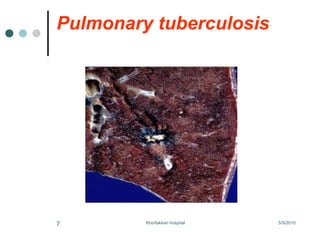
Pulmonary tuberculosis
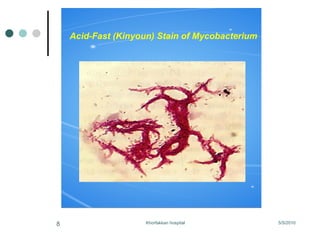
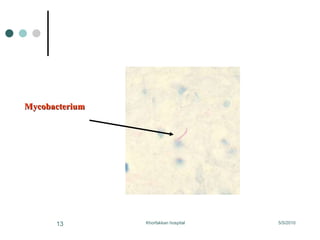
Acid-Fast (Kinyoun) Stain of Mycobacterium
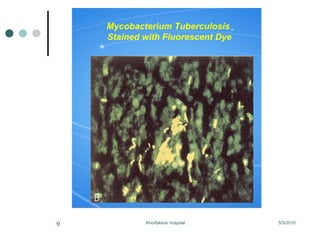
Mycobacterium Tuberculosis  Stained with Fluorescent Dye
Fibrocaseous
Miliary
Granuloma
Mycobacterium
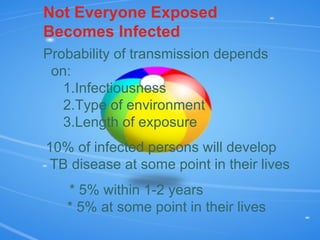
Not Everyone Exposed  Becomes Infected Probability of transmission depends  on: 1.Infectiousness 2.Type of environment  3.Length of exposure 10% of infected persons will develop TB disease at some point in their lives * 5% within 1-2 years * 5% at some point in their lives
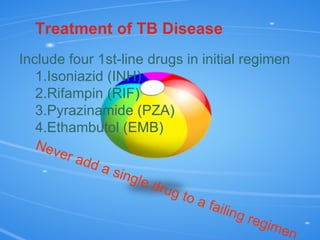
Treatment of TB Disease Include four 1st-line drugs in initial regimen 1.Isoniazid (INH) 2.Rifampin (RIF) 3.Pyrazinamide (PZA) 4.Ethambutol (EMB) Never add a single drug to a failing regimen
Barriers to Adherence Stigma Extensive duration of treatment Adverse reactions to medications Concerns of toxicity Lack of knowledge about TB  and its treatment
Improving Adherence Adherence is the responsibility of the provider, not the patient and can be ensured by: -Patient education Directly observed therapy (DOT) Case management Incentives/enablers
Directly Observed Therapy (DOT) *Health care worker watches patient  swallow each dose of medication *DOT is the best way to ensure adherence Should be used with all intermittent regimens Reduces relapse of TB disease and acquired drug resistance
Remember “ A decision to test is  a decision to treat.” Thank you

Pulmonary TB

  • 1.
    Highlights on Pulmonary Tuberculosis Prof. Dr. Saad S Al-Ani Senior Pediatric Consultant Head of Pediatric department Khorfakkan Hospital
  • 2.
    TB Diagnosis “The first rule of TB diagnosis: is to think of TB….” Include TB in your differential diagnosis when history, symptoms are consistent with TB diagnosis Order the appropriate diagnostic tests
  • 3.
    Pulmonary infections Predisposingfactors 1.Decreased cough reflex 2.Injury to cilia 3.Decreased function of alveolar macrophages 4.Edema or congestion 5.Retention of secretions
  • 4.
    3.Progressive primary pneumoniaMiliary dissemination ( blood stream ). Pulmonary tuberculosis Primary 1.Single granuloma within parenchyma and hilar lymph nodes ( Ghon complex ). 2.Infection does not progress (most common).
  • 5.
    Secondary Pulmonary tuberculosisCont. Infection (mostly through reactivation) in a previously sensitized individual Pathology Cavitary fibrocaseous lesions Bronchopneumonia Miliary TB
  • 6.
    Typical Progression ofPulmonary tuberculosis 1.Pneumonia 2.Granuloma formation with fibrosis 3.Caseous necrosis 4.Calcification 5.Cavity formation
  • 7.
  • 8.
    Acid-Fast (Kinyoun) Stainof Mycobacterium
  • 9.
    Mycobacterium Tuberculosis Stained with Fluorescent Dye
  • 10.
  • 11.
  • 12.
  • 13.
  • 14.
    Not Everyone Exposed Becomes Infected Probability of transmission depends on: 1.Infectiousness 2.Type of environment 3.Length of exposure 10% of infected persons will develop TB disease at some point in their lives * 5% within 1-2 years * 5% at some point in their lives
  • 15.
    Treatment of TBDisease Include four 1st-line drugs in initial regimen 1.Isoniazid (INH) 2.Rifampin (RIF) 3.Pyrazinamide (PZA) 4.Ethambutol (EMB) Never add a single drug to a failing regimen
  • 16.
    Barriers to AdherenceStigma Extensive duration of treatment Adverse reactions to medications Concerns of toxicity Lack of knowledge about TB and its treatment
  • 17.
    Improving Adherence Adherenceis the responsibility of the provider, not the patient and can be ensured by: -Patient education Directly observed therapy (DOT) Case management Incentives/enablers
  • 18.
    Directly Observed Therapy(DOT) *Health care worker watches patient swallow each dose of medication *DOT is the best way to ensure adherence Should be used with all intermittent regimens Reduces relapse of TB disease and acquired drug resistance
  • 19.
    Remember “ Adecision to test is a decision to treat.” Thank you