Green Preservation
Methods in Food
Processing
Presented by:
Alaa Ayman Mohamed
Under supervision:
Prof. Shahinaz Ahmed Helmy
Dr. Marwa Rashad Ali
Contents:
Presentation title 2
o Introduction.
o Aims.
o Classification of preservation methods.

o The novel thermal technology in food
processing.
o The novel Nonthermal technology in
food processing.
Introduction
 Food preservation ensures the
safety and quality of the food which
is the prime goal of food processors.
 Consumer demands for more
convenient and varied food
products have grown exponentially,
with the need for faster production
rates, improved quality, and
extended shelf life (Pereira and
Vicente, 2010).
Presentation title 3
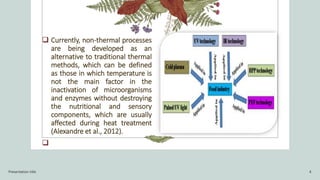
 Currently, non-thermal processes
are being developed as an
alternative to traditional thermal
methods, which can be defined
as those in which temperature is
not the main factor in the
inactivation of microorganisms
and enzymes without destroying
the nutritional and sensory
components, which are usually
affected during heat treatment
(Alexandre et al., 2012).

Presentation title 4
AIMS:
1. State the disadvantages of traditional thermal technology and its
effects on food quality.
2. Compare traditional thermal technology with novel thermal and
nonthermal technologies.
3. Declare advantages of innovation thermal and nonthermal
technology in food processing.
4. Emphasize the effect of innovative thermal and nonthermal
technologies on food quality.
Presentation title 5
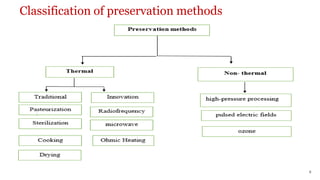
Classification of preservation methods
6
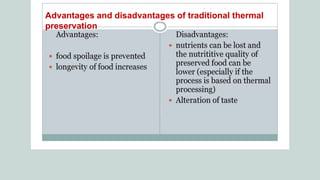
Advantages and disadvantages of traditional thermal
preservation
Novel Thermal Technology in Food
Preservation
1) Microwave (M.W. )
2) Radio Frequency Heating (RF)
3) Ohmic heating (OH)
8
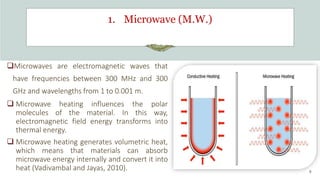
1. Microwave (M.W.)
Microwaves are electromagnetic waves that
have frequencies between 300 MHz and 300
GHz and wavelengths from 1 to 0.001 m.
 Microwave heating influences the polar
molecules of the material. In this way,
electromagnetic field energy transforms into
thermal energy.
 Microwave heating generates volumetric heat,
which means that materials can absorb
microwave energy internally and convert it into
heat (Vadivambal and Jayas, 2010). 9
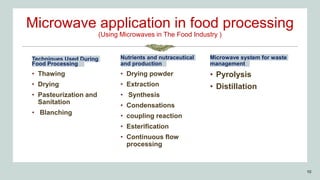
Microwave application in food processing
)Using Microwaves in The Food Industry )
Techniques Used During
Food Processing
• Thawing
• Drying
• Pasteurization and
Sanitation
• Blanching
Nutrients and nutraceutical
and production
• Drying powder
• Extraction
• Synthesis
• Condensations
• coupling reaction
• Esterification
• Continuous flow
processing
10
Microwave system for waste
management
• Pyrolysis
• Distillation
Advantages
 Reduction in thermal processing
time
 Fresh taste, texture and improves
the visual appearance.
 Increase retention of nutrients and
sensory properties.
 Better energy usage (Tavman et al.,
2019).
11
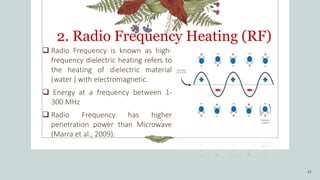
2. Radio Frequency Heating (RF)
 Radio Frequency is known as high-
frequency dielectric heating refers to
the heating of dielectric material
(water ) with electromagnetic.
 Energy at a frequency between 1-
300 MHz
 Radio Frequency has higher
penetration power than Microwave
(Marra et al., 2009).
12
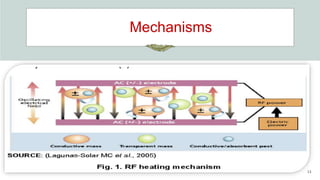
Mechanisms
13
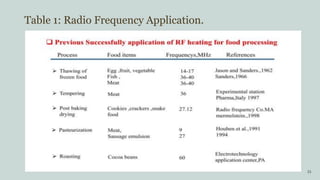
Table 1: Radio Frequency Application.
15
Advantages
 Faster heating and reduced drying time
 Uniform heating and drying
 High efficiency
 Deep penetration heating
 Avoiding over-heating on the surface of the product
 Reducing microbial contamination and improving food safety and
quality
 Heat is generated within the product. (Osaili, 2012).
16
3. Ohmic Heating (OH)
17
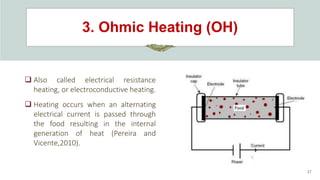
 Also called electrical resistance
heating, or electroconductive heating.
 Heating occurs when an alternating
electrical current is passed through
the food resulting in the internal
generation of heat (Pereira and
Vicente,2010).
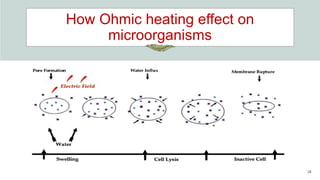
How Ohmic heating effect on
microorganisms
18
Applications
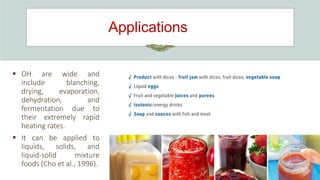
 OH are wide and
include blanching,
drying, evaporation,
dehydration, and
fermentation due to
their extremely rapid
heating rates.
 It can be applied to
liquids, solids, and
liquid-solid mixture
foods (Cho et al., 1996).
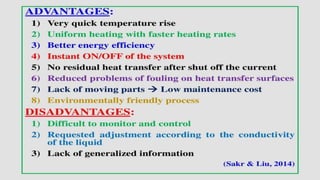
Advantages:
20
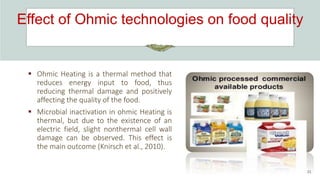
Effect of Ohmic technologies on food quality
21
 Ohmic Heating is a thermal method that
reduces energy input to food, thus
reducing thermal damage and positively
affecting the quality of the food.
 Microbial inactivation in ohmic Heating is
thermal, but due to the existence of an
electric field, slight nonthermal cell wall
damage can be observed. This effect is
the main outcome (Knirsch et al., 2010).
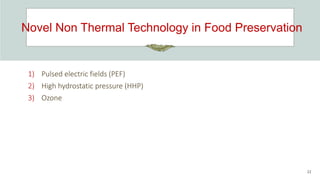
Novel Non Thermal Technology in Food Preservation
22
1) Pulsed electric fields (PEF)
2) High hydrostatic pressure (HHP)
3) Ozone
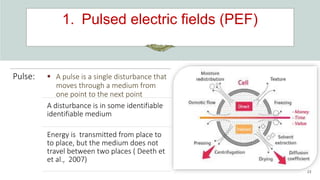
1. Pulsed electric fields (PEF)
23
Pulse:  A pulse is a single disturbance that
moves through a medium from
one point to the next point
A disturbance is in some identifiable
identifiable medium
Energy is transmitted from place to
to place, but the medium does not
travel between two places ( Deeth et
et al., 2007)
pulsed is electric field
24
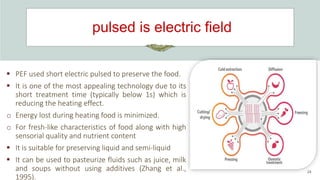
 PEF used short electric pulsed to preserve the food.
 It is one of the most appealing technology due to its
short treatment time (typically below 1s) which is
reducing the heating effect.
o Energy lost during heating food is minimized.
o For fresh-like characteristics of food along with high
sensorial quality and nutrient content
 It is suitable for preserving liquid and semi-liquid
 It can be used to pasteurize fluids such as juice, milk
and soups without using additives (Zhang et al.,
1995).
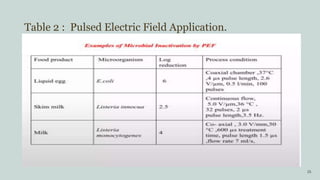
Table 2 : Pulsed Electric Field Application.
25
Advantages
26
 Treatment time is short
 Low treatment temperature
 Substitute for conventional heat post pasteurization or it can operate at room temperature
to retain quality and heat-sensitive vitamins
 Increase shelf life and maintain food safety with low processing cost
 Minimally processed food of fresh quality, which has higher nutritional value because of
color and flavor retention
 PEF inactivates vegetative micro-organisms including yeasts, spoilage microorganisms and
pathogens (Pereira and Vicente, 2010).
Effect of PEF technologies on food
quality
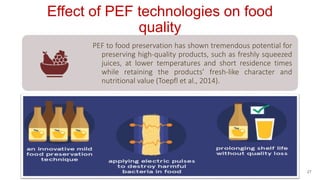
PEF to food preservation has shown tremendous potential for
preserving high-quality products, such as freshly squeezed
juices, at lower temperatures and short residence times
while retaining the products’ fresh-like character and
nutritional value (Toepfl et al., 2014).
27
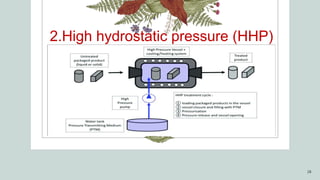
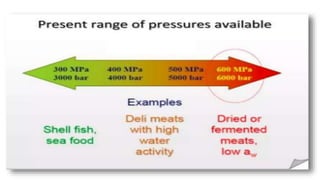
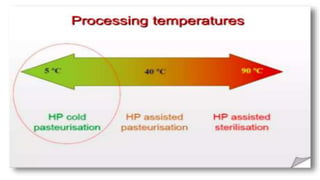
2.High hydrostatic pressure (HHP)
28
Food that can be HHP treated
 Solids food, mainly vacuum packed
 Dry-cured, cheeses, or cooked meat
products
 Fish, seafood, and marinated products
 Ready-to-eat meals, sauce
 Fruits, marmalades / Jam
 Liquid Food, in flexible packaging
 Dairy products
 Fruits Juices (Norton and Sun, 2008).
31
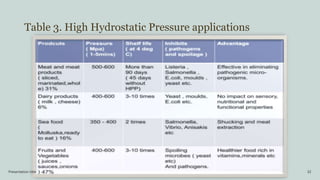
Table 3. High Hydrostatic Pressure applications
Presentation title 32
Advantages
 Homogeneity of a treatment since pressure is uniformly applied around and throughout the
food product.
 Minimal heat impact.
 Shelf lives like thermal pasteurization while maintaining the natural food quality parameters
 A small amount of energy is needed to compress a solid or liquid to 500 MPa compared to
Heating to 100 (Tewari and Juneja, 2008).
 Low cost
 Very low use of energy
 Accepted by consumers and retailers 33
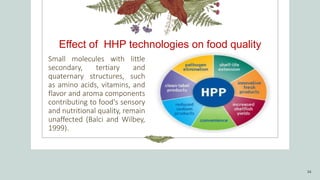
Effect of HHP technologies on food quality
Small molecules with little
secondary, tertiary and
quaternary structures, such
as amino acids, vitamins, and
flavor and aroma components
contributing to food's sensory
and nutritional quality, remain
unaffected (Balci and Wilbey,
1999).
34
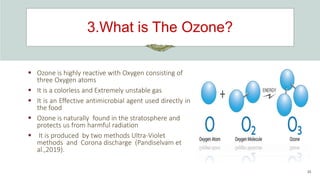
3.What is The Ozone?
35
 Ozone is highly reactive with Oxygen consisting of
three Oxygen atoms
 It is a colorless and Extremely unstable gas
 It is an Effective antimicrobial agent used directly in
the food
 Ozone is naturally found in the stratosphere and
protects us from harmful radiation
 It is produced by two methods Ultra-Violet
methods and Corona discharge (Pandiselvam et
al.,2019).
How does Ozone work?
 The unstable third oxygen atom of
ozone can combine with organic
and inorganic molecules to
destroy them through oxidation.
 Finally Ozone Reverts back to
oxygen after it is used. This
makes it a very environmentally
friendly oxidant (Mohammadi et
al., 2017)
36
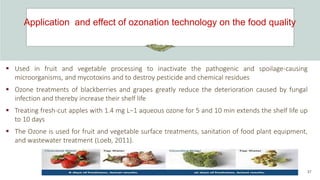
Application and effect of ozonation technology on the food quality
37
 Used in fruit and vegetable processing to inactivate the pathogenic and spoilage-causing
microorganisms, and mycotoxins and to destroy pesticide and chemical residues
 Ozone treatments of blackberries and grapes greatly reduce the deterioration caused by fungal
infection and thereby increase their shelf life
 Treating fresh-cut apples with 1.4 mg L−1 aqueous ozone for 5 and 10 min extends the shelf life up
to 10 days
 The Ozone is used for fruit and vegetable surface treatments, sanitation of food plant equipment,
and wastewater treatment (Loeb, 2011).
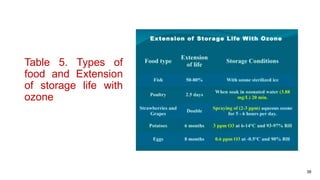
Table 5. Types of
food and Extension
of storage life with
ozone
38
Advantages of Ozone
39
 It is natural and friendly process
 Highly effective in cold water, which saves energy and cost
 Significant reduction in processing time
 Effective against a wide range of harmful Microorganisms
 Dissolved metallic substances like iron and manganese
 Removes unwanted color, taste and color of the product (Khadre et al., 2001).
Reference
40
• Pereira, R. N. and Vicente, A. A. (2010). Environmental impact of novel thermal and non-thermal technologies in food processing. Food
Research International, 43(7), 1936-1943.
• Alexandre, E. M., Brandão, T. R. and Silva, C. L. (2012). Efficacy of non-thermal technologies and sanitizer solutions on microbial load
reduction and quality retention of strawberries. Journal of Food Engineering, 108(3), 417-426.
• Balci, A. T. and Wilbey, R. A. (1999). High-pressure processing of milk the first 100 years in the development of new
technology. International Journal of Dairy Technology, 52(4), 149-155.
• Deeth, H. C., Datta, N., Ross, A. I. and Dam, X. T. Advances in Thermal and Non-Thermal Food Preservation. Ames, Iowa, USA: Blackwell
Publishing (2007). p. 241–69. Pulsed Electric Field Technology: Effect on Milk and Fruit Juices.
• Khadre, M. A., Yousef, A. E. and Kim, J. G. (2001). Microbiological aspects of ozone applications in food: a review. Journal of Food
Science, 66(9), 1242-1252.
• Knirsch, M. C., Dos Santos, C. A., de Oliveira Soares, A. A. M. and Penna, T. C. V. (2010). Ohmic heating–a review. Trends in Food Science &
Technology, 21(9), 436-441.
• Loeb, B. L. (2011). Thirty-three years and growing. Ozone–Science & Engineering, 33, 329-342.
• Marra, F., Zhang, L. and Lyng, J. G. (2009). Radiofrequency treatment of foods: Review of recent advances. Journal of Food
Engineering, 91(4), 497-508.
• Mohammadi, H., Mazloomi, S. M., Eskandari, M. H., Aminlari, M. and Niakousari, M. (2017). The effect of ozone on aflatoxin M1,
oxidative stability, carotenoid content, and the microbial count of milk. Ozone: Science & Engineering, 39(6), 447-453.
Reference
41
• Norton, T. and Sun, D. W. (2008). Recent advances in the use of high pressure as an effective processing technique in the food
industry. Food and Bioprocess Technology, 1(1), 2-34..
• Osaili, T. M. (2012). Developments in the Thermal Processing of Food. Progress in Food Preservation, 211.
• Pandiselvam, R., Subhashini, S., Banuu Priya, E. P., Kothakota, A., Ramesh, S. V. and Shahir, S. (2019). Ozone-based
food preservation: A promising green technology for enhanced food safety. Ozone: Science & Engineering, 41(1),
17-34.
• Tavman, S., Otles, S., Glue, S. and Gogus, N. (2019). Food preservation technologies. In Saving Food (pp. 117-140). Academic
Press.
• Tewari, G. and Juneja, V. (2008). Advances in thermal and non-thermal food preservation. John Wiley & Sons (Eds.).
• Toepfl, S., Siemer, C., Saldaña-Navarro, G. and Heinz, V. (2014). Overview of pulsed electric fields processing for food. In Emerging
technologies for food processing 93-114.
• Vadivambal, R. and Jayas, D. S. (2010). Non-uniform temperature distribution during microwave heating of food
materials—A review. Food and Bioprocess Technology, 3(2), 161-171.
Green preservation methods 3-1 (3).pptx

Green preservation methods 3-1 (3).pptx

  • 1.
    Green Preservation Methods inFood Processing Presented by: Alaa Ayman Mohamed Under supervision: Prof. Shahinaz Ahmed Helmy Dr. Marwa Rashad Ali
  • 2.
    Contents: Presentation title 2 oIntroduction. o Aims. o Classification of preservation methods. o The novel thermal technology in food processing. o The novel Nonthermal technology in food processing.
  • 3.
    Introduction  Food preservationensures the safety and quality of the food which is the prime goal of food processors.  Consumer demands for more convenient and varied food products have grown exponentially, with the need for faster production rates, improved quality, and extended shelf life (Pereira and Vicente, 2010). Presentation title 3
  • 4.
     Currently, non-thermalprocesses are being developed as an alternative to traditional thermal methods, which can be defined as those in which temperature is not the main factor in the inactivation of microorganisms and enzymes without destroying the nutritional and sensory components, which are usually affected during heat treatment (Alexandre et al., 2012).  Presentation title 4
  • 5.
    AIMS: 1. State thedisadvantages of traditional thermal technology and its effects on food quality. 2. Compare traditional thermal technology with novel thermal and nonthermal technologies. 3. Declare advantages of innovation thermal and nonthermal technology in food processing. 4. Emphasize the effect of innovative thermal and nonthermal technologies on food quality. Presentation title 5
  • 6.
  • 7.
    Advantages and disadvantagesof traditional thermal preservation
  • 8.
    Novel Thermal Technologyin Food Preservation 1) Microwave (M.W. ) 2) Radio Frequency Heating (RF) 3) Ohmic heating (OH) 8
  • 9.
    1. Microwave (M.W.) Microwavesare electromagnetic waves that have frequencies between 300 MHz and 300 GHz and wavelengths from 1 to 0.001 m.  Microwave heating influences the polar molecules of the material. In this way, electromagnetic field energy transforms into thermal energy.  Microwave heating generates volumetric heat, which means that materials can absorb microwave energy internally and convert it into heat (Vadivambal and Jayas, 2010). 9
  • 10.
    Microwave application infood processing )Using Microwaves in The Food Industry ) Techniques Used During Food Processing • Thawing • Drying • Pasteurization and Sanitation • Blanching Nutrients and nutraceutical and production • Drying powder • Extraction • Synthesis • Condensations • coupling reaction • Esterification • Continuous flow processing 10 Microwave system for waste management • Pyrolysis • Distillation
  • 11.
    Advantages  Reduction inthermal processing time  Fresh taste, texture and improves the visual appearance.  Increase retention of nutrients and sensory properties.  Better energy usage (Tavman et al., 2019). 11
  • 12.
    2. Radio FrequencyHeating (RF)  Radio Frequency is known as high- frequency dielectric heating refers to the heating of dielectric material (water ) with electromagnetic.  Energy at a frequency between 1- 300 MHz  Radio Frequency has higher penetration power than Microwave (Marra et al., 2009). 12
  • 13.
  • 15.
    Table 1: RadioFrequency Application. 15
  • 16.
    Advantages  Faster heatingand reduced drying time  Uniform heating and drying  High efficiency  Deep penetration heating  Avoiding over-heating on the surface of the product  Reducing microbial contamination and improving food safety and quality  Heat is generated within the product. (Osaili, 2012). 16
  • 17.
    3. Ohmic Heating(OH) 17  Also called electrical resistance heating, or electroconductive heating.  Heating occurs when an alternating electrical current is passed through the food resulting in the internal generation of heat (Pereira and Vicente,2010).
  • 18.
    How Ohmic heatingeffect on microorganisms 18
  • 19.
    Applications  OH arewide and include blanching, drying, evaporation, dehydration, and fermentation due to their extremely rapid heating rates.  It can be applied to liquids, solids, and liquid-solid mixture foods (Cho et al., 1996).
  • 20.
  • 21.
    Effect of Ohmictechnologies on food quality 21  Ohmic Heating is a thermal method that reduces energy input to food, thus reducing thermal damage and positively affecting the quality of the food.  Microbial inactivation in ohmic Heating is thermal, but due to the existence of an electric field, slight nonthermal cell wall damage can be observed. This effect is the main outcome (Knirsch et al., 2010).
  • 22.
    Novel Non ThermalTechnology in Food Preservation 22 1) Pulsed electric fields (PEF) 2) High hydrostatic pressure (HHP) 3) Ozone
  • 23.
    1. Pulsed electricfields (PEF) 23 Pulse:  A pulse is a single disturbance that moves through a medium from one point to the next point A disturbance is in some identifiable identifiable medium Energy is transmitted from place to to place, but the medium does not travel between two places ( Deeth et et al., 2007)
  • 24.
    pulsed is electricfield 24  PEF used short electric pulsed to preserve the food.  It is one of the most appealing technology due to its short treatment time (typically below 1s) which is reducing the heating effect. o Energy lost during heating food is minimized. o For fresh-like characteristics of food along with high sensorial quality and nutrient content  It is suitable for preserving liquid and semi-liquid  It can be used to pasteurize fluids such as juice, milk and soups without using additives (Zhang et al., 1995).
  • 25.
    Table 2 :Pulsed Electric Field Application. 25
  • 26.
    Advantages 26  Treatment timeis short  Low treatment temperature  Substitute for conventional heat post pasteurization or it can operate at room temperature to retain quality and heat-sensitive vitamins  Increase shelf life and maintain food safety with low processing cost  Minimally processed food of fresh quality, which has higher nutritional value because of color and flavor retention  PEF inactivates vegetative micro-organisms including yeasts, spoilage microorganisms and pathogens (Pereira and Vicente, 2010).
  • 27.
    Effect of PEFtechnologies on food quality PEF to food preservation has shown tremendous potential for preserving high-quality products, such as freshly squeezed juices, at lower temperatures and short residence times while retaining the products’ fresh-like character and nutritional value (Toepfl et al., 2014). 27
  • 28.
  • 31.
    Food that canbe HHP treated  Solids food, mainly vacuum packed  Dry-cured, cheeses, or cooked meat products  Fish, seafood, and marinated products  Ready-to-eat meals, sauce  Fruits, marmalades / Jam  Liquid Food, in flexible packaging  Dairy products  Fruits Juices (Norton and Sun, 2008). 31
  • 32.
    Table 3. HighHydrostatic Pressure applications Presentation title 32
  • 33.
    Advantages  Homogeneity ofa treatment since pressure is uniformly applied around and throughout the food product.  Minimal heat impact.  Shelf lives like thermal pasteurization while maintaining the natural food quality parameters  A small amount of energy is needed to compress a solid or liquid to 500 MPa compared to Heating to 100 (Tewari and Juneja, 2008).  Low cost  Very low use of energy  Accepted by consumers and retailers 33
  • 34.
    Effect of HHPtechnologies on food quality Small molecules with little secondary, tertiary and quaternary structures, such as amino acids, vitamins, and flavor and aroma components contributing to food's sensory and nutritional quality, remain unaffected (Balci and Wilbey, 1999). 34
  • 35.
    3.What is TheOzone? 35  Ozone is highly reactive with Oxygen consisting of three Oxygen atoms  It is a colorless and Extremely unstable gas  It is an Effective antimicrobial agent used directly in the food  Ozone is naturally found in the stratosphere and protects us from harmful radiation  It is produced by two methods Ultra-Violet methods and Corona discharge (Pandiselvam et al.,2019).
  • 36.
    How does Ozonework?  The unstable third oxygen atom of ozone can combine with organic and inorganic molecules to destroy them through oxidation.  Finally Ozone Reverts back to oxygen after it is used. This makes it a very environmentally friendly oxidant (Mohammadi et al., 2017) 36
  • 37.
    Application and effectof ozonation technology on the food quality 37  Used in fruit and vegetable processing to inactivate the pathogenic and spoilage-causing microorganisms, and mycotoxins and to destroy pesticide and chemical residues  Ozone treatments of blackberries and grapes greatly reduce the deterioration caused by fungal infection and thereby increase their shelf life  Treating fresh-cut apples with 1.4 mg L−1 aqueous ozone for 5 and 10 min extends the shelf life up to 10 days  The Ozone is used for fruit and vegetable surface treatments, sanitation of food plant equipment, and wastewater treatment (Loeb, 2011).
  • 38.
    Table 5. Typesof food and Extension of storage life with ozone 38
  • 39.
    Advantages of Ozone 39 It is natural and friendly process  Highly effective in cold water, which saves energy and cost  Significant reduction in processing time  Effective against a wide range of harmful Microorganisms  Dissolved metallic substances like iron and manganese  Removes unwanted color, taste and color of the product (Khadre et al., 2001).
  • 40.
    Reference 40 • Pereira, R.N. and Vicente, A. A. (2010). Environmental impact of novel thermal and non-thermal technologies in food processing. Food Research International, 43(7), 1936-1943. • Alexandre, E. M., Brandão, T. R. and Silva, C. L. (2012). Efficacy of non-thermal technologies and sanitizer solutions on microbial load reduction and quality retention of strawberries. Journal of Food Engineering, 108(3), 417-426. • Balci, A. T. and Wilbey, R. A. (1999). High-pressure processing of milk the first 100 years in the development of new technology. International Journal of Dairy Technology, 52(4), 149-155. • Deeth, H. C., Datta, N., Ross, A. I. and Dam, X. T. Advances in Thermal and Non-Thermal Food Preservation. Ames, Iowa, USA: Blackwell Publishing (2007). p. 241–69. Pulsed Electric Field Technology: Effect on Milk and Fruit Juices. • Khadre, M. A., Yousef, A. E. and Kim, J. G. (2001). Microbiological aspects of ozone applications in food: a review. Journal of Food Science, 66(9), 1242-1252. • Knirsch, M. C., Dos Santos, C. A., de Oliveira Soares, A. A. M. and Penna, T. C. V. (2010). Ohmic heating–a review. Trends in Food Science & Technology, 21(9), 436-441. • Loeb, B. L. (2011). Thirty-three years and growing. Ozone–Science & Engineering, 33, 329-342. • Marra, F., Zhang, L. and Lyng, J. G. (2009). Radiofrequency treatment of foods: Review of recent advances. Journal of Food Engineering, 91(4), 497-508. • Mohammadi, H., Mazloomi, S. M., Eskandari, M. H., Aminlari, M. and Niakousari, M. (2017). The effect of ozone on aflatoxin M1, oxidative stability, carotenoid content, and the microbial count of milk. Ozone: Science & Engineering, 39(6), 447-453.
  • 41.
    Reference 41 • Norton, T.and Sun, D. W. (2008). Recent advances in the use of high pressure as an effective processing technique in the food industry. Food and Bioprocess Technology, 1(1), 2-34.. • Osaili, T. M. (2012). Developments in the Thermal Processing of Food. Progress in Food Preservation, 211. • Pandiselvam, R., Subhashini, S., Banuu Priya, E. P., Kothakota, A., Ramesh, S. V. and Shahir, S. (2019). Ozone-based food preservation: A promising green technology for enhanced food safety. Ozone: Science & Engineering, 41(1), 17-34. • Tavman, S., Otles, S., Glue, S. and Gogus, N. (2019). Food preservation technologies. In Saving Food (pp. 117-140). Academic Press. • Tewari, G. and Juneja, V. (2008). Advances in thermal and non-thermal food preservation. John Wiley & Sons (Eds.). • Toepfl, S., Siemer, C., Saldaña-Navarro, G. and Heinz, V. (2014). Overview of pulsed electric fields processing for food. In Emerging technologies for food processing 93-114. • Vadivambal, R. and Jayas, D. S. (2010). Non-uniform temperature distribution during microwave heating of food materials—A review. Food and Bioprocess Technology, 3(2), 161-171.