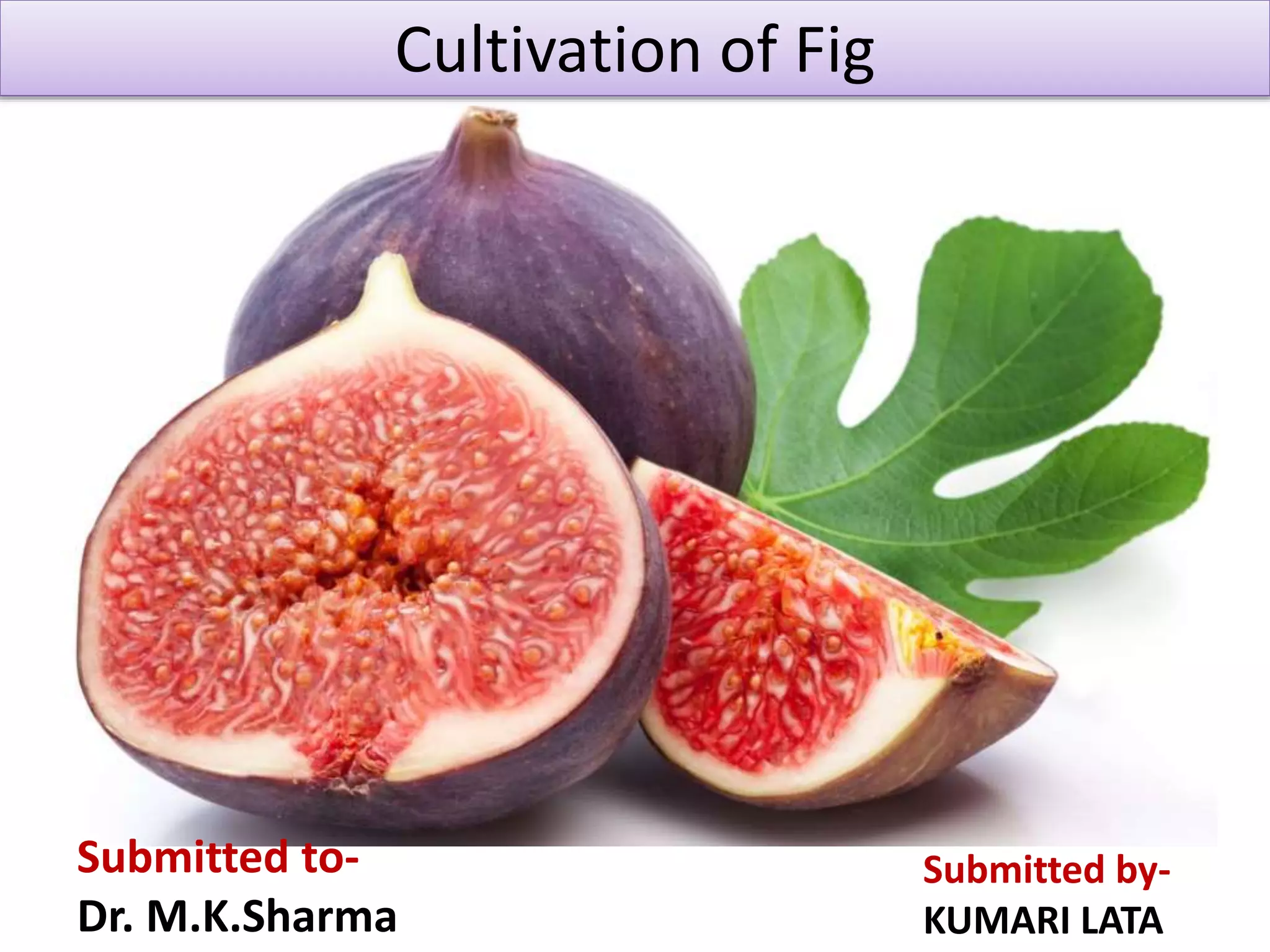
Cultivation of Fig
Submitted to-
Dr. M.K.Sharma
Submitted by-
KUMARI LATA
BOTANY
• Common Fig- Ficus carica
• Family – Moracea
• Chromosome no.- 56
• Origin- West Asia
• Tree – moderate size ( deciduous in subtropics
but perform evergreen in tropic)
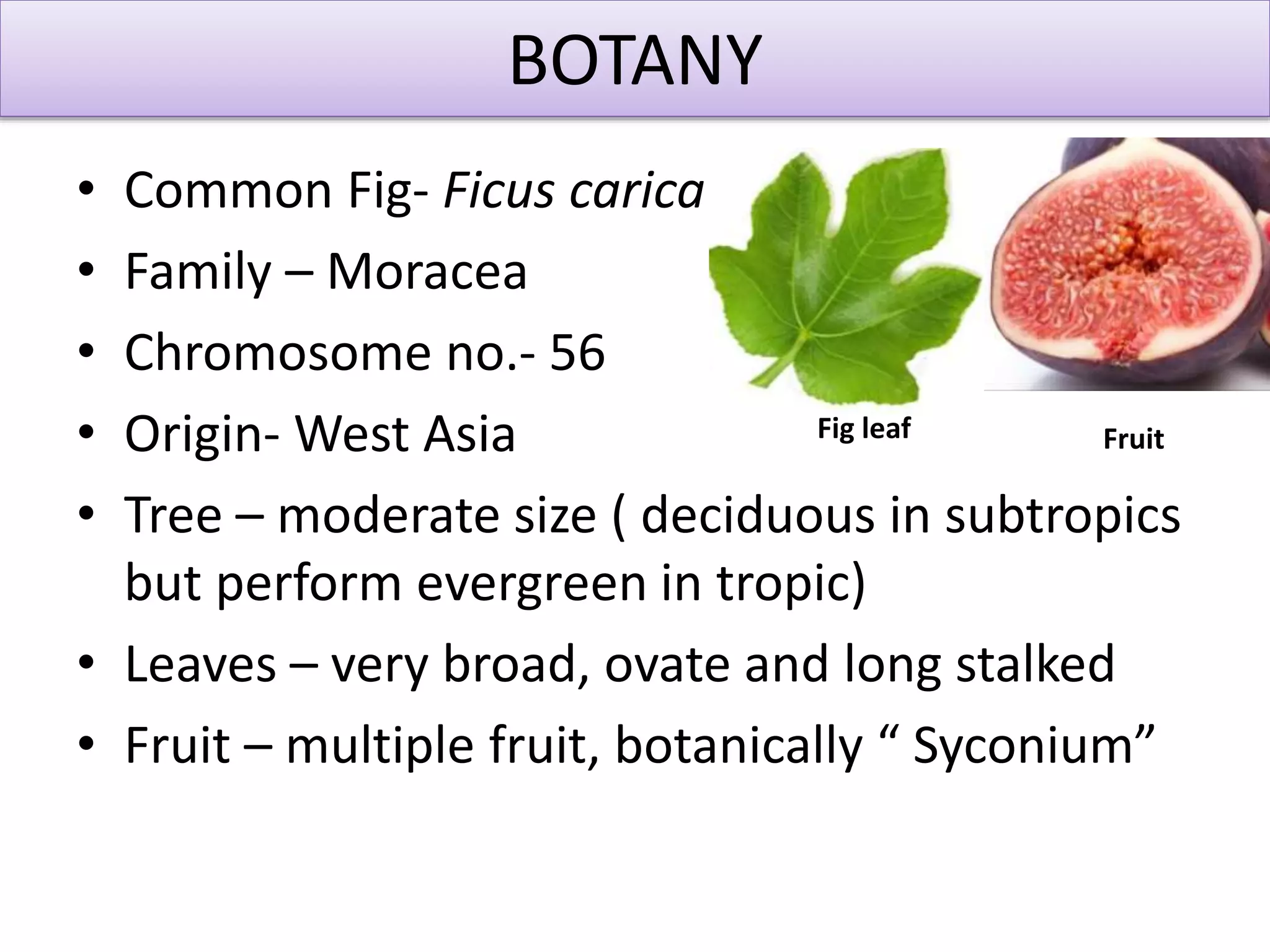
• Leaves – very broad, ovate and long stalked
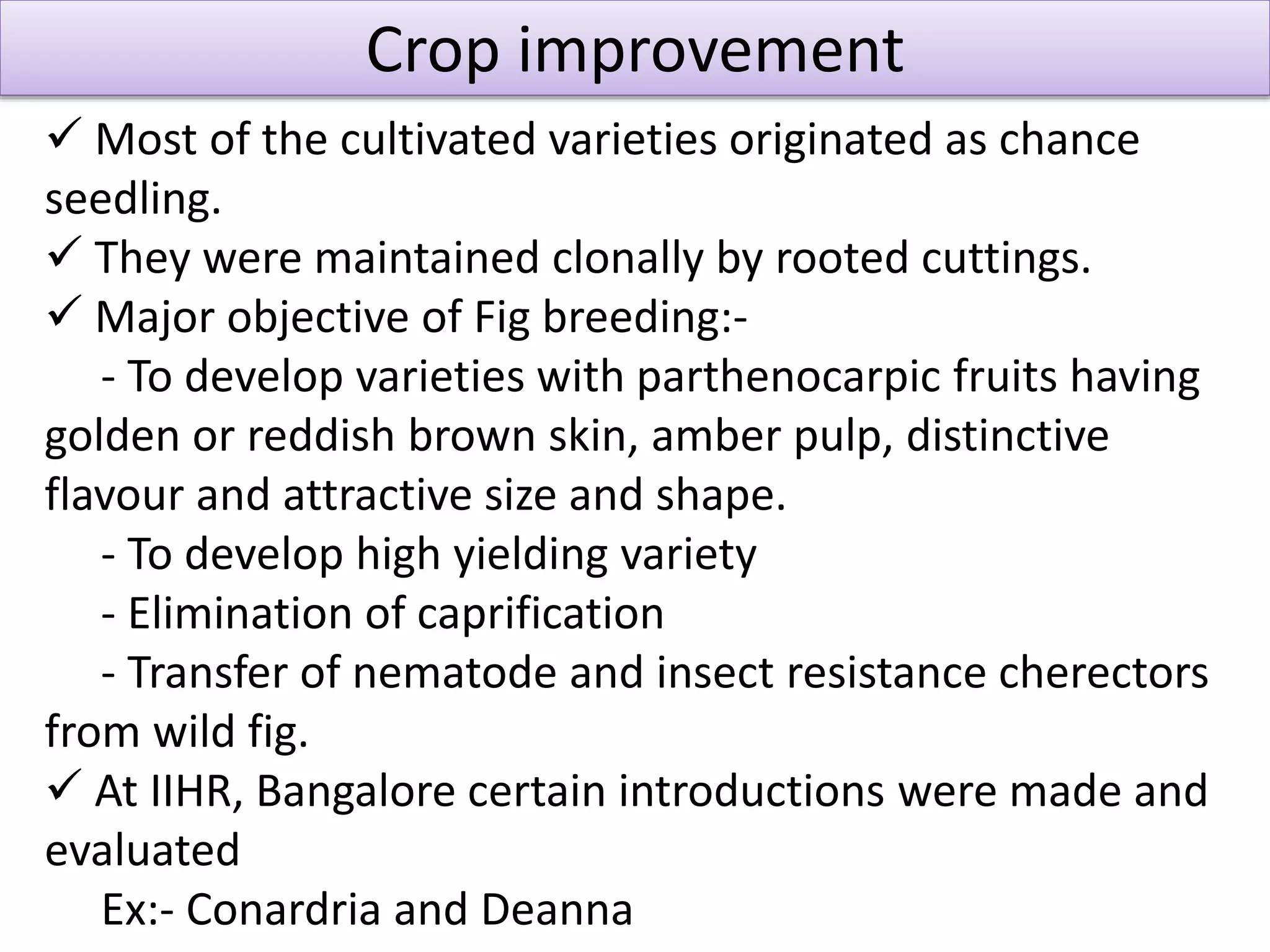
• Fruit – multiple fruit, botanically “ Syconium”
Fig leaf Fruit
COMPOSITION
 Pulp – 85%
 skin – 15%
 calorific value – High (269 cal)
 100g edible portion of dried fig
contain.
Protein : – 4g
Carbohydrate :–69g
Fat :– 1g
Calcium :– 200mg
Iron :– 4mg
Vit. A :– 100IU
Thiamine :– 0.1 mg
USES of Fig
 used as luxative and in treatment of skin
infection
 CONSPTION – Fresh, preserved or
canned fruit
Very much used as a dried fruit
Also processed into jelly and paste
Latex is used to coagulate milk
Types / varieties
Based on pollination pattern and sex of flower, there
are four types of fig
Common fig/
Edible fig
Smyrna fig San pedro fig Wild fig/
Capri fig
Flower Long styled
pistillate flower
Long styled,
pistillate flower
Long styled
pistilate flower
Short styled
pistillate flower
with functional
male
Fruit
develop
Parthenocarpically After pollination Pollination Self fertile
Varieties Conardia
Poona
Kadata
Brown Turkey
Mission
Adriatic
Calimyrna
Taranimt
Zidi
San Pedro
King
Gentile
Lampeiria
Samson
Stanford
Brawley
Crop improvement
 Most of the cultivated varieties originated as chance
seedling.
 They were maintained clonally by rooted cuttings.
 Major objective of Fig breeding:-
- To develop varieties with parthenocarpic fruits having
golden or reddish brown skin, amber pulp, distinctive
flavour and attractive size and shape.
- To develop high yielding variety
- Elimination of caprification
- Transfer of nematode and insect resistance cherectors
from wild fig.
 At IIHR, Bangalore certain introductions were made and
evaluated
Ex:- Conardria and Deanna
CLIMATE and SOIL
 It is a subtropical deciduous plant
 Young trees are susceptible to frost.
 It can tolerate temp. up to 45°C
 high humidity cause fruit splitting
 Arid and semi arid regions ( high summer, temp,
enough sunlight, and relative cool winter) are ideal for
quality fruit production.
 Soil- well drained, non alkaline, deep, medium black
soils or alluvial clay soil much suitable.
 Fig tolerate salt and drought condition.
PROPAGATION
 By seed or asexually ( Cutting,
layering, grafting and micro-propagation)
 Common and most successful method
is hard wood cutting.
 It is taken from 1-2 years old shoots
 Pre girdling of shoots, 30 days before
taking the cutting results in quick and
increased rooting.
 Cutting taken from basal portion of
crown having short internodes.
 Air layering on one year old shoots
during June
 Top working done with bark or cleft
grafting or patch budding
CULTIVATION
Planting:-
North Indian States:- during early spring (Propagule
are in dormant stage
South and West India:- During monsoon
After planting irrigation given
Spacing:-
Usually – 8-10m in square system
Present recommonded spacing- 5x5m2
Poona variety- 2.5x 2.5m2
Pit size- 60 cm3 ,
Dug 15 days before planting
Fill with top soil: compost: sand:: 1:1:1
along with 2kg of neem cake/ pit
MANURE and FERTILIZER
Age of plant Organic manure (kg) Inorganic manure (g)
(years) FYM Oil cake (neem/ castor/
pongamiya)
N P K
1-2 15 0.5 75 50 50
3.5 25 1.0 – 1.5 150 100 100
>5 40 2.0 300 200 200
TRAINING
 Trees are trained to a
desired height and shape to
enhance productivity and
facilitate harvesting.
 Trees are headed back at a
height of 1-1.5m and allow
growth of side branches.
PRUNING
 Annual pruning recommonded for inducing growth of
flowering wood and improving yield and quality
Light and heavy pruning is adopted
 After pruning copper fungicide should be applied on cut
surface
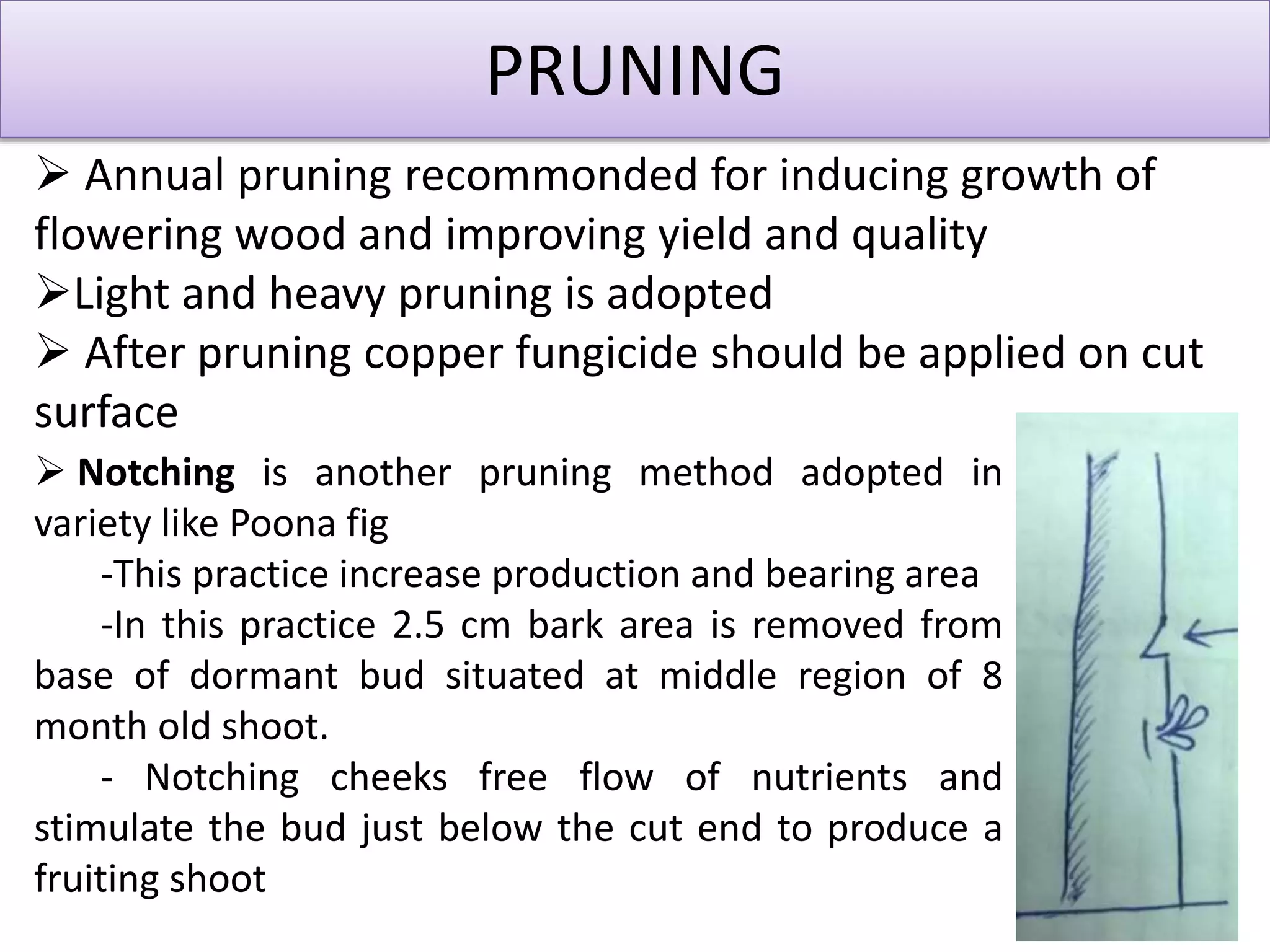
 Notching is another pruning method adopted in
variety like Poona fig
-This practice increase production and bearing area
-In this practice 2.5 cm bark area is removed from
base of dormant bud situated at middle region of 8
month old shoot.
- Notching cheeks free flow of nutrients and
stimulate the bud just below the cut end to produce a
fruiting shoot
IRRIGATION
 Fig is drought tolerant but irrigated plants
produce good shoot growth and yield
 Commercial orchard irrigated during summer
 Flood ( basin diameter- 60cm) or drip system of
irrigation is practiced at 1- 12 days interval
 Excess irrigation cause splitting of fruits and
production of insipid fruits
 Inadequate watering – hardening of fruits and
reduction in fruit size
Flowering and Fruiting
 Flowering starts within 3 years.
 Steady yield is obtained from 5th yr
 Economic life period- 40- 45 years
 W. India – Flowering season- Oct-
Nov.
 N. India – Jan- Feb
 S. India – two flowering season
1. March- April
2. Oct- Dec.
 Fruit mature 4-5 months after
flowering
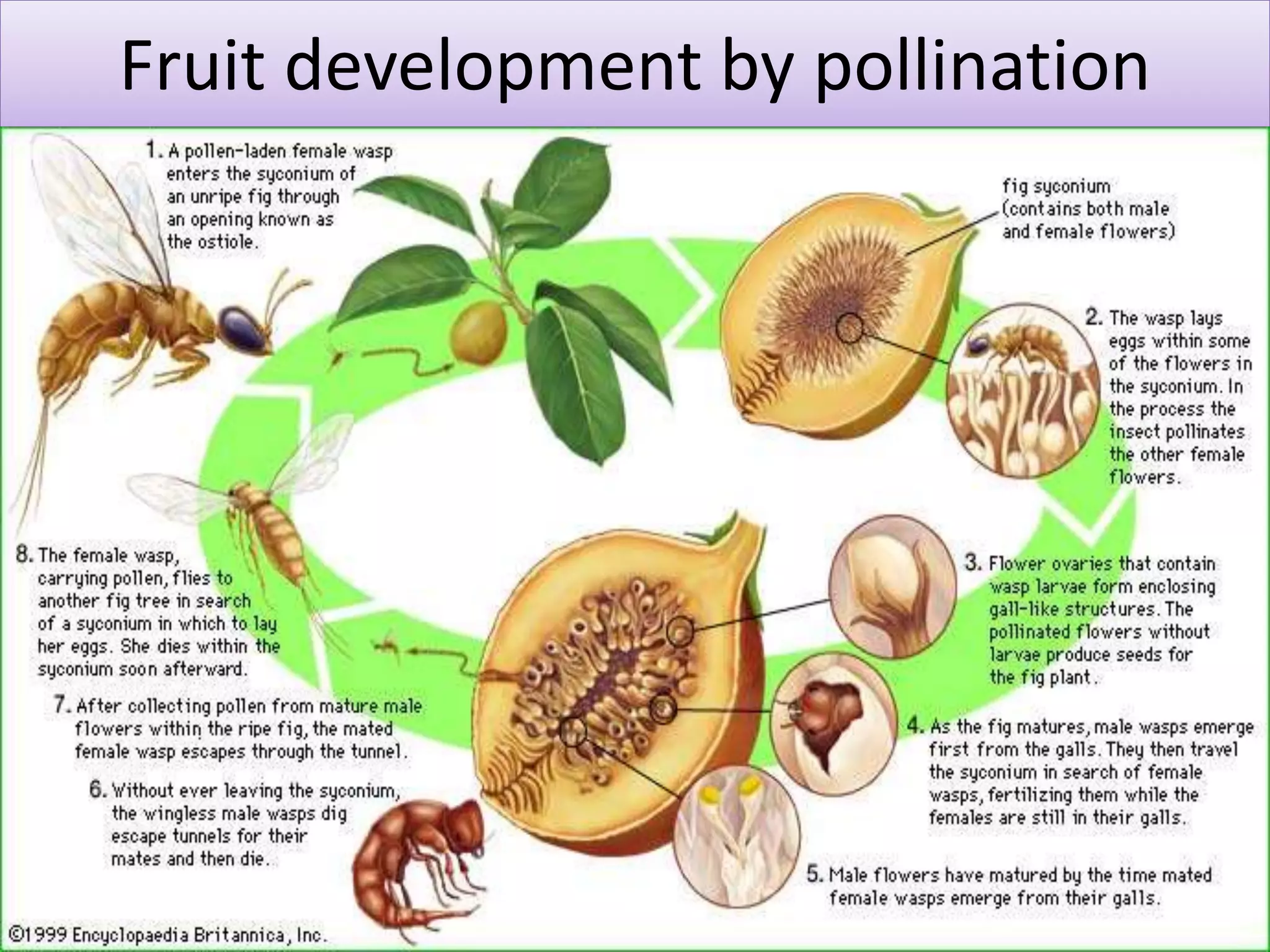
Fruit development by pollination
Harvesting and Yield
 Fig is climecteric fruit so harvest at fully maturity stage
 Harvesting indices are disappearance of milky latex at
time of plucking, softening of fruit, wilting at neck region,
hanging down of fruits, sudden increase in size and
opening of ostiole.
 Harvesting is done by hand either by cutting or twisting
neck at stem end
 If it is grown for dry fruit production, they are allow to
ripen and to dry partially on the tree and allow to fall on
ground
 Hence area beneath the tree has been clen and collect
the fruits once in 1- 5 days for drying.
 Avg. Yield- 150-400 fruits /plant
Post harvest management
Packing:-
- Fruits are graded according to weight
into three groups viz; fruit weighing 50g or
more, 40- 50g and 30- 40g.
- They are packed in corrugated box
cartoon and are arranged in double layers,
each containing 28 fruits.
- Fig leaves are used as cushioning
material.
Storage
- It is a highly perishable fruit so at room temp. it can be stored for few days.
- Shelf life can be extended for a week by keeping at 0°C with 85- 90% humidity.
- fully mature fig can be either dried or frozen and this will not affect flavour or
colour of fruit.
- Before drying fruits are fumigated by sulphure and then dried at temp of 70- 72°C
Dried Fig
Physiological disorders
1. Sun burn- serious problem affecting young trees.
The affected parts crack and the bark peels off.
Heavy pruning and exposure of branches to sunlight
are the causes
2. Fruit splitting- when sudden change in atmospheric
humidity and soil moisture level due to rains.
Fruit become unfit for consumption as microbes
affect exposed pulp.
3. Fruit drop- major factor are excess heat and
drought, cold nights, light frost and lack of
pollination.
.

cultivation of fig

  • 1.
    Cultivation of Fig Submittedto- Dr. M.K.Sharma Submitted by- KUMARI LATA
  • 2.
    BOTANY • Common Fig-Ficus carica • Family – Moracea • Chromosome no.- 56 • Origin- West Asia • Tree – moderate size ( deciduous in subtropics but perform evergreen in tropic) • Leaves – very broad, ovate and long stalked • Fruit – multiple fruit, botanically “ Syconium” Fig leaf Fruit
  • 3.
    COMPOSITION  Pulp –85%  skin – 15%  calorific value – High (269 cal)  100g edible portion of dried fig contain. Protein : – 4g Carbohydrate :–69g Fat :– 1g Calcium :– 200mg Iron :– 4mg Vit. A :– 100IU Thiamine :– 0.1 mg
  • 4.
    USES of Fig used as luxative and in treatment of skin infection  CONSPTION – Fresh, preserved or canned fruit Very much used as a dried fruit Also processed into jelly and paste Latex is used to coagulate milk
  • 5.
    Types / varieties Basedon pollination pattern and sex of flower, there are four types of fig Common fig/ Edible fig Smyrna fig San pedro fig Wild fig/ Capri fig Flower Long styled pistillate flower Long styled, pistillate flower Long styled pistilate flower Short styled pistillate flower with functional male Fruit develop Parthenocarpically After pollination Pollination Self fertile Varieties Conardia Poona Kadata Brown Turkey Mission Adriatic Calimyrna Taranimt Zidi San Pedro King Gentile Lampeiria Samson Stanford Brawley
  • 6.
    Crop improvement  Mostof the cultivated varieties originated as chance seedling.  They were maintained clonally by rooted cuttings.  Major objective of Fig breeding:- - To develop varieties with parthenocarpic fruits having golden or reddish brown skin, amber pulp, distinctive flavour and attractive size and shape. - To develop high yielding variety - Elimination of caprification - Transfer of nematode and insect resistance cherectors from wild fig.  At IIHR, Bangalore certain introductions were made and evaluated Ex:- Conardria and Deanna
  • 7.
    CLIMATE and SOIL It is a subtropical deciduous plant  Young trees are susceptible to frost.  It can tolerate temp. up to 45°C  high humidity cause fruit splitting  Arid and semi arid regions ( high summer, temp, enough sunlight, and relative cool winter) are ideal for quality fruit production.  Soil- well drained, non alkaline, deep, medium black soils or alluvial clay soil much suitable.  Fig tolerate salt and drought condition.
  • 8.
    PROPAGATION  By seedor asexually ( Cutting, layering, grafting and micro-propagation)  Common and most successful method is hard wood cutting.  It is taken from 1-2 years old shoots  Pre girdling of shoots, 30 days before taking the cutting results in quick and increased rooting.  Cutting taken from basal portion of crown having short internodes.  Air layering on one year old shoots during June  Top working done with bark or cleft grafting or patch budding
  • 9.
    CULTIVATION Planting:- North Indian States:-during early spring (Propagule are in dormant stage South and West India:- During monsoon After planting irrigation given Spacing:- Usually – 8-10m in square system Present recommonded spacing- 5x5m2 Poona variety- 2.5x 2.5m2 Pit size- 60 cm3 , Dug 15 days before planting Fill with top soil: compost: sand:: 1:1:1 along with 2kg of neem cake/ pit
  • 10.
    MANURE and FERTILIZER Ageof plant Organic manure (kg) Inorganic manure (g) (years) FYM Oil cake (neem/ castor/ pongamiya) N P K 1-2 15 0.5 75 50 50 3.5 25 1.0 – 1.5 150 100 100 >5 40 2.0 300 200 200
  • 11.
    TRAINING  Trees aretrained to a desired height and shape to enhance productivity and facilitate harvesting.  Trees are headed back at a height of 1-1.5m and allow growth of side branches.
  • 12.
    PRUNING  Annual pruningrecommonded for inducing growth of flowering wood and improving yield and quality Light and heavy pruning is adopted  After pruning copper fungicide should be applied on cut surface  Notching is another pruning method adopted in variety like Poona fig -This practice increase production and bearing area -In this practice 2.5 cm bark area is removed from base of dormant bud situated at middle region of 8 month old shoot. - Notching cheeks free flow of nutrients and stimulate the bud just below the cut end to produce a fruiting shoot
  • 13.
    IRRIGATION  Fig isdrought tolerant but irrigated plants produce good shoot growth and yield  Commercial orchard irrigated during summer  Flood ( basin diameter- 60cm) or drip system of irrigation is practiced at 1- 12 days interval  Excess irrigation cause splitting of fruits and production of insipid fruits  Inadequate watering – hardening of fruits and reduction in fruit size
  • 14.
    Flowering and Fruiting Flowering starts within 3 years.  Steady yield is obtained from 5th yr  Economic life period- 40- 45 years  W. India – Flowering season- Oct- Nov.  N. India – Jan- Feb  S. India – two flowering season 1. March- April 2. Oct- Dec.  Fruit mature 4-5 months after flowering
  • 15.
  • 16.
    Harvesting and Yield Fig is climecteric fruit so harvest at fully maturity stage  Harvesting indices are disappearance of milky latex at time of plucking, softening of fruit, wilting at neck region, hanging down of fruits, sudden increase in size and opening of ostiole.  Harvesting is done by hand either by cutting or twisting neck at stem end  If it is grown for dry fruit production, they are allow to ripen and to dry partially on the tree and allow to fall on ground  Hence area beneath the tree has been clen and collect the fruits once in 1- 5 days for drying.  Avg. Yield- 150-400 fruits /plant
  • 17.
    Post harvest management Packing:- -Fruits are graded according to weight into three groups viz; fruit weighing 50g or more, 40- 50g and 30- 40g. - They are packed in corrugated box cartoon and are arranged in double layers, each containing 28 fruits. - Fig leaves are used as cushioning material. Storage - It is a highly perishable fruit so at room temp. it can be stored for few days. - Shelf life can be extended for a week by keeping at 0°C with 85- 90% humidity. - fully mature fig can be either dried or frozen and this will not affect flavour or colour of fruit. - Before drying fruits are fumigated by sulphure and then dried at temp of 70- 72°C Dried Fig
  • 18.
    Physiological disorders 1. Sunburn- serious problem affecting young trees. The affected parts crack and the bark peels off. Heavy pruning and exposure of branches to sunlight are the causes 2. Fruit splitting- when sudden change in atmospheric humidity and soil moisture level due to rains. Fruit become unfit for consumption as microbes affect exposed pulp. 3. Fruit drop- major factor are excess heat and drought, cold nights, light frost and lack of pollination.
  • 19.