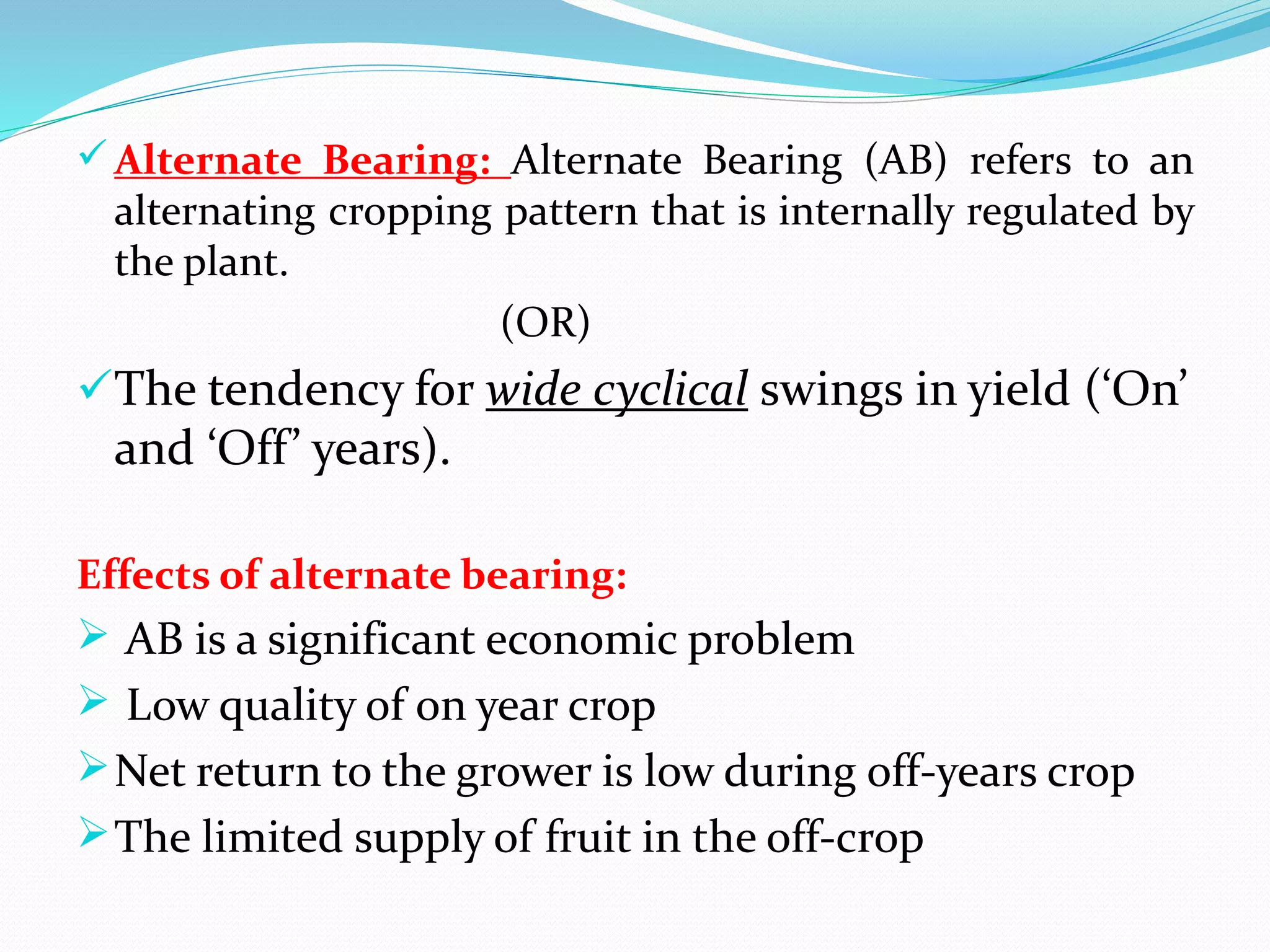
 Alternate Bearing: Alternate Bearing (AB) refers to an
alternating cropping pattern that is internally regulated by
the plant.
(OR)
The tendency for wide cyclical swings in yield (‘On’
and ‘Off’ years).
Effects of alternate bearing:
 AB is a significant economic problem
 Low quality of on year crop
Net return to the grower is low during off-years crop
The limited supply of fruit in the off-crop
Nuts Temperate
Fruits
Sub-Tropical
Fruits
Tropical
Fruits
Most effected with AB
Formula 1: Alternate bearing index (I) = (year 1 yield) - (year 2 yield) / (year 1 yield + year 2
yield), where I = 0 is no alternate bearing and I = 1.0 is complete alternate bearing; and
Formula 2: Alternate bearing = (current year's yield) - (5-year running average yield)/5-year
running average yield; when the current yield is 20% greater than the 5-year average yield, it is
an on-crop and when the current yield is 20% less than the 5-year average, it is an off-crop.
( Monselise and Goldschmidt, 1982)
ABI:
Theories of alternate bearing
Starch depletion theory
Inhibition of flowering by hormones
S.no Endogenous factors
1 Genotypic differences 10 Effects of leaves
2 Competition between vegetative
and reproductive sinks
11 Crop over load
3 Carbohydrate reserves (C:N) 12 Tree age and vigour
4 Hormonal imbalance (auxin, GAs,
CK, ABA and Poly amines)
13 Natural abscission of buds,
flowers and fruits
5. Flower inhibition by growing fruits 14 Nutrient status
6 Pollination 15 Age and size of shoot
7 Effects of seeds on fruit drop 16 Fruiting habit
8 Root stocks 17 Growth pattern
9 Branch anatomy 18 Others
Exogenous factors
I. Environmental factors
Temperature
Light
Relative humidity
Rains
Snow
Spring frost
Hails
Water stress
II. Edaphic factors
III. Biotic factors
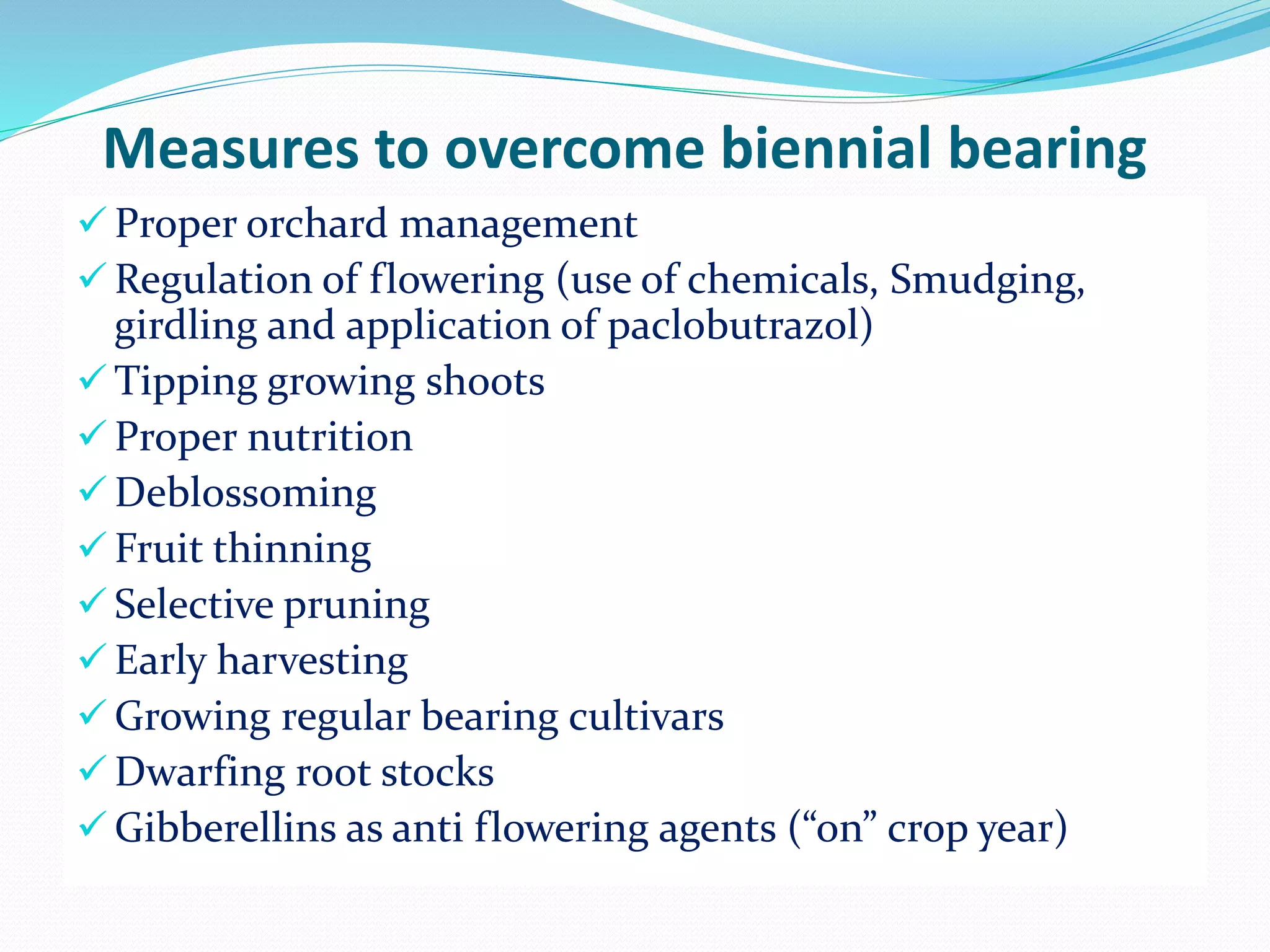
Measures to overcome biennial bearing
 Proper orchard management
 Regulation of flowering (use of chemicals, Smudging,
girdling and application of paclobutrazol)
 Tipping growing shoots
 Proper nutrition
 Deblossoming
 Fruit thinning
 Selective pruning
 Early harvesting
 Growing regular bearing cultivars
 Dwarfing root stocks
 Gibberellins as anti flowering agents (“on” crop year)
Conclusion:
 Alternate bearing is a serious economic problem for growers and the
industry
 It is difficult to find a hypothesis that explains all aspects involved in
alternate bearing
 Horticulturally the key is to attempt the maintenance of the ideal
vegetative and reproductive balance as determined for particular
environmental conditions
 Research in specific areas is needed in order to fine tune orchard
management practices that growers can use to eliminate alternate
bearing
Alternate bearing in mango and apple

Alternate bearing in mango and apple

  • 2.
     Alternate Bearing:Alternate Bearing (AB) refers to an alternating cropping pattern that is internally regulated by the plant. (OR) The tendency for wide cyclical swings in yield (‘On’ and ‘Off’ years). Effects of alternate bearing:  AB is a significant economic problem  Low quality of on year crop Net return to the grower is low during off-years crop The limited supply of fruit in the off-crop
  • 3.
    Nuts Temperate Fruits Sub-Tropical Fruits Tropical Fruits Most effectedwith AB Formula 1: Alternate bearing index (I) = (year 1 yield) - (year 2 yield) / (year 1 yield + year 2 yield), where I = 0 is no alternate bearing and I = 1.0 is complete alternate bearing; and Formula 2: Alternate bearing = (current year's yield) - (5-year running average yield)/5-year running average yield; when the current yield is 20% greater than the 5-year average yield, it is an on-crop and when the current yield is 20% less than the 5-year average, it is an off-crop. ( Monselise and Goldschmidt, 1982) ABI:
  • 4.
    Theories of alternatebearing Starch depletion theory Inhibition of flowering by hormones
  • 5.
    S.no Endogenous factors 1Genotypic differences 10 Effects of leaves 2 Competition between vegetative and reproductive sinks 11 Crop over load 3 Carbohydrate reserves (C:N) 12 Tree age and vigour 4 Hormonal imbalance (auxin, GAs, CK, ABA and Poly amines) 13 Natural abscission of buds, flowers and fruits 5. Flower inhibition by growing fruits 14 Nutrient status 6 Pollination 15 Age and size of shoot 7 Effects of seeds on fruit drop 16 Fruiting habit 8 Root stocks 17 Growth pattern 9 Branch anatomy 18 Others
  • 6.
    Exogenous factors I. Environmentalfactors Temperature Light Relative humidity Rains Snow Spring frost Hails Water stress II. Edaphic factors III. Biotic factors
  • 7.
    Measures to overcomebiennial bearing  Proper orchard management  Regulation of flowering (use of chemicals, Smudging, girdling and application of paclobutrazol)  Tipping growing shoots  Proper nutrition  Deblossoming  Fruit thinning  Selective pruning  Early harvesting  Growing regular bearing cultivars  Dwarfing root stocks  Gibberellins as anti flowering agents (“on” crop year)
  • 8.
    Conclusion:  Alternate bearingis a serious economic problem for growers and the industry  It is difficult to find a hypothesis that explains all aspects involved in alternate bearing  Horticulturally the key is to attempt the maintenance of the ideal vegetative and reproductive balance as determined for particular environmental conditions  Research in specific areas is needed in order to fine tune orchard management practices that growers can use to eliminate alternate bearing