Dr. Adel Abd el khalek 
G.M 
Ali & Ali Pharmacies
?What are OTC drugs 
They are Over The Counter drugs that FDA 
decides that they are safe & effective for use 
without a doctor’s prescription {non – 
prescription} 
FDA classifies these drugs in over eighty 
categories as 
•allergy 
•cough / cold medications 
• pain relievers 
•digestives 
•antibacterial drugs
OTC drugs have main characteristics 
• Their benefits outweigh their risks 
• The potential for misuse & abuse is low 
• Health practitioners are not needed for safe & 
effective use of product
:Regulations for OTC drugs usage 
(1) THE DOSE 
OTC drugs rarely come in one – size fits all so the 
pharmacist must discuss in full details the dose for the 
patient according to age & weight also he must mention 
for how long the drug will be used 
(2) CHRONIC DISEASES 
Some drugs may interact with health conditions as diabetes, 
kidney diseases, hepatic disease & high blood pressure So 
the pharmacist must ask the patient if he suffers from any 
chronic diseases 
For example: 
Nasal decongestant must not be given to patients of high 
blood pressure , depression , heart diseases or thyroid 
diseases 
Products containing aspirin must be taken with caution for 
diabetic patients or patients suffering from gout
(3) Drug - Drug interaction 
It is important to know drug interactions if you are giving an 
otc drug for a patient taking a prescription drug . 
For example 
* Antihistaminics must not be given with drugs that treat 
sleeplessness. 
* Drugs that treat sleeplessness are not taken with sedatives or 
tranquilizers 
* Aspirin is not given with blood thinner drugs 
(4) Drug - Food interaction 
* Tetracyclines are not given with milk products 
* Alcoholic patients must avoid antihistaminic drugs
(5) Secondary symptoms 
For example 
if a patient suffers from constipation the pharmacist must 
not prescribe a laxative until asking the patient if 
constipation is accompanied with nausea or vomiting or 
not ? 
If so we don’t use laxative & a doctor must be consulted 
AS A CONCLUSION A questionnaire must be done to the 
patient including: 
( 1) Age & sex ( if customer is not the patient) 
( 2) History of chronic diseases & used drugs 
( 3) Life style of the patient i.e his job to avoid giving 
any sedative drug if his job needs concentration
Antacid Products 
•Stomach is very busy organ . It stores food, mixes food with 
gastric, secrtions & empties food into! The small intestine for 
digestion & absorption . 
* Gastric secretions help with digestion & absorption of food 
& it also kills bacteria found in the stomach
Gastric Secretions 
There are 3 phases of gastric secretions 
1- Cephalic phase 
It’s a para sympathetic response transmitted by the 
vagus nerve, it is stimulation by the sight, smell or 
thought of food. 
Vagal stimulation causes release of hydro chloric acid , 
pepsinogin & gastrin
2- Gastric Phase 
The presense of food in the stomach initiates the gastric 
phase of secretin by : 
a) physical action 
The stretching of fundic mucosa mediates the 
release of HCL 
b) chemical action 
Stimulation of HCL release
3- Intestinal phase 
It is controlled by the intestine & involves stimulation & 
inhibition of secretions. As long as partly digested food 
is in the intestine there is continued gastric secretion. 
- The PH of gastric acid is extremely high 4 million 
times more acidic than pH of blood. The stomach has a 
lining to protect it from this acid. The lining secretes 
mucus & bicarbonates which form a barrier against 
acid.
Risk factors for hyper acidity & ulcers 
1. Some medications as aspirin , caffeine , indomethacins 
& corticosteroids 
2. Alcohol intake 
3. Smoking
Symptoms of hyper acidity 
1. Heart burn 
2. Gases 
3. Indigestion 
N.B. if hyper acidity is un properly controlled ulcers may 
occur. 
Ulcers may be acute mainly in stomach & rarely 
duodenum as result of drugs & food style. This ulcer 
heals rapidly & rarely requires chronic antacid therapy. 
Chronic mainly in duodenum.
To differentiate between duodenal ulcer 
& gastric ulcer 
The pain of gastric ulcers occurs within 30 to 60 min 
after meals & lasts between 60 & 90 min . 
The pain of duodenal ulcer begins 2 to 3 hours after 
meals & continue untill the next meal. 
N.B H2 is a type of acid
Antacids 
1. H2 – antagonist 
Treat ulcers & HEART BURN 
They block the formation of excess acid in the stomach 
N.B should not be taken for more than 2 weeks
2. non H2 antagonist 
( neutralizing of the gastric acid in the 
stomach) 
e.g. (Ca Co3 short term treatment) 
Sod. Bicarbonete contraindicated in C H F , hypertension , 
kidney failure ( instant relief) 
- AL SALTS V. slowly& cause constipation. 
- Mg. Salts moderate &cause diarrhea. 
- Aluminium accompanid by magnesium salts are best 
used.
The pharmacists advise to the 
: patient 
1) Compliance: 
The antacid should be taken on schedule 1 hr after 
meals to provid max. duration of activity. 
:Change in Bowel habits) 2 
To prevent self-medication for an iatrognic condition, 
the patient should understand that the antacid may 
cause diarrhea or constipation. Control is usually 
provided by giving an alternative antacid
3) Sodium content: 
Patients with restricted salt intake should be informed of 
the amount of Na in the medication & advised of product 
of low sodium content. 
4) Tablets 
The lesser effectiveness of tab should be made clear. If 
liquid are unacceptable, tablets should be chewed 
thoroughly & followed with a full glass of water to help 
dissolution & dispersion in the stomach. Effervescent 
tablet should be dissolved in water & the bubbles should 
subside before swallowing.
Other medicatins) 5 
Additional medication should be identified to 
enable the pharmacist to monitor for drug 
interaction 
6) Duration of usages 
We must assure that Non-h2 antagonist antacids should 
not be used more than 6 weeks & H2 antagonists must 
not be used more than 2 weeks. 
As general If discomfort is not relived after 2 weeks of 
therapeutic doses medical help is indicated
Questionnaire to patients 
1. how long has the burn been present? 
2. When dose pain occur? After meals or several 
hours before meals ( to determine if there is 
ulcer or not) ? 
3. Have you vomited blood or any blood in 
stool? 
4. What medications are you currently taking? 
5. Have you used antacids before? Which ones? 
6. Are you on any dietry restrictions such as a 
low salt diet? 
7. Are you under the care of a physcian?
ANTHELMINTICS 
Drugs are used to treat worms ( helmimth ) 
-Few effective non-prescrioption drugs are available 
for helminth infections that self-medication should be 
discourged. 
The following show some common helminth infections 
& their symptoms &suggested treatment:-
(1) Round worm (Hookworm) 
Source of infestation 
Spreading by contact with contaminated soil. Larvae 
are ingested or penetrate the skin on contact 
SYMPTOMS 
*Anemia caused by blood loss ; weakness 
* Indigestion ;vomiting ;diarrhea 
* Anorexia 
* Headache 
* Cough 
* Urticaria at the site of entery into the skin 
Treatment 
chloroethylene Prescription drugs only ,mainly tetra
ASCARIS LUMBRICOIDES( 2) 
Source of infestation 
Indigesting eggs through contact with fecally 
contaminated soil 
Symptoms 
Mild cases may be asymptomatic .GIT discomfort pain 
&diarrhea.Intestinal obstruction in severe cases 
occasionly bile or pancreatic duct may be obstructed & 
allergic reactions occur
(3) ENTEROBIUS VERMICULARIS (OXYURIS) 
PINWORM, SEAT WORM , THREAD WORM) 
Source of infestation 
Ingesting eggs by fecal contamination of hands 
,food,clothing & bedding.Reinfection is common 
SYMPTOMS 
Indigestion, intense perianal itching especially at night 
resulting in loss of sleep .Scratching may cause infection 
,irritability & fatigue in children 
TREATMENT 
Mostly it can be treated with mebendazole. 
Simultaneous treatment of every member of the family is 
advised for best results
PHARMACIST advises for 
patients of oxyuris infestation 
1. Adaily morning shower to remove eggs deposited in the 
perianal region during night [as female worm migrates 
down the colon out the anus &deposits the eggs in the 
perianal region at night] 
2. Regular application of ammoniated mercury oint. 
Over the perianal region at bed time as it is toxic for 
eggs &we may use also antipruritic oint. 
3. Regular trimming of an infected child's nail 
&scrubbing of the fingers with a brush after going to 
bathroom. 
4. Daily use of disinfectants on the toilet seat 
5. Frequent washing of hands before meals
summary 
The clinical manifestations of these parasitic disease are 
so general & so characteristic of other illness that 
attempts at self-diagnosis of helminthiasis are not only 
difficult but could lead to the neglect of a more serious 
condition. 
N.B Diagnosis should be made on basis of clinical & 
laboratory evidence
QUESTIONNAIRE TO PATIENT 
1. Have you had nausea , diarrhea or abdominal 
pain? 
2. Have you been bothered by itching in the anal 
area? 
3. Have you lost weight or do you become fatigued 
easily? 
4. How long have the symptoms been present? 
5. If the patient is not an adult ,what is the age and 
approximate weight of the patient? 
6. Have worms appeared in your stool? 
7. Are other members of you family also affected?
ANTI-DIARRHEAL 
DRUGS 
DIARRHEA is the frequent passage of unformed stool
Types of diarrhea 
1)Acute diarrhea 
Sudden onset of loose stool in a previously healthy 
patient 
2)Chronic diarrhea 
Persistant or recurrent episodes with anorexia , weight loss 
&chronic weakness.
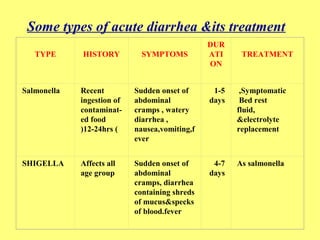
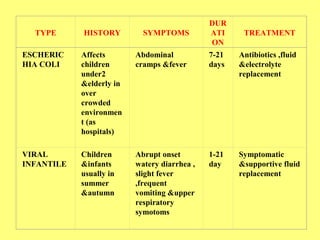
Some types of acute diarrhea &its treatment 
TYPE 
HISTORY 
SYMPTOMS 
DUR 
ATI 
ON 
TREATMENT 
Salmonella Recent 
ingestion of 
contaminat-ed 
food 
)12-24hrs ) 
Sudden onset of 
abdominal 
cramps , watery 
diarrhea , 
nausea,vomiting,f 
ever 
1-5 
days 
,Symptomatic 
Bed rest 
fluid , 
&electrolyte 
replacement 
SHIGELLA Affects all 
age group 
Sudden onset of 
abdominal 
cramps, diarrhea 
containing shreds 
of mucus&specks 
of blood.fever 
4-7 
days 
As salmonella
ESCHERIC 
HIA COLI 
Affects 
children 
under2 
&elderly in 
over 
crowded 
environmen 
t )as 
hospitals) 
Abdominal 
cramps &fever 
7-21 
days 
Antibiotics ,fluid 
&electrolyte 
replacement 
VIRAL 
INFANTILE 
Children 
&infants 
usually in 
summer 
&autumn 
Abrupt onset 
watery diarrhea , 
slight fever 
,frequent 
vomiting &upper 
respiratory 
symotoms 
1-21 
day 
Symptomatic 
&supportive fluid 
replacement 
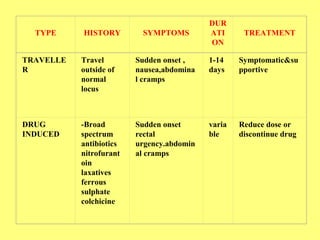
TYPE 
HISTORY 
SYMPTOMS 
DUR 
ATI 
ON 
TREATMENT
TRAVELLE 
R 
Travel 
outside of 
normal 
locus 
Sudden onset , 
nausea,abdomina 
l cramps 
1-14 
days 
Symptomatic&su 
pportive 
DRUG 
INDUCED 
-Broad 
spectrum 
antibiotics 
nitrofurant 
oin 
laxatives 
ferrous 
sulphate 
colchicine 
Sudden onset 
rectal 
urgency.abdomin 
al cramps 
varia 
ble 
Reduce dose or 
discontinue drug 
TYPE 
HISTORY 
SYMPTOMS 
DUR 
ATI 
ON 
TREATMENT
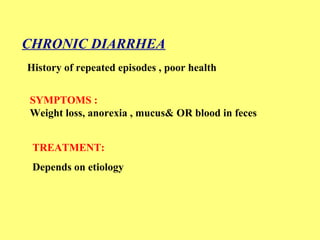
CHRONIC DIARRHEA 
History of repeated episodes , poor health 
SYMPTOMS : 
Weight loss, anorexia , mucus& OR blood in feces 
TREATMENT: 
Depends on etiology
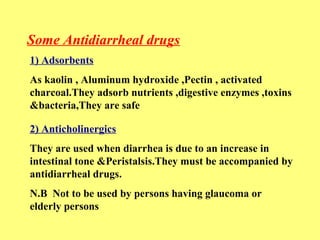
Some Antidiarrheal drugs 
1) Adsorbents 
As kaolin , Aluminum hydroxide ,Pectin , activated 
charcoal.They adsorb nutrients ,digestive enzymes ,toxins 
&bacteria,They are safe 
2) Anticholinergics 
They are used when diarrhea is due to an increase in 
intestinal tone &Peristalsis.They must be accompanied by 
antidiarrheal drugs. 
N.B Not to be used by persons having glaucoma or 
elderly persons
3) Lactobacillus preparations 
The flora of GI tract plays a significant role in 
maintenance of bowel function in nutrition.Antibiotic 
therapy often disrupts the balance of intestinal &bowel 
function. 
Seeding the bowel with viable lactobacillus acidophilus 
&L.bulgaricus micro-organisms has an effective treatment 
for functional intestinal disturbances including diarrhea. 
The micro –organisms are effective in suppressing the 
growth of pathogenic micro-organisms & re-establishing 
the normal intestinal flora
QUESTIONNAIRE TO PATIENT 
1. Is diarrhea associated with other symptoms 
such as fever, vomiting or pain? 
2. How long has the problem existed?was it 
sudden in onset? 
3. Can you relate the onset of diarrhea to a 
specific cause such as particular food or drug? 
4. Is the patient an infant or small child? 
5. Is there blood or mucus in the stool 
6. What medicines are you currently taking? 
7. Do you have any chronic disease? 
8. Have you tried any antidiarrheal products?
LAXATIVES 
Laxatives products facilitate the passage and elemination 
of feaces from the colon &rectum
Causes of CONSTIPATION 
1. Neglecting to respond to the defecation urge 
2. Failure to aquire the habit of regular defecation 
3. Environmental changes 
4. Faulty eating habits &limited water intake 
5. Atony or hypertonicity of the colon 
6. Insensitivity of the defecation reflex initated by fecal 
mass in the rectum 
7. Mental stress 
8. Excessive ingestion of foods that harden stools such as 
processed cheese 
9. Prolonged use of drugs such as aluminum 
hydroxide;calcium carbonate;anti-cholinergic drugs
Types of Laxatives 
[1] Stimulant Laxatives 
Increase peristaltic activity of the intestine by local 
irritation of the mucosa or action on smooth muscles of the 
intestine to increase motility 
N.B.stimulant laxatives are contrindicated with abdominal 
pain ;nausea;vomiting which are some of symptoms of 
appendicitis 
)E.g. ANTHRAQUINONES )Senna &Cascara 
) BISACODYL )Biscadyl tab. & supp 
Misuse of stimulant laxatives may cause dehydration 
&severe cramping
Bulk-forming Laxatives[ 2] 
They are natural &semi synthetic ; polysaccharides 
&cellulose derivatives that swell in the intestinal fluid 
They should be mixed with water just before ingestion 
&adminsterated with a large amount of fluid 
E.g.Metamucil ; Agiolax
[3] Emollient laxative 
Dioctyl sodium sulfosuccinate[DSS] is a surface active 
agent which when adminsterated orally increases the 
wetting efficiency of intestinal water &promotes the 
formation of oil in water emulsion.It facilitates admixture 
of aqueous &fatty sub.with the fecal mass to soften it. 
N.B.It is added also to enema in case of fecal impactation
[4] Saline laxatives 
Non-absorbable anions &cations such as magnesium 
&sulphate ions.It osmotically causes retension of water 
in the intestinal lumen thus by mechanical stimulus 
increase intestinal motility
ADVICE to patients concerning 
laxative products 
1. Laxatives are not for long term use 
i.e. If not effective after one week a physician should 
be consulted 
2. Laxative products that contain sodium ; potassium ; 
or magnesium should not be used if there is kidney 
disease 
3. Saline laxatives should not be used daily &should 
not be adminsterated orally to children under six 
years or rectally to infants under two years 
4. Stimulating laxatives are not used if there is 
abdominal pain ; nausea &vomiting
QUESTIONNAIRE TO PATIENT 
1. What is the normal frequency of your bowel 
movement?How has it changed? 
2. Have you experienced symptoms as abdominal pain 
or weight loss? 
3. Are you under the care of a physician for any illness? 
4. Have you attempted to alleviate constipation by 
dietary measures such as increasing fruit 
consumption? 
5. Which laxative products have you used previously ?
ANTIEMETICS 
Nausea &vomiting are symptoms to many serious & 
minor disorders
CONSIDERATION TO DETERMINE 
WHETHER AN ANTIEMETIC IS 
: INDICATED ARE 
(a)AGE OF PATIENT 
#Vomiting in newborns may be simple as a result of 
overfeeding or feeding too quickly this case maybe resolved 
without drug therapy. 
#Vomiting maybe due gastroenteritis &this can be 
controlled by carbonated beverages. 
#Vomiting maybe produced by acidosis & dehydration 
secondary to severe diarrhea so rehydration may control 
this vomiting
(b) SEX OF THE PATIENT 
Nausea &vomiting maybe one of the earliest symptoms of 
pregnancy.This can be overcomed by trying small frequent 
feedings to control morning sickness 
(c) CURRENT Drug use 
e.g. DIGITALIS toxicity maybe manifested as nausea 
&vomiting 
Other drugs as tetracyclines , estrogens &opiates 
analgesics can cause side effects as nausea & vomiting
d) DURATION of vomiting & blood in the vomitus 
A patient who vomits forcefully several times a day for 2 
or 3 days or who has blood in the vomitus must be 
referred to a physician for diagnosis of the cause 
(e)MOTION sickness 
Motion sickness can be controlled by antihistamines 
& parasympatholytics
QUESTIONNAIRE TO PATIENT 
1. What is the age of the patient for whom the 
antiemetic is intended? 
2. Is the patient pregnant ? 
3. How long has nausea &vomiting been a problem ? 
4. Have you noted blood in the vomitus ? 
5. Have you noted other symotoms as abdominal pain 
,headache or diarrhea?
HEMORRHOIDAL 
Products 
Hemorrhoids are a form of varicose (swollen or knotted) veins 
that occur when the veins around the anus become swollen or 
irritation or bleeding around the anus
HEMORRHOIDS ARE CLASSIFIED 
ACCORDING TO THEIR DEGREE 
OF DEVELOPMENT 
1) FIRST Degree 
Number & size of veins of anal canal are increased 
&sometimes bleeding may occur 
N.B. Not prolapsed 
2) SECOND Degree 
Internal or mixed hemorrhoids that appear outside during 
defecation but return spontaneously to the anal canal where 
they remain untill defecation
3) THIRD Degree 
Internal &mixed hemorrhoids remain constantly 
outside the anal sphincter unless they are replaced by 
hand 
4) FOURTH Degree 
These are hemorrhoids that have developed an edematous 
skin covering &have become so large that they cannot be 
returned into the anal canal
THERE ARE TWO WAYS to treat 
hemorrhoids using OTC Drugs 
1) CREAMS & SUPPOSITORIES 
They relieve most of the symptoms .They contain soothing 
agents that contains an antiseptic , an astringent (as 
bismuth ,witchhazel & zinc oxide )or a vasoconstrictor 
(shrinks blood vessels) & some local anesthetic (pain blocker) 
to ease pain . 
These creams & suppositories decrease swelling , burning & 
itching 
2) RELIEVE CONSTIPATION 
Laxatives soften waste to ease its passage through the 
intestine
QUESTIONNAIRE TO PATIENT 
• Have a physician diagnosed the problem as 
hemorrhoids ? 
• Are you having minor discomfort (itching 
&irritation)or is there severe pain & bleeding ? 
• Do you strain at the stool ? 
• Are you pregnant ? 
• Have you tried any products for the condition ?
COMMON COLD 
PRODUCTS 
Contrary to popular belief going outside on a cold day 
with wet hair does not cause a person to catch common 
cold. 
Viruses,tiny disease producing particles are the cause & 
is transferred from person to another via the air or 
objects such as telephones 
SYMPTOMS 
#running or stuffy nose 
#coughing 
#sneezing & sore throat
TREATMENT 
• there is no cure for a cold or flu 
• The only medical option is treatment of symptoms 
• They usually contain antihistamincs,decongestants 
& analgesics such as aspirin or ibuprofen 
N.B. # If symptoms persist for seven to ten days & 
include fever , tiredness & headach it could be 
influenza (flu) & treatment may include broad 
spectrum antibiotic to avoid complications. 
• Topical decongestant e.g.otrivin drops should not be 
used for more than three days because there is a risk 
of developing a problem called rebound congestion
QUESTIONNAIRE TO PATIENT 
1. How old are you? 
2. what are the symptoms? 
3. Have youa a history of allergy or asthma? 
4. Do you have diabetus , glucoma or hypertension?
COUGH 
MEDICATIONS 
There are two types of cough 
1. PRODUCTIVE COUGH 
2. DRY COUGH
1-PRODUCTIVE Cough 
Cough which bring up phlegm (mucus produced by the 
mucus membrane in chest &lungs) 
EXPECTORANTS used in cases of reproductive cough act 
EITHER BY 
•Direct stimulation of secretory glands of the lower 
respiratory tract 
• Reflex stimulation of respiratory secretions
Examples of chemical expectorants 
A. Ammonium chloride 
acts by direct stimulation of secretory glands 
B. POTASSIUM iodide 
act both reflexly & directory 
NOW A DAY the motto BACK TO NATURE is 
strongly applied .They found some natural extracts 
& tinctures are used as expectorants
Examples of natural expectorants 
A. Tr.SCILLA 
It increases the water contents of sputum thus 
decrease the sputum viscosity leading to easily 
expectoration 
B. Tr.LOBELIA 
Has a stimulatory effect for the release of epinephrine 
from the supra renal gland leading to relaxation of the 
bronchial smooth muscles 
C. Tr.STRAMONIUM 
Has a parasympatholytic effect leading to 
bronchodilatation
2-DRY cough (Non –productive cough) 
Cough suppressants act by relatively selective depressing 
effect on the cough control center in the medulla. 
Some natural products as liquorice has a demulsent effect 
thus giving a soothing effect. 
N.B OTC COUGH DRUGS ARE DEALING with cough 
not associated with fever
QUESTIONNAIRE TO PATIENT 
1. How old is the patient ? 
2. Type of cough (productive or non-roductive ) 
3. Do you have any respiratory diseases such as asthma 
or bronchitis?
INTERNAL 
ANALGESICS 
PAIN IS CATEGORIZED ACCORDING TO ITS 
ORIGIN:- 
1-Somatic Pain 
Originate from the musculo skeletal system or skin 
2-Visceral Pain 
Originate from the organs or viscera of the thorax 
&abdomen
OTC ANALGESICS are more effective in treating musculo 
skeletal or somatic pain than visceral pain 
OTC ANALGESICS ARE USED FOR : 
1. HEADACHE 
2. NEURALGIA(peripheral nerves) 
3. ARTHRALGIA (joints) 
4. MYALGIA(muscles
1-HEADACHE 
N.B/If headache is associated with nausea &vomiting 
,blurred vision ,dizziness or hearing loss a physician 
must be consulted.BLOOD pressure must be put in 
consideration
TO DIFFERENTIATE between different 
types of headache 
a-Tension headache 
symptoms: 
* Feeling of tightness 
* Pressure at base of the head 
* Localized pain in the forehead &base of skull 
b-Sinus headache 
symptoms: 
* It's location is restricted to the frontal areas of the 
forehead & scalp & behind or around the eyes . 
* It's accompanied by nasal congestion . 
* Treatment is usually by analgesics & Decongestants
2-NEURALGIA 
Pain in the distribution of a sensory nerve. 
Symptoms:Sharp pain in the face or jaw region 
OTC analgesics are helpful in alleviating this type of 
facial pain
3-MYALGIA 
Pain from skeletal muscles.We use OTC analgesics and 
adjunctive treatment with rubefacients 
&counterirritants & heat 
4-ARTHALGIA 
Pain in the joints.The cause of joint pain is the inflamation 
of synovial membrane
SOME OTC 
ANALGESICS
1)ASPIRIN {acetyl salicylic acid } 
IN 1897 german chemist FELIX HOFFMAN developed 
aspirin while trying t find a way to relieve the painof his 
father's arthritis.He worked in a company called Bayer. 
*Aspirin works by inhibiting the release of hormone-like 
substance called prostaglandin. 
*Prostaglandin affects blood vessels & the functions of 
blood platelets & sensitizes nerve endings to pain. 
*By limiting prostaglandin aspirin affect blood 
clotting ,eases inflamation & prevents the nerve ending 
at the site of the pain from becoming stimulated
USES 
Headache ,muscle pain ,arthritis,&to reduce fever 
N.B. 
ASPIRIN can irritate the stomach so we can: 
*Give it as buffered to reduce the irritation of stomach 
*Enteric –coated so as to pass through the stomach into 
the small intestine 
*Take aspirin with an antacid or after meals to reduce 
stomach irritation
Side effects of aspirin 
1. High doses cause ringing in the ear 
2. If children or adolescents infected with chicken pox or 
influenza (flu) are given aspirin they could develop 
Reye's syndrome. 
3. Aspirin should not be given to someone directly or 
after surgery as it decreases blood's ability to clot & 
cause excessive bleeding 
4. Should not be used to children under the age of twelve 
or pregnant women secially during the last three 
months as it can cause complications during delivery.
2)ACETAMINOPHEN 
As Tylenol & Excedrin 
*Works by affecting the brain & spinal cord altering the 
perception of pain. 
*Acetaminophen is similar to hormones that the brain 
produces called ENDORPHINS.These hormones stop the 
pain sensation from being transmitted from cell to cell. 
*It reduces fevers by affecting the area of the brain that 
regulates temperature. 
N.B. Acetaminophen not used as anti-inflammatory
3)IBUPROFEN 
It works like aspirin by inhibiting production of 
prostaglandin.It is a stronger analgesic than aspirin or 
acetaminophen & a better anti-inflammatory . 
BRAND name :Brufen , Advil 
Ketoprofen & naproxen are pain reliever similar to 
ibuprofen 
Side Effect 
*Drowsiness 
*Heart –burn 
*Upset stomach
QUESTIONNAIRE TO PATIENT 
1. Do you have asthma diseases or ulcers? 
2. Are you now taking any medication which affects the 
clotting of your blood? 
3. Have you ever had an allergic reaction to aspirin? 
4. What type of pain do you have &how long have you 
had it? 
5. Do you have any other symptoms which you feel 
associated with the pain you have?
ANTI-ACNE DRUGS 
What is acne? 
During puberty an increase in hormones causes oil glands 
on the face, neck &chest to become stimulated .The glands 
produce large amount of sebum(a fatty substance).Sebum 
normally flows out of the skin along the hair follicles. 
Too much sebum combined with skin debris can form a 
plug in the hair follicle called A Black Head
Once the hair follicle becomes plugged bacteria grow in 
it.The bacterial infection is called ACNE. 
In severe cases of deep acne , inflamed cysts may form 
&can cause permanent scars. 
N.B. Acne may also occur in elder people.Certain drugs 
,industrial chemicals , oily cosmetics or hot humid 
conditions may also cause acne.
OTC Topical anti acne products contains 
1)SULPHUR 
Usually used in conc. From 2 to 10% 
It helps to resolve comedones 
2)RESORCINOL & SALICYLIC ACID 
Have also comedogenic effect but more stonger than 
sulphur 
Resorcinol is used in conc.1 to 4 %
3)Benzoyl Peroxide 
Works by mildly irritating the skin thus encourage skin 
cells to slough off &thus helps open blocked pores.Also 
benzoyl peroxide kills bacteria thus prevent black heade 
from turning into pimples. 
N.B AVOID unnecessary sun exposure &use sun screen 
if treating acne with benzoyl peroxide
OTC Oral anti-acne products 
1) Tetracyclines 
They are successful in the treatment of 
inflammatory acne 
2) YEAST tablets 
Yeast is a perfect source of natural B group 
vitamins.The B group vitamins play a role in many 
metabolic processes as they provide the body cells 
with necessary energy &help in keeping healthy 
appearance of skin
ADVISES TO PATIENTS 
1. Regular washing with soap & water (soap may be 
medicated as sulphur , salicylic &antibacterial soaps 
or unmedicated in highly sensitive skin) 
2. Moderate exposure to sunlight or using sun screens 
3. A balanced diet (eating lot of vegetables & avoid 
chocolates &fatty foods)
QUESTIONNAIRE TO PATIENT 
1. What types of medications are you currently using? 
2. Types of cosmetics u are using? 
3. How old are you ? 
4. How long have you had acne ?

Otc drugs

  • 1.
    Dr. Adel Abdel khalek G.M Ali & Ali Pharmacies
  • 2.
    ?What are OTCdrugs They are Over The Counter drugs that FDA decides that they are safe & effective for use without a doctor’s prescription {non – prescription} FDA classifies these drugs in over eighty categories as •allergy •cough / cold medications • pain relievers •digestives •antibacterial drugs
  • 3.
    OTC drugs havemain characteristics • Their benefits outweigh their risks • The potential for misuse & abuse is low • Health practitioners are not needed for safe & effective use of product
  • 4.
    :Regulations for OTCdrugs usage (1) THE DOSE OTC drugs rarely come in one – size fits all so the pharmacist must discuss in full details the dose for the patient according to age & weight also he must mention for how long the drug will be used (2) CHRONIC DISEASES Some drugs may interact with health conditions as diabetes, kidney diseases, hepatic disease & high blood pressure So the pharmacist must ask the patient if he suffers from any chronic diseases For example: Nasal decongestant must not be given to patients of high blood pressure , depression , heart diseases or thyroid diseases Products containing aspirin must be taken with caution for diabetic patients or patients suffering from gout
  • 5.
    (3) Drug -Drug interaction It is important to know drug interactions if you are giving an otc drug for a patient taking a prescription drug . For example * Antihistaminics must not be given with drugs that treat sleeplessness. * Drugs that treat sleeplessness are not taken with sedatives or tranquilizers * Aspirin is not given with blood thinner drugs (4) Drug - Food interaction * Tetracyclines are not given with milk products * Alcoholic patients must avoid antihistaminic drugs
  • 6.
    (5) Secondary symptoms For example if a patient suffers from constipation the pharmacist must not prescribe a laxative until asking the patient if constipation is accompanied with nausea or vomiting or not ? If so we don’t use laxative & a doctor must be consulted AS A CONCLUSION A questionnaire must be done to the patient including: ( 1) Age & sex ( if customer is not the patient) ( 2) History of chronic diseases & used drugs ( 3) Life style of the patient i.e his job to avoid giving any sedative drug if his job needs concentration
  • 7.
    Antacid Products •Stomachis very busy organ . It stores food, mixes food with gastric, secrtions & empties food into! The small intestine for digestion & absorption . * Gastric secretions help with digestion & absorption of food & it also kills bacteria found in the stomach
  • 8.
    Gastric Secretions Thereare 3 phases of gastric secretions 1- Cephalic phase It’s a para sympathetic response transmitted by the vagus nerve, it is stimulation by the sight, smell or thought of food. Vagal stimulation causes release of hydro chloric acid , pepsinogin & gastrin
  • 9.
    2- Gastric Phase The presense of food in the stomach initiates the gastric phase of secretin by : a) physical action The stretching of fundic mucosa mediates the release of HCL b) chemical action Stimulation of HCL release
  • 10.
    3- Intestinal phase It is controlled by the intestine & involves stimulation & inhibition of secretions. As long as partly digested food is in the intestine there is continued gastric secretion. - The PH of gastric acid is extremely high 4 million times more acidic than pH of blood. The stomach has a lining to protect it from this acid. The lining secretes mucus & bicarbonates which form a barrier against acid.
  • 11.
    Risk factors forhyper acidity & ulcers 1. Some medications as aspirin , caffeine , indomethacins & corticosteroids 2. Alcohol intake 3. Smoking
  • 12.
    Symptoms of hyperacidity 1. Heart burn 2. Gases 3. Indigestion N.B. if hyper acidity is un properly controlled ulcers may occur. Ulcers may be acute mainly in stomach & rarely duodenum as result of drugs & food style. This ulcer heals rapidly & rarely requires chronic antacid therapy. Chronic mainly in duodenum.
  • 13.
    To differentiate betweenduodenal ulcer & gastric ulcer The pain of gastric ulcers occurs within 30 to 60 min after meals & lasts between 60 & 90 min . The pain of duodenal ulcer begins 2 to 3 hours after meals & continue untill the next meal. N.B H2 is a type of acid
  • 14.
    Antacids 1. H2– antagonist Treat ulcers & HEART BURN They block the formation of excess acid in the stomach N.B should not be taken for more than 2 weeks
  • 15.
    2. non H2antagonist ( neutralizing of the gastric acid in the stomach) e.g. (Ca Co3 short term treatment) Sod. Bicarbonete contraindicated in C H F , hypertension , kidney failure ( instant relief) - AL SALTS V. slowly& cause constipation. - Mg. Salts moderate &cause diarrhea. - Aluminium accompanid by magnesium salts are best used.
  • 16.
    The pharmacists adviseto the : patient 1) Compliance: The antacid should be taken on schedule 1 hr after meals to provid max. duration of activity. :Change in Bowel habits) 2 To prevent self-medication for an iatrognic condition, the patient should understand that the antacid may cause diarrhea or constipation. Control is usually provided by giving an alternative antacid
  • 17.
    3) Sodium content: Patients with restricted salt intake should be informed of the amount of Na in the medication & advised of product of low sodium content. 4) Tablets The lesser effectiveness of tab should be made clear. If liquid are unacceptable, tablets should be chewed thoroughly & followed with a full glass of water to help dissolution & dispersion in the stomach. Effervescent tablet should be dissolved in water & the bubbles should subside before swallowing.
  • 18.
    Other medicatins) 5 Additional medication should be identified to enable the pharmacist to monitor for drug interaction 6) Duration of usages We must assure that Non-h2 antagonist antacids should not be used more than 6 weeks & H2 antagonists must not be used more than 2 weeks. As general If discomfort is not relived after 2 weeks of therapeutic doses medical help is indicated
  • 19.
    Questionnaire to patients 1. how long has the burn been present? 2. When dose pain occur? After meals or several hours before meals ( to determine if there is ulcer or not) ? 3. Have you vomited blood or any blood in stool? 4. What medications are you currently taking? 5. Have you used antacids before? Which ones? 6. Are you on any dietry restrictions such as a low salt diet? 7. Are you under the care of a physcian?
  • 20.
    ANTHELMINTICS Drugs areused to treat worms ( helmimth ) -Few effective non-prescrioption drugs are available for helminth infections that self-medication should be discourged. The following show some common helminth infections & their symptoms &suggested treatment:-
  • 21.
    (1) Round worm(Hookworm) Source of infestation Spreading by contact with contaminated soil. Larvae are ingested or penetrate the skin on contact SYMPTOMS *Anemia caused by blood loss ; weakness * Indigestion ;vomiting ;diarrhea * Anorexia * Headache * Cough * Urticaria at the site of entery into the skin Treatment chloroethylene Prescription drugs only ,mainly tetra
  • 22.
    ASCARIS LUMBRICOIDES( 2) Source of infestation Indigesting eggs through contact with fecally contaminated soil Symptoms Mild cases may be asymptomatic .GIT discomfort pain &diarrhea.Intestinal obstruction in severe cases occasionly bile or pancreatic duct may be obstructed & allergic reactions occur
  • 23.
    (3) ENTEROBIUS VERMICULARIS(OXYURIS) PINWORM, SEAT WORM , THREAD WORM) Source of infestation Ingesting eggs by fecal contamination of hands ,food,clothing & bedding.Reinfection is common SYMPTOMS Indigestion, intense perianal itching especially at night resulting in loss of sleep .Scratching may cause infection ,irritability & fatigue in children TREATMENT Mostly it can be treated with mebendazole. Simultaneous treatment of every member of the family is advised for best results
  • 24.
    PHARMACIST advises for patients of oxyuris infestation 1. Adaily morning shower to remove eggs deposited in the perianal region during night [as female worm migrates down the colon out the anus &deposits the eggs in the perianal region at night] 2. Regular application of ammoniated mercury oint. Over the perianal region at bed time as it is toxic for eggs &we may use also antipruritic oint. 3. Regular trimming of an infected child's nail &scrubbing of the fingers with a brush after going to bathroom. 4. Daily use of disinfectants on the toilet seat 5. Frequent washing of hands before meals
  • 25.
    summary The clinicalmanifestations of these parasitic disease are so general & so characteristic of other illness that attempts at self-diagnosis of helminthiasis are not only difficult but could lead to the neglect of a more serious condition. N.B Diagnosis should be made on basis of clinical & laboratory evidence
  • 26.
    QUESTIONNAIRE TO PATIENT 1. Have you had nausea , diarrhea or abdominal pain? 2. Have you been bothered by itching in the anal area? 3. Have you lost weight or do you become fatigued easily? 4. How long have the symptoms been present? 5. If the patient is not an adult ,what is the age and approximate weight of the patient? 6. Have worms appeared in your stool? 7. Are other members of you family also affected?
  • 27.
    ANTI-DIARRHEAL DRUGS DIARRHEAis the frequent passage of unformed stool
  • 28.
    Types of diarrhea 1)Acute diarrhea Sudden onset of loose stool in a previously healthy patient 2)Chronic diarrhea Persistant or recurrent episodes with anorexia , weight loss &chronic weakness.
  • 29.
    Some types ofacute diarrhea &its treatment TYPE HISTORY SYMPTOMS DUR ATI ON TREATMENT Salmonella Recent ingestion of contaminat-ed food )12-24hrs ) Sudden onset of abdominal cramps , watery diarrhea , nausea,vomiting,f ever 1-5 days ,Symptomatic Bed rest fluid , &electrolyte replacement SHIGELLA Affects all age group Sudden onset of abdominal cramps, diarrhea containing shreds of mucus&specks of blood.fever 4-7 days As salmonella
  • 30.
    ESCHERIC HIA COLI Affects children under2 &elderly in over crowded environmen t )as hospitals) Abdominal cramps &fever 7-21 days Antibiotics ,fluid &electrolyte replacement VIRAL INFANTILE Children &infants usually in summer &autumn Abrupt onset watery diarrhea , slight fever ,frequent vomiting &upper respiratory symotoms 1-21 day Symptomatic &supportive fluid replacement TYPE HISTORY SYMPTOMS DUR ATI ON TREATMENT
  • 31.
    TRAVELLE R Travel outside of normal locus Sudden onset , nausea,abdomina l cramps 1-14 days Symptomatic&su pportive DRUG INDUCED -Broad spectrum antibiotics nitrofurant oin laxatives ferrous sulphate colchicine Sudden onset rectal urgency.abdomin al cramps varia ble Reduce dose or discontinue drug TYPE HISTORY SYMPTOMS DUR ATI ON TREATMENT
  • 32.
    CHRONIC DIARRHEA Historyof repeated episodes , poor health SYMPTOMS : Weight loss, anorexia , mucus& OR blood in feces TREATMENT: Depends on etiology
  • 33.
    Some Antidiarrheal drugs 1) Adsorbents As kaolin , Aluminum hydroxide ,Pectin , activated charcoal.They adsorb nutrients ,digestive enzymes ,toxins &bacteria,They are safe 2) Anticholinergics They are used when diarrhea is due to an increase in intestinal tone &Peristalsis.They must be accompanied by antidiarrheal drugs. N.B Not to be used by persons having glaucoma or elderly persons
  • 34.
    3) Lactobacillus preparations The flora of GI tract plays a significant role in maintenance of bowel function in nutrition.Antibiotic therapy often disrupts the balance of intestinal &bowel function. Seeding the bowel with viable lactobacillus acidophilus &L.bulgaricus micro-organisms has an effective treatment for functional intestinal disturbances including diarrhea. The micro –organisms are effective in suppressing the growth of pathogenic micro-organisms & re-establishing the normal intestinal flora
  • 35.
    QUESTIONNAIRE TO PATIENT 1. Is diarrhea associated with other symptoms such as fever, vomiting or pain? 2. How long has the problem existed?was it sudden in onset? 3. Can you relate the onset of diarrhea to a specific cause such as particular food or drug? 4. Is the patient an infant or small child? 5. Is there blood or mucus in the stool 6. What medicines are you currently taking? 7. Do you have any chronic disease? 8. Have you tried any antidiarrheal products?
  • 36.
    LAXATIVES Laxatives productsfacilitate the passage and elemination of feaces from the colon &rectum
  • 37.
    Causes of CONSTIPATION 1. Neglecting to respond to the defecation urge 2. Failure to aquire the habit of regular defecation 3. Environmental changes 4. Faulty eating habits &limited water intake 5. Atony or hypertonicity of the colon 6. Insensitivity of the defecation reflex initated by fecal mass in the rectum 7. Mental stress 8. Excessive ingestion of foods that harden stools such as processed cheese 9. Prolonged use of drugs such as aluminum hydroxide;calcium carbonate;anti-cholinergic drugs
  • 38.
    Types of Laxatives [1] Stimulant Laxatives Increase peristaltic activity of the intestine by local irritation of the mucosa or action on smooth muscles of the intestine to increase motility N.B.stimulant laxatives are contrindicated with abdominal pain ;nausea;vomiting which are some of symptoms of appendicitis )E.g. ANTHRAQUINONES )Senna &Cascara ) BISACODYL )Biscadyl tab. & supp Misuse of stimulant laxatives may cause dehydration &severe cramping
  • 39.
    Bulk-forming Laxatives[ 2] They are natural &semi synthetic ; polysaccharides &cellulose derivatives that swell in the intestinal fluid They should be mixed with water just before ingestion &adminsterated with a large amount of fluid E.g.Metamucil ; Agiolax
  • 40.
    [3] Emollient laxative Dioctyl sodium sulfosuccinate[DSS] is a surface active agent which when adminsterated orally increases the wetting efficiency of intestinal water &promotes the formation of oil in water emulsion.It facilitates admixture of aqueous &fatty sub.with the fecal mass to soften it. N.B.It is added also to enema in case of fecal impactation
  • 41.
    [4] Saline laxatives Non-absorbable anions &cations such as magnesium &sulphate ions.It osmotically causes retension of water in the intestinal lumen thus by mechanical stimulus increase intestinal motility
  • 42.
    ADVICE to patientsconcerning laxative products 1. Laxatives are not for long term use i.e. If not effective after one week a physician should be consulted 2. Laxative products that contain sodium ; potassium ; or magnesium should not be used if there is kidney disease 3. Saline laxatives should not be used daily &should not be adminsterated orally to children under six years or rectally to infants under two years 4. Stimulating laxatives are not used if there is abdominal pain ; nausea &vomiting
  • 43.
    QUESTIONNAIRE TO PATIENT 1. What is the normal frequency of your bowel movement?How has it changed? 2. Have you experienced symptoms as abdominal pain or weight loss? 3. Are you under the care of a physician for any illness? 4. Have you attempted to alleviate constipation by dietary measures such as increasing fruit consumption? 5. Which laxative products have you used previously ?
  • 44.
    ANTIEMETICS Nausea &vomitingare symptoms to many serious & minor disorders
  • 45.
    CONSIDERATION TO DETERMINE WHETHER AN ANTIEMETIC IS : INDICATED ARE (a)AGE OF PATIENT #Vomiting in newborns may be simple as a result of overfeeding or feeding too quickly this case maybe resolved without drug therapy. #Vomiting maybe due gastroenteritis &this can be controlled by carbonated beverages. #Vomiting maybe produced by acidosis & dehydration secondary to severe diarrhea so rehydration may control this vomiting
  • 46.
    (b) SEX OFTHE PATIENT Nausea &vomiting maybe one of the earliest symptoms of pregnancy.This can be overcomed by trying small frequent feedings to control morning sickness (c) CURRENT Drug use e.g. DIGITALIS toxicity maybe manifested as nausea &vomiting Other drugs as tetracyclines , estrogens &opiates analgesics can cause side effects as nausea & vomiting
  • 47.
    d) DURATION ofvomiting & blood in the vomitus A patient who vomits forcefully several times a day for 2 or 3 days or who has blood in the vomitus must be referred to a physician for diagnosis of the cause (e)MOTION sickness Motion sickness can be controlled by antihistamines & parasympatholytics
  • 48.
    QUESTIONNAIRE TO PATIENT 1. What is the age of the patient for whom the antiemetic is intended? 2. Is the patient pregnant ? 3. How long has nausea &vomiting been a problem ? 4. Have you noted blood in the vomitus ? 5. Have you noted other symotoms as abdominal pain ,headache or diarrhea?
  • 49.
    HEMORRHOIDAL Products Hemorrhoidsare a form of varicose (swollen or knotted) veins that occur when the veins around the anus become swollen or irritation or bleeding around the anus
  • 50.
    HEMORRHOIDS ARE CLASSIFIED ACCORDING TO THEIR DEGREE OF DEVELOPMENT 1) FIRST Degree Number & size of veins of anal canal are increased &sometimes bleeding may occur N.B. Not prolapsed 2) SECOND Degree Internal or mixed hemorrhoids that appear outside during defecation but return spontaneously to the anal canal where they remain untill defecation
  • 51.
    3) THIRD Degree Internal &mixed hemorrhoids remain constantly outside the anal sphincter unless they are replaced by hand 4) FOURTH Degree These are hemorrhoids that have developed an edematous skin covering &have become so large that they cannot be returned into the anal canal
  • 52.
    THERE ARE TWOWAYS to treat hemorrhoids using OTC Drugs 1) CREAMS & SUPPOSITORIES They relieve most of the symptoms .They contain soothing agents that contains an antiseptic , an astringent (as bismuth ,witchhazel & zinc oxide )or a vasoconstrictor (shrinks blood vessels) & some local anesthetic (pain blocker) to ease pain . These creams & suppositories decrease swelling , burning & itching 2) RELIEVE CONSTIPATION Laxatives soften waste to ease its passage through the intestine
  • 53.
    QUESTIONNAIRE TO PATIENT • Have a physician diagnosed the problem as hemorrhoids ? • Are you having minor discomfort (itching &irritation)or is there severe pain & bleeding ? • Do you strain at the stool ? • Are you pregnant ? • Have you tried any products for the condition ?
  • 54.
    COMMON COLD PRODUCTS Contrary to popular belief going outside on a cold day with wet hair does not cause a person to catch common cold. Viruses,tiny disease producing particles are the cause & is transferred from person to another via the air or objects such as telephones SYMPTOMS #running or stuffy nose #coughing #sneezing & sore throat
  • 55.
    TREATMENT • thereis no cure for a cold or flu • The only medical option is treatment of symptoms • They usually contain antihistamincs,decongestants & analgesics such as aspirin or ibuprofen N.B. # If symptoms persist for seven to ten days & include fever , tiredness & headach it could be influenza (flu) & treatment may include broad spectrum antibiotic to avoid complications. • Topical decongestant e.g.otrivin drops should not be used for more than three days because there is a risk of developing a problem called rebound congestion
  • 56.
    QUESTIONNAIRE TO PATIENT 1. How old are you? 2. what are the symptoms? 3. Have youa a history of allergy or asthma? 4. Do you have diabetus , glucoma or hypertension?
  • 57.
    COUGH MEDICATIONS Thereare two types of cough 1. PRODUCTIVE COUGH 2. DRY COUGH
  • 58.
    1-PRODUCTIVE Cough Coughwhich bring up phlegm (mucus produced by the mucus membrane in chest &lungs) EXPECTORANTS used in cases of reproductive cough act EITHER BY •Direct stimulation of secretory glands of the lower respiratory tract • Reflex stimulation of respiratory secretions
  • 59.
    Examples of chemicalexpectorants A. Ammonium chloride acts by direct stimulation of secretory glands B. POTASSIUM iodide act both reflexly & directory NOW A DAY the motto BACK TO NATURE is strongly applied .They found some natural extracts & tinctures are used as expectorants
  • 60.
    Examples of naturalexpectorants A. Tr.SCILLA It increases the water contents of sputum thus decrease the sputum viscosity leading to easily expectoration B. Tr.LOBELIA Has a stimulatory effect for the release of epinephrine from the supra renal gland leading to relaxation of the bronchial smooth muscles C. Tr.STRAMONIUM Has a parasympatholytic effect leading to bronchodilatation
  • 61.
    2-DRY cough (Non–productive cough) Cough suppressants act by relatively selective depressing effect on the cough control center in the medulla. Some natural products as liquorice has a demulsent effect thus giving a soothing effect. N.B OTC COUGH DRUGS ARE DEALING with cough not associated with fever
  • 62.
    QUESTIONNAIRE TO PATIENT 1. How old is the patient ? 2. Type of cough (productive or non-roductive ) 3. Do you have any respiratory diseases such as asthma or bronchitis?
  • 63.
    INTERNAL ANALGESICS PAINIS CATEGORIZED ACCORDING TO ITS ORIGIN:- 1-Somatic Pain Originate from the musculo skeletal system or skin 2-Visceral Pain Originate from the organs or viscera of the thorax &abdomen
  • 64.
    OTC ANALGESICS aremore effective in treating musculo skeletal or somatic pain than visceral pain OTC ANALGESICS ARE USED FOR : 1. HEADACHE 2. NEURALGIA(peripheral nerves) 3. ARTHRALGIA (joints) 4. MYALGIA(muscles
  • 65.
    1-HEADACHE N.B/If headacheis associated with nausea &vomiting ,blurred vision ,dizziness or hearing loss a physician must be consulted.BLOOD pressure must be put in consideration
  • 66.
    TO DIFFERENTIATE betweendifferent types of headache a-Tension headache symptoms: * Feeling of tightness * Pressure at base of the head * Localized pain in the forehead &base of skull b-Sinus headache symptoms: * It's location is restricted to the frontal areas of the forehead & scalp & behind or around the eyes . * It's accompanied by nasal congestion . * Treatment is usually by analgesics & Decongestants
  • 67.
    2-NEURALGIA Pain inthe distribution of a sensory nerve. Symptoms:Sharp pain in the face or jaw region OTC analgesics are helpful in alleviating this type of facial pain
  • 68.
    3-MYALGIA Pain fromskeletal muscles.We use OTC analgesics and adjunctive treatment with rubefacients &counterirritants & heat 4-ARTHALGIA Pain in the joints.The cause of joint pain is the inflamation of synovial membrane
  • 69.
  • 70.
    1)ASPIRIN {acetyl salicylicacid } IN 1897 german chemist FELIX HOFFMAN developed aspirin while trying t find a way to relieve the painof his father's arthritis.He worked in a company called Bayer. *Aspirin works by inhibiting the release of hormone-like substance called prostaglandin. *Prostaglandin affects blood vessels & the functions of blood platelets & sensitizes nerve endings to pain. *By limiting prostaglandin aspirin affect blood clotting ,eases inflamation & prevents the nerve ending at the site of the pain from becoming stimulated
  • 71.
    USES Headache ,musclepain ,arthritis,&to reduce fever N.B. ASPIRIN can irritate the stomach so we can: *Give it as buffered to reduce the irritation of stomach *Enteric –coated so as to pass through the stomach into the small intestine *Take aspirin with an antacid or after meals to reduce stomach irritation
  • 72.
    Side effects ofaspirin 1. High doses cause ringing in the ear 2. If children or adolescents infected with chicken pox or influenza (flu) are given aspirin they could develop Reye's syndrome. 3. Aspirin should not be given to someone directly or after surgery as it decreases blood's ability to clot & cause excessive bleeding 4. Should not be used to children under the age of twelve or pregnant women secially during the last three months as it can cause complications during delivery.
  • 73.
    2)ACETAMINOPHEN As Tylenol& Excedrin *Works by affecting the brain & spinal cord altering the perception of pain. *Acetaminophen is similar to hormones that the brain produces called ENDORPHINS.These hormones stop the pain sensation from being transmitted from cell to cell. *It reduces fevers by affecting the area of the brain that regulates temperature. N.B. Acetaminophen not used as anti-inflammatory
  • 74.
    3)IBUPROFEN It workslike aspirin by inhibiting production of prostaglandin.It is a stronger analgesic than aspirin or acetaminophen & a better anti-inflammatory . BRAND name :Brufen , Advil Ketoprofen & naproxen are pain reliever similar to ibuprofen Side Effect *Drowsiness *Heart –burn *Upset stomach
  • 75.
    QUESTIONNAIRE TO PATIENT 1. Do you have asthma diseases or ulcers? 2. Are you now taking any medication which affects the clotting of your blood? 3. Have you ever had an allergic reaction to aspirin? 4. What type of pain do you have &how long have you had it? 5. Do you have any other symptoms which you feel associated with the pain you have?
  • 76.
    ANTI-ACNE DRUGS Whatis acne? During puberty an increase in hormones causes oil glands on the face, neck &chest to become stimulated .The glands produce large amount of sebum(a fatty substance).Sebum normally flows out of the skin along the hair follicles. Too much sebum combined with skin debris can form a plug in the hair follicle called A Black Head
  • 77.
    Once the hairfollicle becomes plugged bacteria grow in it.The bacterial infection is called ACNE. In severe cases of deep acne , inflamed cysts may form &can cause permanent scars. N.B. Acne may also occur in elder people.Certain drugs ,industrial chemicals , oily cosmetics or hot humid conditions may also cause acne.
  • 78.
    OTC Topical antiacne products contains 1)SULPHUR Usually used in conc. From 2 to 10% It helps to resolve comedones 2)RESORCINOL & SALICYLIC ACID Have also comedogenic effect but more stonger than sulphur Resorcinol is used in conc.1 to 4 %
  • 79.
    3)Benzoyl Peroxide Worksby mildly irritating the skin thus encourage skin cells to slough off &thus helps open blocked pores.Also benzoyl peroxide kills bacteria thus prevent black heade from turning into pimples. N.B AVOID unnecessary sun exposure &use sun screen if treating acne with benzoyl peroxide
  • 80.
    OTC Oral anti-acneproducts 1) Tetracyclines They are successful in the treatment of inflammatory acne 2) YEAST tablets Yeast is a perfect source of natural B group vitamins.The B group vitamins play a role in many metabolic processes as they provide the body cells with necessary energy &help in keeping healthy appearance of skin
  • 81.
    ADVISES TO PATIENTS 1. Regular washing with soap & water (soap may be medicated as sulphur , salicylic &antibacterial soaps or unmedicated in highly sensitive skin) 2. Moderate exposure to sunlight or using sun screens 3. A balanced diet (eating lot of vegetables & avoid chocolates &fatty foods)
  • 82.
    QUESTIONNAIRE TO PATIENT 1. What types of medications are you currently using? 2. Types of cosmetics u are using? 3. How old are you ? 4. How long have you had acne ?