
PPI’S – AN OVERVIEW
DR S.VADIVEL KUARAN
CONSULTANT MEDICAL GASTROENTEROLOGIST
AND
HEPATOLOGIST
KAUVERY HOSPITAL,ALWARPET
CHENNAI
INTRODUCTION
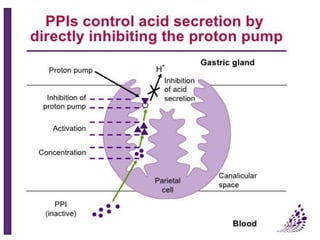
• Decrease gastric acid secretion by inhibiting
gastric H⁺K⁺-ATPase .
• Omeprazole first PPI- 1989.
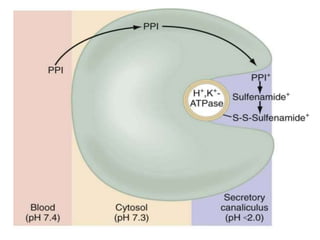
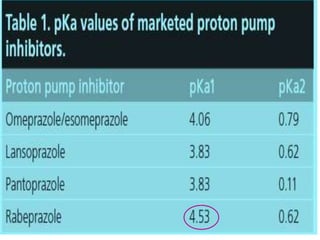
• PPI’s are weak bases that concentrate in acidic
spaces with pKa1- 3-8 to 4.5.
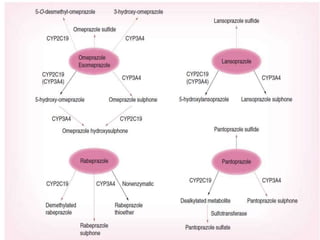
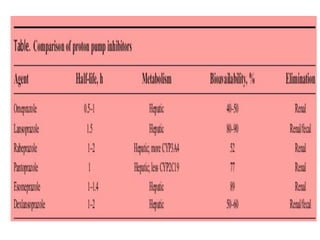
• PPI’s are metabolised by CYP2C19 and CYP3A4.
• Rabeprazole has higher affinity for CYP3A4.
• Conc. of PPI in secretory canaliculus is 100000 to
1000000 higher than in blood.
• All PPI bind to cysteine 813.
• Omeprazole- cysteine 892
Lansoprazole- cysteine 321
Pantoprazole – cysteine 822
INDICATIONS
• PEPTIC ULCER DISEASE
• TREATMENT AND PREVENTION OF
GASTRODUODENAL ULCERS DUE TO NASAID.
• ERADICATION OF H.PYLORI
• ZOLLINGER ELLISON SYNDROME
• BARRETT’S METAPLASIA
• GASTROESOPHAGEAL REFLUX DISEASE
• ESOPHAGEAL STRICTURES
• EXTRAESOPHAGEAL MANIFESTATIONS
pKa??
• It refers to degree of willingness of compoud
to accept or donate a proton.
• Compound with pKa of 5 is 10 fold more basic
than compound with pKa of 4.
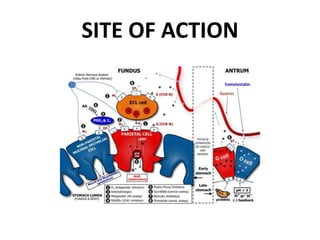
SITE OF ACTION
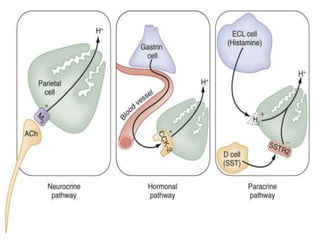
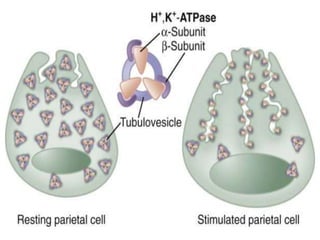
GASTRIC H⁺K-ATPase
• Found in parietal cells and small amounts in
renal medulla.
• It has α and β subunits.
• 3 types F, V1, P1 and P2.
COMMON SIDE EFFECTS
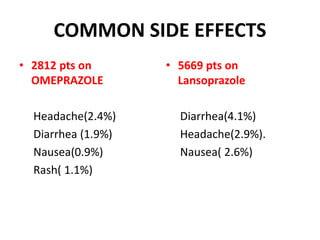
• 2812 pts on
OMEPRAZOLE
Headache(2.4%)
Diarrhea (1.9%)
Nausea(0.9%)
Rash( 1.1%)
• 5669 pts on
Lansoprazole
Diarrhea(4.1%)
Headache(2.9%).
Nausea( 2.6%)
ADVERSE EFFECTS
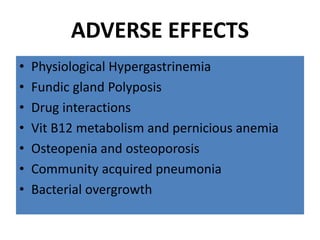
• Physiological Hypergastrinemia
• Fundic gland Polyposis
• Drug interactions
• Vit B12 metabolism and pernicious anemia
• Osteopenia and osteoporosis
• Community acquired pneumonia
• Bacterial overgrowth
HYPERGASTRINEMIA
• PPI’s cause physiological hypergastrinemia.
• Hypergastrinemia causing ECL Hyperplasia is
controversial.
• Only one published report of ECL Hyperplasia
and gastric malignancy in ZES pt treated with
high dose PPI.
FUNDIC GLAND POLYPOSIS(FGP)
• PPI use leads to 4 fold risk of Fundic gland
polyposis.
• H.pylori also increases risk of FGP.
• Eradication of H.pylori or stopping PPI leads to
regression of polyposis.
• It doesn’t lead to Adenocarcinoma.
DRUG INTERACTIONS
• All PPI’s metabolized by CYP2C19 except
Rabeprazole high affinity for CYP3A4.
• Reduce absorption and bioavailability of
ketoconazole, Itraconazole and sucralfate.
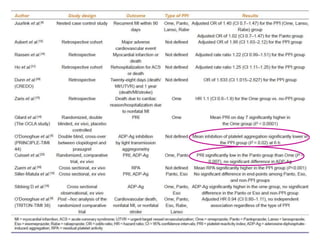
• All PPI’s except Pantoprazole affect the
effectiveness of clopidogrel- 40% risk of
coronary stent occlusion.
IRON & B12
• To small extent affect iron absorption.
• Elderly and ZES pts on high dose PPI have
reduced B12 concentration.
PPI and Metabolic bone disease???
• PPI > 5 yrs risk of osteoporosis by 1.62 fold
• PPI > 7 yrs risk of osteoporosis by 4.55 fold.
• Rarely osteoporotic fractures reported even
with 6- 12 months of high dose PPI.
CAP
• PPI use leads to bacterial colonization of
stomach and pulmonary micro aspirations.
• Odd’s ratio is 1.89 for current PPI use , 1.55 for
past PPI use.
• On contrary PPI do not increase risk of HAP.
PPI & SIBO??
• PPI postulated as one of etiological factor for
SIBO due to reduced acid provacating
bacterial colonization of GIT.
• Clostridium difficile infection.
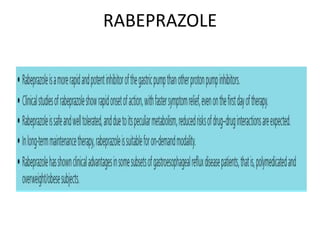
RABEPRAZOLE
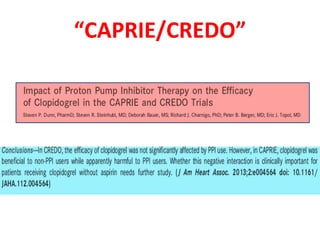
“CAPRIE/CREDO”
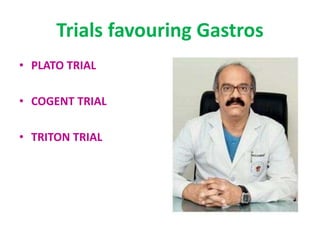
Trials favouring Gastros
• PLATO TRIAL
• COGENT TRIAL
• TRITON TRIAL
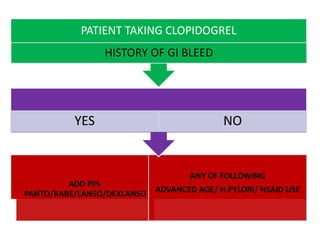
ADD PPI-
PANTO/RABE/LANSO/DEXLANSO
ANY OF FOLLOWING
ADVANCED AGE/ H.PYLORI/ NSAID USE
YES NO
PATIENT TAKING CLOPIDOGREL
HISTORY OF GI BLEED
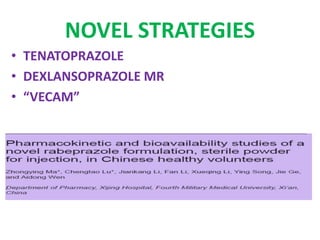
NOVEL STRATEGIES
• TENATOPRAZOLE
• DEXLANSOPRAZOLE MR
• “VECAM”
TAKE HOME MESSAGE
• PPI TO BE ADMINISTERED 30 MIN BEFORE BREAKFAST.
• TWICE DOSAGE FOR MAXIMAL ACID SUPPRESSION.
• RABEPRAZOLE ACID LABILE, RAPID ONSET OF ACTION.
• RATIONALIZE CONCOMITANT USE OF PPI AND
ANTIPLATELETS.
• RCT’S – OMEPRAZOLE & ESOMEPRAZOLE MORE
INTERACTIONS WITH ANTIPLATELETS
PPI when and where

PPI when and where

  • 1.
    PPI’S – ANOVERVIEW DR S.VADIVEL KUARAN CONSULTANT MEDICAL GASTROENTEROLOGIST AND HEPATOLOGIST KAUVERY HOSPITAL,ALWARPET CHENNAI
  • 4.
    INTRODUCTION • Decrease gastricacid secretion by inhibiting gastric H⁺K⁺-ATPase . • Omeprazole first PPI- 1989. • PPI’s are weak bases that concentrate in acidic spaces with pKa1- 3-8 to 4.5.
  • 5.
    • PPI’s aremetabolised by CYP2C19 and CYP3A4. • Rabeprazole has higher affinity for CYP3A4. • Conc. of PPI in secretory canaliculus is 100000 to 1000000 higher than in blood. • All PPI bind to cysteine 813. • Omeprazole- cysteine 892 Lansoprazole- cysteine 321 Pantoprazole – cysteine 822
  • 6.
    INDICATIONS • PEPTIC ULCERDISEASE • TREATMENT AND PREVENTION OF GASTRODUODENAL ULCERS DUE TO NASAID. • ERADICATION OF H.PYLORI • ZOLLINGER ELLISON SYNDROME • BARRETT’S METAPLASIA • GASTROESOPHAGEAL REFLUX DISEASE • ESOPHAGEAL STRICTURES • EXTRAESOPHAGEAL MANIFESTATIONS
  • 7.
    pKa?? • It refersto degree of willingness of compoud to accept or donate a proton. • Compound with pKa of 5 is 10 fold more basic than compound with pKa of 4.
  • 10.
  • 11.
    GASTRIC H⁺K-ATPase • Foundin parietal cells and small amounts in renal medulla. • It has α and β subunits. • 3 types F, V1, P1 and P2.
  • 15.
    COMMON SIDE EFFECTS •2812 pts on OMEPRAZOLE Headache(2.4%) Diarrhea (1.9%) Nausea(0.9%) Rash( 1.1%) • 5669 pts on Lansoprazole Diarrhea(4.1%) Headache(2.9%). Nausea( 2.6%)
  • 16.
    ADVERSE EFFECTS • PhysiologicalHypergastrinemia • Fundic gland Polyposis • Drug interactions • Vit B12 metabolism and pernicious anemia • Osteopenia and osteoporosis • Community acquired pneumonia • Bacterial overgrowth
  • 17.
    HYPERGASTRINEMIA • PPI’s causephysiological hypergastrinemia. • Hypergastrinemia causing ECL Hyperplasia is controversial. • Only one published report of ECL Hyperplasia and gastric malignancy in ZES pt treated with high dose PPI.
  • 18.
    FUNDIC GLAND POLYPOSIS(FGP) •PPI use leads to 4 fold risk of Fundic gland polyposis. • H.pylori also increases risk of FGP. • Eradication of H.pylori or stopping PPI leads to regression of polyposis. • It doesn’t lead to Adenocarcinoma.
  • 19.
    DRUG INTERACTIONS • AllPPI’s metabolized by CYP2C19 except Rabeprazole high affinity for CYP3A4. • Reduce absorption and bioavailability of ketoconazole, Itraconazole and sucralfate. • All PPI’s except Pantoprazole affect the effectiveness of clopidogrel- 40% risk of coronary stent occlusion.
  • 20.
    IRON & B12 •To small extent affect iron absorption. • Elderly and ZES pts on high dose PPI have reduced B12 concentration.
  • 21.
    PPI and Metabolicbone disease??? • PPI > 5 yrs risk of osteoporosis by 1.62 fold • PPI > 7 yrs risk of osteoporosis by 4.55 fold. • Rarely osteoporotic fractures reported even with 6- 12 months of high dose PPI.
  • 22.
    CAP • PPI useleads to bacterial colonization of stomach and pulmonary micro aspirations. • Odd’s ratio is 1.89 for current PPI use , 1.55 for past PPI use. • On contrary PPI do not increase risk of HAP.
  • 23.
    PPI & SIBO?? •PPI postulated as one of etiological factor for SIBO due to reduced acid provacating bacterial colonization of GIT. • Clostridium difficile infection.
  • 24.
  • 27.
  • 28.
    Trials favouring Gastros •PLATO TRIAL • COGENT TRIAL • TRITON TRIAL
  • 30.
    ADD PPI- PANTO/RABE/LANSO/DEXLANSO ANY OFFOLLOWING ADVANCED AGE/ H.PYLORI/ NSAID USE YES NO PATIENT TAKING CLOPIDOGREL HISTORY OF GI BLEED
  • 31.
    NOVEL STRATEGIES • TENATOPRAZOLE •DEXLANSOPRAZOLE MR • “VECAM”
  • 32.
    TAKE HOME MESSAGE •PPI TO BE ADMINISTERED 30 MIN BEFORE BREAKFAST. • TWICE DOSAGE FOR MAXIMAL ACID SUPPRESSION. • RABEPRAZOLE ACID LABILE, RAPID ONSET OF ACTION. • RATIONALIZE CONCOMITANT USE OF PPI AND ANTIPLATELETS. • RCT’S – OMEPRAZOLE & ESOMEPRAZOLE MORE INTERACTIONS WITH ANTIPLATELETS