Camilla Schéele, PhD
Associate Professor,
Novo Nordisk Foundation Center
for Basic Metabolic Research,
Copenhagen, Denmark
Obesity Series 2020
Heterogeneity and Crosstalk of Human
Brown Adipose Tissue
Christian Wolfrum, PhD
Professor,
Department of Health Science and
Technology at ETH Zürich,
Zürich, Switzerland
Camilla Schéele & Christian Wolfrum discuss
the physiology of brown adipose tissue and
share late-breaking research on the role of BAT
in whole body metabolic regulation.
Obesity Series 2020
Heterogeneity and Crosstalk of Human
Brown Adipose Tissue
Thank you to our partners and sponsors that
have helped make this webinar series possible!
Partners & Sponsors
Camilla Scheele
Novo Nordisk Foundation Center for Basic Metabolic Research
Obesity Webinar series 2020
Heterogeneity and crosstalk of
human brown adipose tissue
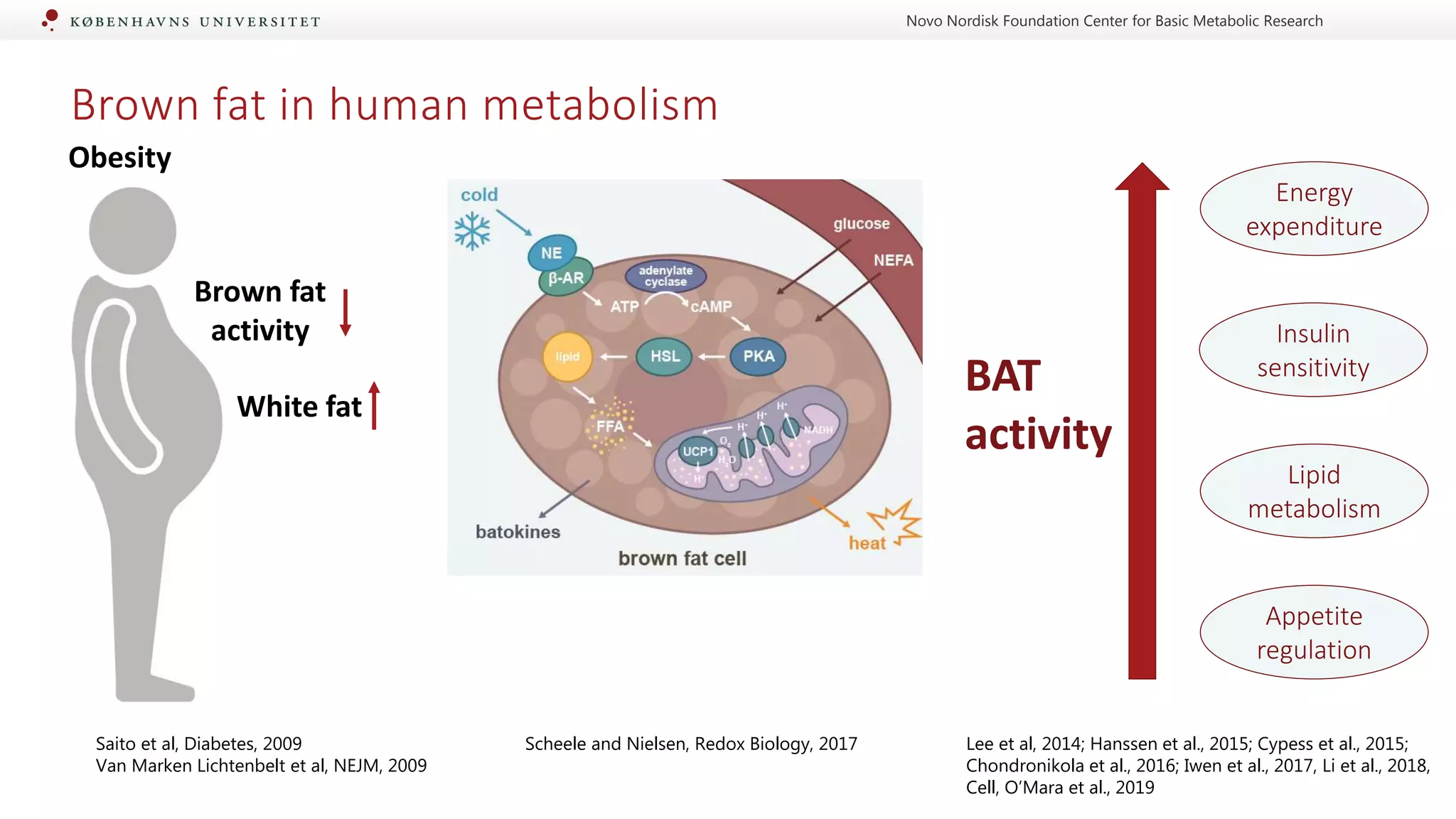
Brown fat in human metabolism
Saito et al, Diabetes, 2009
Van Marken Lichtenbelt et al, NEJM, 2009
Scheele and Nielsen, Redox Biology, 2017
Novo Nordisk Foundation Center for Basic Metabolic Research
Obesity
White fat
Brown fat
activity
BAT
activity
Insulin
sensitivity
Appetite
regulation
Energy
expenditure
Lipid
metabolism
Lee et al, 2014; Hanssen et al., 2015; Cypess et al., 2015;
Chondronikola et al., 2016; Iwen et al., 2017, Li et al., 2018,
Cell, O’Mara et al., 2019
Brown fat is partly maintained in adulthood
Newborn,
Autopsy sample mapping
MRI (postmortem)
Warm adult
PET-FDG (glucose tracer)
Cold (non-shivering)
adult
Aherne et al 1964; Lidell et al Nat. Med. 2013 Søberg et al, unpublished
Novo Nordisk Foundation Center for Basic Metabolic Research
Heterogeneous brown fat in adult humans
Can we restore childhood phenotype and BAT activity in the adult human?
Jespersen et al., Cell Metabol. 2013
Found in ages <20 Found in ages <60
Found in all ages Found in all ages
Heaton, J. Anat. 1972
Novo Nordisk Foundation Center for Basic Metabolic Research
Brown adipose in adult humans – how brown can we get?
Leitner et al. PNAS 2017
Total BAT : 510-2358 ml
Active BAT: 26.1+/- 23%
4.3% of total fat mass
Frontini et al Biochemica et Biophysica Acta, 2014
Tumor in adrenal gland:
overproduction of
norepinephrine
Adrenal gland
Pheochromocytoma
Before surgery at
room temperature
Søndergaard et al. Diabetic Medicine, 2015
Novo Nordisk Foundation Center for Basic Metabolic Research
After surgery
Brown fat activation in humans
Normal activation Total activation Hormonal activation
(e.g. Pheochromocytoma)
What kind of fat surrounds the kidneys?
Interpretation of Søberg et al (left), Leitner et al. (middle) and Søndergaard et al. (right)
Novo Nordisk Foundation Center for Basic Metabolic Research
Dormant brown fat in the perirenal depot
Jespersen et al., Molecular Metabolism, 2019
Healthy kidney donors
Novo Nordisk Foundation Center for Basic Metabolic Research
multilocular
perirenal
unilocular
perirenal
unilocular
subcutaneous
Brown fat progenitors are present in the adipose tissue surrounding the kidneys
Dormant brown fat in obesity
BAT
Normalweight Obese/overweight
COX41A
LIMCHI
GO Biological processes
4C 4D
4A 4B
4C 4D
In vitro differentiated progenitors were responsive to norepinephrine
Thermogenic capacity is reduced but brown fat identity is kept in obesity
Jespersen et al., BioRxiv 2020
Novo Nordisk Foundation Center for Basic Metabolic Research
Isolation of
adipogenic
progenitors
Thermogenic capacity
Batokines as regulators of browning
Scheele and Wolfrum, Endocrine reviews, 2019
Thermogenesis
Adipogenesis
Angiogenesis
Immunometabolism
Neurite outgrowth
Novo Nordisk Foundation Center for Basic Metabolic Research
Isolation of human brown and white preadipocytes
Jespersen et al., Cell Metabolism, 2013, Larsen et al., unpublished
UCP1
Model
Novo Nordisk Foundation Center for Basic Metabolic Research
The human brown and white adipocytes secretomes
Deshmuck et al, Cell Metabolism 2019
Deshmukh et al, Cell Metabolism, 2019
Novo Nordisk Foundation Center for Basic Metabolic Research
Distinct secretomes of human brown and white adipocytes
Novo Nordisk Foundation Center for Basic Metabolic Research
quantified
Extracellular
matrix
Complement
system
white brown
Deshmukh et al, Cell Metabolism, 2019
Only from Brown: Mammalian ependymin-related protein 1 (EPDR1)
In vitro knockdown of EPDR1
In vivo knockout of EPDR1
s i C T R L s i E P D R 1 s i C T R L s i E P D R 1
0
5 0
1 0 0
1 5 0
UCP1mRNA/PPIA(A.U.)
w h i t e a d i p o c y t e s b r o w n a d i p o c y t e s
N E - + - + - + - +
* * *
Epdr1 Dio2 Ppar Pgc-1 Ucp1
0.0
0.5
1.0
1.5
2.0
2.5
iBATRelativegeneexpression Epdr1+/+
Epdr1-/-
**
**
*
Epdr1+/+
Epdr1-/-
0.10
0.15
0.20
0.25
(molO2/hr/mgtissue)
**
iBAT Oxygen Consumption
Ex vivo oxygen consumption
Novo Nordisk Foundation Center for Basic Metabolic Research
Reduction of EPDR1 decrease norepinephrine-response Deshmukh et al, Cell Metabolism, 2019
Proteomics analysis following EPDR1 knockdown
Failure in thermogenic differentiation
Novo Nordisk Foundation Center for Basic Metabolic Research
Reduced mitochondrial proteins
Proteins in the
electron transport chain
EPDR1 GLUT4
24
26
28
30
32
Log2LFQintensities
siControl
siEPDR1
Reduced GLUT4
Deshmukh et al, Cell Metabolism, 2019
Mature brown adipocytes promote BAT programming
Novo Nordisk Foundation Center for Basic Metabolic Research
EPDR1 mediates thermogenic committment of preadipocytes
EPDR1 in human plasmaUCP1 after 3 weeks
daily injections EPDR1
Deshmukh et al, Cell Metabolism, 2019
COX8ACOX41A PDHA1
LIMCHI DMTN NEIL2
Batokines
Summary
Dormant brown fat in adults and obesity
Novo Nordisk Foundation Center for Basic Metabolic Research
EPDR1
NNF Center for Basic Metabolic Research (CBMR)
Zach Gerhart-Hines, Tao Ma
Centre for Physical Activity Research (CFAS)
Søren Nielsen, Bente Klarlund Pedersen
Rigshospitalet, University Hospital of Copenhagen
Kirsten Møller
Søren Daugaard
Per Bagi, Bo Feldt Rasmussen
Johan Löfgren, Andreas Kjær
Peter Garred, Rafael Bayarri-Olmos
NNF Center for Protein Research
Matthias Mann, Atul Desmukh
University of Toronto
Daniel Drucker, Jaqueline Beaudry, Gil Privé
Køge hospital
Preben Homøe
Novo Nordisk Research Centre Oxford
Amir Feizi
Novo Nordisk A/S
Mads Tang, Annika Sanfridsson, Birgitte Andersson, Jacob Steen
Novo Nordisk Foundation Center for Basic Metabolic Research
Acknowledgements
Scheele group: Mai Severinsen, Naja Jespersen, Lone Peijs, Verena Hirschberg, Susanna Søberg
+ newly added members: Jo Beldring Henningsen, Birgitte Romme Lisdorf
Christian Wolfrum, PhD
Professor,
Department of Health Science and Technology
ETH Zürich,
Zürich, Switzerland
Copyright 2020 C Wolfrum, APS and InsideScientific. All Rights Reserved.
Obesity Series 2020
The Many Facets of
Adipose Tissue
(classical)
brown adipocyte
white adipocyte
lipid droplet
nucleus
mitochondrium
brown adipose tissue white adipose tissue
brite adipocyte
The many facets of adipose tissue
Brown and white adipose tissue in mice
brown adipose tissue white adipose tissue
Modified from Cinti 2005
before stimulation
(week 0)
after stimulation
(week 1)
stimulation + 1 week
(week 2)
stimulation + 2 weeks
(week 3)
stimulation + 5 weeks
(week 6)
Rosenwald et al., 2013
Formation of brite adipocytes is reversed in weeks
Uncoupling Protein 1
COX 7a1CIDE-A
Formation of brite adipocytes is reversed in weeks
X
Brite adipocytes are not eliminated
X X
DAPI
GFP
RFP merge
Tracing of brite adipocytes shows interconversion
DAPI
GFP
RFP merge
Tracing of brite adipocytes shows interconversion
X X
X X
DAPI
GFP
RFP merge
Tracing of brite adipocytes shows interconversion
Regulation of brown fat formation and function
adapted from Tim J. Schulz et al., 2009
Role of BMP4 and BMP7 in adipocyte development
Ucp1
0.0
0.5
1.0
1.5
2
4
6
8
10
relativemRNAlevels
a
b
c
d
AdLacZ RT
AdLBmp4 RT
AdLacZ 6C
AdLBmp4 6C
Pgc1a
0
2
4
6
8
a
c
a
b
Adenoviral delivery of Bmp4 to iBAT
Bmp4 controls mature brown adipocyte function
Ucp1 Pgc1αUcp1
0.0
0.5
1.0
1.5
2
4
6
8
10
relativemRNAlevels
a
b
c
d
Bmp4 controls mature brown adipocyte function
Human neck
Association of blood BMP4 levels with obesity
r2
=0.30899 p<0.001r2
=0.148613 p=0.068 r2
=0.21759 p=0.0011
Regulation of adipose tissue formation and function
BMP4
BAT active BAT inactive
Sun et al., 2018
Retrospective analysis of human BAT
Birthday Distribution by Activation Grade
Prenatal cold exposure in mice
Control
Maternal CE
Paternal CE
Paternal vs. Maternal cold exposure
Paternal cold exposure and BAT activity
PCE offspring are less suceptible to DIO
Environmental stimuli
Adipose tissue formation
Jozef Ukropec, Bratislava
Gottfried Rudofsky, Olten
Bart Deplancke, Lausanne
Irene Burger, Baden
Saverio Cinti, Ascona
Harald Köfeler, Graz
Erick Carreira, Zürich
Wenfei Sun Salvatore Modica
Hua Dong Matthias Rosenwald
Miro Balaz
Lucy Balzova
Lab Members and Collaborators
Camilla Schéele, PhD
Associate Professor,
Novo Nordisk Foundation Center
for Basic Metabolic Research,
Copenhagen, Denmark
Christian Wolfrum, PhD
Professor,
Department of Health Science and
Technology at ETH Zürich,
Zürich, Switzerland
Thank you for
participating!
CLICK HERE to learn
more and watch the
webinar

Heterogeneity and Crosstalk of Human Brown Adipose Tissue

  • 1.
    Camilla Schéele, PhD AssociateProfessor, Novo Nordisk Foundation Center for Basic Metabolic Research, Copenhagen, Denmark Obesity Series 2020 Heterogeneity and Crosstalk of Human Brown Adipose Tissue Christian Wolfrum, PhD Professor, Department of Health Science and Technology at ETH Zürich, Zürich, Switzerland
  • 2.
    Camilla Schéele &Christian Wolfrum discuss the physiology of brown adipose tissue and share late-breaking research on the role of BAT in whole body metabolic regulation. Obesity Series 2020 Heterogeneity and Crosstalk of Human Brown Adipose Tissue
  • 3.
    Thank you toour partners and sponsors that have helped make this webinar series possible! Partners & Sponsors
  • 4.
    Camilla Scheele Novo NordiskFoundation Center for Basic Metabolic Research Obesity Webinar series 2020 Heterogeneity and crosstalk of human brown adipose tissue
  • 5.
    Brown fat inhuman metabolism Saito et al, Diabetes, 2009 Van Marken Lichtenbelt et al, NEJM, 2009 Scheele and Nielsen, Redox Biology, 2017 Novo Nordisk Foundation Center for Basic Metabolic Research Obesity White fat Brown fat activity BAT activity Insulin sensitivity Appetite regulation Energy expenditure Lipid metabolism Lee et al, 2014; Hanssen et al., 2015; Cypess et al., 2015; Chondronikola et al., 2016; Iwen et al., 2017, Li et al., 2018, Cell, O’Mara et al., 2019
  • 6.
    Brown fat ispartly maintained in adulthood Newborn, Autopsy sample mapping MRI (postmortem) Warm adult PET-FDG (glucose tracer) Cold (non-shivering) adult Aherne et al 1964; Lidell et al Nat. Med. 2013 Søberg et al, unpublished Novo Nordisk Foundation Center for Basic Metabolic Research
  • 7.
    Heterogeneous brown fatin adult humans Can we restore childhood phenotype and BAT activity in the adult human? Jespersen et al., Cell Metabol. 2013 Found in ages <20 Found in ages <60 Found in all ages Found in all ages Heaton, J. Anat. 1972 Novo Nordisk Foundation Center for Basic Metabolic Research
  • 8.
    Brown adipose inadult humans – how brown can we get? Leitner et al. PNAS 2017 Total BAT : 510-2358 ml Active BAT: 26.1+/- 23% 4.3% of total fat mass Frontini et al Biochemica et Biophysica Acta, 2014 Tumor in adrenal gland: overproduction of norepinephrine Adrenal gland Pheochromocytoma Before surgery at room temperature Søndergaard et al. Diabetic Medicine, 2015 Novo Nordisk Foundation Center for Basic Metabolic Research After surgery
  • 9.
    Brown fat activationin humans Normal activation Total activation Hormonal activation (e.g. Pheochromocytoma) What kind of fat surrounds the kidneys? Interpretation of Søberg et al (left), Leitner et al. (middle) and Søndergaard et al. (right) Novo Nordisk Foundation Center for Basic Metabolic Research
  • 10.
    Dormant brown fatin the perirenal depot Jespersen et al., Molecular Metabolism, 2019 Healthy kidney donors Novo Nordisk Foundation Center for Basic Metabolic Research multilocular perirenal unilocular perirenal unilocular subcutaneous Brown fat progenitors are present in the adipose tissue surrounding the kidneys
  • 11.
    Dormant brown fatin obesity BAT Normalweight Obese/overweight COX41A LIMCHI GO Biological processes 4C 4D 4A 4B 4C 4D In vitro differentiated progenitors were responsive to norepinephrine Thermogenic capacity is reduced but brown fat identity is kept in obesity Jespersen et al., BioRxiv 2020 Novo Nordisk Foundation Center for Basic Metabolic Research Isolation of adipogenic progenitors Thermogenic capacity
  • 12.
    Batokines as regulatorsof browning Scheele and Wolfrum, Endocrine reviews, 2019 Thermogenesis Adipogenesis Angiogenesis Immunometabolism Neurite outgrowth Novo Nordisk Foundation Center for Basic Metabolic Research
  • 13.
    Isolation of humanbrown and white preadipocytes Jespersen et al., Cell Metabolism, 2013, Larsen et al., unpublished UCP1 Model Novo Nordisk Foundation Center for Basic Metabolic Research
  • 14.
    The human brownand white adipocytes secretomes Deshmuck et al, Cell Metabolism 2019 Deshmukh et al, Cell Metabolism, 2019 Novo Nordisk Foundation Center for Basic Metabolic Research
  • 15.
    Distinct secretomes ofhuman brown and white adipocytes Novo Nordisk Foundation Center for Basic Metabolic Research quantified Extracellular matrix Complement system white brown Deshmukh et al, Cell Metabolism, 2019
  • 16.
    Only from Brown:Mammalian ependymin-related protein 1 (EPDR1) In vitro knockdown of EPDR1 In vivo knockout of EPDR1 s i C T R L s i E P D R 1 s i C T R L s i E P D R 1 0 5 0 1 0 0 1 5 0 UCP1mRNA/PPIA(A.U.) w h i t e a d i p o c y t e s b r o w n a d i p o c y t e s N E - + - + - + - + * * * Epdr1 Dio2 Ppar Pgc-1 Ucp1 0.0 0.5 1.0 1.5 2.0 2.5 iBATRelativegeneexpression Epdr1+/+ Epdr1-/- ** ** * Epdr1+/+ Epdr1-/- 0.10 0.15 0.20 0.25 (molO2/hr/mgtissue) ** iBAT Oxygen Consumption Ex vivo oxygen consumption Novo Nordisk Foundation Center for Basic Metabolic Research Reduction of EPDR1 decrease norepinephrine-response Deshmukh et al, Cell Metabolism, 2019
  • 17.
    Proteomics analysis followingEPDR1 knockdown Failure in thermogenic differentiation Novo Nordisk Foundation Center for Basic Metabolic Research Reduced mitochondrial proteins Proteins in the electron transport chain EPDR1 GLUT4 24 26 28 30 32 Log2LFQintensities siControl siEPDR1 Reduced GLUT4 Deshmukh et al, Cell Metabolism, 2019
  • 18.
    Mature brown adipocytespromote BAT programming Novo Nordisk Foundation Center for Basic Metabolic Research EPDR1 mediates thermogenic committment of preadipocytes EPDR1 in human plasmaUCP1 after 3 weeks daily injections EPDR1 Deshmukh et al, Cell Metabolism, 2019
  • 19.
    COX8ACOX41A PDHA1 LIMCHI DMTNNEIL2 Batokines Summary Dormant brown fat in adults and obesity Novo Nordisk Foundation Center for Basic Metabolic Research EPDR1
  • 20.
    NNF Center forBasic Metabolic Research (CBMR) Zach Gerhart-Hines, Tao Ma Centre for Physical Activity Research (CFAS) Søren Nielsen, Bente Klarlund Pedersen Rigshospitalet, University Hospital of Copenhagen Kirsten Møller Søren Daugaard Per Bagi, Bo Feldt Rasmussen Johan Löfgren, Andreas Kjær Peter Garred, Rafael Bayarri-Olmos NNF Center for Protein Research Matthias Mann, Atul Desmukh University of Toronto Daniel Drucker, Jaqueline Beaudry, Gil Privé Køge hospital Preben Homøe Novo Nordisk Research Centre Oxford Amir Feizi Novo Nordisk A/S Mads Tang, Annika Sanfridsson, Birgitte Andersson, Jacob Steen Novo Nordisk Foundation Center for Basic Metabolic Research Acknowledgements Scheele group: Mai Severinsen, Naja Jespersen, Lone Peijs, Verena Hirschberg, Susanna Søberg + newly added members: Jo Beldring Henningsen, Birgitte Romme Lisdorf
  • 21.
    Christian Wolfrum, PhD Professor, Departmentof Health Science and Technology ETH Zürich, Zürich, Switzerland Copyright 2020 C Wolfrum, APS and InsideScientific. All Rights Reserved. Obesity Series 2020 The Many Facets of Adipose Tissue
  • 22.
    (classical) brown adipocyte white adipocyte lipiddroplet nucleus mitochondrium brown adipose tissue white adipose tissue brite adipocyte The many facets of adipose tissue
  • 23.
    Brown and whiteadipose tissue in mice brown adipose tissue white adipose tissue Modified from Cinti 2005
  • 24.
    before stimulation (week 0) afterstimulation (week 1) stimulation + 1 week (week 2) stimulation + 2 weeks (week 3) stimulation + 5 weeks (week 6) Rosenwald et al., 2013 Formation of brite adipocytes is reversed in weeks
  • 25.
    Uncoupling Protein 1 COX7a1CIDE-A Formation of brite adipocytes is reversed in weeks
  • 26.
    X Brite adipocytes arenot eliminated
  • 27.
    X X DAPI GFP RFP merge Tracingof brite adipocytes shows interconversion
  • 28.
    DAPI GFP RFP merge Tracing ofbrite adipocytes shows interconversion X X
  • 29.
    X X DAPI GFP RFP merge Tracingof brite adipocytes shows interconversion
  • 30.
    Regulation of brownfat formation and function
  • 31.
    adapted from TimJ. Schulz et al., 2009 Role of BMP4 and BMP7 in adipocyte development
  • 32.
    Ucp1 0.0 0.5 1.0 1.5 2 4 6 8 10 relativemRNAlevels a b c d AdLacZ RT AdLBmp4 RT AdLacZ6C AdLBmp4 6C Pgc1a 0 2 4 6 8 a c a b Adenoviral delivery of Bmp4 to iBAT Bmp4 controls mature brown adipocyte function Ucp1 Pgc1αUcp1 0.0 0.5 1.0 1.5 2 4 6 8 10 relativemRNAlevels a b c d
  • 33.
    Bmp4 controls maturebrown adipocyte function
  • 34.
    Human neck Association ofblood BMP4 levels with obesity r2 =0.30899 p<0.001r2 =0.148613 p=0.068 r2 =0.21759 p=0.0011
  • 35.
    Regulation of adiposetissue formation and function BMP4
  • 36.
    BAT active BATinactive Sun et al., 2018 Retrospective analysis of human BAT Birthday Distribution by Activation Grade
  • 37.
  • 38.
    Control Maternal CE Paternal CE Paternalvs. Maternal cold exposure
  • 39.
    Paternal cold exposureand BAT activity
  • 40.
    PCE offspring areless suceptible to DIO
  • 41.
    PCE offspring areless suceptible to DIO
  • 42.
  • 43.
    Jozef Ukropec, Bratislava GottfriedRudofsky, Olten Bart Deplancke, Lausanne Irene Burger, Baden Saverio Cinti, Ascona Harald Köfeler, Graz Erick Carreira, Zürich Wenfei Sun Salvatore Modica Hua Dong Matthias Rosenwald Miro Balaz Lucy Balzova Lab Members and Collaborators
  • 44.
    Camilla Schéele, PhD AssociateProfessor, Novo Nordisk Foundation Center for Basic Metabolic Research, Copenhagen, Denmark Christian Wolfrum, PhD Professor, Department of Health Science and Technology at ETH Zürich, Zürich, Switzerland Thank you for participating! CLICK HERE to learn more and watch the webinar

Editor's Notes

  • #2 Welcome everyone to the fourth webinar of Obesity 2020, a joint webinar series brought to you by InsideScientific and the American Physiological Society. Between now and December, we have a number of webinars lined up, all focused on the science being conducted by leading obesity researchers around the world. This is Liam Sanio from InsideScientific and I’m very pleased to be your host for today’s event. This webinar is titled “Heterogeneity and Crosstalk of Human Brown Adipose Tissue” and will feature Dr. Camilla Scheele, associate professor at the Novo Nordisk Foundation Center for Basic Metabolic Research, and Dr. Christian Wolfrum, professor in the department of health science and technology at ETH Zurich. Today Dr. Scheele and Dr. Wolfrum will discuss the physiology of brown adipose tissue and share late-breaking research on the role of BAT in whole-body metabolic regulation.
  • #3 Welcome everyone to the third webinar of Obesity 2020, a joint webinar series brought to you by InsideScientific and the American Physiological Society. Between now and December, we have a number of webinars lined up, all focused on the science being conducted by leading obesity researchers around the world. This is Liam Sanio from InsideScientific and I’m very pleased to be your host for today’s event. This webinar is titled “Calories, Carbs or Quality? What Matters Most for Body Weight” and will feature Dr. Kevin Hall, section chief of Integrative Physiology at the National Institute of Diabetes, Digestive and Kidney Diseases at the National Institutes of Health in Bethesda, Maryland. Dr. Hall will talk about how our bodies adapt to various changes in our diet. For example, if you want to lose weight, is it better to reduce your fat, or reduce your carbs? And what about highly processed foods – what’s their impact on obesity and body weight?
  • #4 First, we’d just like to acknowledge our partners at the APS and thank the sponsors of this webinar series for making it all possible.
  • #5 And with that, I’m pleased to welcome Dr. Camilla Scheele. Camilla, thanks for joining us today! The floor is yours whenever you’re ready
  • #14 This model represent mature, active brown adipocytes, responsive to norepinephrine treatment
  • #25 Animation: 27:07
  • #45  …Alright, thanks Camilla and Christian for all of your fantastic insights today, both in your presentation as well as the Q&A session. ========== Thank you everyone for joining us today to attend the webinar! Again, the slides and a recording of today’s webinar will be available soon at InsideScientific.com, so look out for an email giving you access to the video recording in the near future.  Before you go, we invite you to take a moment to provide your feedback on the survey and let us know what webinar topics you’d like to see in the future. And finally, if you still have any questions, feel free to submit them now using the Ask a Question box and we will make sure to forward any unanswered questions along to our presenters. In closing, thank you again for taking part in this InsideScientific webinar produced in partnership with the American Physiological Society, and we look forward to having you with us again soon!