Professor : Dr. Sabangan 
Subj / Sec : DMA 111 * DAB 
Prepared by : 
 Khafi Makoo , Noorallah
Adipose Tissue 
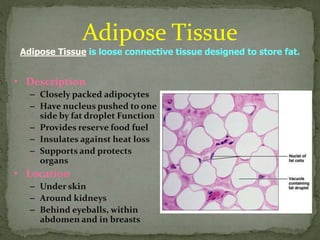
Adipose Tissue is loose connective tissue designed to store fat. 
• Description 
– Closely packed adipocytes 
– Have nucleus pushed to one 
side by fat droplet Function 
– Provides reserve food fuel 
– Insulates against heat loss 
– Supports and protects 
organs 
• Location 
– Under skin 
– Around kidneys 
– Behind eyeballs, within 
abdomen and in breasts
 Fat cells are “adipocytes” 
 Found in aggregates 
 Fat may be identified macroscopically or only 
microscopically. 
 Adipose tissue accounts for: 
 20-25% of the weight of women 
 15-20% of the weight of men
 Largest repository of energy in the body 
 Triglycerides 
 9.3kcal/g 
 Contributes to thermal insulation 
 Important for temperature regulation 
 Fills spaces between structures/protects 
 Between organs 
 Aids fit of valves in heart 
 Pads of fat protect heels, palms
Development of Fat Tissue 
BROWN 
ADIPOSE 
TISSUE 
WHITE 
ADIPOSE 
TISSUE
WHITE is comprised of 
2 Fractions: 
1) adipocytes 
2) SVF which consists of: 
 preadipocytes 
 endothelial cells 
 macrophages 
WHITE is central to energy 
storage in the body and the 
mobilization of this energy 
store is highly regulated.
Basic Adipose Tissue Expansion 
Preadipocyte Mature adipocyte
 Predominant type of fat in humans 
 Adipocytes have single large lipid inclusion
 Evenly distributed throughout body, though with 
some differences due to sex and age 
Android Gynecoid
 Pads and insulates organs
 Energy reservoir providing low-weight, high 
calorie form of energy 
 Endocrine organ involved in energy metabolism
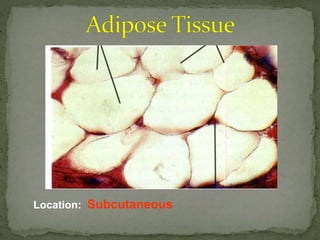
Location: Subcutaneous
WHITE ADIPOSE 
TISSUE 
Adipocyte nuclei at 
arrow 
Less differentiated 
adipocyte at 
asterisk 
*
Chicken-wire appearance of mature white fat
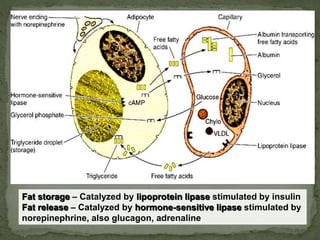
Fat storage – Catalyzed by lipoprotein lipase stimulated by insulin 
Fat release – Catalyzed by hormone-sensitive lipase stimulated by 
norepinephrine, also glucagon, adrenaline
 Uncommon in adult humans 
 Sole purpose is heat generation, especially in 
hibernation, after birth, and during cold 
stress 
 Main site of non-shivering heat production 
under cold stress (newborns can’t shiver!) 
 Lipid accumulates in multilocular pattern 
 Mitochondria and vascularity contribute to 
dark color
Human newborn 
Multilocular 
(brown) adipose 
tissue constitutes 
2--5% of body 
weight and is 
distributed as 
shown in black; 
shaded areas are 
a mixture of 
multilocular and 
unilocular adipose 
tissue.
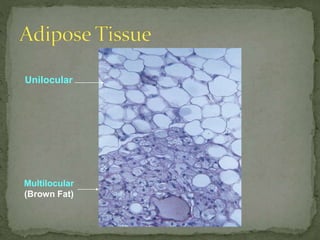
Unilocular 
Multilocular 
(Brown Fat)
 In the adult human, found only around deep 
structures (kidney) 
 In adult rats, brown fat cells are dormant; have 
lost mitochondria; can be “reawakened”; still 
being 
studied in humans 
 Tumors known as 
“hibernomas”
Note multiple lipid droplets and increased vascularity
 Cold stimulates sympathetic nerves to liberate 
norepinephrine into fat tissue. 
 Activates hormone-sensitive lipase in 
adipocytes, promoting hydrolysis of 
triglycerides into fatty acids and glycerol. 
 Liberated fatty acids are metabolized in the 
adipocyte. 
 Oxygen consumption and heat production 
increases, elevating tissue temperature and 
warming blood coursing through it.
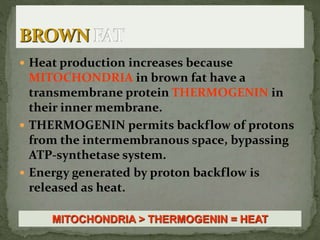
 Heat production increases because 
MITOCHONDRIA in brown fat have a 
transmembrane protein THERMOGENIN in 
their inner membrane. 
 THERMOGENIN permits backflow of protons 
from the intermembranous space, bypassing 
ATP-synthetase system. 
 Energy generated by proton backflow is 
released as heat. 
MITOCHONDRIA > THERMOGENIN = HEAT
 Ubiquitous, all ages 
 82% fat; 15% water; 3% 
protein 
 Capillary supply 
 Sympathetic 
 Food storage, padding 
 Unilocular 
 80-150 nm diameter 
 Newborn 
 30% fat; 55% water; 15% 
protein 
 Dense capillary network 
 Sympathetic 
 Thermogenesis 
 Multilocular 
 8-60 nm diameter 
 Increased mitochondria
WAT BAT
White 
Brown
Neck 
Supraclavicul 
ar 
mediastinum 
Paraverteb 
ra 
suprarenal
 HYPERTROPHIC: 
 Excessive accumulation of fat in unilocular 
adipocytes, increasing size of cells 
 HYPERPLASTIC: 
 Increase in the number of adipocytes
- Hypertrophic obesity is excessive weight gain in 
adulthood. Hypertrophic is when the fat cells get 
bigger.
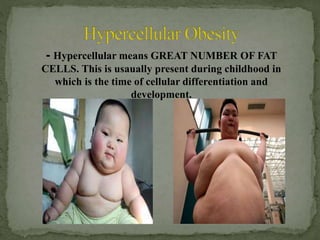
- Hypercellular means GREAT NUMBER OF FAT 
CELLS. This is usaually present during childhood in 
which is the time of cellular differentiation and 
development.
 Fetal fat stores exist by 30th week of gestation 
 Fat cells added thru postpartum period 
 Fat cells added prior to and during puberty 
 Adults: with long term obesity, adipocytes 
become filled with lipid to critical level -- and 
precursors are stimulated to add more cells. 
 Once adipocytes are formed, they remain for 
life, and, naturally, we can only reduce cell 
size, not the number!
ONLY WAY TO REDUCE CELL NUMBER
A man tipping the scales at 560 kilograms (1,234 pounds) will be 
listed as the world's fattest man by the Guinness Book of Records, 
while a loss of 200 kilos (440 pounds) may make him the man who 
lost the most weight. 
"I'm glad to be in the Guinness Book as the fattest man. I am also 
happy to have lost 200 kilos”. His reward is a lifetime supply of 
burgers from his local burger shack (aka Adipocytes-R-US)
Adipose tissue

Adipose tissue

  • 1.
    Professor : Dr.Sabangan Subj / Sec : DMA 111 * DAB Prepared by :  Khafi Makoo , Noorallah
  • 2.
    Adipose Tissue AdiposeTissue is loose connective tissue designed to store fat. • Description – Closely packed adipocytes – Have nucleus pushed to one side by fat droplet Function – Provides reserve food fuel – Insulates against heat loss – Supports and protects organs • Location – Under skin – Around kidneys – Behind eyeballs, within abdomen and in breasts
  • 3.
     Fat cellsare “adipocytes”  Found in aggregates  Fat may be identified macroscopically or only microscopically.  Adipose tissue accounts for:  20-25% of the weight of women  15-20% of the weight of men
  • 4.
     Largest repositoryof energy in the body  Triglycerides  9.3kcal/g  Contributes to thermal insulation  Important for temperature regulation  Fills spaces between structures/protects  Between organs  Aids fit of valves in heart  Pads of fat protect heels, palms
  • 5.
    Development of FatTissue BROWN ADIPOSE TISSUE WHITE ADIPOSE TISSUE
  • 7.
    WHITE is comprisedof 2 Fractions: 1) adipocytes 2) SVF which consists of:  preadipocytes  endothelial cells  macrophages WHITE is central to energy storage in the body and the mobilization of this energy store is highly regulated.
  • 8.
    Basic Adipose TissueExpansion Preadipocyte Mature adipocyte
  • 9.
     Predominant typeof fat in humans  Adipocytes have single large lipid inclusion
  • 10.
     Evenly distributedthroughout body, though with some differences due to sex and age Android Gynecoid
  • 11.
     Pads andinsulates organs
  • 12.
     Energy reservoirproviding low-weight, high calorie form of energy  Endocrine organ involved in energy metabolism
  • 13.
  • 14.
    WHITE ADIPOSE TISSUE Adipocyte nuclei at arrow Less differentiated adipocyte at asterisk *
  • 15.
  • 16.
    Fat storage –Catalyzed by lipoprotein lipase stimulated by insulin Fat release – Catalyzed by hormone-sensitive lipase stimulated by norepinephrine, also glucagon, adrenaline
  • 17.
     Uncommon inadult humans  Sole purpose is heat generation, especially in hibernation, after birth, and during cold stress  Main site of non-shivering heat production under cold stress (newborns can’t shiver!)  Lipid accumulates in multilocular pattern  Mitochondria and vascularity contribute to dark color
  • 18.
    Human newborn Multilocular (brown) adipose tissue constitutes 2--5% of body weight and is distributed as shown in black; shaded areas are a mixture of multilocular and unilocular adipose tissue.
  • 19.
  • 20.
     In theadult human, found only around deep structures (kidney)  In adult rats, brown fat cells are dormant; have lost mitochondria; can be “reawakened”; still being studied in humans  Tumors known as “hibernomas”
  • 21.
    Note multiple lipiddroplets and increased vascularity
  • 22.
     Cold stimulatessympathetic nerves to liberate norepinephrine into fat tissue.  Activates hormone-sensitive lipase in adipocytes, promoting hydrolysis of triglycerides into fatty acids and glycerol.  Liberated fatty acids are metabolized in the adipocyte.  Oxygen consumption and heat production increases, elevating tissue temperature and warming blood coursing through it.
  • 24.
     Heat productionincreases because MITOCHONDRIA in brown fat have a transmembrane protein THERMOGENIN in their inner membrane.  THERMOGENIN permits backflow of protons from the intermembranous space, bypassing ATP-synthetase system.  Energy generated by proton backflow is released as heat. MITOCHONDRIA > THERMOGENIN = HEAT
  • 25.
     Ubiquitous, allages  82% fat; 15% water; 3% protein  Capillary supply  Sympathetic  Food storage, padding  Unilocular  80-150 nm diameter  Newborn  30% fat; 55% water; 15% protein  Dense capillary network  Sympathetic  Thermogenesis  Multilocular  8-60 nm diameter  Increased mitochondria
  • 27.
  • 28.
  • 29.
    Neck Supraclavicul ar mediastinum Paraverteb ra suprarenal
  • 30.
     HYPERTROPHIC: Excessive accumulation of fat in unilocular adipocytes, increasing size of cells  HYPERPLASTIC:  Increase in the number of adipocytes
  • 31.
    - Hypertrophic obesityis excessive weight gain in adulthood. Hypertrophic is when the fat cells get bigger.
  • 32.
    - Hypercellular meansGREAT NUMBER OF FAT CELLS. This is usaually present during childhood in which is the time of cellular differentiation and development.
  • 33.
     Fetal fatstores exist by 30th week of gestation  Fat cells added thru postpartum period  Fat cells added prior to and during puberty  Adults: with long term obesity, adipocytes become filled with lipid to critical level -- and precursors are stimulated to add more cells.  Once adipocytes are formed, they remain for life, and, naturally, we can only reduce cell size, not the number!
  • 34.
    ONLY WAY TOREDUCE CELL NUMBER
  • 35.
    A man tippingthe scales at 560 kilograms (1,234 pounds) will be listed as the world's fattest man by the Guinness Book of Records, while a loss of 200 kilos (440 pounds) may make him the man who lost the most weight. "I'm glad to be in the Guinness Book as the fattest man. I am also happy to have lost 200 kilos”. His reward is a lifetime supply of burgers from his local burger shack (aka Adipocytes-R-US)