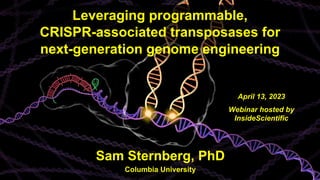
Leveraging programmable,
CRISPR-associated transposases for
next-generation genome engineering
April 13, 2023
Webinar hosted by
InsideScientific
Sam Sternberg, PhD
Columbia University
A bit about me
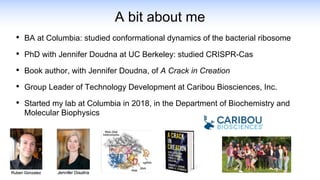
• BA at Columbia: studied conformational dynamics of the bacterial ribosome
• PhD with Jennifer Doudna at UC Berkeley: studied CRISPR-Cas
• Book author, with Jennifer Doudna, of A Crack in Creation
• Group Leader of Technology Development at Caribou Biosciences, Inc.
• Started my lab at Columbia in 2018, in the Department of Biochemistry and
Molecular Biophysics
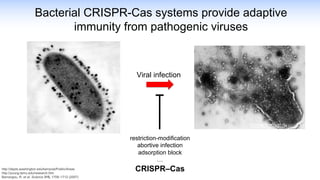
Bacterial CRISPR-Cas systems provide adaptive
immunity from pathogenic viruses
Viral infection
restriction-modification
abortive infection
adsorption block
…
CRISPR–Cas
http://depts.washington.edu/kerrpost/Public/Areas
http://young.tamu.edu/research.htm
Barrangou, R. et al. Science 315, 1709–1712 (2007)
Cas9
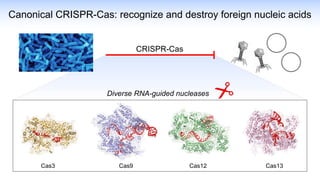
Diverse RNA-guided nucleases
Cas3 Cas9 Cas12 Cas13
CRISPR-Cas
Canonical CRISPR-Cas: recognize and destroy foreign nucleic acids
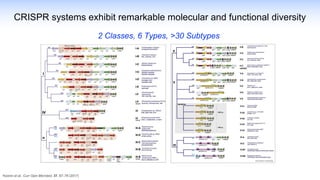
Koonin et al., Curr Opin Microbiol. 37, 67–78 (2017)
2 Classes, 6 Types, >30 Subtypes
CRISPR systems exhibit remarkable molecular and functional diversity
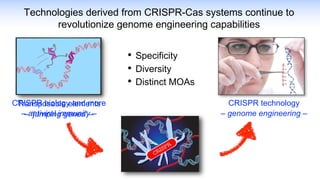
Technologies derived from CRISPR-Cas systems continue to
revolutionize genome engineering capabilities
CRISPR biology and more
– antiviral immunity –
CRISPR technology
– genome engineering –
• Specificity
• Diversity
• Distinct MOAs
Transposable elements
– ‘jumping genes’ –
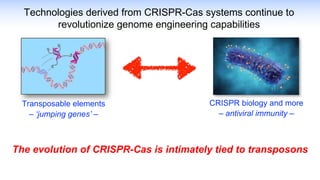
Technologies derived from CRISPR-Cas systems continue to
revolutionize genome engineering capabilities
CRISPR biology and more
– antiviral immunity –
Transposable elements
– ‘jumping genes’ –
The evolution of CRISPR-Cas is intimately tied to transposons
Often: other cargo genes
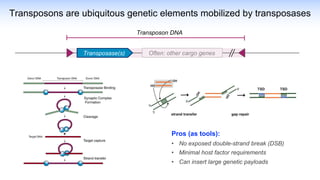
Transposon DNA
Transposase(s)
Pros (as tools):
• No exposed double-strand break (DSB)
• Minimal host factor requirements
• Can insert large genetic payloads
Transposons are ubiquitous genetic elements mobilized by transposases
Often: other cargo genes
Transposon DNA
Transposase(s)
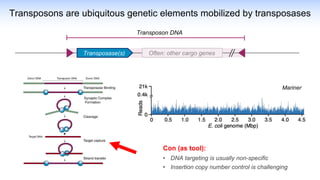
Mariner
Con (as tool):
• DNA targeting is usually non-specific
• Insertion copy number control is challenging
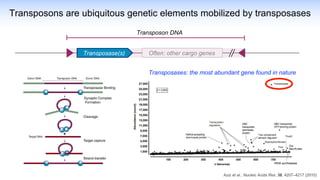
Aziz et al., Nucleic Acids Res. 38, 4207–4217 (2010)
Transposases: the most abundant gene found in nature
Transposons are ubiquitous genetic elements mobilized by transposases
Often: other cargo genes
Transposon DNA
Transposase(s)
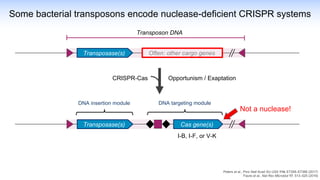
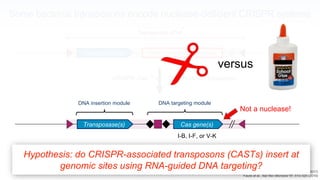
Some bacterial transposons encode nuclease-deficient CRISPR systems
Often: other cargo genes
Transposon DNA
Transposase(s)
Opportunism / Exaptation
CRISPR-Cas
DNA insertion module DNA targeting module
Not a nuclease!
Peters et al., Proc Natl Acad Sci USA 114, E7358–E7366 (2017)
Faure et al., Nat Rev Microbiol 17, 513–525 (2019)
Transposase(s) Cas gene(s)
I-B, I-F, or V-K
Some bacterial transposons encode nuclease-deficient CRISPR systems
Often: other cargo genes
Transposon DNA
Transposase(s)
Opportunism / Exaptation
CRISPR-Cas
DNA insertion module DNA targeting module
Not a nuclease!
Peters et al., Proc Natl Acad Sci USA 114, E7358–E7366 (2017)
Faure et al., Nat Rev Microbiol 17, 513–525 (2019)
Transposase(s) Cas gene(s)
I-B, I-F, or V-K
Hypothesis: do CRISPR-associated transposons (CASTs) insert at
genomic sites using RNA-guided DNA targeting?
versus
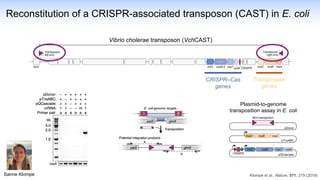
Reconstitution of a CRISPR-associated transposon (CAST) in E. coli
Plasmid-to-genome
transposition assay in E. coli
Vibrio cholerae transposon (VchCAST)
Klompe et al., Nature, 571, 219 (2019)
Sanne Klompe
CRISPR–Cas
genes
Transposase
genes
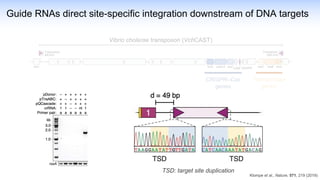
Guide RNAs direct site-specific integration downstream of DNA targets
Vibrio cholerae transposon (VchCAST)
Klompe et al., Nature, 571, 219 (2019)
CRISPR–Cas
genes
Transposase
genes
TSD: target site duplication
Klompe et al., Nature, 571, 219 (2019)
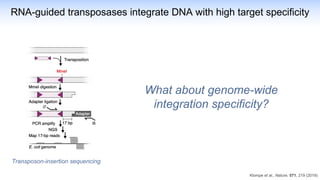
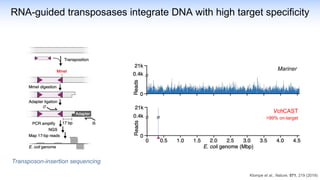
RNA-guided transposases integrate DNA with high target specificity
Transposon-insertion sequencing
What about genome-wide
integration specificity?
Mariner
VchCAST
>99% on-target
Klompe et al., Nature, 571, 219 (2019)
RNA-guided transposases integrate DNA with high target specificity
Transposon-insertion sequencing
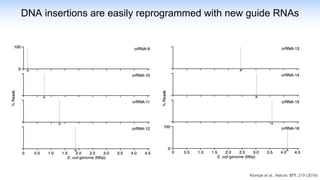
DNA insertions are easily reprogrammed with new guide RNAs
Klompe et al., Nature, 571, 219 (2019)
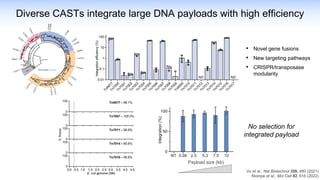
Diverse CASTs integrate large DNA payloads with high efficiency
Vo et al., Nat Biotechnol 359, 480 (2021)
Klompe et al., Mol Cell 82, 616 (2022)
• Novel gene fusions
• New targeting pathways
• CRISPR/transposase
modularity
No selection for
integrated payload
Payload size (kb)
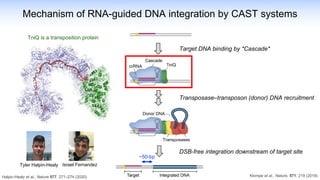
Mechanism of RNA-guided DNA integration by CAST systems
~50-bp
Klompe et al., Nature, 571, 219 (2019)
Target DNA binding by *Cascade*
DSB-free integration downstream of target site
Halpin-Healy et al., Nature 577, 271–274 (2020)
Tyler Halpin-Healy Israel Fernandez
Transposases
Transposase–transposon (donor) DNA recruitment
TniQ is a transposition protein
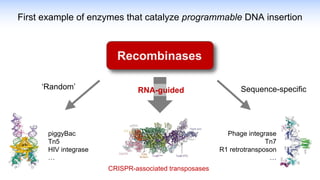
First example of enzymes that catalyze programmable DNA insertion
Recombinases
‘Random’
piggyBac
Tn5
HIV integrase
…
Sequence-specific
Phage integrase
Tn7
R1 retrotransposon
…
RNA-guided
CRISPR-associated transposases
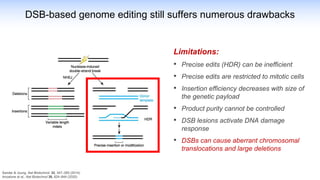
Limitations:
• Precise edits (HDR) can be inefficient
• Precise edits are restricted to mitotic cells
• Insertion efficiency decreases with size of
the genetic payload
• Product purity cannot be controlled
• DSB lesions activate DNA damage
response
• DSBs can cause aberrant chromosomal
translocations and large deletions
DSB-based genome editing still suffers numerous drawbacks
Sander & Joung. Nat Biotechnol. 32, 347–355 (2014)
Anzalone et al,. Nat Biotechnol 38, 824–844 (2020)
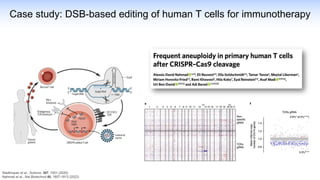
Case study: DSB-based editing of human T cells for immunotherapy
Stadtmauer et al., Science. 367, 1001 (2020)
Nahmad et al., Nat Biotechnol 40, 1807-1813 (2022)
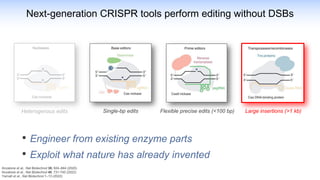
Next-generation CRISPR tools perform editing without DSBs
Flexible precise edits (<100 bp)
Single-bp edits Large insertions (>1 kb)
Heterogenous edits
• Engineer from existing enzyme parts
• Exploit what nature has already invented
Anzalone et al,. Nat Biotechnol 38, 824–844 (2020)
Anzalone et al., Nat Biotechnol 40, 731-740 (2022)
Yarnall et al., Nat Biotechnol 1–13 (2022)
How do CRISPR-associated transposases
accurately target the correct genomic site?
Progress on harnessing CAST systems for
programmable DNA integration in mammalian cells
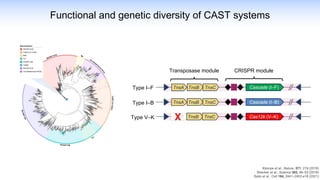
Functional and genetic diversity of CAST systems
Klompe et al., Nature, 571, 219 (2019)
Strecker et al., Science 365, 48–53 (2019)
Saito et al., Cell 184, 2441–2453.e18 (2021)
Transposase module CRISPR module
Type I–F
Type I–B
Type V–K
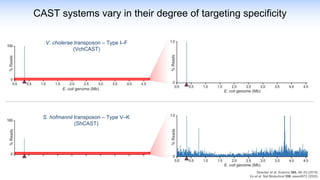
S. hofmannii transposon – Type V–K
(ShCAST)
V. cholerae transposon – Type I–F
(VchCAST)
CAST systems vary in their degree of targeting specificity
Strecker et al. Science 365, 48–53 (2019)
Vo et al. Nat Biotechnol 359, eaan4672 (2020)
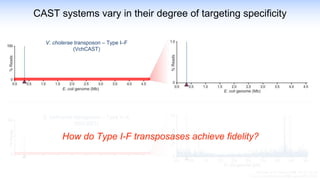
S. hofmannii transposon – Type V–K
(ShCAST)
V. cholerae transposon – Type I–F
(VchCAST)
CAST systems vary in their degree of targeting specificity
Strecker et al. Science 365, 48–53 (2019)
Vo et al. Nat Biotechnol 359, eaan4672 (2020)
How do Type I-F transposases achieve fidelity?
Leslie Beh Florian Hoffmann
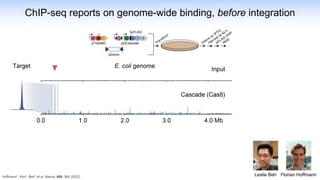
ChIP-seq reports on genome-wide binding, before integration
Hoffmann*, Kim*, Beh* et al. Nature, 609, 384 (2022)
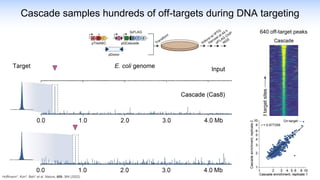
Cascade samples hundreds of off-targets during DNA targeting
640 off-target peaks
Hoffmann*, Kim*, Beh* et al. Nature, 609, 384 (2022)
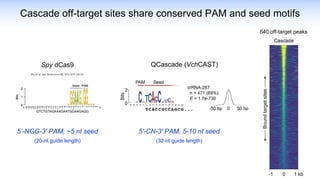
Cascade off-target sites share conserved PAM and seed motifs
640 off-target peaks
5'-CN-3' PAM, 5-10 nt seed
(32-nt guide length)
QCascade (VchCAST)
Spy dCas9
5’-NGG-3' PAM, ~5 nt seed
(20-nt guide length)
Wu et al. Nat Biotechnol 32, 670–676 (2014)
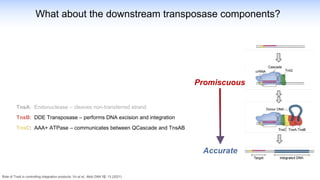
TnsA: Endonuclease – cleaves non-transferred strand
TnsB: DDE Transposase – performs DNA excision and integration
TnsC: AAA+ ATPase – communicates between QCascade and TnsAB
What about the downstream transposase components?
Role of TnsA in controlling integration products: Vo et al., Mob DNA 12, 13 (2021)
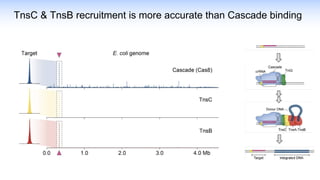
Promiscuous
Accurate
TnsC & TnsB recruitment is more accurate than Cascade binding
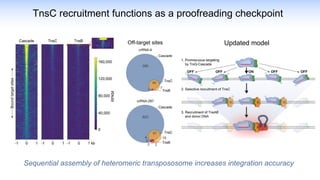
TnsC recruitment functions as a proofreading checkpoint
Sequential assembly of heteromeric transpososome increases integration accuracy
Off-target sites Updated model
Cascade
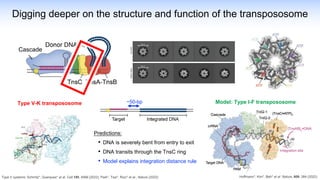
Digging deeper on the structure and function of the transpososome
Type V systems: Schmitz*, Querques* et al. Cell 185, 4999 (2022). Park*, Tsai*, Rizo* et al., Nature (2022)
Model: Type I-F transpososome
Type V-K transpososome
Hoffmann*, Kim*, Beh* et al. Nature, 609, 384 (2022)
~50-bp
Predictions:
• DNA is severely bent from entry to exit
• DNA transits through the TnsC ring
• Model explains integration distance rule
How do RNA-guided transposase complexes
accurately target the correct genomic site?
Progress on harnessing CAST systems for
programmable DNA integration in mammalian cells
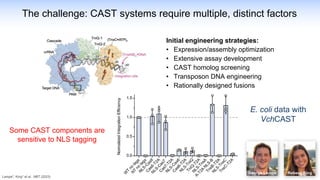
The challenge: CAST systems require multiple, distinct factors
Lampe*, King* et al., NBT (2023)
Rebeca King
George Lampe
Initial engineering strategies:
• Expression/assembly optimization
• Extensive assay development
• CAST homolog screening
• Transposon DNA engineering
• Rationally designed fusions
E. coli data with
VchCAST
Some CAST components are
sensitive to NLS tagging
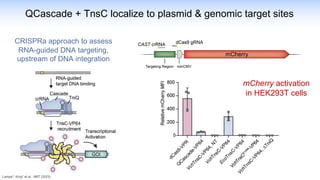
QCascade + TnsC localize to plasmid & genomic target sites
mCherry activation
in HEK293T cells
CRISPRa approach to assess
RNA-guided DNA targeting,
upstream of DNA integration
Lampe*, King* et al., NBT (2023)
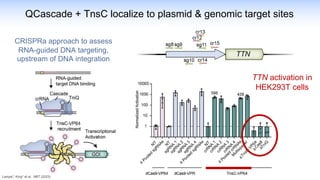
QCascade + TnsC localize to plasmid & genomic target sites
TTN activation in
HEK293T cells
CRISPRa approach to assess
RNA-guided DNA targeting,
upstream of DNA integration
Lampe*, King* et al., NBT (2023)
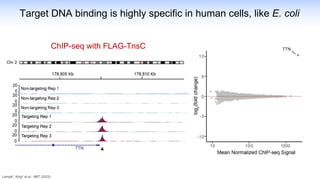
Target DNA binding is highly specific in human cells, like E. coli
ChIP-seq with FLAG-TnsC
Lampe*, King* et al., NBT (2023)
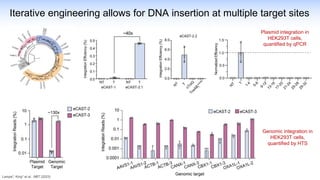
Iterative engineering allows for DNA insertion at multiple target sites
Plasmid integration in
HEK293T cells,
quantified by qPCR
Genomic integration in
HEK293T cells,
quantified by HTS
Lampe*, King* et al., NBT (2023)
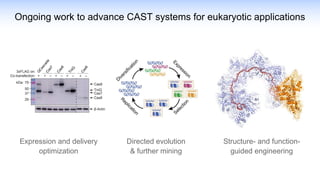
Ongoing work to advance CAST systems for eukaryotic applications
Structure- and function-
guided engineering
Expression and delivery
optimization
Directed evolution
& further mining
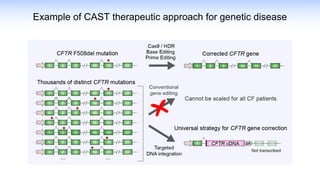
Example of CAST therapeutic approach for genetic disease
Diego Gelsinger, PhD
Jerrin George, PhD
Florian Hoffmann
Rebeca King
Sanne Klompe
George Lampe
Emily Lan
Henry Le
Ashley Liang
Chance Meers, PhD
Edan Mortman
Sanjana Pesari
Stephen Tang
Matt Walker
Dennis Zhang
Rimante Zedaveinyte
Sternberg Laboratory
Dr. Harris Wang
Dr. Laura Landweber
Dr. Eric Greene
- Columbia University
Dr. Israel Fernandez
- St. Jude
Dr. David Liu
- Broad Institute
www.sternberglab.org
Leveraging Programmable CRISPR-Associated Transposases for Next-Generation Genome Engineering

Leveraging Programmable CRISPR-Associated Transposases for Next-Generation Genome Engineering

  • 2.
    Leveraging programmable, CRISPR-associated transposasesfor next-generation genome engineering April 13, 2023 Webinar hosted by InsideScientific Sam Sternberg, PhD Columbia University
  • 3.
    A bit aboutme • BA at Columbia: studied conformational dynamics of the bacterial ribosome • PhD with Jennifer Doudna at UC Berkeley: studied CRISPR-Cas • Book author, with Jennifer Doudna, of A Crack in Creation • Group Leader of Technology Development at Caribou Biosciences, Inc. • Started my lab at Columbia in 2018, in the Department of Biochemistry and Molecular Biophysics
  • 4.
    Bacterial CRISPR-Cas systemsprovide adaptive immunity from pathogenic viruses Viral infection restriction-modification abortive infection adsorption block … CRISPR–Cas http://depts.washington.edu/kerrpost/Public/Areas http://young.tamu.edu/research.htm Barrangou, R. et al. Science 315, 1709–1712 (2007)
  • 5.
    Cas9 Diverse RNA-guided nucleases Cas3Cas9 Cas12 Cas13 CRISPR-Cas Canonical CRISPR-Cas: recognize and destroy foreign nucleic acids
  • 6.
    Koonin et al.,Curr Opin Microbiol. 37, 67–78 (2017) 2 Classes, 6 Types, >30 Subtypes CRISPR systems exhibit remarkable molecular and functional diversity
  • 7.
    Technologies derived fromCRISPR-Cas systems continue to revolutionize genome engineering capabilities CRISPR biology and more – antiviral immunity – CRISPR technology – genome engineering – • Specificity • Diversity • Distinct MOAs Transposable elements – ‘jumping genes’ –
  • 8.
    Technologies derived fromCRISPR-Cas systems continue to revolutionize genome engineering capabilities CRISPR biology and more – antiviral immunity – Transposable elements – ‘jumping genes’ – The evolution of CRISPR-Cas is intimately tied to transposons
  • 9.
    Often: other cargogenes Transposon DNA Transposase(s) Pros (as tools): • No exposed double-strand break (DSB) • Minimal host factor requirements • Can insert large genetic payloads Transposons are ubiquitous genetic elements mobilized by transposases
  • 10.
    Transposons are ubiquitousgenetic elements mobilized by transposases Often: other cargo genes Transposon DNA Transposase(s) Mariner Con (as tool): • DNA targeting is usually non-specific • Insertion copy number control is challenging
  • 11.
    Aziz et al.,Nucleic Acids Res. 38, 4207–4217 (2010) Transposases: the most abundant gene found in nature Transposons are ubiquitous genetic elements mobilized by transposases Often: other cargo genes Transposon DNA Transposase(s)
  • 12.
    Some bacterial transposonsencode nuclease-deficient CRISPR systems Often: other cargo genes Transposon DNA Transposase(s) Opportunism / Exaptation CRISPR-Cas DNA insertion module DNA targeting module Not a nuclease! Peters et al., Proc Natl Acad Sci USA 114, E7358–E7366 (2017) Faure et al., Nat Rev Microbiol 17, 513–525 (2019) Transposase(s) Cas gene(s) I-B, I-F, or V-K
  • 13.
    Some bacterial transposonsencode nuclease-deficient CRISPR systems Often: other cargo genes Transposon DNA Transposase(s) Opportunism / Exaptation CRISPR-Cas DNA insertion module DNA targeting module Not a nuclease! Peters et al., Proc Natl Acad Sci USA 114, E7358–E7366 (2017) Faure et al., Nat Rev Microbiol 17, 513–525 (2019) Transposase(s) Cas gene(s) I-B, I-F, or V-K Hypothesis: do CRISPR-associated transposons (CASTs) insert at genomic sites using RNA-guided DNA targeting? versus
  • 14.
    Reconstitution of aCRISPR-associated transposon (CAST) in E. coli Plasmid-to-genome transposition assay in E. coli Vibrio cholerae transposon (VchCAST) Klompe et al., Nature, 571, 219 (2019) Sanne Klompe CRISPR–Cas genes Transposase genes
  • 15.
    Guide RNAs directsite-specific integration downstream of DNA targets Vibrio cholerae transposon (VchCAST) Klompe et al., Nature, 571, 219 (2019) CRISPR–Cas genes Transposase genes TSD: target site duplication
  • 16.
    Klompe et al.,Nature, 571, 219 (2019) RNA-guided transposases integrate DNA with high target specificity Transposon-insertion sequencing What about genome-wide integration specificity?
  • 17.
    Mariner VchCAST >99% on-target Klompe etal., Nature, 571, 219 (2019) RNA-guided transposases integrate DNA with high target specificity Transposon-insertion sequencing
  • 18.
    DNA insertions areeasily reprogrammed with new guide RNAs Klompe et al., Nature, 571, 219 (2019)
  • 19.
    Diverse CASTs integratelarge DNA payloads with high efficiency Vo et al., Nat Biotechnol 359, 480 (2021) Klompe et al., Mol Cell 82, 616 (2022) • Novel gene fusions • New targeting pathways • CRISPR/transposase modularity No selection for integrated payload Payload size (kb)
  • 20.
    Mechanism of RNA-guidedDNA integration by CAST systems ~50-bp Klompe et al., Nature, 571, 219 (2019) Target DNA binding by *Cascade* DSB-free integration downstream of target site Halpin-Healy et al., Nature 577, 271–274 (2020) Tyler Halpin-Healy Israel Fernandez Transposases Transposase–transposon (donor) DNA recruitment TniQ is a transposition protein
  • 21.
    First example ofenzymes that catalyze programmable DNA insertion Recombinases ‘Random’ piggyBac Tn5 HIV integrase … Sequence-specific Phage integrase Tn7 R1 retrotransposon … RNA-guided CRISPR-associated transposases
  • 22.
    Limitations: • Precise edits(HDR) can be inefficient • Precise edits are restricted to mitotic cells • Insertion efficiency decreases with size of the genetic payload • Product purity cannot be controlled • DSB lesions activate DNA damage response • DSBs can cause aberrant chromosomal translocations and large deletions DSB-based genome editing still suffers numerous drawbacks Sander & Joung. Nat Biotechnol. 32, 347–355 (2014) Anzalone et al,. Nat Biotechnol 38, 824–844 (2020)
  • 23.
    Case study: DSB-basedediting of human T cells for immunotherapy Stadtmauer et al., Science. 367, 1001 (2020) Nahmad et al., Nat Biotechnol 40, 1807-1813 (2022)
  • 24.
    Next-generation CRISPR toolsperform editing without DSBs Flexible precise edits (<100 bp) Single-bp edits Large insertions (>1 kb) Heterogenous edits • Engineer from existing enzyme parts • Exploit what nature has already invented Anzalone et al,. Nat Biotechnol 38, 824–844 (2020) Anzalone et al., Nat Biotechnol 40, 731-740 (2022) Yarnall et al., Nat Biotechnol 1–13 (2022)
  • 25.
    How do CRISPR-associatedtransposases accurately target the correct genomic site? Progress on harnessing CAST systems for programmable DNA integration in mammalian cells
  • 26.
    Functional and geneticdiversity of CAST systems Klompe et al., Nature, 571, 219 (2019) Strecker et al., Science 365, 48–53 (2019) Saito et al., Cell 184, 2441–2453.e18 (2021) Transposase module CRISPR module Type I–F Type I–B Type V–K
  • 27.
    S. hofmannii transposon– Type V–K (ShCAST) V. cholerae transposon – Type I–F (VchCAST) CAST systems vary in their degree of targeting specificity Strecker et al. Science 365, 48–53 (2019) Vo et al. Nat Biotechnol 359, eaan4672 (2020)
  • 28.
    S. hofmannii transposon– Type V–K (ShCAST) V. cholerae transposon – Type I–F (VchCAST) CAST systems vary in their degree of targeting specificity Strecker et al. Science 365, 48–53 (2019) Vo et al. Nat Biotechnol 359, eaan4672 (2020) How do Type I-F transposases achieve fidelity?
  • 29.
    Leslie Beh FlorianHoffmann ChIP-seq reports on genome-wide binding, before integration Hoffmann*, Kim*, Beh* et al. Nature, 609, 384 (2022)
  • 30.
    Cascade samples hundredsof off-targets during DNA targeting 640 off-target peaks Hoffmann*, Kim*, Beh* et al. Nature, 609, 384 (2022)
  • 31.
    Cascade off-target sitesshare conserved PAM and seed motifs 640 off-target peaks 5'-CN-3' PAM, 5-10 nt seed (32-nt guide length) QCascade (VchCAST) Spy dCas9 5’-NGG-3' PAM, ~5 nt seed (20-nt guide length) Wu et al. Nat Biotechnol 32, 670–676 (2014)
  • 32.
    TnsA: Endonuclease –cleaves non-transferred strand TnsB: DDE Transposase – performs DNA excision and integration TnsC: AAA+ ATPase – communicates between QCascade and TnsAB What about the downstream transposase components? Role of TnsA in controlling integration products: Vo et al., Mob DNA 12, 13 (2021) Promiscuous Accurate
  • 33.
    TnsC & TnsBrecruitment is more accurate than Cascade binding
  • 34.
    TnsC recruitment functionsas a proofreading checkpoint Sequential assembly of heteromeric transpososome increases integration accuracy Off-target sites Updated model
  • 35.
    Cascade Digging deeper onthe structure and function of the transpososome Type V systems: Schmitz*, Querques* et al. Cell 185, 4999 (2022). Park*, Tsai*, Rizo* et al., Nature (2022) Model: Type I-F transpososome Type V-K transpososome Hoffmann*, Kim*, Beh* et al. Nature, 609, 384 (2022) ~50-bp Predictions: • DNA is severely bent from entry to exit • DNA transits through the TnsC ring • Model explains integration distance rule
  • 36.
    How do RNA-guidedtransposase complexes accurately target the correct genomic site? Progress on harnessing CAST systems for programmable DNA integration in mammalian cells
  • 37.
    The challenge: CASTsystems require multiple, distinct factors Lampe*, King* et al., NBT (2023) Rebeca King George Lampe Initial engineering strategies: • Expression/assembly optimization • Extensive assay development • CAST homolog screening • Transposon DNA engineering • Rationally designed fusions E. coli data with VchCAST Some CAST components are sensitive to NLS tagging
  • 38.
    QCascade + TnsClocalize to plasmid & genomic target sites mCherry activation in HEK293T cells CRISPRa approach to assess RNA-guided DNA targeting, upstream of DNA integration Lampe*, King* et al., NBT (2023)
  • 39.
    QCascade + TnsClocalize to plasmid & genomic target sites TTN activation in HEK293T cells CRISPRa approach to assess RNA-guided DNA targeting, upstream of DNA integration Lampe*, King* et al., NBT (2023)
  • 40.
    Target DNA bindingis highly specific in human cells, like E. coli ChIP-seq with FLAG-TnsC Lampe*, King* et al., NBT (2023)
  • 41.
    Iterative engineering allowsfor DNA insertion at multiple target sites Plasmid integration in HEK293T cells, quantified by qPCR Genomic integration in HEK293T cells, quantified by HTS Lampe*, King* et al., NBT (2023)
  • 42.
    Ongoing work toadvance CAST systems for eukaryotic applications Structure- and function- guided engineering Expression and delivery optimization Directed evolution & further mining
  • 43.
    Example of CASTtherapeutic approach for genetic disease
  • 44.
    Diego Gelsinger, PhD JerrinGeorge, PhD Florian Hoffmann Rebeca King Sanne Klompe George Lampe Emily Lan Henry Le Ashley Liang Chance Meers, PhD Edan Mortman Sanjana Pesari Stephen Tang Matt Walker Dennis Zhang Rimante Zedaveinyte Sternberg Laboratory Dr. Harris Wang Dr. Laura Landweber Dr. Eric Greene - Columbia University Dr. Israel Fernandez - St. Jude Dr. David Liu - Broad Institute www.sternberglab.org