Adipose Tissue
Maha Hammady Hemdan
MBBCh, Demonstrator at Medical
Histology & Cell Biology
Department,
Faculty of Medicine Alexandria
university
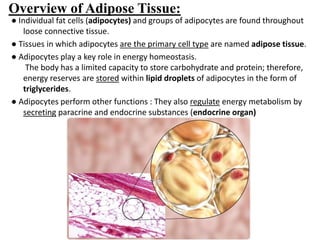
● Individual fat cells (adipocytes) and groups of adipocytes are found throughout
loose connective tissue.
● Tissues in which adipocytes are the primary cell type are named adipose tissue.
● Adipocytes play a key role in energy homeostasis.
The body has a limited capacity to store carbohydrate and protein; therefore,
energy reserves are stored within lipid droplets of adipocytes in the form of
triglycerides.
● Adipocytes perform other functions : They also regulate energy metabolism by
secreting paracrine and endocrine substances (endocrine organ)
Overview of Adipose Tissue:
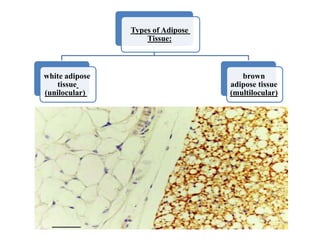
Types of Adipose
Tissue:
white adipose
tissue
(unilocular)
brown
adipose tissue
(multilocular)
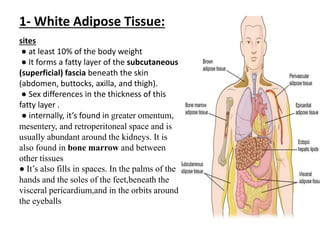
1- White Adipose Tissue:
sites
● at least 10% of the body weight
● It forms a fatty layer of the subcutaneous
(superficial) fascia beneath the skin
(abdomen, buttocks, axilla, and thigh).
● Sex differences in the thickness of this
fatty layer .
● internally, it’s found in greater omentum,
mesentery, and retroperitoneal space and is
usually abundant around the kidneys. It is
also found in bone marrow and between
other tissues
● It’s also fills in spaces. In the palms of the
hands and the soles of the feet,beneath the
visceral pericardium,and in the orbits around
the eyeballs
Function of White Adipose Tissue:
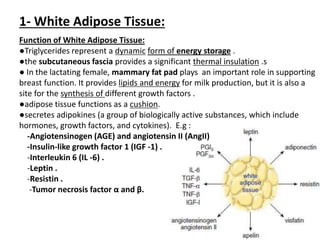
●Triglycerides represent a dynamic form of energy storage .
●the subcutaneous fascia provides a significant thermal insulation .s
● In the lactating female, mammary fat pad plays an important role in supporting
breast function. It provides lipids and energy for milk production, but it is also a
site for the synthesis of different growth factors .
●adipose tissue functions as a cushion.
●secretes adipokines (a group of biologically active substances, which include
hormones, growth factors, and cytokines). E.g :
-Angiotensinogen (AGE) and angiotensin II (AngII)
-Insulin-like growth factor 1 (IGF -1) .
-Interleukin 6 (IL -6) .
-Leptin .
-Resistin .
-Tumor necrosis factor α and β.
1- White Adipose Tissue:
Differentiation of white Adipocytes:
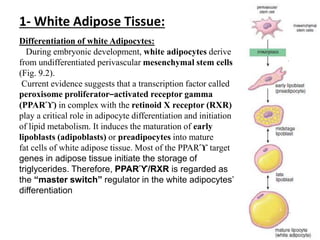
During embryonic development, white adipocytes derive
from undifferentiated perivascular mesenchymal stem cells
(Fig. 9.2).
Current evidence suggests that a transcription factor called
peroxisome proliferator–activated receptor gamma
(PPARϓ) in complex with the retinoid X receptor (RXR)
play a critical role in adipocyte differentiation and initiation
of lipid metabolism. It induces the maturation of early
lipoblasts (adipoblasts) or preadipocytes into mature
fat cells of white adipose tissue. Most of the PPARϓ target
genes in adipose tissue initiate the storage of
triglycerides. Therefore, PPARϓ/RXR is regarded as
the “master switch” regulator in the white adipocytes’
differentiation
1- White Adipose Tissue:
Histological features:
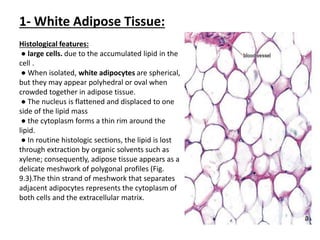
● large cells. due to the accumulated lipid in the
cell .
● When isolated, white adipocytes are spherical,
but they may appear polyhedral or oval when
crowded together in adipose tissue.
● The nucleus is flattened and displaced to one
side of the lipid mass
● the cytoplasm forms a thin rim around the
lipid.
● In routine histologic sections, the lipid is lost
through extraction by organic solvents such as
xylene; consequently, adipose tissue appears as a
delicate meshwork of polygonal profiles (Fig.
9.3).The thin strand of meshwork that separates
adjacent adipocytes represents the cytoplasm of
both cells and the extracellular matrix.
1- White Adipose Tissue:
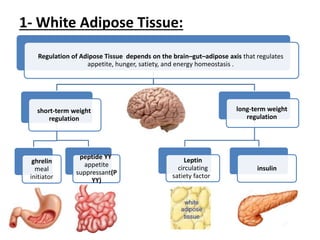
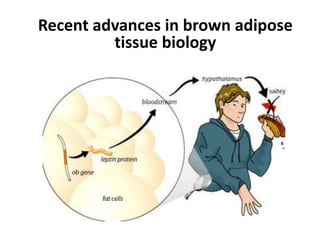
Regulation of Adipose Tissue depends on the brain–gut–adipose axis that regulates
appetite, hunger, satiety, and energy homeostasis .
short-term weight
regulation
ghrelin
meal
initiator
peptide YY
appetite
suppressant(P
YY)
long-term weight
regulation
Leptin
circulating
satiety factor
insulin
2- Brown Adipose Tissue:
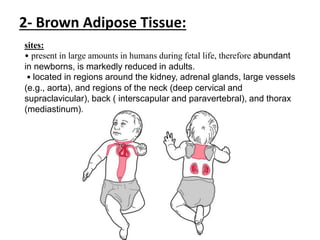
sites:
• present in large amounts in humans during fetal life, therefore abundant
in newborns, is markedly reduced in adults.
• located in regions around the kidney, adrenal glands, large vessels
(e.g., aorta), and regions of the neck (deep cervical and
supraclavicular), back ( interscapular and paravertebral), and thorax
(mediastinum).
2- Brown Adipose Tissue:
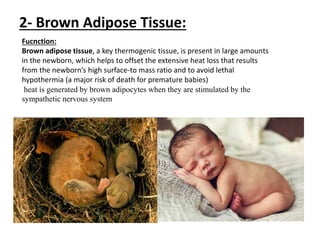
Fucnction:
Brown adipose tissue, a key thermogenic tissue, is present in large amounts
in the newborn, which helps to offset the extensive heat loss that results
from the newborn’s high surface-to mass ratio and to avoid lethal
hypothermia (a major risk of death for premature babies)
heat is generated by brown adipocytes when they are stimulated by the
sympathetic nervous system
2- Brown Adipose Tissue:
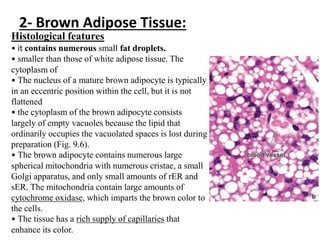
Histological features
• it contains numerous small fat droplets.
• smaller than those of white adipose tissue. The
cytoplasm of
• The nucleus of a mature brown adipocyte is typically
in an eccentric position within the cell, but it is not
flattened
• the cytoplasm of the brown adipocyte consists
largely of empty vacuoles because the lipid that
ordinarily occupies the vacuolated spaces is lost during
preparation (Fig. 9.6).
• The brown adipocyte contains numerous large
spherical mitochondria with numerous cristae, a small
Golgi apparatus, and only small amounts of rER and
sER. The mitochondria contain large amounts of
cytochrome oxidase, which imparts the brown color to
the cells.
• The tissue has a rich supply of capillaries that
enhance its color.
2- Brown Adipose Tissue:
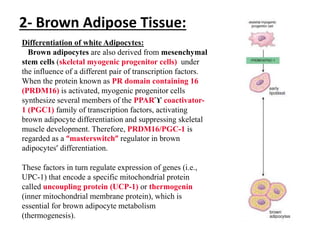
Differentiation of white Adipocytes:
Brown adipocytes are also derived from mesenchymal
stem cells (skeletal myogenic progenitor cells) under
the influence of a different pair of transcription factors.
When the protein known as PR domain containing 16
(PRDM16) is activated, myogenic progenitor cells
synthesize several members of the PPARϓ coactivator-
1 (PGC1) family of transcription factors, activating
brown adipocyte differentiation and suppressing skeletal
muscle development. Therefore, PRDM16/PGC-1 is
regarded as a “masterswitch” regulator in brown
adipocytes’ differentiation.
These factors in turn regulate expression of genes (i.e.,
UPC-1) that encode a specific mitochondrial protein
called uncoupling protein (UCP-1) or thermogenin
(inner mitochondrial membrane protein), which is
essential for brown adipocyte metabolism
(thermogenesis).
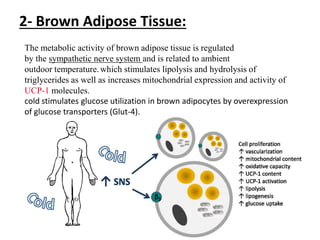
The metabolic activity of brown adipose tissue is regulated
by the sympathetic nerve system and is related to ambient
outdoor temperature.which stimulates lipolysis and hydrolysis of
triglycerides as well as increases mitochondrial expression and activity of
UCP-1 molecules.
cold stimulates glucose utilization in brown adipocytes by overexpression
of glucose transporters (Glut-4).
2- Brown Adipose Tissue:
Recent advances in brown adipose
tissue biology
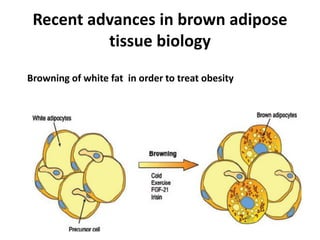
Browning of white fat in order to treat obesity
Recent advances in brown adipose
tissue biology
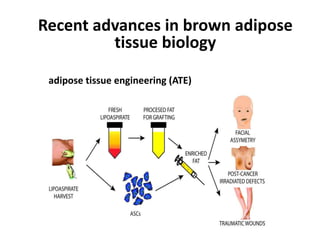
adipose tissue engineering (ATE)
Recent advances in brown adipose
tissue biology
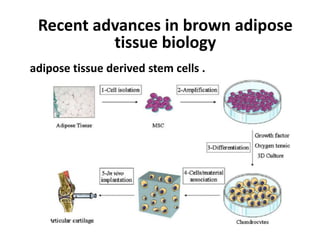
adipose tissue derived stem cells .
Recent advances in brown adipose
tissue biology
Adipose tissue histology - maha hammady

Adipose tissue histology - maha hammady

  • 1.
    Adipose Tissue Maha HammadyHemdan MBBCh, Demonstrator at Medical Histology & Cell Biology Department, Faculty of Medicine Alexandria university
  • 2.
    ● Individual fatcells (adipocytes) and groups of adipocytes are found throughout loose connective tissue. ● Tissues in which adipocytes are the primary cell type are named adipose tissue. ● Adipocytes play a key role in energy homeostasis. The body has a limited capacity to store carbohydrate and protein; therefore, energy reserves are stored within lipid droplets of adipocytes in the form of triglycerides. ● Adipocytes perform other functions : They also regulate energy metabolism by secreting paracrine and endocrine substances (endocrine organ) Overview of Adipose Tissue:
  • 3.
    Types of Adipose Tissue: whiteadipose tissue (unilocular) brown adipose tissue (multilocular)
  • 4.
    1- White AdiposeTissue: sites ● at least 10% of the body weight ● It forms a fatty layer of the subcutaneous (superficial) fascia beneath the skin (abdomen, buttocks, axilla, and thigh). ● Sex differences in the thickness of this fatty layer . ● internally, it’s found in greater omentum, mesentery, and retroperitoneal space and is usually abundant around the kidneys. It is also found in bone marrow and between other tissues ● It’s also fills in spaces. In the palms of the hands and the soles of the feet,beneath the visceral pericardium,and in the orbits around the eyeballs
  • 5.
    Function of WhiteAdipose Tissue: ●Triglycerides represent a dynamic form of energy storage . ●the subcutaneous fascia provides a significant thermal insulation .s ● In the lactating female, mammary fat pad plays an important role in supporting breast function. It provides lipids and energy for milk production, but it is also a site for the synthesis of different growth factors . ●adipose tissue functions as a cushion. ●secretes adipokines (a group of biologically active substances, which include hormones, growth factors, and cytokines). E.g : -Angiotensinogen (AGE) and angiotensin II (AngII) -Insulin-like growth factor 1 (IGF -1) . -Interleukin 6 (IL -6) . -Leptin . -Resistin . -Tumor necrosis factor α and β. 1- White Adipose Tissue:
  • 6.
    Differentiation of whiteAdipocytes: During embryonic development, white adipocytes derive from undifferentiated perivascular mesenchymal stem cells (Fig. 9.2). Current evidence suggests that a transcription factor called peroxisome proliferator–activated receptor gamma (PPARϓ) in complex with the retinoid X receptor (RXR) play a critical role in adipocyte differentiation and initiation of lipid metabolism. It induces the maturation of early lipoblasts (adipoblasts) or preadipocytes into mature fat cells of white adipose tissue. Most of the PPARϓ target genes in adipose tissue initiate the storage of triglycerides. Therefore, PPARϓ/RXR is regarded as the “master switch” regulator in the white adipocytes’ differentiation 1- White Adipose Tissue:
  • 7.
    1- White AdiposeTissue: Histological features: ● large cells. due to the accumulated lipid in the cell . ● When isolated, white adipocytes are spherical, but they may appear polyhedral or oval when crowded together in adipose tissue. ● The nucleus is flattened and displaced to one side of the lipid mass ● the cytoplasm forms a thin rim around the lipid. ● In routine histologic sections, the lipid is lost through extraction by organic solvents such as xylene; consequently, adipose tissue appears as a delicate meshwork of polygonal profiles (Fig. 9.3).The thin strand of meshwork that separates adjacent adipocytes represents the cytoplasm of both cells and the extracellular matrix.
  • 8.
    1- White AdiposeTissue: Regulation of Adipose Tissue depends on the brain–gut–adipose axis that regulates appetite, hunger, satiety, and energy homeostasis . short-term weight regulation ghrelin meal initiator peptide YY appetite suppressant(P YY) long-term weight regulation Leptin circulating satiety factor insulin
  • 9.
    2- Brown AdiposeTissue: sites: • present in large amounts in humans during fetal life, therefore abundant in newborns, is markedly reduced in adults. • located in regions around the kidney, adrenal glands, large vessels (e.g., aorta), and regions of the neck (deep cervical and supraclavicular), back ( interscapular and paravertebral), and thorax (mediastinum).
  • 10.
    2- Brown AdiposeTissue: Fucnction: Brown adipose tissue, a key thermogenic tissue, is present in large amounts in the newborn, which helps to offset the extensive heat loss that results from the newborn’s high surface-to mass ratio and to avoid lethal hypothermia (a major risk of death for premature babies) heat is generated by brown adipocytes when they are stimulated by the sympathetic nervous system
  • 11.
    2- Brown AdiposeTissue: Histological features • it contains numerous small fat droplets. • smaller than those of white adipose tissue. The cytoplasm of • The nucleus of a mature brown adipocyte is typically in an eccentric position within the cell, but it is not flattened • the cytoplasm of the brown adipocyte consists largely of empty vacuoles because the lipid that ordinarily occupies the vacuolated spaces is lost during preparation (Fig. 9.6). • The brown adipocyte contains numerous large spherical mitochondria with numerous cristae, a small Golgi apparatus, and only small amounts of rER and sER. The mitochondria contain large amounts of cytochrome oxidase, which imparts the brown color to the cells. • The tissue has a rich supply of capillaries that enhance its color.
  • 12.
    2- Brown AdiposeTissue: Differentiation of white Adipocytes: Brown adipocytes are also derived from mesenchymal stem cells (skeletal myogenic progenitor cells) under the influence of a different pair of transcription factors. When the protein known as PR domain containing 16 (PRDM16) is activated, myogenic progenitor cells synthesize several members of the PPARϓ coactivator- 1 (PGC1) family of transcription factors, activating brown adipocyte differentiation and suppressing skeletal muscle development. Therefore, PRDM16/PGC-1 is regarded as a “masterswitch” regulator in brown adipocytes’ differentiation. These factors in turn regulate expression of genes (i.e., UPC-1) that encode a specific mitochondrial protein called uncoupling protein (UCP-1) or thermogenin (inner mitochondrial membrane protein), which is essential for brown adipocyte metabolism (thermogenesis).
  • 13.
    The metabolic activityof brown adipose tissue is regulated by the sympathetic nerve system and is related to ambient outdoor temperature.which stimulates lipolysis and hydrolysis of triglycerides as well as increases mitochondrial expression and activity of UCP-1 molecules. cold stimulates glucose utilization in brown adipocytes by overexpression of glucose transporters (Glut-4). 2- Brown Adipose Tissue:
  • 14.
    Recent advances inbrown adipose tissue biology Browning of white fat in order to treat obesity
  • 15.
    Recent advances inbrown adipose tissue biology adipose tissue engineering (ATE)
  • 16.
    Recent advances inbrown adipose tissue biology adipose tissue derived stem cells .
  • 17.
    Recent advances inbrown adipose tissue biology