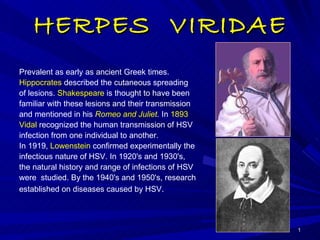
HERPES  VIRIDAE Prevalent as early as ancient Greek times.  Hippocrates  described the cutaneous spreading of lesions.  Shakespeare  is thought to have been familiar with these lesions and their transmission and mentioned in his  Romeo and Juliet .  In  1893  Vidal  recognized the human transmission of HSV infection from one individual to another.  In 1919,  Lowenstein  confirmed experimentally the infectious nature of HSV. In 1920's and 1930's, the natural history and range of infections of HSV were  studied. By the 1940's and 1950's, research established on diseases caused by HSV .
The members of this family are also known as  herpesviruses . Name is derived from the Greek word  herpein  ("to creep or crawl").  Latent, reactivation , recurring and lytic  infections are typical of this group of viruses.  Herpesviridae , a large family of DNA viruses that cause diseases in animals and humans.
Medically important viruses – Three subfamilies. Alpha herpes virinae. Rapid growth, Latent  infection in  sensory ganglia. HSV – 1,  HSV – 2,  V – Z  Virus. Beta herpes virinae Slow growth. Grow  best in Fibroblasts.  Latent  infection  in  salivary gland. HHV – 5  ( CMV )  HHV– 6  ,  HHV – 7
Gamma herpes virinae Grow  in Lymphoblastoid cells. Latent  infection  in Lymphoid  tissue. HHV – 4  (Epstein – Barr Virus) HHV – 8  ( Kaposi’s sarcoma herpes virus)   Neurotropic viruses: HSV,VZV; Lymphotropic viruses: EBV,HHV6,HHV7
Morphology   Enveloped (Lipid) Double stranded DNA  Icosahedral capsid “ Tegument” Glycoprotein  spikes ( Surface  spikes) Naked  virus
Virus  replicates in host cell  nucleus. Cowdry type A   intranuclear inclusion bodies. Susceptible  to   Ether Chloroform Bile  salts. Heat  labile. Replication  and susceptibility
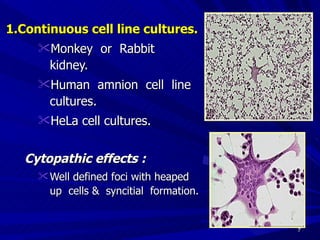
1.Continuous cell line cultures. Monkey  or  Rabbit  kidney. Human  amnion  cell  line cultures. HeLa cell cultures. Cytopathic effects : Well defined foci with heaped up  cells &  syncitial  formation.
2 .Growth on Chick  embryo  CAM   Shiny,  non  necrotic  pocks.
Pathogenesis   Enters ‘thru’  defects in skin  &mucus  membranes. Local  multiplication  Local  LN  involvement. Retrograde  axonal flow  from sensory nerves  …. Reaches Ganglia.   Maintains latency Viral replication in the nerves.   Decreased CMI. Centrifugal  migration to skin & mucus  membranes. Recurrence of the disease. Physical, Emotional stress. Trauma, Fever. Sun light. Trigeminal, Sacral
Primary infection   Vesicle formation (Ballooning degeneration of intra-epithelial cells)   Site  of  eruption  shows Pain, tingling, warmth & itch,  erythema & papule   Thin walled   umbilicated vesicle    roof  breaks down and forms an ulcer. with fever (cold sore or fever blisters). Mucus membrane, non-keratinized  epithelia. Recurrent infections are seen with  severe  pain, ulceration.
Neuroinvasiveness Neurotoxicity Latency in dorsal root ganglion of CNS Damaged epithelium is  repaired  by  Natural  killer cells. Viral glycoproteins initiates the  T-cell  activity which activate  primed B cells   to  produce  antibodies .
1. Mucocutaneous  infections  Cheeks, chin,  forehead. Napkin  rash in infants. Acute gingivostomatitis Around the mouth & on lips. Pre-school children. Majority of primary infections;  Teething   /  oral  thrush. Pathological lesions Herpetic gingivostomatitis Ruptured  lesions
. Herpetic lesions in oral cavity  Dental  anomalies  followed  by Herpes viral infections.
Skin infections   Herpetic whitlow ,   Toddlers, Dentists,  Nurses,  Herpes  gladiatorum  (Wrestlers) Painful, swollen,  grouped vesicles with pus.
Eczema herpeticum     Severe form of Atopic eczema (Kaposi's   varicelliform eruption.)   Extensive ulceration. Eye infections:  Branching/dendritic  corneal ulcer.
Visceral  HSV:   Esophagitis Tracheobronchitis Pneumonitis CNS:  Sporadic, fatal encephalitis (HSV 1). Seizures, Hemi paresis and paraesthesia Congenital infections : Transplacental infection. Congenital  malformations  are rare.
-Symptomatic infections with sores, fever and lymphadenopathy of  genital tract ,  heal within 2-4 weeks.  -Patients may suffer with 4-5 outbreaks (recurrent) within a year.  -Causes psychological distress.  -Infection during late pregnancy poses a greater risk of transmission to the baby.  - Sacral radiculopathy common with urinary retention. HSV- 2  transmitted by   auto infection, sexual /orogenital  contact.  Most infections are asymptomatic.
Genital  herpes Shaft of the Penis Labial herpes Perianal herpes
2.Neonatal  herpes Localized to Skin , eyes,  mouth. Disseminated  infection leads to Multi  organ involvement  (Liver, Adrenals, Brain) Complication:   Neurological impairment. 3.Aseptic meningitis:
1.  Smears   Scrapings from  base of Vesicle  CSF,  Saliva. Serum  - Primary infection.  -ELISA most useful. -CFT. Laboratory diagnosis Microscopy:   Tzanck  smear 1 % Aqu. sol. of Toludine   blue .    Multinucleated giant cells  with  faceted nuclei ,  ground glass chromatin.  (Tzanck cells)  Best  :  Giemsa, Papanicolou  stain
3.Antigen detection :  Fluorescent antibody , ELISA 4.Viral isolation: Cell line culture – growth within 1 -3 days. 5.Molecular techniques:  PCR  and DNA probes. Treatment  :   No cure. Acyclovir :   Primary infection (< 72 hrs).   Reduce the recurrences. Famciclovir:   For resistant cases.
Varicella-Zoster virus  Varicella Mildest childhood exanthemata Source: Patient  Droplet nuclei from Respiratory tract  Inhalation.  Incubation period  7– 23 days  Centripetal distribution. Macule    Papule    Vesicle   Pustule   Scab Vesicular rash  surrounded by a ring (Trunk)   Superficial  “Drop of water”
Hemorrhagic & bullous. Interstetial Pneumonia. Postviral encephalitis. Guillain- Barre syndrome. Recovery  is  spontaneous. Can cross placenta   Neuromuscular  disorders. Appears in crops, Profuse in adults
Lab. Diagnosis :  Same as HSV. Specimens :  Buccal /  Cutaneous lesions Prophylaxis  :   V – Z immunoglobulins.   Live attenuated varicella  vaccine.
Old age  (>60 years). Latent virus in  dorsal root or  cranial nerve  ganglia   Neuritic pain,   Parasthesia   for  weeks / months.  Unilateral, painful eruption in  thoracic region. Commonest sites:   Areas innervated by spinal cord segments D3 – L2 & Trigeminal nerve. Herpes Zoster  (Creeping girdle) Herpes zoster ophthalmicus.
Complications : LMN  Paralysis. Meningo-encephalitis Ramsay Hunt syndrome Facial palsy + eruption on tympanic  membrane & external auditory canal
Cytomegalovirus  (Salivary gland virus)   Infected cells : Cytomegaly  (Owl’s eye appearance) Most of the infections are unapparent. Commonest  cause for  congenital defects . Pathogenesis: Latent infection :  Mononuclear leucocytes (Monocytes,  B -lymphocytes) Secretary glands Kidney. Replication  seen in  ductal epithelial cells. Excretion in body fluids, Milk  & Urine.
Modes of transmission Transplacental.  Sexual contact. Blood and its products. Organ transplantation. Urine,  Saliva,  Cervical secretions, semen, breast milk. Perinatal  &  Postnatal infections:   Infected birth canal,Breast milk.
1 . Transplacental route: Condition severe if infection occurs during first  trimester of pregnancy. Cytomegalic  Inclusion  disease  of  Newborn(10%) c haracterised by varied type of clinical manifestations .   Hepatospleenomegaly Jaundice Thrombocytopenic purpura Haemolytic anaemia Microcephaly Cerebral calcifications. Mental retardation.
IMN  like disease: Young adults. Hepatitis, fever, atypical lymphocytosis. (No pharyngitis, no lymphadenopathy,  Negative  for heterophile antibody) Respiratory tract infections: Pneumonitis in infants. Immunocompromised individuals:   Pneumonia Fatal encephalitis Chorioretinitis
Lab.  Diagnosis: Adults:   Urine, Saliva, BAL,    Semen  &  Cervical secretions. Neonate:  Urine 1.  Microscopy: Centrifuged deposits of secretions. Giemsa stain:   Cytomegalic cells
2.Isolation:   “ Human diploid fibroblast cell”  culture.   Large retractile cells with cytoplasmic      granules. 3.Serology: Anti CMV  IgM  Ab estimation  by  ELISA.  Treatment:   Ganciclovir  &  Foscarnet. Prophylaxis:   Acyclovir.
Epstein – Barr (EB)  Virus   Burkitt's lymphoma in 1964 . Affinity for  B – lymphocytes  (CD 21  receptors.) 80 – 90% of children by  three years of  age. Asymptomatic. Not highly contagious.  Droplets are not infectious. Source  :   Saliva, Oropharyngeal secretions
Pathogenesis  Infected  saliva. Pharyngeal epithelial cells (Multiplies locally).   Persistence     Shed in saliva   Invades blood stream   Infects B. lymphocytes .   Liver  Spleen  Polyclonal activation cell death  .   Unchecked  replication   results  in  Lymphomas Neoantigen formation Atypical  lymphocytosis .
Clinical Diseases Incubation period : 4 – 7 weeks 1.Infectious Mononucleosis (Glandular disease, Kissing disease) Acute self limiting illness. Fever, sore throat. Lymphadenopathy.  Sub clinical Hepatitis, Tender spleenomegaly Abnormal lymphocytes in PS
2.Chronic  fatigue  syndrome. 3.Malignancies  associated  with  EB.   Burkitt’s lymphoma  (Malignant B cell lymphoma of jaw) Nasopharyngeal carcinoma Lymphomas in HIV infected   persons.
Lab diagnosis 1.Blood smear examination : Atypical Lymphocytosis. 2.Paul  -  Bunnel test: Heterophile  antibody  detection test. Inactivated serum  +  1% sheep RBC  suspension     37 0 C    4 hrs       Agglutination (>100) 3. EBV  Specific antibodies:   EBNA  Ab EBNA Ig M VCA, Ig G VCA 4. PCR:  More sensitive.
HHV – 6 Isolated in 1986 from AIDS patient   T - lymphocytotropic (CD+) Transmission through Oral secretions. Roseola infantum (Exanthema subitum) High fever  with generalized rash. Chronic fatigue syndrome .
HHV – 7 Isolated  from AIDS  patient in 1990. No  disease  association. Remains  as  orphan virus. HHV – 8   Kaposi's sarcoma related  herpes virus. In  1994  : Association  with  Kaposi's  sarcoma . (Rare type of “B cell  lymphoma” from  AIDS patients).
Alzheimer's disease atherosclerosis cholangiocarcinoma Crohn's disease chronic fatigue syndrome  fibromyalgia Irritable bowel syndrome  multiple sclerosis pancreatic cancer pityriasis rosea Type II Diabetes Research is currently ongoing into a variety of side-effect or co-conditions related to the herpesviruses.
Prepared for   e -learning   by   Dr .P.SRINIVASULU REDDY ,  M D., Professor, Department of Microbiology Narayana Medical College NELLORE

Herpes viruses

  • 1.
    HERPES VIRIDAEPrevalent as early as ancient Greek times. Hippocrates described the cutaneous spreading of lesions. Shakespeare is thought to have been familiar with these lesions and their transmission and mentioned in his Romeo and Juliet . In 1893 Vidal recognized the human transmission of HSV infection from one individual to another. In 1919, Lowenstein confirmed experimentally the infectious nature of HSV. In 1920's and 1930's, the natural history and range of infections of HSV were studied. By the 1940's and 1950's, research established on diseases caused by HSV .
  • 2.
    The members ofthis family are also known as herpesviruses . Name is derived from the Greek word herpein (&quot;to creep or crawl&quot;). Latent, reactivation , recurring and lytic infections are typical of this group of viruses. Herpesviridae , a large family of DNA viruses that cause diseases in animals and humans.
  • 3.
    Medically important viruses– Three subfamilies. Alpha herpes virinae. Rapid growth, Latent infection in sensory ganglia. HSV – 1, HSV – 2, V – Z Virus. Beta herpes virinae Slow growth. Grow best in Fibroblasts. Latent infection in salivary gland. HHV – 5 ( CMV ) HHV– 6 , HHV – 7
  • 4.
    Gamma herpes virinaeGrow in Lymphoblastoid cells. Latent infection in Lymphoid tissue. HHV – 4 (Epstein – Barr Virus) HHV – 8 ( Kaposi’s sarcoma herpes virus) Neurotropic viruses: HSV,VZV; Lymphotropic viruses: EBV,HHV6,HHV7
  • 5.
    Morphology Enveloped (Lipid) Double stranded DNA Icosahedral capsid “ Tegument” Glycoprotein spikes ( Surface spikes) Naked virus
  • 6.
    Virus replicatesin host cell nucleus. Cowdry type A intranuclear inclusion bodies. Susceptible to Ether Chloroform Bile salts. Heat labile. Replication and susceptibility
  • 7.
    1.Continuous cell linecultures. Monkey or Rabbit kidney. Human amnion cell line cultures. HeLa cell cultures. Cytopathic effects : Well defined foci with heaped up cells & syncitial formation.
  • 8.
    2 .Growth onChick embryo CAM Shiny, non necrotic pocks.
  • 9.
    Pathogenesis Enters ‘thru’ defects in skin &mucus membranes. Local multiplication Local LN involvement. Retrograde axonal flow from sensory nerves …. Reaches Ganglia. Maintains latency Viral replication in the nerves. Decreased CMI. Centrifugal migration to skin & mucus membranes. Recurrence of the disease. Physical, Emotional stress. Trauma, Fever. Sun light. Trigeminal, Sacral
  • 10.
    Primary infection Vesicle formation (Ballooning degeneration of intra-epithelial cells) Site of eruption shows Pain, tingling, warmth & itch, erythema & papule  Thin walled umbilicated vesicle  roof breaks down and forms an ulcer. with fever (cold sore or fever blisters). Mucus membrane, non-keratinized epithelia. Recurrent infections are seen with severe pain, ulceration.
  • 11.
    Neuroinvasiveness Neurotoxicity Latencyin dorsal root ganglion of CNS Damaged epithelium is repaired by Natural killer cells. Viral glycoproteins initiates the T-cell activity which activate primed B cells to produce antibodies .
  • 12.
    1. Mucocutaneous infections Cheeks, chin, forehead. Napkin rash in infants. Acute gingivostomatitis Around the mouth & on lips. Pre-school children. Majority of primary infections; Teething / oral thrush. Pathological lesions Herpetic gingivostomatitis Ruptured lesions
  • 13.
    . Herpetic lesionsin oral cavity Dental anomalies followed by Herpes viral infections.
  • 14.
    Skin infections Herpetic whitlow , Toddlers, Dentists, Nurses, Herpes gladiatorum (Wrestlers) Painful, swollen, grouped vesicles with pus.
  • 15.
    Eczema herpeticum Severe form of Atopic eczema (Kaposi's varicelliform eruption.) Extensive ulceration. Eye infections: Branching/dendritic corneal ulcer.
  • 16.
    Visceral HSV: Esophagitis Tracheobronchitis Pneumonitis CNS: Sporadic, fatal encephalitis (HSV 1). Seizures, Hemi paresis and paraesthesia Congenital infections : Transplacental infection. Congenital malformations are rare.
  • 17.
    -Symptomatic infections withsores, fever and lymphadenopathy of genital tract , heal within 2-4 weeks. -Patients may suffer with 4-5 outbreaks (recurrent) within a year. -Causes psychological distress. -Infection during late pregnancy poses a greater risk of transmission to the baby. - Sacral radiculopathy common with urinary retention. HSV- 2 transmitted by auto infection, sexual /orogenital contact. Most infections are asymptomatic.
  • 18.
    Genital herpesShaft of the Penis Labial herpes Perianal herpes
  • 19.
    2.Neonatal herpesLocalized to Skin , eyes, mouth. Disseminated infection leads to Multi organ involvement (Liver, Adrenals, Brain) Complication: Neurological impairment. 3.Aseptic meningitis:
  • 20.
    1. Smears Scrapings from base of Vesicle CSF, Saliva. Serum - Primary infection. -ELISA most useful. -CFT. Laboratory diagnosis Microscopy: Tzanck smear 1 % Aqu. sol. of Toludine blue . Multinucleated giant cells with faceted nuclei , ground glass chromatin. (Tzanck cells) Best : Giemsa, Papanicolou stain
  • 21.
    3.Antigen detection : Fluorescent antibody , ELISA 4.Viral isolation: Cell line culture – growth within 1 -3 days. 5.Molecular techniques: PCR and DNA probes. Treatment : No cure. Acyclovir : Primary infection (< 72 hrs). Reduce the recurrences. Famciclovir: For resistant cases.
  • 22.
    Varicella-Zoster virus Varicella Mildest childhood exanthemata Source: Patient Droplet nuclei from Respiratory tract Inhalation. Incubation period 7– 23 days Centripetal distribution. Macule  Papule  Vesicle  Pustule  Scab Vesicular rash surrounded by a ring (Trunk) Superficial “Drop of water”
  • 23.
    Hemorrhagic & bullous.Interstetial Pneumonia. Postviral encephalitis. Guillain- Barre syndrome. Recovery is spontaneous. Can cross placenta  Neuromuscular disorders. Appears in crops, Profuse in adults
  • 24.
    Lab. Diagnosis : Same as HSV. Specimens : Buccal / Cutaneous lesions Prophylaxis : V – Z immunoglobulins. Live attenuated varicella vaccine.
  • 25.
    Old age (>60 years). Latent virus in dorsal root or cranial nerve ganglia Neuritic pain, Parasthesia for weeks / months. Unilateral, painful eruption in thoracic region. Commonest sites: Areas innervated by spinal cord segments D3 – L2 & Trigeminal nerve. Herpes Zoster (Creeping girdle) Herpes zoster ophthalmicus.
  • 26.
    Complications : LMN Paralysis. Meningo-encephalitis Ramsay Hunt syndrome Facial palsy + eruption on tympanic membrane & external auditory canal
  • 27.
    Cytomegalovirus (Salivarygland virus) Infected cells : Cytomegaly (Owl’s eye appearance) Most of the infections are unapparent. Commonest cause for congenital defects . Pathogenesis: Latent infection : Mononuclear leucocytes (Monocytes, B -lymphocytes) Secretary glands Kidney. Replication seen in ductal epithelial cells. Excretion in body fluids, Milk & Urine.
  • 28.
    Modes of transmissionTransplacental. Sexual contact. Blood and its products. Organ transplantation. Urine, Saliva, Cervical secretions, semen, breast milk. Perinatal & Postnatal infections: Infected birth canal,Breast milk.
  • 29.
    1 . Transplacentalroute: Condition severe if infection occurs during first trimester of pregnancy. Cytomegalic Inclusion disease of Newborn(10%) c haracterised by varied type of clinical manifestations . Hepatospleenomegaly Jaundice Thrombocytopenic purpura Haemolytic anaemia Microcephaly Cerebral calcifications. Mental retardation.
  • 30.
    IMN likedisease: Young adults. Hepatitis, fever, atypical lymphocytosis. (No pharyngitis, no lymphadenopathy, Negative for heterophile antibody) Respiratory tract infections: Pneumonitis in infants. Immunocompromised individuals: Pneumonia Fatal encephalitis Chorioretinitis
  • 31.
    Lab. Diagnosis:Adults: Urine, Saliva, BAL, Semen & Cervical secretions. Neonate: Urine 1. Microscopy: Centrifuged deposits of secretions. Giemsa stain: Cytomegalic cells
  • 32.
    2.Isolation: “ Human diploid fibroblast cell” culture. Large retractile cells with cytoplasmic granules. 3.Serology: Anti CMV IgM Ab estimation by ELISA. Treatment: Ganciclovir & Foscarnet. Prophylaxis: Acyclovir.
  • 33.
    Epstein – Barr(EB) Virus Burkitt's lymphoma in 1964 . Affinity for B – lymphocytes (CD 21 receptors.) 80 – 90% of children by three years of age. Asymptomatic. Not highly contagious. Droplets are not infectious. Source : Saliva, Oropharyngeal secretions
  • 34.
    Pathogenesis Infected saliva. Pharyngeal epithelial cells (Multiplies locally). Persistence Shed in saliva Invades blood stream Infects B. lymphocytes . Liver Spleen Polyclonal activation cell death . Unchecked replication results in Lymphomas Neoantigen formation Atypical lymphocytosis .
  • 35.
    Clinical Diseases Incubationperiod : 4 – 7 weeks 1.Infectious Mononucleosis (Glandular disease, Kissing disease) Acute self limiting illness. Fever, sore throat. Lymphadenopathy. Sub clinical Hepatitis, Tender spleenomegaly Abnormal lymphocytes in PS
  • 36.
    2.Chronic fatigue syndrome. 3.Malignancies associated with EB. Burkitt’s lymphoma (Malignant B cell lymphoma of jaw) Nasopharyngeal carcinoma Lymphomas in HIV infected persons.
  • 37.
    Lab diagnosis 1.Bloodsmear examination : Atypical Lymphocytosis. 2.Paul - Bunnel test: Heterophile antibody detection test. Inactivated serum + 1% sheep RBC suspension  37 0 C  4 hrs  Agglutination (>100) 3. EBV Specific antibodies: EBNA Ab EBNA Ig M VCA, Ig G VCA 4. PCR: More sensitive.
  • 38.
    HHV – 6Isolated in 1986 from AIDS patient T - lymphocytotropic (CD+) Transmission through Oral secretions. Roseola infantum (Exanthema subitum) High fever with generalized rash. Chronic fatigue syndrome .
  • 39.
    HHV – 7Isolated from AIDS patient in 1990. No disease association. Remains as orphan virus. HHV – 8 Kaposi's sarcoma related herpes virus. In 1994 : Association with Kaposi's sarcoma . (Rare type of “B cell lymphoma” from AIDS patients).
  • 40.
    Alzheimer's disease atherosclerosischolangiocarcinoma Crohn's disease chronic fatigue syndrome fibromyalgia Irritable bowel syndrome multiple sclerosis pancreatic cancer pityriasis rosea Type II Diabetes Research is currently ongoing into a variety of side-effect or co-conditions related to the herpesviruses.
  • 41.
    Prepared for e -learning by Dr .P.SRINIVASULU REDDY , M D., Professor, Department of Microbiology Narayana Medical College NELLORE