HEPARINE INDUCED
THROMBOCYTOPENIA
HIT
SAMIR EL ANSARY
ICU PROFESSOR
AIN SHAMS
CAIRO
elansarysamir@yahoo.com
https://www.facebook.com/groups/14516101151295
55/#!/groups/1451610115129555/
Wellcome in our new group ..... Dr.SAMIR EL ANSARY
No click
HEPARIN-INDUCED
THROMBOCYTOPENIA
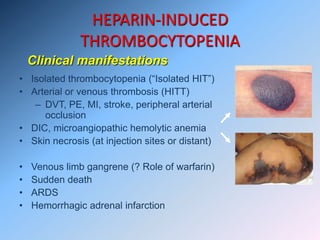
• Isolated thrombocytopenia (“Isolated HIT”)
• Arterial or venous thrombosis (HITT)
– DVT, PE, MI, stroke, peripheral arterial
occlusion
• DIC, microangiopathic hemolytic anemia
• Skin necrosis (at injection sites or distant)
• Venous limb gangrene (? Role of warfarin)
• Sudden death
• ARDS
• Hemorrhagic adrenal infarction
Clinical manifestations
Three Characteristic Features of HIT vs
“thrombocytopenia” (NOS)
• Timing: Platelet count decreases
beginning 5-14 days after the start of
heparin treatment
• Severity of thrombocytopenia: it’s usually
mild to moderate
• Large vessel venous or arterial thrombosis
in association with thrombocytopenia
HEPARIN-INDUCED
THROMBOCYTOPENIA
• Unfractionated heparin (UFH) (beef >
pork)
– Continuous intravenous infusion
– Cardiopulmonary bypass
– Low dose subcutaneous
– Heparin flushes
– Heparin-bonded catheters
• Low molecular weight heparin (LMWH)
– More likely to cause HIT if pt previously
exposed to UFH
Causative agents
HEPARIN-INDUCED
THROMBOCYTOPENIA
• UFH > LMWH >> Fondaparinux
• Duration of heparin treatment ≥ 6 days
• Rarely occurs in patients < 40 years old
• 2-3 fold higher incidence in women
• Surgical > medical > obstetric patients
• Incidence in trauma patients proportional to
severity of trauma
– Related to degree of platelet activation?
Epidemiology
PATHOPHYSIOLOGY
OF HIT
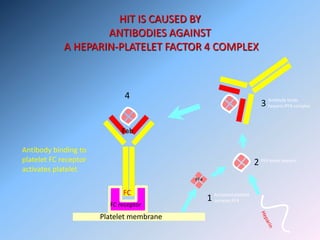
HIT IS CAUSED BY
ANTIBODIES AGAINST
A HEPARIN-PLATELET FACTOR 4 COMPLEX
Platelet membrane
FC receptor
Fab
FC
Antibody binding to
platelet FC receptor
activates platelet
4
1
PF4
Activated platelet
secretes PF4
2 PF4 binds heparin
3 Antibody binds
heparin-PF4 complex
Heparin-induced thrombocytopenia:
Platelet factor 4 (PF4) released by activated
platelet. This binds heparin, creating a potential
neoantigen.
Antibody binds the complex of heparin-PF4. The
antigen antibody complex then binds to the FC
receptor on another platelet, causing platelet
activation.
This may account for the association between HIT
and thrombosis in some patients.
PATHOPHYSIOLOGY OF HIT
• Heparin-PF4 complexes stimulate antibody
production
• Ag-Ab complex binds to and activates platelets,
monocytes
Size of immune complex is critical, varies
with PF4 and heparin concentrations
Inhibited by high heparin concentrations
• may cross-react with PF4 bound to endothelial
cell heparan sulfate → vessel wall injury
PATHOPHYSIOLOGY OF HIT
• Some HIT antibodies can activate
platelets in the absence of heparin
• Activated platelets release
procoagulant microparticles
• Activated monocytes produce
tissue factor Antibodies
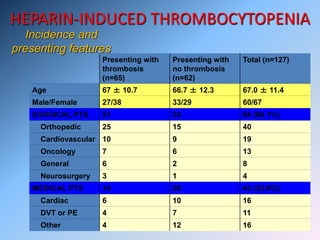
HEPARIN-INDUCED THROMBOCYTOPENIA
Presenting with
thrombosis
(n=65)
Presenting with
no thrombosis
(n=62)
Total (n=127)
Age 67 ± 10.7 66.7 ± 12.3 67.0 ± 11.4
Male/Female 27/38 33/29 60/67
SURGICAL PTS 51 33 84 (66.1%)
Orthopedic 25 15 40
Cardiovascular 10 9 19
Oncology 7 6 13
General 6 2 8
Neurosurgery 3 1 4
MEDICAL PTS 14 29 43 (33.9%)
Cardiac 6 10 16
DVT or PE 4 7 11
Other 4 12 16
Incidence and
presenting features
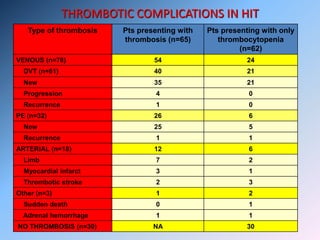
THROMBOTIC COMPLICATIONS IN HIT
Type of thrombosis Pts presenting with
thrombosis (n=65)
Pts presenting with only
thrombocytopenia
(n=62)
VENOUS (n=78) 54 24
DVT (n=61) 40 21
New 35 21
Progression 4 0
Recurrence 1 0
PE (n=32) 26 6
New 25 5
Recurrence 1 1
ARTERIAL (n=18) 12 6
Limb 7 2
Myocardial infarct 3 1
Thrombotic stroke 2 3
Other (n=3) 1 2
Sudden death 0 1
Adrenal hemorrhage 1 1
NO THROMBOSIS (n=30) NA 30
ISOLATED HIT IS ASSOCIATED WITH A HIGH RISK OF
SUBSEQUENT THROMBOSIS
 Over 50% of patients presenting with “isolated HIT”
had a subsequent thrombotic episode within 30
days
 Substitution of warfarin for heparin after the
onset of thrombocytopenia did not prevent
thrombosis
UNFRACTIONATED HEPARIN IS MORE LIKELY TO CAUSE
HIT THAN LMWH
THE FREQUENCY OF THROMBOSIS AFTER HIP SURGERY IS
MUCH HIGHER IN PATIENTS WITH HIT THAN IN THOSE
WITHOUT HIT
Development of HIT antibodies is
more common in major surgery
than minor surgery, and more
common with UFH than LMWH
*
**
* **
**
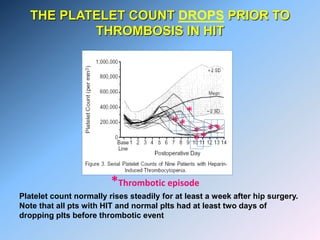
THE PLATELET COUNT DROPS PRIOR TO
THROMBOSIS IN HIT
*Thrombotic episode
Platelet count normally rises steadily for at least a week after hip surgery.
Note that all pts with HIT and normal plts had at least two days of
dropping plts before thrombotic event
Recent heparin exposure may cause
“rapid onset” HIT
HIT virtually never happens less
than 4 days after starting heparin
UNLESS there has been prior
exposure to heparin
Rapid-onset HIT is associated with
re-exposure to heparin within 90 days
Heparin-dependent antibodies
usually disappear within 90 days
an episode of HIT
We have said that HIT can occur without
thrombocytopenia.
It can also occur when a patient is no longer
getting heparin.
This is a particularly difficult form of HIT to
diagnose, and the consequences of not
diagnosing it can be dire
DELAYED ONSET HIT
• Some studies describes patients treated with heparin,
discharged, and later re-hospitalized with
thromboembolism and positive tests for HIT antibodies
• Most patients got heparin during cardiac surgery
• Some had mild thrombocytopenia (66-145K) at time of
thrombotic episode
• Median time between discharge and readmission 14
days, maximum 40 days
 Some patients re-treated with heparin: all had clinical
deterioration and worsening thrombocytopenia
Heparin concentration affects the size and charge of
heparin:PF4 complexes
and their ability to activate platelets
Low heparin:PF4 ratio → small complexes
High heparin:PF4 ratio → small complexes
1:1 heparin:PF4 → large complexes
Chargeofcomplexes
Heparin conc→
Clinical factors may help determine the
likelihood of developing HIT
• Healthy volunteers given heparin or LMWH
make IgM antibodies to heparin/PF4
• Pathologic HIT antibodies are usually IgG
• Concomitant immune stimulus necessary to
promote IgG HIT antibody formation?
• Higher PF4 levels after surgery or acute illness
may promote formation of larger immune
complexes
DIAGNOSIS OF HIT
DISTINGUISHING IMMUNE FROM NON-IMMUNE
HEPARIN INDUCED THROMBOCYTOPENIA
• Many patients have a transient decrease in
platelets within 24 hours of receiving
heparin.
• This is not an antibody-mediated effect and
not associated with thrombosis
• How can it be distinguished from HIT?
1. By the time course
2. By the clinical picture
3. By serology and other lab tests
• Median platelet nadir 55K
• 15% had nadir >150K (diagnosed because
platelet count fell more than 50% or because
of clinical events)
• The severity of thrombocytopenia did not
predict thrombotic events
Severe thrombocytopenia
is rare in HIT
15% are not thrombocytopenic at all. Rarely does plt count drop below 20K
No connection between severity of thrombocytopenia and clinical course
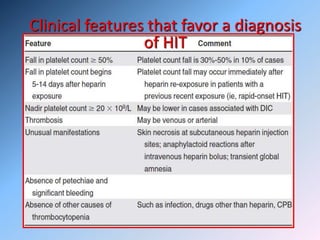
Clinical features that favor a diagnosis
of HIT
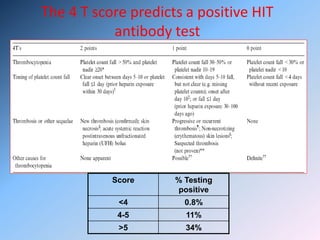
The 4 T score predicts a positive HIT
antibody test
Score % Testing
positive
<4 0.8%
4-5 11%
>5 34%
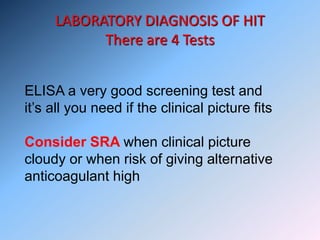
LABORATORY DIAGNOSIS OF HIT
There are 4 Tests
1. Serotonin release assay (SRA)
2. Heparin-induced platelet aggregation assay (HIPA)
3. Solid phase imunoassay (H-PF4) (Enzyme linked
immunosorbant assay [ELISA])
4. Particle gel immunoassay
HIPA: highly specific but less sensitive than SRA
SRA: Largely restricted to centers studying HIT
C-14-SRA is the “gold standard” assay with sensitivity
and specificity of 90 and nearly 100%, respectively
LABORATORY DIAGNOSIS OF HIT
There are 4 Tests
ELISA a very good screening test and
it’s all you need if the clinical picture fits
Consider SRA when clinical picture
cloudy or when risk of giving alternative
anticoagulant high
TREATMENT
OF HIT
TREATMENT OF HIT
• Discontinue all heparin, including flushes
• LMWH may cross-react with HIT antibodies,
should not be used
• If thrombosis present: give
alternative thrombin inhibitor
• Consider treating even if thrombosis absent
(high risk of thrombosis in patients with
isolated HIT)
TREATMENT OF HIT
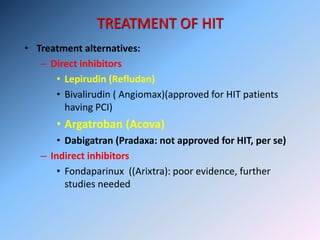
• Treatment alternatives:
– Direct inhibitors
• Lepirudin (Refludan)
• Bivalirudin ( Angiomax)(approved for HIT patients
having PCI)
• Argatroban (Acova)
• Dabigatran (Pradaxa: not approved for HIT, per se)
– Indirect inhibitors
• Fondaparinux ((Arixtra): poor evidence, further
studies needed
Do not give
Warfarin
(risk of venous gangrene)
DIRECT THROMBIN INHIBITORS
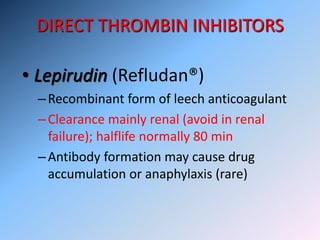
• Lepirudin (Refludan®)
–Recombinant form of leech anticoagulant
–Clearance mainly renal (avoid in renal
failure); halflife normally 80 min
–Antibody formation may cause drug
accumulation or anaphylaxis (rare)
DIRECT THROMBIN INHIBITORS
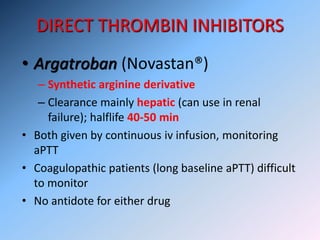
• Argatroban (Novastan®)
– Synthetic arginine derivative
– Clearance mainly hepatic (can use in renal
failure); halflife 40-50 min
• Both given by continuous iv infusion, monitoring
aPTT
• Coagulopathic patients (long baseline aPTT) difficult
to monitor
• No antidote for either drug
LEPIRUDIN IN HIT
ACCP RECOMMENDATIONS
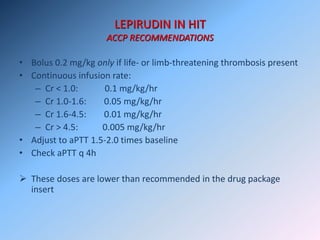
• Bolus 0.2 mg/kg only if life- or limb-threatening thrombosis present
• Continuous infusion rate:
– Cr < 1.0: 0.1 mg/kg/hr
– Cr 1.0-1.6: 0.05 mg/kg/hr
– Cr 1.6-4.5: 0.01 mg/kg/hr
– Cr > 4.5: 0.005 mg/kg/hr
• Adjust to aPTT 1.5-2.0 times baseline
• Check aPTT q 4h
 These doses are lower than recommended in the drug package
insert
ARGATROBAN IN HIT
ACCP RECOMMENDATIONS
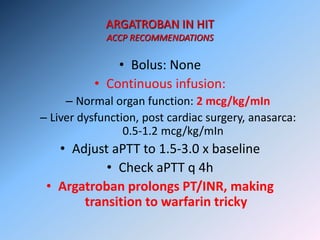
• Bolus: None
• Continuous infusion:
– Normal organ function: 2 mcg/kg/mIn
– Liver dysfunction, post cardiac surgery, anasarca:
0.5-1.2 mcg/kg/mIn
• Adjust aPTT to 1.5-3.0 x baseline
• Check aPTT q 4h
• Argatroban prolongs PT/INR, making
transition to warfarin tricky
FONDAPARINUX (Arixtra®)
• Synthetic polysaccharide, inhibits factor Xa
preferentially
• Does not typically cross-react with HIT
antibodies
• Long half-life (17-20 h), no antidote
• SQ administration
• Monitoring unnecessary
• Not FDA-approved for HIT treatment
FONDAPARINUX DOSING
• Weight based:
< 50 kg: 5 mg sc daily
50-100 kg: 7.5 mg sc daily
> 100 kg: 10 mg sc daily
• Prophylactic dose: 2.5 mg sc daily
• With renal insufficiency:
CrCl 30-50 ml/min: use caution
CrCl < 30: do not use
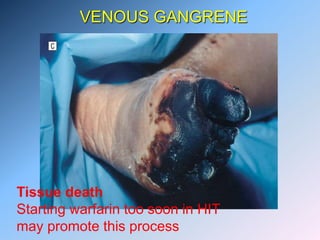
VENOUS GANGRENE
Tissue death
Starting warfarin too soon in HIT
may promote this process
WARFARIN MAY PROMOTE
VENOUS GANGRENE IN HIT
Retrospective study in which all of the HIT
patients who developed VG VENOUS
GANGRENE had been treated with
WARFARIN
Long INR not protective
Biochemical evidence that warfarin’s effect
on protein C levels may mediate this effect
WARFARIN MAY
PROMOTE VENOUS GANGRENE IN HIT
Conclusion: warfarin treatment of
DVT associated with HIT may cause
venous limb gangrene, possibly
because of acquired defect in protein
C pathway
Do not start warfarin treatment
until HIT resolves (platelet count
returns to normal)
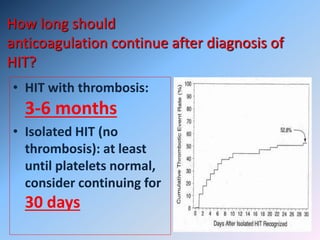
How long should
anticoagulation continue after diagnosis of
HIT?
• HIT with thrombosis:
3-6 months
• Isolated HIT (no
thrombosis): at least
until platelets normal,
consider continuing for
30 days
Can patients with a history of HIT
be given heparin again?
• Heparin should not be given while tests
for heparin antibodies remain positive
– If cardiac surgery cannot be delayed, use
alternative anticoagulant (e.g., bivalirudin)
Can patients with a history of HIT
be given heparin again?
• HIT recurrence or secondary antibody
response uncommon in patients with
“remote HIT” and negative HIT antibody
test
Heparin administration should be
limited to the intraoperative
period
• CONCLUSION
• HIT typically occurs after 5+ days of
exposure to unfractionated heparin
• Suspect HIT if platelet count falls by >
50% during heparin administration, or if
new thrombotic event occurs within 2-3
weeks of heparin exposure
• Onset may be earlier if there was prior
exposure to heparin within past 100
days
• CONCLUSION
• Onset may follow discontinuation of
heparin
• LMWH rarely causes HIT but may
perpetuate it
• Risk of thrombosis in HIT is high even if
patient does not have thrombosis at
time of diagnosis
• CONCLUSION
• HIT is caused by production of antibodies to
heparin-PF4 complex that activate platelets
• HIT is unlikely if tests for heparin-PF4
antibodies are negative
• Patients with HIT should generally be treated
with a thrombin or Xa inhibitor other than
heparin or LMWH
• Warfarin treatment should be delayed until
platelet count is normal
https://www.facebook.com/groups/14516101151295
55/#!/groups/1451610115129555/
Wellcome in our new group ..... Dr.SAMIR EL ANSARY
No click
GOOD LUCK
SAMIR EL ANSARY
ICU PROFESSOR
AIN SHAMS
CAIRO
elansarysamir@yahoo.com

Heparine induced thrombocytopenia

  • 1.
    HEPARINE INDUCED THROMBOCYTOPENIA HIT SAMIR ELANSARY ICU PROFESSOR AIN SHAMS CAIRO elansarysamir@yahoo.com
  • 2.
  • 3.
    HEPARIN-INDUCED THROMBOCYTOPENIA • Isolated thrombocytopenia(“Isolated HIT”) • Arterial or venous thrombosis (HITT) – DVT, PE, MI, stroke, peripheral arterial occlusion • DIC, microangiopathic hemolytic anemia • Skin necrosis (at injection sites or distant) • Venous limb gangrene (? Role of warfarin) • Sudden death • ARDS • Hemorrhagic adrenal infarction Clinical manifestations
  • 4.
    Three Characteristic Featuresof HIT vs “thrombocytopenia” (NOS) • Timing: Platelet count decreases beginning 5-14 days after the start of heparin treatment • Severity of thrombocytopenia: it’s usually mild to moderate • Large vessel venous or arterial thrombosis in association with thrombocytopenia
  • 5.
    HEPARIN-INDUCED THROMBOCYTOPENIA • Unfractionated heparin(UFH) (beef > pork) – Continuous intravenous infusion – Cardiopulmonary bypass – Low dose subcutaneous – Heparin flushes – Heparin-bonded catheters • Low molecular weight heparin (LMWH) – More likely to cause HIT if pt previously exposed to UFH Causative agents
  • 6.
    HEPARIN-INDUCED THROMBOCYTOPENIA • UFH >LMWH >> Fondaparinux • Duration of heparin treatment ≥ 6 days • Rarely occurs in patients < 40 years old • 2-3 fold higher incidence in women • Surgical > medical > obstetric patients • Incidence in trauma patients proportional to severity of trauma – Related to degree of platelet activation? Epidemiology
  • 7.
  • 8.
    HIT IS CAUSEDBY ANTIBODIES AGAINST A HEPARIN-PLATELET FACTOR 4 COMPLEX Platelet membrane FC receptor Fab FC Antibody binding to platelet FC receptor activates platelet 4 1 PF4 Activated platelet secretes PF4 2 PF4 binds heparin 3 Antibody binds heparin-PF4 complex
  • 9.
    Heparin-induced thrombocytopenia: Platelet factor4 (PF4) released by activated platelet. This binds heparin, creating a potential neoantigen. Antibody binds the complex of heparin-PF4. The antigen antibody complex then binds to the FC receptor on another platelet, causing platelet activation. This may account for the association between HIT and thrombosis in some patients.
  • 10.
    PATHOPHYSIOLOGY OF HIT •Heparin-PF4 complexes stimulate antibody production • Ag-Ab complex binds to and activates platelets, monocytes Size of immune complex is critical, varies with PF4 and heparin concentrations Inhibited by high heparin concentrations • may cross-react with PF4 bound to endothelial cell heparan sulfate → vessel wall injury
  • 11.
    PATHOPHYSIOLOGY OF HIT •Some HIT antibodies can activate platelets in the absence of heparin • Activated platelets release procoagulant microparticles • Activated monocytes produce tissue factor Antibodies
  • 12.
    HEPARIN-INDUCED THROMBOCYTOPENIA Presenting with thrombosis (n=65) Presentingwith no thrombosis (n=62) Total (n=127) Age 67 ± 10.7 66.7 ± 12.3 67.0 ± 11.4 Male/Female 27/38 33/29 60/67 SURGICAL PTS 51 33 84 (66.1%) Orthopedic 25 15 40 Cardiovascular 10 9 19 Oncology 7 6 13 General 6 2 8 Neurosurgery 3 1 4 MEDICAL PTS 14 29 43 (33.9%) Cardiac 6 10 16 DVT or PE 4 7 11 Other 4 12 16 Incidence and presenting features
  • 13.
    THROMBOTIC COMPLICATIONS INHIT Type of thrombosis Pts presenting with thrombosis (n=65) Pts presenting with only thrombocytopenia (n=62) VENOUS (n=78) 54 24 DVT (n=61) 40 21 New 35 21 Progression 4 0 Recurrence 1 0 PE (n=32) 26 6 New 25 5 Recurrence 1 1 ARTERIAL (n=18) 12 6 Limb 7 2 Myocardial infarct 3 1 Thrombotic stroke 2 3 Other (n=3) 1 2 Sudden death 0 1 Adrenal hemorrhage 1 1 NO THROMBOSIS (n=30) NA 30
  • 14.
    ISOLATED HIT ISASSOCIATED WITH A HIGH RISK OF SUBSEQUENT THROMBOSIS  Over 50% of patients presenting with “isolated HIT” had a subsequent thrombotic episode within 30 days  Substitution of warfarin for heparin after the onset of thrombocytopenia did not prevent thrombosis UNFRACTIONATED HEPARIN IS MORE LIKELY TO CAUSE HIT THAN LMWH THE FREQUENCY OF THROMBOSIS AFTER HIP SURGERY IS MUCH HIGHER IN PATIENTS WITH HIT THAN IN THOSE WITHOUT HIT
  • 15.
    Development of HITantibodies is more common in major surgery than minor surgery, and more common with UFH than LMWH
  • 16.
    * ** * ** ** THE PLATELETCOUNT DROPS PRIOR TO THROMBOSIS IN HIT *Thrombotic episode Platelet count normally rises steadily for at least a week after hip surgery. Note that all pts with HIT and normal plts had at least two days of dropping plts before thrombotic event
  • 17.
    Recent heparin exposuremay cause “rapid onset” HIT HIT virtually never happens less than 4 days after starting heparin UNLESS there has been prior exposure to heparin Rapid-onset HIT is associated with re-exposure to heparin within 90 days
  • 18.
    Heparin-dependent antibodies usually disappearwithin 90 days an episode of HIT We have said that HIT can occur without thrombocytopenia. It can also occur when a patient is no longer getting heparin. This is a particularly difficult form of HIT to diagnose, and the consequences of not diagnosing it can be dire
  • 19.
    DELAYED ONSET HIT •Some studies describes patients treated with heparin, discharged, and later re-hospitalized with thromboembolism and positive tests for HIT antibodies • Most patients got heparin during cardiac surgery • Some had mild thrombocytopenia (66-145K) at time of thrombotic episode • Median time between discharge and readmission 14 days, maximum 40 days  Some patients re-treated with heparin: all had clinical deterioration and worsening thrombocytopenia
  • 20.
    Heparin concentration affectsthe size and charge of heparin:PF4 complexes and their ability to activate platelets Low heparin:PF4 ratio → small complexes High heparin:PF4 ratio → small complexes 1:1 heparin:PF4 → large complexes Chargeofcomplexes Heparin conc→
  • 21.
    Clinical factors mayhelp determine the likelihood of developing HIT • Healthy volunteers given heparin or LMWH make IgM antibodies to heparin/PF4 • Pathologic HIT antibodies are usually IgG • Concomitant immune stimulus necessary to promote IgG HIT antibody formation? • Higher PF4 levels after surgery or acute illness may promote formation of larger immune complexes
  • 22.
  • 23.
    DISTINGUISHING IMMUNE FROMNON-IMMUNE HEPARIN INDUCED THROMBOCYTOPENIA • Many patients have a transient decrease in platelets within 24 hours of receiving heparin. • This is not an antibody-mediated effect and not associated with thrombosis • How can it be distinguished from HIT? 1. By the time course 2. By the clinical picture 3. By serology and other lab tests
  • 24.
    • Median plateletnadir 55K • 15% had nadir >150K (diagnosed because platelet count fell more than 50% or because of clinical events) • The severity of thrombocytopenia did not predict thrombotic events Severe thrombocytopenia is rare in HIT 15% are not thrombocytopenic at all. Rarely does plt count drop below 20K No connection between severity of thrombocytopenia and clinical course
  • 25.
    Clinical features thatfavor a diagnosis of HIT
  • 26.
    The 4 Tscore predicts a positive HIT antibody test Score % Testing positive <4 0.8% 4-5 11% >5 34%
  • 27.
    LABORATORY DIAGNOSIS OFHIT There are 4 Tests 1. Serotonin release assay (SRA) 2. Heparin-induced platelet aggregation assay (HIPA) 3. Solid phase imunoassay (H-PF4) (Enzyme linked immunosorbant assay [ELISA]) 4. Particle gel immunoassay HIPA: highly specific but less sensitive than SRA SRA: Largely restricted to centers studying HIT C-14-SRA is the “gold standard” assay with sensitivity and specificity of 90 and nearly 100%, respectively
  • 28.
    LABORATORY DIAGNOSIS OFHIT There are 4 Tests ELISA a very good screening test and it’s all you need if the clinical picture fits Consider SRA when clinical picture cloudy or when risk of giving alternative anticoagulant high
  • 29.
  • 30.
    TREATMENT OF HIT •Discontinue all heparin, including flushes • LMWH may cross-react with HIT antibodies, should not be used • If thrombosis present: give alternative thrombin inhibitor • Consider treating even if thrombosis absent (high risk of thrombosis in patients with isolated HIT)
  • 31.
    TREATMENT OF HIT •Treatment alternatives: – Direct inhibitors • Lepirudin (Refludan) • Bivalirudin ( Angiomax)(approved for HIT patients having PCI) • Argatroban (Acova) • Dabigatran (Pradaxa: not approved for HIT, per se) – Indirect inhibitors • Fondaparinux ((Arixtra): poor evidence, further studies needed
  • 32.
    Do not give Warfarin (riskof venous gangrene)
  • 33.
    DIRECT THROMBIN INHIBITORS •Lepirudin (Refludan®) –Recombinant form of leech anticoagulant –Clearance mainly renal (avoid in renal failure); halflife normally 80 min –Antibody formation may cause drug accumulation or anaphylaxis (rare)
  • 34.
    DIRECT THROMBIN INHIBITORS •Argatroban (Novastan®) – Synthetic arginine derivative – Clearance mainly hepatic (can use in renal failure); halflife 40-50 min • Both given by continuous iv infusion, monitoring aPTT • Coagulopathic patients (long baseline aPTT) difficult to monitor • No antidote for either drug
  • 35.
    LEPIRUDIN IN HIT ACCPRECOMMENDATIONS • Bolus 0.2 mg/kg only if life- or limb-threatening thrombosis present • Continuous infusion rate: – Cr < 1.0: 0.1 mg/kg/hr – Cr 1.0-1.6: 0.05 mg/kg/hr – Cr 1.6-4.5: 0.01 mg/kg/hr – Cr > 4.5: 0.005 mg/kg/hr • Adjust to aPTT 1.5-2.0 times baseline • Check aPTT q 4h  These doses are lower than recommended in the drug package insert
  • 36.
    ARGATROBAN IN HIT ACCPRECOMMENDATIONS • Bolus: None • Continuous infusion: – Normal organ function: 2 mcg/kg/mIn – Liver dysfunction, post cardiac surgery, anasarca: 0.5-1.2 mcg/kg/mIn • Adjust aPTT to 1.5-3.0 x baseline • Check aPTT q 4h • Argatroban prolongs PT/INR, making transition to warfarin tricky
  • 37.
    FONDAPARINUX (Arixtra®) • Syntheticpolysaccharide, inhibits factor Xa preferentially • Does not typically cross-react with HIT antibodies • Long half-life (17-20 h), no antidote • SQ administration • Monitoring unnecessary • Not FDA-approved for HIT treatment
  • 38.
    FONDAPARINUX DOSING • Weightbased: < 50 kg: 5 mg sc daily 50-100 kg: 7.5 mg sc daily > 100 kg: 10 mg sc daily • Prophylactic dose: 2.5 mg sc daily • With renal insufficiency: CrCl 30-50 ml/min: use caution CrCl < 30: do not use
  • 39.
    VENOUS GANGRENE Tissue death Startingwarfarin too soon in HIT may promote this process
  • 40.
    WARFARIN MAY PROMOTE VENOUSGANGRENE IN HIT Retrospective study in which all of the HIT patients who developed VG VENOUS GANGRENE had been treated with WARFARIN Long INR not protective Biochemical evidence that warfarin’s effect on protein C levels may mediate this effect
  • 41.
    WARFARIN MAY PROMOTE VENOUSGANGRENE IN HIT Conclusion: warfarin treatment of DVT associated with HIT may cause venous limb gangrene, possibly because of acquired defect in protein C pathway Do not start warfarin treatment until HIT resolves (platelet count returns to normal)
  • 42.
    How long should anticoagulationcontinue after diagnosis of HIT? • HIT with thrombosis: 3-6 months • Isolated HIT (no thrombosis): at least until platelets normal, consider continuing for 30 days
  • 43.
    Can patients witha history of HIT be given heparin again? • Heparin should not be given while tests for heparin antibodies remain positive – If cardiac surgery cannot be delayed, use alternative anticoagulant (e.g., bivalirudin)
  • 44.
    Can patients witha history of HIT be given heparin again? • HIT recurrence or secondary antibody response uncommon in patients with “remote HIT” and negative HIT antibody test Heparin administration should be limited to the intraoperative period
  • 45.
    • CONCLUSION • HITtypically occurs after 5+ days of exposure to unfractionated heparin • Suspect HIT if platelet count falls by > 50% during heparin administration, or if new thrombotic event occurs within 2-3 weeks of heparin exposure • Onset may be earlier if there was prior exposure to heparin within past 100 days
  • 46.
    • CONCLUSION • Onsetmay follow discontinuation of heparin • LMWH rarely causes HIT but may perpetuate it • Risk of thrombosis in HIT is high even if patient does not have thrombosis at time of diagnosis
  • 47.
    • CONCLUSION • HITis caused by production of antibodies to heparin-PF4 complex that activate platelets • HIT is unlikely if tests for heparin-PF4 antibodies are negative • Patients with HIT should generally be treated with a thrombin or Xa inhibitor other than heparin or LMWH • Warfarin treatment should be delayed until platelet count is normal
  • 48.
  • 49.
    GOOD LUCK SAMIR ELANSARY ICU PROFESSOR AIN SHAMS CAIRO elansarysamir@yahoo.com