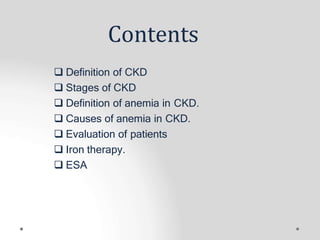
Contents
 Definition of CKD
 Stages of CKD
 Definition of anemia in CKD.
 Causes of anemia in CKD.
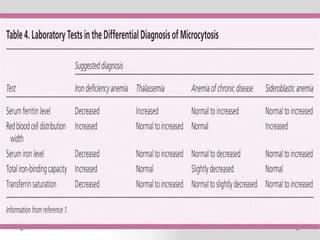
 Evaluation of patients
 Iron therapy.
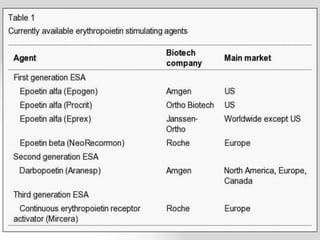
 ESA
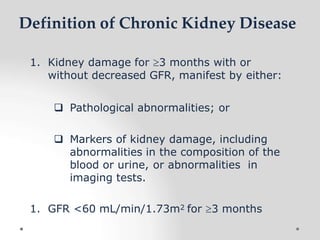
Definition of Chronic Kidney Disease
1. Kidney damage for 3 months with or
without decreased GFR, manifest by either:
 Pathological abnormalities; or
 Markers of kidney damage, including
abnormalities in the composition of the
blood or urine, or abnormalities in
imaging tests.
1. GFR <60 mL/min/1.73m2 for 3 months
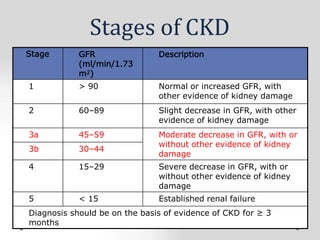
Stages of CKD
Stage GFR
(ml/min/1.73
m2)
Description
1 > 90 Normal or increased GFR, with
other evidence of kidney damage
2 60–89 Slight decrease in GFR, with other
evidence of kidney damage
3a 45–59 Moderate decrease in GFR, with or
without other evidence of kidney
damage
3b 30–44
4 15–29 Severe decrease in GFR, with or
without other evidence of kidney
damage
5 < 15 Established renal failure
Diagnosis should be on the basis of evidence of CKD for ≥ 3
months
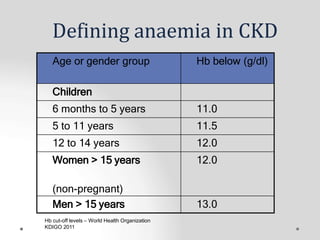
Defining anaemia in CKD
Age or gender group Hb below (g/dl)
Children
6 months to 5 years 11.0
5 to 11 years 11.5
12 to 14 years 12.0
Women > 15 years
(non-pregnant)
12.0
Men > 15 years 13.0
Hb cut-off levels – World Health Organization
KDIGO 2011
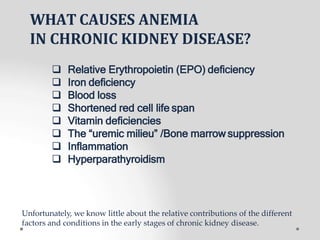
WHAT CAUSES ANEMIA
IN CHRONIC KIDNEY DISEASE?
 Relative Erythropoietin (EPO) deficiency
 Iron deficiency
 Blood loss
 Shortened red cell life span
 Vitamin deficiencies
 The “uremic milieu” /Bone marrow suppression
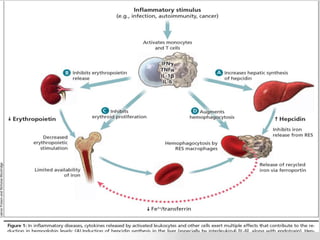
 Inflammation
 Hyperparathyroidism
Unfortunately, we know little about the relative contributions of the different
factors and conditions in the early stages of chronic kidney disease.
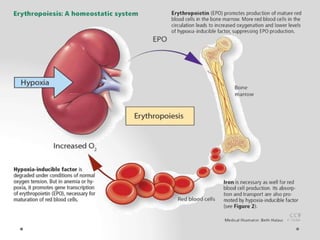
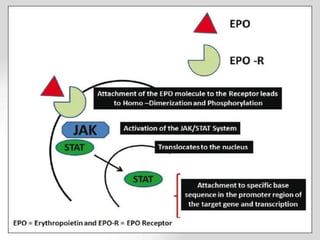
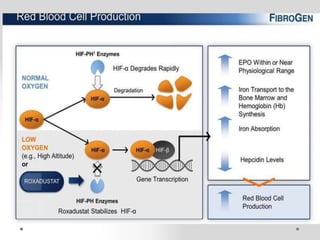
Relative EPO deficiency
• Erythropoietin regulates Erythropoiesis
• Glycosylated polypeptide
• 90% produced in the peritubular interstitial Fibroblasts
like cells of kideny ,10 % in the liver
• Produced in response to low oxygen tension in the
tissues of kidneys
CAUSES ANEMIA
IN CKD
IDA in CKD
• Blood loss from GI tract
• In HD patients : Repeated Blood Loss ; retention
of Blood in Dialyzer and blood lines.
• Frequent Blood Sampling for Ix
• Loss from Surgical Procedures ( vascular
access)
• Interference with absorption due to Meds (
Gastric acid inhibitors ,Phosphate Binders )
Reduced absorption due to inflammation
CAUSES ANEMIA
IN CKD
Blood loss
• Risk of blood loss due to plateletdysfunction.
• The main cause of blood loss is dialysis,
especially hemodialysis, and the loss results in
absolute iron deficiency.
• Hemodialysis patients may lose 3 to 5 g of iron
per year.
CAUSES ANEMIA
IN CKD
Shortened red blood cell life span
• The life span of red cells is reduced by
approximately one third in hemodialysis patients
CAUSES ANEMIA
IN CKD
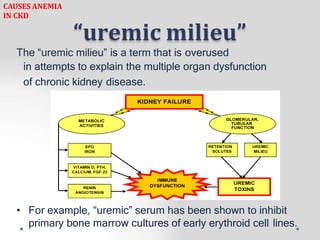
“uremic milieu”
The “uremic milieu” is a term that is overused
in attempts to explain the multiple organ dysfunction
of chronic kidney disease.
• For example, “uremic” serum has been shown to inhibit
primary bone marrow cultures of early erythroid cell lines.
CAUSES ANEMIA
IN CKD
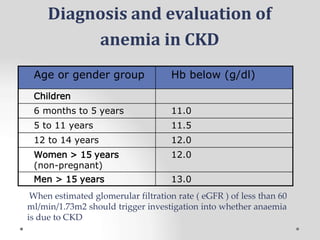
Diagnosis and evaluation of
anemia in CKD
Age or gender group Hb below (g/dl)
Children
6 months to 5 years 11.0
5 to 11 years 11.5
12 to 14 years 12.0
Women > 15 years
(non-pregnant)
12.0
Men > 15 years 13.0
When estimated glomerular filtration rate ( eGFR ) of less than 60
ml/min/1.73m2 should trigger investigation into whether anaemia
is due to CKD
Use of iron to treat anemia in CKD
Iron supplementation is widely used in CKD
patients:
To treat iron deficiency
Prevent its development in ESA treated
patients
Raise Hb levels in the presence or absence of
ESA treatment
Reduce ESA doses in patients receiving ESA
treatment.
When to start iron therapy?
For adult CKD patients with anemia not on iron or
ESA therapy, a trial of IV iron (or in CKD ND
patients alternatively a 1–3 month trial of oral iron
therapy) if:
an increase in Hb concentration without starting
ESA treatment is desired and
TSAT is <30% and ferritin is <500 ng/ml (<500
mg/l)
For adult CKD patients on ESA therapy who are not
receiving iron supplementation, a trial of IV iron(or in
CKD ND patients alternatively a 1–3 month trial of
oral iron therapy) if :
 an increase in Hb concentration or a decrease in
ESA dose is desired and
 TSAT is <30% and ferritin is <500 ng/ml (<500
mg/l)
• At increasingly higher ferritin levels, there is some
evidence to indicate that hepatic deposition of iron
increases
• Routine use of iron supplementation in patients
with TSAT >30% or serum ferritin >500 ng/ml
(>500mg/l) is not recommended
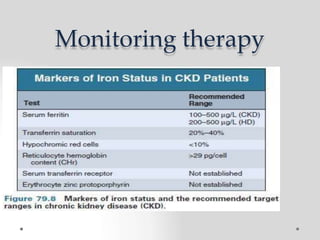
Monitoring therapy
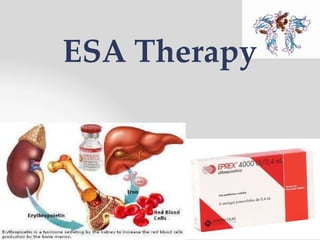
ESA Therapy
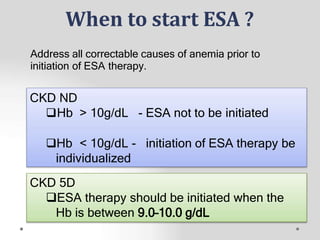
When to start ESA ?
CKD 5D
ESA therapy should be initiated when the
Hb is between 9.0–10.0 g/dL
Address all correctable causes of anemia prior to
initiation of ESA therapy.
CKD ND
Hb > 10g/dL - ESA not to be initiated
Hb < 10g/dL - initiation of ESA therapy be
individualized
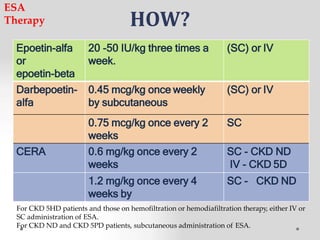
HOW?
Epoetin-alfa
or
epoetin-beta
20 -50 IU/kg three times a

week.
(SC) or IV
Darbepoetin-
alfa
0.45 mcg/kg once weekly
by subcutaneous
(SC) or IV
0.75 mcg/kg once every 2
weeks
SC
CERA 0.6 mg/kg once every 2
weeks
SC - CKD ND
IV - CKD 5D
1.2 mg/kg once every 4
weeks by
SC - CKD ND
For CKD 5HD patients and those on hemofiltration or hemodiafiltration therapy, either IV or
SC administration of ESA.
For CKD ND and CKD 5PD patients, subcutaneous administration of ESA.
ESA
Therapy
TARGET HB LEVEL:
• Objective of initial ESA therapy is a rate of increase in (Hb) of
1.0 to 2.0 g/dl (10 to 20 g/l) per month
• Rise in Hb of > 2.0 g/dl (20 g/l) over a 4-week period should
be avoided
• Target Hb ; not to exceed > 11.5g/dL
• HB initially monitored weekly , dose adjustment made every
4 weekly.
• Once stable HB achieved , monitor 4 weekly to 3 monthly , or
in between any intercurrent illness or symptomatic.
ESA
Therapy
DOSE MODIFICATION
If HB level increases by >1gm%/2wks, then
reduce dose of EPO by 25%.
If HB level not increases by >1gm%/ mnth , then
increase dose of EPO by 25%.
ESA
Therapy
Thank you

Anemia in ckd

  • 2.
    Contents  Definition ofCKD  Stages of CKD  Definition of anemia in CKD.  Causes of anemia in CKD.  Evaluation of patients  Iron therapy.  ESA
  • 3.
    Definition of ChronicKidney Disease 1. Kidney damage for 3 months with or without decreased GFR, manifest by either:  Pathological abnormalities; or  Markers of kidney damage, including abnormalities in the composition of the blood or urine, or abnormalities in imaging tests. 1. GFR <60 mL/min/1.73m2 for 3 months
  • 4.
    Stages of CKD StageGFR (ml/min/1.73 m2) Description 1 > 90 Normal or increased GFR, with other evidence of kidney damage 2 60–89 Slight decrease in GFR, with other evidence of kidney damage 3a 45–59 Moderate decrease in GFR, with or without other evidence of kidney damage 3b 30–44 4 15–29 Severe decrease in GFR, with or without other evidence of kidney damage 5 < 15 Established renal failure Diagnosis should be on the basis of evidence of CKD for ≥ 3 months
  • 5.
    Defining anaemia inCKD Age or gender group Hb below (g/dl) Children 6 months to 5 years 11.0 5 to 11 years 11.5 12 to 14 years 12.0 Women > 15 years (non-pregnant) 12.0 Men > 15 years 13.0 Hb cut-off levels – World Health Organization KDIGO 2011
  • 6.
    WHAT CAUSES ANEMIA INCHRONIC KIDNEY DISEASE?  Relative Erythropoietin (EPO) deficiency  Iron deficiency  Blood loss  Shortened red cell life span  Vitamin deficiencies  The “uremic milieu” /Bone marrow suppression  Inflammation  Hyperparathyroidism Unfortunately, we know little about the relative contributions of the different factors and conditions in the early stages of chronic kidney disease.
  • 8.
    Relative EPO deficiency •Erythropoietin regulates Erythropoiesis • Glycosylated polypeptide • 90% produced in the peritubular interstitial Fibroblasts like cells of kideny ,10 % in the liver • Produced in response to low oxygen tension in the tissues of kidneys CAUSES ANEMIA IN CKD
  • 10.
    IDA in CKD •Blood loss from GI tract • In HD patients : Repeated Blood Loss ; retention of Blood in Dialyzer and blood lines. • Frequent Blood Sampling for Ix • Loss from Surgical Procedures ( vascular access) • Interference with absorption due to Meds ( Gastric acid inhibitors ,Phosphate Binders ) Reduced absorption due to inflammation CAUSES ANEMIA IN CKD
  • 11.
    Blood loss • Riskof blood loss due to plateletdysfunction. • The main cause of blood loss is dialysis, especially hemodialysis, and the loss results in absolute iron deficiency. • Hemodialysis patients may lose 3 to 5 g of iron per year. CAUSES ANEMIA IN CKD
  • 12.
    Shortened red bloodcell life span • The life span of red cells is reduced by approximately one third in hemodialysis patients CAUSES ANEMIA IN CKD
  • 13.
    “uremic milieu” The “uremicmilieu” is a term that is overused in attempts to explain the multiple organ dysfunction of chronic kidney disease. • For example, “uremic” serum has been shown to inhibit primary bone marrow cultures of early erythroid cell lines. CAUSES ANEMIA IN CKD
  • 15.
    Diagnosis and evaluationof anemia in CKD Age or gender group Hb below (g/dl) Children 6 months to 5 years 11.0 5 to 11 years 11.5 12 to 14 years 12.0 Women > 15 years (non-pregnant) 12.0 Men > 15 years 13.0 When estimated glomerular filtration rate ( eGFR ) of less than 60 ml/min/1.73m2 should trigger investigation into whether anaemia is due to CKD
  • 18.
    Use of ironto treat anemia in CKD Iron supplementation is widely used in CKD patients: To treat iron deficiency Prevent its development in ESA treated patients Raise Hb levels in the presence or absence of ESA treatment Reduce ESA doses in patients receiving ESA treatment.
  • 19.
    When to startiron therapy? For adult CKD patients with anemia not on iron or ESA therapy, a trial of IV iron (or in CKD ND patients alternatively a 1–3 month trial of oral iron therapy) if: an increase in Hb concentration without starting ESA treatment is desired and TSAT is <30% and ferritin is <500 ng/ml (<500 mg/l)
  • 20.
    For adult CKDpatients on ESA therapy who are not receiving iron supplementation, a trial of IV iron(or in CKD ND patients alternatively a 1–3 month trial of oral iron therapy) if :  an increase in Hb concentration or a decrease in ESA dose is desired and  TSAT is <30% and ferritin is <500 ng/ml (<500 mg/l)
  • 21.
    • At increasinglyhigher ferritin levels, there is some evidence to indicate that hepatic deposition of iron increases • Routine use of iron supplementation in patients with TSAT >30% or serum ferritin >500 ng/ml (>500mg/l) is not recommended
  • 23.
  • 24.
  • 27.
    When to startESA ? CKD 5D ESA therapy should be initiated when the Hb is between 9.0–10.0 g/dL Address all correctable causes of anemia prior to initiation of ESA therapy. CKD ND Hb > 10g/dL - ESA not to be initiated Hb < 10g/dL - initiation of ESA therapy be individualized
  • 28.
    HOW? Epoetin-alfa or epoetin-beta 20 -50 IU/kgthree times a week. (SC) or IV Darbepoetin- alfa 0.45 mcg/kg once weekly by subcutaneous (SC) or IV 0.75 mcg/kg once every 2 weeks SC CERA 0.6 mg/kg once every 2 weeks SC - CKD ND IV - CKD 5D 1.2 mg/kg once every 4 weeks by SC - CKD ND For CKD 5HD patients and those on hemofiltration or hemodiafiltration therapy, either IV or SC administration of ESA. For CKD ND and CKD 5PD patients, subcutaneous administration of ESA. ESA Therapy
  • 29.
    TARGET HB LEVEL: •Objective of initial ESA therapy is a rate of increase in (Hb) of 1.0 to 2.0 g/dl (10 to 20 g/l) per month • Rise in Hb of > 2.0 g/dl (20 g/l) over a 4-week period should be avoided • Target Hb ; not to exceed > 11.5g/dL • HB initially monitored weekly , dose adjustment made every 4 weekly. • Once stable HB achieved , monitor 4 weekly to 3 monthly , or in between any intercurrent illness or symptomatic. ESA Therapy
  • 30.
    DOSE MODIFICATION If HBlevel increases by >1gm%/2wks, then reduce dose of EPO by 25%. If HB level not increases by >1gm%/ mnth , then increase dose of EPO by 25%. ESA Therapy
  • 33.